Seven All Alone Summary, Characters and Themes
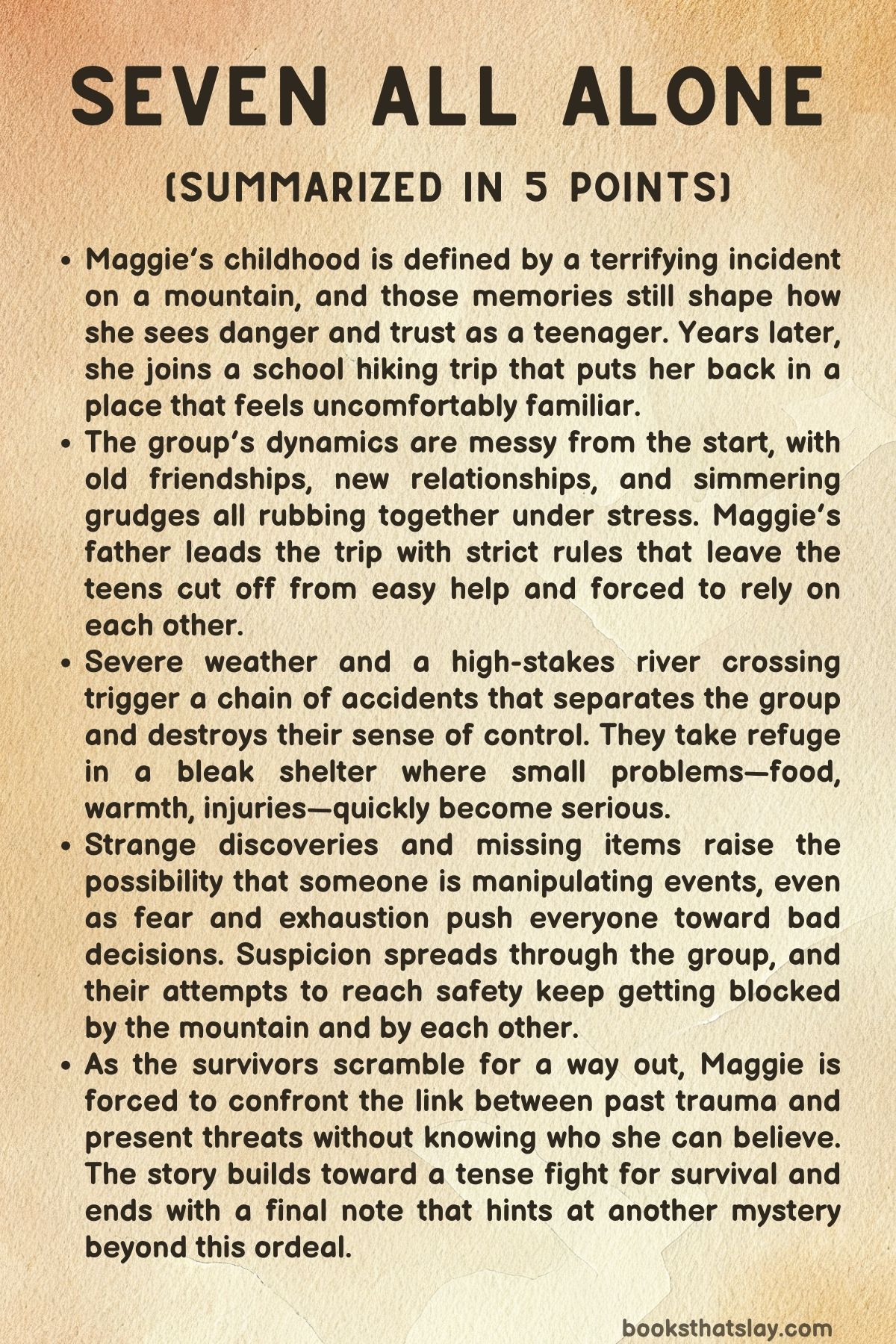
Seven All Alone by Kirsty McKay is a survival thriller set in the Scottish Highlands, told through the eyes of Maggie Atkins. As a child, Maggie survived a horrifying abduction that ended on a cliff edge.
Years later, she returns to the same landscape on a school hiking trip led by her strict, distant father. When a river accident separates the group, the teenagers are forced to shelter in a remote hut with worsening weather, vanishing supplies, and rising suspicion. As fear turns into evidence of deliberate harm, Maggie must confront old trauma and a new threat—one that has been close all along.
Summary
Six-year-old Maggie Atkins climbs into her school minivan on an ordinary October morning, pleased to sit up front because she’s tall for her age. The quiet driver speaks to her more than usual, commenting on the cold, bright day.
Behind them ride other children from Maggie’s class: her best friend Ben, the McTavish twins Lawrence and Sebastian, Nicholas, and two girls, Stephanie and Antonia. Maggie trusts the driver, so at first she doesn’t question it when the van takes a route she doesn’t recognize and keeps traveling far longer than it should.
The van stops on a dirt road. The driver orders the children out and marches them up a steep trail to a cave.
Inside the damp darkness, the truth sinks in: they are being held captive. For three days and nights the driver controls them with threats and bursts of rage, barely speaking.
The other children eventually escape, but Maggie is left behind. When the driver realizes she is alone with him, he drags her out at dusk to a cliff under a red moon and tells her that God wants her dead.
He begins singing “When the Saints Go Marching In” and tries to force her to jump with him. Maggie bites his hand hard enough to tear skin.
The shock makes him loosen his grip, and Maggie twists free. The driver falls backward off the cliff.
In the instant before he disappears, he looks at her in panic, as if asking to be saved, but she cannot help him.
Years later, Maggie is a teenager arriving at a café to meet classmates for a school “Enrichment Week” hiking trip. She stumbles as she enters and pretends it doesn’t matter, but her embarrassment spikes when she makes eye contact with Ben.
They were once inseparable, then dated, then split, and now Ben is with Stephanie. Maggie’s father, Mungo Atkins, is leading the trip.
He runs it with stern rules and a harsh tone that makes Maggie feel like she’s walking on broken glass around him. Still, she shows up because she wants connection with him again, even if it’s awkward.
The hiking group includes Maggie, Ben, Stephanie, Cass, Lawrence and Sebastian McTavish, and Ant Zito, who covers nerves with nonstop jokes. Before they set off, Mungo collects everyone’s phones and seals them in a tea box, insisting that the next four days will be about teamwork and real conversation.
Maggie hates the idea, but she also knows that arguing won’t bring her father closer, so she keeps quiet.
They hike into wind and rain toward Cairn Gealach. Hours later, they reach a swollen river that must be crossed in an inflatable dinghy.
Mungo insists it’s safe enough and assigns seats. The crossing is terrifying.
The dinghy bucks through rapids, slams into waves, and finally scrapes into a rocky landing on the far bank. Everyone clambers out, soaked and shaken, and begins unloading.
Then Ant realizes a pack is missing and jumps back into the dinghy without thinking. The movement pushes the boat away from the bank.
Cass and Maggie grab for the tether, but it jerks free. The dinghy slides into the current with Ant still inside.
Cass falls into the river trying to catch it, and Mungo lunges to save her. He hauls Cass out, but the force drags him in.
Maggie runs toward the water screaming as Ben holds her back. Mungo manages to hook an arm onto the dinghy, fighting to pull himself aboard while the current carries him downstream.
Ant paddles hard, then tries to help Mungo into the boat. The dinghy rounds a bend and vanishes from sight.
Maggie, Cass, Lawrence, and Sebastian sprint along the riverbank after them, but the terrain turns into a steep gulley that blocks their route. Maggie tries a dangerous descent alone, slips, and only avoids tumbling farther when her jacket snags on a bush.
Cass grabs her wrists while Lawrence helps pull her back up. With the storm worsening, the group argues.
They finally decide to return to the landing site and stay together, reasoning that Mungo and Ant will land somewhere downstream and walk back.
Back at the landing, Ben and Stephanie have waited behind. Stephanie’s nose is bleeding and swollen—broken from when Maggie was thrown backward in the dinghy.
The injury sharpens the tension between Maggie and Ben. Ben is protective of Stephanie and angry at Maggie, and Maggie feels blamed for everything she can’t control.
Ben pushes them toward a shepherd’s hut marked on Stephanie’s map, warning that lightning is coming.
They hike through heavy rain and thunder, and Stephanie becomes convinced she sees a tall figure watching them from the trees. They search and find nothing, but the fear sticks.
They reach the final climb—Devil’s Chute, a steep muddy slope—and crawl upward on hands and knees. When they reach the hut, it isn’t comforting.
It’s a squat stone building, dark, damp, and filthy, with the stink of mold and old food.
Inside, they try to settle. Cass lights the stove while Ben tends Stephanie’s face.
They find a black plastic crate under the table that Mungo must have stocked, but it’s secured with a three-digit combination lock, and nobody knows the code. They eat scraps of what they carried.
Sebastian opens a tub of mackerel that smells awful, and the group separates into uneasy corners of the hut. Maggie keeps watching the window for her father and Ant, tracking the slope and the river line with growing dread.
Lightning cracks close overhead, rattling the building. The blast triggers Maggie’s buried terror from the cave years ago.
She bolts outside into the storm, pressed against the stone wall, struggling to breathe. Ben follows her out, snaps at her to get inside, then softens.
He admits he’s scared too and tries to convince her that Mungo and Ant have gear and will survive the night. Maggie steadies herself enough to return.
Later, the hut door swings open into darkness. Maggie rushes forward thinking it might be her father, but no one is there.
At the threshold she steps on something sharp and discovers a large hunting knife buried in the mud. It slices her foot.
The knife has dried blood on it, and nobody can explain why it is there. They wedge the door shut with a chair and stack weight against it.
They decide no one goes outside at night, not even for the toilet.
Maggie wakes the next day to daylight and confusion. Mungo and Ant still haven’t arrived.
Worse, the locked crate is gone, and so is the hunting knife. No one admits taking either.
Stephanie insists they must hike out because her nose is badly injured and she needs help. Maggie argues that leaving could strand her father if he returns, but the group is divided and fear is growing.
Cass reports evidence of a landslide, explaining the hut shaking they felt in the night.
They attempt to descend Devil’s Chute using plastic sacks like sleds. Mud and fog swallow them.
Maggie tumbles and ends up filthy but unhurt. They follow the river toward a footbridge Stephanie expects to use, only to find it submerged by floodwater, making it unusable.
Pressure builds until Stephanie breaks down screaming. Fights flare.
Maggie loses control and shoves Sebastian, and Lawrence has to step between them.
They turn and move again, trying to find a workable route, only to be pushed back by weather, blocked paths, and the sense that someone is leading them in circles. They return to the hut later, battered and exhausted, with signs that someone has been ahead of them: the smashed remains of the missing crate on rocks, and the growing certainty that they are not alone out here.
A plan forms in the hut. Lawrence decides they cannot stay forever.
In the morning, Ben will remain behind with Stephanie because she’s too injured to push hard, while Lawrence leads the others toward the pickup point on the far side of Cairn Gealach. Maggie chooses to go with Lawrence, though it means leaving Ben and Stephanie behind, which twists her stomach with guilt.
Before they can leave, they split briefly to gather firewood. When they return, a scream tears through the hut.
Stephanie is cold and not breathing. Cass performs CPR while Ant counts out the rhythm, but nothing changes.
Stephanie is dead. Ben collapses into grief and blames himself for staying, for not noticing, for everything.
The shock pushes the group into raw suspicion. Someone had time to hurt Stephanie while people were outside, and now nobody trusts anyone.
They decide to move. They take what they can from Stephanie’s pack and leave her body in the hut.
Maggie stays back long enough to force Ben to come with them, pressing Stephanie’s compass into his hands because they need navigation more than they need blame. Ben follows, hollow-eyed and shaking.
As they head toward the mountain, Ben becomes convinced Sebastian is involved, replaying moments from the river and the hut. Sebastian reacts with anger and denial.
The group pushes through woods where visibility is poor and fear fills the gaps. Sebastian breaks down, screaming that he saw a large figure chasing him—something he calls the bodach.
Lawrence thinks he’s making it up or panicking, but the terror is contagious. They form a defensive circle with sticks and rocks until the silence becomes unbearable, then they run, driven by exhaustion and instinct.
The climb up Cairn Gealach is slow and punishing. Mist hides the landscape.
Rain returns in waves. At the summit, they leave a note pointing rescuers toward their path.
The descent becomes a new problem: the marked route drops into unstable scree, and the safer alternative is a narrow ridge with sheer drops. Lightning and hail make both options deadly.
They take shelter under a rock overhang and pitch tents close together, trying to stay warm with a small fire.
That night, unease spikes again. Sebastian claims the figure he saw wasn’t a stranger at all but Nicholas McDonal, a boy tied to their childhood kidnapping who later died by suicide.
The claim angers the others, but it also reopens the old wound Maggie tries to keep sealed. As they attempt to sleep, the air turns electrically charged.
Ben warns that it means lightning danger even if they can’t hear thunder. Lawrence quietly drugs Sebastian with pills to calm him down.
Maggie wakes to movement inside her tent and lashes out in panic, believing an attacker has entered. It turns out to be Ben, fleeing the other tent because he couldn’t cope with what was happening beside him.
They share a moment of bitter honesty and fear, then fall into exhausted sleep.
At dawn, Maggie sees their tent has been cleanly slashed by a blade. Outside, she finds Lawrence face down across the fire, burning.
She drags him away and beats at flames with her hands until the others rush out. Cass screams accusations at Maggie, convinced Maggie attacked him, but Maggie points to the tent cut as proof that someone else was there.
The group stumbles into chaos again, trying to treat Lawrence’s burns while the mountain closes in around them.
They later flee downhill, scattered by panic and weather, trying to reach a car park they believe will mean safety. Maggie, Ben, and Ant search for Cass and find her injured and crying, her ankle twisted badly from a fall.
They keep moving together. When they finally reach the car park, relief hits hard—until they realize how empty it is.
They find an old army-green 4×4 hidden behind bushes and pile in, thinking they can escape, but a wheel lock blocks the steering wheel from turning.
Ben works on the lock while the others try to recover. Cass makes a chocolate drink from packets and water and passes it around.
Ant drinks more than the others and begins to slump, pale and unfocused. Cass asks for help getting to the portable toilet, and Maggie assists her, still scanning the hillside for movement.
Back at the vehicle, Maggie notices Cass’s small cosmetic pouch drop onto the ground. It feels too heavy.
Inside, Maggie finds a working phone—powered on, with signal. Cass has been hiding it.
Maggie slips into the portable toilet with the phone and tries calling emergency services, but the signal drops. She tries to text and send messages, but it fails again and again.
Cass approaches the door and speaks softly through it, asking what Maggie is doing. Cass calmly confirms what Maggie fears: Ben has passed out, Ant can’t be woken, and Cass knows exactly why.
Maggie waits for a moment of quiet, then bolts uphill to chase signal. She gets only a few steps before she’s struck from behind, and the world goes black.
Maggie wakes bound in the same cave from her childhood. Candles flicker in the darkness.
Cass sits nearby, composed, speaking as if this is the natural end of a story. Cass admits she knocked Maggie out and has been orchestrating everything—Stephanie’s death, the terror, the drugs—using the Book of Saints as a script for punishment.
Cass blames Maggie for the death of the original driver, Maximilian Del Vento, claiming he was her father and that Maggie “killed” him by letting him fall.
Maggie demands to know where Ben and Ant are. Cass taunts her and implies Ant is helpless.
Then a figure appears: Sebastian, alive. The hanging was staged.
Cass and Sebastian reveal they planned to frame Maggie for a murder-suicide. Ben is dragged into view, injured with crossbow bolts.
Cass and Sebastian argue over control, mistakes, and what comes next. Then Cass turns on Sebastian and shoots him for real, killing him.
She forces Maggie’s hand onto the crossbow to plant fingerprints and orders her toward the cliff ledge for the final staged ending.
Maggie refuses, then uses the candles to melt the plastic ties and frees herself. She runs through tunnels, finding the tight gap she remembers from childhood.
Cass corners her with the crossbow and threatens to torture Ben to death if Maggie doesn’t come out. Maggie returns, drawn by Ben’s screams.
Cass forces her toward the ledge again. Maggie swings the heavy book into Cass’s jaw, knocking her off balance.
Cass topples over the edge, but grabs Maggie and nearly drags her with her.
Ant appears—alive, having vomited up the drugged drink. Ant strikes Cass in the face with a pen embedded in Cass’s cheek, breaking Cass’s grip.
Cass falls screaming into the darkness. Maggie and Ant cling together, then rush back to help Ben.
Maggie wakes later in a hospital, disoriented and convinced danger is still close. She reunites with her father, who explains Cass drugged him heavily early in the trip.
He nearly died but managed to trigger an SOS on his GPS device. Rescue teams found clues, located Lawrence alive in a ravine, and tracked the survivors near the cave after Maggie’s mother received a message that finally went through.
The aftermath brings more truth. Cass was not Del Vento’s daughter; she built the identity through obsession and fixation.
Evidence suggests Sebastian manipulated school assignments to engineer who ended up on the trip. Back home, Maggie visits Ben.
He apologizes for abandoning her when they were six, and Maggie forgives him. They accept that what happened changed them, but it also proved what they can do for each other.
Maggie walks home under a new moon, alive and no longer alone.
A final shift introduces Esme at Moon Mountain Resort, worried because her older sister Gaia never came back after a party. Gaia doesn’t answer texts, and her friends haven’t seen her.
Esme’s mother tells Esme’s father that Gaia is gone, setting the stage for another disappearance.
Characters
Maggie Atkins
Maggie is the emotional core of Seven All Alone, shaped by a childhood kidnapping that never truly releases its grip on her. As a teenager, she carries a quiet vigilance that shows up in the way she watches routes, notices inconsistencies, and scans for danger even when others are focused on comfort or social drama.
Her height and the childhood detail of being placed in the front seat become symbolic of how she is repeatedly forced into the “front” position—closest to threat, closest to responsibility, and often closest to blame when things go wrong. Maggie’s inner life is a constant negotiation between fear and function: she wants normalcy, connection, and her father’s attention, but the mountain setting turns every stressor into a trigger, and her reactions swing between careful reasoning and raw panic.
What makes her compelling is that her courage is not the absence of terror; it is the decision to keep moving while terrified, to keep choosing people over self-protection, and to keep resisting the story that trauma tries to write for her.
Maximilian Del Vento
Del Vento is introduced as a silent, uncanny authority figure whose control relies less on elaborate manipulation and more on the children’s instinct to obey adults. His quietness is not calm; it is predatory, a vacuum that forces the children to interpret and comply without negotiation, and that same silence makes his explosions of screaming feel monstrous and animalistic.
His religiosity is weaponized, not nurturing—he frames violence as divine instruction, turning “God” into a tool for absolution and coercion, which deepens the psychological horror because it leaves Maggie facing not only death but spiritual condemnation. His final moment—desperate, almost pleading as he falls—adds a disturbing ambiguity: he is both abuser and a human being confronting his own end, and Maggie’s inability to save him becomes a foundational knot of guilt and unresolved meaning that later villains attempt to exploit.
Even after his death, he continues to function like a ghost in Maggie’s mind, not as a literal presence but as the template of betrayal and captivity that the mountain later reactivates.
Mungo Atkins
Mungo is a paradox: he is present as a leader and absent as a father, and Maggie’s longing for him is tangled with resentment and disappointment. His drill-sergeant approach to the hike reads like competence at first—structure, rules, the confiscated phones, clear directives—but it gradually reveals a deeper flaw: he mistakes control for safety and confidence for judgment.
The river crossing shows his leadership at its most dangerous, because his certainty becomes a liability that pulls the group into exposure they cannot undo, and his disappearance turns him into a shadow hanging over every decision after. To Maggie, he is also a symbol of what she missed: she wants the reliable protector she didn’t have, and she keeps trying to interpret his choices as care even when they look like ego or negligence.
When the truth of his incapacitation is revealed later, it complicates the earlier anger; he is not simply reckless, but a man outmatched by both nature and manipulation, and still, crucially, a father who manages—barely—to push help into motion.
Ben
Ben is defined by fracture: once Maggie’s closest friend, later her ex, and throughout the ordeal a person torn between guilt, loyalty, and emotional self-preservation. His relationship choices and his defensiveness around Stephanie create a social tension that amplifies the group’s instability, but underneath that is a boy who has been running from the same childhood event Maggie survived.
Ben’s harshness toward Maggie in the hut is less about her actual “carelessness” and more about displacement—he lashes out at the person who most clearly reflects the fear he tries to deny. As the crisis deepens, his competence surfaces in practical ways—problem-solving, watching patterns, pushing for survival actions—yet he also spirals into suspicion and obsessive timelines, showing how trauma can turn the mind into a courtroom that never adjourns.
His arc becomes redemptive not because he transforms into a flawless hero, but because he keeps returning: he follows Maggie outside, he ultimately rejoins the group, he survives the cave, and afterward he finally names the oldest wound—abandoning her when they were six—and seeks forgiveness without demanding it.
Cass
Cass is the most chilling character because she weaponizes intimacy, presenting herself as rational, helpful, and emotionally steady while quietly engineering the group’s destruction. Her competence is real—lighting the stove, organizing, speaking with calm authority—so when she later reveals herself as the architect of the murders, it feels like the betrayal of someone the group unconsciously leaned on to stay functional.
Cass is driven by a constructed mythology: she uses religious language, the saints book, and a rigid “script” to grant herself the certainty of destiny, reframing cruelty as righteousness and murder as ritual. Her obsession with Del Vento is less about factual lineage and more about identity theft—she adopts a story that gives her power, purpose, and a villain to blame, and Maggie becomes the chosen target because Maggie’s childhood act disrupted the narrative Cass wants to sanctify.
What makes Cass dangerous is her adaptability: she can switch from soothing to vicious instantly, she can stage scenes, drug people, manipulate evidence, and still speak as if she is simply carrying out an ordained plan, which highlights a personality built around control, performance, and moral inversion.
Lawrence McTavish
Lawrence emerges as the group’s stabilizer, a person whose instincts tend toward order, protection, and practical problem-solving when everyone else is dominated by fear or ego. He often behaves like the reluctant adult among teens—securing the hut, stacking wood, making decisions about routes and defensive posture—yet his authority is not purely dominance; it grows from being the one who can still think in systems.
He can be rigid, and that rigidity sometimes rubs others the wrong way, but it also prevents the group from dissolving into chaos at key moments. Lawrence’s leadership is defined by triage: he keeps choosing the least-worst option with incomplete information, and he carries the moral weight of decisions that can’t be clean, including when the group leaves Stephanie behind and later when they are forced to move forward after death.
His injuries later underscore the cost of being the one who stands between others and danger—his body becomes proof that survival in this story is not just earned by bravery but paid for.
Sebastian McTavish
Sebastian operates as a destabilizing force long before the full conspiracy becomes explicit, partly because of his volatility and partly because he carries a strange relationship with truth. He can be selfish, evasive, and performative, and those traits make him both suspicious and useful to the real villains because he naturally generates mistrust inside the group.
His panic episodes and claims about being chased blur the line between genuine fear and manipulation, leaving others unsure whether to protect him or treat him as a threat, which is exactly the kind of uncertainty that fractures a survival unit. When his staged death is revealed, it retroactively reframes his earlier chaos as an instrument of a larger plan, but his later real death at Cass’s hands exposes a crucial detail about Cass: she does not truly share power.
Sebastian’s end turns him into a disposable pawn—someone who believed he was helping write the story, only to be killed the moment he became inconvenient.
Ant Zito
Ant is introduced as the class clown, hyperactive and always joking, which initially makes him easy to underestimate, but that same trait becomes a survival tool because humor acts like psychological oxygen when panic is choking the group. His impulsiveness is a double-edged blade: it directly contributes to the river disaster, yet his energy and forward motion repeatedly help the group keep moving when despair would otherwise anchor them.
Ant’s courage is not polished; it is messy, reactive, and stubborn, which feels realistic for a teenager thrown into terror. He also becomes one of the most satisfying counterweights to Cass because he survives being drugged through sheer bodily rejection and then shows up at the decisive moment in the cave, not as a perfect rescuer but as someone who refuses to let the final scene play out.
Ant’s arc suggests that resilience does not always look like calm leadership; sometimes it looks like noise, movement, and the refusal to stop fighting even when you are scared and sick.
Stephanie
Stephanie begins as a social flashpoint—Ben’s girlfriend, Maggie’s emotional rival, and someone whose presence makes old wounds feel immediate—but she gradually becomes more layered through vulnerability and unexpected kindness. Her broken nose is not only a physical injury; it becomes the pressure point that turns group decisions into conflict, because pain demands urgency while fear demands caution.
Stephanie’s moment of reassurance to Maggie in the hut is important because it briefly interrupts the social script both girls are trapped in; she offers a kind of grace that contrasts with the group’s tendency to assign blame. Her death is especially brutal because it is quiet, intimate, and domestic in its setting, emphasizing that the threat is not just the wilderness but the people beside you.
After she dies, Stephanie’s role shifts again: she becomes the moral weight the survivors carry, the reminder that small arguments and jealousies were never the true battle, and that the real enemy was hiding inside their circle.
Nicholas McDonal
Nicholas functions more as a haunting reference point than an active participant in the present-day ordeal, but his shadow is potent because he represents what trauma can do over time. The mention of his suicide turns the childhood event into a long corridor rather than a closed room—something that continued harming people years after the cave.
When Sebastian invokes Nicholas as a figure in the woods, it blurs grief, fear, superstition, and manipulation, illustrating how the mind under stress will grab any available symbol to explain terror. Nicholas’s presence in the narrative reinforces a central theme of Seven All Alone: survival is not a single moment of escape but an ongoing struggle to live with what happened, and not everyone makes it through that long aftermath.
Esme
Esme appears at the end as a tonal hinge, introducing a new perspective that signals continuation beyond Maggie’s story. She is defined initially by ordinary teenage assumptions—believing her sister returned after a party, trusting that silence is temporary—and that normalcy is precisely what makes the final reveal unsettling.
Esme’s role is not to resolve anything but to reopen the thematic door: the world contains more missing girls, more gaps between “last seen” and “gone,” and more families about to be pulled into fear. By shifting to Esme, Seven All Alone implies that the cycle of disappearance, uncertainty, and dread is larger than one mountain and one survivor, and it invites the reader to carry forward the unease that safety is never guaranteed just because one story ended.
Gaia
Gaia is mostly absent, yet she becomes instantly central through that absence, acting as the gravitational pull of the closing pages. What we learn about her is minimal—she is older, socially active, connected to a resort setting—and that sparseness is deliberate because it mirrors how disappearances feel to those left behind: a person reduced to last moments, incomplete information, and unanswered messages.
Gaia’s role is to transform the ending into a beginning, suggesting another narrative shaped by loss, uncertainty, and the terrifying blank space where a person should be. In the context of Seven All Alone, Gaia’s disappearance echoes Maggie’s childhood kidnapping, but with a crucial difference: this time the story starts in the aftermath, with a family realizing too late that something is wrong.
Themes
Trauma, Memory, and the Body’s Alarm System
From the first moment Maggie steps into the October minivan years earlier, fear is planted in her life in a form that does not stay neatly in the past. As a teenager, she walks into the hike already carrying an internal warning system that is always half-switched on, even when she tries to act normal.
The story shows trauma less as a “memory” and more as a reflex that lives in muscles, breathing, and attention. Maggie’s reactions are not about being dramatic; they are the cost of having learned, at six years old, that trusted adults can turn into threats without warning.
The mountain becomes a trigger because it resembles the original landscape of captivity, but the bigger trigger is loss of control—being told where to go, being trapped by weather, being made dependent on other people’s choices. When lightning hits and the hut shakes, her panic does not require a logical reason; her body already knows what it feels like to be trapped in darkness, unable to escape, waiting for harm.
The narrative also shows how trauma distorts time. Maggie is moving forward in years, but her fear keeps dragging her back to a moment that never finished resolving inside her.
Even the driver’s last look—desperate, pleading—adds a complicated layer: Maggie survives, but survival does not provide clean emotional closure. That single second leaves room for guilt and questions about responsibility, the kind that return during later crises when she doubts her own perceptions.
The story treats healing not as a quick breakthrough but as a slow rebuilding of trust in reality: learning to interpret danger accurately instead of reacting to echoes. By the end, Maggie’s survival is not only physical.
She gains proof that her instincts can be reliable, that she can act decisively, and that she is not frozen in the role of the frightened child left behind.
Control, Authority, and the Danger of “I Know Best”
Power in the story is often disguised as reassurance. The driver’s quiet confidence, Maggie’s father’s militaristic leadership, and Cass’s calm competence all present themselves as stability.
The plot keeps testing how easily people accept control when it is delivered with certainty. Maggie’s father confiscating phones is framed as a lesson in “real-world interaction,” but it also removes safety nets and turns the group into a closed system where one person’s judgment can become law.
His insistence on crossing dangerous water shows how authority can slide from leadership into stubbornness, especially when pride is involved. Once he disappears downriver, the vacuum of authority becomes just as risky.
Without structure, the group swings between arguments, impulsive decisions, and desperation, and whoever sounds most confident gets followed. This is where Cass becomes especially frightening: she understands that control is not only physical; it is psychological.
She manages the group’s movement, their access to resources, and eventually their sense of what is true. The locked crate, the missing knife, and the changing plans become tools to keep everyone off-balance.
Even the idea of “shelter” is turned into a trap, because the hut feels safe while quietly limiting options. The theme also explores how quickly authority can be mistaken for morality.
Cass uses religious language and a “script” to justify violence, presenting cruelty as obedience. That logic mirrors the driver’s claim that God wants Maggie dead—two different people using the same kind of authority claim to shut down resistance.
The book suggests that the most dangerous leaders are not always loud; they can be calm, reasonable, even helpful, right up until the moment they enforce their private rules. Against that, Maggie’s growth is shown through refusal: she begins to challenge decisions, notice inconsistencies, and act even when others dismiss her.
Survival depends on learning that confidence is not proof, and that “being in charge” does not mean “being right.”
Friendship, Betrayal, and the Cost of Abandonment
The emotional center of the story is the wound left by separation—children who escaped a cave but left Maggie behind, and teenagers who carry the consequences into their relationships. The tension between Maggie and Ben is not just awkward ex-drama; it is the aftershock of a childhood event that reshaped their trust in each other.
Ben’s presence forces Maggie to relive not only fear but humiliation and loneliness, because abandonment often hurts more when it comes from someone who mattered. The hike turns that old dynamic into something immediate: Ben tries to restrain Maggie at the riverbank, he argues with her, he comforts her, and he also fails her at key moments through anger, blame, or hesitation.
Their connection becomes a test of whether people can repair damage that was done when they were too young to understand what they were doing. The story refuses to make betrayal simple.
Ben’s childhood choice is awful in its outcome, but it is also the choice of a frightened child who ran. That complexity matters because it mirrors Maggie’s own survival moment at the cliff: she cannot save the driver, even as his expression suggests he wants saving.
The book keeps asking what someone “owes” another person in a crisis, and what guilt does to people afterward. Friendship inside the group is also fragile and conditional.
The characters form temporary alliances based on need—sharing food, building fires, dividing supplies—yet suspicion poisons those bonds quickly. Missing items and unexplained events turn ordinary disagreements into accusations, and stress reveals who defaults to empathy and who defaults to self-protection.
Even Stephanie’s death becomes a moral fracture point, because grief mixes with fear, and fear makes people look for someone to blame. When Maggie and Ben finally talk honestly at the end, the forgiveness is not sentimental; it is practical and earned through shared danger.
Their renewed bond is built on actions rather than promises, showing that trust can return, but it returns differently—less innocent, more aware of how quickly people can fail each other, and how much it matters when they choose not to.
Survival, Nature’s Indifference, and Human-Made Horror
The mountain does not “target” the group; it simply does what mountains do. Storms intensify, rivers swell, visibility collapses, and routes vanish under landslides and floodwater.
This indifference is important because it forces a hard distinction: the environment is lethal without intention, while the human threat is lethal with intention. The story builds pressure by first letting nature create believable danger—rapids, cold, exhaustion, exposure—so that paranoia about a stalker seems like stress rather than certainty.
As the group tries to navigate, small mistakes become catastrophic because survival depends on margins: keeping dry enough, warm enough, fed enough, calm enough to think. The confiscated phones and the lack of reliable maps make them feel like they’ve slipped into an older world where rescue is uncertain and time is measured by daylight and weather.
This is where the theme sharpens: nature pushes them to their limits, but it is Cass who exploits the exhaustion that nature creates. Once people are cold, hungry, injured, and sleep-deprived, it becomes easier to manipulate them, split them apart, and make them doubt themselves.
The deaths and attacks gain their power partly because they occur in a setting where accidents are already plausible. A fall can be weather.
A missing object can be panic. A strange noise can be wind.
The mountain becomes cover for human cruelty. This contrast also highlights the difference between fear and danger.
The group’s fear is constant, but danger changes form—sometimes it is exposure, sometimes it is a weapon, sometimes it is poison hidden in a drink. Maggie’s survival depends on learning to respond to both kinds at once: respect the land’s risks without being blinded to human intentions.
When the truth is revealed, the horror is not that the environment is harsh; it is that someone chose to turn that harshness into a stage for murder. The book ultimately suggests that nature can be endured with skill and teamwork, but a person who decides to harm others can undo teamwork from the inside.
Identity, Obsession, and the Need to Turn Pain into a Story
Cass’s identity is constructed rather than discovered. She does not simply believe something; she builds a whole self around it, borrowing names, motives, and symbols until the fantasy becomes a plan.
The story presents obsession as a form of hunger: a craving for meaning strong enough to override empathy. Cass wants the past to explain her, and when reality does not provide a satisfying role, she invents one.
Her fixation on Maximilian Del Vento and her insistence that Maggie must pay transforms trauma into mythology—less about what happened and more about what Cass needs it to mean. The “script” idea is crucial.
Cass doesn’t just kill; she stages, frames, arranges, and choreographs. That behavior shows a mind that is not satisfied with violence alone; she wants narrative control.
The Book of Saints becomes her permission slip and her manual, allowing her to treat people like characters who must hit their marks. This reveals something uncomfortable about humans: when someone is desperate for a story that makes them feel important, they can treat real suffering as raw material.
The theme also plays out in Maggie’s life in a healthier, painful way. Maggie also carries a story about herself—“the girl left behind,” “the girl who caused a death,” “the damaged one”—and the hike forces her to fight for a new version of her identity.
The ending’s revelation that Cass was not actually Del Vento’s daughter strips away the supposed logic and exposes the core: the motive was not blood, it was obsession. That matters because it shifts the message from “fate” to “choice.” Cass chose to build a belief system that justified harm.
Maggie, by contrast, chooses to face the truth without making it a grand destiny. She does not need to become a symbol; she needs to become a person who can live after surviving.
The final note about another girl disappearing points to how easily stories of harm can repeat, but it also suggests that identity is always at risk of being written by someone else—unless people fight to keep their lives grounded in reality rather than someone’s private script.