Seven Deadly Thorns Summary, Characters and Themes
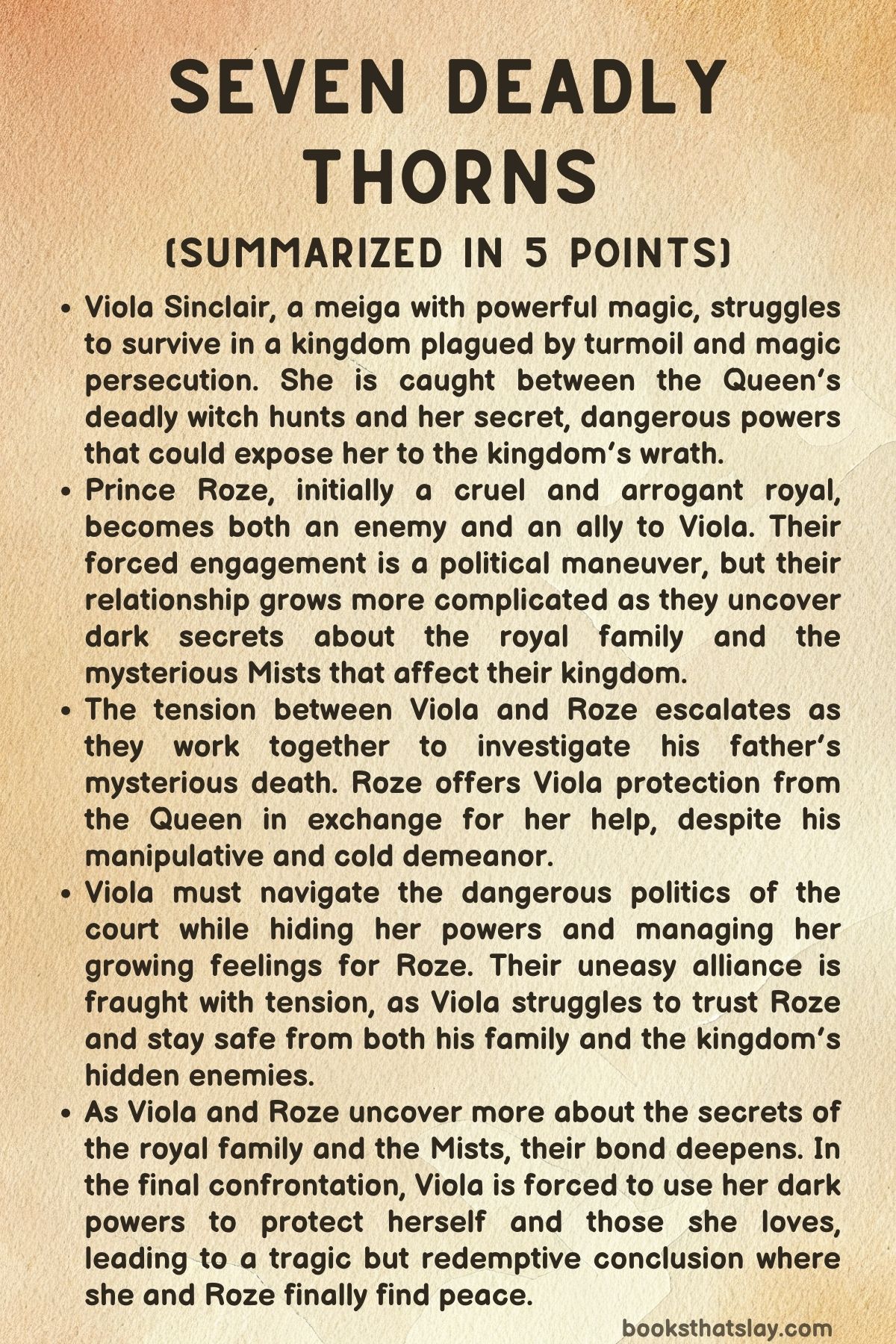
Seven Deadly Thorns by Amber Hamilton is a fantasy novel set in a kingdom plagued by political unrest, disease, and magical mystery. The story follows Viola Sinclair, a powerful meiga (a magic user), whose life becomes entangled with Prince Roze, an entitled and cruel royal.
Roze, despite his outward arrogance and disdain for magic, is secretly protecting the meigas from his mother’s oppressive reign. When Viola’s magical abilities are exposed, she faces dire consequences, but an unlikely alliance with Roze may be her only hope for survival. As Viola navigates the dangerous court and uncovers dark family secrets, her journey becomes a struggle not just for survival but for love and redemption.
Summary
Viola Sinclair is a meiga, a rare and dangerous individual who wields powerful magic, in a kingdom where magic users are hunted by the Queen. Her life at Vandenberghe Academy is already difficult due to her magical abilities, but things take a darker turn when Prince Roze Roquelart, a cruel and entitled royal, torments a freshman, forcing him to sit naked on a statue in front of the students.
Viola, unable to stand by, intervenes, which leads to a confrontation with Roze. This encounter results in Viola accidentally revealing her magic, as her emotions cause her shadows to slip free.
Roze, keenly aware of her secret, seems to delight in knowing that she is a meiga, a fact that makes her vulnerable in a kingdom where magic users are hunted.
The situation escalates further when Viola punches Roze in frustration. The conflict draws attention, and Kole, a prefect and Viola’s friend, arrives to report the incident.
Viola fears the worst, especially since Roze might expose her secret to the Queen, which could lead to her execution. Her fears are heightened by the political unrest following the mysterious death of the King.
The Queen, grieving her husband’s death, has ramped up her witch hunts, persecuting anyone suspected of using magic.
Viola’s worries seem to deepen when Professor Borges, a mentor, reveals that he’s been researching a book that might hold the key to the Mists—mysterious forces that plague the kingdom. The book, tied to the Book of Odds, contains ancient runes and symbols that may offer some answers.
However, before she can learn more, Viola is apprehended by the Captain of the Guard, who reveals that Roze has informed the Queen of her magic. Viola is soon taken to the cathedral, where the Captain plans to execute her.
In a shocking twist, Roze intervenes, killing the Captain to save Viola. He reveals that although he despises her, his mother’s influence and her orders force him into this situation.
Roze offers Viola a deal—if she helps him uncover the truth behind his father’s mysterious death, he will protect her from the Queen. Though reluctant, Viola agrees to the bargain, realizing she has little choice.
Roze believes that his father’s death was no accident, and he’s determined to uncover the truth, even if it means going against his mother.
Their partnership becomes more complicated as Roze insists that Viola pretend to be his fiancée in public, in order to protect both of them from the Queen’s wrath. Their engagement is a strategy, designed to shield Viola from the Queen’s persecution while also advancing Roze’s own agenda.
Viola resents this arrangement, but she recognizes its necessity, as her survival depends on staying close to the prince. Roze, despite his arrogance and manipulation, is hiding his own vulnerabilities and struggles, particularly regarding his relationship with his mother and his duty to uphold the royal family’s legacy.
As the investigation into the King’s death deepens, Viola begins to uncover secrets that could change everything. She discovers that the Mists, which have enveloped their kingdom, are linked to the royal family and the ancient magics that have been suppressed for generations.
The deeper Viola digs, the more dangerous the stakes become, especially as she begins to question who she can trust in the royal court. The political landscape grows more unstable as the Queen’s grip on power tightens, and Viola’s involvement with Roze becomes more dangerous by the day.
Tensions rise when Viola and Roze, posing as a couple, attend a royal dinner. The Queen, ever the cold and manipulative figure, scrutinizes Viola, while Roze’s sisters show open hostility.
Viola’s standing in the court is tenuous, and she must navigate a complex web of lies and deceit. Her powers continue to grow, though she struggles to control them.
Meanwhile, her emotional conflict with Roze grows, as the forced proximity between them begins to blur the lines between animosity and attraction. She finds herself questioning her feelings for him, even as she resists the dangerous allure he holds over her.
As the story unfolds, Viola learns that Roze, who has been portrayed as a villain, has secretly been protecting meigas from his mother’s wrath. He confesses the burden of his position: if his mother places a tattoo on him, he would have no choice but to kill.
Despite his role in killing meigas, Roze is not without guilt. Viola reassures him that he is not to blame for the actions of his mother, and they share a deeper understanding of each other’s pain.
The plot thickens as Viola continues translating ancient texts, uncovering more about the Book of Odds and the mystery behind Roze’s father’s death. Meanwhile, the Queen’s influence grows stronger, and Roze’s sister, Belladonna, takes control of the kingdom, intensifying the search for Viola.
As Viola faces mounting danger, she struggles with her growing feelings for Roze. Despite their animosity, there is an undeniable connection between them.
The final act of the novel sees Viola and Roze making a daring escape from the castle, fighting to survive in the treacherous world they find themselves in. As they uncover more about the royal family’s dark history, they must confront the Queen’s twisted power and break free from her control.
In the end, Viola must sacrifice herself to save Roze, but the story concludes with the unraveling of the Queen’s magic and the lifting of the Mists. Viola and Roze find solace in each other, free from the horrors of the past, and are finally able to move forward together, ready to face the future with newfound strength.
Characters
Prince Roze Roquelart
Prince Roze is a complex and multifaceted character who oscillates between cruelty and vulnerability. Initially presented as a cold, entitled royal with a penchant for tormenting others, Roze is anything but one-dimensional.
His actions, such as mocking and humiliating others, especially Viola, initially paint him as a narcissistic figure with little regard for anyone but himself. However, beneath this facade lies a deeper conflict.
Roze harbors guilt over his mother’s ruthless manipulation and his role in the killing of meigas, those who wield dangerous magic. His twisted actions are often a result of the emotional and political pressures he faces, particularly from his mother, the Queen.
Despite his initial cruelty toward Viola, he forms an uneasy alliance with her as they search for the truth behind his father’s mysterious death. Over time, Roze’s feelings toward Viola become more complicated.
He is drawn to her in ways he doesn’t fully understand, and their shared darkness, symbolized by his “thorns,” draws them closer. His internal struggles, driven by the weight of family loyalty and personal desire, make him an unpredictable and layered character.
Roze’s journey is one of redemption, as he tries to protect Viola and uncover the hidden truths of the royal family, all while navigating his own dark past.
Viola Sinclair
Viola Sinclair is the protagonist of Seven Deadly Thorns, a young meiga—someone with magical powers that are feared and hunted by the kingdom. Her abilities make her both a target and a symbol of danger.
Viola’s vulnerability is heightened by the political and social turmoil in the kingdom, where meigas are persecuted by the Queen. She is an intelligent and determined individual, constantly striving to protect herself and those she cares about.
Viola’s character is defined by her inner strength and the conflicts she faces between her growing feelings for Roze and the dangerous world she inhabits. Throughout the story, Viola struggles to reconcile her powers, which she fears will lead to her undoing, with the desire to uncover the truth about her father’s death and the mysterious Mists that plague the kingdom.
Her journey is filled with self-doubt and guilt, especially after the tragic death of her brother, which she blames herself for due to her inability to control her powers. Despite these challenges, Viola is not a passive character.
She actively pursues answers and fights against the oppressive forces that seek to control her, even as she wrestles with the dangerous allure of Roze and the shadows she wields. Viola’s emotional growth and personal strength come to the forefront as she navigates the dark forces surrounding her.
Cerise
Cerise is Viola’s loyal and unwavering best friend, who plays a crucial role in the story. Though she does not possess magical abilities like Viola, Cerise is brave, compassionate, and fiercely protective of her friend.
She provides emotional support during the most difficult times, offering comfort and reassurance when Viola’s fears become overwhelming. Cerise’s connection to the royal family, particularly her secret involvement with Belladonna, adds an additional layer of intrigue and complexity to her character.
She is more than just a sidekick to Viola; Cerise is a character with her own motives and struggles, particularly when it comes to navigating the shifting alliances and dangerous political environment within the castle. Her bond with Viola is one of deep trust, and she is willing to go to great lengths to help her friend, even when the risks are high.
Cerise’s loyalty and bravery make her an essential ally to Viola as they face the dangers of the royal court and uncover the dark secrets of the kingdom.
The Queen (Roze’s Mother)
The Queen, a cold and manipulative figure, serves as one of the primary antagonists of the story. She embodies the oppressive forces of the kingdom, using her position of power to control and intimidate those around her, including her son, Roze.
Her cruelty knows no bounds, particularly when it comes to her persecution of meigas, which stems from a deep-seated fear and hatred of magic. The Queen’s role in the kingdom is not just as a political figure but as a symbol of the corruption and decay that has taken hold of the royal family.
She is the driving force behind the hunt for Viola and other magical beings, seeing them as threats to her reign and the stability of the kingdom. Her relationship with Roze is complex, as she manipulates him into carrying out her wishes, including the execution of meigas, despite Roze’s inner conflict.
Her actions are fueled by power, control, and a twisted sense of duty to maintain the kingdom’s status quo. As the story unfolds, the Queen’s influence over her family and the kingdom becomes more apparent, and her role as a tyrant is revealed in stark detail.
Her eventual confrontation with Viola becomes a turning point in the narrative, as it forces Viola to confront the darkness within herself and the corruption that has taken root in the royal family.
Belladonna
Belladonna is Roze’s sister, who takes a prominent role in the power struggle that consumes the royal family. Unlike Roze, Belladonna is aligned with the Queen’s views and is loyal to her mother’s oppressive regime.
She is ruthless, calculating, and determined to maintain her position of power, especially as the kingdom teeters on the brink of collapse. Belladonna’s character is defined by her ambition and her willingness to go to extreme lengths to achieve her goals.
As she rises to power, her hostility toward Viola becomes more pronounced, especially after the Queen’s death. Belladonna’s actions reflect her desire to control the kingdom, and she becomes a formidable opponent to Viola and Roze as they attempt to unravel the mysteries of the kingdom and the forces that govern it.
Though her motivations are largely shaped by her loyalty to her mother, Belladonna’s character also reveals the complexity of family dynamics and the price of power. Her growing control over the kingdom makes her one of the central threats to Viola’s survival and her quest for the truth.
Professor Borges
Professor Borges serves as a mentor figure to Viola, guiding her in her search for answers regarding the ancient texts and the mysterious Mists that plague the kingdom. His knowledge of the past and the magical forces at play makes him an essential ally to Viola as she seeks to uncover the truth behind the royal family’s secrets.
However, his loyalty comes into question as Viola begins to suspect that he may be working for the enemy, specifically Castelle, a rival kingdom that seems to be involved in the larger conspiracy surrounding the King’s death. Borges’ character is intriguing because, while he is a source of knowledge and support, his motivations are not always clear.
As the story unfolds, his role becomes more ambiguous, and his relationship with Viola becomes more strained as the dangers surrounding them grow. Despite the suspicion surrounding him, Professor Borges remains a key figure in Viola’s journey, helping to piece together the clues that will ultimately reveal the truth about the royal family and the Mists.
Themes
Power and Control
The theme of power and control runs deeply throughout Seven Deadly Thorns, where the characters, particularly Viola and Roze, are constantly entangled in struggles for dominance and influence. Viola, as a meiga, lives in constant fear of being discovered for her magical powers, which are seen as dangerous in the kingdom.
Her powers are not just a source of personal strength but also a symbol of her vulnerability, as the Queen and the royal court relentlessly hunt meigas. Roze, on the other hand, wields a different kind of power—his royal status allows him to manipulate people and situations, but his position also places him under the control of his mother, the Queen, whose harsh rule drives much of the political tension.
Roze’s attempts to protect Viola, while self-serving, also highlight his internal struggle between using his power for his personal gain and using it to shield those he cares about.
Roze’s position of privilege places him in an awkward power dynamic with Viola, especially as they are forced into a fake engagement. His controlling nature is apparent in how he keeps Viola close, ostensibly for her safety, but also to maintain his control over the situation.
Viola, on the other hand, tries to assert some autonomy, pushing back against Roze’s domineering behavior while also balancing the complex web of relationships around her. Ultimately, both characters face the overarching influence of the Queen, whose power has corrupted the kingdom and twisted it into a dark, oppressive force.
Her manipulation of Roze, whom she controls through guilt and fear, showcases the toxic nature of power when wielded without compassion. Viola’s internal battle is one of accepting her own powers and reconciling them with the oppressive control the Queen has over her and the kingdom at large.
Identity and Self-Acceptance
In Seven Deadly Thorns, identity is a crucial theme, particularly in terms of self-acceptance and the struggle between external perceptions and inner truth. Viola’s journey is deeply intertwined with her understanding and acceptance of her own powers as a meiga, a person with magical abilities that society views with fear and suspicion.
Her fear of discovery is not just a personal matter but a reflection of the larger societal rejection of those like her. Viola is forced to navigate a world where her identity as a meiga makes her a target, and every step she takes risks exposing her.
The internal conflict she faces is one of shame and fear, as she tries to hide parts of herself from the world, including the very powers that could save her.
Roze, too, struggles with identity—his cold and aloof persona is a mask he wears to protect himself from the expectations placed on him by his mother and the kingdom. His actions, particularly his cruel treatment of Viola, reflect his need to maintain control over a situation that seems far beyond his understanding.
As Viola and Roze work together, their interactions evolve from antagonistic to more complex, revealing layers of their personalities. Roze’s willingness to protect Viola, despite his cruel exterior, and Viola’s gradual acceptance of her powers, form the backbone of their relationship.
Viola’s acceptance of who she truly is, despite the stigma attached to her powers, becomes a central aspect of her growth, while Roze’s eventual realization of his role in the suffering of meigas forces him to confront his own identity and the legacy of his family. By the end of the story, both characters come to terms with who they are and, in doing so, learn to accept each other in their most vulnerable states.
Love and Sacrifice
Love and sacrifice are recurrent themes in Seven Deadly Thorns, manifesting in both personal and political contexts. The forced engagement between Viola and Roze, initially born out of necessity and manipulation, evolves into something more complicated as the two characters form an uneasy alliance.
Although their relationship begins with disdain and mistrust, it gradually transforms into a deep, if flawed, bond. Roze’s protective instincts towards Viola begin to outweigh his desire to control her, and Viola, in turn, sees Roze not just as a tormentor but as someone trapped by circumstances beyond his control.
The dynamic between them shifts as they are drawn closer together by their shared struggles and the need for mutual survival.
Sacrifice becomes an inevitable part of their relationship, especially as Viola comes to realize that her survival is linked to uncovering the dark secrets of the royal family and the Mists. The ultimate sacrifice occurs when Viola offers her life to save Roze, cementing her willingness to put the needs of others before her own.
This act of selflessness contrasts sharply with Roze’s earlier, more selfish behavior and marks a turning point in his character development. He is forced to reconsider his motivations and confront the extent of his dependence on Viola.
In turn, Roze also sacrifices his own life for Viola, an act that represents his ultimate release from the control of his mother and his newfound understanding of what it means to love and protect someone. The theme of sacrifice not only propels their personal relationship but also ties into the larger political dynamics at play.
The characters’ personal growth is intricately tied to their ability to put others before themselves, making sacrifice a key theme in the story’s resolution.
Corruption and Redemption
Seven Deadly Thorns also explores the theme of corruption and redemption, particularly in the context of the royal family and the overarching political landscape. The Queen, as the primary antagonist, embodies the corrupting influence of unchecked power.
Her manipulation of Roze and her cruel treatment of Viola reflect a larger societal issue: the toxic effects of leadership driven by fear, control, and vengeance. The Queen’s actions—both towards Viola as a meiga and towards Roze as her son—demonstrate how power can be used to destroy rather than uplift.
Her legacy is one of fear, isolation, and death, and her oppressive reign has plunged the kingdom into darkness.
Roze’s path, however, offers a potential redemption arc. Despite his complicity in the deaths of meigas and the overall atmosphere of fear that surrounds him, Roze is not beyond redemption.
His internal conflict and guilt highlight his desire to break free from the Queen’s control and find his own path, even if that means going against his mother’s wishes. Viola’s influence on him is pivotal in this journey.
By showing him kindness and understanding, she provides him with a path towards redemption, even though his actions remain tainted by his past. The culmination of this theme is found in Roze’s final decision to fight against his mother’s hold on him and to protect Viola at all costs.
Their shared struggle for freedom, both from the Queen’s oppressive rule and from their own personal demons, underscores the narrative of redemption in the story. Ultimately, redemption is not just about moral or personal change but about breaking free from the past to create a future where one can live freely, without the corruption of power and control.