Shadow Ticket by Thomas Pynchon Summary, Characters and Themes
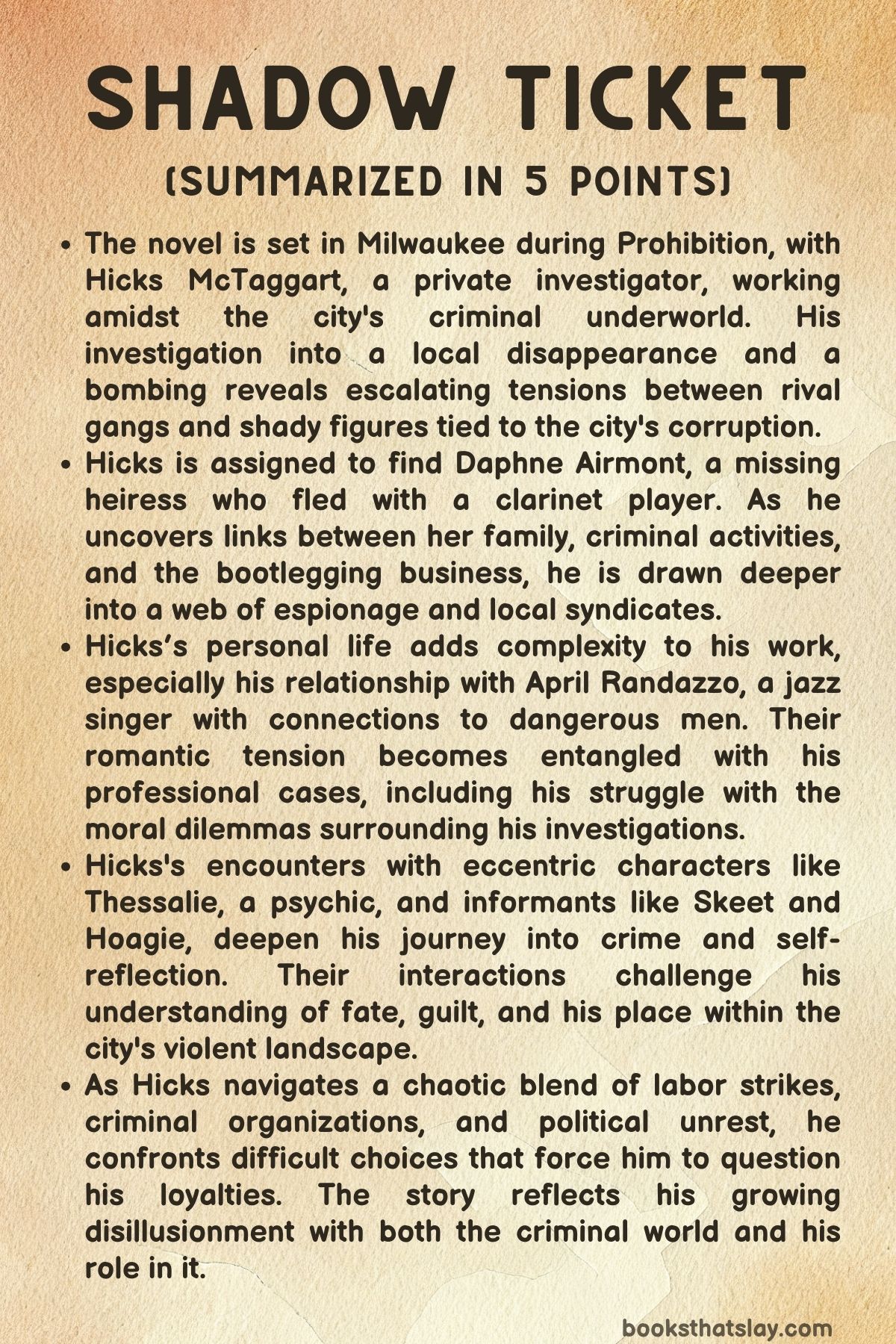
Shadow Ticket by Thomas Pynchon is a complex and multifaceted narrative set during the Prohibition era in Milwaukee, weaving together a series of events involving crime, espionage, and personal conflicts. The central character, Hicks McTaggart, is a private investigator caught in the midst of a criminal underworld, where gang wars, mysterious disappearances, and shifting allegiances shape his path.
As he uncovers hidden truths about the criminal activities around him, Hicks navigates his relationships with eccentric figures, including a jazz singer named April and a psychic named Thessalie. Amidst personal and professional turmoil, Hicks grapples with moral dilemmas and a growing sense of disillusionment, ultimately questioning his role in the chaos surrounding him.
Summary
The story unfolds in Milwaukee during the Prohibition era, with Hicks McTaggart, a private investigator, at the center of a narrative filled with crime, corruption, and intrigue. Working at the Unamalgamated Ops detective agency under Boynt Crosstown, Hicks is tasked with several cases that pull him deeper into the city’s underworld.
Initially, he becomes involved in the case of Daphne Airmont, a missing heiress who has fled with a clarinet player. Daphne’s disappearance is tied to her wealthy father’s criminal dealings, and despite Hicks’s reluctance, Boynt insists he take on the case.
This assignment sets the stage for a series of complicated investigations involving gang violence, family secrets, and political unrest.
Milwaukee’s Third Ward, controlled by the Chicago Outfit, is home to various criminal enterprises, and Hicks soon learns that his work will require him to navigate through a web of rival gangs, including the Teutonia Society and other ethnic crime groups. A bombing at Stuffy Keegan’s hooch wagon marks the beginning of a larger conflict, as Hicks begins to uncover tensions between local factions vying for control of illegal trade.
Alongside his investigative work, Hicks encounters a young informant named Skeet Wheeler and Hoagie Hivnak, a former soda jerk turned informant, who hint that the bombing might have been orchestrated by a German gang rather than an Italian one. This discovery deepens the mystery and points to a broader conflict between different criminal factions in the city.
As Hicks dives deeper into these cases, his personal life becomes increasingly complicated. He reconnects with April Randazzo, a jazz singer he met in Chicago, who draws him into a tense and emotionally charged relationship.
April, who has a fascination with married men, becomes a significant influence on Hicks, but their relationship is fraught with tension and uncertainty. Despite his efforts to maintain distance, Hicks finds himself drawn to her, adding emotional complexity to an already fraught situation.
Hicks’s investigations uncover a larger conspiracy involving bootlegging, labor strikes, and the criminal syndicates operating in Milwaukee. His uncle, Lefty, a former industrial enforcer, reveals that the city is on the brink of a violent confrontation between Nazi sympathizers and other local factions.
The rising political tension adds a volatile backdrop to Hicks’s already dangerous life, forcing him to confront not only the criminal elements around him but also the shifting political landscape.
Throughout the narrative, Hicks struggles with his role in the criminal underworld. His investigations into labor strikes and his own guilt over a past incident where he almost killed a man force him to reassess his place in the world.
His growing disillusionment with violence is compounded by his encounters with Thessalie Wayward, a psychic who reads objects to uncover hidden truths. Thessalie’s ability to perceive the traces left by people and objects challenges Hicks’s understanding of fate and guilt, forcing him to confront deeper philosophical questions about the choices he has made.
As the story progresses, Hicks’s connections with both the criminal world and the upper echelons of Milwaukee society pull him into a dangerous game of power, betrayal, and survival. He navigates a series of moral dilemmas, especially as he becomes more involved in the tensions between labor strikes and criminal enterprises.
These dilemmas are compounded by his personal struggles, particularly his feelings of guilt and his increasing awareness of the violent nature of his profession.
The plot takes several twists and turns as Hicks discovers more about Daphne Airmont’s disappearance and the shady dealings of her family. His investigations lead him to uncover a series of underground activities involving the criminal elite, including espionage and secretive military operations.
This leads Hicks to the discovery of a mysterious submarine operating in Lake Michigan and encrypted radio messages, hinting at a larger conspiracy that ties back to the criminal syndicates in the city.
Meanwhile, Hicks’s involvement with the Airmont family reveals an even darker side to his investigations. Daphne’s father, Bruno Airmont, is heavily involved in a criminal empire that spans various illegal activities, including the production of radioactive cheese.
The Airmont family’s connections to organized crime lead Hicks into a world of espionage, political intrigue, and moral ambiguity. As he uncovers more about their activities, he must navigate the shifting allegiances between criminal groups, law enforcement, and government agencies.
The narrative grows even more surreal as Hicks’s journey leads him to Budapest, where he encounters new operatives and learns more about the criminal syndicates at play. Here, he becomes involved in a covert operation concerning the missing heiress and the enigmatic criminal mastermind, Bruno Airmont.
Hicks’s role in the investigation becomes increasingly complex as he questions his own motivations and the true nature of his mission.
Throughout the story, Hicks is forced to confront the blurred lines between right and wrong, truth and deception, as he navigates a world filled with dangerous criminals, political extremists, and covert operatives. His search for Daphne Airmont and his involvement in the criminal conspiracy lead him to a series of high-stakes situations that test his loyalty and morality.
Ultimately, Hicks is left reflecting on his choices, his identity, and his place in a world that seems defined by corruption and violence.
As the story reaches its conclusion, Hicks’s personal and professional lives collide, and he is left to grapple with the consequences of his actions. The story’s complexity, filled with shifting alliances and morally ambiguous characters, paints a picture of a man struggling to make sense of his place in a world that is far more dangerous and complicated than he ever imagined.
Characters
Hicks McTaggart
Hicks McTaggart is the central character of Shadow Ticket, a private investigator caught in a tumultuous world of criminal activity, personal conflict, and moral dilemmas. Working for the Unamalgamated Ops detective agency in Milwaukee during the Prohibition era, Hicks is a man who grapples with both the intricacies of his profession and the personal costs of his work.
His role as a detective forces him into a complex web of corruption, crime, and political unrest. Despite his involvement in numerous cases—such as the disappearance of Daphne Airmont and the investigation of a bomb attack—Hicks is emotionally distant, preferring to remain detached from the personal lives of his clients and their struggles.
However, his relationship with April Randazzo, a jazz singer with a tumultuous past, exposes his vulnerability. While he is initially reluctant to get involved with her, he finds himself increasingly drawn to her, adding a layer of emotional complexity to his character.
Hicks’s involvement in the labor strikes and his guilt over a past violent incident mark his transition from a straightforward investigator to someone questioning his own moral compass. He is forced to confront the blurry line between right and wrong, ultimately seeking a sense of purpose in a world rife with betrayal, deception, and shifting allegiances.
April Randazzo
April Randazzo, a jazz singer with a troubled history, plays a significant role in Shadow Ticket, particularly in the emotional landscape of Hicks McTaggart. April’s connection to powerful criminal figures, such as Don Peppino Infernacci, presents a complicated backdrop for her relationship with Hicks.
Initially, she appears as just another distraction for Hicks, but as the narrative unfolds, it becomes clear that she is much more than a mere romantic interest. April’s entanglement with dangerous individuals raises questions about her agency and motivations, with hints suggesting that she may be caught in a situation beyond her control.
Her relationship with Hicks is fraught with tension, especially around her attraction to married men, something Hicks tries to avoid but ultimately cannot escape. As Hicks navigates the cases at hand, April’s presence in his life complicates his personal and professional balance.
Her mysterious past and involvement with powerful underworld figures give her an air of intrigue, adding emotional and psychological depth to the otherwise gritty and violent narrative.
Daphne Airmont
Daphne Airmont, the daughter of millionaire businessman Bruno Airmont, is a key figure in Shadow Ticket, particularly in the central investigation that Hicks McTaggart takes on. Daphne’s disappearance—running away with a clarinet player—sets off a chain of events that draws Hicks deeper into the criminal underworld.
Although she initially appears as a rebellious young woman seeking escape from her wealthy and overbearing father, Daphne’s motivations are layered and more complex. As Hicks delves further into her case, it becomes clear that Daphne is not simply running away from a privileged life, but may be following her own path within a web of crime and corruption that extends beyond her family.
Her connection to the criminal empire of her father, particularly in relation to the illicit activities tied to the Radio-Cheez business, reveals her involvement in a much darker world than anyone initially realizes. Daphne’s actions challenge the boundaries of family loyalty and personal autonomy, and her eventual fate raises questions about the role of individual agency within larger, oppressive systems.
Boynt Crosstown
Boynt Crosstown, Hicks McTaggart’s boss at the Unamalgamated Ops detective agency, is a character whose motivations and decisions significantly impact the unfolding of the plot in Shadow Ticket. Although Boynt is a figure of authority, his actions are often driven by personal interests rather than pure professionalism.
His insistence that Hicks take on the case of Daphne Airmont is tied to Hicks’s past connection with her, suggesting that Boynt is not simply a detached figure in the world of private investigation, but rather someone whose personal life and biases influence his professional decisions. Boynt’s role as the head of the agency places him at the intersection of both the criminal and more legitimate sides of Milwaukee’s society, and his ambiguous morality adds to the narrative’s themes of corruption and betrayal.
While Boynt is not directly involved in the more criminal aspects of the plot, his presence is felt as a guiding force, subtly pushing Hicks toward cases that blur the lines between right and wrong.
Lefty
Lefty, Hicks McTaggart’s uncle, is a former industrial enforcer who plays an important but background role in Shadow Ticket. Lefty’s history as a hardened figure in Milwaukee’s industrial scene provides him with a unique perspective on the political unrest brewing in the city.
As Hicks becomes entangled in the larger social and political movements, including the labor strikes and the rise of Nazi sympathizers, Lefty serves as a reminder of the violence and ruthlessness that once defined his own life. Lefty’s involvement in the narrative serves as both a moral guidepost for Hicks and a symbol of the tough, violent world that Hicks is attempting to navigate.
Lefty’s experience in dealing with power struggles, both within the criminal world and in the industrial realm, allows him to offer Hicks advice and warnings that ultimately help shape the younger man’s decisions in the story.
Thessalie Wayward
Thessalie Wayward, a psychic with the ability to read objects and uncover hidden truths, provides an intriguing and mysterious presence in Shadow Ticket. Her unique skill, which allows her to see the traces left by people and objects, positions her as a character who bridges the gap between the tangible world of crime and the more metaphysical realm.
Thessalie’s encounters with Hicks offer him new insights into fate, guilt, and the complexities of human decisions. Her ability to read objects challenges Hicks’s understanding of reality, leading him to question not only the cases he’s working on but also his own past.
Thessalie’s role in the story is significant because she offers Hicks an alternative perspective on the world, one that is not based purely on logic and investigation but also on intuition and perception. Her mysterious nature, combined with her deep understanding of the unseen forces at play, introduces an element of the supernatural into the otherwise gritty and grounded world of Milwaukee’s criminal underworld.
Bruno Airmont
Bruno Airmont, the wealthy businessman and father of Daphne, plays a pivotal role in the plot of Shadow Ticket. A complex and morally ambiguous character, Bruno is deeply involved in the criminal activities surrounding his business, including the illicit production of the infamous Radio-Cheez product.
His role as a powerful figure in Milwaukee’s criminal and economic landscape places him at the center of the story’s web of corruption. Bruno’s motivations are driven by a mix of greed, power, and control, particularly in his relationship with his daughter, Daphne.
His obsession with maintaining the family legacy and protecting his business interests leads him to take extreme measures, including using Hicks to track down his daughter. Bruno’s character represents the corrupting influence of wealth and the lengths to which individuals will go to preserve their status and influence, even at the expense of family bonds and personal integrity.
Ace
Ace is a grifter caught in a dangerous web of crime and politics in Shadow Ticket. His initial role as a small-time con artist, trying to stay afloat during a turbulent period, quickly spirals into a series of morally questionable decisions.
Ace is recruited by Bruno Airmont for a job that requires him to track down a Jewish individual and seize his belongings, a task that forces Ace to confront the darker side of his profession. As he becomes increasingly aware of the consequences of his actions, Ace’s moral compass begins to shift.
His decision to flee to Bratislava in an attempt to escape the tightening grip of Bruno and the surrounding political chaos marks his desperation and growing realization of the danger he is in. Ace’s journey is one of survival and escape, as he is caught between competing criminal factions, including the International Cheese Syndicate and violent fascist militias, all while grappling with his own guilt and the weight of his past decisions.
His encounters with Terike, a woman with a mysterious past, add further complexity to his character, as their tense relationship navigates the ever-present threat of violence and betrayal.
Themes
Crime and Corruption
In Shadow Ticket, crime and corruption permeate every aspect of life, shaping both the external world and the internal struggles of the characters. Set in Milwaukee during the Prohibition era, the narrative is steeped in the activities of organized crime syndicates, rival gangs, and illicit dealings.
The city itself is portrayed as a battleground for power, where criminal empires vie for control over illegal trades, such as bootlegging and smuggling, and the influence of politicians, businessmen, and law enforcement is just as fraught with moral compromises. This pervasive corruption affects everyone, from the powerful Airmont family, involved in illegal cheese production and organized crime, to the more personal interactions, such as Hicks McTaggart’s entanglements with various figures.
As Hicks navigates this world, he uncovers not just the criminal organizations but also the subtle ways in which corruption seeps into the institutions meant to maintain order, including the police force and political system. The complexity of these criminal operations highlights how deeply they are intertwined with the city’s infrastructure and societal fabric, reflecting a world where right and wrong are blurred, and survival often means compromising one’s morals.
The theme of corruption isn’t just external; it also manifests within the characters themselves. For instance, Hicks’s internal struggle regarding his role in labor strikes and his past actions reveals the personal toll that crime and corruption exact on the individual, forcing them to confront their own culpability in a larger, morally bankrupt system.
The story paints a bleak picture of a society where personal gain is often prioritized over justice, and where survival can only be achieved by navigating the murky waters of crime and deceit.
Moral Dilemmas and Guilt
The theme of moral dilemmas and guilt is central to the internal conflict faced by Hicks McTaggart in Shadow Ticket. As he is drawn deeper into a world of crime, espionage, and betrayal, Hicks is forced to confront the ethical consequences of his actions and decisions.
His involvement in cases like the disappearance of Daphne Airmont and his interactions with criminal elements put him in situations where right and wrong are not easily distinguishable. This moral ambiguity is further complicated by his personal connections, such as his relationship with April Randazzo, which adds emotional complexity to his decision-making process.
Hicks’s guilt is not just a result of his professional actions but also stems from a past incident where he almost killed a man, an event that haunts him throughout the story. This feeling of guilt is compounded as Hicks begins to see the broader impact of his actions on the people around him, particularly as he becomes more involved in the labor strikes and witnesses the consequences of violence and corruption.
The introduction of Thessalie Wayward, a psychic who can read the traces left by objects and people, forces Hicks to question the concept of fate and his role in the web of events. Her ability to uncover hidden truths challenges Hicks’s understanding of his own guilt, suggesting that the past cannot easily be escaped, and that every action leaves an indelible mark.
Ultimately, Hicks’s journey is one of self-reflection and reckoning with his past, as he tries to navigate a world filled with moral gray areas and come to terms with the consequences of his choices.
Personal Connections and Emotional Complexity
The theme of personal connections and emotional complexity runs throughout Shadow Ticket, highlighting the way in which personal relationships intersect with and complicate the characters’ lives in a world marked by crime and moral ambiguity. Hicks McTaggart’s interactions with people such as April Randazzo, Daphne Airmont, and his uncle Lefty reveal the emotional toll of living in such a corrupt environment.
While Hicks is deeply entrenched in his work as a private investigator, which often requires detachment and pragmatism, his personal relationships constantly pull him into emotional territory. His connection with April, in particular, is fraught with tension, as her fascination with married men creates a difficult dynamic.
Although Hicks tries to avoid entangling his personal life with his work, he finds himself drawn to April despite the complications it causes. This relationship highlights the emotional cost of living in a world where trust is scarce, and human connections often come with hidden agendas.
Similarly, Hicks’s investigation into Daphne Airmont’s disappearance reveals the impact of family dynamics and personal history. Daphne’s decision to flee with a clarinet player challenges the notion of family loyalty and raises questions about individual desires versus familial expectations.
The emotional complexity of these relationships reflects the broader themes of the story, where personal conflicts are often entangled with larger societal issues, and the pursuit of love, loyalty, and happiness is complicated by the surrounding corruption and crime. Hicks’s interactions with these characters provide a poignant counterpoint to the more violent and sinister elements of the plot, underscoring the fragile nature of human connection in a world driven by self-interest and survival.
Political Unrest and Ideological Conflict
Shadow Ticket is set against the backdrop of political unrest, particularly the rise of Nazi sympathizers and fascist groups, which provides a volatile context for the unfolding drama. The tensions between different political factions in Milwaukee—ranging from labor strikes to the violent actions of extremist groups—create an atmosphere of uncertainty and fear.
This ideological conflict is not limited to the external political landscape; it also seeps into the personal lives of the characters, forcing them to make choices that align or conflict with their own beliefs. Hicks McTaggart’s involvement in labor strikes and his exposure to the increasing polarization of the political climate reveal the ways in which personal survival becomes entangled with broader ideological battles.
As Hicks witnesses the growing unrest, he must confront his own position within these conflicts and question where his loyalties lie. The rise of fascist militias, such as the Vladboys, further complicates the situation, as characters like Ace and Bruno are drawn into the violent rhetoric and actions of political extremists.
The story explores the dangerous intersection of politics, violence, and personal gain, showing how political ideologies can manipulate and influence the behavior of individuals, often leading to betrayal and moral compromise. This theme emphasizes the fragility of political and social stability, particularly in times of economic hardship and societal upheaval, where ideologies can be used to justify extreme actions and further entrench divisions within society.
Espionage and Conspiracy
The theme of espionage and conspiracy plays a critical role in Shadow Ticket, as characters are constantly navigating a world filled with secretive operations, hidden agendas, and covert activities. Hicks McTaggart’s work as a private investigator brings him into contact with a web of intrigue, including espionage related to both criminal enterprises and political factions.
The presence of covert operations, such as the search for a missing heiress and the investigation into Bruno Airmont’s criminal empire, introduces a sense of paranoia and suspicion that pervades the narrative. The story delves into the shadowy world of intelligence agencies, including MI3b, which seeks to recruit new agents in the U.S. to track down codebreakers and infiltrate enemy networks.
This element of espionage adds an additional layer of complexity to the plot, where personal agendas are often in conflict with larger, more sinister forces at play. The presence of mysterious submarines, encrypted radio signals, and secretive networks hints at a larger conspiracy involving both government and criminal organizations, all vying for control of information and power.
The characters’ involvement in these clandestine operations forces them to navigate a world where trust is scarce, and betrayal is a constant threat. Espionage, in this context, is not just about gathering intelligence but also about the manipulation of individuals, where personal relationships and loyalties become tools for larger strategic goals.
The theme of conspiracy in Shadow Ticket reflects the pervasive sense of mistrust and secrecy that defines the world of crime, politics, and personal survival.