Shattered Gods Summary, Characters and Themes
Shattered Gods by Katee Robert is a dark political romance set in a modern Olympus where inherited titles, private wealth, and old alliances have pushed the city toward collapse. Robert centers the story on Hecate, Circe, and Atalanta, three formidable women connected by love, betrayal, revolutionary ambition, and competing ideas of justice.
As Circe returns from presumed death to destroy the ruling Thirteen, Hecate and Atalanta must decide whether reform can survive vengeance. The book combines political conflict, moral uncertainty, trauma, desire, and the difficult work of building a fairer society after a violent order finally loses its authority. It is the tenth and final book in the Dark Olympus series.
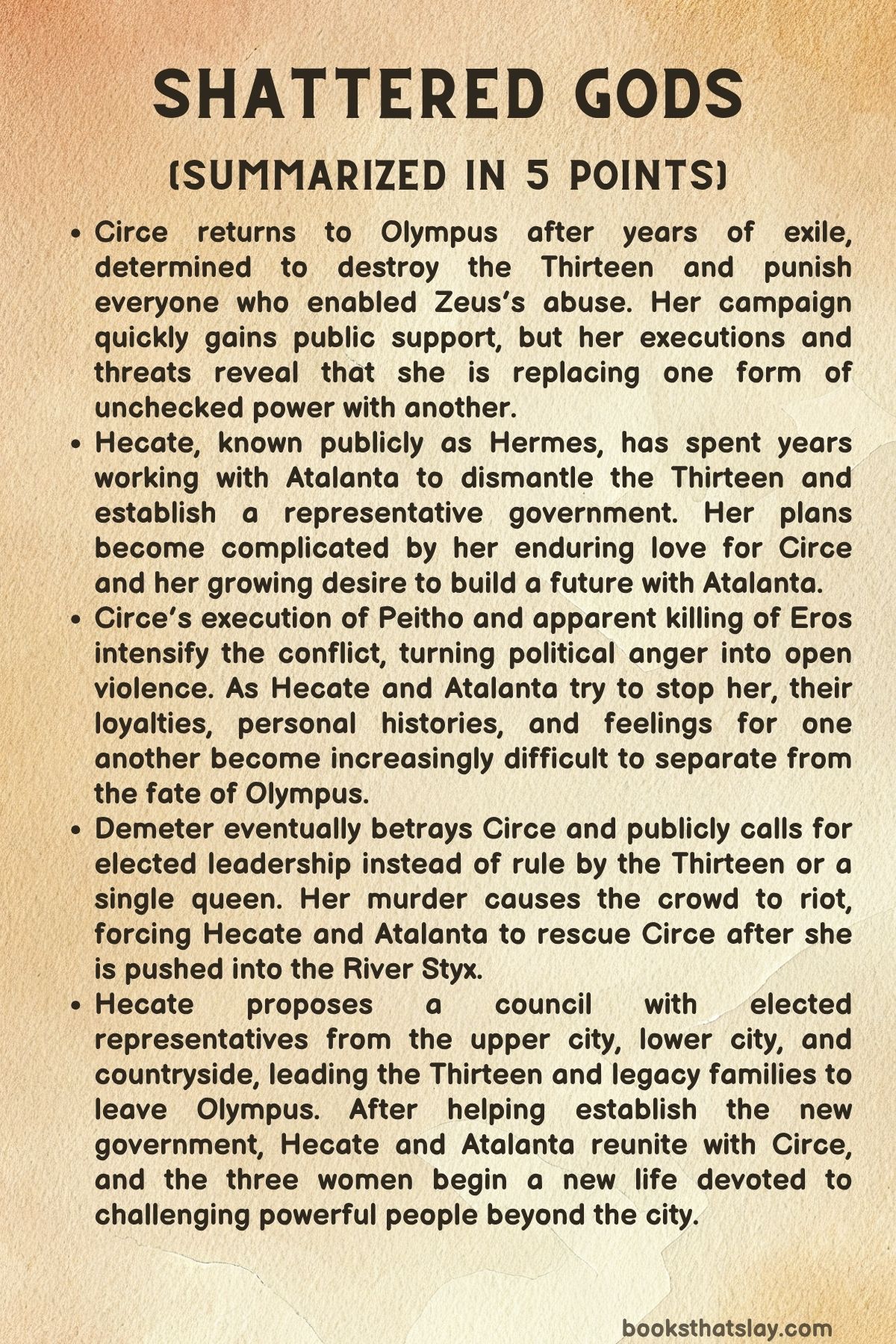
Summary
Olympus stands on the edge of collapse after years of political upheaval. The old barrier around the city has fallen, Circe has returned with armed supporters and displaced civilians, and the remaining members of the Thirteen cannot agree on a defense.
Once known as Hera and believed dead, Circe presents herself as an exiled queen returning to punish the people and families who allowed Zeus to abuse her. She does not intend merely to remove the current rulers; she wants to prevent their titles and bloodlines from ever regaining control.
Hermes, whose original name is Hecate, knows Circe’s arrival is partly her fault. Circe used their former love, a kiss, and a drug to prevent Hecate from stopping her advance, leaving Hecate caught between guilt and lingering devotion.
For a decade, Hecate and Atalanta have secretly worked to dismantle the Thirteen and replace inherited rule with a representative government. Circe’s plan, however, is far more violent than the revolution they imagined.
Atalanta begins moving influential families toward Hades’s protected lower city, even though crossing the barrier means leaving Hecate outside. She and Athena escort Apollo’s parents to safety, then discover that Hades, Persephone, Zeus, and Hera are already considering how to respond.
When Hera reveals Atalanta’s conspiracy with Hermes, the leaders treat her as a threat rather than an ally. Atalanta argues that abolishing the Thirteen does not require murdering its members, but the ruling families remain suspicious of her motives.
Circe establishes her headquarters at the university and stages a public trial for Peitho, the former Aphrodite. She accuses Peitho of enabling her forced marriage, reporting her resistance to Zeus, and ordering murders through Eros.
Hecate tries to interrupt the execution, but Circe shoots Peitho before the crowd. Eros attacks in grief, and Circe shoots him twice while Psyche and Demeter desperately attempt to save him.
The spectacle changes the conflict. Citizens who have suffered under the Thirteen cheer the violence, while Circe uses their anger to strengthen her claim to power.
She sends the crowd toward the bridges and takes Hecate prisoner, believing she can still persuade the woman she once loved to stand beside her. Hecate remains horrified by Circe’s actions but cannot deny the emotional force of their reunion.
In captivity, Hecate learns the full history of Circe’s survival. Zeus abused her throughout their marriage, nearly drowned her after she tried to poison him, and left her for dead at sea.
Antigone rescued her, and Circe spent the following years building the force she would use to return, punish the ruling families, and erase every bloodline capable of restoring the old titles. Her campaign has therefore become inseparable from the trauma she never escaped.
Hecate accepts Circe’s suffering but rejects her conclusion that mass execution can create justice. She argues that the present Zeus is not the man who harmed Circe and that killing individuals will not stop another corrupt system from forming.
Their argument is complicated by enduring desire. When Hecate attempts to restrain Circe, Circe drugs her rather than risk killing the person she still loves.
Atalanta recruits Apollo and Cassandra to help rescue Hecate, then enters the university through a forgotten route. When she encounters Circe alone, she decides that killing her may be the only way to end the crisis.
Their fight is brutal and evenly matched until Circe drives a knife into Atalanta’s upper chest. Although Atalanta intended to kill her, Circe orders her people to provide medical aid rather than allowing her to die.
Despite the wound, Atalanta reaches Hecate and frees her. They escape through maintenance tunnels and call Dionysus, who takes them to a hidden clinic where Iaso removes the blade.
The near loss forces Hecate to admit how strongly she wants a future with Atalanta, including a home, family, and life beyond political struggle. Atalanta, however, remains aware that Circe occupies a part of Hecate’s heart she may never fully understand.
Hecate later meets Circe at a house built around the future they once imagined together. Their anger gives way to intimacy, but Hecate cannot kill Circe even when she has the opportunity.
Circe’s nightmares reveal the terrified survivor beneath the commanding public figure. Hecate recognizes that the woman she loved still exists, though that recognition does not remove her responsibility for the deaths she has caused.
Atalanta feels abandoned when she learns that Hecate left her recovery to reunite with Circe. She returns to the lower city, where she exposes the full history of the conspiracy to Athena and accepts that she may no longer have a place among Athena’s people.
Demeter, meanwhile, turns against Circe after Eros’s shooting and the growing threat to her daughters. She reveals to Hecate that Eros survived because she arranged secret medical care and allowed Circe to believe he was dead.
Demeter agrees that the Thirteen must end, but she refuses to let Circe replace them with another form of absolute rule. Her position becomes the foundation of a public plan to redirect the citizens’ anger.
Circe’s certainty also begins to weaken. The sight of frightened children among the captured legacy families makes her question the plan to eliminate entire bloodlines, while the deaths and injuries suffered by her followers expose the cost of her obsession.
Her encounters with Atalanta deepen that uncertainty. Their hostility develops into attraction and eventually into a vulnerable physical relationship in which both women admit that desire does not erase their political opposition.
Atalanta has a chance to kill Circe during their encounter, but Circe offers no defense and admits that she has become a villain in her own campaign. Atalanta lowers the knife, recognizing that Circe’s death would not repair Olympus and that she is tired of sacrificing every private desire to the mission.
The choice does not create trust, but it makes it impossible for either woman to view the other as merely an enemy. It also complicates Atalanta’s relationship with Hecate, since all three women are now emotionally connected.
The decisive confrontation occurs near Cypress Bridge, where Circe plans to put Artemis on public trial. Demeter takes the microphone and instead calls for elected representation, rejecting both the Thirteen and a single queen.
Hecate and Atalanta destroy the speakers before Circe can recover control. Antigone then kills Artemis without completing the trial and shoots Demeter before Demeter can fire at Circe.
Demeter’s death turns the crowd into a mob. Circe’s soldiers are overwhelmed, and Antigone pushes Circe from the bridge into the River Styx to save her from being torn apart.
The fall forces Circe to relive the drowning that nearly killed her years earlier. For a moment she considers surrendering to the water, but memories of those who sacrificed themselves for her force her to fight.
Hecate dives after Circe, and Atalanta pulls both women from the freezing river. They take shelter in one of Hecate’s safe apartments while riots spread through the city.
Inside the apartment, the three women confront grief, jealousy, trauma, and their complicated love. Hecate and Atalanta repair part of their damaged relationship, while Circe mourns Antigone and finally loses the certainty that sustained her campaign.
Their growing bond does not excuse Circe’s crimes. It does, however, give all three a personal reason to seek an outcome that does not require further killing.
Hecate proposes a council of nine elected representatives, with three delegates each from the upper city, lower city, and countryside. The Thirteen and their legacy families must leave Olympus, elections must follow, and no single office should again possess the power to starve, exile, or destroy an entire community.
Circe challenges the plan but gradually accepts that killing every titleholder would not remove the deeper source of corruption. She agrees to cooperate if Hecate protects her surviving followers and allows the public to believe she died in the river.
Hades and Zeus accept that retaining their titles would continue the cycle they claim to oppose. Hades lowers the lower-city barrier and invites respected residents to choose temporary delegates, while the ruling families prepare to depart.
Hecate publicly reveals her identity, her long conspiracy, and her intention to remain only until a new government can function without her. By presenting herself as a temporary obstacle rather than a permanent leader, she gives the divided territories a common reason to cooperate.
Representatives from all three regions meet at the university and begin drafting laws, distributing authority, and planning elections. Their disagreements are difficult, but the slow work of negotiation succeeds where executions and inherited commands failed.
Hecate and Atalanta spend months helping the council survive its early conflicts, while Circe leaves Olympus and creates a new home elsewhere. Once elected delegates take office, Hecate and Atalanta finally join her.
Their reunion shows that none of them is suited to a quiet suburban existence. Circe has already attacked a local criminal organization and proposes a new campaign against destructive billionaires, while Hecate and Atalanta insist on methods that dismantle power rather than simply transferring it through murder.
The three women leave together, choosing a shared future built on love, accountability, and a continuing fight against people who believe wealth places them beyond consequence.
Characters
Hecate, Also Known as Hermes
Shattered Gods presents Hecate as a revolutionary who has survived by turning performance into a form of armor. As Hermes, she appears witty, unpredictable, and socially effortless, but that public identity conceals years of planning, grief, and disciplined political work.
Her central conflict is not simply a choice between Circe and Atalanta. It is a struggle between the part of her shaped by an old promise and the part that has learned to imagine a future beyond sacrifice, secrecy, and inherited power.
Hecate understands better than most characters that removing corrupt leaders is not enough unless the structure that empowered them is replaced. Her proposal for an elected council proves that her rebellion has always been directed toward institutions rather than personal revenge, even when her private loyalties repeatedly threaten that purpose.
Her flaws are serious because she withholds information, assumes she can carry danger alone, and places Atalanta in emotional and physical jeopardy. Yet she grows by admitting the damage caused by those choices and by accepting that love does not weaken political commitment; it gives her a reason to create something that can endure.
Circe
In Shattered Gods, Circe is both a survivor of extreme abuse and the architect of a campaign that reproduces many of the same abuses of power she condemns. Her pain explains her decisions, but the book refuses to treat explanation as absolution.
She returns to Olympus with strategic intelligence, personal magnetism, and a clear understanding of public anger. By turning private revenge into public trials, she transforms legitimate grievances into a source of authority and gradually becomes the single ruler she claims the city no longer needs.
Circe’s greatest strength is her refusal to remain defined by what Zeus did to her. Her greatest weakness is that she builds her new identity around defeating the past, which leaves her unable to recognize when punishment has become another form of domination.
Her relationships with Hecate and Atalanta expose the person beneath the queenly image. She can be honest, protective, playful, and unexpectedly gentle, but those qualities exist beside manipulation, execution, and reckless ambition, making her morally difficult rather than easily redeemable.
Atalanta
Atalanta is the most disciplined member of the central trio and the person most accustomed to measuring herself by usefulness. Years inside Athena’s organization have taught her to control pain, hide emotion, and treat every relationship as a possible weakness.
Her decade-long partnership with Hecate gives her life direction, but it also traps her in a pattern of self-denial. She believes the mission must always come first, even when that belief leaves her isolated and makes Hecate’s divided loyalties feel like proof that she will never be chosen.
Atalanta’s encounter with Circe changes her because it forces her to confront desire without pretending it serves a political goal. When she lowers the knife instead of killing Circe, she is not surrendering her moral judgment; she is acknowledging that a single death cannot repair a broken society.
Her development lies in accepting that loyalty does not require erasing herself. By the end, she remains practical and dangerous, but she also permits herself love, friendship, pleasure, and a future that is not defined entirely by another person’s revolution.
Demeter
Demeter begins as a political survivor who has long treated power as the safest way to protect her daughters. Her alliance with Circe is therefore less an act of devotion than a calculated attempt to remain influential after the old order falls.
Eros’s shooting exposes the limits of that calculation. Once Circe threatens Persephone, Hera, Psyche, and their children, Demeter recognizes that she has supported a ruler whose authority is as dangerous as the system she hoped to replace.
Her final speech is powerful because it includes self-accusation. She does not merely condemn Circe or the Thirteen; she admits that no individual, including herself, should possess the ability to control food, movement, safety, or political survival for an entire population.
Demeter’s death completes a difficult moral transformation. She cannot undo the harm caused by her ambition, but she uses her public credibility and her life to create space for a government that will not depend on the mercy of powerful families.
Antigone
Antigone is Circe’s fiercest protector and the person most willing to act when hesitation could endanger their campaign. Her loyalty comes from history, shared survival, and the belief that Circe’s victory will justify every sacrifice made along the way.
She often sees threats more clearly than Circe does, especially where Hecate is concerned. Her advice to kill Hecate is ruthless, but it reflects an accurate understanding that Circe’s emotional attachment can disrupt strategic judgment.
Antigone becomes increasingly dangerous because loyalty replaces independent moral reasoning. She kills Artemis without completing the trial and shoots Demeter to protect Circe, choices that destroy the public legitimacy Circe has tried to build.
Her final act, pushing Circe into the river, is both loving and tragic. Antigone gives Circe the chance to live, yet dies inside a catastrophe partly created by her own willingness to answer every crisis with violence.
Nerissa
Nerissa functions as a quieter counterpoint to Antigone. She is loyal to Circe and active in the occupation, but she is less defined by open aggression and more by operational competence.
Her injuries and the danger she faces remind readers that Circe’s campaign is carried out by people who have attached their lives to her promise of justice. They are not faceless soldiers, even when their actions contribute to fear and instability.
Circe’s concern for Nerissa reveals that she is capable of caring for followers as individuals rather than viewing them only as tools. Nerissa’s survival also gives Circe one final responsibility after the collapse of her authority: protecting the people who trusted her enough to risk everything.
Eros
Eros is shaped by the violent legacy of his mother, Peitho, and by the life he has tried to build with Psyche. His past as Aphrodite’s weapon makes him both a participant in the old system and one of its damaged products.
When Circe executes Peitho, Eros responds as a grieving son rather than a calculating assassin. His attack is reckless, but it shows how public punishment can produce immediate cycles of retaliation instead of the orderly justice Circe claims to provide.
His survival becomes politically important because it exposes Demeter’s ability to outmaneuver Circe and preserves hope within a story filled with apparent loss. More importantly, it allows Eros and Psyche to choose departure rather than remain trapped in another struggle over inherited power.
Psyche
Psyche is one of the clearest emotional measures of the conflict’s human cost. She is used as leverage against Demeter, forced to witness violence against Eros, and left to protect him while others make decisions about the future of Olympus.
Her strength is not displayed through public speeches or combat. It appears in endurance, loyalty, and her refusal to abandon Eros when his survival must remain secret.
Psyche’s decision to leave the city is not cowardice. It is a rejection of the belief that every person connected to power must stay and become a symbol, hostage, or sacrifice for someone else’s political cause.
Hades
Hades is deeply identified with the lower city and initially experiences his title as a duty rather than a privilege. His barrier, resources, and authority have protected people whom the rest of Olympus often ignored.
That protective role also makes surrender difficult. Hades fears that leaving will expose his community, and he must recognize that ruling people for their own safety can still deny them the right to choose their representatives.
His development is strongest when he listens to residents rather than deciding for them. By lowering the barrier, gathering trusted community figures, and preparing to leave, he turns protection into a transfer of power instead of a permanent claim to authority.
Persephone
Persephone combines political awareness with a strong commitment to the lower city and her family. She understands why Circe and Hecate reject the Thirteen, even while refusing to accept murder or a new dictatorship as legitimate solutions.
Her pregnancy raises the stakes because Circe views future children as possible heirs to the old system. Persephone therefore represents the question of whether inherited identity must determine a person’s political destiny before birth.
She also serves as a stabilizing presence during Demeter’s final actions. By preventing her sisters from rushing into danger, she demonstrates painful maturity and recognizes that love sometimes requires allowing another person to make an irreversible choice.
Zeus, Also Known as Perseus
The current Zeus inherits a title contaminated by the crimes of the man before him. He is not personally responsible for Circe’s abuse, yet he benefits from a system that preserved Zeus’s authority and protected the office from meaningful accountability.
His response to the crisis is more reflective than defensive. Watching the public support Circe forces him to question whether preserving the Thirteen is worth further suffering, particularly when his wife and future family will bear the consequences.
His willingness to leave Olympus shows a meaningful break from the entitlement associated with the title. He recognizes that wealth gives him options unavailable to ordinary citizens and chooses exile rather than demanding that others fight to preserve his position.
Hera
Hera is politically perceptive, emotionally controlled, and alert to threats that others would rather dismiss. She identifies Atalanta’s hidden alliance and quickly understands that Circe’s agents may already be operating inside the lower city.
Her grief over Eros reveals a more vulnerable side beneath her strategic manner. The loss is not abstract political damage; it is the apparent death of someone connected to her family and to the wider network of relationships the ruling class often treats as secondary.
Like Zeus, Hera eventually accepts that leaving may protect more than staying. Her choice suggests that abandoning inherited power can be an act of care rather than defeat.
Athena
Athena represents competence compromised by accommodation. She knows the former Zeus was dangerous, but she accepted Circe’s suffering as the price of political stability because opposing him might have destroyed her position and influence.
Her anger toward Atalanta is partly personal. Atalanta’s secret work proves that the loyalty Athena expected was never complete, and it exposes how Athena used capable people while assuming their obedience.
Still, Athena is not incapable of change. She listens to Atalanta’s account, releases her people, and ultimately participates in the withdrawal of the Thirteen, showing that moral failure does not prevent a later decision to stop defending the structure that enabled it.
Artemis
Artemis remains physically and politically isolated during much of the crisis, refusing sanctuary and later becoming Circe’s prisoner. Her stubbornness reflects both pride and a refusal to let fear dictate her movement.
At the public trial, she responds to Circe with contempt rather than submission. That defiance exposes how unstable the proceeding has become, because Circe’s claim to justice cannot survive mockery, disagreement, or loss of control.
Her death at Antigone’s hands is deliberately abrupt and lawless. It confirms that the trials are no longer legal or moral processes, but performances whose outcome depends entirely on armed authority.
Apollo
Apollo stays in the upper city to protect communication and technical systems from Circe’s forces. His decision shows a practical form of courage, since control of information may matter as much as physical defense during a political takeover.
He is also protective of Cassandra, sometimes to the point of trying to decide for her. Their disagreement reflects the tension between care and control that appears throughout the novel.
Apollo eventually accepts that Cassandra’s safety requires action rather than stubborn resistance. His role supports the wider idea that people can remain useful without becoming rulers, martyrs, or central heroes.
Cassandra
Cassandra is direct, perceptive, and unwilling to be managed by the people who love her. Her past connection to Hecate gives her a personal reason to take the rescue seriously once Atalanta explains the danger.
She immediately chooses involvement, which separates her from characters who spend valuable time defending status or debating appearances. At the same time, she resists Apollo’s assumption that protection gives him the right to make decisions on her behalf.
Cassandra’s presence reinforces the book’s distinction between support and control. Genuine partnership requires respect for another person’s judgment, even when fear makes unilateral action feel easier.
Dionysus
Dionysus is disillusioned with Hermes and the Thirteen, but he remains loyal when a person in danger asks for help. His response to Hecate’s call shows that damaged trust does not erase every bond.
He provides transport, access to medical care, and shelter without demanding immediate explanations. That restraint contrasts sharply with the political culture of Olympus, where assistance is often exchanged for obedience, information, or future leverage.
His character demonstrates a form of community based on care rather than office. Even after feeling betrayed, he protects people first and leaves accountability for a moment when survival is no longer at risk.
Poseidon
Poseidon is defensive when Hecate approaches him because he knows her goal includes abolishing his title. His suspicion is reasonable, especially when both Circe and the revolutionaries are discussing futures in which legacy families lose power.
Hecate’s warning forces him to distinguish between losing authority and losing his life. Circe threatens every possible heir, while the proposed new government offers the possibility of departure and private existence.
Poseidon’s role highlights the fear that sustains entrenched systems. People may defend unjust authority not only from greed, but because they cannot imagine safety, identity, or purpose without the position they inherited.
Eurydice
Eurydice acts with practical compassion when she escorts Atalanta out of the lower city. She understands that Atalanta is dangerous to the current leadership, but she also recognizes that Hermes and Psyche may die without help.
Her request that Atalanta rescue Psyche transforms a political expulsion into an exchange of trust. Later, her assistance at the bridge and communication during the riots make her a crucial link between people separated by territory and suspicion.
Eurydice’s choices show that ethical action often occurs through small decisions rather than public declarations. She repeatedly uses limited access and influence to keep others alive.
Achilles
Achilles appears as a representative of loyalty that survives political disagreement. Although Atalanta has admitted conspiring against the Thirteen, he refuses to treat her as disposable.
By giving her shelter, a coat, and a secret route back to the upper city, he takes a personal risk without pretending her actions have no consequences. His help is especially meaningful because Atalanta has long believed only Hecate truly cares whether she survives.
Achilles also reflects the growing doubt among people connected to the ruling system. Exposure to records of earlier crimes makes him question whether inherited titles deserve protection simply because familiar people now hold them.
Peitho
Peitho embodies the bureaucratic and social machinery that allowed Zeus’s abuse to continue. She did not need to inflict every injury herself; organizing the marriage, reporting Circe’s resistance, and ignoring pleas for help made her an active participant.
Her own use of Eros as a killer further demonstrates how power turns family relationships into instruments. She protects her position by making others carry out violence on her behalf.
Peitho deserves accountability, but her execution still reveals the danger of Circe’s method. A public accusation controlled by one armed ruler, followed by an immediate death sentence, offers no independent judgment and turns punishment into political theater.
Hephaestus
Hephaestus remains behind to protect systems that could determine control of the city. His role is largely functional, but it emphasizes that political power in modern Olympus depends on infrastructure, surveillance, communications, and access.
His attempt to reach Juniper Bridge shows commitment under dangerous conditions. Circe’s order authorizing lethal force against him also demonstrates how quickly strategic targets become expendable people once violence is normalized.
Iaso
Iaso provides the medical care that allows Atalanta to survive Circe’s knife wound. Her clinic operates outside the official structures of Olympus, suggesting that vital networks of care already exist beyond the authority of the Thirteen.
She is calm, competent, and direct about the seriousness of Atalanta’s condition. Her presence reminds the central characters that survival depends not only on fighters and leaders, but also on people who repair the damage those figures create.
Calliope and Oeagrus
Calliope and Oeagrus respond to evacuation with more flexibility than Atalanta expects. Their willingness to pack and leave suggests that not every legacy-connected family will defend the old order to the point of destruction.
Calliope’s attempt to arrange a match between Apollo and Athena is comic, but it also exposes how deeply political habit survives crisis. Even while fleeing, she continues to think in terms of alliance, status, and family strategy.
Orpheus
Orpheus appears mainly through his reunion with his parents at the lower-city barrier. His role gives the evacuation a personal dimension, turning the movement of influential families into a moment of relief between separated relatives.
He also represents the way older conflicts continue to shape younger generations. The political choices of titleholders affect where families can live, whom they can trust, and whether ordinary reunions require armed permission.
The Citizens of Olympus
The citizens operate as a collective political force whose anger can support liberation or enable cruelty. Their enthusiasm during Peitho’s execution gives Circe legitimacy, but it also reveals how quickly justified resentment can become approval for death without due process.
Demeter’s speech redirects that anger toward representation, yet her murder turns the gathering into a riot. The crowd is neither purely heroic nor naturally violent; it responds to years of neglect, deliberate manipulation, public grief, and the sudden collapse of institutions.
By eventually choosing delegates, the population becomes more than an audience for powerful figures. The citizens begin the difficult transition from reacting to rulers toward accepting responsibility for government itself.
Themes
Power, Legitimacy, and Representative Government
Political authority in Shattered Gods is presented as dangerous when it depends on inheritance, wealth, force, or public fascination rather than consent. The Thirteen may include individuals who believe they are protecting their communities, but the system gives them powers no private person should possess.
Circe correctly identifies the corruption of the old order, yet her answer repeats its central failure. She controls trials, sentences, soldiers, information, and access to safety, making justice dependent on her judgment just as Olympus once depended on the judgment of titleholders.
Hecate’s council proposal changes the political question from who deserves to rule to how rule should be limited. Equal representation for the upper city, lower city, and countryside acknowledges that geography and class have produced different needs, while elections and term limits prevent any one faction from claiming permanent ownership of the city.
The ending does not pretend that representative government will be simple or pure. Delegates argue, compromise, and struggle over documents, but this slow process is treated as healthier than the speed of commands, executions, and inherited decisions.
The theme ultimately connects legitimacy to participation and restraint. A fair government is not defined by finding a perfect ruler; it is built by distributing authority, allowing disagreement, and creating a peaceful way to remove leaders who misuse public trust.
Trauma, Revenge, and Moral Responsibility
Circe’s campaign grows from real suffering that Olympus ignored. Zeus abused her, Peitho enabled him, and other powerful figures preserved their own safety by treating her captivity as an acceptable political cost.
The story gives that history full moral weight without allowing trauma to excuse every later action. Circe’s public executions, threats against children, and willingness to erase entire bloodlines show how a survivor can become responsible for new harm while still remaining a survivor.
Hecate’s response offers the clearest distinction between understanding and absolution. She believes Circe, loves her, and recognizes the failures that made revenge possible, but she continues to argue that pain cannot serve as a permanent source of political authority.
Circe begins to change only when consequences become personal and undeniable. Eros’s shooting, the fear of captive children, Atalanta’s wound, Antigone’s death, and the collapse at the bridge make it impossible for her to describe every loss as a necessary step toward justice.
Responsibility therefore requires more than regret. Circe must end her campaign, protect surviving followers, surrender her claim, and accept absence from the political future she tried to control, demonstrating that healing cannot begin until power is relinquished and harm is honestly named.
Love, Loyalty, and Chosen Partnership
The relationship among Hecate, Circe, and Atalanta challenges the idea that love must be exclusive, simple, or morally uncomplicated. Each bond has a different history: Hecate and Circe share youthful devotion and traumatic separation, Hecate and Atalanta share years of secret work, and Atalanta and Circe discover attraction through conflict and recognition.
Love repeatedly creates risk because the women hide information, make decisions for one another, and confuse protection with control. Hecate leaves an injured Atalanta to see Circe, Circe drugs Hecate rather than accept rejection, and Atalanta considers killing Circe partly because she fears what Circe means to Hecate.
Their eventual partnership becomes possible only when possession gives way to choice. Circe cannot claim Atalanta through Hecate, Hecate cannot expect Atalanta to accept endless sacrifice, and Atalanta cannot reduce Circe to an obstacle without denying the person she has come to understand.
Physical closeness does not erase betrayal or create instant trust. Instead, it reveals needs the characters have suppressed and gives them a reason to practice honesty, apology, boundaries, and shared decision-making.
The resulting relationship is meaningful because it remains unfinished. The three women choose one another without pretending love has solved their political disagreements, personal wounds, or need for accountability.
Sacrifice, Grief, and Political Transformation
Major change in Olympus is driven not only by strategy but by losses that destroy the stories powerful people tell about themselves. Eros’s apparent death, Demeter’s murder, Antigone’s sacrifice, Artemis’s execution, and the bodies on Cypress Bridge make every political position impossible to discuss as an abstract theory.
Demeter’s final action gives sacrifice its clearest public meaning. She does not die to restore her family’s position; she uses her reputation to reject both the Thirteen and Circe, accepting that her daughters may inherit freedom only if she helps end the system that once protected them.
Antigone’s death presents a darker form of sacrifice. Her loyalty saves Circe’s life, but it also reflects how devotion to a leader can consume judgment and carry faithful followers into disasters they did not create alone.
Grief becomes politically productive only when characters refuse to convert it into further revenge. Hades carries Demeter’s body home, Circe mourns Antigone, and Hecate faces the damage caused by secrecy, yet the eventual response is departure, negotiation, and institution-building rather than another round of executions.
Transformation therefore demands both mourning and release. Olympus cannot build a new order by forgetting its dead, but neither can it survive if every loss becomes a reason to preserve hatred, inherited duty, or permanent war.