She Didn’t See It Coming Summary, Characters and Themes
She Didn’t See It Coming by Shari Lapena is a psychological crime novel about the sudden disappearance and murder of Bryden Frost, a wife, mother and successful professional living in an apparently secure condominium building.
What begins as a missing-person investigation soon exposes domestic violence, adultery, addiction, jealousy, concealed crimes and dangerous private obsessions. Detective Jayne Salter must separate Bryden’s murder from the many unrelated secrets surrounding her family, neighbours and acquaintances. As suspicion shifts from one person to another, the novel examines how easily respectable appearances can conceal cruelty and how personal lies can make innocent people appear guilty while allowing the real killer to remain unnoticed.
Summary
Six weeks before her death, Bryden Frost accidentally drives her old Volvo into a Tesla while rushing to collect her three-year-old daughter, Clara, from day care. The Tesla belongs to Derek Gardner, a wealthy and charming cybersecurity businessman who responds calmly and agrees to settle the repair privately.
Bryden later withdraws $2,700 and meets Derek at a coffee shop to pay for the damage. Their brief interaction seems unimportant, but it later becomes the basis for a damaging lie that sends the murder investigation in the wrong direction.
On an ordinary Tuesday, Bryden takes Clara to day care and returns to the condominium where she lives with her husband, Sam. She plans to spend the day working from home and sends several professional emails before her computer activity suddenly stops shortly after 12:42 p.m.
That evening, the day-care centre contacts Sam because Bryden has not arrived to collect Clara. Sam takes the frightened child home and discovers Bryden’s car in the underground garage, while her handbag, phone, keys and computer remain inside the apartment.
Nothing appears damaged or disturbed, but Bryden is gone. Knowing that she would never willingly leave Clara waiting, Sam calls the police after consulting Bryden’s sister, Lizzie.
Detective Jayne Salter takes charge of the investigation with Detective Tom Kilgour. Jayne immediately treats the disappearance as suspicious because Bryden seems to have vanished without leaving through either monitored entrance.
The building’s garage cameras have been broken for two weeks, creating an unobserved route through which someone could have entered or removed Bryden. Searches of the garages, stairwells, roof, storage areas and vacant units initially produce no result.
Attention first falls on Henry Kemp, a neighbour who was previously accused of abducting and raping a young woman named Kayly Medoff. Henry is angry about being questioned, while his wife, Tracy, privately wonders whether the earlier accusation was true.
Henry has access to numerous vehicles through his used-car dealership, making him appear capable of transporting a victim without attracting attention. However, security footage, witnesses and business records eventually provide him with a firm alibi for the period when Bryden disappeared.
The detectives then begin examining Bryden’s family and recent contacts. Sam claims his marriage was happy, but he cannot account convincingly for a two-hour absence from work around the suspected time of the crime.
He says he bought lunch and ate alone in Washington Park, although no witness can confirm this. His unexplained movements, nervous behaviour and occasional use of the past tense when referring to Bryden make Jayne increasingly suspicious.
A second search is conducted with a police dog named Brutus. After following Bryden’s scent through the apartment and common areas, the dog reacts strongly to the Frost family’s unlocked basement storage locker.
Behind boxes containing baby clothes and equipment, officers find a large suitcase belonging to Sam. Bryden’s body has been folded inside it, stripped to her underwear and carefully concealed among possessions saved for the second child she had hoped to have.
The autopsy shows that Bryden was suffocated with a plastic bag. Her clothing was removed after death, and both the body and suitcase were cleaned so thoroughly that investigators find almost no useful fingerprints, fibres or biological material.
The discovery immediately increases suspicion against Sam. The suitcase belongs to him, the body was hidden in his family’s locker and his unexplained lunch break overlaps with the estimated time of death.
Further investigation reveals that Bryden recently sought medical treatment for a cracked rib. Her doctor believed the injury could have resulted from being kicked and offered her information about domestic-abuse services.
Sam denies attacking Bryden, but his private thoughts later confirm that he had physically abused her during angry confrontations. He also secretly contacted her employer to check whether she had really attended certain business trips, revealing jealousy and controlling behaviour.
Bryden’s best friend, Paige Mason, creates another line of suspicion by claiming Bryden had an affair with Derek Gardner. Paige says Bryden became attracted to Derek after the traffic accident and secretly met him during supposed work trips.
Derek denies the relationship and refuses further questioning without his attorney. His wife, Alice, is not fully convinced by his denial because she knows he has been unfaithful before.
Although Derek lacks a confirmed alibi, investigators cannot find evidence that he communicated with Bryden beyond the car-repair arrangement. The supposed affair nevertheless provides him with an apparent motive and causes the police to examine his private life.
That examination exposes serious crimes unrelated to Bryden. Alice inherited more than three million dollars after her mother, Mary Smelt, was killed in an unsolved hit-and-run, and Jayne discovers that Alice and Derek’s alibis depend entirely on each other.
Alice had deliberately killed her mother to obtain the inheritance, while Derek helped conceal evidence and supported her false account. Alice had also murdered an older lover named Rich and persuaded investigators that she acted in self-defence.
Derek conducts illegal cybersecurity operations for secret clients, breaking into protected systems and altering confidential information. These crimes explain why the couple behaves defensively and attempts to redirect attention toward Sam even though neither killed Bryden.
Alice becomes particularly aggressive toward Jayne. She confronts Lizzie in a park, joins an online discussion about the murder under a false identity and secretly breaks into Jayne’s apartment to examine the detective’s private possessions.
Meanwhile, Lizzie responds to grief by immersing herself in an online true-crime group. Using an anonymous profile, she releases confidential information about Bryden’s body, the suitcase, the storage locker and the building’s broken cameras.
Lizzie pretends to have a source within the police department and eventually invents evidence to make her posts more important. She encourages strangers to investigate Sam, Derek, Alice, Henry and other residents, even as group members turn Bryden’s murder into gossip and entertainment.
Jayne eventually identifies Lizzie as the source of the leaks. Lizzie admits that she enjoyed receiving attention and wanted to help solve the case, but her detailed posts and lack of an alibi briefly make her a suspect.
Lizzie’s private resentment toward Bryden also becomes clear. Although she loved her sister, she spent years feeling inferior to Bryden’s successful career, marriage, home and motherhood.
The investigation also reveals that Sam and Paige were having an affair. They met secretly during Bryden’s supposed work trips and sometimes had sex in the bed Sam shared with his wife.
Paige believed their relationship might eventually become permanent, while Sam treated it as an escape from work, parenting and marital tension. Even after Bryden’s death, Paige begins acting as though she can replace her as Sam’s partner and Clara’s mother.
A breakthrough comes from Francine Logan, a resident who remembers sharing the elevator with someone transporting a suitcase around the time of the murder. She cannot remember the person’s appearance, but she recalls a damaged red-and-yellow sticker on the suitcase and the sound of “Bitter Sweet Symphony” playing as the person’s phone ringtone.
Jayne remembers hearing the same ringtone on Paige’s phone. When confronted, Paige first denies being in the building but requests an attorney after the detectives reveal what the witness heard.
Paige then admits that she transported Bryden’s body and disposed of her clothing, but she accuses Sam of committing the murder. She claims Sam killed Bryden after she discovered their affair and then summoned Paige with a secret phone to help conceal the crime.
Paige also admits that Bryden never had an affair with Derek. She invented the allegation because she needed another suspect and knew Bryden had once described Derek as attractive.
Believing Paige’s account, the police arrest Sam for murder. His history of abuse, jealousy, adultery and lying appears to support her story, while Paige presents herself as a frightened accomplice who obeyed him under pressure.
Sam finally reveals the real reason he left work that afternoon. He has a concealed opioid addiction and used the lunch break to visit his drug dealer rather than sit in Washington Park.
Another customer witnessed Sam at the dealer’s home, and the police confirm that he could not have been inside the condominium when Bryden was killed. His lie protected his job and access to Clara, but it nearly allowed Paige to frame him for murder.
Once Sam’s alibi is established, Paige’s accusation collapses. Her furious reaction during a second interview further demonstrates that she expected Sam’s lack of an alibi to protect her.
The truth is that Paige went to the condominium alone after confirming Bryden would be working from home. She used the garage intercom and claimed she urgently needed to speak with her, knowing Bryden would allow her best friend inside.
When Bryden turned toward the kitchen to prepare coffee, Paige attacked her from behind with a plastic bag. She used her greater height and strength to hold it over Bryden’s head until she stopped struggling.
Paige killed Bryden because she wanted her husband, daughter, home and position within the family. She then removed Bryden’s clothing, cleaned the apartment, placed the body in Sam’s suitcase and transported it to the unlocked storage locker.
The ringtone heard by Francine exposed Paige’s role. Once investigators proved Sam was elsewhere, Paige was left responsible for the murder, disposal of the body, destruction of evidence and false accusations against Sam and Derek.
Jayne solves Bryden’s murder, but the investigation leaves many consequences unresolved. Sam remains an abusive husband, unfaithful partner and addicted father even though he is not a murderer, while Derek, Alice and Henry continue carrying responsibility for other serious crimes.
Bryden’s death also permanently changes Clara’s future and destroys the Frost family’s image of domestic security. The case proves that the people surrounding a victim may all be dishonest without all of them being responsible for the central crime.
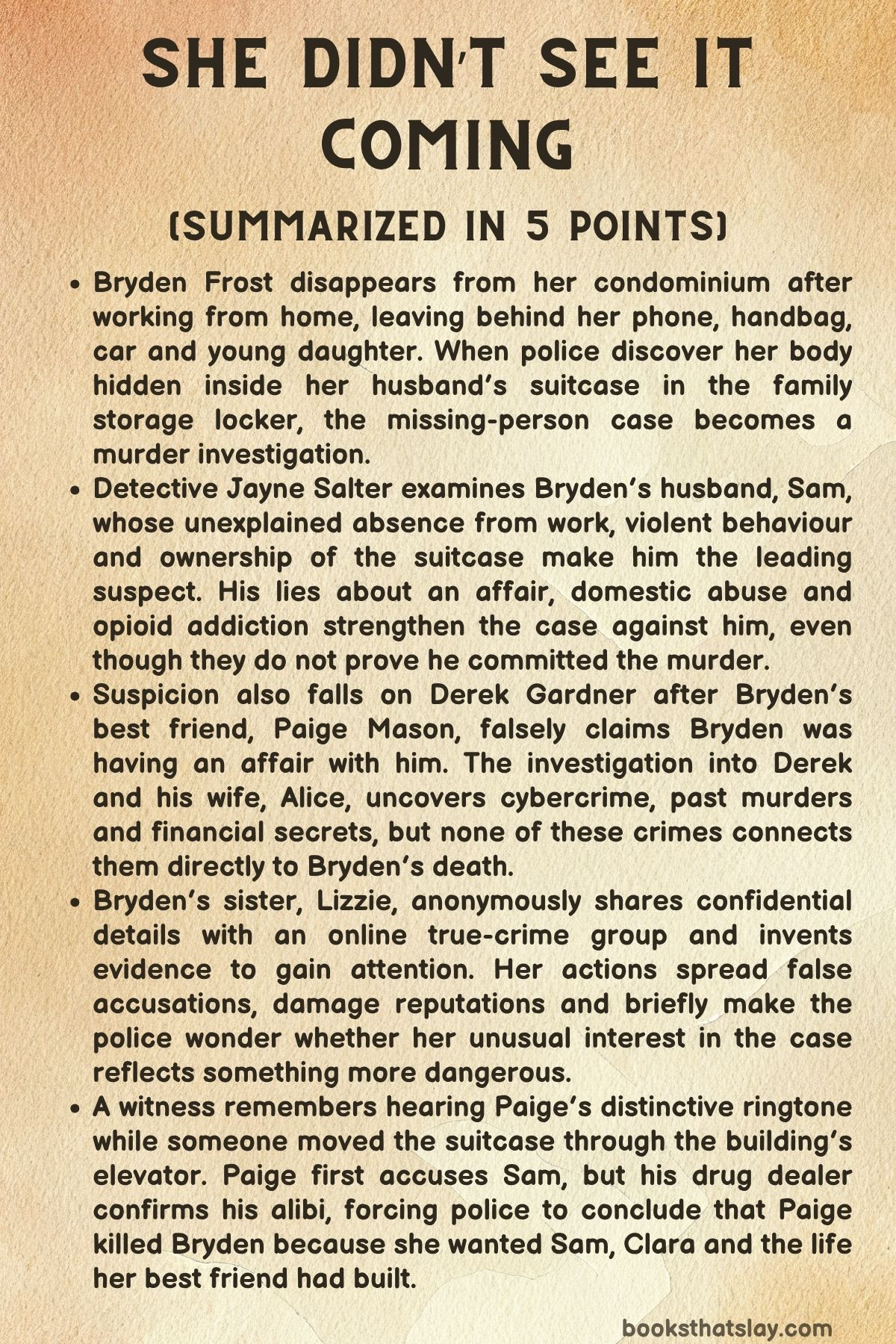
Characters
Bryden Frost
Bryden is the victim at the centre of She Didn’t See It Coming, but the gradual discovery of her private life gives her a presence far beyond her death. She is a successful professional, a devoted mother and a woman who works hard to preserve the appearance of a stable family.
Her decision to hide Sam’s violence shows how fear, shame and hope can keep a victim trapped inside an abusive marriage. She protects Sam’s reputation, conceals her injuries and continues imagining a future in which they might have another child, even though the relationship has become unsafe.
Bryden’s kindness ultimately makes her vulnerable to Paige. She allows her closest friend into the building without suspicion because trust has always formed the foundation of their relationship.
Her final thoughts are of Clara rather than herself, confirming that motherhood is the strongest part of her identity. Although she cannot control the false stories told after her death, the investigation gradually restores the truth of what was done to her.
Detective Jayne Salter
Jayne is intelligent, persistent and professionally cautious. She does not accept the Frost family’s idealized version of Bryden’s life and repeatedly tests statements that appear emotionally convincing but lack supporting evidence.
Within She Didn’t See It Coming, she functions as the person responsible for separating murder from the many other crimes and betrayals exposed by the investigation. Her greatest challenge is not finding suspicious behaviour but determining which suspicious behaviour is actually connected to Bryden.
Jayne understands that grief, guilt and deception can produce similar outward reactions. She therefore remains suspicious of Sam without deciding too early that he is guilty, and she examines Derek, Alice, Lizzie, Henry and Paige as new information emerges.
Her instincts about Alice are accurate, although Alice’s crimes do not include Bryden’s murder. This distinction shows Jayne’s developing ability to respect intuition without allowing it to replace evidence.
Jayne’s relationship with Michael reveals the personal cost of her career. She values his patience and emotional stability but worries that marriage or motherhood may conflict with the demands of homicide work.
Paige Mason
Paige is Bryden’s best friend, Clara’s godmother, Sam’s secret lover and the murderer. Her position inside the family gives her access, trust and detailed knowledge that an outsider could never have gained.
She presents herself as loyal and supportive, but her friendship with Bryden has become corrupted by envy. Rather than building an independent life, Paige becomes convinced that Bryden’s husband, child and home should belong to her.
Paige misreads her affair with Sam as evidence of a meaningful future. Sam sees the relationship as temporary relief, while Paige interprets every secret meeting as a step toward replacing Bryden permanently.
Her crime is planned rather than impulsive. She confirms Bryden will be alone, wears concealing clothes and gloves, gains entry through trust, uses a method that leaves little visible evidence and cleans the scene afterward.
Paige is also an effective liar under pressure. She invents Bryden’s affair with Derek and later constructs a detailed accusation against Sam, using his abuse, jealousy and missing alibi to make the story believable.
Her central weakness is her assumption that no one noticed her. Francine’s memory of the ringtone destroys the anonymity on which the entire plan depended.
Sam Frost
Sam is morally guilty of serious harm even though he is innocent of murder. He abuses Bryden, has an affair with her best friend, neglects domestic responsibilities and hides an opioid addiction while insisting that his marriage was happy.
His behaviour makes him an exceptionally convincing suspect. The suitcase belongs to him, the body is found in his storage locker and he lies about where he was during the killing.
Sam’s lies are driven mainly by self-preservation. He fears losing his career, reputation and custody of Clara more than he fears obstructing the investigation into his wife’s death.
His treatment of Paige is equally selfish. He accepts sex, childcare and emotional support from her without sharing her desire for a lasting relationship.
Sam’s innocence does not transform him into a sympathetic husband. The book makes a clear distinction between legal innocence in Bryden’s murder and moral responsibility for the suffering she experienced while alive.
His eventual alibi saves him from a wrongful conviction, but it does not erase his abuse or betrayal. He remains responsible for rebuilding Clara’s life while carrying the consequences of what he did to her mother.
Clara Frost
In She Didn’t See It Coming, Clara represents the human cost of every adult decision in the story. At three years old, she cannot understand why her mother failed to collect her or why Bryden will never return.
Her repeated requests for her mother emphasize the difference between the investigation as a public mystery and the murder as a permanent personal loss. While adults argue about suspects, alibis and reputations, Clara simply wants the safety that Bryden provided.
Several characters claim to act for Clara’s benefit, yet they repeatedly use her to support their own desires. Paige imagines becoming her mother, Donna fears losing access to her and Sam treats custody as something his secrets might endanger.
Clara also reveals Sam’s impatience and Paige’s self-deception. Paige believes she can manage Sam and replace Bryden, even after watching him respond physically and angrily to his daughter’s distress.
Lizzie
Lizzie loves Bryden but has spent much of her life comparing herself with her sister. Bryden’s marriage, career, child and home represent the achievements Lizzie believes their parents valued more than her own life.
Her nursing background allows her to appear practical during the crisis, yet her interest in true crime quickly becomes an unhealthy response to grief. She transforms Bryden’s murder into an online investigation that gives her recognition she has long felt denied.
Lizzie’s actions are motivated by a mixture of love, resentment, loneliness and ambition. She genuinely wants the killer found, but she also enjoys being viewed as a person with privileged access to an important case.
Her decision to release confidential information shows poor judgment and a weakening respect for Bryden’s privacy. When genuine details no longer produce enough attention, she invents evidence and encourages strangers to attack suspects.
Lizzie is not the murderer, but her behaviour demonstrates how personal tragedy can become a source of status. She must eventually face the fact that she used her sister’s death to satisfy needs she had never acknowledged openly.
Donna
In She Didn’t See It Coming, Donna is Bryden and Lizzie’s mother and one of the characters most deeply affected by the murder. Her grief is joined by fear that Clara may be left with the man who killed Bryden.
She initially wants to believe in Sam, but the suitcase, abuse allegation and missing alibi gradually destroy her trust. Her suspicion is understandable because she receives only fragments of information and must make decisions about her granddaughter without knowing the truth.
Donna also notices Lizzie’s increasing isolation before anyone else fully understands it. She seeks professional support because she fears grief has triggered a psychological crisis in her surviving daughter.
Her actions are driven by protection rather than curiosity. Unlike Lizzie, she does not treat the investigation as a source of excitement and remains focused on Clara’s safety and the family’s survival.
Jim
In She Didn’t See It Coming, Jim is quieter and less reactive than Donna, but he shares her grief and concern for Clara. He attempts to avoid premature conclusions about Sam, even when the available evidence appears damaging.
His caution provides a small measure of balance within the family. Where Donna responds strongly to fear and Lizzie responds through obsession, Jim generally accepts that the police must determine what happened.
He also represents parental helplessness. He can support Donna, attend to funeral arrangements and help care for Clara, but he cannot protect Bryden retroactively or control the investigation.
Detective Tom Kilgour
Kilgour is Jayne’s investigative partner and provides practical support throughout the case. He helps organize searches, conduct interviews and test the changing theories surrounding Sam, Derek, Alice, Lizzie and Paige.
His role is less psychologically prominent than Jayne’s, but he contributes stability and professional discipline. He is willing to question apparent victims, grieving relatives and wealthy suspects without being distracted by social position.
Kilgour also helps prevent the investigation from becoming dependent on one detective’s instincts. His exchanges with Jayne allow them to challenge assumptions and reconsider evidence as the case changes direction.
Derek Gardner
In She Didn’t See It Coming, Derek is introduced through Bryden’s traffic accident and initially appears charming, patient and respectable. His wealth, appearance and controlled manner make him easy to trust during their brief encounter.
The false affair allegation transforms him into a serious suspect because he lacks a reliable alibi and has a plausible connection to Bryden. His previous infidelity makes Paige’s invention more believable to both Alice and the police.
Derek is innocent of Bryden’s murder but not innocent in a broader sense. He conducts illegal cybersecurity operations, manipulates protected information and helps Alice conceal the truth about Mary’s death.
His marriage is based partly on money, shared secrets and mutual blackmail. He remains with Alice because each possesses information capable of destroying the other.
Derek’s arrogance encourages him to believe that wealth, technical knowledge and legal representation can protect him. The investigation shows that these advantages may delay consequences but cannot completely remove suspicion.
Alice Gardner
Alice is one of the most dangerous people in the novel despite having no role in Bryden’s death. She is intelligent, wealthy, controlled and capable of murder without remorse.
She killed her mother to obtain an inheritance and murdered Rich after losing interest in their affair. In both cases, she planned the situation carefully and manipulated investigators afterward.
Alice views people primarily in terms of usefulness, threat and control. Bryden matters to her only because the murder investigation brings Jayne close to crimes Alice believed were safely hidden.
Her decision to confront Lizzie, enter the online group and break into Jayne’s apartment demonstrates both confidence and recklessness. She does not tolerate uncertainty and prefers to act directly against anyone who threatens her security.
Alice’s marriage to Derek is a partnership sustained by criminal knowledge. Their loyalty is not based on trust but on the certainty that betrayal would destroy them both.
She also acts as a dark counterpart to Paige. Both women want control over lives they envy, but Alice possesses far greater experience in planning violence and protecting herself afterward.
Tracy Kemp
Tracy is trapped between loyalty to Henry and her belief that women who report sexual assault should be taken seriously. For two years, she publicly defends her husband while privately doubting his account.
Bryden’s disappearance forces Tracy to reconsider everything she previously accepted. Henry’s possible involvement becomes frightening because Tracy knows that his earlier accuser may have told the truth.
Her decision to meet Kayly is an act of moral courage. By listening to the woman directly, Tracy stops treating her as an enemy and begins recognizing the harm caused by her own defence of Henry.
The detail about Henry’s finger-tapping habit finally confirms Kayly’s account for her. Tracy’s development concerns the painful movement from denial to knowledge and the responsibility that knowledge creates.
Henry Kemp
Henry is an aggressive and deeply threatening figure whose past makes him an immediate suspect. Although he has a firm alibi for Bryden’s murder, the story strongly establishes that Kayly’s accusation against him was truthful.
His confidence after being cleared reveals how he interprets the absence of charges as proof of safety rather than proof of innocence. He believes that weak evidence and Tracy’s public support will continue protecting him.
Henry’s presence serves an important investigative purpose. He demonstrates that a person can be guilty of a serious crime without being guilty of the particular crime currently under investigation.
His treatment of Tracy also depends on control. He expects loyalty and reacts angrily when questioned, leaving her emotionally isolated and afraid of what she may discover.
Kayly Medoff
Kayly is the woman who accused Henry of abducting and raping her. Her delayed report and the absence of physical evidence allowed others to question her credibility, even though she consistently identified Henry.
Her conversation with Tracy restores her humanity after she has been treated as a rumour surrounding Henry. The precise detail she remembers about his voice and finger-tapping habit demonstrates the reliability of her memory.
Kayly also reveals the damage caused when institutions demand perfect behaviour from victims. Her hesitation is used against her even though fear, trauma and confusion offer reasonable explanations for the delay.
Angela Romano
Angela is Bryden’s neighbour and friend, and she assists the family by caring for Clara during the early crisis. Her willingness to help provides immediate practical support when Sam is unable to manage the situation alone.
She also directs police attention toward Henry by mentioning the earlier accusation against him. Although her information is based partly on building gossip, it reflects a genuine concern that someone dangerous may live near Bryden.
Angela’s role shows how residents of a supposedly secure building possess only partial knowledge of one another. Physical closeness does not create real understanding, and neighbours may carry histories that others know only through rumours.
Michael Fraser
Michael is Jayne’s partner and an important source of emotional stability. He is disappointed when the investigation interrupts their anniversary, but he understands that Jayne’s work demands immediate attention.
His background in psychology allows him to discuss criminal behaviour without pretending that every action has a simple explanation. He encourages Jayne to respect instinctive reactions while continuing to depend on evidence.
Michael does not pressure Jayne into making quick decisions about marriage or children. His patience contrasts with the controlling, secretive and transactional relationships surrounding the murder investigation.
Francine Logan
Francine initially appears to be an unreliable witness because she remembers almost nothing about the person with the suitcase. She spent most of the elevator ride looking at her phone and cannot identify the carrier’s face, body or gender.
Her importance lies in the small sensory details that return later. The damaged sticker and distinctive ringtone provide information that only someone inside the elevator could know.
Francine’s evidence demonstrates that witnesses do not always recognize the importance of what they observe. A detail that seems trivial at the time can become decisive when matched with other evidence.
Ravi Sabharwal
Ravi is the condominium’s building manager and provides the police with access to restricted areas, vacant units and information about the security system. His knowledge helps investigators understand how someone could enter or move through the building unnoticed.
The broken garage cameras expose a serious weakness in a property that residents assume is secure. Ravi’s role therefore emphasizes the difference between the appearance of safety and the reality of incomplete surveillance.
Officer Hank Bremmer and Brutus
Officer Hank Bremmer handles Brutus during the second search of the condominium. Their work changes the investigation from a missing-person case into a murder inquiry.
Brutus follows Bryden’s scent through the building and reacts strongly at the Frost family’s storage locker. The dog’s discovery ends the family’s remaining hope that Bryden might still be alive but ensures that her body is recovered.
Bremmer responds professionally and calmly to the discovery. His handling of the search demonstrates the importance of trained specialists when ordinary visual inspection fails.
Ginny and Jonathan Fell
Ginny, the forensic pathologist in She Didn’t She It Coming, determines that Bryden died from asphyxiation and explains the physical effort required to suffocate her. Her findings help investigators understand that the killer needed sustained control rather than a single impulsive act.
Jonathan Fell examines the unusually clean suitcase and body. His observation that the crime appears almost professional highlights the killer’s preparation, use of gloves and careful removal of physical evidence.
Together, they give Jayne the medical and forensic framework needed to test the competing accounts. Their work also prevents emotional theories from replacing scientific findings.
Kate Dixon
Kate Dixon is Paige’s attorney and helps her manage the police interview once the ringtone connects her to the suitcase. Her presence forces the detectives to proceed carefully and gives Paige time to construct a new defence.
Paige uses that opportunity to accuse Sam rather than confess fully. Kate’s professional role does not make her responsible for the lie, but her intervention allows Paige to shift from denial to a calculated attempt at reducing her own responsibility.
Mary Smelt
Mary is Alice’s mother and the source of the inheritance that finances the Gardners’ lifestyle. Although she dies years before Bryden, her unresolved death becomes important when Jayne examines the couple’s background.
Alice treats Mary less as a parent than as an obstacle between herself and wealth. Her murder reveals the extreme entitlement and emotional emptiness that define Alice’s decisions.
Mary’s case also shows how a poorly investigated death can remain unresolved when the offender understands routine, evidence and appearance. The original authorities fail to examine the people who benefit most directly from her death.
Rich
Rich is Alice’s older lover and another victim of her capacity for planned violence. When he refuses to accept the end of their relationship, Alice arranges a meeting and kills him.
She then presents herself as a woman who fought desperately in self-defence. Her successful performance demonstrates how she manipulates social expectations and emotional appearances.
Rich’s death confirms that Alice does not kill only for money. She also uses murder to remove people who become inconvenient, demanding or difficult to control.
Susan Cleeve
Susan is a former friend who knows enough about Alice’s relationship with Rich to threaten the official version of his death. She may not possess complete proof, but her knowledge could encourage investigators to reopen the case.
Alice’s desire to locate Susan shows how fear survives beneath her outward confidence. Every person who remembers part of the truth becomes a possible danger to her.
Susan therefore represents the lasting vulnerability created by hidden crimes. Evidence may disappear, but other people’s memories cannot always be controlled.
Themes
The Difference Between Secrecy and Guilt
Nearly every important person in She Didn’t See It Coming hides something, creating an investigative world in which suspicious behaviour does not automatically indicate responsibility for Bryden’s murder. Sam conceals abuse, adultery and addiction, Derek hides cybercrime, Alice protects multiple killings, Lizzie lies about her online activity, Tracy suppresses doubts about Henry and Paige disguises both an affair and a murder.
These secrets give the police legitimate reasons to question each person. They also create false patterns because the behaviour associated with concealment—nervousness, anger, inconsistent statements and missing alibis—can look similar regardless of what is being hidden.
Sam is the clearest example of this distinction. His lies nearly lead to a murder conviction, yet the truth he conceals is an opioid purchase rather than a meeting with Bryden.
The novel does not suggest that Sam deserves sympathy simply because he did not kill his wife. Instead, it separates different forms of responsibility and shows why legal investigation must remain focused on evidence.
Alice provides the opposite problem. Jayne correctly senses that Alice is capable of murder, but intuition alone cannot connect her to Bryden.
The case is solved only when Francine’s memory, Paige’s ringtone and Sam’s verified alibi establish a direct chain of evidence. The story therefore argues that moral corruption may guide suspicion, but proof must determine guilt.
Domestic Appearances and Private Violence
The Frost family initially appears stable, affectionate and financially comfortable. Bryden has a respected career, Sam holds a prestigious position and Clara seems to be growing up inside a secure home.
That appearance depends on Bryden’s silence. She hides her cracked rib, minimizes Sam’s violence and allows relatives and friends to believe their marriage is happy.
Sam also protects the illusion by describing himself as a loving husband and presenting domestic conflict as ordinary stress. Even Lizzie and Paige, who know more than the police, reveal only the facts that suit their immediate needs.
The Gardners maintain a more polished version of the same deception. Their expensive home, education, business success and social confidence hide a marriage built on murder, cybercrime, infidelity and mutual blackmail.
The condominium building functions as a physical symbol of this false security. Cameras, key cards, controlled entrances and private storage areas create an impression of protection, yet the broken garage system allows a killer to enter unnoticed.
Bryden’s body is hidden among carefully preserved baby items, placing violence beside her hope for another child. The location exposes the distance between the future she imagined and the danger already present in her life.
Respectability therefore offers no reliable measure of safety. The greatest threats come from people welcomed into private spaces through marriage, friendship and trust.
Jealousy, Envy and the Desire to Replace Another Person
Paige does not simply want a relationship with Sam. She wants the complete life that belongs to Bryden, including her home, child, social position and role within the family.
Her envy grows because she sees Bryden’s life from close range. As a best friend and godmother, she is invited into the very spaces she later attempts to claim.
After the murder, Paige uses Bryden’s mirror and hairbrush, cares for Clara and performs domestic duties inside the Frost home. These actions reveal that the killing is connected to replacement rather than temporary romantic competition.
Lizzie experiences a less violent but still destructive form of envy. She has spent years believing Bryden received greater parental approval because she achieved conventional signs of success.
Her online identity allows her to become more important than the sister who once overshadowed her. By controlling confidential information, Lizzie turns Bryden’s death into a situation in which strangers finally depend on her.
Alice also responds to threats through possession and control. Although she does not kill Bryden, she cannot tolerate the possibility that Derek’s actions may endanger the wealth and security she believes belong to her.
The novel presents envy as an emotion that changes how people understand others. Paige stops seeing Bryden as a friend and begins seeing her as an obstacle, while Lizzie temporarily treats her sister’s death as an opportunity for recognition.
True Crime, Public Curiosity and the Loss of Human Dignity
In She Didn’t See It Coming, Lizzie’s online activity begins with the belief that a group of strangers might notice evidence the police have missed. Her interest is partly sincere, since online communities have occasionally contributed information to real investigations.
The group quickly demonstrates the dangers of treating crime as entertainment. Members create polls, repeat rumours, examine private records, circulate photographs and accuse people without understanding the evidence.
Bryden gradually becomes less important as a person than as the subject of an exciting case. Commenters joke about the suitcase, discuss whether a body can fit inside it and compete to produce the most dramatic theory.
Lizzie contributes to this loss of dignity by releasing private photographs and confidential facts. When genuine information no longer gives her enough attention, she invents hotel footage and exaggerates police evidence.
The false claims harm Derek and Alice, while public accusations against Henry spread before lawful action is taken. Some suspicions may be morally justified, but the group lacks the authority, evidence standards and accountability required of investigators.
Lizzie’s anonymous identity also changes her behaviour because she no longer feels personally responsible for the consequences of her posts. She is disturbed when strangers criticize Bryden’s sister but cannot defend herself without revealing the truth.
The novel ultimately presents public fascination with murder as ethically dangerous when curiosity replaces respect. Investigation should seek justice for the victim, not transform private suffering into status, amusement or collective spectacle.