Simply More by Cynthia Erivo Summary and Analysis
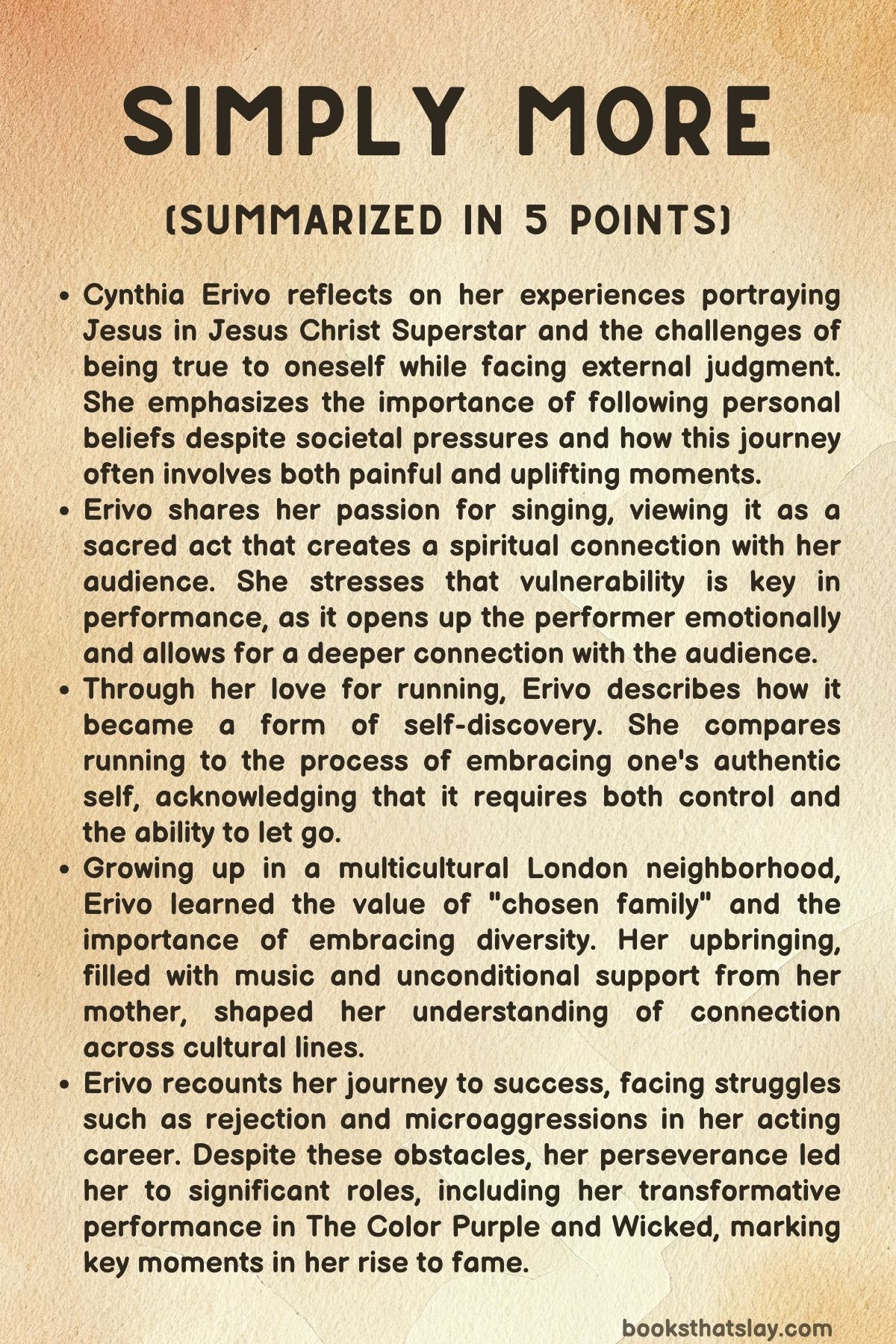
Simply More by Cynthia Erivo is a deeply personal memoir that reflects on the experiences and lessons learned throughout the author’s journey as an artist, performer, and individual striving for authenticity. Erivo shares her insights on vulnerability, self-discovery, and perseverance, drawing from both her professional accomplishments and personal life.
The book is not just about her rise to stardom, but also about her inner battles, personal growth, and the importance of embracing one’s true self despite the challenges that arise. From her time at RADA to portraying iconic figures like Harriet Tubman, Erivo’s story is one of resilience, self-acceptance, and the power of following one’s passion.
Summary
Simply More chronicles Cynthia Erivo’s life, starting from her childhood and continuing through her career as an acclaimed artist and performer. The book explores the complexities of Erivo’s journey toward embracing her true self, sharing personal experiences and lessons that have shaped her path.
Erivo begins by reflecting on her role in the production of Jesus Christ Superstar at the Hollywood Bowl, a decision that sparked controversy due to the expectations placed on her as a Black woman in a role often seen as controversial. She speaks about the challenge of being more than others expect and the importance of living authentically.
Erivo emphasizes that staying true to oneself, despite external criticism, is essential for growth and self-acceptance. Her journey toward self-ownership, she notes, has been a long one, full of both joy and struggle.
One of the key themes in Erivo’s memoir is the significance of singing and performing. For her, singing is more than just an act of making music; it’s about connecting spiritually with an audience and telling a story.
Erivo believes that everyone has gifts to share with the world, and it’s vital not to let judgment from others stop one from offering those gifts. This sense of purpose became evident early on in her life when she began to embrace her passion for performance, particularly singing.
Her childhood memories include the joy of singing “Silent Night” at the age of five in a school play and feeling “sparkly” from the audience’s applause. This early recognition of her talent helped her realize that her boldness and curiosity were gifts that would guide her toward a career in music and acting.
Another important aspect of Erivo’s journey is her reflection on vulnerability. She reveals that singing requires emotional openness and physical vulnerability, as it involves both the body and spirit.
This vulnerability, while risky, allows for deeper connections with others and provides a sense of freedom. Erivo also connects this idea to the Japanese concept of ikigai—the sense of fulfillment one finds when their passion aligns with their ability to contribute to the world.
In the early part of her memoir, Erivo discusses her childhood in South London, where she was raised by her mother, a Nigerian immigrant who encouraged her passion for music. Erivo’s mother, who had her own struggles, was supportive of Erivo’s dreams, which was not a common sentiment in many Nigerian families, where careers in medicine or law were often prioritized.
Erivo describes how music was always present in her home, with her mother playing a variety of genres, and how her upbringing shaped her understanding of the world.
Erivo also reflects on the impact of her father’s absence in her life. At the age of sixteen, her father left her at a London Underground station, marking the last time they ever spoke.
Despite knowing very little about him, she often thinks about their shared traits, such as their gap teeth and love of singing, which later influenced her identity and career.
Her journey toward becoming a professional performer began when she was selected to join a theatrical troupe at the age of eleven. As a teenager, she auditioned for Romeo and Juliet with no preparation and ended up being cast as Juliet, marking a pivotal moment in her career.
This was followed by a difficult time at RADA, where Erivo faced challenges as one of the few Black students in her class. She encountered microaggressions and was often typecast in roles that conformed to stereotypes.
Despite these struggles, Erivo’s determination never wavered. She worked multiple jobs to support herself and eventually gained acceptance into the prestigious drama school.
At RADA, Erivo encountered feelings of isolation and was often relegated to small, insignificant roles. However, she found support in a fellow student, Joan Oliver, who became a mentor and recognized Erivo’s potential.
Through her friendship with Joan, Erivo started to build her confidence as an artist. She also formed a bond with Michael Pivoy, another student who introduced her to musical theater, and for the first time, she felt free to express herself without judgment.
Erivo’s experience at RADA was marked by rejection and frustration, but she learned that these setbacks were part of the process. After leaving the school, she pursued her career with a renewed sense of purpose.
She faced challenges as a Black woman in a predominantly white industry, often being overlooked for significant roles. One breakthrough came when she relentlessly pursued the role of Celie in The Color Purple, despite initial rejection by producers.
Her persistence paid off, and she was eventually cast in the role, leading to a transformative experience and a Tony Award for her performance.
As Erivo’s career continued to flourish, she took on more challenging roles, including portraying iconic figures such as Harriet Tubman and Aretha Franklin. Each of these roles pushed her boundaries, forcing her to confront both emotional and physical challenges.
Through these experiences, Erivo discovered that embracing her true self was essential to her craft. This realization deepened her connection to her characters and fueled her artistic growth.
Erivo’s time in Wicked marked another turning point in her career. Although she had long dreamed of playing Elphaba, she initially thought it was an impossible goal.
However, she eventually auditioned for the role, and it became one of the most significant achievements of her career. Through her journey in Wicked, Erivo learned the importance of persistence, vulnerability, and trusting her instincts.
Her rise to fame came with its own struggles, but each challenge contributed to her ultimate success.
Throughout the book, Erivo emphasizes the importance of authenticity, resilience, and perseverance. She speaks about the challenges of being scrutinized by the public, particularly regarding her appearance and identity.
Despite facing judgment, she learned to block out negativity and focus on self-love and acceptance. She also discusses the importance of creating a supportive team, surrounding oneself with people who encourage and challenge growth.
The memoir concludes with a reflection on finding joy in the small moments of life. Erivo acknowledges the importance of self-care and taking time to rest and recharge.
Ultimately, the book serves as a testament to the power of resilience, self-acceptance, and the journey toward authenticity.
Key People
Cynthia Erivo
Cynthia Erivo is the heart and soul of Simply More, as the book is largely based on her personal journey. Erivo’s path to self-acceptance and fame is shaped by her deep love for singing and performing.
She reflects on the significant moments of her life that helped her find the courage to embrace her true self, like her early days of singing and acting, and how her childhood curiosity and boldness led her to a career in the arts. A passionate advocate for vulnerability, Erivo expresses that performing is a sacred act, one that demands emotional openness.
As an artist, her resilience is evident in the challenges she faced while pursuing a career in a space that often overlooked her. She describes overcoming microaggressions and biases, particularly in the context of her time at RADA, where being one of the few Black students came with challenges that forced her to confront discomfort and rejection.
Despite these struggles, Erivo’s unwavering determination and her drive to be true to herself propelled her to success. Her performances in The Color Purple, Wicked, and other major productions showcase her talent and resilience, marking her as a role model for anyone striving to be their authentic self, no matter the obstacles.
Edith
Edith, Erivo’s mother, plays a foundational role in shaping her identity and career. A Nigerian immigrant, she offered Erivo a love of music and an unconventional approach to raising her daughter.
Unlike many Nigerian families who prioritize careers in medicine or law, Erivo’s mother encouraged her passion for music, which was rare but powerful. She also shared her own struggles with Erivo, including her battle for approval from her parents when moving to the UK, and her experiences as an immigrant.
These lessons of perseverance and independence were passed down to Erivo, fostering a sense of self-worth and ambition in her. The love and encouragement Erivo received from her mother formed the backbone of her self-confidence, inspiring her to pursue a career in music and theater despite the challenges that lay ahead.
Joan Oliver
Joan Oliver, a Black woman at RADA, became one of Erivo’s most significant mentors. Her support during Erivo’s time at drama school helped her find the confidence to continue pursuing her dream of performing.
Joan’s recognition of Erivo’s potential, even when others overlooked her, was a crucial source of encouragement in a predominantly white environment where Erivo often felt isolated and marginalized. Joan’s influence on Erivo went beyond professional guidance; she provided a sense of belonging that helped Erivo persist through the difficult moments of rejection and discrimination.
Through Joan, Erivo learned the value of mentorship, and the bond they shared was a source of strength in her journey to self-discovery and success.
Michael Pivoy
Michael Pivoy, a fellow student at RADA, is another key figure in Erivo’s early life. He introduced her to singing songs from musicals, a practice that would become crucial in her artistic development.
Their time spent together, singing and exploring music, was transformative for Erivo. For the first time, she felt comfortable and free to express herself without fear of judgment.
This newfound freedom allowed Erivo to discover her authentic voice and the deep connection she had with music, ultimately shaping her approach to performance and artistry. Michael’s friendship was a turning point in her career, helping her realize that she could be herself, and through that self-expression, connect with others.
Ariana
Ariana, Erivo’s co-star in Wicked, played a crucial role in supporting her during the intense and physically demanding process of preparing for their roles. The two women formed a bond rooted in collaboration, rejecting the competitive dynamics often seen in women working together in high-profile projects.
They made a pact to emotionally and professionally support one another, fostering a partnership based on mutual respect and authenticity. Ariana’s support helped Erivo through the emotional and physical challenges she faced while filming, especially in scenes where she had to learn to fly for her role as Elphaba.
Their bond grew into a deep personal connection, with both women offering each other encouragement and strength in navigating the demands of their careers.
Karis Musongole
Karis Musongole, a young actress playing the younger version of Elphaba on the Wicked set served as a reminder to Erivo of the magic and wonder of performance. When Erivo had the opportunity to show this young actress the magic of flying, it became a pivotal moment for her, reinforcing the idea that despite the physical exhaustion and challenges of the role, there was joy to be found in every moment of the process.
This interaction also allowed Erivo to reflect on the importance of passing on the passion for performance and inspiring the next generation of artists. The young actress symbolized the continuing cycle of inspiration and growth that is central to Erivo’s career and artistic journey.
Erivo’s Father
Though largely absent from her life, Erivo’s father’s departure had a lasting impact on her. She reflects on the moment he left her at a London Underground station when she was sixteen, marking the last time they spoke.
Despite their estrangement, Erivo sees aspects of herself in him, such as their gap teeth and love for singing, which helps her understand him in ways she hadn’t before. This complex relationship adds depth to Erivo’s understanding of family, identity, and self-discovery.
Her father’s absence has shaped her perspective on relationships, particularly the role of family in shaping one’s sense of self-worth and belonging.
Themes
Authenticity and Self-Acceptance
In Simply More, the theme of authenticity and self-acceptance is deeply explored as Cynthia Erivo recounts her personal journey. From the moment she takes on the role of Jesus in Jesus Christ Superstar to her reflections on vulnerability in singing, Erivo continuously emphasizes the importance of embracing one’s true self, despite the societal pressures to conform.
Throughout her life and career, Erivo has faced external judgments and expectations—whether it’s being the “Strong Black Woman” stereotype or being told she couldn’t succeed in the roles she aspired to. However, she continually chooses to push past these barriers and stay true to herself.
Erivo acknowledges that the path to self-acceptance is often painful and filled with doubts, but it is also an empowering and transformative journey. She reflects on how she learned to harness the power of vulnerability, particularly in her singing and acting, and how this openness has allowed her to forge deeper connections with her audience and characters.
Ultimately, she concludes that true success lies not in external validation but in staying aligned with one’s own beliefs and strengths. This theme serves as a reminder that self-ownership is the key to fulfillment, even when others may not fully understand or accept your path.
Resilience and Overcoming Adversity
Resilience is a recurring theme in Simply More, as Erivo recounts the many challenges and setbacks she faced, both in her personal life and professional career. Whether dealing with rejection at RADA, facing microaggressions as one of the few Black students in her class, or struggling to secure meaningful roles in theater, Erivo’s journey is marked by perseverance.
Despite the challenges, she learns to transform each rejection into an opportunity for growth. This theme is particularly highlighted during her pursuit of the role of Celie in The Color Purple, a role that she was initially told was not suitable for her.
Erivo’s unwavering determination and belief in her talent eventually led to a transformative career moment. Her resilience extends beyond the professional realm—she also reflects on her ability to withstand personal struggles, including the absence of her father and the emotional toll of public scrutiny.
In all these instances, Erivo’s story is a testament to the power of persistence, demonstrating that every setback is not a sign of failure but a stepping stone toward eventual success. The theme of resilience emphasizes the importance of continuing to move forward, even when the odds seem stacked against you.
The Importance of Vulnerability
Vulnerability emerges as a crucial theme in Simply More, particularly in Erivo’s exploration of her craft as a performer. She highlights the emotional openness required in singing and acting, noting that true connection with an audience can only be achieved when one allows themselves to be vulnerable.
For Erivo, vulnerability is not a weakness but a strength—a way of showing one’s authentic self, even at the risk of rejection or misunderstanding. She discusses how this openness has been central to her personal and professional development, particularly when she portrays complex characters like Celie in The Color Purple and Harriet Tubman in Harriet.
Through these roles, Erivo has learned that embracing vulnerability allows her to connect with her audience on a deeper level, creating an emotional experience that goes beyond the performance itself. This theme extends to her personal life as well, where vulnerability has allowed her to confront her fears, heal from past traumas, and build stronger relationships.
In the context of Erivo’s life and work, vulnerability becomes a powerful tool for transformation, both for herself and for those who witness her journey.
The Power of Music and Performance
In Simply More, music and performance hold a central place in Erivo’s life, not just as a career but as a source of spiritual connection and self-expression. Erivo’s belief in the sacredness of singing as a way of conveying stories and emotions is one of the driving forces of her narrative.
From her childhood memories of singing “Silent Night” to her transformative roles in Broadway productions, music has always been a way for Erivo to connect with herself and the world around her. She views singing as more than just an art form—it is a means of creating an intimate bond between the performer and the audience.
In her discussions of her experiences on stage, she reflects on how music allows her to channel deep emotions and bring characters to life in a way that is uniquely powerful. This theme emphasizes the profound impact that music and performance can have, not just in entertainment but in healing and personal growth.
Through her work, Erivo demonstrates how music has the ability to transcend barriers, creating a universal language of connection and understanding.
Identity and Belonging
Identity and belonging are recurring themes in Simply More, particularly as Erivo reflects on her upbringing and the cultural influences that shaped her understanding of the world. Growing up in a multicultural South London neighborhood, Erivo was exposed to a wide range of cultures and traditions, which led her to appreciate the concept of a “chosen family.” In a world where cultural differences often divide people, Erivo found solace and connection in shared experiences, such as food, music, and love.
This sense of belonging, forged through her community, became an important part of her identity and understanding of the world. Erivo also touches on the complexities of identity as a Black woman in a predominantly white industry.
Her experiences at RADA and later in her career highlight the challenges of navigating a world that often tries to impose limiting identities on marginalized individuals. Despite these challenges, Erivo’s story is one of reclaiming and celebrating her identity.
She demonstrates that belonging is not just about fitting into a prescribed mold but about creating spaces where one can be fully authentic, even when others may not understand or accept them. Through this theme, Erivo explores the power of community and self-empowerment, showing how identity can be a source of strength and connection.
Empowerment Through Boundaries and Self-Respect
In Simply More, Erivo delves into the theme of empowerment through boundaries and self-respect, particularly in the context of her professional and personal relationships. She emphasizes that setting boundaries, though often challenging, is a vital part of maintaining self-respect and personal well-being.
Erivo reflects on a key moment in her career when she had to stand up for herself after being wronged by a manager. Her anger and frustration in this situation were not just about the immediate conflict but also about the larger issue of not allowing others to define her or take advantage of her.
This moment of assertiveness marked a shift in Erivo’s understanding of her own worth and her right to be treated with respect. As she continues her journey, she becomes more intentional about surrounding herself with people who not only support her but also challenge her to grow.
In the context of her work on Wicked, she recognizes the importance of having a team that shares her vision and holds her accountable, further emphasizing the role of boundaries in maintaining authenticity. This theme speaks to the broader idea that empowerment comes from within—by standing firm in one’s values and creating space for personal growth, individuals can navigate even the most challenging circumstances with strength and dignity.