Sin Bin Summary, Characters and Themes
Sin Bin by Chelsea Curto is a contemporary sports romance set in the high-pressure world of pro hockey and elite figure skating. Brody Saunders is the steady, intimidating head coach of the DC Stars, carrying the weight of leadership, fatherhood, and a past he doesn’t like to revisit.
Hannah Everett is a world champion figure skater whose confidence has been shaken by burnout and public scrutiny. When a crisis brings them close and a later twist makes them work together, attraction turns into something harder to ignore. The story balances team loyalty, career uncertainty, and a relationship that has real consequences for everyone around them. It’s the 5th book in the D.C. Stars series.
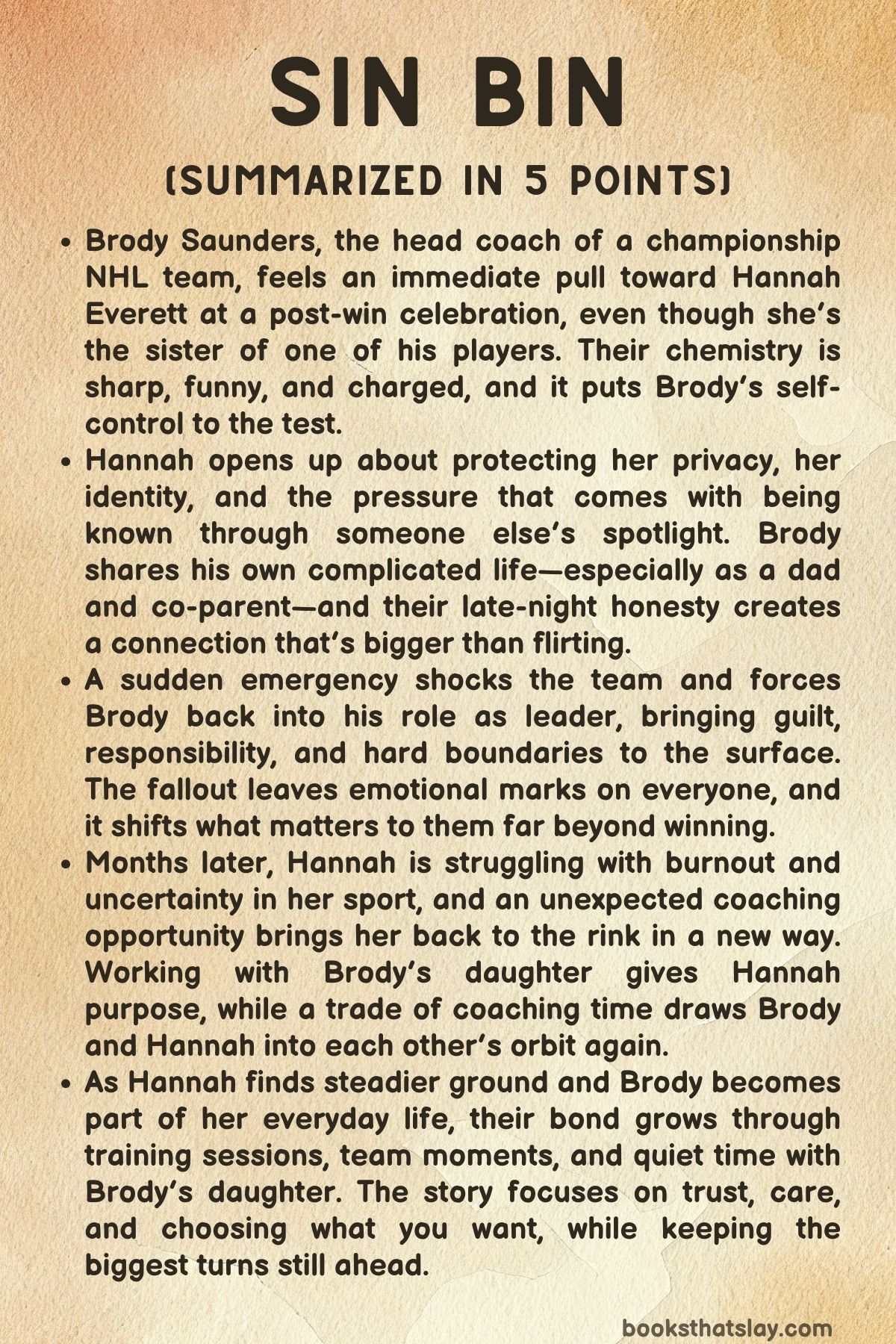
Summary
Brody Saunders should be celebrating. His DC Stars have just won the Stanley Cup for the second year in a row, and the team is packed into a nightclub that’s loud enough to make his skull throb.
He feels too old for the chaos, too tired to enjoy it, and too aware of the responsibilities waiting for him the next morning. Still, his attention keeps snapping to one person across the room: Hannah Everett.
Brody knows exactly who she is. Hannah is the younger sister of Grant Everett, one of his players, which should make her untouchable by default.
Brody tries to keep his distance, but Hannah has no interest in making it easy for him. She slides up beside him at the bar, flirts without hesitation, and calls out his stern, “important” vibe like it’s a joke.
When he admits he’s thirty-seven and his birthday is tomorrow, she leans into it, teasing him for being an “old man” and acting like she’s doing him a favor by paying attention.
Brody tells himself he won’t follow her lead. He tells himself he can walk away.
But Hannah suggests they find somewhere quieter, and even when he insists it’s just a walk, his feet still carry him out the door with her.
Outside, the air cools them down. Hannah pulls on Brody’s sweatshirt when she gets cold, and the flirtation turns into honest conversation.
Hannah mentions she’s bisexual and hasn’t told Grant, not because she’s afraid of him, but because she’s tired of her personal life becoming something other people use to build a story around her family. Brody’s reaction is immediate and protective; he promises he’ll deal with Grant himself if anyone ever treats her poorly.
Hannah also admits that, despite being a world champion figure skater, she’s been struggling lately and can’t find the drive she used to have.
Brody, guarded as always, reveals more than he usually does. He has a daughter, Olivia, who skates too.
He’s separated from Olivia’s mother, Kali, and they co-parent well but aren’t a couple. The more Hannah talks, the harder it is for Brody to treat her like a rule he can obey.
Hannah brings him to her apartment, insisting he at least eat something. She orders pizza—half pineapple and ham, half cheese—pours them whiskey, and keeps teasing him until his restraint starts to crack.
Brody admits what he’s been trying to deny: he’s been attracted to her for months and has been avoiding her on purpose. Hannah is surprised because he usually acts like she’s invisible at team events.
She pushes him to stop hiding behind excuses and tell her what he actually wants. The tension finally gives way, and they kiss.
It escalates quickly, and they end up in her bedroom, both of them ignoring every reason they shouldn’t be doing this.
Then Brody’s phone starts ringing.
At first, he thinks it’s his captain, Maverick Miller, being drunk and annoying. He ignores it, tries to return to Hannah, and lets the call go to voicemail.
But it keeps ringing. Hannah picks it up, and her expression changes fast.
She hands the phone to Brody, and everything shifts in a single sentence.
Hudson Hayes tells him that Riley Mitchell has been in a serious car accident in an Uber, and it’s bad enough that he might not survive.
Brody goes cold. He throws on his clothes and bolts for the door, already in coach mode, already in crisis mode.
Hannah offers to come with him, but Brody shuts that down immediately because he can’t handle the questions that would follow if they show up together. The guilt hits him hard—guilt about Riley, guilt about the timing, guilt about the fact that he was in Hannah’s bed when the call came.
Overwhelmed, he tells Hannah they have to pretend the night never happened. He insists they left separately, that he was never there.
Hannah is clearly hurt, but she swallows it and agrees, staying composed as he disappears.
At the hospital, the Stars are gathered in the waiting room, tense and shaken. Liam Sullivan is ready to fight the receptionist for information, and Brody steps in to take control the way he always does when things spin out.
Maverick explains Riley left the club early and the Uber driver called about the crash. When the doctor finally speaks to them, the news is brutal: Riley is alive and breathing, but his right leg is beyond repair.
The injury is catastrophic, and the only option is an above-the-knee amputation. Lexi Armstrong, the team’s athletic trainer, translates the medical language into something that lands like a punch.
The doctor makes it clear Riley won’t skate again.
Brody is rocked by it in a way he doesn’t show the team. He knows what it’s like to have a career ripped away; his own playing days ended because of injury.
He’s determined that Riley won’t be pushed into decisions that sacrifice long-term health for short-term optimism.
Grant, devastated, calls Hannah to tell her what’s happening, and Brody overhears enough to feel even worse. Later, Grant sits with Brody, notices his shirt is inside out, and breaks down.
Riley is one of Grant’s closest friends, and he can’t see how hockey matters after this. Brody doesn’t pretend he has the right words.
He promises Grant he isn’t alone and that they’ll get through what comes next, one step at a time.
Sixteen months pass.
Hannah is training again in DC, but her skating feels heavy instead of electric. Her coach, Justine, criticizes her, and her best friend Tierney Paige tries to help her adjust technique, but Hannah keeps falling apart on the ice—physically and mentally.
Over lunch, Tierney pushes her to admit what’s really happening. Hannah finally says it out loud: she’s burned out.
Skating feels like a chore. The pressure is constant.
She’s tired of chasing perfection and fixing mistakes until she can’t feel anything else. She’s considering stepping away, starting with withdrawing from Skate America even though she’s projected to do well.
Tierney supports her and encourages her to talk to Grant, but Hannah worries about media chatter and being reduced to gossip. Even so, she knows she can’t keep forcing herself through misery.
Around the same time, Brody is home when Olivia storms in furious after practice. Olivia’s coach is pregnant and taking leave, and Olivia is panicking because she’s only ten months away from the Potomac Memorial Open, a major competition on her qualifying path.
Without a coach, her training plan and ice access could unravel. Brody promises he’ll fix it, even though Olivia insists this isn’t something money can simply solve.
Brody thinks about Olivia’s mother, Kali, and how Olivia came from a one-night stand during a rough period after Brody’s forced retirement. Brody and Kali tried to date, but they work better as co-parents.
Kali is now married to Bryant, and the arrangement is stable, even if Brody sometimes feels like he’s constantly trying to prove he deserves it.
Desperate for a solution, Brody messages the team’s group chat asking for figure skating coach recommendations. The replies turn into jokes immediately, but Grant mentions his sister Hannah—an elite skater—and suggests she could coach Olivia.
Brody’s stomach drops, because he hasn’t forgotten Hannah’s apartment, his own choices, or the way he ran and then erased her.
Grant calls to confirm Hannah is open to hearing details, then gives Brody her number. Brody stalls for days, hiding behind work and nerves.
Meanwhile, the team faces its own stress, including Maverick’s worry about his pregnant wife, Emerson, and Brody’s ongoing effort to keep the Stars sharp. He’s strict, demanding, and used to carrying everything alone.
Eventually, Brody texts Hannah, awkwardly offering to pay her to coach Olivia. Hannah takes time to respond.
She’s dealing with her own mess: she withdrew from Skate America and the internet has turned it into a feeding frenzy. Rumors spread.
People question her talent, her drive, her future. When she meets Grant at a bar, she vents about feeling lost and tired of being treated like a headline.
Coaching Olivia starts to sound like a way to stay near the ice without being trapped by it, and she wants Olivia to have someone who cares about her as a person.
Hannah warns Brody she has no coaching experience. Brody tells her Olivia believes in her, and he’s watched Hannah’s skating.
They agree to meet at the Stars arena. Brody is anxious the whole morning, and when Hannah arrives, he finally apologizes for how he left her that night.
He admits he handled it badly. Hannah accepts it, saying she isn’t angry anymore, and they move into the practical details: Olivia’s schedule, her goals, and what she needs.
Hannah agrees to coach Olivia with clear boundaries, and she proposes a trade: Brody will spend time coaching Hannah in a hockey-style way that helps her reconnect with skating basics and find enjoyment again. Brody agrees.
They decide to use the Stars training facility, and Hannah suggests they try being friends to cut the awkwardness.
When Brody tells Olivia and Kali that Hannah Everett will be Olivia’s new coach, Olivia explodes with excitement—Hannah is a skater she admires. Kali immediately notices Brody’s weird energy and teases him, but Brody dodges the questions and focuses on logistics.
Hannah’s first session with Olivia goes better than she expects. Olivia fangirls for about five seconds, then turns serious.
Hannah sets expectations: no diet pressure, honest communication, and safe skill-building. She watches Olivia’s jumps, breaks down a problem with Olivia’s double toe loop, and patiently rebuilds the technique until Olivia lands it cleanly.
Olivia is thrilled. Hannah, surprisingly, feels peaceful on the ice again.
Brody offers Hannah an extremely high fee, insisting Olivia’s happiness is worth it. Hannah leaves flustered but committed, and their texting starts to take on its own rhythm—playful, teasing, and more personal than either of them admits.
Over the following weeks, the relationship between them grows through small moments: a race on the ice where Hannah falls into Brody and he instinctively protects her from the impact; a Thanksgiving team dinner where Brody shows up with flowers and finds himself pulled into the warmth of the group; and quiet conversations where Hannah starts to feel like she belongs around the team rather than orbiting it.
Riley’s recovery becomes a steady thread through everything. He’s rehabbing with a prosthetic and slowly building toward the possibility of playing again at a lower level.
When he hints at an AHL debut, Brody supports him fiercely, proud and protective.
Hannah and Brody also start to shift from flirtation to something that looks like real care. Brody notices when Hannah is struggling emotionally, especially when other competitions happen without her.
Instead of letting her retreat, he calls her on it and gets her out of her own head—food, conversation, and blunt reassurance that her value isn’t tied to medals. He lends her his sweatshirt, insists she keep it, and proves in small, steady ways that he’s paying attention.
When Emerson goes into labor, Brody’s fear spikes from old trauma, but the night ends with relief and joy. The team floods the hospital waiting room, Maverick becomes a father, and Brody is asked to be the baby’s godfather.
The moment hits Brody harder than he expects, reminding him that his team is also his family.
As Hannah’s confidence begins to return, she considers entering a smaller March competition. She starts saying yes to life outside relentless training, including spending time with Brody and Olivia together.
The three of them go cosmic bowling, joke like a real unit, and Hannah realizes she likes how it feels to be included.
Eventually, the tension between Hannah and Brody finally breaks for real. They spend a night together at Brody’s place, and this time it’s not cut off by panic or denial.
Brody is attentive and careful, making sure Hannah feels safe and in control. Afterward, they trade gifts—Brody gives Hannah quirky keychains because she once mentioned she collects them, and Hannah gives Brody a new whistle and gives Olivia pink skate laces.
It’s domestic, simple, and strangely intimate.
On New Year’s Eve, Brody invites Hannah into a low-key “adventure” that turns out to be helping Olivia practice driving in an empty parking lot. Brody is anxious and overprotective, while Hannah helps him breathe through the fact that he can’t stop time or danger.
Later, Hannah comes to Brody’s condo dressed up with champagne, and he tells her she makes him feel lighter than his strict coach persona ever allows. They talk about resolutions—Hannah choosing patience and scary opportunities, Brody choosing more fun—and she confirms she’s officially entered the March competition.
Even when Brody travels, they stay connected. A FaceTime call turns intimate, but what matters more is what they admit afterward: Hannah likes him for more than sex, for how he listens and how they talk.
Brody, who usually doesn’t enjoy opening up, realizes he likes talking to her too.
As their bond deepens, Brody also grows in other areas—he listens when player Ethan confides about learning disabilities and bullying, and Brody starts planning support instead of punishment. Hannah tells Tierney she and Brody are exclusive, and Tierney encourages her to enjoy what she’s building.
Hannah still carries fear about competition, injury, and losing skating again. Brody reassures her that his care isn’t conditional on results, and he promises he’ll show up for her.
Their intimacy expands with trust and consent, and they acknowledge—without needing a perfect label—that what they have is becoming serious. Hannah is finding her way back to herself, and Brody is learning that letting someone in doesn’t weaken his control; it gives him something worth protecting for the right reasons.
Characters
Brody Saunders
Brody Saunders is the rigid, high-performing center of Sin Bin. As head coach of the DC Stars, he carries responsibility like armor—controlling systems, people, and outcomes because unpredictability has already taken so much from him, including his own playing career.
That need for control shows up in how he leads: he’s demanding, intensely observant, and quick to take charge in crisis (especially in the hospital after Riley’s accident), yet his authority is tied to a deep protective instinct rather than ego alone. Under the “no-nonsense coach” exterior is a man who feels older than his years, haunted by guilt and constantly measuring risk, which explains both his initial attraction to Hannah and his panicked retreat the first time they cross the line.
His growth is gradual and telling: he learns to treat emotional honesty as part of leadership, not a threat to it—whether that’s giving Maverick permission to choose family over hockey, listening to Ethan’s vulnerabilities without judgment, or showing up for Riley’s uncertain future. With Olivia and Hannah, Brody’s personality softens into something fuller: he becomes a caretaker who wants joy back in the lives of the people he loves, and in his own, even if it means letting go of the illusion that he can prevent every hurt.
Hannah Everett
Hannah Everett is portrayed as both magnetic and fragile in ways she rarely allows others to see. She comes across bold—flirtatious, teasing, and unafraid to needle Brody’s pride—yet that confidence is also a strategy for keeping control of how people perceive her.
Beneath the surface, Hannah is navigating burnout, grief for the version of herself who used to win easily, and the suffocating scrutiny that turns every choice into a public narrative. Her bisexuality and her guardedness with Grant highlight how carefully she protects her autonomy; it isn’t fear of rejection so much as fear of being reduced to a storyline.
Hannah’s arc isn’t simply romantic—it’s about rebuilding her relationship with skating on healthier terms. Coaching Olivia becomes a bridge back to the ice that doesn’t demand perfection, and the reciprocal deal with Brody reframes training as something that can be playful, honest, and human.
With Brody, Hannah moves from seeking intensity as distraction to seeking steadiness as safety; the relationship becomes a place where she can admit insecurity, ask for reassurance, and still be desired. Her evolution is most visible when she begins saying yes again—to competition, to friendship with the team, to a future that isn’t defined solely by medals.
Grant Everett
Grant Everett functions as Hannah’s protective brother and as a crucial hinge between her private life and Brody’s professional world. He’s loyal to the point of possessiveness, not because he doubts Hannah’s choices, but because he knows how sports culture and media can chew people up.
The “locker room code” jokes reveal his instinct to shield his sister from being objectified or used as a status symbol, yet they also show his blind spot: he sometimes treats Hannah as an extension of team boundaries rather than her own person. Grant’s emotional core comes forward most strongly around Riley’s accident, where he’s shaken, grieving, and forced to confront how quickly the game can become meaningless.
In those moments, Grant is less the confident athlete and more a young man relying on Brody for leadership and comfort. That tension—being both a grown professional and someone still searching for stability—makes him a believable counterweight to Brody’s steadier adulthood and Hannah’s fight for agency.
Olivia “Liv” Saunders
Olivia is the story’s clearest symbol of hope and forward momentum, but she’s not written as a simple “cute kid” device. She’s ambitious, disciplined, and emotionally intense—her panic about losing her coach ten months before a major competition shows how tightly her identity is tied to progress and structure, mirroring Brody’s own psychology.
At the same time, Liv is funny, candid, and fearless in how she pushes adults into honesty; she senses chemistry, asks the questions no one wants to answer, and refuses to let the grown-ups hide behind logistics. Her bond with Hannah becomes restorative for both of them: Olivia gets technical support and emotional safety (no dieting pressure, honest communication), while Hannah gets a reason to love the ice again.
Liv also reveals Brody’s tenderness—his overprotectiveness during driving practice, his pride in her growth, and his desperation to give her stability even when he can’t control the world.
Riley Mitchell
Riley Mitchell is the emotional rupture that forces every major character to confront what they’re really afraid of. His car accident doesn’t just threaten a career; it threatens identity, belonging, and the fantasy that talent guarantees safety.
Riley’s injury also mirrors Brody’s history of career-ending trauma, which is why Brody’s reaction feels so personal and why he becomes determined to protect Riley from being rushed or treated as an asset. Riley’s arc, from catastrophic loss to rehab and a possible return to play in the AHL, embodies resilience without pretending it’s inspirationally neat.
He represents the team’s collective vulnerability, and his presence later—quietly sharing news, accepting support, becoming the center of a glass-side tribute—shows how community can transform tragedy into something survivable. His plan to propose to Lexi adds another dimension: Riley isn’t only fighting to skate again; he’s choosing a life that still has love, commitment, and future tense.
Maverick Miller
Maverick Miller initially reads as the classic loud, chaotic leader type, but he becomes a surprisingly tender portrait of anxious adulthood. His panic during Emmy’s labor—especially framed against the memory of Riley’s accident—reveals how trauma echoes through a locker room long after the headlines fade.
Maverick’s role also highlights Brody’s leadership style at its best: Brody doesn’t shame him for fear; he steadies him with blunt reassurance, sets boundaries for the team, and shows up. Maverick’s transition into fatherhood makes him a living counterpoint to Brody’s isolated self-reliance, and the godfather request signals how deeply the team trusts Brody’s character beyond the rink.
Emerson “Emmy” Hartwell
Emmy is written less as a plot prop and more as a stabilizing force who expands the emotional world of the team. Her labor sequence becomes a communal moment that contrasts sharply with the earlier hospital tragedy, allowing the story to show how the same space can hold terror and joy.
Emmy’s relationship with Maverick also underscores a recurring theme: sports careers don’t exist in isolation, and the partners’ lives, sacrifices, and ambitions matter. By asking Brody to be godfather, Emmy helps redefine him not just as “coach” but as family-adjacent, someone worthy of intimate trust.
Lexi Armstrong
Lexi Armstrong, the team’s athletic trainer, is the voice of blunt reality when emotions threaten to become denial. In the hospital scene, she translates medical language into terms the players cannot hide from, which positions her as both caretaker and truth-teller.
Later, her closeness to Riley and the proposal plan suggest that she embodies the grounded resilience Riley needs: someone who understands injury, limitations, and recovery without romanticizing any of it. Lexi’s presence also broadens the team ecosystem—she’s not an accessory to the players’ world; she’s essential labor, expertise, and emotional glue.
Tierney Paige
Tierney Paige serves as Hannah’s mirror and anchor, the friend who can call burnout by its name without turning it into shame. She offers practical care—asking what’s really going on, pushing Hannah toward honesty with Grant, supporting the idea of stepping away—while also protecting Hannah’s dignity.
Tierney’s role is crucial because she doesn’t treat Hannah’s slump as drama; she treats it as a human limit being reached. When Hannah later reveals she’s exclusive with Brody, Tierney doesn’t moralize; she encourages Hannah to experience joy, reinforcing the story’s message that Hannah deserves a life beyond performance narratives.
Justine
Justine, Hannah’s coach, represents the strict traditionalism of elite sport: posture corrections, relentless standards, and the pressure to fix everything immediately. She isn’t necessarily cruel, but her approach reflects the environment that helped create Hannah’s burnout—an atmosphere where value is measured in execution and results.
Justine’s presence helps explain why Hannah finds Brody’s hockey-style reframing so freeing; compared to Justine’s perfection-driven lens, Brody’s emphasis on honesty, steadiness, and enjoyment becomes a radical alternative.
Kali Saunders
Kali is a steady example of maturity after mistakes. Her history with Brody—a one-night stand that led to Olivia—could have been written as bitterness, but instead it becomes a functional co-parenting partnership built on realism.
Kali’s teasing about Brody blushing and her gentle pushes for him not to be alone on Thanksgiving show that she still cares about him as a person, not as an ex. She also provides an adult counterbalance to Brody’s intensity: Kali accepts what is, adapts, and keeps the focus on Olivia’s well-being rather than on unresolved romantic history.
Bryant
Bryant appears as Kali’s husband and, symbolically, as proof that the past doesn’t have to stay open and bleeding. Even with limited on-page detail, his role matters because his existence confirms that Olivia’s family structure is bigger than Brody’s control, and that Brody has had to learn cooperation and humility.
Bryant’s presence implicitly pressures Brody to define his worth not by possession or legacy, but by showing up consistently as a father.
Hudson Hayes
Hudson Hayes functions as the messenger who detonates the story’s first major turning point. By calling Brody with the news of Riley’s crash, Hudson becomes the voice of emergency that shatters the illusion that Brody can keep personal desire separate from professional duty.
Even in a small role, Hudson represents the team’s reliance on Brody in crisis and the way bad news travels fast through tightly bonded systems.
Liam Sullivan
Liam Sullivan’s anger in the hospital waiting room captures the helplessness athletes feel when their bodies and careers are suddenly beyond their control. His rage at the receptionist isn’t about entitlement so much as panic, and it shows how quickly competitive intensity can turn into grief when someone they love is on the line.
Liam’s presence helps broaden the emotional texture of the team: not everyone collapses quietly; some people fight the air because they don’t know what else to do.
Ethan
Ethan is one of the clearest examples of Brody learning to coach the whole person rather than only the player. Initially perceived through the lens of penalty minutes and discipline, Ethan reframes that narrative by revealing learning disabilities, past bullying, and targeted harassment from a rival.
His confession turns “problem athlete” into “athlete in pain,” and the scene becomes a quiet critique of environments that punish symptoms without understanding causes. Ethan also strengthens Brody’s arc: Brody recognizes his own misjudgment, pivots toward accommodation and support, and still holds Ethan accountable, showing a more nuanced form of authority.
Brady Williams
Brady Williams is a contained but potent antagonist figure: not a complex villain, but a realistic kind of cruelty that thrives in competitive spaces. By targeting Ethan with insults meant to provoke fights, Brady represents the uglier side of hockey culture—where intimidation and humiliation are weaponized for advantage.
His presence gives Ethan’s struggles context and justifies why Brody’s leadership must include protection and strategy, not just training plans.
Susannah
Susannah, Olivia’s former coach, matters primarily through absence. Her pregnancy and leave aren’t framed as wrongdoing, but as a reminder that athletes’ plans are built on human beings who have their own lives.
For Olivia, Susannah’s departure triggers panic and exposes how fragile the pipeline of elite training can be; for Brody, it becomes a test of whether he can solve problems without trying to buy control outright. Susannah’s role emphasizes the theme that change is inevitable, and coping with it is part of growth.
Mikal and Parker
Mikal and Parker, Brody’s assistant coaches, act as pressure valves in his world. Their “no hockey talk” rule and casual beers scene show that Brody’s intensity isn’t only internal—it’s cultural, always present—and that he needs deliberate spaces where he can be human.
They also help characterize Brody indirectly: he trusts them enough to step out of command mode, which hints that he’s not emotionally closed off by nature, just exhausted by constant responsibility.
Murphy Miller Hartwell
Murphy is the story’s purest emblem of renewal. His birth creates a communal counter-scene to Riley’s accident: where the earlier hospital moment symbolized loss and uncertainty, this one symbolizes continuity, family, and shared joy.
Murphy also draws out Brody’s tenderness and longing—holding the baby moves him in a way he doesn’t fully control—reinforcing the idea that beneath his strictness is someone who deeply wants connection and softness.
Piper and Madeline
Piper and Madeline appear as part of the broader support network around the team, helping turn what could be a closed male locker-room story into a more communal world. Their presence at Riley’s AHL game, alongside Lexi, Emmy, and Hannah, emphasizes that recovery and celebration aren’t solely team matters—they’re shared by partners, friends, and found family.
Even with limited individual detail, they function as evidence that these athletes’ lives spill outward into meaningful relationships that shape how they survive crisis and rebuild joy.
Themes
Desire, Power, and the Weight of “Off-Limits”
The attraction between Brody and Hannah in Sin Bin doesn’t read like a simple workplace crush; it carries the pressure of hierarchy, public optics, and the fragile trust that holds a team together. Brody isn’t just older—he has institutional authority as head coach, and that authority follows him even when he’s off the clock.
Hannah, meanwhile, is not only a player’s sister but also a public-facing athlete with her own reputation to protect. The story keeps returning to how desire becomes complicated when it sits next to responsibility.
Brody’s pull toward Hannah is real, but so is his awareness that a single decision can ripple across careers, locker-room dynamics, and media narratives. That tension drives his push-pull behavior: he wants closeness, then panics at what closeness implies, then tries to control the consequences by setting rules after the fact.
What makes this theme hit harder is that both characters understand the stakes but still step into the grey zone. Hannah initiates plenty, challenges Brody openly, and refuses to be treated like a secret shame, yet she also recognizes that being seen with him would immediately become a story someone else owns.
Brody’s instinct is to manage risk—his default mode as a coach—and he initially applies that same management style to feelings: “pretend it didn’t happen,” “leave separately,” “don’t ask why we’re together.” The novel shows how control can look like protection while still causing harm. His attempt to shield the team and Hannah from gossip also strips Hannah of dignity in the moment, because it frames her as a problem to erase rather than a person to stand beside.
Over time, the theme evolves from “can they” to “how should they.” The shift happens through actions more than declarations: showing up, making space for Hannah in the team’s orbit, letting her be seen with him in safe contexts, and slowly choosing honesty over secrecy. The relationship becomes a test of whether Brody can be more than his job title and whether Hannah can demand respect without turning her life into a spectacle.
The power imbalance never disappears, but the story keeps asking what ethical intimacy looks like when one person has more professional control than the other—and it answers by emphasizing consent, boundaries that are mutual instead of imposed, and accountability when someone’s fear causes damage.
Privacy, Identity, and Who Gets to Tell Your Story
Hannah’s disclosure about being bisexual isn’t treated as a dramatic reveal for shock value; it lands as an example of how personal truth can become public property when your life is adjacent to fame. In Sin Bin, Hannah’s hesitation isn’t rooted in fear that Grant will reject her.
It’s rooted in the reality that athletes and their families often get turned into content. She doesn’t want her identity to become a headline, a narrative hook for commentators, or a storyline that gets stapled onto her brother’s career.
That distinction matters: the threat isn’t her family’s love, it’s the external machine that feeds on anything personal and turns it into something marketable.
The theme expands beyond sexuality into a broader argument about self-ownership. Hannah is a world champion skater whose results have slipped, and that performance dip invites speculation, rumor, and cruelty.
When she withdraws from competitions and gets targeted online, the book shows how quickly a person’s private struggle becomes a public debate about whether they’re “washed,” “lazy,” or “dramatic.” Her burnout is real and physical—drained motivation, dread, a sense that the sport has become punishment—but the world around her wants a simpler version: scandal or weakness. The noise doesn’t just hurt her feelings; it changes her options.
Even choosing rest becomes risky because people will fill the silence with their own story.
Brody’s protectiveness intersects with this theme in complicated ways. He wants to shield Hannah from being consumed by the media, and he understands how narratives harden into “truth” once they’re repeated.
But his early solution is secrecy, which is still a form of losing control—just in a different direction. Hannah’s core demand is not “hide me better,” it’s “don’t reduce me.” She wants her identity and her choices to remain hers, not Grant’s, not the team’s, not the internet’s, and not even Brody’s anxiety management plan.
That’s why her coaching boundary with Olivia—no diet pressure, honest communication, safety-first skill building—matters thematically. It’s Hannah insisting that athletes are people before they are performances.
By the time Hannah begins saying yes to life outside competition—friendship, team gatherings, cosmic bowling, intimacy that isn’t tied to medals—the theme becomes about rebuilding a self that doesn’t rely on public approval. Privacy isn’t just about hiding; it’s about choosing what you share, with whom, and why.
The book frames that choice as a form of strength, especially for someone whose whole career trained her to treat her body, her image, and her results as public assets.
Trauma, Crisis, and the Aftermath That Doesn’t End When the Night Does
Riley’s accident functions like a fault line in the emotional landscape of Sin Bin. The immediate shock is brutal—catastrophic injury, amputation, the sudden confirmation that a skating career is over—but the deeper theme is what happens after the crisis becomes “the new normal.” The team’s waiting room reaction isn’t just fear for a friend; it’s rage at helplessness, grief for the future that was assumed, and a dawning understanding that talent and effort do not guarantee safety.
For Brody, the news triggers his own history of career-ending injury, and that memory changes how he approaches leadership. He’s no longer only the strategist chasing wins; he becomes the guardian of long-term well-being, someone willing to be unpopular if it protects a player from being rushed back for short-term gain.
The story also highlights how trauma scrambles priorities without providing clean answers. Grant’s breakdown—how hockey can matter after this—captures that disorienting moment when the thing you’ve organized your life around suddenly feels trivial.
Brody can’t offer a neat speech because there isn’t one. Instead, he offers presence and structure: you aren’t alone, we’ll figure out next steps together.
That response is thematically consistent with the book’s view of recovery. Healing is shown as logistical and emotional at the same time: medical realities, rehab timelines, prosthetics, career adjustments, and also shame, anger, and fear that return in unexpected waves.
Riley’s later return to the ice in the AHL orbit becomes a different kind of emotional event. It’s not framed as “overcoming” in a glossy way; it’s framed as reclaiming identity while accepting permanent change.
The secrecy around his possible debut underscores how vulnerable hope can feel after trauma. People protect good news because they know how easily it can be snatched away.
When the team shows up—sitting on the glass, making the moment communal—the theme shifts toward collective resilience. The injury doesn’t become a private burden Riley must carry alone; it becomes part of the team’s shared memory, and their support becomes a way of saying his value isn’t conditional on being the same athlete he was before.
Brody’s personal guilt from the night of the accident adds another layer. He tries to cut Hannah out of the story because he feels responsible for being distracted, for not picking up the phone, for being in a situation that looks selfish in hindsight.
The book uses that guilt to show how people search for “the moment it went wrong,” even when the truth is that tragedy often has no moral logic. Brody’s growth is partly about learning to respond to crisis without turning every pain into a verdict on his character.
The aftermath becomes a teacher: leadership means showing up, making hard choices, and letting yourself be human in front of the people you lead.
Burnout, Joy, and Learning a New Relationship With Excellence
Hannah’s skating struggle is portrayed as exhaustion that seeps into identity, not a temporary slump that can be fixed with more discipline. In Sin Bin, her burnout shows up as dread, numbness, and the feeling that every practice is a ledger of mistakes she’s obligated to pay off.
The pressure of being “world champion” becomes a trap: if you’ve once been the best, anything less can feel like failure, and the sport that once gave meaning starts to feel like a constant reminder of what you’re not achieving anymore. Her impulse to withdraw from Skate America isn’t laziness; it’s self-preservation.
She’s trying to stop the bleeding before the thing she loves becomes the thing that breaks her completely.
The theme becomes richer when Hannah chooses coaching as a way back to the ice. Coaching Olivia lets her engage with skating without the same brutal scoreboard in her head.
She can focus on fundamentals, safety, and confidence-building rather than proving herself. The way she sets expectations—no dieting pressure, honest communication, skill-building without reckless pushing—reads like Hannah rewriting the rules she once lived under.
It also positions her as someone capable of giving the next generation a healthier model. That matters because burnout is often inherited culturally: harsh coaching norms, body scrutiny, and the belief that pain is simply the entry fee for greatness.
Brody’s reciprocal offer—teaching Hannah “skating basics” through a hockey-style approach—adds a key dimension. Hockey and figure skating both demand athletic precision, but the cultures around them can be very different in how they talk about toughness, failure, and fun.
Brody’s coaching persona is strict and controlled, yet with Hannah he begins to practice a softer form of excellence: progress without punishment, honesty without humiliation, ambition without self-erasure. He doesn’t tell her to “get over it.” He notices when she’s spiraling, changes the plan, feeds her, talks to her, and reminds her that his support isn’t conditional on medals.
That relational steadiness becomes the ground where joy can return.
The book also refuses to romanticize recovery as linear. Hannah watches a major competition happening without her, and the jealousy and grief hit hard.
Her Olympic fall in Beijing becomes a psychological scar that keeps reopening, because in elite sports, one public mistake can echo for years in your own mind. The story’s answer isn’t a miracle comeback; it’s a gradual redefinition of what skating is allowed to mean.
Hannah starts entering a March competition not because she’s certain she’ll win, but because she wants to be brave again. The shift is subtle but powerful: excellence stops being a referendum on her worth and becomes something she can choose for herself, on terms that leave room for her whole life.
Parenthood, Caretaking, and the Fear of Failing the People You Love
Brody’s identity as a father is not a background detail; it shapes nearly every decision he makes, including the ones he thinks are about hockey. In Sin Bin, his protectiveness comes from lived experience: he’s already had a career end against his will, and he knows how fast life can change.
That history translates into a deep need to keep his daughter safe, supported, and on track. When Olivia’s coach leaves and Olivia panics about losing momentum before a key competition, Brody’s response is immediate problem-solving.
He doesn’t minimize her fear; he treats it as real, because for a young athlete, timing feels like destiny. His willingness to spend absurd money on Hannah’s coaching isn’t just privilege on display—it’s a father trying to buy certainty in a world that won’t provide it.
The theme complicates itself by showing how caretaking can slide into overcontrol. Brody’s anxiety during Liv’s driving practice is almost comical, but it reveals something tender and painful: he wants to freeze time at the moment when his protection still works.
Hannah’s intervention—reminding him he can’t stop time—becomes an emotional turning point. She validates his love while challenging the way fear can shrink a child’s independence.
In that scene, parenting isn’t about dominance; it’s about tolerating risk while staying present.
Hannah’s relationship with Olivia creates a parallel form of caretaking that is just as central. Hannah arrives as a famous skater, but she chooses to be a steady adult in Olivia’s life, setting boundaries that prioritize health and communication.
This matters because Hannah is also rebuilding her own sense of worth, and helping Olivia lets her practice tenderness without the usual performance pressure. Olivia, in turn, becomes a mirror for both adults: Brody sees the parts of himself he needs to soften, and Hannah sees a version of skating that can be about growth instead of punishment.
Even the team’s hospital scenes and the labor-and-delivery sequence echo this theme. Brody’s fear spikes when Maverick calls in panic because crisis has trained Brody’s nervous system to expect catastrophe.
The relief of a birth instead of a tragedy shows how caretaking includes holding both terror and joy. When Brody is asked to be godfather, it lands as recognition: his leadership is not only tactical, it’s emotional labor—calming people down, setting rules that protect privacy, showing up in waiting rooms, making sure nobody feels alone.
The book suggests that love often looks like logistics: rides, texts, boundaries, planning, and the quiet work of being there consistently. And it also suggests that caretakers need caretaking too, which is why Hannah’s presence begins to change Brody’s inner life from constant vigilance to something closer to ease.
Belonging, Found Family, and Choosing to Be Seen
The DC Stars environment in Sin Bin is written as more than a workplace; it functions as a community that can hold people up when their individual lives wobble. The group chat chaos, the team dinner pressure, the hospital gatherings, the AHL tribute, and the shared rule of “no social media” during sensitive moments all point toward an ecosystem where belonging is actively maintained.
This theme matters because both main characters have reasons to keep themselves separate. Brody is used to being the authority figure who stands apart, and Hannah is used to being evaluated, ranked, and discussed.
Being absorbed into a warm, messy, loud circle is a kind of risk for both of them.
Thanksgiving becomes a key example of how belonging is negotiated. Brody shows up with flowers and hesitation, worried he’ll feel like an outsider, only to find that the players want him there in a real way.
Hannah’s role is crucial: she doesn’t just bring him inside; she gives him a script for surviving closeness. That dynamic reveals the emotional truth beneath the jokes: Brody, for all his competence, is lonely, and Hannah recognizes it.
When Grant brings up the “locker room code,” it isn’t just comedic jealousy—it’s a reminder that belonging has rules, and breaking them can cost you. Hannah’s insistence that she isn’t a mistake is the theme stated plainly.
She isn’t asking for special treatment; she’s asking to be treated as a person worthy of standing in the light.
Belonging also shows up in how intimacy shifts from secret heat to shared life. The keychains, the hoodie, the whistle, the pink skate laces—these gifts aren’t grand romance gestures.
They’re everyday tokens that signal inclusion: I listened, I remember, I’m part of your routines. When Hannah shows Brody her keychain wall and includes what he gave her, she’s telling him he has a place in her private world.
When Brody ties Hannah’s ribbon around his wrist at the AHL game, he’s doing the same—marking connection publicly enough to matter, but gently enough to respect the stakes.
The team’s response to Riley’s return further deepens the theme. They don’t treat him like a fragile symbol or a tragic tale; they treat him like their person.
That distinction is what makes “found family” feel earned rather than sentimental. The book argues that belonging isn’t just being invited; it’s being considered, defended, and included in the small decisions that make up daily life.
For Hannah, joining this orbit helps repair the part of her that felt cracked by burnout and public judgment. For Brody, letting someone see him outside his strict coach persona becomes a kind of healing.
In a story full of careers that can end in one night, chosen community becomes the most stable home either of them can build.