Sinister by Veronica Lancet Summary, Characters and Themes
Sinister by Veronica Lancet is a dark paranormal romance that combines gothic horror, supernatural mystery, reincarnation, and obsessive love. Set in the fictional town of Radcliffe, the novel follows Petra Valentine, an isolated teenager whose unexpected relationship with the mysterious Sin Arnoult draws her into a centuries-old conflict involving demonic bargains, ritual murders, and forbidden relationships.
As Petra experiences disturbing visions of a previous life, she discovers that her connection with Sin reaches far beyond their apparent first meeting. Through its alternating historical and contemporary storylines, the book explores the consequences of immortality, the dangerous extremes of devotion, and the struggle to find belonging in a world shaped by cruelty and supernatural forces.
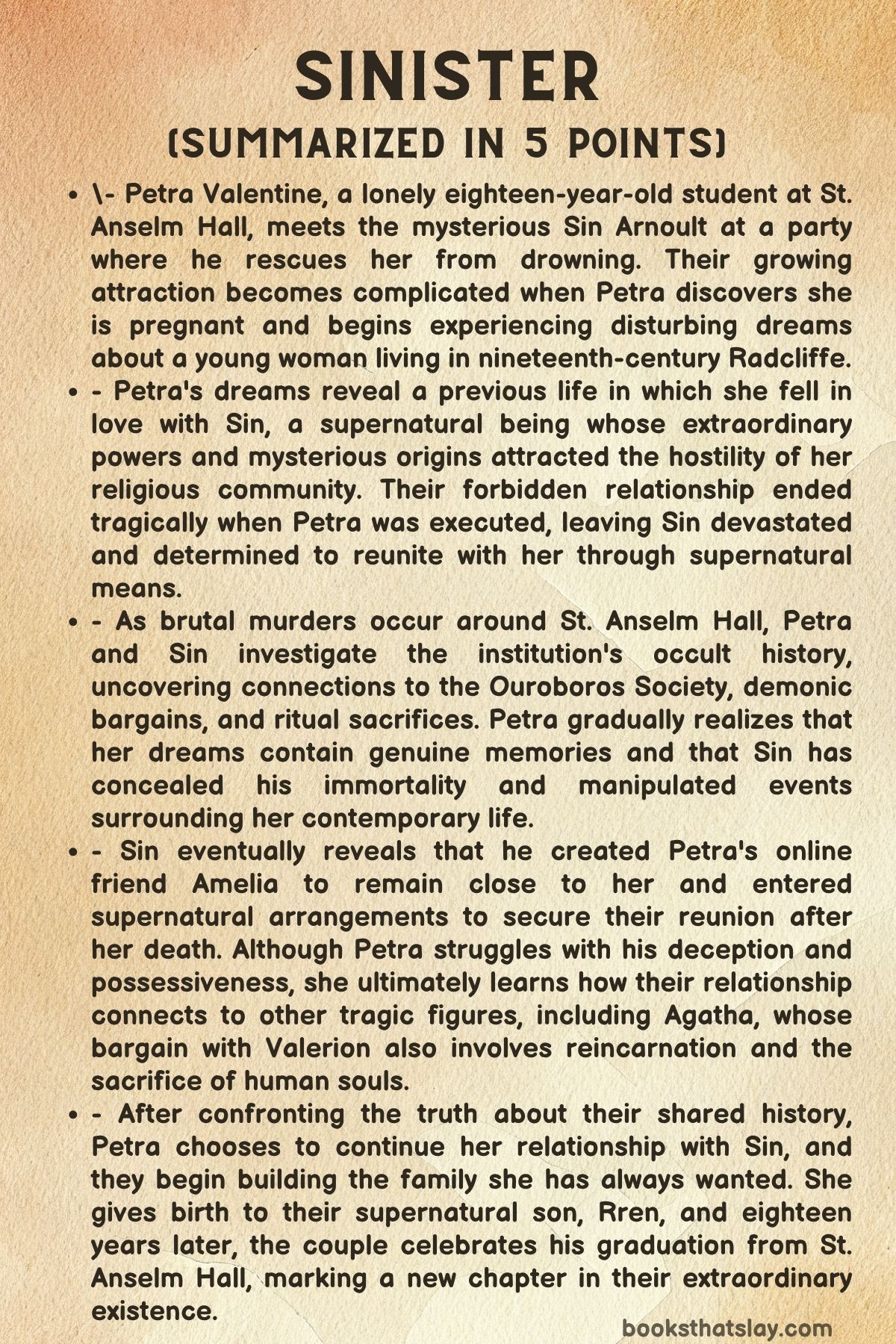
Summary
Thirty years before the main events, St. Anselm Hall reopens as an exclusive private school in Radcliffe. The institution was previously a prestigious university, but it closed in 1896 after more than twenty students died in circumstances associated with occult rituals.
Although the school’s administrators insist that its supernatural history belongs to the past, members of Radcliffe’s Reformationist religious community remain suspicious. Their ancestors helped shut down the university, and the conflict between the institution and the town’s religious population has never entirely disappeared.
In the present, Petra Valentine attends a party at Elias Rutherford’s mansion on her eighteenth birthday. Her wealthy but emotionally distant parents have forgotten the occasion, leaving her desperate for companionship.
At the party, Petra encounters Sin Arnoult, a popular and attractive student who treats her with unexpected kindness. Their conversation offers relief from the hostility she regularly experiences from Daphne, Lenora, François, and other classmates.
However, the evening takes a frightening turn when an unidentified person pushes Petra into the swimming pool. Sin rescues her and takes her upstairs to recover.
As they talk, Petra reveals her loneliness, her passion for graphic design, and her close friendship with an online companion named Amelia. Sin listens attentively, and their growing attraction leads to physical intimacy.
Petra eventually loses consciousness during their encounter, leaving her with incomplete memories of the night. Two and a half months later, she begins experiencing exhaustion, unusual physical symptoms, and disturbing dreams.
The dreams transport her to 1896, where another Petra lives under the oppressive authority of a strict religious community. This historical Petra secretly encounters a mysterious professor associated with St. Anselm Hall.
The stranger encourages her intellectual independence by giving her forbidden books. When her father discovers one of them, he brutally punishes her, reinforcing her resentment toward the religious restrictions governing her life.
Despite the danger, the historical Petra continues exchanging letters with the stranger. She eventually learns that he studies demonology and possesses unusual abilities.
Their relationship grows increasingly intimate, but his disturbing behavior makes her question his identity. He demonstrates impossible knowledge of her private actions and offers supernatural protection that she cannot fully understand.
Meanwhile, the contemporary Petra discovers that she is pregnant. Believing Sin is the father, she struggles to reconcile the pregnancy with her educational ambitions and her uncertainty about their relationship.
She arranges a private meeting with him but initially cannot bring herself to reveal the news. Sin expresses genuine interest in continuing their relationship, although his increasingly possessive behavior sometimes frightens her.
The situation becomes more complicated when fellow student Edwin Greenfield is murdered. Petra is questioned by investigators Fiona and Phil, and the violence appears disturbingly similar to the historical events in her dreams.
Sin eventually leads Petra into hidden passages beneath St. Anselm Hall. There, he introduces her to the legend of a secret society whose members supposedly obtained wealth and influence through demonic bargains.
According to the legend, the society’s descendants must continue making sacrifices to preserve their inherited privileges. Petra begins suspecting that the recent murders may represent the continuation of these rituals.
As their investigation develops, Petra grows closer to Sin. However, their relationship suffers another devastating setback during the school ball, where a humiliating video involving Petra is publicly displayed.
The evening becomes even more horrifying when Harry, a kind student who has shown romantic interest in her, is killed. Petra is overwhelmed by grief and begins questioning whether her association with Sin has exposed her to danger.
Sin’s jealousy creates further conflict. When he discovers Petra’s pregnancy, she falsely claims that another man is the father, hoping to discourage his pursuit.
His reaction reveals that he has secretly interfered with her interactions with other boys. Frightened by his controlling behavior, Petra attempts to distance herself.
Meanwhile, her historical visions reveal the growing intimacy between her earlier self and the mysterious professor. The man describes his miserable childhood in an orphanage and a supernatural encounter that changed his existence.
The historical Petra gradually discovers that he possesses extraordinary abilities and has participated in transactions involving human souls. Although she sympathizes with his suffering, she fears the moral consequences of his supernatural arrangements.
Their relationship becomes bound by a ritual involving blood and matching markings. The symbols suggest that their attachment may survive death itself.
The historical storyline also introduces Snowden, a wealthy and dangerous man connected to St. Anselm Hall’s occult society. His daughter Leah becomes pregnant through a forbidden relationship with Sinclair Arnoult.
When Snowden discovers the pregnancy, he murders Leah. The tragedy provokes a confrontation in which Petra kills Snowden while attempting to protect Sin.
Sin is seriously injured, and the events set in motion a devastating chain of consequences. After he leaves to assist someone affected by the tragedy, Petra’s father discovers her forbidden relationship.
Accusing his daughter of associating with the devil, he subjects her to extreme violence. She is subsequently condemned by her religious community and burned at the stake.
As she dies, Petra desperately hopes that Sin will rescue her. His failure to arrive leaves her believing that he has abandoned her.
In the present, these memories become increasingly vivid. Petra discovers that the supernatural marking from her dreams has appeared on her own body.
She also encounters historical photographs, documents, and preserved rooms suggesting that Sin has maintained a connection to the nineteenth-century events. The evidence leads her to consider that he may be immortal rather than merely descended from the original man.
Their investigation uncovers references to the Ouroboros Society and a prophecy concerning Arnoult’s return during a blood moon. Petra suspects that the contemporary murders are connected to an attempt to resurrect someone from the past.
At the same time, her pregnancy develops in increasingly unusual ways. During a medical examination, the building shakes, equipment malfunctions, and Petra experiences frightening physical symptoms.
The events suggest that her unborn child possesses supernatural characteristics. Sin’s reassurances offer temporary comfort, but Petra becomes increasingly determined to uncover the truth about him.
Their visit to an old mausoleum results in another terrifying confrontation when religious extremists surround the building and set it on fire. Sin guides Petra through hidden passages into an underground residence containing objects connected to her historical memories.
The discoveries convince her that their apparent first meeting was not accidental. She begins suspecting that Sin has influenced her life for years, arranging circumstances that brought them together.
Eventually, she learns an even more devastating truth about Amelia, the online friend who supported her throughout her lonely adolescence.
Amelia never existed as an independent person. Sin created the identity to communicate with Petra after her reincarnation, allowing him to remain close to her before their romantic relationship resumed.
Petra is horrified that the person she trusted most has secretly controlled such an important part of her emotional life. Nevertheless, she recognizes that the encouragement she received was meaningful, even though the deception fundamentally changes her understanding of it.
Sin finally explains his past. His original name was Sin Kimaris, and he grew up rejected because of his unusual supernatural nature.
He reveals that he genuinely loved Petra in 1896 and attempted to rescue her from execution. However, he arrived too late and found her already dead.
Unable to accept losing her, he entered supernatural arrangements intended to restore their relationship. These bargains involved the deaths of numerous people and helped establish the circumstances surrounding her eventual reincarnation.
Petra realizes that Sin’s devotion is both sincere and morally disturbing. She asks for time to consider whether she can accept a relationship founded on such extensive manipulation and suffering.
Another historical narrative reveals the experiences of Agatha, a woman who lost her beloved Elroy and their child, Plum. Seeking relief from grief, she entered St. Anselm Convent and became Sister Agatha.
During her religious life, Agatha encountered Valerion, a powerful supernatural being whose ancestry included demonic and divine origins. He offered to reunite her with her lost family through reincarnation.
The arrangement required Agatha to deliver five evil souls. She accepted, establishing another supernatural bargain that would eventually become connected to the contemporary violence.
The different arrangements converge when Petra awakens inside a dark underground chamber and discovers a mutilated corpse. Detective Fiona appears and treats her as a murderer.
Petra attempts to escape, but Fiona pursues her through the passages and fires at her. Their confrontation reveals that the detective possesses knowledge connected to the historical supernatural arrangements.
After the violent encounter, Sin and Valerion appear. Valerion congratulates Agatha for completing her agreement, exposing the larger connection between the murders, reincarnation, and the recovery of lost loved ones.
Petra finally understands that her life has been shaped by supernatural bargains extending across centuries. Sin’s actions were intended to restore their relationship after the tragedy that separated them, although his methods involved terrible consequences.
Despite her reservations, Petra ultimately chooses to build a future with him. Their reconciliation allows her to contemplate motherhood and the possibility of creating the loving family she has always wanted.
Four months later, Petra’s parents have become more involved in her life, acknowledging the emotional neglect that defined her childhood. Her pregnancy continues beyond the expected delivery date, creating further concerns about the baby’s unusual nature.
Eventually, she gives birth to a son named Rren. The child inherits extraordinary abilities, including fangs and an unusual need for blood.
Eighteen years later, Petra and Sin attend Rren’s graduation from St. Anselm Hall. Their supernatural nature has preserved their youthful appearances, allowing them to disguise themselves as fellow students.
Although Rren’s emerging powers create new complications, his parents celebrate his achievement. Petra reflects on the extraordinary family she has built, recognizing that her life has moved far beyond the loneliness and uncertainty of her adolescence.
The novel concludes with Petra, Sin, and Rren facing an unpredictable future together, their enduring family connection offering a sense of belonging despite the supernatural dangers that remain.
Characters
Petra Valentine
Petra Valentine is the central protagonist of Sinister, a young woman whose emotional isolation makes her particularly vulnerable to both genuine affection and manipulation. Her transformation from an insecure teenager into someone capable of confronting supernatural truths gives the novel its central emotional direction.
At eighteen, Petra possesses considerable material privilege but experiences little emotional security. Her parents’ professional ambitions have created a household in which financial comfort substitutes for companionship, leaving her feeling unwanted despite her family’s wealth.
Her passion for graphic design reveals an independent identity that exists beyond her social difficulties. Unlike the people who expect her to follow a conventional path, Petra wants to pursue a future shaped by her creativity and personal interests.
Her relationship with Sin initially appears to offer everything she has been missing. He appreciates her intelligence, encourages her artistic ambitions, and provides the attention she has rarely received from others.
However, Petra gradually discovers that affection does not necessarily guarantee emotional safety. Sin’s possessiveness, secrecy, and interference with her relationships force her to confront the difference between feeling loved and retaining control over her own life.
Her pregnancy intensifies this conflict because she must consider responsibilities extending beyond her immediate emotional needs. Her fear of disappointing her parents and losing her independence reflects the difficult transition from adolescence into adulthood.
The historical visions also transform her understanding of herself. Discovering that she may have lived before forces Petra to question whether her present identity can exist independently of experiences she cannot remember.
One of her defining qualities is her determination to investigate the truth, even when it threatens the relationship she most wants to preserve. Her willingness to confront Sin demonstrates that her affection does not completely eliminate her capacity for independent judgment.
By the conclusion, Petra accepts the extraordinary circumstances surrounding her existence and chooses to establish a family with Sin. Her development illustrates the complicated relationship between emotional belonging, personal freedom, and the consequences of decisions made under supernatural influence.
Sin Arnoult / Sin Kimaris
Sin is the mysterious romantic protagonist whose supernatural existence connects the historical and contemporary narratives. His character embodies the contradictions between tenderness and cruelty, devotion and possession, and the desire for companionship and the willingness to control others.
Initially presented as a handsome, popular student, Sin possesses an effortless confidence that attracts Petra. His ability to recognize her loneliness and appreciate her artistic interests distinguishes him from the classmates who routinely mistreat her.
His background gradually reveals a considerably more complicated figure. Born with an unusual supernatural nature, he grew up in an orphanage where rejection and cruelty convinced him that he did not belong among ordinary people.
His suffering culminated in a suicide attempt during adolescence. A supernatural encounter subsequently changed his existence and introduced him to powers that could overcome ordinary human limitations.
This history explains much of his desperate attachment to Petra. Having experienced profound loneliness, he identifies her acceptance as the fulfillment of a desire he has carried throughout his life.
Nevertheless, Sinister does not present his devotion as uncomplicated affection. Sin repeatedly crosses personal boundaries, interferes with Petra’s relationships, and conceals information that would allow her to make fully informed decisions.
His creation of Amelia’s online identity represents one of his most consequential deceptions. Through that persona, he becomes Petra’s closest confidant while concealing his involvement in her life.
His immortality also changes the moral scale of his actions. While Petra experiences their relationship as something new, Sin approaches it with the memories and expectations of an attachment established more than a century earlier.
His grief over the historical Petra’s execution provides the emotional foundation for his supernatural bargains. Yet his willingness to sacrifice other people demonstrates how profoundly his desire for reunion has distorted his moral boundaries.
Sin remains capable of genuine tenderness, particularly in his concern for Petra’s pregnancy and his desire to create a loving family. His character ultimately illustrates how the fear of abandonment can produce both extraordinary loyalty and dangerous possessiveness.
The Historical Petra
The nineteenth-century Petra functions as both a distinct historical character and an earlier existence of the contemporary protagonist. Her experiences reveal the origins of the supernatural connection governing the present-day romance.
Raised within a restrictive religious community, she lives under the authority of a violent father who controls her reading, movements, and personal relationships. Her outward obedience conceals an intense curiosity about the world beyond her household.
Books become instruments of intellectual independence. Her willingness to accept forbidden reading material demonstrates a determination to develop her own understanding of the world, even when doing so exposes her to punishment.
Her relationship with Sin introduces a possibility of freedom that she has never previously experienced. He recognizes her individuality and encourages her to challenge the restrictions imposed by her family.
However, the alternative he offers also carries dangers. His supernatural abilities, unsettling gifts, and insistence on an enduring bond reveal that escaping one controlling environment does not necessarily guarantee complete independence.
Her willingness to warn Sin about the religious community’s plans demonstrates considerable courage. She risks punishment because she cannot ignore the possibility that someone she cares about may be harmed.
Her decision to kill Snowden while protecting Sin represents a decisive rejection of the passive role assigned to her. For the first time, she acts directly against a powerful man rather than surrendering to his authority.
Her eventual execution exposes the brutality of a community that claims moral righteousness while practicing extreme cruelty. Her final belief that Sin has abandoned her makes the tragedy particularly devastating because the person who represented freedom appears absent when she needs him most.
In Sinister, her fate establishes the emotional and supernatural circumstances surrounding the contemporary relationship. Her suffering becomes the event that motivates Sin’s centuries-long determination to restore their connection.
Amelia
Amelia initially appears to be Petra’s closest friend and most dependable emotional companion. Their online friendship provides a space where Petra can discuss her loneliness, ambitions, and personal difficulties without fearing the judgment she encounters at school.
Her encouragement of Petra’s interest in graphic design makes her particularly important. While Petra’s parents fail to understand her creative aspirations, Amelia offers the consistent support that helps her preserve confidence in her abilities.
The revelation that Amelia is actually an identity created by Sin transforms the character’s significance. What appeared to be an independent friendship becomes evidence of Sin’s extensive involvement in Petra’s life.
This deception raises difficult questions about the authenticity of their emotional connection. Petra’s conversations with Amelia were meaningful to her, but their foundation depended on concealing the identity of the person offering support.
Amelia therefore functions as both a source of comfort and an instrument of manipulation. The character’s significance lies in demonstrating how emotional intimacy can be genuine in its effects while remaining compromised by dishonesty.
Harry
Harry represents an alternative form of companionship in Petra’s contemporary life. His kindness and apparent romantic interest contrast with the intensity and unpredictability of her relationship with Sin.
He approaches Petra without the same possessive behavior that frequently characterizes Sin’s interactions. His invitation to the school ball suggests the possibility of an ordinary teenage romance, free from supernatural bargains and historical obligations.
His presence also exposes Sin’s jealousy. Petra’s interactions with Harry become another opportunity for Sin to demonstrate his desire to control her social relationships.
Harry’s murder during the school ball abruptly destroys the possibility of exploring their connection further. The tragedy leaves Petra questioning whether choosing a different romantic companion might have changed the outcome.
His death is important because it demonstrates that the dangers surrounding Petra are not confined to her private relationship. Other young people become casualties of the larger conflict, regardless of how much they understand about its origins.
Harry also represents the ordinary adolescence Petra is repeatedly denied. His loss reinforces the contrast between the relatively normal life she desires and the violent supernatural reality surrounding her.
Daphne
Daphne is one of Petra’s principal social antagonists. Her behavior reflects the cruelty and exclusion that have made Petra’s school experience so difficult.
She repeatedly exploits Petra’s isolation, often acting alongside Lenora and François. Her hostility is particularly damaging because Petra already struggles with insecurity and lacks dependable support within her immediate social environment.
Daphne also appears during moments when Petra is exceptionally vulnerable. Her comments about Petra’s physical condition threaten to expose the pregnancy before Petra is prepared to discuss it.
Her function extends beyond ordinary school bullying. She represents a social environment in which private suffering becomes a source of entertainment and humiliation.
The incident in which Daphne falls into François’s grave introduces a darker dimension to her role. Petra suspects that Sin may have caused the accident, suggesting that Daphne’s cruelty could expose her to supernatural retaliation.
Although Daphne’s behavior is often malicious, the possibility of violent punishment raises questions about proportionality and revenge. Her character helps demonstrate how everyday social aggression becomes entangled with the novel’s larger atmosphere of supernatural violence.
François
François belongs to the group of students responsible for making Petra’s school life miserable. His treatment of her contributes to the social environment in which humiliation and cruelty are normalized.
His involvement in the disturbing video that circulates among the students makes him especially significant. The footage becomes a means of attacking Petra’s reputation and exposing her to public judgment.
His eventual death transforms him from an antagonist into another casualty of the violence affecting Radcliffe. The subsequent funeral demonstrates how the murders have disrupted the entire school community.
François illustrates the distinction between personal wrongdoing and the much larger consequences produced by supernatural revenge. His cruelty contributes to Petra’s suffering, but his death also reveals the horrifying scale of the conflict surrounding her.
Lenora
Lenora is another member of Daphne’s social circle and participates in the hostility directed toward Petra. Although she receives less individual development than the principal characters, her presence reinforces the collective nature of Petra’s exclusion.
Her association with Daphne and François demonstrates how cruelty becomes more effective when several people participate. Their behavior leaves Petra facing not merely individual insults but an entire social group that treats her as an acceptable target.
Lenora’s role also emphasizes the importance of conformity within the school’s social hierarchy. By participating in the group’s treatment of Petra, she helps preserve a system in which popularity provides protection while isolation invites ridicule.
Elias Rutherford
Elias Rutherford is a wealthy student whose mansion provides the setting for Petra’s eighteenth-birthday party. His social position places him among the privileged families associated with Radcliffe and St. Anselm Hall.
The events at his party initiate several of the novel’s central conflicts. Petra’s encounter with Sin, the swimming-pool attack, and the circumstances surrounding her pregnancy all originate during the celebration.
Elias also provides a connection to the Rutherford family’s history. His nineteenth-century predecessor, Joseph Rutherford, was an influential industrialist and financial supporter of St. Anselm Hall University.
Joseph’s murder reveals that the family’s involvement with the institution extends beyond contemporary social prestige. The historical relationship between wealth and occult activity makes the Rutherford name significant within the investigation.
Elias therefore helps connect Radcliffe’s modern elite with the powerful families whose activities shaped the town’s supernatural history.
Sinclair Arnoult
Sinclair Arnoult is a significant figure in the historical narrative, particularly through his association with the Ouroboros Society and his relationship with Leah Snowden.
His academic reputation attracts both admiration and suspicion. Accusations involving demonology, occult gatherings, and supernatural communication make him a central figure in the controversy surrounding St. Anselm Hall.
His relationship with Leah creates a conflict involving her father, whose reaction to the pregnancy proves devastating. Snowden’s murder of his daughter reveals the extreme consequences of the secret relationships and rivalries within Radcliffe’s influential families.
Arnoult’s grief subsequently becomes connected to the possibility of resurrection. His suffering demonstrates how the supernatural pursuit of reunion can emerge from an inability to accept death.
The distinction between Arnoult and Sin Kimaris becomes important as Petra uncovers the concealed identities and relationships within the historical events. Their association contributes to her uncertainty about the true origins of the supernatural arrangements.
Arnoult represents the connection between forbidden scholarship, personal tragedy, and the attempt to use extraordinary powers to reverse irreversible loss.
Leah Snowden
Leah is a tragic historical character whose pregnancy exposes the violent expectations imposed on women by powerful families. Her relationship with Sinclair Arnoult places her in direct conflict with her father’s authority.
Her circumstances mirror elements of the contemporary Petra’s experience. Both young women face pregnancy while navigating complicated romantic relationships and fearing the consequences of public discovery.
However, Leah’s situation is particularly dangerous because her father considers her choices a betrayal of his interests. His reaction demonstrates that family reputation and personal power matter more to him than his daughter’s welfare.
Her murder becomes a turning point in the historical conflict. It provokes grief, retaliation, and further violence, ultimately contributing to the events that lead to Petra’s execution.
Leah’s importance extends beyond her death. Her story reveals how the supernatural history of Radcliffe is shaped not only by occult ambitions but also by ordinary human possessiveness and patriarchal control.
Snowden
Snowden is a wealthy and influential antagonist whose respectable public position conceals a capacity for extreme violence. His connections to St. Anselm Hall’s occult community establish him as an important participant in the historical conflict.
His treatment of Leah reveals the depth of his cruelty. Rather than recognizing her autonomy, he treats her forbidden relationship and pregnancy as offenses against his authority.
His decision to murder his daughter demonstrates how completely his desire for control overrides parental affection. The act also exposes the hypocrisy of Radcliffe’s powerful families, whose outward respectability conceals disturbing private conduct.
Snowden’s supernatural resources make him particularly dangerous. His confrontation with Sin demonstrates that the conflict involves competing powers rather than a straightforward struggle between ordinary people and supernatural beings.
His eventual death at Petra’s hands represents a decisive moment in her rebellion against oppressive authority. However, killing him does not immediately end the danger because the secrets he has exposed continue affecting the surviving characters.
Snowden is important because his actions demonstrate that human cruelty can be as destructive as supernatural evil.
Petra’s Father
The historical Petra’s father represents the most oppressive aspects of Radcliffe’s religious community. His authority over his household is absolute, and he uses violence to enforce obedience.
His punishment of Petra for reading forbidden material demonstrates that intellectual curiosity is treated as a threat. He regards independent thought as disobedience rather than a natural part of his daughter’s development.
His relationship with religious authority allows him to justify cruelty through moral language. The contrast between his professed beliefs and his treatment of Petra exposes the hypocrisy underlying his conduct.
His most devastating action occurs when he participates in her condemnation and execution. Instead of protecting his daughter, he permits the community to destroy her because she has violated its religious expectations.
The character demonstrates how ideological certainty can become dangerous when combined with unchecked personal power. His conduct turns the family, which should provide protection, into the institution responsible for Petra’s destruction.
Petra’s Mother
The contemporary Petra’s mother initially appears emotionally unavailable because of her demanding professional life. Alongside her husband, she has prioritized financial success over sustained involvement in their daughter’s upbringing.
Her failure to remember Petra’s eighteenth birthday illustrates the distance within their family. Although she provides material comfort, she has not recognized the emotional consequences of her absence.
Her later apology introduces a more complicated understanding of her behavior. She explains that becoming a parent while financially insecure encouraged her and her husband to pursue professional success aggressively.
Their intentions were connected to providing Petra with a better future, but their methods deprived her of the companionship she needed. This distinction allows the novel to explore parental neglect without presenting every failure as evidence of deliberate cruelty.
Her willingness to acknowledge these mistakes creates the possibility of reconciliation. As Petra approaches motherhood, her parents become more involved in her life and begin providing the emotional support previously missing.
Her development demonstrates that family relationships can change when people recognize the consequences of their choices and act differently.
Petra’s Father in the Present
Petra’s contemporary father shares responsibility for the emotional neglect defining her childhood. His professional commitments have contributed to a household where financial achievement receives greater attention than personal connection.
Unlike the historical father, however, his failures arise from misguided priorities rather than overt religious violence. This distinction is important because it demonstrates that Petra’s different lives contain related emotional difficulties without reproducing identical family circumstances.
His eventual attempts to repair their relationship suggest that he is capable of recognizing his mistakes. By becoming more involved in Petra’s life, he begins offering the affection that she previously sought almost exclusively from others.
His changing behavior contributes to the more stable family environment surrounding the birth of Petra’s son.
Tom, Lisa, and Marie Arnoult
Tom, Lisa, and Marie constitute Sin’s contemporary family. Their welcoming treatment of Petra provides an important contrast to her experience of emotional distance within her own household.
Tom and Lisa receive Petra warmly, while Marie participates in the family’s relaxed and affectionate interactions. Their ordinary exchanges reveal a side of Sin that Petra has rarely encountered at school.
The household’s atmosphere demonstrates that family intimacy need not depend on formality, wealth, or rigid expectations. Petra is surprised by how naturally the Arnoults express their affection for one another.
Their presence also strengthens her desire to establish a family of her own. By observing the warmth surrounding Sin, she begins imagining that motherhood might offer an opportunity to create the emotional belonging she has always wanted.
Sister Agatha
Sister Agatha is one of the novel’s most consequential historical figures because her supernatural bargain establishes an important connection between personal grief and the contemporary murders.
Before entering religious life, she experienced devastating losses involving her beloved Elroy and their child, Plum. Her decision to enter St. Anselm Convent represents an attempt to find stability after those tragedies.
Religious devotion does not eliminate her longing for reunion. Her grief continues shaping her decisions, eventually making Valerion’s supernatural offer extraordinarily tempting.
Her experience with demonic possession demonstrates considerable courage. She confronts dangerous supernatural circumstances even after conventional religious methods fail and Father Benedict is killed.
However, her willingness to provide five evil souls in exchange for recovering her family introduces a serious moral contradiction. She accepts an arrangement that treats the deaths of other people as the price of fulfilling her deepest desire.
Agatha’s motivations resemble Sin’s in their emotional foundation. Both characters experience profound loss and pursue extraordinary means of restoring the relationships that gave their lives meaning.
Her actions demonstrate how grief can become destructive when the desire for reunion overrides ethical limitations. The eventual fulfillment of her bargain reveals that the contemporary violence belongs to a much longer history of supernatural transactions.
Valerion
Valerion is an exceptionally powerful supernatural being whose existence challenges the distinction between divine and demonic identities. His unusual ancestry gives him abilities beyond those of ordinary demons.
His introduction occurs when Sister Agatha’s convent faces a dangerous possession. Conventional religious intervention has failed, but Valerion demonstrates the power to confront the entity and resolve the immediate crisis.
His apparent immortality becomes evident as Agatha observes that his appearance remains unchanged over decades. His extraordinary nature gradually establishes him as someone operating beyond ordinary human experience.
Valerion’s most consequential role is that of a supernatural intermediary. He offers Agatha the possibility of recovering her lost family in exchange for five evil souls.
The bargain demonstrates his ability to manipulate the boundaries between life, death, and reincarnation. Yet it also reveals a transactional approach to human suffering.
Valerion’s appearance during the contemporary confrontation exposes the connections between the historical arrangements and Petra’s circumstances. In Sinister, he represents a supernatural order in which extraordinary possibilities remain subject to conditions and costs.
Detective Fiona
Detective Fiona initially appears to represent the ordinary legal investigation into Radcliffe’s murders. Alongside Phil, she questions Petra about Edwin Greenfield’s death.
Her professional position makes her presence particularly unsettling when Petra later encounters her in the underground chamber. Instead of providing protection, Fiona treats Petra as a suspect and attempts to restrain her.
The confrontation reveals that Fiona possesses knowledge extending beyond the contemporary criminal investigation. Her accusations suggest that she understands aspects of the historical supernatural arrangements.
Her connection to Agatha’s storyline becomes significant as the different narratives converge. The relationship between past and present complicates Petra’s understanding of Fiona’s motives.
Fiona’s pursuit of Petra also challenges the assumption that institutional authority guarantees safety. The person apparently responsible for investigating violence becomes a direct source of danger.
Her role demonstrates how the supernatural conflict has affected institutions that outwardly operate according to ordinary social rules.
Detective Phil
Phil works alongside Fiona during the investigation into Edwin Greenfield’s murder. His involvement establishes the presence of conventional law enforcement within the increasingly supernatural circumstances surrounding St. Anselm Hall.
Although he receives less individual development, his participation in questioning Petra reinforces the seriousness of the contemporary murders. The investigation places additional pressure on a protagonist already struggling with pregnancy, social isolation, and disturbing visions.
Phil’s role helps establish the contrast between ordinary investigative methods and the extraordinary forces ultimately revealed to be operating in Radcliffe.
Principal Rhodes
Principal Rhodes represents the administrative authority of St. Anselm Hall. His responsibility for cooperating with investigators becomes important after Edwin Greenfield’s murder.
His decision to summon Petra for questioning places her under additional scrutiny. Although he is fulfilling an institutional obligation, the encounter increases her sense of vulnerability.
Rhodes also embodies the school’s attempt to maintain normal operations despite its disturbing history and contemporary violence. His presence reinforces the contrast between the institution’s prestigious public image and the dangerous events occurring within its walls.
Ms. Matthews
Ms. Matthews is a member of the school staff whose involvement in Petra’s academic arrangements becomes relevant to her relationship with Sin. Petra considers approaching her to request a different academic partner.
Although her role is limited, she represents the ordinary educational structure that Petra attempts to preserve while her personal life becomes increasingly unstable.
Her presence reminds readers that Petra remains a student with academic responsibilities and ambitions, even as supernatural events begin dominating her life.
Claire
Claire appears in the historical convent storyline as a young girl suffering from a dangerous supernatural possession. Her condition exposes the limitations of the religious authorities attempting to intervene.
The entity possessing her proves exceptionally powerful, resulting in Father Benedict’s death and leaving the convent unable to resolve the situation through conventional means.
Claire’s circumstances eventually bring Valerion into Agatha’s life. Her importance lies in initiating the encounter that makes Agatha’s later supernatural bargain possible.
Father Benedict
Father Benedict is the priest responsible for attempting to exorcise the entity possessing Claire. His intervention reflects the religious community’s belief that established spiritual practices can overcome supernatural evil.
His death demonstrates that the forces operating within the novel do not necessarily conform to human expectations of religious authority.
The failure of his intervention leaves Agatha desperate for another solution, creating the circumstances in which Valerion’s assistance becomes possible.
Elroy and Plum
Elroy and Plum are Agatha’s lost loved ones, whose deaths establish the emotional motivation for her supernatural bargain. Elroy was her beloved, while Plum was their child.
Although their direct involvement in the contemporary narrative is limited, their absence determines many of Agatha’s subsequent decisions. Her inability to accept permanent separation leads her into religious life and eventually toward Valerion.
They represent the family she hopes to recover, transforming the abstract possibility of reincarnation into a deeply personal objective.
Their importance lies in demonstrating how the loss of loved ones can continue affecting events long after the original tragedy.
Rren
Rren is Petra and Sin’s son, whose birth marks the beginning of their shared family life. His existence gives tangible form to the companionship and belonging that both parents have sought.
His supernatural inheritance becomes apparent immediately after his birth. His fangs, unusual need for blood, and extraordinary abilities demonstrate that he occupies a position between ordinary humanity and his father’s supernatural existence.
As he grows older, his parents attempt to provide him with a relatively normal upbringing. Their restrictions on certain activities reflect the difficulty of raising a child whose abilities exceed those of his peers.
His graduation from St. Anselm Hall offers a meaningful contrast to Petra’s experiences at the same institution. Where she encountered loneliness and violence, Rren reaches an important milestone surrounded by parental affection.
His later sensitivity to sunlight introduces uncertainty about his developing nature. Even Sin’s supernatural knowledge cannot immediately resolve every difficulty associated with their son’s inheritance.
Rren represents both the fulfillment of his parents’ desire for family and the beginning of a new set of supernatural questions. His character allows the novel to conclude with continuity and the possibility of further transformation.
Themes
1. Obsessive Love and the Boundaries of Personal Freedom
Sin’s devotion to Petra transforms romantic attachment into a force capable of crossing ordinary boundaries of time, identity, and personal autonomy. His refusal to accept her historical death motivates supernatural bargains that eventually allow their relationship to continue in another lifetime.
His determination initially appears connected to understandable emotional needs. Having experienced rejection throughout his childhood, he regards Petra’s acceptance as the foundation of the home and companionship he has always desired.
However, his desire to preserve their relationship frequently conflicts with Petra’s independence. He interferes with her interactions with other boys, withholds essential information, and secretly communicates with her through Amelia’s invented identity.
These actions establish a distinction between emotional devotion and possessive control. Sin genuinely cares about Petra, but his affection repeatedly becomes an attempt to determine the circumstances of her existence.
The revelation that he has influenced her life since childhood makes this contradiction particularly significant. Petra must consider whether her feelings developed independently or were shaped by someone who possessed extraordinary knowledge of her previous existence.
Sinister explores this tension without separating romantic tenderness from its darker consequences. The same character who encourages Petra’s artistic ambitions also manipulates her emotional relationships and conceals information about her identity.
Petra’s eventual acceptance of Sin does not erase these contradictions. Rather, their relationship demonstrates how powerful attachment can involve affection, dependence, forgiveness, and serious questions about consent.
The supernatural dimension intensifies these concerns because an immortal lover possesses advantages that an ordinary human partner cannot match. Sin’s knowledge of the past and his ability to influence events create an imbalance that Petra must gradually recognize.
Through their relationship, the novel examines the difficulty of distinguishing unconditional devotion from the desire to possess another person permanently.
2. Religious Authority, Hypocrisy, and the Abuse of Power
The religious community of nineteenth-century Radcliffe exercises control over nearly every aspect of Petra’s existence. Its restrictions govern her reading, clothing, movements, relationships, and understanding of morality.
Her father uses religious principles to justify extreme violence. When Petra reads forbidden material, he punishes her physically rather than attempting to understand her curiosity or intellectual interests.
This treatment exposes the difference between publicly proclaimed moral values and private conduct. The community preaches forgiveness and righteousness while permitting cruelty within families and supporting the persecution of people accused of supernatural associations.
The conflict surrounding St. Anselm Hall extends this contradiction into public life. The religious population regards the university’s occult activities as a threat, yet its response frequently involves intimidation, violence, and collective punishment.
Petra’s execution represents the most devastating expression of this abuse of authority. Her father and the surrounding community transform her relationship with Sin into justification for destroying her.
The historical newspaper accounts reinforce the criticism by presenting her death through the language of religious condemnation. Rather than recognizing the execution as an act of cruelty, public discussion focuses on her supposed association with demonic forces.
The contemporary attack on Arnoult’s mausoleum demonstrates that these patterns have survived across generations. Religious extremists attempt to destroy the tomb and its occupants, reproducing the violence that characterized the historical conflict.
At the same time, the novel does not establish that supernatural dangers are imaginary. Occult rituals, demonic bargains, and unnatural violence genuinely exist within its fictional world.
This complexity distinguishes the existence of supernatural threats from the justification of indiscriminate persecution. The presence of dangerous forces does not make every accusation accurate or every violent response morally defensible.
The theme ultimately concerns the corruption of authority when fear and ideological certainty replace compassion, evidence, and individual judgment.
3. Grief, Reincarnation, and the Refusal to Accept Death
Death repeatedly separates characters from the people who provide meaning to their lives. Rather than accepting those losses, several individuals pursue supernatural arrangements intended to restore relationships that ordinary human existence cannot preserve.
Sin’s response to Petra’s execution establishes the central expression of this theme. His inability to save her becomes a defining trauma, motivating centuries of supernatural intervention.
His grief is intensified by the circumstances of her death. Petra dies believing that he has abandoned her, while Sin arrives too late to prevent the tragedy.
The supernatural possibility of reincarnation offers him a way to challenge that separation. Yet recovering Petra requires arrangements involving other people’s lives, transforming his personal suffering into a source of wider violence.
Agatha’s experiences establish a parallel narrative. Following the deaths of Elroy and Plum, she enters religious life in an attempt to manage her grief.
Her spiritual commitments do not eliminate her longing for her family. When Valerion offers the possibility of reunion, she accepts a bargain requiring five evil souls.
Both characters demonstrate how grief can alter ethical judgment. Their desires are rooted in recognizable human suffering, but their supernatural solutions involve consequences extending far beyond themselves.
Sinister also considers whether reunion can restore the relationship that originally existed. Petra’s reincarnation does not initially provide her with memories of her historical life, meaning that Sin approaches her with an understanding she does not share.
Her identity has changed through a different childhood, family, and set of experiences. The return of her earlier memories complicates the distinction between recovering someone who died and establishing a new relationship with someone who possesses a separate existence.
Reincarnation therefore becomes more than a mechanism for reversing death. It raises questions about personal continuity, emotional obligation, and whether love established in one lifetime should determine the choices made in another.
The eventual birth of Rren provides a different response to mortality and loss. Rather than focusing exclusively on recovering the past, Petra and Sin begin creating a future through their shared family.
4. Identity, Belonging, and the Search for Family
Petra and Sin are connected by a powerful desire to belong somewhere without having to conceal essential parts of themselves. Their circumstances differ considerably, but both experience forms of isolation that shape their understanding of affection.
Petra grows up in a wealthy household where emotional neglect leaves her feeling invisible. Her parents provide financial security but fail to offer the companionship and encouragement she needs.
Sin experiences a more extreme form of rejection. His unusual supernatural nature makes him an object of suspicion during childhood, and the cruelty he encounters convinces him that ordinary society has no place for him.
Their attraction emerges partly from recognizing these vulnerabilities in one another. Sin appreciates Petra’s intelligence and creativity, while Petra responds to his attention and the apparent acceptance he offers.
However, the theme becomes more complicated when Petra discovers that Amelia, her most dependable childhood companion, was actually Sin. The revelation forces her to reconsider a relationship that helped shape her identity.
Her historical memories introduce another dimension to this uncertainty. She must reconcile her contemporary personality with the experiences of a woman who lived more than a century earlier.
The question becomes whether belonging requires accepting a predetermined identity or whether Petra can establish a future through her present choices. Her growing independence suggests that personal identity involves more than inherited memories and supernatural connections.
The reconciliation with her parents offers a significant development. Their acknowledgment of past mistakes allows Petra to experience family affection without depending entirely on Sin.
Her relationship with the Arnoult household provides another example of belonging. The warmth among Tom, Lisa, and Marie introduces her to a family environment characterized by companionship and emotional openness.
The birth of Rren completes this development while introducing new responsibilities. Petra and Sin must create an environment where their son can understand his extraordinary abilities without experiencing the rejection that shaped his father’s childhood.
His graduation illustrates the progress they have made toward this goal. Despite the difficulties associated with his supernatural nature, Rren grows up surrounded by parents who are actively involved in his life.
The concluding family scenes demonstrate that belonging is not simply a matter of finding someone who offers unconditional attachment. It also requires sustained care, mutual recognition, and the willingness to create a home in which individual differences can exist without becoming sources of shame.