Sky Shielder Summary, Characters and Themes
Sky Shielder by Lindsay Buroker is a fantasy adventure with dragons, court politics, survival stakes, and an enemies-to-allies romance that never stops complicating itself. Princess Syla Moonmark is a royal healer who’d rather mend the wounded than play palace games, but her world changes in a single night when dragon riders strike her island home.
With her battered bodyguard at her side and her kingdom’s magical defenses shattered, Syla is pushed into leadership she never wanted. To save everyone left, she must recover a ruined relic, bargain with dangerous dragons, and decide whether the enemy captain who keeps saving her is her greatest threat—or her best chance.
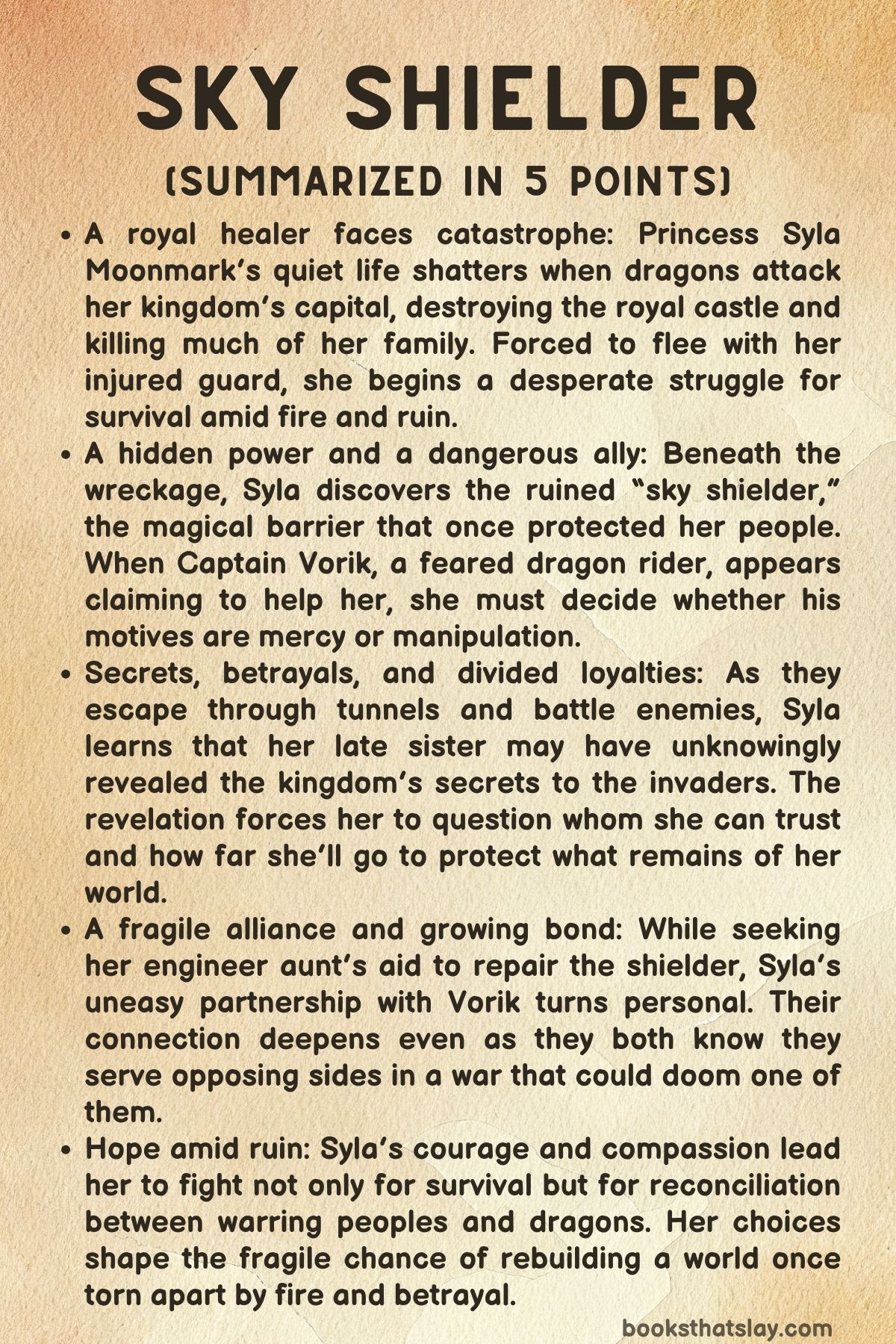
Summary
Princess Syla Moonmark puts off her weekly royal dinner by ducking into an antiques shop, where a strange instrument from an old wreck catches her interest. Her bodyguard, Sergeant Fel, is near retirement and worn down by old injuries, but he snaps to attention when he thinks he sees a dragon flying too low over the city.
Moments later, his fear proves justified. Dragons of many colors circle the castle, raining fire onto towers while defenders answer with arrows, cannons, and crossbows.
Fel drags Syla away from the open streets, insisting she survive first, even as she protests that people need a healer.
Their escape turns into a scramble through smoke and collapsing buildings. A rider targets a cart of kegs that explodes with unnatural force, blasting apart storefronts and setting rooftops alight.
Fel hauls Syla into shelter, but danger follows. In an alley, a large green dragon appears with a rider who stares straight at Syla’s moon-marked hand.
Fel recognizes him as Captain Vorik Wingborn, a notorious dragon rider tied to years of coastal raids. Before Syla and Fel can flee, the dragon’s tail smashes the nearby structure, burying them under rubble.
Syla wakes half-crushed beneath Fel’s weight, fighting for breath and fighting panic when she realizes her spectacles are gone. Nearly blind, she claws herself free and finds Fel badly injured.
She breaks the rules that require consent for healing magic, choosing his life over legality, and uses her moon-mark to mend a skull injury, cracked ribs, and internal bruising while rationing her strength. Looters wander close, sniffing out valuables among the ruins.
Syla tries to defend herself, fails, and blacks out.
When she comes around again, Fel has dealt with the looters and carries her through a city that looks burned out and broken. The healer’s temple has been flattened.
The castle is gutted, bodies lie in the courtyard, and scavenging wyverns circle like they’ve already claimed the place. Syla and Fel reach her old room, strangely intact, where she finds spare spectacles and packs supplies, along with a red glass dragon figurine that feels faintly magical.
The real crisis, though, is bigger than survival: the kingdom’s “shielder,” the protective magic that kept Castle Island safe, has been sabotaged.
Trying to move through the damaged halls, they’re attacked by wyverns. Fel’s mace barely slows them.
Then the green dragon returns, rips open the ceiling, and seizes Syla. Vorik is riding again, calm as if he’s doing her a favor, and he claims he’s taking her somewhere safe.
Syla demands he help Fel first, and the dragon kills the wyverns in the courtyard, buying Fel a chance to regroup. Fel shoots at Vorik, Vorik’s dragon burns the bolt, and Syla uses the chaos to jump off and flee into the wreckage, determined not to become anyone’s prisoner.
Syla searches for hidden access to the tunnels beneath the castle, believing the shielder can be reached from below. In the old royal theater, she reunites with Fel, battered but alive, and together they find the concealed entrance under the stage.
With moon-mark magic, Syla opens trapdoors and leads them down into ancient corridors. There are signs someone is already there: torchlight, open doors, and fresh disturbance in places that should have been sealed for generations.
In the catacombs where the shielder rests, Syla finds a horror she can’t fix. Her sister Venia lies dead, killed with a dagger carved from gargoyle bone.
The shielder itself, once a bright silver orb, is dark and broken, torn open as if something ripped its heart out. Syla senses only the faintest spark of life left within the artifact, enough to suggest it might be repairable if the right expert can be found.
She thinks immediately of her moon-marked aunt, Tibby, an engineer with the skill to rebuild what others call impossible.
Enemies strike before they can retreat. A stormer warrior bursts from hiding, and Fel fights while Syla tries to escape deeper into the tunnels.
When a second attacker appears, Syla throws down her pack as a distraction—only for Vorik to step out of the shadows and kill the stormers with lethal efficiency. Fel wants him dead on principle.
Vorik claims he’s trying to protect Syla and says he belongs to a “Freeborn” faction that opposes the worst of the stormer forces. The story doesn’t erase what Syla saw burning aboveground, but it explains why he moves like someone with his own agenda.
Vorik insists the stormers learned the shielder’s location through Venia, claiming she had secret meetings with a stormer lieutenant named Mavus. Syla refuses to believe her sister would betray their family, yet the evidence in the tunnels makes denial hard to hold.
Vorik offers escape and says he will wait until dawn at the coastal lighthouse. Syla sends him away, choosing duty over trust.
Not long after, loyal soldiers find her and announce the final blow: her mother and siblings are dead or missing, leaving Syla the only royal left. She is now responsible for what remains of the kingdom, whether she feels ready or not.
Alone again, Syla examines the red glass dragon figurine from her father. It flares with warmth and pulls her into a vision through the eyes of a wild red dragon named Wreylith flying above Castle Island.
The dragon senses the intrusion and demands repayment: heal a wound or die for spying. Wreylith soon arrives in person, snatching Syla from the ruined castle and carrying her to the lighthouse—straight to Vorik.
Syla’s priority becomes repairing or replacing a shielder before dragons return in force. Tibby joins them, blunt and furious, urging Syla to poison Vorik.
Syla refuses. She won’t trade her integrity for convenience, especially when Vorik has had plenty of chances to harm her and hasn’t taken them.
Syla heals Wreylith’s injured talon, then tries to bargain for passage to Harvest Island, where another shielder can be found. Wreylith agrees in her own way, grabbing Syla and Tibby and tossing them onto her back.
Vorik follows on his green dragon Agrevlari, surprisingly scooping up Fel so he isn’t left behind.
Other stormer dragons intercept them midair, demanding Syla be surrendered. Wreylith refuses and fights, fire tearing through the sky.
Syla clings on and uses her healing magic to strengthen the dragon when wounds open. Vorik joins the aerial battle, dueling riders and trying to keep enemies from surrounding them.
In the confusion, Wreylith throws Syla and Tibby into the sea to save herself, and Syla nearly drowns. She spots Vorik unconscious in the water and, despite Fel’s protests, drags him toward shore.
Fel helps, grudgingly, and together they haul him inland to a temple.
Vorik is imprisoned, interrogators are coming, and Syla insists on treating his injuries anyway. The bond between them shifts from suspicion to dangerous intimacy.
Vorik admits he is under orders tied to the shielder’s destruction, and Syla admits she can’t stop thinking about him even while she mistrusts him. They spend a night together, and Syla makes a hard choice: she uses sedative-scented candles to put Vorik into deep sleep so she can continue her mission without him stopping her.
Syla, Tibby, and Fel locate a functioning shielder orb on Harvest Island and struggle to move its immense weight to a hidden cove. A fleet waits, and Syla chooses a decoy plan: the shielder is concealed on one ship while she boards another to draw pursuit.
Vorik wakes, realizes he was drugged, and takes to the skies after her anyway. At sea, stormer forces assemble under Vorik’s brother, General Jhiton, who rides a massive black dragon.
Jhiton orders Vorik to destroy the vessel carrying the shielder. Cannons and dragonfire turn the water into chaos.
With ships burning, Syla uses the figurine to reach Wreylith and bargains information about rich prey in exchange for aid. Wreylith arrives with wild dragons, crashing into the stormer formation and ripping apart their control of the battlefield.
Agrevlari, drawn to Wreylith, turns on Jhiton’s dragon, and the fight between the great beasts throws riders and plans into disorder. Syla survives by clinging to Wreylith as the dragon hauls her from the wreckage.
The decoy buys enough time for Tibby’s ship to escape with the real shielder.
Days later, Castle Island raises its defenses again as the replacement shielder is installed. Syla begins the long work of ruling, healing, and rebuilding, knowing her enemies will return.
Wreylith flies overhead one last time to drop the red figurine back into Syla’s hands, as if reminding her that dragons keep their own accounts. Far away, Vorik faces Jhiton, who wants the secret of Syla’s connection to Wreylith.
Vorik accepts his next order, torn between loyalty, fear, and a hunger to see Syla again—because the war isn’t over, and neither is whatever has started between them.
Characters
Princess Syla Moonmark
Princess Syla Moonmark is the emotional and moral core of Sky Shielder, embodying both the fragility and strength of a reluctant heroine thrust into chaos. Born into royalty yet more comfortable as a healer than a ruler, Syla’s character arc evolves from a sheltered princess to a resilient leader.
Her defining trait is compassion — she risks her life repeatedly to heal the wounded, even when the law forbids it without consent. This empathy contrasts sharply with the ruthlessness of the world around her, making her both vulnerable and admirable.
The destruction of her kingdom forces her to abandon passivity, confront grief, and step into authority as the last surviving royal.
Syla’s moral conflict deepens through her interactions with Captain Vorik Wingborn. Despite him being an enemy responsible for much of her suffering, she sees shades of humanity and honor within him.
Their relationship reveals her struggle between duty and desire, trust and self-preservation. Her intelligence is matched by practicality; even when emotionally torn, she uses strategy and foresight — whether by forging alliances or deceiving Vorik with the sedative-laced candles to fulfill her mission.
Syla’s defining moment is her leadership during the reconstruction of the kingdom, where she blends compassion with newfound strength, ultimately embodying hope and continuity in a ravaged world.
Captain Vorik Wingborn
Captain Vorik Wingborn is a study in duality — a fierce warrior bound by loyalty and guilt, and a man torn between duty and love. Introduced as a formidable dragon rider allied with the enemy Stormers, he initially appears as the antagonist who helps destroy Syla’s home.
Yet as the narrative unfolds, his complexity surfaces. Vorik is not a simple villain but a conflicted soldier haunted by the consequences of his obedience.
His allegiance to the Freeborn Faction, which seeks peace amid the warring powers, sets him apart from his ruthless peers. However, his devotion to his brother, General Jhiton, and the Stormer command constantly forces him into moral compromise.
Vorik’s relationship with Syla reveals his inner struggle. His attraction to her grows from curiosity and admiration for her courage into genuine love, yet it remains tainted by the knowledge that he might one day betray her.
His respect for her compassion and strength mirrors his yearning for redemption. Despite his commanding presence and martial prowess, Vorik’s true conflict lies within — between the disciplined soldier molded by war and the human being longing for forgiveness.
By the story’s end, his lingering attachment to Syla and his refusal to abandon his mission underscore his tragic complexity, leaving him as both a hero and a betrayer in equal measure.
Sergeant Fel
Sergeant Fel serves as the grounding force of Sky Shielder, representing loyalty, endurance, and the unspoken cost of war. An aging bodyguard with old wounds and weary eyes, Fel’s steadfast protection of Syla transcends mere duty.
His character reflects the fading ideals of honor in a world unraveling under dragonfire. His gruff pragmatism often clashes with Syla’s idealism; where she wishes to save everyone, Fel understands survival sometimes demands sacrifice.
Yet beneath his hardened exterior lies deep affection — he becomes a paternal figure to Syla, guiding her through chaos even as his strength wanes.
Fel’s skepticism of Vorik provides moral contrast within the group. His distrust of the enemy captain is not rooted in prejudice but in experience, born from years of betrayal and loss.
Despite this, Fel ultimately respects Syla’s judgment and supports her leadership, even when he disagrees. His courage, loyalty, and grim humor anchor the story’s humanity.
Fel’s journey, from weary veteran seeking peace to selfless protector of the last royal, underscores the theme of devotion amid despair.
Aunt Tibby Moonmark
Aunt Tibby, the eccentric engineer and inventor, provides the novel’s pragmatic intellect and emotional resilience. As one of the few surviving members of the Moonmark family, Tibby bridges science and magic, embodying the merging of intellect and heritage.
Her practical genius is crucial to the kingdom’s survival, especially in repairing or recreating the shielder. Though brusque and skeptical, Tibby’s actions are guided by fierce loyalty to her niece.
Her occasional ruthlessness — such as advocating for poisoning Vorik — reveals her survivalist instincts, shaped by years of hardship and disillusionment.
Tibby’s relationship with Syla is maternal yet respectful. She recognizes Syla’s emotional depth but urges her to adopt a more pragmatic worldview, often serving as a foil to Syla’s idealism.
Her mechanical brilliance and no-nonsense demeanor inject realism into the story’s fantasy setting, grounding the grand conflicts in human ingenuity. In the end, Tibby symbolizes the resilience of knowledge and craft — proof that even in a shattered world, intellect and will can rebuild what was lost.
Wreylith
Wreylith, the red dragon, stands as a being of ancient majesty and unpredictable temperament. Initially distant and disdainful of humans, Wreylith evolves into a complex symbol of power that transcends allegiance.
Her bond with Syla, formed through the magical figurine, redefines the relationship between dragons and humankind. Unlike the enslaved dragons of the Stormers, Wreylith acts out of her own will — proud, fierce, and capriciously compassionate.
She rescues Syla multiple times, not out of servitude but curiosity and mutual respect, seeing in the princess a spark of something that defies ordinary humanity.
Wreylith’s personality oscillates between arrogance and protectiveness. Her telepathic voice reveals intelligence and wit, while her defiance against other dragons — particularly during aerial battles — cements her as a force of chaos allied temporarily with hope.
As a symbol, Wreylith represents freedom unbound by human or divine order, and her eventual return of the figurine to Syla signifies both gratitude and acknowledgment of equality.
General Jhiton
General Jhiton embodies tyranny cloaked in righteousness. As Vorik’s brother and the commander of the Stormer forces, he serves as the ideological and emotional antagonist of Sky Shielder.
Jhiton believes in domination through control — of dragons, humans, and even nature itself. His ambitions extend beyond conquest; he seeks to reshape the world according to his vision, eliminating the weak and ruling through fear.
Jhiton’s manipulation of Vorik exposes his mastery of psychological warfare, using familial loyalty to enforce obedience.
His bond with the black dragon Ozlemar reflects his inner nature — powerful, merciless, and driven by an insatiable hunger for supremacy. Unlike Vorik, Jhiton feels no moral conflict about destruction; he views it as progress.
Yet, his intelligence and charisma make him more than a caricature of evil; he is a reflection of how conviction can corrupt. Jhiton’s downfall, amid dragon rebellion and fraternal conflict, completes the moral cycle of the novel — the tyrant undone by his own hubris.
Themes
Survival and Resilience
Throughout Sky Shielder, survival emerges as the fundamental struggle shaping every decision and emotional response of the characters. The destruction of Castle Island and the massacre of its royal family leave Princess Syla Moonmark as one of the few survivors, forcing her to adapt to a world transformed by chaos.
Her background as a healer contrasts sharply with the brutality surrounding her, and yet, she learns that compassion alone is not enough to ensure survival. The text repeatedly examines how humans preserve their moral compass when confronted with devastation and loss.
Fel’s physical endurance and unwavering loyalty mirror Syla’s emotional strength, illustrating that survival requires both bodily and spiritual resilience. The moments when Syla fights exhaustion to heal Fel, or when she drags an unconscious Vorik from drowning despite his betrayal, highlight the cost of maintaining humanity in an environment dominated by destruction.
The novel portrays resilience not as mere endurance but as transformation—the necessity to grow beyond grief, fear, and moral hesitation. Syla’s evolution from a sheltered princess into a capable leader embodies this theme.
Even as she witnesses the collapse of everything she knows, her persistence in protecting others and rebuilding the Sky Shielder signifies hope born from ruin. Lindsay Buroker uses the motif of fire—destruction by dragons and rekindling through healing magic—to underscore that endurance is both physical survival and the reclamation of purpose after despair.
Trust, Betrayal, and Moral Ambiguity
Trust operates as a volatile force throughout Sky Shielder, continuously shifting between necessity and danger. The relationship between Syla and Captain Vorik Wingborn embodies this tension, revealing how survival often depends on trusting the untrustworthy.
Vorik’s dual nature as both destroyer and savior blurs the line between enemy and ally, forcing Syla to balance instinct with empathy. Her interactions with him are fraught with moral conflict—he is responsible for the devastation of her kingdom, yet he also rescues her repeatedly and expresses genuine remorse.
This moral grayness reflects a world where allegiance is rarely pure and intentions are never simple. Fel’s suspicion of Vorik, Tibby’s pragmatic ruthlessness, and Syla’s hesitant forgiveness together create a complex moral landscape where right and wrong are defined by circumstance rather than creed.
The narrative resists idealism; even acts of kindness are shadowed by ulterior motives, and betrayal becomes an extension of survival. When Syla drugs Vorik after their night together, her action embodies this ambiguity—betrayal in the name of duty.
Trust in the novel becomes both a weapon and a wound. It is the thread that binds humans in crisis but also the fault line that fractures them when loyalty collides with necessity.
Through this, Buroker examines the fragility of moral conviction when compassion and survival are in conflict, suggesting that trust is less about faith in others and more about accepting the risk of being broken.
Love as Conflict
Romantic and emotional attachment in Sky Shielder is portrayed not as refuge but as battlefield. The connection between Syla and Vorik is driven by attraction, gratitude, and shared trauma, yet poisoned by their opposing loyalties.
Their intimacy is both genuine and dangerous, functioning as a metaphor for the human desire to find meaning amid violence. Love, in this narrative, cannot exist outside of conflict—it thrives in contradiction.
Syla’s compassion for Vorik, despite his allegiance to the enemy, challenges her understanding of loyalty, while Vorik’s affection for her endangers his position within the Stormer hierarchy. Their relationship becomes a study in the incompatibility between emotion and duty.
Even in moments of tenderness, betrayal hovers close, reminding readers that affection does not erase enmity. Buroker portrays love as an act of courage and defiance, a refusal to surrender humanity in a world consumed by war.
Yet, it also exposes vulnerability, as Syla’s empathy often puts her life and mission at risk. The novel suggests that love does not heal divisions but rather exposes the depth of what is at stake.
It forces the characters to confront their contradictions, turning affection into a crucible where moral clarity dissolves, and emotional truth becomes indistinguishable from weakness.
Power, Control, and the Ethics of Magic
The use of magic in Sky Shielder functions as an exploration of responsibility and the limits of human control. Syla’s moon-marked healing abilities symbolize both compassion and danger, as her power constantly tempts her to cross ethical boundaries.
The rule requiring consent before healing serves as a reminder that power, even when benevolent, can become coercive. Her decision to heal Fel without permission reveals the moral complexity of doing good under pressure.
Similarly, the Sky Shielder—a magical artifact meant to protect the kingdom—embodies the dual nature of power: salvation through domination. When it fails, chaos reigns, suggesting that dependence on centralized, absolute control breeds vulnerability.
Dragons and dragon riders further mirror this theme, with their telepathic bonds representing the uneasy fusion of freedom and submission. Vorik’s struggle against his brother’s command exposes the cost of obedience within a militarized magical hierarchy.
Through these dynamics, Buroker questions whether power can ever be ethical when survival is at stake. Magic becomes a moral mirror—its corruption reflecting human greed, and its healing reflecting compassion restrained by conscience.
The destruction and attempted restoration of the shielder encapsulate humanity’s recurring cycle of building protection that inevitably turns into oppression. Syla’s journey is thus not only about restoring magic but redefining its moral use in a world scarred by its consequences.
Leadership, Duty, and Identity
Syla’s transformation from a reluctant princess into a determined leader lies at the emotional core of Sky Shielder. Her evolution represents the tension between personal desire and public responsibility.
Initially portrayed as a healer who avoids the political realm, she is thrust into leadership by tragedy and necessity. The loss of her family and homeland forces her to reassess what it means to rule—not through authority, but through compassion and endurance.
Her refusal to kill Vorik despite his crimes and her insistence on saving civilians even during battle mark her as a leader who values life over victory. Buroker constructs leadership not as dominance but as moral stewardship, an act of continuous sacrifice rather than triumph.
The presence of Fel and Tibby reinforces contrasting models of guidance: Fel’s loyalty grounded in discipline and Tibby’s pragmatism shaped by intellect. Against these influences, Syla forges her own path, defined by empathy and accountability.
Her royal identity becomes both burden and compass, compelling her to act for others even when she doubts herself. By the novel’s conclusion, her leadership is not legitimized by lineage but by choice—the decision to rebuild rather than avenge.
The theme underscores that identity is not inherited but forged through endurance, and true authority arises from the ability to sustain hope amid ruin.