Slasher Summer Summary, Characters and Themes
Slasher Summer by E. L. Chen is a contemporary horror novel about seven former friends who reunite at a cabin made famous by a cult slasher film. What begins as a nostalgic weekend becomes a carefully planned night of suspicion, revenge, and murder.
The story combines classic horror conventions with conflicts involving shame, identity, friendship, control, and unresolved trauma. Each character carries private guilt or resentment, making it increasingly difficult to distinguish the victims from the possible killers. Beneath its violent mystery, the novel examines what happens when people try to reclaim power without understanding the difference between healing, punishment, and destruction.
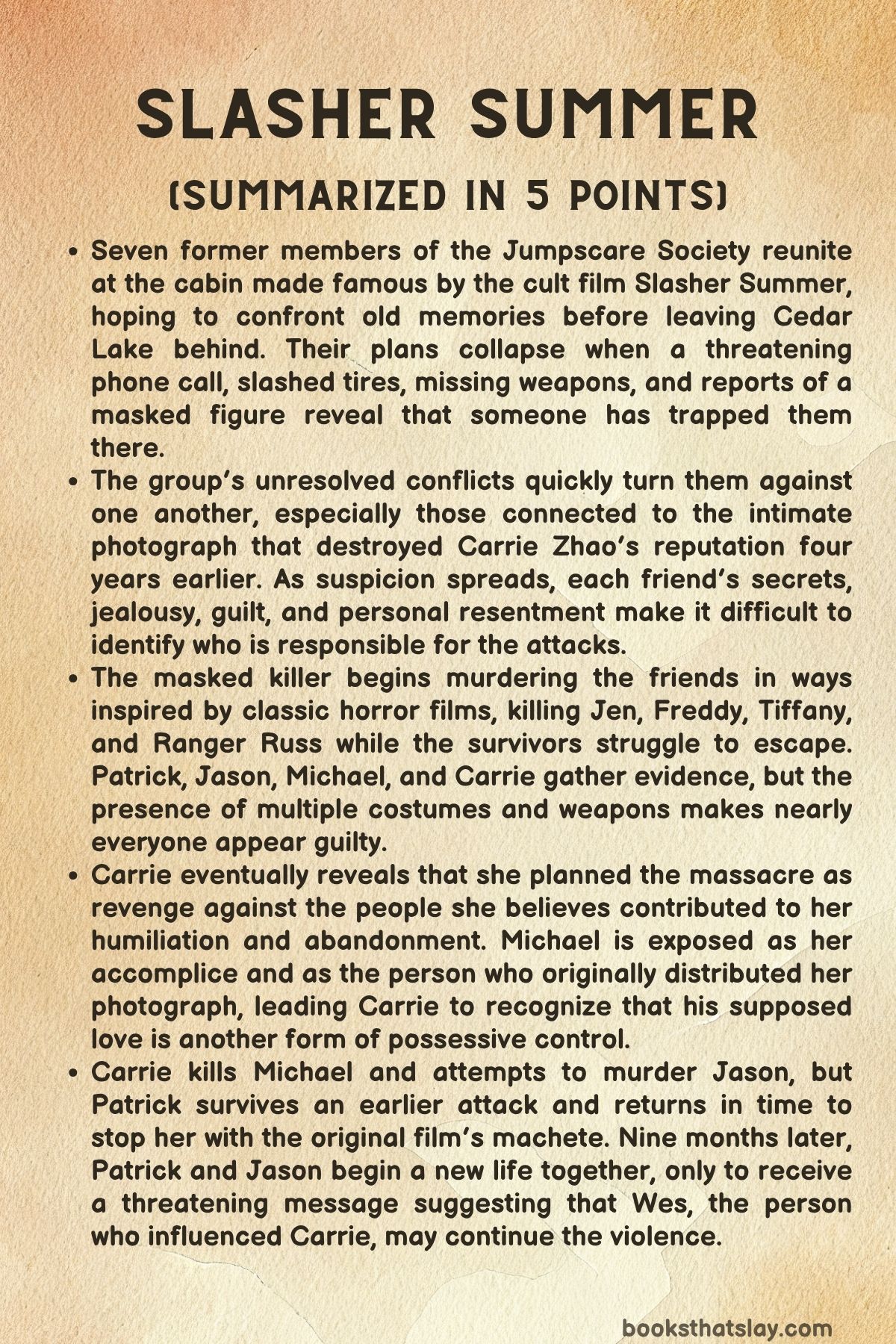
Summary
Cedar Lake has built much of its identity around Slasher, a cult horror film released four decades earlier. The cabin used in the movie remains standing outside the town, and local businesses profit from screenings, merchandise, guided tours, and an annual convention known as Slasher Summer.
During a theatrical screening, a teenage shadow cast performs the film’s famous murders while the audience cheers. A hooded observer watches from the back of the theatre, paying particular attention to the actress playing the Final Girl and treating the staged deaths as preparation for real violence.
Carrie Zhao returns to Cedar Lake after four years away, hoping to confront the place where her life was publicly destroyed. Her first meeting with her seriously ill mother quickly becomes painful because Mama continues to blame Carrie for the scandal rather than acknowledging the cruelty she endured.
The scandal began when an intimate photograph of Carrie circulated throughout her school. She had posed in the Slasher’s plaid jacket while holding a machete, intending the picture only for Jason, but its distribution led to harassment, humiliation, family rejection, and her departure from town.
Carrie is also escaping Daniel, a controlling former boyfriend who became interested in her because of the photograph. Although she has ended their relationship, Daniel refuses to accept the breakup and has sent messages suggesting that he intends to find her.
Carrie joins her former friends at the Slasher cabin for a final reunion of the Jumpscare Society, the horror club Patrick created in high school. Patrick formed the group after the murder of his sister Clare, using horror films as a way to impose understandable rules on violence that otherwise seemed random.
The reunion includes Patrick, Jason, Michael, Tiffany, Jen, Freddy, and Carrie. Old tensions immediately return because Tiffany still believes Carrie betrayed her by sending Jason the photograph, while Carrie remains hurt that Jason failed to defend her when the image spread.
Jen admits that she secretly invited Carrie because she believes the friends cannot move forward without facing their shared past. Before the group can settle into the weekend, Freddy arrives in a panic and claims that someone dressed as the Slasher appeared in front of his van.
Tiffany dismisses Freddy’s warning and goes swimming, partly to calm herself and partly to attract Jason’s attention. Something grabs her beneath the water, and she briefly sees what appears to be a masked face before Carrie rescues her.
Although Tiffany later suggests that vegetation may have trapped her, the incident becomes harder to dismiss when Jen reports seeing a motionless person watching the cabin from the opposite side of the lake. Carrie then reveals Daniel’s threats, leading the friends to suspect that he may have followed her.
A storm forces everyone inside, and the electricity fails almost immediately. The cabin’s rotary telephone rings even though no one outside the rental office should know its number, and a disguised voice tells Carrie that everyone in the cabin will die before morning.
The group decides to leave but discovers that every vehicle has slashed tires. A mask and work clothing are found inside Freddy’s van, though Freddy explains that he uses the costume while working at the Rialto Theatre.
Ranger Russ arrives in a Park Services vehicle, but Carrie mistakes him for Daniel in the darkness. Michael strikes Russ with a fireplace poker while trying to protect her, apparently leaving the ranger gravely injured.
Overcome by guilt, Michael runs into the woods to find a cellular signal and call for help. When Patrick later returns to check Russ, the ranger has vanished, leaving behind only a bloodstain and growing uncertainty about whether he was an innocent victim or the person threatening them.
The friends divide into pairs to search for Michael. Patrick discovers that the largest kitchen knife is missing, while Tiffany and Jason learn that an axe has disappeared from the toolshed.
Tiffany tries to repair her relationship with Jason during their search, but he refuses to reunite with her. He admits that he feels trapped by the future she has planned for them and needs space to understand his identity, anger, and bisexuality.
Jen searches with Patrick but secretly leads them toward the highway because she wants to escape rather than return to the cabin. After Patrick suddenly disappears, the masked killer attacks Jen and chases her through the woods.
Jen fights back with a knife and refuses to surrender quietly, but she is badly injured during the pursuit. She eventually falls onto a broken tree trunk and dies while realizing that every ambitious plan she made for leaving Cedar Lake will remain unfulfilled.
Michael, meanwhile, finds a clean Slasher costume and an axe hidden in the forest. He takes the weapon and heads back toward the cabin, imagining that rescuing the others will finally prove that he is stronger and more capable than Jason.
Carrie and Freddy also encounter the masked figure. Freddy panics and abandons Carrie, then returns to the cabin alone, where the killer attacks him with the missing axe.
Freddy attempts to defend himself with household objects and one of Patrick’s professional knives. He is eventually cornered, disembowelled, and displayed over the upstairs banister as part of the killer’s recreation of a slasher-film death.
Jason and Tiffany later find a second costume hidden inside an unusable motorboat. During their walk back, Jason finally ends their relationship with complete honesty, explaining that familiarity is no longer enough to justify remaining together.
Carrie overhears part of their conversation and later joins them. Jason apologizes for failing to defend her after the photograph spread, but the apology cannot repair the years of suffering caused by his silence.
Patrick reappears and reports that the Slasher chased him through the woods. When the group hears a voice that sounds like Michael calling for help, they move toward it and fall down a steep hillside, becoming separated once again.
Tiffany reaches the lake and decides to swim toward a nearby summer camp where she believes she can contact help. She discovers that the cabin’s canoe has been deliberately sunk, confirming that the night’s events were carefully prepared.
A motorboat approaches with the masked killer at the controls. Despite Tiffany’s strength as a swimmer, the attacker circles her and uses an axe to sever her limbs before killing her in the water.
Patrick returns to the cabin and finds Freddy’s mutilated body. He also discovers that the telephone cord was intentionally cut, proving that the threatening call was part of a larger plan rather than an impulsive prank.
In the cellar, Patrick finds Ranger Russ bound, gagged, and murdered with the missing kitchen knife. He takes Russ’s vehicle keys but cannot start the SUV, leaving him trapped near the cabin.
A news notification on Patrick’s phone reports that Daniel has been murdered in another town. Since Daniel died before the reunion began, he cannot be responsible for the attacks, and Patrick begins to suspect Michael.
Michael returns after witnessing Tiffany’s death and finds Jason. Although he reports what happened, he privately welcomes the opportunity to appear braver than Jason and imagines that Tiffany’s death may bring Carrie closer to him.
At the cabin, Jason and Michael encounter the masked attacker. Jason fires a flare gun, causing an explosion and a small fire, but Patrick’s emergency equipment allows them to extinguish the flames.
Carrie then appears in the lake with Tiffany’s body, claiming that she hid during the attack and recovered the remains afterward. Patrick informs her that Daniel is dead and soon confronts Michael, who returns carrying the missing axe.
Patrick presents his evidence against Michael, but Michael responds by accusing Patrick. Each surviving man has suspicious behavior, access to weapons, emotional motives, or unexplained periods of absence, allowing distrust to spread among them.
Carrie listens as they accuse one another and concludes that none of them has truly changed. She puts on gloves, retrieves a concealed axe, and reveals that she is one of the killers.
Carrie explains that she murdered Daniel as practice and intended to blame the cabin massacre on an obsessed Slasher fan. When Russ arrived unexpectedly, she killed him and arranged the scene so that the others would consider him a suspect.
She holds every member of the Jumpscare Society responsible for some part of her suffering. Jen took the photograph, Tiffany encouraged the harassment, Jason remained silent, Freddy drugged her, and Patrick encouraged her to take the romantic risk that led to the picture.
Carrie also describes the influence of Wes, the therapist who taught her to remove toxic people from her life and make those who hurt her experience consequences. She has transformed his language about empowerment into a justification for murder.
While Carrie attacks, Patrick, Jason, and Michael attempt to escape. Michael suddenly pushes Patrick down the cellar stairs, revealing that he is not another victim but Carrie’s accomplice.
Michael explains that the pair used two costumes so each could appear innocent while the other attacked. He arranged the threatening telephone call, cut the landline, helped disable the vehicles, chased several members of the group, and murdered Jen.
Carrie killed Daniel, Russ, Freddy, and Tiffany. Together, she and Michael manipulated the group’s existing resentments so that the friends would accuse one another instead of recognizing the partnership behind the violence.
Michael stabs Jason and proposes framing him for the massacre. Jason’s anger, football background, failed relationship with Tiffany, fingerprints, and access to the toolshed would make him a believable suspect.
Jason then reveals that he never distributed Carrie’s photograph. Michael secretly copied it from Jason’s phone and printed it because he believed public humiliation would make Carrie emotionally dependent on him.
Michael admits that he caused the scandal and claims he acted out of love. Carrie recognizes that his possessiveness is no different from Daniel’s desire to own and control her, so she kills Michael with the axe.
Carrie turns on Jason and admits that revenge is no longer her only motivation. Murdering Daniel made her realize that she enjoys violence and feels powerful when deciding who deserves to live.
Though badly injured, Jason fights back with flour, furniture, cookware, and objects from the cabin. He finally pulls down an antler chandelier, which falls onto Carrie and severely wounds her.
Carrie rises despite her injuries and prepares to kill Jason. Patrick, who survived the fall down the stairs, appears with the genuine machete used in the original film and kills her before she can strike.
Nine months later, Patrick and Jason have built a new life in a coastal town. Patrick has left economics for culinary school, while Jason has abandoned football and now manages a diner after suffering lasting damage to his arm.
The two are openly together and attempting to live beyond the roles imposed on them by family, fear, and social expectations. Their peace is disturbed when a young woman delivers a poster for Slasher 2: A New Chapter.
The delivery was ordered by someone named Wes, and the poster contains a handwritten promise that the Slasher will see them soon. Patrick and Jason realize that the person who encouraged Carrie’s transformation may still be watching them.
Characters
Carrie Zhao
Carrie is the central tragic force in Slasher Summer, beginning as a woman who appears to be returning home in search of closure but gradually emerging as the architect of much of the violence. Her history of public humiliation, family rejection, romantic betrayal, and emotional abuse makes her anger understandable, even though her response becomes morally indefensible.
Her intimate photograph did more than embarrass her; it took away her ability to control how others saw her body, motives, and identity. The cruelty of her classmates and the silence of her friends taught her that social acceptance could disappear instantly, leaving her with a lasting need to regain control.
Carrie initially appears more emotionally stable because she speaks about therapy, boundaries, affirmations, and personal strength. These methods have not produced genuine recovery, however, because they have been reshaped into arguments for punishment rather than tools for processing pain.
Her revenge depends on assigning each friend a fixed role in her suffering. Instead of recognizing different levels of responsibility, immaturity, cowardice, and remorse, she treats every failure as proof that the person deserves death.
Carrie’s relationship with Michael exposes the contradiction in her ideas about empowerment. She accepts his assistance while believing he worships her, yet she kills him as soon as she learns that his claimed love was based on manipulation and possession.
That decision shows that Carrie can still recognize abusive behavior when it is directed at her. What she cannot recognize is how closely her own conduct resembles the control practiced by Daniel, Michael, and the people she condemns.
By the end, Carrie no longer presents herself solely as an injured person seeking justice. She admits that killing gives her pleasure, revealing that revenge has become a convenient moral explanation for desires that now extend beyond her original trauma.
Patrick
Patrick serves as the emotional and practical stabilizer of Slasher Summer, although his need for control also contributes to the group’s vulnerability. He responds to fear by planning, organizing, preparing supplies, and trying to make unpredictable situations obey clear rules.
His fascination with horror began after Clare’s murder. Films offered him a world in which threats had recognizable patterns and survival depended on understanding those patterns, unlike the senseless real-life violence that took his sister away.
Patrick creates the Jumpscare Society because he needs community as much as he needs explanations. The group becomes a place where grief, queerness, fear, and social difference can temporarily exist without judgment.
His greatest weakness is his belief that careful preparation can solve emotional problems. He organizes the reunion as though the correct location, schedule, equipment, and atmosphere can repair relationships that have remained damaged for years.
Patrick repeatedly resists abandoning the cabin because leaving would mean admitting that his plan has failed. His refusal is not malicious, but it demonstrates how the desire to protect people can become controlling when one person assumes that only his judgment is reasonable.
His feelings for Jason also reveal his vulnerability. Patrick fears that acknowledging hope will destroy their friendship, so he hides behind caution even when Jen suggests that Jason may return his feelings.
During the attacks, Patrick’s preparations prove essential. His emergency supplies, fire extinguishers, compasses, weapons knowledge, and attention to evidence repeatedly help the survivors, transforming traits that once seemed excessive into genuine strengths.
His final rescue of Jason completes his development without turning him into a conventional invincible hero. Patrick survives because he is observant and persistent, but his later decision to pursue cooking shows that survival also means choosing a life shaped by desire rather than fear.
Jason
Jason is presented as someone who appears powerful but has spent much of his life surrendering control to other people’s expectations. His athletic ability, popularity, physical size, and protective reputation conceal how uncertain he feels about his future and identity.
His father expects him to build his life around football and conventional masculinity. Tiffany similarly imagines a shared future in which Jason continues performing the role of the dependable heterosexual boyfriend she believes him to be.
Jason’s bisexuality is important because it represents more than romantic uncertainty. It forces him to question how many of his choices have been made freely and how many were accepted because resistance might disappoint his family, teammates, or partner.
His attraction to Patrick is connected to emotional safety. Patrick sees him as a complete person rather than a symbol of success, strength, or social status, allowing Jason to imagine a relationship in which he does not have to perform constantly.
Jason’s treatment of Carrie remains one of his greatest moral failures. Although he did not distribute the photograph, he remained silent when she was attacked because defending her would have disrupted his relationship and social comfort.
His eventual apology is sincere but limited. Jason learns that remorse cannot erase the consequences of cowardice and that the injured person is not required to offer him immediate forgiveness or emotional relief.
Jason also fears inheriting his father’s anger. His willingness to admit that he needs help distinguishes him from characters who treat aggression as proof of strength and marks an important step toward ending that pattern.
By leaving football, separating from Tiffany, acknowledging his sexuality, and building a life with Patrick, Jason finally stops allowing other people to write his future. His survival carries lasting physical and emotional damage, but it also creates the possibility of a more honest life.
Michael
Michael is one of the book’s most deceptive characters because his insecurity initially resembles vulnerability. He appears to be the overlooked younger member of the group, but his private thoughts reveal resentment, entitlement, and an obsessive need to prove superiority.
His childhood instability helps explain his attachment to Carrie and Jason. Carrie cared for him when his parents were absent or intoxicated, while Jason’s family provided security and Jason’s popularity protected him from bullies.
Michael comes to hate the very protection he once needed. He interprets Jason’s support as evidence that others see him as weak, causing gratitude to harden into rivalry and resentment.
His love for Carrie is based on a fantasy in which success will make her recognize that they belong together. He does not view her as an independent person whose feelings may differ from his own, but as a reward he expects to receive after proving his worth.
The photograph reveals the full extent of his entitlement. Michael causes Carrie’s humiliation because he assumes that destroying her social world will make her dependent on him, turning her pain into a strategy for securing affection.
His partnership with Carrie temporarily gives him the role he has always desired. He can appear intelligent, brave, and essential while Jason becomes frightened, injured, and uncertain.
Michael’s actions during the reunion repeatedly show that he values recognition more than human life. Even after Tiffany’s death, he privately enjoys the opportunity to appear stronger than Jason and imagines how the murder may benefit his romantic ambitions.
Carrie kills him when she finally understands that his devotion is another form of control. His death exposes the emptiness of his claim that love justifies harm, since he has never respected the freedom or dignity of the person he says he loves.
Tiffany
Tiffany initially appears self-assured, socially powerful, and determined to control every situation. Her confidence is genuine, but it is closely tied to the belief that people and events will eventually conform to the future she has imagined.
She treats her separations from Jason as temporary disruptions rather than final decisions. This assumption allows her to avoid asking whether he wants the same life, since she believes their shared history gives her permanent authority over the relationship.
Tiffany’s hostility toward Carrie comes from jealousy, betrayal, and a refusal to reconsider the past. She interprets the photograph as an attack on her relationship while ignoring the far greater harm caused when the image was circulated publicly.
Her participation in Carrie’s harassment reflects how social power can encourage cruelty. Tiffany does not create every consequence Carrie experiences, but her attitude helps give others permission to treat Carrie as an object of ridicule.
Despite these flaws, Tiffany is not a simple antagonist. She is intelligent, physically capable, ambitious, and able to make difficult decisions when she is alone.
Her final attempt to swim for help demonstrates courage and practical judgment. She studies the environment, identifies the summer camp as a possible source of rescue, and acts even while injured and isolated.
Tiffany’s thoughts about publishing an account of her survival show both resilience and self-centeredness. She immediately imagines converting suffering into a narrative of personal triumph, revealing how deeply she depends on controlling the way others perceive her.
Her death is especially cruel because swimming is one of the areas in which she feels strongest. The killer removes her physical power piece by piece, turning her confidence in her own body into helplessness.
Jen
Jen uses sarcasm, irreverence, and reckless humor to prevent other people from seeing her fear. She presents herself as detached from relationships and consequences, but her decision to invite Carrie reveals that she understands the group cannot escape its past indefinitely.
Her role in taking the photograph makes her directly responsible for creating the object that later destroyed Carrie’s reputation. Even though Michael secretly distributes it, Jen fails to foresee how dangerous the image could become once it exists.
Jen’s desire to travel through Europe after receiving her trust fund reflects her determination to escape Cedar Lake. She imagines distance as a form of reinvention, believing she can leave behind the town, her mistakes, and the expectations attached to her.
Her suspicion of others demonstrates sharp observational ability. She examines who was absent, who had access to weapons, whose physical condition matches the attacks, and who benefits from keeping the group at the cabin.
At the same time, Jen’s confidence leads her to underestimate danger. She deliberately abandons the agreed search route because she trusts her own escape plan more than the group’s decisions.
During her confrontation with the killer, Jen remains defiant. She fights, insults her attacker, tears herself free from a severe injury, and refuses to accept the passive victimhood expected in traditional horror narratives.
Her final thoughts expose the insecurity beneath her performance. What frightens her is not only dying but dying in an ordinary, isolated place before becoming the adventurous and admired person she intended to be.
Jen’s death therefore carries a bitter irony. The woman most determined to escape the town becomes physically fixed within its landscape, while the future identity she carefully imagined disappears with her.
Freddy
Freddy is defined by fear, imagination, and a desperate wish to transform his life through filmmaking. He interprets events as scenes because cinema gives him a language for experiences that otherwise feel chaotic and humiliating.
His screenplay represents his hope of becoming more than the frightened and unsuccessful person he believes others see. Completing it would prove that his years of watching films and dreaming about escape had a meaningful purpose.
Freddy’s fear often makes him unreliable. He arrives with an accurate warning about the masked figure, but his history, nervous behavior, costume, and apparent intoxication cause the others to dismiss him.
When he abandons Carrie in the woods, his instinct for self-preservation overcomes loyalty. He feels immediate shame, showing that he understands his failure even though he cannot force himself to behave bravely.
The fake blood on his clothing and the mask in his van turn him into an ideal suspect. Carrie and Michael benefit from the fact that Freddy’s work places genuine incriminating objects around him without requiring them to plant every piece of evidence.
His final defense is more courageous than his earlier actions suggest. Trapped inside the cabin, Freddy uses dishes, food, kitchen tools, a chef’s knife, and a corkscrew in an increasingly desperate attempt to survive.
Even in death, he thinks like a filmmaker, imagining cuts and endings rather than focusing solely on physical pain. This response shows how completely artistic ambition has become the structure through which he understands himself.
Ranger Russ
Russ enters the story as a possible rescuer but is immediately transformed into a suspect and victim. His connection to Carrie begins innocently when Jeb asks him to watch out for her, yet the group’s fear prevents them from recognizing his arrival as potential help.
Michael’s attack on Russ demonstrates how quickly panic can turn uncertainty into violence. Carrie’s mistaken identification and Michael’s desire to protect her create a situation in which no one pauses long enough to confirm who Russ is.
His earlier reputation as a troubled student makes suspicion easier. Once Patrick remembers the meat-cleaver incident from school, the group begins fitting Russ into the role of dangerous outsider.
Russ’s disappearance from the floor intensifies that suspicion, though the truth is that Carrie has moved and murdered him. His body is then hidden with objects from the cabin, allowing the killers to use him as both a victim and a false explanation for the attacks.
His fate illustrates the danger of narratives formed from incomplete evidence. Russ becomes frightening not because of his actions at the cabin, but because the survivors combine old rumors, present fear, and carefully arranged clues.
Daniel Williams
Daniel never arrives at the cabin alive, yet his influence shapes the group’s early understanding of the danger. His threatening messages and refusal to accept Carrie’s breakup make him the most obvious initial suspect.
His interest in Carrie begins with the notorious photograph, meaning that he knows her first as a sexualized image rather than as a complete person. This foundation contributes to a relationship built on obsession, possession, and control.
Daniel’s behavior gives Carrie a genuine reason to fear him. His promise to come for her sounds especially dangerous when a masked figure begins following the group.
Carrie chooses him as her practice victim partly because he harmed her and partly because blaming him would be easy. His history provides a believable explanation for why a violent stalker might follow her to Cedar Lake.
His death also marks the point at which Carrie recognizes that she enjoys killing. Daniel therefore functions as both a victim of her revenge and the threshold between targeted retaliation and a broader appetite for violence.
Wes
Wes is one of the most unsettling figures because his precise role remains uncertain. Carrie describes him as a therapist who taught her about consequences, toxic relationships, personal boundaries, and the need to reclaim control.
Those ideas can support healthy recovery, but Carrie interprets them in the most violent manner possible. It is unclear whether Wes intentionally encouraged murder, manipulated an unstable client, or communicated in ways she radically distorted.
The final poster strongly suggests that Wes is a real person with knowledge of the massacre. His message indicates that he may have guided Carrie toward violence and may continue to identify with the Slasher persona after her death.
Wes therefore expands the threat beyond one traumatised woman and her obsessive accomplice. He represents the possibility of an ideology that converts therapeutic language into permission to punish anyone classified as harmful.
His unseen presence also prevents the ending from offering complete safety. Patrick and Jason escape Carrie, but the ideas that shaped her may still be active through someone who understands their location and history.
Carrie’s Mother
Carrie’s mother contributes to her daughter’s trauma by treating shame as a moral failure rather than responding with protection. When Carrie returns after four years, Mama’s first concern is whether she has repeated the behavior connected to the scandal.
Her response reflects a rigid belief that respectability depends on controlling female sexuality and public appearance. Instead of condemning those who distributed the photograph, she directs blame toward the person exposed by it.
Carrie enters the meeting hoping that illness, time, or therapy may have changed their relationship. Mama’s immediate condemnation confirms that returning home will not provide the acceptance or accountability Carrie seeks.
Although Mama does not cause Carrie’s later murders, her rejection helps explain why Carrie finds promises of absolute self-reliance so appealing. When family protection fails, Carrie becomes increasingly receptive to the belief that safety can come only from removing anyone who might hurt her.
Clare
Clare is absent from the central events because she was murdered before the reunion, but her death shapes Patrick’s personality and the formation of the Jumpscare Society. Her loss teaches him that real violence can be sudden, senseless, and impossible to control.
Patrick turns to horror films because their rules offer an alternative to that randomness. In fictional stories, viewers can identify the threat, anticipate danger, and imagine that preparation may lead to survival.
Clare’s death also explains Patrick’s protective behavior. His emergency supplies and careful plans come from an unspoken determination never again to be helpless while someone he loves is in danger.
Her influence remains present when Patrick finally kills Carrie to save Jason. The action places him once more in direct contact with lethal violence, but this time he can prevent the loss that he was powerless to prevent with his sister.
Jeb
Jeb appears briefly at the isolated gas station, yet his warning establishes the sense that Carrie is entering a place separated from ordinary protection. His familiarity with the region allows him to recognize the risks created by distance, poor communication, and limited access to help.
By asking Russ to watch out for Carrie, Jeb tries to create a small network of protection around a traveller who appears vulnerable. His concern contrasts with the suspicion that later causes the group to attack Russ.
Jeb also resembles the warning figure common to slasher films, but his advice is practical rather than supernatural. The danger comes not from a cursed landscape but from people who have deliberately chosen isolation as the setting for revenge.
Jason’s Father
Jason’s father does not appear directly at the cabin, but his expectations strongly influence Jason’s fear, anger, and indecision. He treats football, toughness, and conventional masculinity as essential parts of his son’s identity.
Jason worries that his own temper may resemble his father’s controlling rage. This fear makes his argument with Tiffany especially disturbing because he recognizes behavior that he does not want to repeat.
His father’s expectations also make Jason’s bisexuality and career doubts difficult to express. Leaving football and moving away therefore become acts of emotional independence rather than simple lifestyle changes.
Clive
Clive is Tiffany’s teaching assistant and temporary romantic interest during her separation from Jason. His limited presence matters mainly because Jen suspects that Tiffany is using the relationship to provoke jealousy rather than forming a sincere attachment.
The relationship shows how Tiffany tries to control emotional uncertainty through performance. Instead of accepting that Jason may permanently leave, she introduces another man into the situation while continuing to treat Jason as her inevitable partner.
Clive consequently functions less as an independent romantic rival than as evidence of Tiffany’s inability to release the future she has planned. His absence from the reunion also emphasizes that her emotional focus remains fixed on Jason.
Uncle Vic
Uncle Vic represents Tiffany’s connection to authority, family support, and practical rescue. When she decides to swim toward the summer camp, contacting him becomes part of her plan for surviving the night.
Her confidence that Vic will respond suggests that she is accustomed to having dependable people and resources available. This background helps explain both her self-assurance and her initial difficulty understanding Carrie’s isolation.
Although Tiffany never reaches him, the thought of Vic gives direction to her final actions. He symbolizes the safe world beyond the lake that remains visible in her mind but physically unreachable.
Jordan Knox
Jordan Knox is the Final Girl within the original Slasher film rather than a direct participant in the cabin reunion. Her image represents innocence, endurance, and the familiar horror convention in which one young woman survives after others are killed.
The shadow-cast performance places Jordan’s staged suffering at the centre of Cedar Lake’s entertainment industry. Audiences cheer because they know the violence is artificial and believe the familiar ending will restore order.
Carrie’s plan challenges that expectation by transforming performance into actual murder. She rejects the idea that she must remain the innocent victim who survives through moral purity and instead chooses to occupy the role of the killer.
Jordan’s symbolic presence therefore shapes the conflict between victimhood and agency. The novel questions what happens when a person sees only two available identities—helpless survivor or violent avenger—and cannot imagine recovery outside either role.
Themes
Trauma, Revenge, and the Corruption of Recovery
Trauma affects nearly every major decision in Slasher Summer, but the story distinguishes clearly between understanding pain and using pain to justify cruelty. Carrie’s humiliation, Patrick’s grief, Jason’s fear of his father, Michael’s neglected childhood, and Tiffany’s loss of control all shape their behavior without automatically determining their moral choices.
Carrie initially appears to be pursuing recovery through therapy, affirmations, and stronger boundaries. The language of healing becomes dangerous when she treats discomfort as proof of toxicity, accountability as punishment, and personal strength as the power to decide who deserves death.
Her revenge fails to restore what was taken from her because murder cannot return privacy, trust, family support, or lost years. Each killing instead pushes her farther from the person who originally wanted recognition and closer to the controlling figures she once feared.
Patrick offers a contrasting response to trauma. Clare’s murder makes him anxious and controlling, but he eventually learns that preparation cannot eliminate uncertainty and that survival must be followed by a life chosen for positive reasons.
Jason also accepts that recovery requires honesty, apology, and professional help rather than domination. The contrast among these characters suggests that trauma may explain destructive impulses, but explanation is not absolution.
Healing requires the difficult acceptance that pain cannot always be reversed. Revenge promises immediate control, yet it keeps the injured person permanently attached to the people and events that caused the original wound.
Performance, Identity, and Assigned Roles
The characters repeatedly perform identities created by families, partners, peers, and horror conventions. Jason plays the successful athlete and dependable boyfriend, Tiffany performs certainty, Freddy imagines himself as a filmmaker, Jen acts fearless, Patrick becomes the prepared protector, and Carrie is treated as either an innocent victim or a sexual scandal.
The Slasher festival turns performance into an entire economy. Fake murders are repeated for entertainment, costumes transform ordinary people into recognizable threats, and the cabin is preserved so visitors can briefly enter a familiar fictional world.
These performances become dangerous when the characters mistake roles for complete identities. Tiffany assumes that being Jason’s long-term girlfriend gives her permanent knowledge of him, while Michael believes that playing Carrie’s protector earns him romantic possession.
Carrie’s violence begins partly as a rebellion against the role imposed on her after the photograph. She refuses to remain the shamed girl waiting for others to defend or forgive her, but she replaces that identity with another rigid role: the powerful killer who cannot be hurt.
Patrick and Jason move toward healthier identities because they allow themselves to change. Patrick leaves a practical academic path for cooking, while Jason abandons football and openly accepts his relationship with Patrick.
Their choices show that identity becomes freeing only when it remains flexible. A person can survive the roles assigned by others, but replacing one restrictive performance with another does not create genuine independence.
Silence, Complicity, and Responsibility
The original harm against Carrie grows because many people participate in different ways. Jen takes the photograph, Michael steals and distributes it, Tiffany encourages hostility, classmates circulate it, Mama blames Carrie, and Jason remains silent while her reputation collapses.
These actions are not equally severe, but the story refuses to treat passive behavior as morally neutral. Jason does not release the photograph, yet his silence protects his comfort while leaving Carrie isolated.
Responsibility becomes more complicated because Carrie refuses to recognize degrees of guilt. She treats poor judgment, cowardice, jealousy, direct abuse, and deliberate manipulation as if they all deserve the same fatal consequence.
The surviving characters must therefore confront two truths at once. They failed Carrie in meaningful ways, but those failures do not make her murders legitimate.
Jason’s apology demonstrates what real responsibility begins to look like. He does not demand forgiveness, deny the harm, or explain his silence as unavoidable; he admits that he chose safety for himself when Carrie needed support.
Michael represents the opposite response. He hides his central responsibility, presents himself as Carrie’s loyal admirer, and describes manipulation as love.
The novel suggests that accountability requires accurate distinctions between intention, action, consequence, and remorse. Without those distinctions, responsibility can be avoided by the guilty or transformed into unlimited permission for revenge.
Control, Isolation, and the Illusion of Safety
Nearly every character tries to manage fear by controlling people, places, or possible outcomes. Patrick controls schedules and supplies, Tiffany plans her future with Jason, Michael engineers Carrie’s dependence, Daniel rejects the end of a relationship, and Carrie creates an environment in which no one can leave.
The cabin becomes the physical expression of that desire for control. Its distance from town, disabled vehicles, cut telephone, hidden weapons, unusable boat, and surrounding forest allow Carrie and Michael to determine how information moves and where the victims can go.
Their plan succeeds because isolation intensifies existing suspicion. Without outside communication, the friends rely on incomplete observations, old resentments, and evidence deliberately placed to mislead them.
Control repeatedly creates the opposite of safety. Patrick’s insistence on preserving the reunion delays escape, Tiffany’s confidence in her planned relationship prevents honest communication, and Michael’s attempt to make Carrie need him produces the very rage that kills him.
Carrie believes that complete control will make her invulnerable. Instead, her need to direct every person’s role makes her unable to adapt when Michael’s secret is revealed and Jason refuses to behave like the weak final victim she expects.
Patrick and Jason find greater safety only after accepting uncertainty. Their new life does not erase danger, but it is built on honest choices, shared vulnerability, and the recognition that love cannot be secured through possession.