Slow Gods Summary, Characters and Themes
Slow Gods by Claire North is a compelling science fiction novel that explores deep philosophical themes, focusing on the nature of existence, love, and the cosmic forces that shape our lives. The story is set against a backdrop of impending galactic destruction, as the inhabitants of Adjumir, a planet facing the collapse of its binary star system, are forced to confront the end of their world.
The narrative follows Mawukana na-Vdnaze, a pilot who becomes entangled in a complex web of survival, power struggles, and existential discovery. As they navigate the crumbling structures of society and the vastness of space, Mawukana’s journey forces them to grapple with questions of meaning, purpose, and the price of survival.
Summary
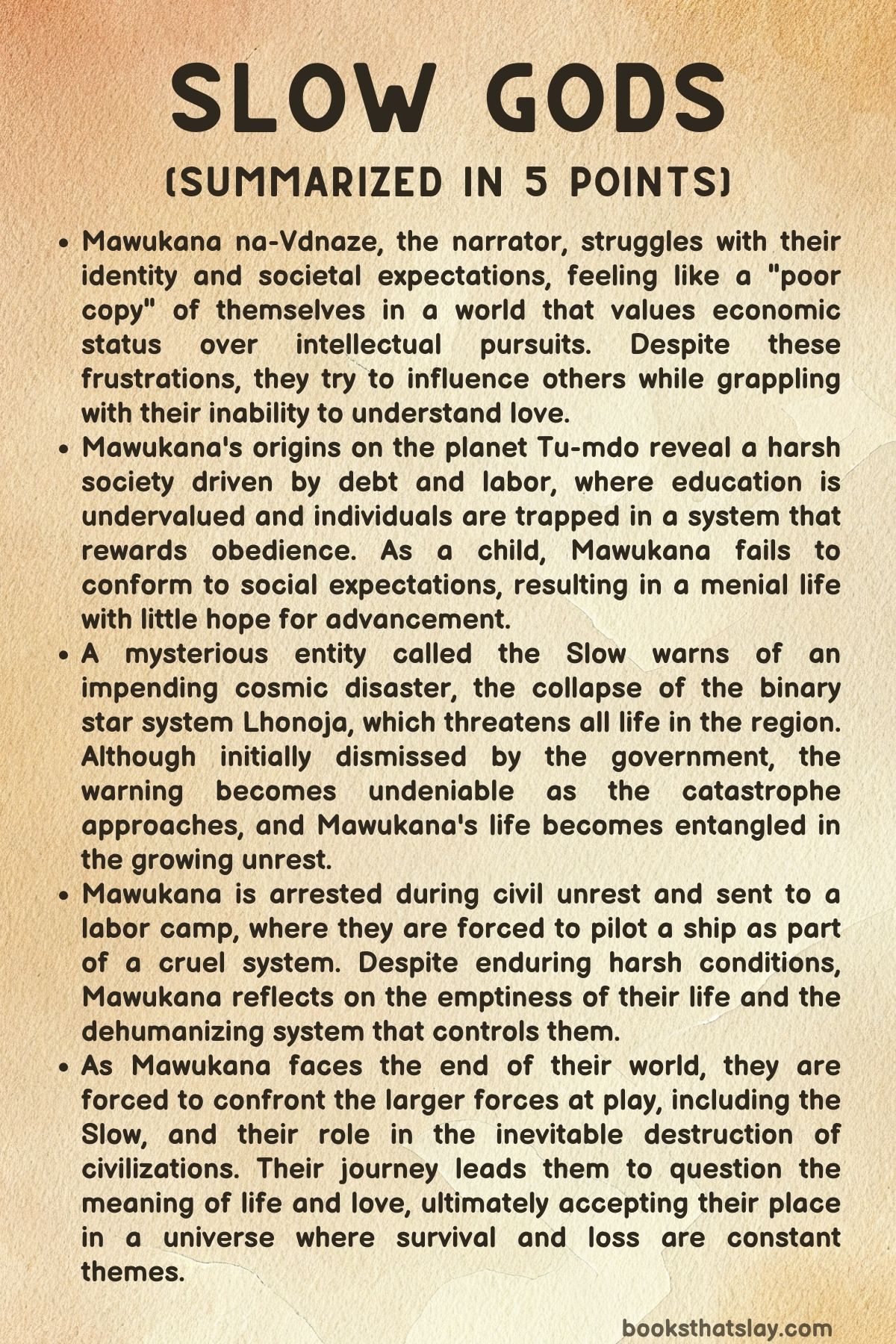
Mawukana na-Vdnaze, the narrator, starts by reflecting on their life. They see themselves as an imperfect version of who they could have been, feeling overshadowed by the societal focus on their “otherness” rather than their intellectual achievements.
Despite their frustrations, Mawukana tries to explain their experiences in ways that others can understand, struggling to grasp the complexities of love.
The story moves back in time to describe Mawukana’s origins on the planet Tu-mdo. Once a promising site for terraforming, Tu-mdo is now a bustling urban center under the governance of the United Social Venture (USV).
Mawukana’s parents, though ambitious, lived modestly. Mawukana’s birth marked the beginning of a life heavily influenced by debt, a common feature of life in the Shine—a society where people work tirelessly to pay off loans.
The Shine values labor and social status (referred to as “Shine”) far more than education or intellectual pursuits.
As a child, Mawukana struggled to fit in. The social expectations of the Shine, which relied on deception and manipulation to succeed, were foreign to them.
Mawukana was relegated to menial tasks, and by the age of fifteen, their future seemed bleak. They worked at the local traffic tower, managing cargo flights and dealing with irate customers.
Despite the monotony, Mawukana remained curious, but they had little understanding of the world beyond their own limited scope.
The arrival of the Slow, an ancient and mysterious entity, changes the course of history. The Slow has appeared before major galactic events, warning civilizations of impending disasters.
The Slow predicts the collapse of the binary star system Lhonoja, a supernova that will send a shockwave obliterating all life within an 83-light-year radius. The government initially dismisses the warning, labeling it a conspiracy, but astronomers eventually confirm the threat.
As the galaxy begins to react, Mawukana’s life continues within the oppressive system of the Shine. Protests erupt over poor living conditions and stagnant wages.
Mawukana, caught in the turmoil, is arrested during civil unrest for subversion and sent to a labor camp on the planet Hasha-to. There, they are subjected to inhumane treatment, working in toxic conditions in factories that produce precious metals.
The Shine uses prisoners like Mawukana to pilot ships capable of faster-than-light (FTL) travel, and they are eventually forced to serve in this capacity.
During Mawukana’s time on Hasha-to, their life is marked by passive resistance. They are drugged, mentally tested, and eventually made the pilot of the MSV Myrmida, a doomed ship.
The journey through arcspace—the space between stars—reveals the strange, disturbing nature of this environment. The crew of the Myrmida faces terrifying, inexplicable phenomena, and the ship veers off course.
Mawukana’s body is later found, exsanguinated, suggesting their death during the journey.
The narrative jumps forward to the aftermath of the Lhonoja explosion. Mawukana, now living in isolation on an island, is approached by the Major from the Xi.
The Major asks Mawukana to assist with a mission to Adjumir, a planet on the brink of destruction. Mawukana, now a broken individual, reflects on their past—marked by forced labor, betrayal, and systemic corruption.
They agree to embark on this mission, unsure of what lies ahead but resigned to the fate of those like them, caught in the wheels of an indifferent universe.
The people of Adjumir are preparing for an exodus. The planet is doomed due to the collapse of the Lhonoja star system, and the population must evacuate.
A hundred years before the supernova, emergency efforts to terraform nearby planets like Adjapar begin, but these projects are slow and incomplete. Cryostorage facilities are built to temporarily house people, and massive motherships are constructed to transport millions.
As the population of Adjumir dwindles, the government accelerates the evacuation process. Yet, the efforts are plagued with complications, from logistical failures to plagues and immunization issues.
Mawukana is tasked with piloting missions to Adjumir, transporting refugees and supplies. Along the way, they form a connection with Gebre, an Adjumiri dedicated to preserving the planet’s cultural artifacts.
Gebre, despite the inevitable destruction of Adjumir, refuses to leave and insists on staying with their people. Mawukana’s relationship with Gebre is physical rather than emotional, but it deepens as Mawukana witnesses the last days of Adjumir.
Despite the evacuation of millions, many are left behind. As the shockwave from the supernova nears, Adjumir is destroyed, and all life on the planet is wiped out.
Mawukana reflects on the loss and the meaning of their actions during the evacuation. Years later, Mawukana is called upon once more by the Major and Rencki, a quan, to retrieve an artifact from Gebre, who is still on Adjumir, involved in saving the planet’s history.
Upon returning to Adjumir, Mawukana learns of Gebre’s continued efforts to preserve the planet’s cultural legacy, even in the face of certain death. Mawukana is tasked with retrieving a crucial artifact, a symbol of the planet’s history.
However, Gebre remains steadfast in their decision to stay with their people, marking the poignant end of Adjumir’s story.
As Mawukana journeys through the galaxy, they encounter the Slow, a powerful being that has observed countless civilizations and their rise and fall. The Slow reveals that it has manipulated events to achieve a greater, often cruel, purpose.
It asserts that love is the only force that transcends time and space, though it must sometimes be cold and unforgiving. Mawukana, now fully aware of their role in the universe’s grand scheme, must come to terms with their purpose—whether they are a witness to a dying galaxy or an active participant in the shaping of its future.
Eventually, Mawukana returns to their home planet, which has fallen into ruin. They meet Theodosius, a former enemy who has survived the collapse of the Shine.
Together, they reflect on their shared past, the nature of survival, and the consequences of power. Mawukana ultimately decides to leave the past behind, continuing their journey across the stars.
The novel ends with Mawukana’s acceptance of their fate, uncertain yet resolute in their continued existence, even in the face of the inevitable end of all things.
Characters
Mawukana na-Vdnaze
Mawukana is the protagonist and narrator of Slow Gods, whose journey is marked by deep introspection and existential questioning. They begin their life feeling like a “poor copy” of what they could be, constantly aware of their “otherness” within a society that values conformity over intellectual pursuits.
Mawukana’s early life on the planet Tu-mdo is shaped by the systemic debt culture and harsh social structures that prioritize labor and practicality over education and curiosity. Despite being relegated to menial tasks, Mawukana’s intellectual curiosity and critical thinking set them apart, although they find it hard to relate to others or to fully understand the concept of love.
Their transformation throughout the narrative is characterized by disillusionment and passive resistance to the oppressive systems they are trapped in. After being arrested and sent to a labor camp, Mawukana’s resilience is tested as they are forced into dangerous labor and the role of pilot for a doomed ship, the MSV Myrmida.
The encounter with the Slow and the imminent supernova that will destroy their world intensifies Mawukana’s personal crisis, leading to an existential confrontation with the inevitability of death and their role in the larger cosmic scheme. Mawukana’s journey is one of survival, introspection, and grappling with the vastness of the universe and their own insignificance in the grand scheme of things.
Gebre
Gebre is an important character from Adjumir, the doomed planet at the heart of the story’s cosmic destruction. Gebre plays a crucial role in preserving the cultural artifacts and history of their people, as Adjumir prepares for its inevitable destruction.
A deeply committed individual, Gebre chooses to stay on the planet despite its impending doom, reflecting a sense of responsibility and attachment to their heritage that contrasts with the urgency of the evacuation efforts. Their relationship with Mawukana is largely physical, but it highlights the emotional strain and the human tendency to cling to what is familiar, even when faced with certain extinction.
Gebre’s decision to remain behind to save the artifacts of their people serves as a poignant commentary on the preservation of culture in the face of inevitable destruction. They embody the tension between survival and the sacrifice required to safeguard what is valuable and irreplaceable.
Gebre’s unwavering dedication to their role as a guardian of their people’s history shows the lengths to which individuals will go to ensure that their culture and identity live on, even when they themselves cannot.
Cuxil
Cuxil is an ambassador for the Consensus, an organization of shared minds, and a key figure in the political intrigue that unfolds throughout Slow Gods. They are a complex character who serves as both a guide and a foil to Mawukana.
Initially, Cuxil attempts to encourage Mawukana to take part in a dangerous mission, despite the protagonist’s hesitations and emotional baggage. Their relationship is one of mutual understanding, as Cuxil recognizes Mawukana’s curiosity and intellectual struggle, encouraging them to engage with the greater challenges facing the galaxy.
Cuxil’s character is driven by the need to balance diplomacy and the deepening crises in the galaxy. As the representative of the Consensus, Cuxil is forced to navigate the escalating tensions and conflicts between factions like the Shine.
Their role in the story is crucial for the unfolding political drama, but it also serves as a vehicle for exploring the tension between collective consciousness and individuality. Cuxil’s own experiences of emotional conflict and the consequences of the Consensus’s decisions reflect the larger theme of collective versus individual identity that runs throughout the novel.
Rencki
Rencki is another character closely tied to Mawukana, acting as a supportive companion and guiding influence. They share a long history with the protagonist and serve as a stabilizing force amidst Mawukana’s chaotic emotional and existential journey.
Rencki encourages Mawukana to confront their curiosity and explore the larger forces at play, even when doing so comes at great personal cost. Rencki’s perspective is pragmatic and often grounded in reality, contrasting with Mawukana’s more philosophical and introspective nature.
Though not as prominent as Mawukana or Cuxil in terms of narrative presence, Rencki’s role is essential in helping the protagonist come to terms with their place in the universe. Their relationship with Mawukana is built on a foundation of understanding and mutual respect, providing a source of comfort and clarity in a story filled with complex cosmic events and personal turmoil.
Rencki’s character helps illuminate the personal stakes of the larger narrative and the emotional burdens that accompany the broader cosmic struggle.
The Slow
The Slow is an enigmatic and god-like entity whose influence permeates the entire narrative of Slow Gods. With immense knowledge and the ability to predict and manipulate events across the galaxy, the Slow serves as both a mysterious force and a philosophical figure.
It views life and civilizations as fleeting flashes of meaning, indifferent to the rise and fall of empires, yet it has a complex relationship with the concept of love. The Slow reveals to the protagonist that it has observed countless civilizations fall without intervening, but it has come to the conclusion that love, in its many forms, is the only force that transcends everything.
The Slow’s role in the story is one of cosmic indifference mixed with a seemingly contradictory desire to shape events for a greater purpose. It manipulates Mawukana and others as part of a larger experiment to shape the future, all the while claiming to be motivated by love.
This juxtaposition between cold logic and the emotional warmth of love provides a thought-provoking exploration of morality and the consequences of wielding immense power. The Slow is both a guiding force and a source of existential dread, pushing characters to question the meaning of their actions and the universe’s larger design.
The Major
The Major represents the military faction of the Xi, who enlist Mawukana’s help in various missions throughout the novel. The Major’s role is largely utilitarian, driven by the need to achieve specific goals that often involve high stakes and great risks.
Despite their commanding position, the Major is portrayed as pragmatic and focused on achieving tangible results, even at the cost of personal relationships or ethical concerns. Their interactions with Mawukana are strategic, underscoring the utilitarian view of individuals as tools for achieving larger, often questionable, objectives.
As a military figure, the Major is less concerned with the emotional or philosophical dimensions of the universe, and more focused on practical outcomes. They serve as a foil to characters like Mawukana and Cuxil, whose actions are driven by deeper personal or moral convictions.
In this way, the Major embodies the stark, often ruthless side of the political and military machinery at play in Slow Gods, highlighting the cost of survival in a galaxy defined by conflict and uncertainty.
Themes
The Impact of Societal Structures on Individual Identity
The narrative of Slow Gods illustrates the profound effect that societal expectations and systems of control have on personal identity, development, and freedom. In the story, Mawukana’s life is shaped by the rigid structures of the Shine, a society where individuals are primarily valued for their labor and economic productivity rather than intellectual or creative pursuits.
From a young age, Mawukana is made to feel inferior, not meeting the expectations of social conformity and intellectual capability demanded by the system. The society values those who adhere to the expected roles—those who succeed through manipulation, deception, and exploitation—while individuals who seek knowledge or challenge the system are viewed as outcasts or failures.
Mawukana’s upbringing in such an environment leads to feelings of frustration and inadequacy, as they are repeatedly pushed into menial roles and denied opportunities for self-actualization. Their intellectual curiosity and desire for more are not only ignored but also seen as dangerous by the societal elite.
This constant disregard for personal growth, except in relation to economic productivity, stifles Mawukana’s sense of self-worth and leads to their eventual sense of disillusionment and resignation. The story powerfully critiques the dehumanizing effect of such societal systems, showing how they diminish the potential of individuals and reduce their worth to mere functionaries within the system.
Moreover, Mawukana’s journey is one of self-discovery amidst the overwhelming weight of this societal framework. Throughout the narrative, they wrestle with their own desires for freedom, their internal resistance to the expectations placed upon them, and their ultimate search for meaning in a world where such meaning is often denied by the very systems that govern it.
The theme illustrates the emotional and psychological toll that oppressive structures take on individuals, stripping away their humanity in favor of maintaining control over the populace.
The Fragility of Life and the Inevitability of Death
The theme of the fragility of life and the inevitability of death is central to the larger narrative of Slow Gods. The novel explores how the awareness of one’s mortality, both on a personal level and within the context of civilizations and entire worlds, shapes the way individuals and societies act.
The catastrophic supernova of Lhonoja serves as the ultimate symbol of this theme, representing the inescapable destruction of all things, regardless of their significance or history. As the story unfolds, characters are forced to confront the reality of their own fleeting existence, both on a planetary and personal scale.
The impending death of the planet Adjumir and the subsequent evacuation efforts serve as a stark reminder of the inevitable end that all living things must face.
The people of Adjumir, despite their advanced civilization, cannot avoid their extinction. In their final days, they are caught between trying to preserve their culture, history, and lives while knowing that everything they hold dear will soon be gone.
This fatalistic view of life is not limited to Adjumir alone, as characters like Mawukana are repeatedly confronted with death throughout their journey. Whether it is the destruction of their homeworld, the collapse of star systems, or the loss of loved ones, Slow Gods constantly reminds its characters—and its readers—that no matter how much one struggles against it, death is an unavoidable part of existence.
This theme is not only about the physical end of life but also about the psychological and existential ramifications of facing such inevitability. For Mawukana, the realization of mortality often manifests in feelings of futility, as they grapple with the lack of agency in a universe defined by such forces beyond their control.
Yet, despite this pervasive despair, there is also a lingering contemplation of meaning. The protagonist’s journey, both physically and emotionally, is shaped by their struggle to find purpose in a universe where the end is an absolute certainty.
The theme raises profound questions about what it means to live when death looms large, asking whether there is any true meaning to life when the inevitable end always follows.
The Power and Perils of Knowledge
In Slow Gods, the pursuit of knowledge and the complexities surrounding it are pivotal in shaping the characters’ lives and decisions. Mawukana’s curiosity, from the very beginning of the story, is both their greatest strength and a source of immense personal conflict.
On the planet Tu-mdo, where curiosity is seen as dangerous, Mawukana’s intellectual pursuits are undervalued, and their questions about the world around them are ignored or suppressed by the society they live in. The novel illustrates how knowledge, especially when it challenges existing power structures, can be seen as a threat.
The authorities in the Shine view Mawukana’s thirst for knowledge as subversive, as it undermines the social order that keeps the population in line. This creates a paradox where knowledge, which could offer freedom and empowerment, becomes a tool for oppression, especially when it is used to question the status quo.
The narrative also explores the cosmic scale of knowledge through the Slow, a mysterious and powerful entity that represents an almost divine understanding of the universe. The Slow’s ability to predict and manipulate events across time and space shows how immense knowledge can influence the course of entire civilizations, but it also reveals the isolating effect that such knowledge can have.
The Slow, in its detached observations, embodies a kind of knowledge that is beyond human comprehension, yet its indifference to the lives it affects highlights the existential danger of being too disconnected from the consequences of that knowledge. This introduces a critique of the unchecked pursuit of knowledge, particularly when it is wielded by powerful entities who are indifferent to the moral and human costs of their actions.
Mawukana’s personal journey, combined with the broader galactic events, paints a picture of knowledge as both a source of empowerment and destruction. While it can offer individuals a way to understand and perhaps transcend their immediate circumstances, it also brings with it immense burdens.
The deeper Mawukana learns about the workings of the universe, the more they are faced with the realization that some knowledge is not meant to be understood, that some truths are too vast or too painful to bear. This theme questions whether humanity—or any being—should strive to possess all knowledge, and whether the pursuit of such understanding is worth the potential loss of empathy, morality, and connection to others.
The Conflict Between Free Will and Cosmic Determinism
The tension between free will and cosmic determinism is another important theme that Slow Gods grapples with throughout its narrative. Mawukana’s existence seems to be shaped by a series of events over which they have little to no control.
The inevitability of the destruction of Adjumir, the manipulation by the Slow, and the recurring cycles of oppression and resistance all point to a universe where the characters’ actions, no matter how significant they seem, are ultimately directed by forces beyond their comprehension. This cosmic determinism reflects the insignificance of individual will in the face of vast, uncontrollable forces such as time, space, and the actions of beings like the Slow.
Despite the overwhelming sense of inevitability, the story also highlights moments where Mawukana, in their struggle for meaning, attempts to exert their free will, even in the face of overwhelming odds. Their role as a pilot in the Exodus, the decisions they make while interacting with others, and the choices they face all serve as expressions of their internal conflict between accepting the fatalistic forces at play in the universe and trying to maintain a sense of agency and autonomy.
These moments of resistance are fraught with uncertainty, as Mawukana often finds that their actions do not lead to meaningful change, and instead, they are merely participants in a grander scheme controlled by larger, more powerful entities.
Ultimately, the narrative leaves the question of free will unresolved, highlighting the complexity of existence. Are individuals truly free to make their own choices, or are they merely cogs in a machine that is bound to repeat the same patterns across time and space?
The novel does not provide definitive answers, but instead encourages reflection on the limitations of personal agency in a universe governed by forces that seem indifferent to human desires and struggles. This theme challenges readers to consider the nature of their own freedom and whether it is possible to ever truly break free from the cosmic determinism that shapes all things.