Smugglers Cove Summary, Characters and Themes
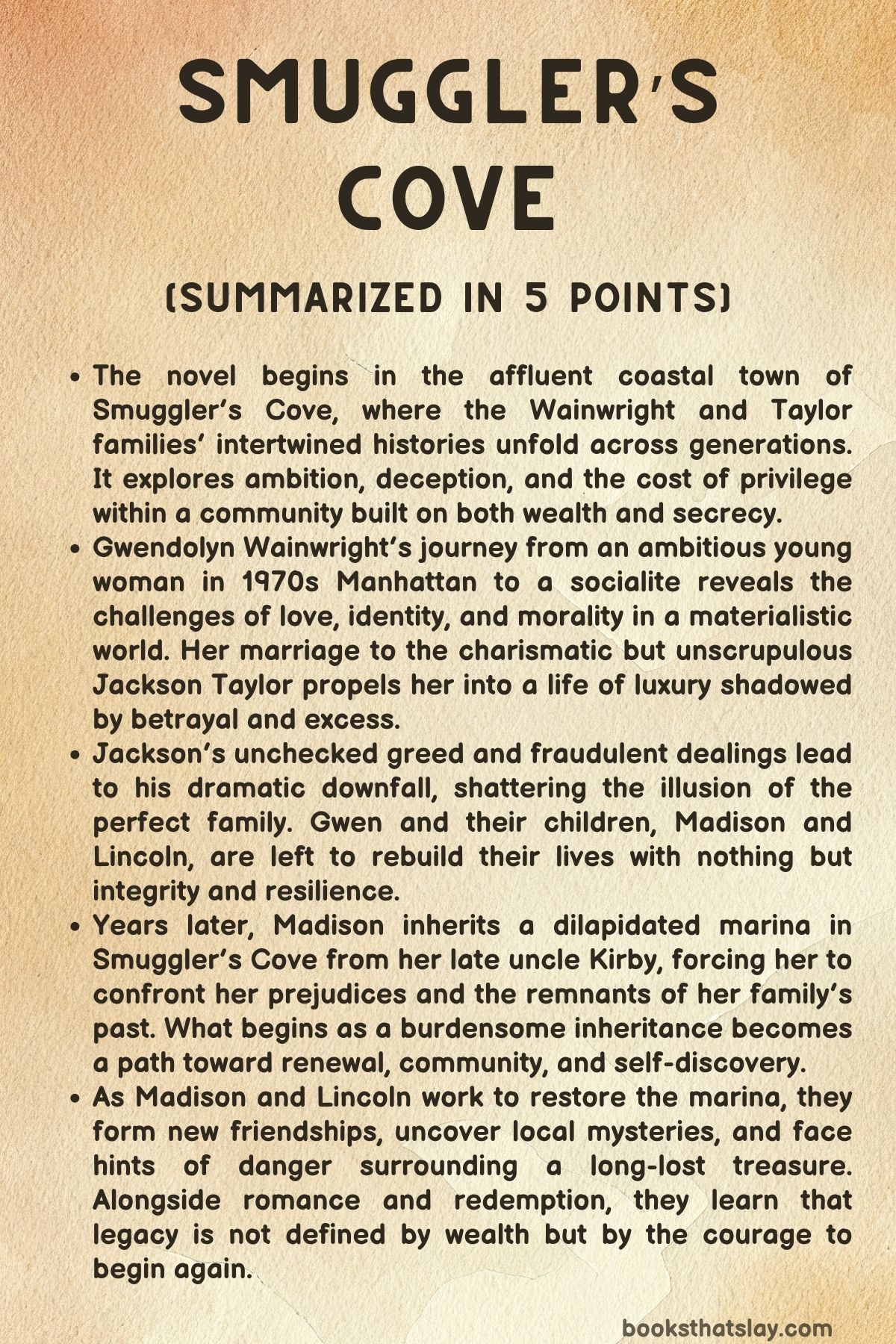
Smuggler’s Cove by Fern Michaels is a sweeping family drama set against the contrasting worlds of Wall Street privilege and small-town resilience. The novel traces the rise and fall of the Taylor family, beginning with Gwen Wainwright’s modest beginnings and her marriage to the ambitious Jackson Taylor, whose greed ultimately destroys everything they built.
Years later, their children Madison and Lincoln inherit not only their father’s sins but also a chance at redemption through their late uncle’s seaside marina in Smuggler’s Cove, New Jersey. Blending mystery, romance, and reinvention, the story examines how integrity and love can restore what wealth and deceit have ruined.
Summary
The story begins in the historic town of Smuggler’s Cove, New Jersey, once a haven for Dutch traders and pirates. This backdrop sets the stage for a multigenerational tale of ambition and moral reckoning.
Gwendolyn Wainwright, born in 1950s Connecticut, grows up in a secure, middle-class family and pursues an English degree with dreams of working in publishing. After graduating, she moves to Manhattan and begins work at a small Wall Street bank.
Intelligent and dedicated, Gwen rises quickly, earning respect and a trusted mentor. Through her social circle, she meets Jackson Taylor, a charming hedge fund manager whose ambition mirrors the excesses of 1970s finance.
Their romance moves swiftly, and within a year, they are married.
Gwen’s life transforms as Jackson’s career flourishes. She becomes a mother to Madison and Lincoln, settling into a life of luxury on Sutton Place.
Jackson, obsessed with prestige, lies about being descended from President Zachary Taylor to gain entry into elite circles. His success, however, is built on deception.
While Gwen manages their household with grace, Jackson indulges in drugs, alcohol, and affairs. Her growing disillusionment contrasts with his unrestrained hunger for wealth.
By the 1980s, Jackson and his associates engage in fraudulent financial schemes involving junk bonds and money laundering. Their glamorous façade crumbles in 1996 when federal marshals raid their apartment.
Gwen hides a few valuables before watching her husband arrested for fraud. Stripped of her fortune and dignity, she walks away, realizing how far she has fallen from her youthful dreams.
The narrative shifts to Jackson’s past. Raised by an abusive, alcoholic father and a resilient mother, Jackson learns early that charm and manipulation can replace honesty.
His younger brother, Kirby, grows into a humble fisherman, content with a simple life—an opposite path to Jackson’s greed. The brothers drift apart, and decades later, Kirby’s death will reconnect their families in unexpected ways.
Madison Taylor, Jackson and Gwen’s daughter, grows up in privilege but without emotional security. Her childhood is marked by her father’s coldness and her mother’s quiet strength.
An extravagant party for Madison’s kindergarten graduation exposes Jackson’s self-absorption when he ignores her fear of clowns for the sake of social appearances. His decision to send Madison to boarding school shocks Gwen but marks the beginning of Madison’s independence.
At Hackley, Madison finds friendship with a Japanese classmate, Niko, and discovers her gift for design by altering uniforms and creating costumes. She later earns a scholarship to the Fashion Institute of Technology.
Her brother Lincoln, sensitive and studious, follows an academic path, guided by teachers who admire his integrity. Their father’s lies about noble ancestry begin to unravel, and both children see the emptiness of his ambitions.
In 1996, Jackson’s crimes catch up with him. Gwen calls Madison with news of the arrest, and the siblings are forced to abandon their home as federal agents seize their assets.
Their lawyer advises them to remain hidden from the press and enraged investors. Gwen, unable to bear public humiliation, leaves the country.
Madison, now hardened by loss, vows to rebuild her life with Lincoln’s support.
Years later, Madison and her lifelong friend Olivia travel to One Willow restaurant to celebrate Madison’s inheritance from her late uncle Kirby—a marina in Smuggler’s Cove. Expecting a valuable property, she is horrified to find a decaying dock and a smelly, rundown office.
When her stiletto heel breaks through a plank, she ends up covered in mud, rescued by a kind local woman named Hannah. Madison’s humiliation softens her arrogance, and Hannah’s warmth begins to open her heart to a different world.
Their brother Lincoln soon arrives, bringing news that deepens the mystery: a body has been found beneath the dock. Detective Burton of the local police explains that the remains are of Dennis Farrell, a treasure hunter rumored to be searching for Captain Kidd’s lost gold.
The investigation introduces the siblings to Captain Viggo Eriksson of the U. S.
Coast Guard, a Norwegian-born officer whose integrity and calm demeanor attract Madison immediately.
Viggo, investigating Farrell’s death, suspects it might be tied to illegal smuggling. As he and Madison interact, a bond forms—respectful and cautious at first but filled with mutual admiration.
Meanwhile, the town prepares a seafood festival in honor of Kirby Taylor, who was beloved by the local fishing community. Madison, touched by the townspeople’s kindness, volunteers to help organize it.
Lincoln, pragmatic and patient, proposes restoring the marina rather than selling it. He discovers that it once turned a steady profit and convinces Madison and Olivia to invest in repairs.
They rent a nearby beach house to oversee the renovation, and for the first time in years, the siblings feel part of a genuine community.
Madison’s perspective changes as she spends time among the locals. She befriends Hannah and her husband Charlie, who run a clam food truck, and even tries their sandwiches despite her initial disgust.
Her connection with Viggo deepens through shared dinners and conversations about the town’s history. For Madison, love and purpose begin to replace the emptiness of luxury she once knew.
During renovation, Lincoln finds an old map hidden inside the marina’s shed walls. It appears to be linked to the same treasure Dennis Farrell sought.
The siblings frame it as a tribute to their uncle, unaware it still holds great value. As work progresses, Madison balances her demanding fashion magazine job in New York with her growing affection for Viggo.
She and Viggo share a lighthearted dinner at One Willow, where humor and honesty bridge their different worlds. Their relationship blossoms, supported by Olivia’s encouragement and Lincoln’s quiet approval.
Wanting to thank the townspeople, Madison hosts a dinner party for all who helped restore the marina. The evening is full of laughter and renewed hope.
When the renovations finish, Kirby’s Marina reopens with a celebratory ribbon-cutting ceremony. The town turns out in full support as Madison and Lincoln dedicate it to their late uncle.
The event symbolizes healing—not just for the siblings, but for their family’s name.
Yet peace is short-lived. Detective Burton arrives with troubling news: the shed has been broken into, and the old treasure map has vanished.
The theft rekindles the legend of Captain Kidd’s gold and hints that Farrell’s death may not have been accidental after all.
In the closing scenes, Madison, Lincoln, and Olivia stand together at the edge of the marina, vowing to find the missing map and protect their uncle’s legacy. Though their father’s greed once destroyed their family, the siblings have found something far greater—a sense of belonging, love, and integrity rooted in Smuggler’s Cove.
The story ends not in ruin, but in renewal, where the true treasure lies not in gold, but in the courage to begin again.
Characters
Gwendolyn (Gwen) Wainwright Taylor
Gwendolyn’s journey in Smugglers Cove is one of the most profound emotional evolutions in the novel. Beginning as a bright and idealistic young woman from a modest Connecticut background, she embodies integrity and aspiration.
Her early dreams of working in publishing reflect her curiosity and love of knowledge, qualities that set her apart in the materialistic world she later enters. Gwen’s marriage to Jackson Taylor becomes the crucible that defines her strength.
Initially swept away by his ambition and charm, she gradually learns that her husband’s empire rests on deceit and moral rot. Throughout her marriage, Gwen evolves from a passive observer of wealth to a woman quietly rebelling against its corruption.
Her nurturing love for her children—especially Madison—anchors her humanity amid chaos. Even in her final act of leaving Jackson and escaping the scandal, Gwen retains dignity, proving that self-respect can survive even the ruin of luxury.
Her arc stands as a testament to endurance, maternal courage, and moral awakening.
Jackson Taylor
Jackson Taylor serves as the novel’s central embodiment of ambition corrupted by greed. Born into dysfunction and poverty, his charm and intelligence become weapons of manipulation.
His father’s alcoholism and violence instill in him a hunger for control and validation that later transforms into ruthless opportunism. Jackson’s climb from an unremarkable background to the glittering world of Wall Street mirrors the era’s obsession with success, yet it also reveals the emptiness beneath the surface of wealth.
He constructs an identity built on lies—most notably his fabricated connection to President Zachary Taylor—to gain social acceptance. His life becomes an unending performance of success, masking emotional emptiness.
Jackson’s moral collapse, culminating in his arrest, exposes the cost of his ambition not only to himself but to his family. He is a man both victim and villain—driven by the scars of childhood and consumed by the very success he once idolized.
Madison Taylor
Madison is the emotional and thematic bridge between past sins and future redemption in Smugglers Cove. Growing up surrounded by affluence and deceit, she represents the new generation’s struggle to redefine worth beyond wealth.
Sensitive, creative, and observant, Madison inherits her mother’s empathy and quiet strength. Her love for fashion and design becomes not merely a career path but a means of self-expression and independence.
The fall of her family’s empire propels her into maturity; stripped of privilege, she learns resilience and humility. Her interactions with the down-to-earth townsfolk of Smuggler’s Cove mark a transformation from snobbery to sincerity.
Her relationship with Captain Viggo Eriksson symbolizes renewal and trust—a contrast to the hollow relationships that shaped her parents’ lives. Madison’s rediscovery of her family roots and her dedication to rebuilding Kirby’s Marina suggest that redemption lies not in denial of the past, but in reclaiming it with honesty and love.
Lincoln Taylor
Lincoln is the moral backbone of the Taylor family—a quiet, intelligent, and introspective character whose life contrasts sharply with his father’s corruption. His childhood is marked by emotional neglect, yet he grows into a young man guided by ethics and compassion.
Lincoln’s bond with Gwen and Madison reveals his deep sense of loyalty and fairness. Though academically gifted and rational, his decisions are often driven by conscience rather than ambition.
In his effort to restore Kirby’s Marina, Lincoln becomes a restorer not just of property but of moral order, seeking to turn the legacy of greed into one of community. His fascination with science and teaching reflects his desire for clarity and truth—values that counterbalance the deceit of his family’s past.
Lincoln’s steady presence anchors the narrative, showing that integrity, while quiet, is powerful enough to rebuild even what greed has destroyed.
Kirby Taylor
Kirby Taylor, Jackson’s brother, stands as a moral foil to him. Where Jackson is consumed by ambition, Kirby embraces simplicity and honesty.
His life as a fisherman and later as the owner of a small bait and tackle shop reflects contentment found in modest living. Despite his limited material wealth, Kirby is rich in integrity and kindness, qualities that endure even after his death.
His marina becomes both a literal and symbolic inheritance—a space where the next generation can rebuild what greed once ruined. Through Kirby’s memory, the novel highlights the idea that legacy is not about fortune but about decency and love.
His unseen influence guides Madison and Lincoln toward redemption, making him the quiet moral compass of the story.
Olivia Martinez
Olivia represents loyalty and compassion within the narrative’s younger generation. Her friendship with Madison transcends social boundaries and becomes a constant source of grounding and encouragement.
Coming from a more modest background, Olivia contrasts sharply with Madison’s early privilege. She navigates life with wit, practicality, and emotional intelligence.
Olivia’s role as a bridge between the Taylors and the local community underscores themes of empathy and understanding. Her presence humanizes Madison, reminding her of the value of authenticity over appearances.
In the later part of the story, her humor and optimism bring warmth to the otherwise somber process of rebuilding both the marina and the family’s sense of belonging.
Captain Viggo Eriksson
Captain Viggo Eriksson enters the story as both a romantic interest and a symbol of moral integrity. His Norwegian roots and maritime background connect him to the sea—an enduring motif in Smugglers Cove representing truth, history, and renewal.
Viggo’s disciplined life as a Coast Guard officer contrasts with the chaos surrounding Madison’s family. His sense of duty and calm composure give him an aura of strength without arrogance.
He serves as a reminder that power can coexist with humility. Through his growing relationship with Madison, Viggo becomes the embodiment of stability and honesty—traits that offer hope for a future untainted by deceit.
His connection to the town and his willingness to help in the investigation reflect his deep respect for community and justice.
Hannah and Charlie
Hannah and Charlie, the local couple who run the food truck “Clams on Wheels & a Pinch of Crabs,” represent the heart of Smuggler’s Cove—the hardworking, grounded spirit of small-town America. Their kindness toward Madison, despite her initial arrogance, becomes a catalyst for her transformation.
Hannah’s empathy and Charlie’s practical wisdom reflect the values of generosity and perseverance. They serve as mirrors to the Taylors’ excess, showing that happiness and dignity reside not in luxury but in honest labor and human connection.
Their friendship with Madison and Lincoln forms the foundation of the Taylors’ reconciliation with their family’s roots and the broader community.
Detective Burton
Detective Burton serves as the rational, grounding force of law and truth within the novel. His steady demeanor and investigative approach expose the moral contrasts between the old world of deceit and the new world of accountability.
Though a minor character in presence, his role is pivotal in connecting the Taylors’ personal redemption with the broader themes of justice. His cooperation with Captain Eriksson and fair treatment of the siblings reinforce the idea that truth, though delayed, always resurfaces—much like the body found beneath the dock that sets the final chain of events in motion.
Themes
Ambition and Moral Corruption
The story in Smugglers Cove captures the destructive nature of unchecked ambition through the rise and fall of Jackson Taylor. From his early years marked by manipulation to his eventual domination of the financial world, Jackson embodies the peril of prioritizing status over substance.
His relentless hunger for wealth blinds him to ethical boundaries, transforming ambition into moral decay. What begins as a drive to transcend his humble beginnings evolves into deceitful schemes and financial crimes.
His need for validation from elite society leads him to fabricate lineage, manipulate his marriage, and commodify his family’s image to sustain an illusion of grandeur. The collapse of his empire exposes not only his personal corruption but also the rot that festers beneath America’s culture of material success.
Jackson’s moral bankruptcy mirrors the greed-driven ethos of Wall Street in the late twentieth century, where ambition, divorced from integrity, becomes self-destructive. His downfall serves as a cautionary reflection on how ambition without conscience can hollow out one’s humanity, leaving behind only ruins—financially, emotionally, and morally.
Female Resilience and Reinvention
Through Gwen Wainwright and later Madison Taylor, Smugglers Cove unfolds as a chronicle of women navigating the expectations imposed by men and society. Gwen begins as a bright, independent woman with dreams rooted in intellect and self-worth.
However, marriage to Jackson redefines her existence around his ambition, reducing her to a social ornament in a world where appearances dictate value. Her silent endurance, though mistaken for submission, becomes a quiet rebellion—she nurtures her children with empathy and moral strength, qualities that survive long after the family’s fortune collapses.
Madison inherits this resilience, facing her father’s legacy of deceit and learning to rebuild her identity not through privilege but through perseverance and creativity. Her evolution—from a pampered socialite to a capable woman restoring her uncle’s marina—embodies renewal.
Fern Michaels portrays female endurance not as passive suffering but as transformation, where grace and determination overcome betrayal and loss. Both Gwen and Madison redefine success on their own terms, proving that strength often thrives in the ruins of broken dreams.
The Illusion of Wealth and Social Status
Throughout Smugglers Cove, wealth is presented as both seductive and poisonous. Jackson Taylor’s obsession with luxury and recognition drives the story’s central tragedy.
He fabricates ancestry, manipulates financial systems, and crafts a life centered on artifice, only to be consumed by it. The Sutton Place apartment, lavish galas, and glittering parties become symbols of a hollow existence, masking instability and emotional voids.
Gwen’s growing disillusionment and Madison’s eventual disconnection from this world reveal how material success, when built on deceit, breeds isolation rather than fulfillment. The marina in Smuggler’s Cove acts as a striking contrast—a place of honest labor, humility, and community.
It reminds the Taylors that worth is not measured by possessions but by integrity and human connection. By the novel’s end, the shift from Wall Street towers to weathered docks marks the family’s moral awakening.
The illusion of wealth collapses, leaving behind an understanding that authenticity—whether in love, work, or identity—outlasts opulence.
Family Legacy and Redemption
The novel traces the Taylor lineage across generations, examining how patterns of deceit, pride, and moral failure can echo through time. Jackson inherits emotional wounds from a fractured childhood dominated by violence and instability, passing those scars onto his own family through emotional neglect and lies.
Yet, through Gwen, Madison, and Lincoln, the narrative offers the possibility of redemption. The discovery of Uncle Kirby’s marina becomes a turning point—a chance to rebuild not only a property but a fractured sense of belonging.
In restoring the marina, the siblings metaphorically cleanse the family name, replacing deceit with honesty, greed with generosity, and detachment with community. Their collaboration with townspeople such as Hannah and Charlie signifies a break from the self-serving legacy of their father.
Redemption here is not sudden or grand but gradual, rooted in humility and labor. The Taylors reclaim dignity not by erasing the past but by transforming its lessons into moral growth, proving that legacy is not fixed—it can be rewritten through integrity and compassion.
Community, Belonging, and the Meaning of Home
In Smugglers Cove, the concept of home evolves from a physical space into an emotional sanctuary shaped by trust and connection. The grandeur of the Taylors’ New York apartment stands in stark contrast to the humble yet genuine warmth of the Smuggler’s Cove community.
Initially, Madison views the marina as an unwanted burden, but it soon becomes a place of rediscovery—where she learns the value of friendship, hard work, and acceptance. The townspeople, unpretentious and kind, offer a form of belonging that wealth never provided.
Through shared meals, laughter, and mutual support, the marina transforms into a symbol of collective renewal. It reflects the healing power of community, where forgiveness and understanding replace isolation and vanity.
By finding a home among ordinary people, Madison rediscovers herself. The cove, once associated with smuggling and secrecy, ultimately becomes a refuge of sincerity and emotional truth.
Fern Michaels turns this setting into a reminder that home is not defined by luxury but by the relationships that give life purpose and warmth.