So Thirsty by Rachel Harrison Summary, Characters and Themes
So Thirsty by Rachel Harrison is a darkly humorous, character-driven horror novel that explores womanhood, aging, friendship, and the search for vitality in a world that often drains both body and spirit.
Through Sloane’s perspective—a thirty-something woman suffocating in her marriage and struggling with the fear of irrelevance—the book takes readers on an eerie and emotional journey. What begins as a weekend getaway between two lifelong friends quickly unravels into a surreal, blood-soaked confrontation with mortality, temptation, and transformation. Harrison balances sharp wit with creeping dread, crafting a modern vampire tale that is as much about identity and empowerment as it is about survival.
Summary
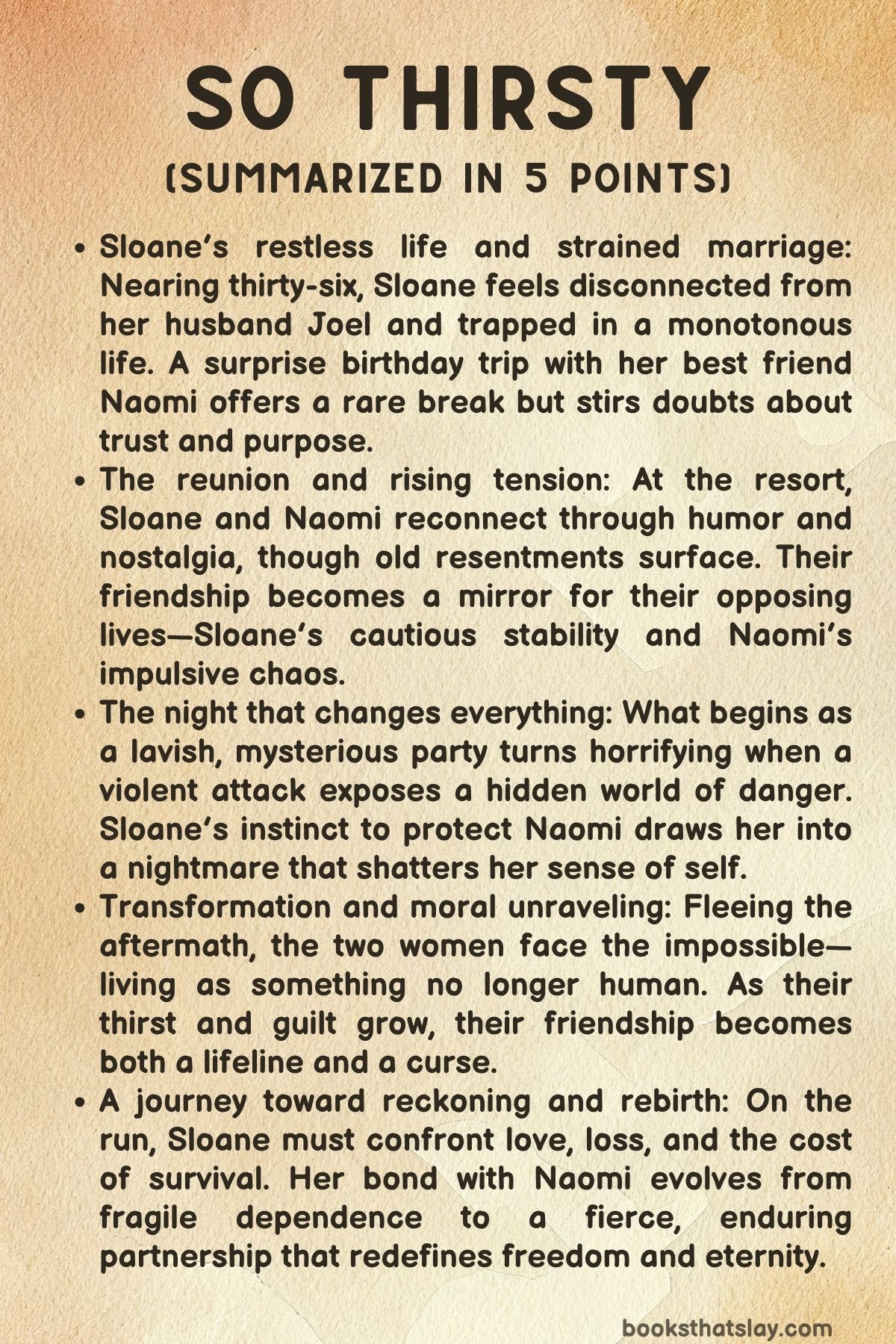
Sloane, nearing her thirty-sixth birthday, wakes from another dream set in her recurring “dream mall,” a strange shared motif she and her best friend Naomi have experienced for years. Her morning feels hollow—her husband Joel’s forced cheer clashes with her own apathy and quiet resentment. She feels the weight of time on her face, her body, and her marriage, which has grown cold since Joel’s past affair.
When Joel surprises her with a weekend trip to a luxury resort in Auburn for her and Naomi, Sloane’s reaction is mixed—grateful yet uneasy. After he leaves for work, she’s filled with restless energy and self-loathing, finding fleeting comfort in routine chores before calling Naomi, who’s abroad with her rock-star boyfriend. Naomi’s chaotic, vibrant presence over the phone reignites Sloane’s spark, and she agrees to the trip despite lingering doubts.
Driving alone through a bleak winter landscape, Sloane reflects on her life’s small disappointments and the invisible cage she’s built for herself. Auburn’s pristine beauty unsettles her—the resort is an opulent, sterile fantasy. Her assigned cottage, “Whispering Woods,” is beautiful but hollow. When Naomi arrives, all energy changes. Naomi storms in with perfume, laughter, and stories, teasing Sloane back to life.
Their dynamic—Naomi’s wildness against Sloane’s restraint—feels like home. That night, they explore the town, stopping at a bar where Naomi drinks and flirts, leaving Sloane to stew in her own loneliness. Memories of their teenage years flood back—two girls forming an unbreakable bond against the dullness of the world. But when Naomi’s drunken antics push Sloane’s patience, they argue, accusing each other of cowardice and denial. The fight fizzles out, replaced by mutual tenderness.
Later that night, strange noises rattle the windows. Sloane sees a shadow outside her second-story window—an impossible sight. She convinces herself it’s a dream, but unease lingers into morning. A handprint on the glass confirms her fears, though she brushes it off. Naomi, ever irreverent, mocks the creepiness and focuses on Sloane’s upcoming birthday.
Over breakfast, they laugh and bicker, temporarily restoring normalcy. Naomi hints at a birthday surprise, and after a day of wine tasting and reminiscing about old high school rebellions, they meet Ilie, a charming host who invites them to a private party at his lakeside mansion. Despite Sloane’s instinct to decline, Naomi insists. The mansion’s lavish interior and seductive atmosphere put Sloane on edge—everything feels too deliberate, too hungry.
Inside, they meet a group of beautiful, unnervingly calm strangers. The mood turns sensual and disorienting as people drink, flirt, and lounge. Naomi, emboldened by drink, removes Sloane’s rings and pushes her to be free for one night. Sloane drifts toward Henry, a quiet man who seems both kind and menacing. Their conversation cuts deep, exposing her insecurities and regrets. They share an impulsive kiss, but Henry soon reveals something disturbing: he saw her through her cottage window the night before. The realization snaps Sloane back into fear.
When she hears noises from the basement, she becomes convinced someone is imprisoned below. Moments later, a ghastly man emerges, pale and skeletal. In a horrifying blur, he attacks Naomi, tearing into her neck. Acting on instinct, Sloane bludgeons him to death with a fire poker, splattering blood across the ornate room as the party descends into chaos.
In the aftermath, Sloane is overwhelmed with guilt, fear, and confusion. But the horror is only beginning. Naomi survives—but changes begin to manifest. Both women develop an unbearable thirst and strange physical sensations. While searching for answers, Sloane follows Naomi into the woods and discovers her feeding on a rabbit. Naomi’s horror and shame mirror Sloane’s disbelief.
Their terror intensifies when a resort porter stumbles upon them; Naomi attacks and drinks his blood. Sloane tries to stop her but ends up succumbing to her own craving, taking a sip that feels euphoric and damning all at once. They bind the man’s wound and flee the resort, realizing they are no longer human.
On the road, they cling to denial, pretending they can control their urges. They plan to hide out at Naomi’s family home, but hunger keeps breaking through. At a rest stop, Naomi kills a man, claiming self-defense. Sloane is horrified but helps her dispose of the body.
The moral boundaries that once defined them begin to blur. As they travel, Naomi’s recklessness and Sloane’s guilt create friction, though their bond endures. Naomi insists on confronting her boyfriend Lee one last time. The meeting turns violent when he grabs her; she bites him and flees. They throw away their phones and wedding rings, symbolically abandoning their pasts. But a black van begins to follow them, its driver revealed to be Ilie, who insists he is their creator and protector. He brings them bags of blood, claiming it’s from hospitals, but Sloane doesn’t trust him. The two friends argue over whether to accept their fate or fight it.
When Naomi loses control again and attacks an innocent woman, the world around them starts collapsing.
Sloane intervenes, and during their chaotic escape, a car crash leaves them uninjured but fully aware of what they’ve become. Naomi runs off into the darkness, driven by thirst. Later, Sloane wakes among Ilie’s group of vampires, including Henry and others who reveal the hidden world she now belongs to. On a journey through desolate towns, she learns about their existence—how vampires sustain themselves, the ethics of feeding, and the constant tension between craving and restraint.
They encounter Ms. Alice, a deranged outcast vampire who feeds on flesh rather than blood.
She tempts Sloane toward savagery, but Henry saves her, revealing his centuries-long burden and loneliness. The group continues their travels, planning to rob a blood bank to survive. The heist goes wrong when a violent confrontation leaves Naomi mortally wounded. Desperate, Sloane kills a man to feed her, but Naomi bleeds out in her arms. In the ruins of an abandoned shopping mall—the same one from her dreams—Sloane lets Naomi drink from her own wrist, sacrificing her blood to revive her. As Sloane fades, Henry and the others arrive, finding both women alive.
Years later, in Prague, two travelers spot a group of ageless figures at a café—Sloane and Naomi, radiant and unbothered, walking hand in hand. Their friendship has survived death, guilt, and transformation.
Together, they live on—eternal, united, and finally free.
Characters
Sloane
Sloane, the protagonist of So Thirsty, embodies a woman suffocating under the weight of her own dissatisfaction and the passage of time. Approaching her thirty-sixth birthday, she feels the sharp dissonance between the life she once imagined and the one she inhabits—a dull, domesticated routine marked by emotional estrangement from her husband, Joel.
Her obsession with small signs of aging—like a single forehead line—reflects a deeper anxiety about invisibility and the loss of identity. The recurring “dream mall” motif represents both nostalgia and the haunting persistence of unfulfilled desire. Throughout the narrative, Sloane’s transformation from a passive, self-contained woman into a creature of hunger and agency—literally through vampirism—mirrors her psychological awakening. As she navigates the violent, erotic, and supernatural shifts in her life, Sloane learns to embrace her suppressed instincts.
The thirst that consumes her becomes both curse and liberation, a metaphor for reclaiming the vitality and rage she once repressed. By the end, Sloane evolves into a figure of autonomy and darkness, her former fragility replaced by a fierce, self-determined immortality shared with Naomi.
Naomi
Naomi serves as Sloane’s mirror opposite—vibrant, reckless, and unashamedly alive. She radiates charisma and chaos, embodying the untamed spirit Sloane lacks. Her bohemian lifestyle, touring Europe with her rock-star boyfriend Lee, is steeped in hedonism and motion, contrasting Sloane’s suburban stagnation.
Naomi’s love for Sloane is profound yet volatile, rooted in their teenage bond and sustained by mutual dependency. When she becomes a vampire, Naomi accepts the transformation almost instinctively, reveling in the thrill and sensuality of it. Her impulsiveness, once a source of conflict, becomes both her strength and her downfall.
Naomi’s evolution captures the danger of unrestrained desire—the same thirst that liberates Sloane ultimately consumes her. Yet, even in death and resurrection, Naomi’s enduring loyalty to Sloane signifies a love that transcends mortality. She remains a symbol of unfiltered passion and fearless rebellion, her immortality defined not by monstrosity but by authenticity.
Joel
Joel, Sloane’s husband, represents the hollow comfort of conformity. His surface-level cheerfulness and attempts at romantic gestures, like the surprise getaway, mask the emotional distance and infidelity that corrode their marriage. To Sloane, Joel is both familiar and alien—a man she once loved but now views through the lens of disillusionment.
His character underscores the novel’s critique of domestic stagnation and performative happiness. While he never becomes a central figure in the supernatural conflict, Joel’s presence lingers as a symbol of Sloane’s former self—the version that tolerated mediocrity and betrayal. His moral weakness and superficial optimism stand in sharp contrast to the raw honesty of Sloane’s later vampiric existence.
When Sloane ultimately leaves him, it signifies her rejection of false security and her acceptance of the dangerous, transformative hunger that defines her new identity.
Henry
Henry is the enigmatic stranger who both seduces and enlightens Sloane. Initially mysterious and unsettling, he challenges her complacency, provoking her to confront her fears and desires.
His confession of having watched her from the shadows establishes him as both predator and confessor—a reflection of the voyeuristic tension that runs through the novel. As the story progresses, Henry evolves into a guide and protector, offering Sloane a philosophy of survival within their vampiric existence. His backstory as a centuries-old prince cursed with immortality adds depth to his melancholy and allure. Through him, Sloane experiences both romantic awakening and existential clarity. Henry’s affection for her is tinged with reverence; he sees in her a reminder of the humanity he has long lost.
Ultimately, Henry represents the paradox of eternal life—beauty intertwined with decay, love with hunger, and freedom with the burden of eternity.
Ilie
Ilie, the charismatic host who lures Sloane and Naomi into his mansion, embodies temptation in its most dangerous form.
With his seductive charm and cryptic hospitality, he acts as the gateway into the underworld of vampirism. Ilie’s motives remain ambiguous—part caretaker, part manipulator, and part predator. His presence blurs the boundary between indulgence and corruption, reflecting the novel’s preoccupation with desire as both ecstasy and enslavement.
When he later reappears offering blood “from the hospital,” his control over Sloane and Naomi symbolizes addiction’s hold—the illusion of care masking coercion. Ilie’s character serves as a dark mirror to Joel’s; where Joel represents mundane deceit, Ilie personifies the seductive danger of transcendence.
Ms. Alice
Ms. Alice is the grotesque embodiment of what happens when thirst consumes all remnants of morality. As an ancient, ostracized vampire, she represents the endpoint of unchecked hunger—a being who has surrendered entirely to monstrosity.
Her macabre hospitality and cannibalistic habits expose the darker side of immortality. She fascinates and horrifies Sloane, serving as a grim warning of what she could become if she loses her humanity.
Alice’s violence and manipulations highlight the moral tension at the heart of So Thirsty: the struggle between feeding and feeling, survival and conscience. Through Alice, the narrative explores the price of eternal life—the decay of empathy and the transformation of desire into corruption.
Tatiana
Tatiana is one of Ilie’s companions, enigmatic and quietly perceptive. She acts as both confidante and skeptic within the vampire group, offering Sloane counsel about embracing her nature while maintaining awareness of its dangers. Tatiana’s calm detachment and philosophical outlook balance the chaos around her.
She recognizes in Sloane the familiar conflict of denial and desire, urging her toward acceptance rather than repression. Her role, though secondary, enriches the thematic texture of the story, representing the possibility of coexistence between monstrosity and mindfulness.
Elisa
Elisa, another member of the vampiric circle, represents the pragmatic survivor. She is practical, composed, and loyal, helping the group navigate the logistical realities of their existence—feeding, hiding, and traveling. While less emotionally vivid than others, Elisa’s steadiness provides contrast to Naomi’s impulsiveness and Sloane’s moral turmoil.
She grounds the narrative’s supernatural elements in a sense of lived continuity, showing that even immortality demands structure and compromise.
Lee
Lee, Naomi’s rock-star boyfriend, is a figure of fame and toxicity. His relationship with Naomi embodies the clash between freedom and possession.
To Naomi, he symbolizes glamour and validation; to Sloane, he epitomizes the superficiality of modern love. When Lee reacts violently to Naomi’s attempt to leave, his aggression exposes the darker currents beneath celebrity and charisma. His encounter with Naomi after her transformation demonstrates how the human world can never reconcile with the monstrous freedom she has embraced.
Lee’s role, though brief, reinforces the novel’s recurring theme of entrapment within appearances—whether through marriage, fame, or immortality.
Matthew and Dave
Matthew, the innocent porter attacked during Naomi’s bloodlust, and Dave, the predatory man shot in self-defense, serve as human casualties in Sloane and Naomi’s descent.
They symbolize the moral cost of survival—the blurring of predator and prey. Through them, the story interrogates guilt, necessity, and the irreversible loss of innocence that accompanies transformation. Each encounter forces Sloane to confront the consequences of her new existence, pushing her further toward the acceptance that morality, like mortality, must evolve in order to endure.
Themes
Identity and Transformation
Sloane’s journey in So Thirsty charts a profound metamorphosis from passive existence to radical self-awareness. Her transformation into a vampire is not a mere supernatural device—it mirrors her psychological awakening.
At the start, she lives within a carefully arranged yet suffocating life, trapped in a stale marriage and a rigid self-concept that prioritizes control over authenticity.
Her dissatisfaction—manifested through her fixation on aging, beauty, and the loss of vitality—reflects a deep spiritual thirst for meaning. The vampire transformation becomes an externalization of this inner void. Through it, she experiences physical empowerment, heightened senses, and emotional liberation, but at the cost of confronting the parts of herself she once repressed: rage, desire, and hunger.
This evolution blurs the line between self-destruction and self-realization. Rachel Harrison uses Sloane’s newfound vampirism to explore what it means to shed socially imposed identities—the obedient wife, the docile friend—and embrace one’s own chaotic nature. Sloane’s “thirst” thus becomes symbolic not only of bloodlust but also of suppressed ambition, neglected sensuality, and the longing to exist without apology. By the novel’s end, her vampiric state represents not monstrosity but completion, a reclamation of her agency.
She no longer defines herself through Joel’s affection or Naomi’s energy; instead, she becomes her own source of power, embracing immortality as a metaphor for eternal self-possession.
Female Friendship and Dependency
At the heart of So Thirsty lies the complex, emotionally charged bond between Sloane and Naomi—a friendship that oscillates between fierce loyalty and toxic dependency. Their connection is built on shared history, mutual admiration, and unspoken envy. Naomi’s unrestrained personality embodies everything Sloane suppresses: spontaneity, sensuality, and defiance.
Sloane, in turn, offers Naomi stability and moral grounding. Together, they create a volatile but vital balance, one that both sustains and endangers them. When vampirism enters their lives, it amplifies these dynamics rather than erases them. Their hunger becomes a metaphor for the emotional consumption that has always defined their relationship—Naomi’s tendency to dominate, Sloane’s inclination to absorb. Yet despite jealousy, betrayal, and violence, their bond remains unbreakable.
Harrison crafts their friendship as a reimagining of romantic intimacy between women—one built not on societal norms but on raw emotional truth. Through shared trauma and survival, they evolve from co-dependent mortals to equal immortals. By the end, Sloane’s revival of Naomi with her own blood transcends friendship and becomes a sacred act of creation—a symbolic rebirth where love overcomes death. Their unity in eternity represents the novel’s ultimate assertion: that chosen kinship can be as transformative, and as binding, as any form of romantic or familial love.
Female Rage and Repression
Throughout So Thirsty, Sloane’s inner rage simmers beneath the surface of her polite suburban existence. Her resentment toward Joel’s infidelity, societal expectations, and her own complicity in living small manifests as fatigue and apathy. The novel gradually exposes how women are conditioned to suppress anger—to smile through betrayal, to maintain order while their desires rot beneath the surface.
The introduction of vampirism becomes an act of rebellion against this conditioning. The thirst for blood mirrors the hunger for expression long denied. When Sloane kills the attacking man at Ilie’s house, the violence is both horrifying and cathartic—it represents a reclamation of the primal energy she has been forced to stifle.
Her subsequent guilt exposes the paradox of liberation: empowerment demands confrontation with one’s own darkness. Harrison uses blood as a visceral metaphor for rage, the life force that women are taught to fear within themselves. By the time Sloane fully embraces her thirst, she ceases to be a victim of repression. Her violence is no longer reactionary but assertive—a refusal to apologize for existing powerfully. The novel thus transforms female fury from something shameful into something sacred, suggesting that rage, when acknowledged, can become a path toward authenticity rather than destruction.
Mortality and the Fear of Time
The shadow of aging and mortality looms large in So Thirsty, framing Sloane’s existential dread long before her transformation.
Her anxiety over a new wrinkle, her fixation on time slipping away, and her fear of stagnation reveal a modern crisis of identity shaped by the cult of youth. The supernatural intervention of immortality forces her to confront what it truly means to live forever. Rather than offering freedom, eternal life intensifies her confrontation with meaning—if time no longer ends, what gives life purpose?
Harrison’s portrayal of vampirism undermines the fantasy of everlasting beauty; immortality becomes an endless cycle of hunger and concealment. Yet paradoxically, it also liberates Sloane from her fear of decline. By dying and being reborn, she realizes that time’s passage is not an enemy but an illusion. Her eventual peace, walking through Prague hand in hand with Naomi, reflects acceptance rather than denial.
The novel suggests that the human obsession with preserving youth is itself a kind of undeath, and true immortality comes only through self-acceptance and emotional evolution. In this way, the story turns mortality into a mirror—forcing both its heroine and readers to question whether eternity without transformation is any better than a mortal life fully lived.
Desire, Control, and the Body
In So Thirsty, desire operates as both a source of empowerment and a site of peril. Sloane’s relationship with her body is defined by control—diet, discipline, restraint.
Her transformation into a vampire obliterates that control, replacing it with an insatiable appetite that demands surrender. The physicality of thirst—blood as sustenance, intimacy, and addiction—forces her to inhabit her own body in ways she never allowed herself to before.
Harrison uses vampirism as a feminist metaphor for bodily autonomy: to hunger, to crave, to consume are radical acts in a culture that demands female self-denial. Yet the novel does not romanticize indulgence. The more Sloane feeds, the more she risks losing her sense of self, suggesting that liberation requires balance between instinct and conscience.
Her evolving relationship with desire—sexual, emotional, and physical—reflects a reconciliation of body and mind. By the end, she no longer fears her cravings or hides from them; she understands that control is not about repression but harmony. Her acceptance of thirst, rather than its eradication, signals the ultimate empowerment: living truthfully within one’s desires without being devoured by them.