Some Bright Nowhere Summary, Characters and Themes
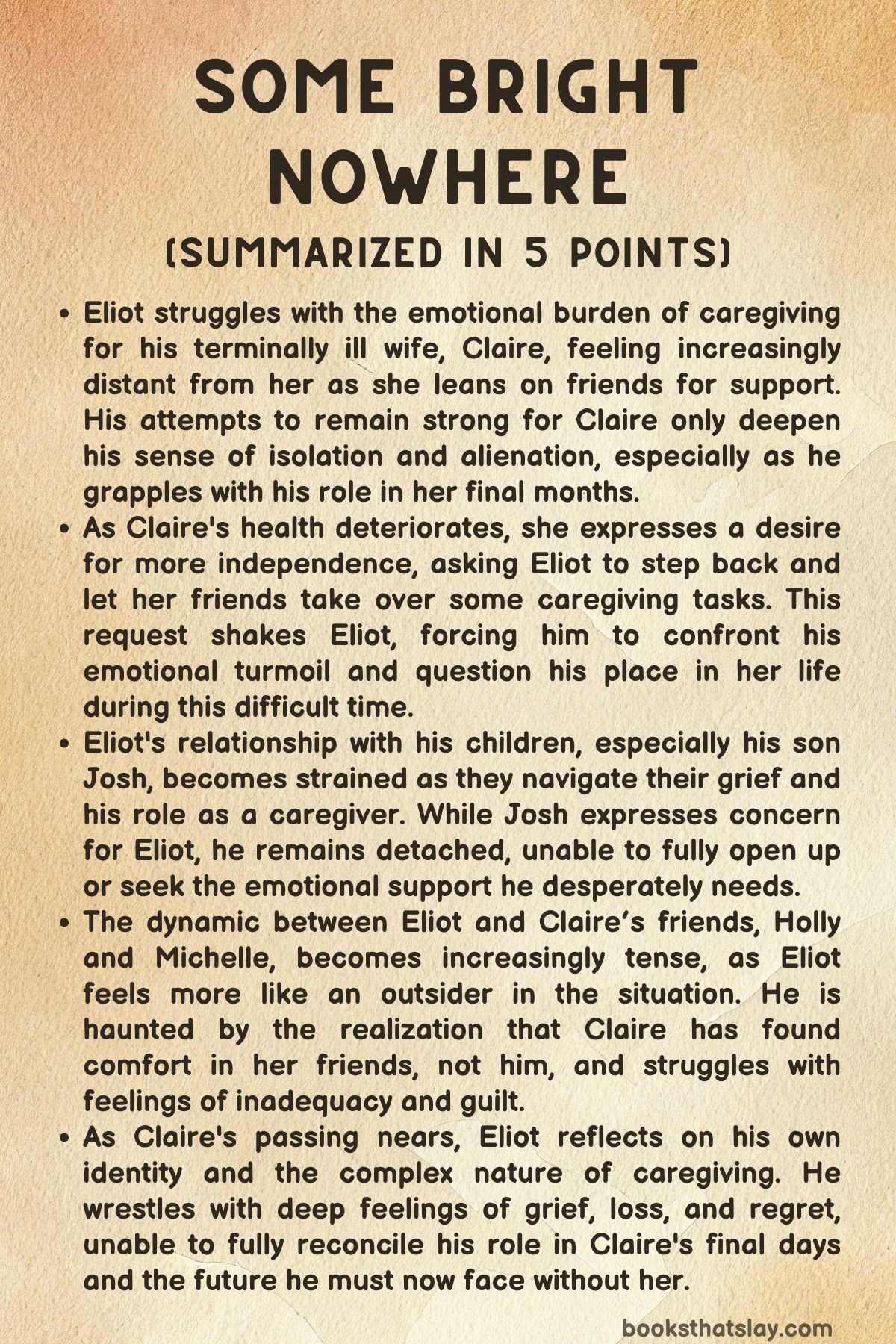
Some Bright Nowhere by Ann Packer is a profound exploration of love, loss, and the complexities of caregiving. Set against the backdrop of a terminal illness, the novel follows Eliot, who is deeply involved in caring for his wife, Claire, in the final months of her life.
As Claire’s health deteriorates, the emotional distance between them grows, and Eliot struggles with his role as her caregiver. The narrative examines the strain of such an experience on personal relationships, particularly with family and friends. Throughout, Eliot faces his own internal turmoil, questioning his decisions, his past, and his identity, while also coming to terms with the impending loss of his partner.
Summary
The story begins as Eliot and his wife Claire visit Dr. Steiner, marking the end of her cancer treatments. While Claire is physically frail and worn out, there is a fleeting moment of levity between her and the doctor.
Despite the ending of her treatment, Claire’s illness continues to take its toll, and she spends much of her time resting in bed, while Eliot struggles to stay engaged in daily tasks. Although he tries to keep busy, he cannot escape the weight of the situation, and his emotional detachment becomes evident when Holly, a close friend of Claire’s, visits with food.
She inquires about Claire’s condition and also asks Eliot how he is coping. His detached response masks the emotional struggle he’s experiencing internally.
The day goes on with Claire’s friends, Holly and Michelle, visiting her, offering comfort and support as Claire’s condition worsens. However, Eliot feels increasingly isolated.
His relationship with his children, Abby and Josh, grows strained. Abby, concerned about her father’s emotional state, suggests that he needs support, but Eliot brushes off her concern.
As Claire’s health deteriorates, she asks Eliot to step back and let her friends take over some of the caregiving responsibilities. Initially hurt by this request, Eliot eventually comes to terms with it, although it amplifies his internal conflict.
He’s torn between wanting to care for Claire and respecting her wishes.
The tension in the family rises when Abby and Josh visit, and Josh expresses his concern for Eliot. Their conversations highlight the growing emotional distance between Eliot and the rest of the family.
Eliot, still unsure of his place in the situation, feels abandoned by Claire, especially after she asks for her friends to be present at the end of her life, rather than him. This request marks a pivotal moment in their relationship and forces Eliot to confront the deepening divide between them.
As Claire’s condition worsens, Eliot becomes more of an observer in her final months. His emotional turmoil increases as he reflects on their past life together, his role as a father, and his failures as a caregiver.
His internal struggles also become apparent in his interactions with friends and family, where he is unable to bridge the growing gap between himself and those around him. His relationship with his children, particularly Josh, becomes more strained as they try to navigate their grief and fear over the impending loss.
Throughout this time, Eliot is left to reconcile his feelings of love, grief, and abandonment, unsure of how to move forward.
Later, Eliot spends some time at his old friend Stuart’s home in Beverly Hills, seeking a change of scenery. There, he reflects on his life and the deep grief he feels for Claire.
While Stuart is preoccupied with his career, Eliot struggles with the emotional weight of his situation. He becomes lost in his thoughts, reflecting on his relationship with Claire and the life he’s losing.
A poem from a friend about waiting for a loved one’s death stirs deep emotions in Eliot, intensifying his sense of loss.
As Claire’s condition deteriorates further, Eliot feels himself growing more lost. He struggles with the emotional and physical demands of caregiving.
He tries to offer comfort, but his efforts feel hollow, especially when Claire responds tepidly to his gesture of bringing her blueberry scones. The disconnect between them grows, leaving Eliot feeling more like a bystander than an active participant in her life.
His efforts to reach out to friends and colleagues also highlight his sense of displacement. Even though he attempts to engage with others, including a former colleague, it only serves to reinforce his isolation.
Eliot’s emotional state continues to unravel as he reflects on his failures as a husband and caregiver. The arrival of his daughter Abby with her children adds to the emotional complexity of the situation.
Abby is acutely aware of her mother’s condition and the toll it has taken on her family, but she too must grapple with the reality of Claire’s decline. Eliot’s relationship with Abby becomes strained as he struggles to manage his grief and responsibility.
Eventually, Claire asks Eliot to assist her with her physical needs, further intensifying his sense of inadequacy. He becomes overwhelmed by the enormity of his role in Claire’s final days, grappling with his inability to make her last moments more meaningful.
While he tries to find comfort in small gestures, nothing seems to ease the emotional burden he bears. The emotional strain intensifies as Claire’s death becomes inevitable.
In the final days, Eliot becomes more involved in Claire’s care but is consumed by guilt, unsure of how to support her. He feels the weight of missed opportunities for emotional connection, and despite his best efforts, he struggles to prepare himself for her death.
When Claire passes away, Eliot is left to confront the deep void her absence creates. His grief is compounded by a sense of failure, as he reflects on their relationship and his role as a caregiver.
As the story concludes, Eliot is left to reckon with his loss, his shortcomings, and the uncertainty of life without Claire. The emotional distance that grew between them during her illness remains, leaving Eliot with unresolved questions about his role in her final days.
Despite his attempts to do right by Claire, he cannot escape the pain of her death or the questions about what he could have done differently. The novel ends on a somber note, highlighting the complexities of love, caregiving, and the grief that accompanies loss.
Characters
Eliot
Eliot is at the heart of the narrative, a man struggling with his identity, his role as a caregiver, and the profound emotional turmoil caused by his wife Claire’s terminal illness. Throughout Some Bright Nowhere, Eliot’s internal conflict is a central theme.
As Claire’s health deteriorates, Eliot becomes increasingly distanced from her, both physically and emotionally. His attempts to maintain a semblance of normalcy by performing small gestures for her, such as delivering soup or bringing her blueberry scones, highlight his deep-seated sense of inadequacy and frustration.
Despite his best efforts, he feels like an outsider in his own life, unable to provide the comfort or emotional connection that Claire craves in her final months. This sense of alienation is exacerbated by Claire’s reliance on her friends, Holly and Michelle, for emotional support, which leaves Eliot questioning his place in her life.
Eliot also grapples with his relationship with their children, Abby and Josh. His refusal to acknowledge his own emotional needs, despite Abby’s attempts to offer support, further isolates him.
As the story progresses, Eliot’s self-reflection intensifies. He questions whether he has truly understood his wife, her desires, and his role in her death.
His journey is one of painful self-discovery, where he must reconcile his feelings of guilt, helplessness, and the overwhelming grief of impending loss.
Claire
Claire’s character is portrayed primarily through the lens of Eliot’s experiences with her. While she is physically present, her emotional distance from Eliot grows as her illness progresses.
Claire’s decline is depicted with a certain resignation, and she expresses a desire for her final days to be surrounded by her friends, Holly and Michelle, rather than Eliot. This request deeply wounds Eliot, but it also marks a turning point in their relationship, where Claire asserts her own needs and preferences for the end of her life.
Throughout the narrative, Claire’s focus is on maintaining some sense of autonomy in her illness, a choice that leads to tension between her and Eliot. While she is not overtly angry or filled with regret, her actions and decisions speak volumes about her emotional state.
Her illness strips away the emotional complexity that might typically characterize such a situation, leaving her with a quiet acceptance of her fate. This portrayal adds depth to her character, showcasing her strength and the way she navigates the final chapter of her life with grace, even as she becomes increasingly dependent on others.
Holly
Holly is one of Claire’s closest friends and plays a pivotal role in Claire’s care, offering both practical and emotional support. While she is a source of comfort for Claire, she also represents the life that Eliot feels increasingly disconnected from.
Holly’s relationship with Eliot evolves as he becomes more isolated in his role as the primary caregiver. Despite the warmth and care she provides, Holly inadvertently serves as a reminder of the distance between Eliot and Claire.
She is also a point of tension in the story, particularly as she becomes part of the tight-knit support system around Claire, which Eliot feels shut out from.
Holly’s interactions with Eliot reveal her awareness of his emotional struggles. She is one of the few characters who sees through his facade of strength, acknowledging his emotional isolation without pressing him to confront it.
Her presence in the story highlights the complexities of friendship during times of crisis and how relationships can evolve when faced with life-altering situations like illness.
Michelle
Michelle, another of Claire’s friends, also plays a significant role in the caregiving process. Along with Holly, she provides the support that Claire needs as Eliot becomes more emotionally distanced.
Michelle’s character is defined by her calm demeanor and practical approach to caregiving, balancing her duties with a sense of quiet resilience. Like Holly, Michelle helps fill the gap left by Eliot’s emotional withdrawal.
Her role in the story also serves to highlight the contrast between the women and Eliot. While Eliot struggles with feelings of inadequacy and frustration in his caregiving role, Michelle embodies a more grounded and accepting attitude toward the situation.
Her ability to support Claire without becoming overwhelmed contrasts sharply with Eliot’s inner turmoil. Michelle represents the practical aspect of caregiving that Eliot is unable to fully embrace, offering a sense of stability in the face of crisis.
Abby
Abby, Eliot’s daughter, is a significant emotional presence in the story, though her relationship with her father is strained. As Claire’s illness progresses, Abby tries to offer support, but Eliot is often too focused on his own emotional battles to truly accept her help.
Abby’s concern for her father’s well-being highlights the fractured nature of their relationship, as she attempts to bridge the emotional gap between them. Her insights into Eliot’s emotional struggles offer a perspective that Eliot himself is reluctant to acknowledge.
Throughout the story, Abby represents the generational divide and the evolving dynamic within families dealing with illness. She is caught between wanting to support her father and recognizing the emotional distance that has grown between them.
Her role underscores the challenges of maintaining familial bonds in the face of terminal illness, where grief, guilt, and unresolved emotions often complicate efforts to connect.
Josh
Josh, Eliot’s son, is an adult who struggles with his own feelings of loss as his mother’s health declines. His relationship with Eliot is similarly strained, and his attempts to connect with his father often go unreciprocated.
Josh’s breakdown over the situation exposes the emotional weight he carries, and his feelings of regret and sadness further highlight the disconnection between the family members.
Josh’s character represents the generational impact of illness, as he grapples with the loss of his mother while also trying to understand his father’s emotional turmoil. His role in the story is critical in portraying the silent suffering of the children in such situations, as they try to navigate their grief while facing the complexities of their parents’ relationship.
Like Abby, Josh struggles with the emotional rift that illness creates, and his frustration with Eliot’s emotional detachment adds another layer of complexity to the family dynamics.
Stuart
Stuart, Eliot’s old friend, represents a world that Eliot feels increasingly disconnected from. Stuart’s successful career in Hollywood and his bustling lifestyle serve as a stark contrast to Eliot’s emotional turmoil.
Despite Stuart’s attempts to reconnect with Eliot during his stay in Beverly Hills, the visit serves more as a reminder of Eliot’s isolation. As Stuart goes about his life, Eliot reflects on his own, realizing how out of place he feels in a world where he can no longer find solace.
Stuart’s character emphasizes Eliot’s sense of displacement, adding depth to the narrative’s exploration of loss, identity, and the passage of time.
Themes
Caregiving and Emotional Isolation
In Some Bright Nowhere, caregiving plays a central role in shaping the characters’ emotional journeys, particularly for Eliot, who finds himself isolated while tending to Claire. As Claire’s health deteriorates, Eliot is thrust into the role of caretaker, a responsibility that begins to weigh heavily on him both physically and emotionally.
Initially, Eliot attempts to provide support, trying to comfort Claire in the best way he knows how. However, as time goes on, it becomes clear that Claire’s needs go beyond what Eliot can offer.
She seeks emotional support from her friends, Holly and Michelle, rather than her husband, further alienating Eliot. This shift marks a turning point in Eliot’s emotional state, as he grapples with feelings of inadequacy and loss, unable to fully understand or fulfill his wife’s needs during her final months.
The complexity of caregiving is portrayed not just as a physical task but as an emotionally taxing experience. Eliot’s internal struggles—his guilt, frustration, and growing sense of isolation—serve to highlight the often-overlooked emotional toll that caregiving can take.
The story paints a poignant picture of how caregiving, particularly when tied to terminal illness, can lead to deep emotional distance, even between people who have shared years of love and intimacy.
Family Dynamics and Strained Relationships
The evolving dynamics within Eliot’s family are explored throughout the novel, revealing the strain that Claire’s illness places on their relationships. Eliot’s role as a father is called into question, especially as his children, Abby and Josh, attempt to navigate the complex emotional landscape of their mother’s illness.
Abby, aware of her father’s emotional struggles, tries to offer support, but Eliot is determined to remain stoic, pushing away any attempt to address his own emotional needs. This resistance creates a gap between father and children, particularly with Josh, who feels the weight of the family’s circumstances and expresses his concerns.
Eliot’s inability to fully connect with his children’s emotions amplifies the tension within the family, showcasing how grief and the burden of caregiving can further isolate individuals. As the story unfolds, Eliot’s relationship with Claire also becomes more strained.
Claire’s decision to rely on her friends for emotional support and to have them take over some caregiving responsibilities highlights the emotional distance between the couple. Her admission that she wants her death to be surrounded by her friends rather than her husband intensifies this tension, signaling a shift in their relationship.
The emotional isolation that Eliot experiences serves as a reflection of the broader theme of strained familial bonds during a time of crisis.
Love, Loss, and Identity
At the heart of Some Bright Nowhere is the exploration of love, loss, and the impact of death on personal identity. As Eliot faces the slow and inevitable loss of his wife, he is forced to confront not only his feelings of grief and love but also his sense of self.
His identity has long been tied to his role as a husband and father, yet as Claire’s illness progresses, his understanding of these roles begins to fracture. He is no longer the supportive partner he once was, nor does he fully know how to engage with his children or his own emotions.
The story paints a complex picture of how loss can lead to a profound transformation in one’s identity, with Eliot questioning his past choices, his role in Claire’s life, and the kind of person he is becoming in the wake of her decline. His emotional turmoil deepens as he reflects on his past decisions and regrets, questioning whether he could have done more for Claire or been more present in their relationship.
As Claire’s death looms, Eliot is forced to reckon with the absence of the person who has shaped so much of his life, leaving him to grapple with the uncertainty of who he will become once she is gone. The novel poignantly captures how love and loss are intricately tied to the evolution of one’s identity, and how the end of a relationship forces individuals to reevaluate their sense of self.
The Struggle for Control and Acceptance
Eliot’s journey throughout the novel is also one of grappling with the loss of control over his circumstances and learning to accept the inevitable. As Claire’s condition worsens, Eliot finds himself unable to fix or improve her situation.
His attempts to provide comfort, whether through gestures like bringing her blueberry scones or trying to connect with her emotionally, are met with indifference, highlighting his growing sense of powerlessness. The more he tries to control the situation, the more he realizes how little control he has over the outcome.
This struggle for control is mirrored by Eliot’s internal battle to accept his wife’s impending death. His emotional journey is marked by resistance, as he holds onto the hope that something can be done to change Claire’s fate.
However, as the story progresses, he begins to accept that death is inevitable, and his role is not to prevent it but to provide comfort and support in her final days. This acceptance is painful, but it ultimately becomes a crucial part of his emotional growth.
The novel highlights the difficulty of coming to terms with a loss that cannot be stopped, and the emotional transformation that occurs when one finally accepts the limitations of their control. It is in this struggle that Eliot experiences both the deepest pain and the greatest moments of emotional clarity.
The Complexity of Grief and Emotional Detachment
Grief in Some Bright Nowhere is portrayed not as a singular, linear experience but as a complex, multifaceted emotion that ebbs and flows in unexpected ways. Eliot’s grief is not confined to moments of outward sadness or despair but is often marked by a sense of emotional detachment and confusion.
As he observes Claire’s illness from a distance, unable to connect with her emotionally, Eliot’s grief becomes intertwined with feelings of frustration and guilt. His struggle to understand what Claire needs and his inability to truly comfort her create a sense of emotional detachment that complicates his mourning process.
Throughout the story, Eliot’s attempts to find solace through small gestures or distractions—whether trying to connect with old friends or focusing on mundane tasks—often fall flat, deepening his sense of isolation. His emotional detachment is both a defense mechanism and a source of inner turmoil, as he remains unable to fully confront his emotions or the reality of Claire’s impending death.
This portrayal of grief challenges the common narrative of what mourning should look like, offering a more nuanced exploration of how grief can manifest as both deep sorrow and emotional numbness. As Eliot contemplates his future without Claire, he faces not only the loss of his wife but also the challenge of navigating his grief in a way that feels authentic and meaningful.