Some Kind of Haunted Summary, Characters and Themes
Some Kind of Haunted by Hazel Beck is a supernatural fantasy novel that combines family secrets, small-town mysteries, romance, and the struggle to overcome inherited fears.
The story follows Lexi Darling, a New York textile designer whose lifelong nightmares begin taking on frightening significance when she inherits her grandmother’s property in Midas, Iowa. What initially appears to be an inconvenient family obligation becomes an encounter with a centuries-old agreement between the town’s founders and demonic forces. As Lexi uncovers the truth about her ancestry, she must reconsider everything she believes about herself while confronting an evil that has controlled generations of Midas residents.
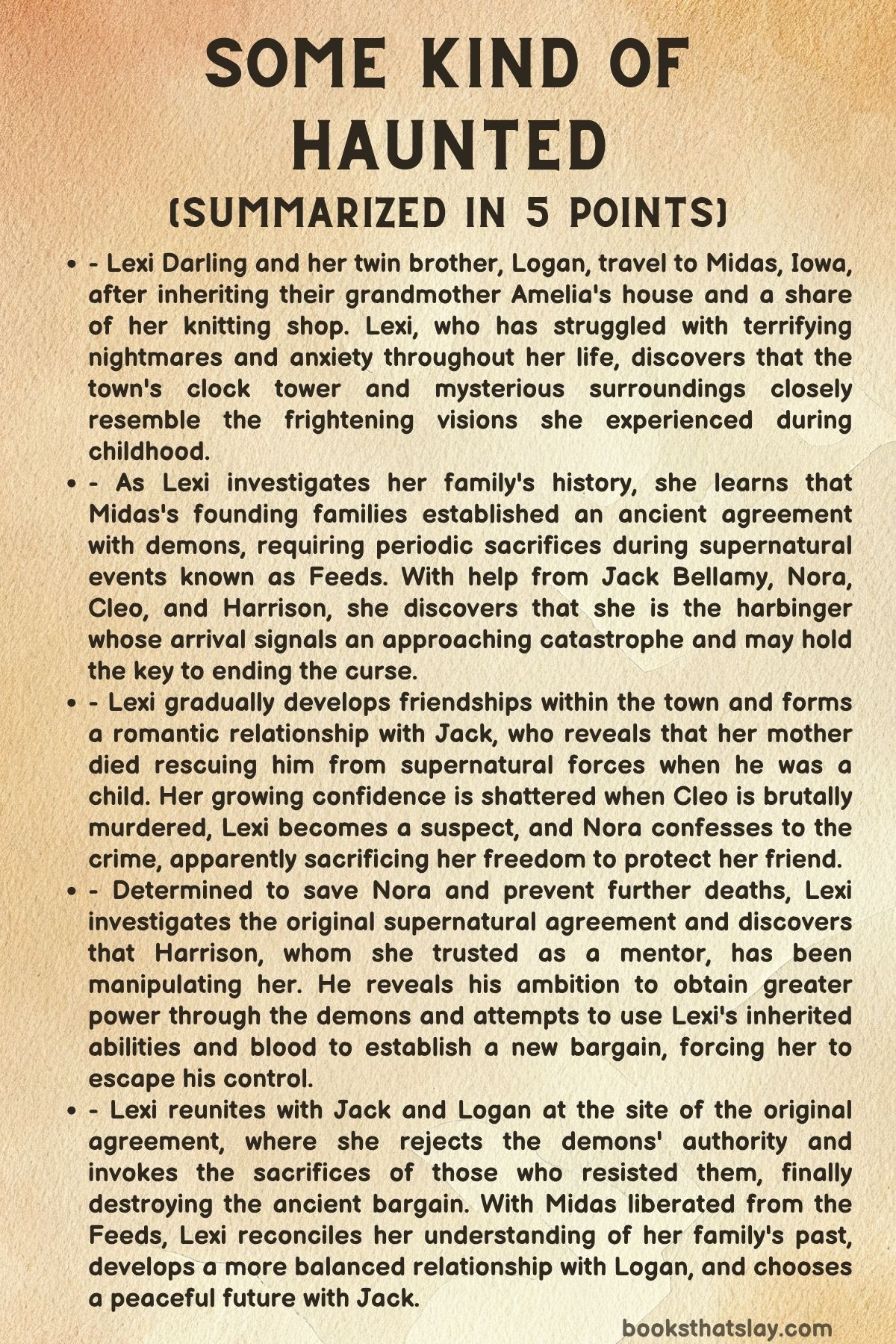
Summary
Lexi Darling has spent much of her life struggling with anxiety, disturbing visions, and recurring nightmares that seem impossible to explain. She has developed elaborate routines to maintain control over her surroundings, relying on therapy, medication, and the reassuring presence of her twin brother, Logan.
When their previously unknown grandmother, Amelia, dies and leaves them her house and a share of her knitting shop, the siblings travel from New York to Midas, Iowa. Their father has always avoided discussing his family, making the inheritance particularly mysterious.
The journey immediately unsettles Lexi. At a remote gas station, she encounters a disheveled stranger whose tongue appears forked, an experience she dismisses as another frightening hallucination.
Midas itself inspires even greater unease. Its massive floodgate, narrow streets, and imposing clock tower provoke an inexplicable sense of recognition, as though Lexi has encountered the town before.
Inside Amelia’s house, the twins discover photographs documenting their lives from childhood onward. Their grandmother had apparently followed their achievements and personal milestones despite the family estrangement their father described.
That night, Lexi experiences a terrifying nightmare involving the clock tower. She watches the structure crack open as a black substance filled with countless eyes emerges, accompanied by disturbing sounds and distant screams.
The dream resembles visions that tormented her throughout childhood. More disturbingly, Logan discovers that she has been sleepwalking, raising questions about whether her experiences are entirely imaginary.
The following morning, the siblings visit a local diner, where Lexi encounters Jack Bellamy, its attractive but openly hostile owner. Their argumentative exchange establishes an immediate attraction, although Jack seems determined to keep her at a distance.
Lexi also meets Harrison, Jack’s grandfather, whose kindness makes her feel unexpectedly welcome. At Amelia’s knitting shop, she encounters Nora and Cleo, the other beneficiaries of the business.
Nora is enthusiastic and friendly, while Cleo possesses a guarded, sarcastic personality. Lexi’s professional interest in textiles gives her an immediate connection to the shop, although the discovery of a mutilated animal outside introduces another disturbing mystery.
The siblings subsequently investigate an abandoned mine, where Logan becomes strangely entranced. Lexi intervenes when she senses something moving inside the darkness, preventing him from proceeding farther.
The experience changes her understanding of their relationship. Logan has always protected her, but she begins recognizing that his confidence and skepticism may leave him vulnerable to dangers she can perceive.
Her fears intensify when she finds herself sleepwalking near the floodgate. Jack discovers her wandering barefoot through the darkness and reacts with considerable alarm.
He brings Lexi and Logan to Harrison, who reveals Midas’s hidden history.
The town’s founding families entered into an agreement with demons, establishing a supernatural arrangement that has governed the community for generations. Periodic events known as Feeds allow the creatures to claim victims, while the arrival of a harbinger signals that another catastrophe is approaching.
Lexi’s recurring nightmares suggest that she is the harbinger. Harrison also explains the concept of a martyr, someone whose sacrifice allows another person to survive.
Logan initially refuses to believe these explanations, but Lexi recognizes connections between the revelations and her lifelong experiences. Harrison gives her a protective locket and warns her that leaving Midas may no longer be possible.
As Jack, Nora, and Cleo explain the town’s supernatural rules, Lexi begins investigating Amelia’s death and the disappearance of protective objects from her house. The original agreement appears to operate according to inherited restrictions involving darkness, family connections, and particular locations.
The residents protect themselves by illuminating their homes, closing curtains, and maintaining inherited protective objects. Their ordinary lives continue between the Feeds, although everyone understands that another period of danger will eventually arrive.
Lexi begins documenting her nightmares, treating them as potentially valuable information rather than evidence of personal instability. Jack takes her observations seriously, and his willingness to listen helps her develop confidence in her own perceptions.
The investigation also reveals that Lexi’s mother was a foundling whose origins may be connected to her daughter’s unusual abilities.
Meanwhile, Lexi grows increasingly attached to Midas. The knitting shop provides a sense of community, and the town’s residents introduce her to forms of companionship she had not expected to find.
Her relationship with Jack also changes. Beneath his defensive manner, she discovers someone shaped by childhood trauma and a powerful sense of responsibility toward the town.
The group examines historical maps and records, searching for weaknesses in the original bargain. Virginia, Cleo’s grandmother and Amelia’s sister, becomes an important potential source of information.
Although Cleo believes Virginia is experiencing dementia, Jack suspects that her disturbing statements contain warnings about the approaching Feed. Her references to darkness and danger suggest that the coming catastrophe may differ from previous events.
The possibility becomes increasingly alarming when supernatural disturbances begin occurring earlier than expected. Jack realizes that Lexi may not have arrived ahead of the approaching Feed; the Feed itself may be arriving prematurely.
During their investigation, Jack reveals a devastating secret about Lexi’s mother.
When he was four years old, supernatural forces lured him into the abandoned mine. Lexi’s mother rescued him but died during the attempt, contradicting the family explanation that she died in childbirth.
Before her death, she warned Jack that her daughter would eventually arrive in Midas and change everything.
This revelation transforms Lexi’s understanding of her family. Her father concealed the circumstances of her mother’s death, and Jack has carried the memory of her sacrifice throughout his life.
The emotional connection between Lexi and Jack deepens as they acknowledge their mutual attraction. They finally kiss, allowing Lexi to imagine a future that includes happiness rather than constant fear.
That hope is shattered when she awakens on the flood wall, surrounded by blood.
Below her lies Cleo’s mutilated body. Lexi cannot remember how she arrived at the scene, and her missing memories make her an immediate suspect.
The police take her into custody despite Logan’s attempts to protect her. During her imprisonment, Lexi dreams of Cleo, who appears to be attempting to communicate something important.
Logan eventually informs her that someone has confessed to the murder.
The confession comes from Nora.
Lexi cannot believe that Nora killed her close friend. She suspects that Nora has sacrificed herself to secure Lexi’s freedom, recalling Harrison’s earlier explanation of martyrdom.
Determined to prevent further deaths, Lexi and Jack investigate the location where the original agreement was established. They hope that confronting the supernatural arrangement at its source will provide an opportunity to end it.
Their investigation leads Lexi toward the clock tower, the structure that has dominated her nightmares since childhood.
Inside, she discovers Harrison waiting for her.
His appearance and behavior reveal that the kindly mentor has been concealing a sinister purpose. He has deliberately manipulated Lexi, using her trust and desire to protect Midas to draw her into his plans.
Harrison seeks greater power through the demons. He intends to establish a new agreement using Lexi’s inherited connection to the founding families, and her blood and willing participation are essential.
Lexi realizes that Harrison has been implicated in Amelia’s and Cleo’s deaths. His earlier questions about the temptations of supernatural bargains reflected his own ambitions rather than innocent curiosity.
When he threatens her with a knife, demonic darkness immobilizes her. Remembering the protective stones she carries, Lexi manages to throw them toward Harrison, briefly disrupting his control.
She escapes the tower and flees through the darkened town.
As she struggles toward the original site of the bargain, Lexi begins recognizing that her strength comes not only from inherited objects but also from her determination to protect the people she loves.
A beam of light across the river helps guide her through the darkness. She eventually reunites with Jack and Logan as midnight approaches.
The floodgate begins closing, and the clock tower announces the approaching deadline. Harrison follows them, attempting to convince Jack that Lexi murdered Cleo and attacked him.
Despite his lifelong attachment to his grandfather, Jack chooses to believe Lexi.
Together, Jack and Lexi approach the stone associated with the original agreement. Remembering the warning that the end lies in the beginning, they repeat the words connecting the bargain’s origin to its destruction.
The stone begins trembling, but Lexi understands that inherited words alone cannot end the curse.
The original agreement resulted from a deliberate choice. Breaking it requires an equally deliberate rejection of the demons’ authority.
Lexi declares the bargain finished, invoking the sacrifices of Amelia, Cleo, her mother, and the countless people who resisted the darkness before her.
The stone explodes, releasing tremendous supernatural energy.
When Lexi regains consciousness, the oppressive presence surrounding Midas has disappeared. Jack and Logan have survived, and the ancient agreement has been broken.
The town can finally experience ordinary nights without the threat of another Feed.
Victory cannot restore the people who died, but their sacrifices have helped create a future free from the supernatural arrangement.
Lexi’s relationship with Logan also changes as they acknowledge their vulnerabilities. She realizes that her brother’s apparent confidence has concealed struggles of his own, just as her anxiety has obscured her courage.
Jack and Lexi finally accept the possibility of building a life together. She understands that the frightening experiences she once regarded as evidence of personal weakness helped her recognize and confront the evil threatening Midas.
The novel concludes with Lexi sleeping peacefully beside Jack, without depending on her familiar rituals or medication. After years of fear and uncertainty, she has found a place where she feels safe, loved, and genuinely at home.
Characters
Lexi Darling
Lexi Darling is the central protagonist of Some Kind of Haunted, and her personal transformation provides the emotional foundation of the novel. A successful New York textile designer, she initially appears sarcastic, demanding, and deeply uncomfortable with anything that disrupts her established routines.
Her difficult behavior conceals years of anxiety, disturbing nightmares, and frightening experiences that she has learned to interpret as evidence that she cannot trust her own mind. Her elaborate daily rituals provide a sense of control over a world she perceives as unpredictable and dangerous.
Lexi’s arrival in Midas challenges the assumptions that have governed her life. The discovery that her nightmares correspond to genuine supernatural events forces her to reconsider the relationship between her psychological struggles and her unusual perceptions.
Importantly, the novel does not simply replace her anxiety with supernatural explanations. Her fears remain real, but she gradually develops a different relationship with them as she discovers that her perceptions can contain useful information.
Her relationship with Logan initially reflects their established roles. She depends on his confidence and practical judgment, while he assumes responsibility for protecting her.
The incident at the abandoned mine begins reversing this arrangement. Lexi recognizes that Logan’s skepticism can expose him to danger, and she decides that protecting him may require trusting her own instincts rather than accepting his explanations.
Her professional interest in textiles also becomes central to her growing sense of belonging. Amelia’s knitting shop connects Lexi with a community that values creativity, craftsmanship, and shared experience.
Through Nora and Cleo, she discovers companionship outside the protective relationship she shares with her brother. These friendships help her move beyond the isolation created by her fear.
Jack’s willingness to believe her experiences contributes significantly to her developing confidence. Unlike people who have encouraged her to dismiss frightening perceptions, he recognizes that her visions may reveal genuine dangers.
Nevertheless, Lexi’s development is not simply the result of romantic acceptance. Her defining achievement is learning to act according to her convictions even when frightened and uncertain.
Her confrontation with Harrison tests this independence. She must recognize his deception, resist supernatural coercion, and make a decision that generations of Midas residents were unable to make.
By the conclusion, Lexi has moved from believing that fear makes her helpless to understanding that courage can exist alongside it. Her peaceful final night represents not the disappearance of every vulnerability but the emergence of security, self-trust, and emotional freedom.
Jack Bellamy
Jack Bellamy initially appears to be an irritable diner owner whose hostility toward Lexi borders on personal resentment. His sharp remarks and refusal to accommodate her requests create an antagonistic first impression, although their exchanges also establish considerable romantic tension.
His defensive behavior gradually becomes understandable as his history emerges. Jack has spent his life knowing that Midas exists under a supernatural threat, and his responsibilities have required constant vigilance.
The defining event of his childhood occurred when demons lured him into the abandoned mine. Lexi’s mother rescued him at the cost of her own life, leaving him with a debt of gratitude and a warning about Lexi’s eventual arrival.
Consequently, Jack recognizes Lexi’s significance before she understands it herself. His early hostility reflects the fear and emotional uncertainty associated with someone whose arrival may signal a dangerous transformation.
His relationship with Harrison is equally important. Raised partly under his grandfather’s influence, Jack has regarded him as a source of stability, knowledge, and family connection.
Harrison’s eventual betrayal therefore challenges Jack’s understanding of his own history. When Harrison accuses Lexi of murder, Jack must decide whether to accept the claims of the man who helped raise him or trust the woman whose experiences have consistently challenged established assumptions.
His decision to believe Lexi demonstrates how far his character has developed. He abandons the security of inherited authority and makes an independent moral judgment.
Jack’s romantic relationship with Lexi also exposes his emotional vulnerability. His attempts to maintain distance gradually give way to attentiveness, tenderness, and a willingness to acknowledge his feelings.
He supports Lexi without ultimately taking control of her choices. During the final confrontation, he remains beside her while recognizing that she must make the decisive declaration herself.
Jack’s development illustrates the movement from protective secrecy toward trust, emotional honesty, and shared responsibility.
Logan Darling
Logan Darling serves as Lexi’s twin brother, closest companion, and longstanding protector. A lawyer by profession, he approaches unfamiliar situations through logic, practical planning, and a strong sense of personal responsibility.
His relationship with Lexi is characterized by affectionate arguments and deeply established habits. He patiently manages her frustrations, handles logistical complications, and regularly attempts to reassure her when she becomes frightened.
Although his confidence initially appears effortless, the novel gradually reveals the emotional demands of his protective role. Logan has spent years supporting his sister, often concealing his own difficulties beneath a composed exterior.
His skepticism about Midas’s supernatural history reflects his commitment to rational explanations. However, his inability to recognize certain dangers becomes a weakness when he encounters forces that do not operate according to ordinary expectations.
The abandoned mine provides a particularly important example. Logan becomes entranced by something within it, and Lexi must intervene to save him.
This reversal challenges the assumptions underlying their relationship. Lexi begins recognizing that Logan is vulnerable, while Logan must eventually acknowledge that his sister possesses strengths he has underestimated.
His legal expertise becomes especially valuable following Cleo’s death. When Lexi is arrested, he immediately attempts to protect her through the criminal justice system.
His developing relationship with Nora introduces another dimension to his character. Their tension suggests that his emotional life is more complicated than Lexi initially appreciates.
By the conclusion, Logan and Lexi achieve a more balanced relationship. Rather than continuing to define themselves exclusively as protector and protected, they recognize each other as independent individuals capable of offering mutual support.
Harrison Bellamy
Harrison Bellamy is the principal human antagonist of Some Kind of Haunted, although his true intentions remain concealed for much of the novel. Initially presented as a kindly older man who welcomes Lexi into Midas, he appears to represent wisdom, hospitality, and continuity with the town’s past.
His extensive knowledge of the founding families makes him an invaluable source of information. He explains the original bargain, describes the Feeds, and introduces Lexi to the protective traditions maintained across generations.
His apparent sympathy is particularly effective because Lexi arrives feeling isolated and uncertain. By treating her seriously and offering explanations for her frightening experiences, Harrison earns the trust she has struggled to find elsewhere.
His role as Jack’s grandfather strengthens his credibility. The affection and authority associated with their family relationship make his deception especially devastating.
The revelation of his ambitions transforms the significance of his earlier conversations. His questions about whether ordinary people might bargain with evil were expressions of his own willingness to exchange other people’s lives for supernatural power.
Harrison understands the mechanics of the original agreement, but he interprets this knowledge as an opportunity for personal advancement rather than collective liberation. His objective is not simply to preserve Midas’s existing arrangement but to establish a more advantageous bargain for himself.
His manipulation of Lexi depends on exploiting her determination to protect others. He presents himself as an ally while guiding her toward circumstances in which her inherited abilities can serve his ambitions.
His involvement in the deaths of Amelia and Cleo also reveals the extent of his moral corruption. These deaths are not unfortunate consequences of an impersonal curse but part of a deliberate effort to obtain power.
Harrison represents the danger of authority divorced from accountability. His age, family position, and historical knowledge initially protect him from suspicion, allowing him to conceal destructive intentions beneath an appearance of benevolence.
His defeat ultimately requires Lexi and Jack to reject the assumption that inherited authority deserves unquestioning obedience.
Nora
Nora is one of the inheritors of Amelia’s knitting shop and becomes an important friend to Lexi. Her enthusiasm, generosity, and commitment to the business contrast with the fear and secrecy surrounding Midas.
She recognizes the importance of preserving Amelia’s legacy, treating the shop as something more meaningful than a financial asset. Through her influence, Lexi begins participating in the town’s everyday community life.
Nora’s familiarity with supernatural danger also provides an important contrast to Lexi’s initial reactions. Having grown up understanding the Feeds, she has learned to function within restrictions that Lexi finds almost unbearable.
Her knowledge makes her a practical guide. She explains protective measures, discusses the consequences of ignoring them, and helps the siblings recognize that apparently ordinary household practices are essential safeguards.
Her relationship with Logan introduces personal tension into the story. His hostility toward her suggests emotional complications that are not immediately explained, making their interactions an important element of the group’s developing relationships.
Nora’s defining action occurs after Cleo’s murder. When Lexi is arrested, Nora confesses to the crime despite the strong indications that she is innocent.
Her decision reflects the novel’s recurring concern with martyrdom. She becomes willing to sacrifice her own freedom to protect someone else, transforming an abstract supernatural concept into a deeply personal act.
The confession also demonstrates the strength of her attachment to the people around her. Nora’s generosity extends beyond friendly behavior into a willingness to accept serious consequences for another person’s survival.
She represents the communal loyalty that makes Midas worth saving, even after generations of suffering have shaped its residents.
Cleo
Cleo is one of the most significant tragic figures in Some Kind of Haunted. Her guarded personality, sharp humor, and occasional sarcasm initially distinguish her from Nora’s open warmth.
She appears comfortable with the unusual circumstances surrounding Midas, but her composure conceals the emotional burdens associated with her family history. Her mother’s unsuccessful attempts to escape the town demonstrate how supernatural restrictions can destroy a person’s independence.
Cleo’s grandmother, Virginia, adds another layer to these difficulties. As Virginia’s behavior becomes increasingly unpredictable, Cleo assumes a protective position and resists attempts to interpret her grandmother’s statements as supernatural warnings.
Her reaction reflects a conflict between the group’s need for information and her responsibility toward a vulnerable family member. She fears that aggressive questioning may cause distress or produce unreliable conclusions.
Cleo’s work at the airfield also establishes her independence. She possesses practical skills, maintains responsibilities outside the knitting shop, and contributes to the group’s investigations.
Her developing friendship with Lexi shows a less guarded aspect of her character. Beneath her sarcastic exterior, she participates in the community connections that help Lexi feel welcome.
Her murder marks the novel’s most devastating turning point. Until then, the approaching Feed has remained partly a future threat, even though disturbing incidents suggest that the danger is increasing.
Cleo’s death establishes that the conspiracy surrounding Lexi has immediate, irreversible consequences. Her loss also exposes Harrison’s willingness to destroy members of his own community.
The dream in which Cleo attempts to communicate with Lexi reinforces the sense that her importance continues beyond her death. Although her warning remains difficult to understand, it suggests that the victims of Midas’s supernatural history cannot simply be forgotten.
Cleo’s character represents the human cost of inherited violence and the personal relationships destroyed when others pursue power without regard for consequences.
Amelia Darling
Amelia Darling is deceased before the events of the novel begin, yet her influence shapes nearly every significant development. Her unexpected inheritance brings Lexi and Logan to Midas, initiating their confrontation with the family’s concealed history.
The photographs displayed throughout her home reveal an affection for her grandchildren that contradicts the apparent estrangement described by their father. Although they never knew her personally, Amelia followed their lives with considerable interest.
Her commitment to the knitting shop establishes another important aspect of her character. She helped sustain a business that functions as a gathering place for the community, preserving relationships through ordinary creative activity.
Amelia also possessed knowledge of Midas’s supernatural history. Her protective objects and established household precautions suggest that she understood the dangers surrounding the founding families.
The disappearance of some of these protections raises questions about the circumstances preceding her death. As the investigation develops, her apparent role in resisting the demonic agreement becomes increasingly significant.
Her decision to leave property to Lexi and Logan suggests an intention to reconnect them with their ancestry. Although her precise expectations cannot be completely reconstructed from the available events, the inheritance places Lexi in a position to investigate the bargain.
Amelia’s relationship with Virginia also links the younger generation to the town’s hidden past. The sisters possess knowledge that becomes important as Lexi attempts to understand her mother’s origins and the dangers surrounding the Feed.
Ultimately, Amelia represents familial love expressed through preparation, protection, and the preservation of knowledge. Her legacy survives through the people and institutions she cared for rather than through her physical presence.
Virginia
Virginia, Amelia’s sister and Cleo’s grandmother, provides a connection between the town’s earlier generations and the approaching supernatural crisis. Her history places her close to the Darling family, including Lexi’s parents.
She later moved to the airfield to assist with Cleo’s upbringing, demonstrating the interconnected nature of Midas’s founding families.
When Lexi encounters her, Virginia is experiencing serious difficulties with memory and behavior. Cleo believes she is suffering from dementia and reliving traumatic experiences associated with previous Feeds.
Jack suspects that her disturbing statements may contain warnings about contemporary events. This disagreement creates an ethical problem because information that might protect the town could also be obtained at the expense of Virginia’s comfort.
Her references to darkness, separation, and danger contribute to the group’s suspicion that the approaching Feed will not follow its expected pattern.
Virginia’s position illustrates the difficulty of interpreting memories shaped by trauma and supernatural experience. Her apparent confusion does not necessarily mean that everything she says is meaningless, but neither does it justify disregarding her vulnerability.
She also represents the burden carried by people who have survived repeated catastrophes. Her history suggests that the consequences of the Feeds extend far beyond the deaths that occur during them.
Through Virginia, the novel explores the relationship between aging, inherited knowledge, and the responsibility younger generations bear toward those who remember the past.
Lexi and Logan’s Mother
The twins’ mother is one of the most influential absent characters in Some Kind of Haunted. Her death has shaped Lexi’s understanding of herself, although the explanation provided by the family proves incomplete.
Lexi initially believes that her mother died during childbirth. Jack’s revelation establishes that she actually died rescuing him from supernatural forces inside the abandoned mine.
This discovery transforms her from a distant family memory into an active participant in Midas’s history.
Her rescue of Jack demonstrates extraordinary courage. She willingly entered a dangerous location to save a child, accepting consequences that eventually cost her life.
Before dying, she told Jack that her daughter would someday arrive and change everything. This warning indicates that she possessed unusual knowledge concerning Lexi’s future importance.
Her background as a foundling also suggests that the supernatural inheritance associated with Lexi may extend beyond the established Darling family history.
For Lexi, learning the truth produces grief, anger, and a new understanding of her mother’s choices. She must confront the fact that her father concealed a significant part of their family history.
Her mother’s sacrifice ultimately becomes central to the destruction of the bargain. Lexi invokes her courage alongside the sacrifices of other people who resisted the demons.
The character embodies the enduring consequences of moral choices and the possibility that an act of protection can influence events long after the person responsible has died.
Lexi and Logan’s Father
The twins’ father remains largely outside the immediate action, but his decisions strongly influence their understanding of family history. His refusal to discuss Amelia creates the impression that the relationship between generations was permanently severed.
His most consequential deception concerns the circumstances of his wife’s death. By allowing Lexi to believe that her mother died during childbirth, he conceals her connection to Midas’s supernatural dangers.
The novel does not establish every motivation behind his secrecy. His behavior may reflect a desire to protect his children from painful knowledge, an attempt to distance them from Midas, or a combination of unresolved family conflicts.
Whatever his intentions, the consequences are substantial. Lexi grows up without understanding the significance of her mother’s sacrifice or the possible origins of her frightening experiences.
The photographs in Amelia’s home also complicate his representation of the family estrangement. Their grandmother’s continuing interest suggests that the emotional separation was not as straightforward as the twins had been led to believe.
His character illustrates how protective secrecy can become harmful when it prevents people from understanding their own lives.
Marleen
Marleen is a supporting character whose presence helps establish the diner as a familiar and welcoming part of Midas. Her interactions with Lexi provide moments of ordinary hospitality amid the increasingly frightening supernatural developments.
Her decision to serve Lexi the customized breakfast and specialty coffee she originally wanted becomes particularly meaningful. The gesture suggests that someone has paid attention to Lexi’s preferences despite the hostility she initially encountered.
Although Jack may have arranged the surprise, Marleen’s participation helps communicate the warmth of the community surrounding the diner.
She represents the everyday kindness that continues despite the town’s extraordinary circumstances. Her role demonstrates that Midas is not defined exclusively by its supernatural curse.
Braxton
Braxton is another supporting figure associated with the diner. His service to Lexi during her increasingly regular visits helps establish the routines through which she begins feeling comfortable in Midas.
The familiar act of receiving coffee becomes part of her adjustment to the town. Such ordinary interactions contrast with the nightmares and supernatural investigations dominating her life.
Although Braxton does not receive an extensive independent character arc, his presence contributes to the social environment that gradually makes Midas feel less threatening to Lexi.
He helps represent the ordinary community life that the central characters ultimately fight to preserve.
The Founding Families
The founding families function as a collective historical presence whose decisions determine the supernatural circumstances inherited by later generations. Their agreement with the demons establishes the conditions under which Midas must continue existing.
Their actions demonstrate how choices made by one generation can impose suffering on people who had no opportunity to consent.
The Bellamy and Darling families become particularly significant because their descendants possess knowledge, responsibilities, and connections related to the bargain.
Their inherited protective practices reveal the complicated nature of this legacy. Although the original agreement created the danger, later generations developed methods of surviving and resisting its consequences.
The founding families therefore represent both the origins of the town’s suffering and the historical knowledge necessary to challenge it.
The Demons
The demons are the principal supernatural threat in the novel. Their arrangement with Midas permits periodic Feeds during which human lives become the price of an ancient agreement.
Their manifestations are associated with darkness, distorted physical appearances, disturbing sounds, and overwhelming psychological terror.
The recurring image of the clock tower opening to release a substance filled with watching eyes establishes their frightening presence long before Lexi understands what she is seeing.
Their ability to lure or influence individuals is demonstrated through Jack’s childhood experience in the mine and Logan’s later encounter with the same location.
Despite their terrifying power, the demons operate within the restrictions of an agreement. This limitation becomes essential because it establishes that their authority is not necessarily permanent.
Their relationship with Harrison also reveals the dangers of human collaboration with supernatural evil. They do not merely attack innocent residents; they benefit from individuals willing to sacrifice others for personal advantage.
The demons embody predatory power sustained through fear, coercion, and inherited submission. Their eventual defeat depends on the rejection of the agreement that allowed them to dominate the town.
Themes
The Relationship Between Fear, Self-Trust, and Personal Identity
Lexi’s lifelong struggle with frightening experiences establishes a conflict between her perceptions and the explanations she has learned to accept. Her nightmares, visions, and anxiety have encouraged her to regard her own mind as something unreliable.
Consequently, she builds her life around routines designed to reduce uncertainty. These habits provide comfort, but they also reveal how strongly fear has shaped her understanding of herself.
Her arrival in Midas begins disrupting this established identity. Places she has never consciously visited appear familiar, and events she previously dismissed as imaginary correspond to genuine supernatural dangers.
The discovery that some of her visions contain useful information does not mean that every frightening perception is automatically trustworthy. Instead, Lexi learns to investigate her experiences rather than immediately rejecting or surrendering to them.
Jack’s willingness to listen becomes important because it offers an alternative to the dismissal she has repeatedly encountered. His recognition encourages her to treat herself as someone capable of understanding difficult circumstances.
However, her developing confidence ultimately depends on her own decisions. She records her nightmares, investigates family history, and acts when others hesitate.
The confrontation with Harrison provides the clearest expression of this transformation. Although terrified and physically threatened, Lexi recognizes his deception and resists his attempts to control her.
In Some Kind of Haunted, courage is not presented as the complete absence of fear. Lexi continues experiencing uncertainty, but she discovers that fear does not have to determine her actions or define her worth.
Her final peaceful night symbolizes a changed relationship with herself. She has acquired the confidence to inhabit the world without treating every unfamiliar circumstance as an immediate threat.
The novel therefore distinguishes personal vulnerability from personal powerlessness. Lexi’s growth emerges through learning that she can experience fear while still making meaningful choices.
Inherited Guilt, Family Secrets, and the Burden of the Past
Midas exists under the consequences of an agreement established long before its present residents were born. The founding families’ decision to bargain with demons creates an inherited system of suffering that later generations must endure.
This arrangement raises questions about responsibility across generations. The people threatened by the Feeds did not necessarily participate in the original decision, yet their lives remain governed by its conditions.
The families preserve protective objects, historical records, and survival practices because knowledge has become essential to their continued existence.
However, inherited knowledge is not always shared openly. Lexi’s father conceals significant details about Amelia and the circumstances of his wife’s death, leaving his children disconnected from their ancestry.
His secrecy demonstrates how attempts to escape painful history can deprive younger generations of information they need to understand themselves.
Amelia’s photographs offer a contrasting form of family memory. They reveal that affection and connection persisted despite the apparent estrangement, complicating Lexi’s assumptions about her grandmother.
The revelation concerning Lexi’s mother also transforms the meaning of the past. A death previously understood as a private family tragedy becomes part of a larger history of resistance against supernatural violence.
Harrison represents the most destructive response to inherited history. Rather than recognizing the suffering produced by the original agreement, he seeks to exploit its mechanisms for additional power.
Lexi ultimately rejects the assumption that inherited arrangements must continue indefinitely. By confronting the bargain at its original location, she demonstrates that understanding history can make transformation possible.
Her declaration also honors those who previously resisted the demons, connecting her individual decision to the accumulated sacrifices of earlier generations.
The destruction of the agreement does not erase the past. Instead, it ends the requirement that future generations continue paying for decisions they never made.
Love, Sacrifice, and the Limits of Protection
The relationships surrounding Lexi repeatedly raise questions about what people are willing to surrender for those they love. Protection appears in several forms, ranging from everyday responsibility to sacrifices involving personal freedom and survival.
Logan’s relationship with Lexi initially provides the clearest example. He organizes practical matters, manages her anxieties, and assumes that protecting his sister is an essential part of his identity.
Although his devotion is genuine, their established arrangement creates limitations. Lexi becomes accustomed to relying on his judgment, while Logan conceals the emotional pressures associated with always appearing confident.
Their growth requires recognizing that love does not justify permanently assigning one person the role of protector and another the role of dependent.
Jack’s relationship with Lexi develops through a similar conflict. His knowledge of the dangers surrounding her arrival initially encourages hostility and emotional distance, but his protective instincts gradually become expressions of affection.
His eventual willingness to stand beside her rather than prevent her from acting demonstrates a more balanced understanding of love.
Other relationships reveal the painful consequences of sacrifice. Lexi’s mother dies rescuing Jack, Amelia contributes to the effort to resist the town’s supernatural history, and Nora confesses to Cleo’s murder to secure Lexi’s release.
These actions reveal the extraordinary lengths to which people may go when another person’s life or freedom is threatened.
Nevertheless, Some Kind of Haunted also questions systems that depend on repeated martyrdom. The original bargain transforms human suffering into an accepted condition of the town’s continued existence.
Lexi’s final decision seeks to end this pattern rather than simply become its next victim. She honors earlier sacrifices by attempting to create circumstances in which future sacrifices will no longer be necessary.
The conclusion presents love as a force capable of inspiring courage, but its deeper achievement lies in transforming the conditions under which people live. Protection becomes meaningful when it creates freedom rather than perpetuating dependence or suffering.
Community, Belonging, and the Power of Collective Resistance
Lexi initially approaches Midas as an outsider who expects disappointment. Accustomed to New York and uncomfortable with unfamiliar surroundings, she sees the small town as an inconvenience rather than a possible home.
Her early encounters reinforce this impression. The isolated landscape, imposing floodgate, threatening clock tower, and Jack’s hostility make Midas appear unwelcoming.
However, the knitting shop gradually transforms her experience. Amelia’s business provides a meeting place where creative work, conversation, and shared interests connect people across generations.
Lexi’s professional knowledge gives her an immediate reason to participate. Instead of being defined exclusively by her anxiety or unusual experiences, she becomes someone whose skills and interests are valued.
Nora’s warmth and Cleo’s developing friendship strengthen this connection. Their companionship allows Lexi to recognize the humanity of a community initially obscured by its supernatural dangers.
The older knitters contribute another important perspective. Their willingness to continue ordinary activities despite knowing about the Feeds demonstrates that the town’s existence cannot be reduced to its curse.
Its residents maintain businesses, friendships, family relationships, and traditions because everyday life remains meaningful even under extraordinary conditions.
This communal strength becomes essential during the confrontation with Harrison. Lexi does not reach the original site of the bargain entirely through her own efforts; the illumination that guides her through the darkness suggests assistance from others.
Jack and Logan also stand beside her, while the sacrifices of earlier generations provide the moral foundation for her declaration.
Her success therefore emerges from collective resistance rather than isolated heroism. Although she performs the decisive act, her courage has been sustained by the knowledge, affection, and sacrifices of numerous people.
The ending transforms Midas from a place of inherited captivity into a community capable of determining its own future.
Lexi’s decision to remain with Jack completes her movement from alienation toward belonging. She discovers that home is not necessarily the place where life feels most familiar, but the place where relationships allow her to experience acceptance, security, and the freedom to become herself.