Son of the Morning Summary, Characters and Themes
Son of the Morning by Akwaeke Emezi is a modern supernatural novel set in and around the city of Salvation, where old bargains still have teeth and power can live in the body like an ache. It follows Galilee Kincaid, raised by an all-women clan on land that seems to breathe and listen, and later drawn into a collision between her hidden nature and forces that move between Heaven, Hell, and earth.
With sharp, intimate character focus and high-stakes mythology, the story asks what it means to belong, to choose, and to survive being made for someone else’s war.
Summary
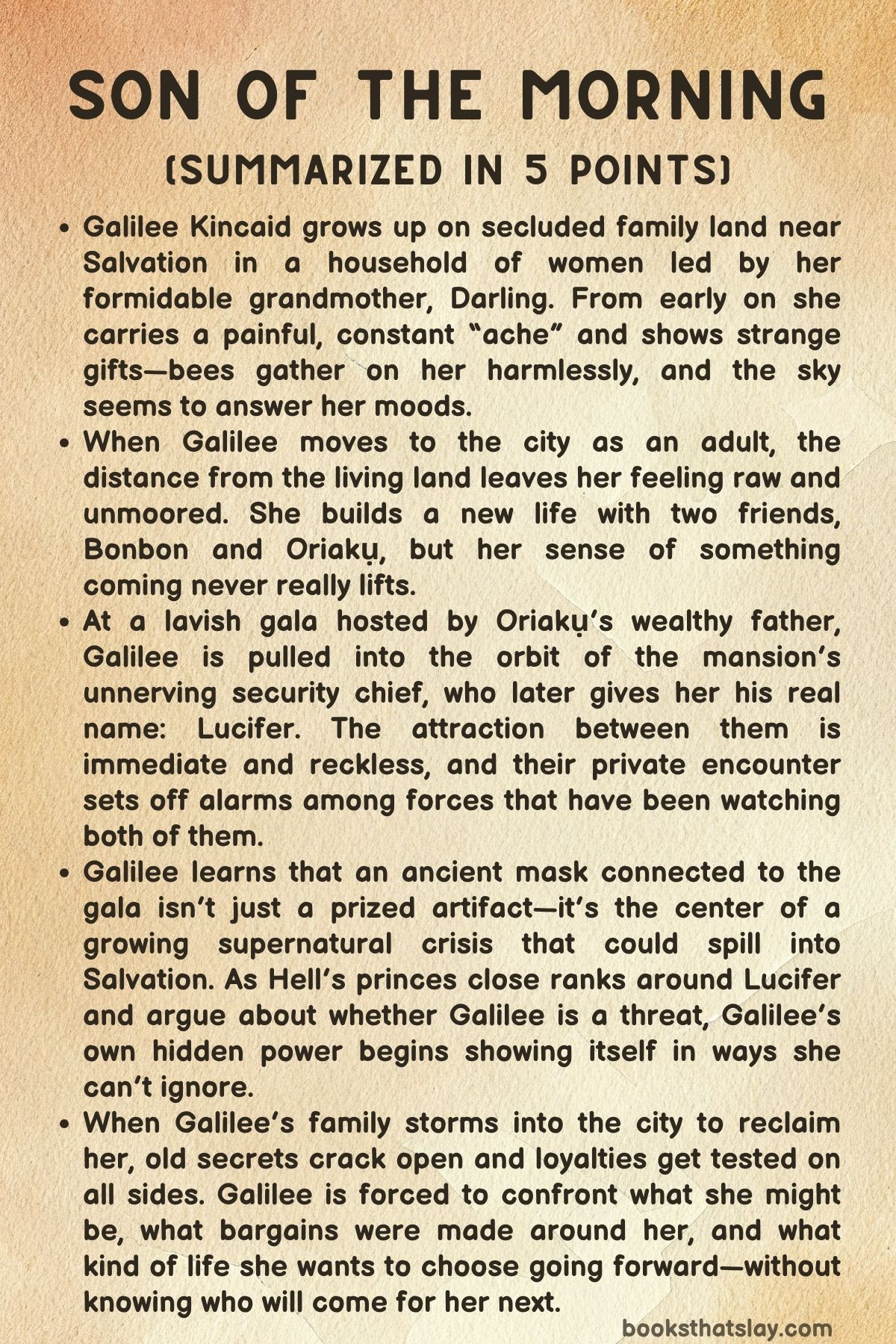
Galilee Kincaid grows up on Kincaid land outside Salvation, raised in a large house run by the matriarch known as Nana Darling. The Kincaids are a women-led family with strict rules: no men, no sons, and no explanations offered to outsiders.
From childhood, Galilee carries a constant ache inside her—restless, stinging, and hungry in a way she can’t name. Strange things happen around her, too.
Bees gather to her without harming her. The weather responds to her moods.
The adults watch her carefully, speaking around the truth instead of saying it. When one relative hints that Galilee might be able to heal with her hands, Nana Darling shuts the idea down, treating Galilee’s gift as dangerous and private, not something the family can use at will.
Another cousin blurts that Galilee feels like she comes from the wrong place, and the sky darkens as if the world reacts to the accusation. Galilee grows up sensing the suspicion but never receiving answers, while an unseen presence observes her and quietly shapes the conditions around her.
At twenty-five, Galilee leaves the land and moves into a penthouse loft in downtown Salvation. The change is painful.
In the city she misses the hum of roots, the steadiness of creeks, the sense that the ground knows her name. She tries to anchor herself by keeping bees, but her powers still leak through: she wakes with sheets singed, her hands glowing with cold light until she forces it back down.
She builds a new social life with two women she meets through yoga. Bonbon is a horror novelist with an approachable warmth and a rising career.
Oriakụ is glamorous, wealthy, and connected to her father’s dangerous influence. Their friendship becomes fast and intense, fueled by celebrations that keep getting bigger, with Oriakụ taking charge of the spectacle.
Oriakụ invites Galilee and Bonbon to her father’s fundraising gala, tied to high-profile cultural “returns” and elite philanthropy. The centerpiece is an ancient ritual mask made of bronze, ivory, and gold, guarded like a weapon.
Galilee feels dread before she even arrives at the mansion, as if something is waiting for her. During the event, Oriakụ leads them away from the party toward the secured wing where the mask is kept.
Armed guards stop them. Oriakụ calls for the head of security, a man named Helel, who appears with a calm that doesn’t match the setting.
Galilee senses something inhuman about him, something predatory and old. When he refuses to let them through, Galilee offers him a trade: a dance in exchange for access.
He agrees on his own terms—he’ll take the dance now, and he’ll show the artifact to Galilee later, alone.
Helel pulls Galilee into a private corridor, and the ache inside her spikes into raw wanting. They share a charged encounter that leaves Galilee shaken and furious at herself for wanting more.
Before sending her back, he gives her a truth like a threat: his name is Lucifer. The disclosure does not free her from him; it hooks into the part of her that already feels like a question with no answer.
Another watcher steps forward—an older, knowing voice with a long history of Heaven’s wars and the politics around Lucifer’s fall. This narrator reveals the gala was engineered.
Oriakụ’s father, Elijah Onyearugbulem, has been used as bait, and the mask is not just a trophy. It is a hellgate, a device Lucifer once used to open a stable passage into Hell.
Now it is malfunctioning in Salvation, straining to open outward and spill what should stay contained. Lucifer and his demon princes, disguised as security, have been warding the gate constantly because it cannot be moved.
Worse, someone powerful has altered it in a way that should not be possible.
Lucifer’s princes—Belial, Asmodeus, and Leviathan—are furious that Galilee got close. Her touch burned Lucifer to the bone, and her presence seems tied to the gate’s instability.
Leviathan argues she should be eliminated before she becomes a larger threat. Lucifer refuses to act without understanding what she is and demands time.
He decides on a compromise that protects Galilee while keeping his court from tearing her apart: he will bind her to him under his protection, a bargain that makes her harder to target.
The next day, Galilee tries to pretend the gala never happened, but the dread returns. Her cousin Celestial calls, warning that the wind carries news and that Galilee has set something in motion.
Before Galilee can decide what to do, Oriakụ and Bonbon arrive at her loft, angry and scared about her disappearance. While they argue, Lucifer slips in through a window, watching with possessive irritation.
He reveals himself, and Oriakụ pulls a gun. A shot lands, tearing Lucifer’s shirt, but the injury doesn’t behave like a human wound.
Panic spreads. Lucifer admits what he is, and Galilee, pushed beyond her limit, shouts a single command that stops time.
Her friends freeze mid-breath, alive but suspended. Galilee is horrified at her own power; Lucifer is impressed—and newly certain that his princes will see her as a direct threat.
Lucifer takes Galilee away through the air, keeping her disoriented so she can’t track his location, and brings her to one of his hidden residences. He refuses to promise he would never hurt her because he does not know what she is, and he fears she may be connected to the hellgate crisis.
Galilee admits she is different but insists she has never been told why. Meanwhile, a hidden celestial meddler inspects the frozen friends in Galilee’s loft, then hides as the Kincaid women arrive armed with blessed weapons.
Nana Darling recognizes the time-stasis and breaks it with the family’s practiced unity, then assumes Lucifer has tampered with the friends’ minds. When a brief breach opens and a few demons escape into the woods, the Kincaids hunt and kill them efficiently, proving they are not ordinary humans guarding a family secret.
The confrontation comes to a head in a garden where Galilee stands between Lucifer and her family. Nana Darling and Galilee’s mother, Collette, demand she come home and accuse Lucifer of control.
Galilee insists she chose him, and her anger ignites the world around her: bees churn overhead, leaves scorch, embers creep through the hedges. When some relatives turn their weapons toward Galilee “for safety,” the betrayal cracks her.
Then Sage drops the truth that finally breaks the last seam: Galilee is not Collette’s biological child. Nana Darling confirms it by failing to deny it.
Galilee’s power surges in a bright, dangerous wave, and she forces Nana Darling to show the past.
In the revealed memory, twenty-five years earlier, Nana Darling and young Celestial met a bloodstained, unnatural woman at a creek carrying a newborn Galilee. The woman demanded a bargain: she would hand over the baby in exchange for a chosen memory.
Nana Darling lost the memories of a lover named Bastien and collapsed under the theft. The woman warned them never to tell Galilee too early or she would return and kill her.
The Kincaids raised Galilee to fulfill the bargain: keep the child safe, no matter what she became.
Soon after, the hellgate crisis escalates. Hell begins to bleed through the mask, and Lucifer’s princes demand Galilee’s death to stabilize the realms.
Leviathan, torn between loyalty and what he has witnessed in Galilee, refuses to strike. Galilee’s power flares out of control, threatening to consume everything nearby, and Lucifer steps toward her instead of ordering her destroyed.
He reaches her not through force but through confession—admitting guilt, fear, and the limits of his control. Leviathan also speaks to Galilee as a person, not a weapon, and his words land.
Galilee regains herself long enough to seal the gate shut, saving both earth and Hell, then collapses from the effort.
When she wakes days later, Leviathan is guarding her. He explains that Lucifer protected her from Heaven by claiming she had sold her soul, a bluff aimed at keeping the archangel Michael from taking her as celestial property.
Leviathan warns that the court of Hell resents her, and that someone in Heaven tampered with the gate. The truth is worse than rumor: Michael and an angel named Deziel were involved in Galilee’s creation, and Deziel is now missing on earth after being cast out and stripped of power.
Galilee’s relationships shift into something complicated but steady. Lucifer remains drawn to her and offers protection, yet he cannot fully erase the danger around them.
Leviathan becomes her guide and anchor as she learns to live with what she is, not as an emptiness but as a presence inside her. Galilee returns to her apartment and her friends, choosing an ordinary life where she can, while accepting that the extraordinary will never fully leave.
Months later, with the hellgate secured and Galilee training to master her power, Lucifer and Leviathan remain part of her world. Far away on Kincaid land, Nana Darling quietly claims Galilee and her devils as family, while Deziel watches from hiding—wingless, broken, and furious—realizing her daughter has escaped the cage Heaven tried to build.
Characters
Galilee Kincaid
Galilee Kincaid stands at the heart of Son of the Morning, a character defined by both mystery and divine contradiction. From her earliest days on the Kincaid land, she is marked by an otherworldly aura—the bees that never sting her, the weather that bends to her moods, and the ache that burns within her as if she carries a different kind of life.
Galilee’s journey is one of becoming and belonging: she begins as an enigma even to herself, raised by women who revere and fear her power in equal measure. Her growth from a confused, lonely child into a woman who commands Lucifer himself charts a striking evolution of agency.
In the city of Salvation, her alienation deepens as her power grows, and her encounter with Lucifer awakens both desire and self-awareness. Throughout the novel, Galilee wrestles with identity—human, celestial, and infernal—and through that struggle, she embodies the liminal space between heaven and hell.
When she learns that she is not fully human but the child of the fallen angel Deziel, her story transforms into one of self-definition: she is neither sinner nor saint, but something entirely her own. By the end, Galilee becomes a bridge between worlds, reclaiming her power not as a curse but as a choice, and her love for Lucifer and Leviathan cements her as a being who transcends the binaries of good and evil.
Lucifer
Lucifer, the Devil himself, emerges as a character of immense depth and paradox. In Son of the Morning, he is not the embodiment of pure malice but a creature of yearning, guilt, and an almost divine tenderness.
When he meets Galilee, his ancient composure fractures; her touch burns him, not from sanctity but from a resonance he cannot name. This vulnerability makes him compelling—he is both predator and penitent, a ruler of Hell undone by wonder.
His interactions with Galilee blur the line between seduction and salvation, suggesting that love may be his final rebellion against both Heaven’s tyranny and Hell’s despair. Lucifer’s relationship with his prince, Leviathan, adds another layer to his complexity, showing his capacity for both cruelty and remorse.
Once a celestial being defined by defiance, he becomes a figure struggling for redemption, seeking meaning through intimacy and loyalty. In his bond with Galilee, he glimpses the possibility of wholeness, while his confrontation with Michael and Deziel reminds him of his eternal exile.
By the novel’s end, Lucifer’s transformation is profound: he remains the King of Hell, yet carries within him a fragile hope—a longing to protect rather than to possess, and to love without domination.
Leviathan
Leviathan is both a prince of Hell and a portrait of devotion fractured by time and betrayal. His presence in Son of the Morning is shadowed by a history of love and pain shared with Lucifer.
Once his lover and most loyal servant, Leviathan bears the scars of a broken trust that still governs their every interaction. He is fierce, disciplined, and wary, yet capable of great compassion—qualities that surface most vividly in his relationship with Galilee.
Unlike Lucifer, who is captivated by her as a mystery, Leviathan sees her humanity first, offering protection and understanding even when duty demands her death. Through him, the novel explores the tension between obedience and feeling, loyalty and individuality.
Leviathan’s eventual defiance of Hell to save both Galilee and Lucifer marks his rebirth as a being of choice rather than servitude. His vulnerability becomes his redemption, and in his shared intimacy with Galilee and Lucifer, he achieves something that transcends the old hierarchies of Heaven and Hell—a communion built on equality, not power.
Nana Darling (Darling Kincaid)
Darling Kincaid, matriarch of the Kincaid women, embodies the formidable will of earthly magic and ancestral power. In Son of the Morning, she rules her household with both authority and love, driven by an old bargain that binds her family to the supernatural.
Darling is the keeper of secrets—the woman who knows too much but says too little. Her strength is practical, rooted in ritual and blood, yet beneath it lies deep sorrow for the choices she was forced to make, especially the sacrifice of her memories to save the newborn Galilee.
She symbolizes the human cost of survival in a world where divine forces intervene in mortal lives. Darling’s relationship with Galilee is complex: she is protector, deceiver, and ultimately, redeemer.
By finally revealing the truth of Galilee’s origin, she not only frees her granddaughter but also reconciles her family’s long debt to the unseen world. Darling’s steadfastness and pain make her a matriarch not of control but of endurance, representing the weight women carry when they become the guardians of impossible truths.
Celestial Kincaid
Celestial serves as both witness and mediator between the ordinary and the extraordinary in Son of the Morning. As Galilee’s cousin and confidant, she straddles loyalty to family and compassion for Galilee’s individuality.
Her gift of foresight and her connection to the family’s rituals make her both insightful and haunted. Celestial’s greatest struggle lies in balancing obedience to Nana Darling with her empathy for Galilee; she fears the power that Galilee wields but also loves her deeply.
Throughout the novel, Celestial evolves from a messenger of warnings to a figure of courage who dares to confront the supernatural forces threatening her kin. Her revelation of the truth about Galilee’s birth is an act of painful honesty that fractures but also heals the family.
In many ways, Celestial represents the conscience of the Kincaids—an embodiment of love tempered by fear, and duty balanced with mercy.
Oriakụ Onyearugbulem
Oriakụ, the daughter of the powerful billionaire Elijah Onyearugbulem, is a study in glamour masking fragility. In Son of the Morning, she enters Galilee’s life as a symbol of modern excess and worldly sophistication, yet her poise conceals deep unease about her father’s empire and its entanglement with dark forces.
Her fascination with power, wealth, and the forbidden draws her toward the supernatural events that unravel during the gala. Oriakụ’s interactions with Lucifer and the mask bring her dangerously close to forces beyond comprehension, and her friendship with Galilee is tested by fear and jealousy.
Despite her privilege, Oriakụ’s courage surfaces in moments of chaos—she is the one who fires on Lucifer, acting out of instinct rather than faith. In the end, she remains human in the truest sense: flawed, curious, and searching for safety in a world where gods and devils walk unseen.
Bonbon
Bonbon, the horror novelist and friend to Galilee, provides an anchor of normalcy amidst the book’s divine chaos. Her open-heartedness and creative mind position her as a bridge between the mundane and the mystical.
In Son of the Morning, Bonbon’s friendship with Galilee reflects the novel’s exploration of chosen family and emotional honesty. She represents belief without understanding, a mortal who accepts the impossible simply because it exists.
Though often overshadowed by stronger personalities, Bonbon’s loyalty never wavers, and her presence underscores the story’s emotional center: that connection, not power, is the truest form of magic. Her survival through the supernatural turmoil stands as quiet testament to resilience and acceptance.
Deziel
Deziel, the fallen angel and Galilee’s true mother, emerges as a tragic architect of both creation and ruin. Once part of Heaven’s order and later an agent of rebellion, Deziel’s fall mirrors Lucifer’s, though her path leads her into deeper desolation.
In Son of the Morning, her legacy defines Galilee’s very existence—her choice to bargain away her child sets in motion the novel’s central conflicts. By the time she reappears, stripped of wings and power, Deziel embodies the consequences of divine ambition.
Her maternal love is warped by regret and pride, leaving her unable to reclaim what she has lost. Yet in her downfall lies the story’s most haunting reflection: even angels can be undone by love.
Deziel’s final act of watching her daughter live freely among both humans and devils closes her arc not with redemption but with acknowledgment—the painful grace of witnessing what she can no longer possess.
Themes
Power, Divinity, and Identity
The story of Son of the Morning explores power not as simple strength or dominance but as something deeply tied to identity and self-understanding. Galilee Kincaid’s journey is shaped by her discovery of abilities that both connect and estrange her from others.
Her control over natural forces, her ability to stop time, and the light within her body all reflect a power that defies human comprehension. Yet, this power is not portrayed as purely divine; it is messy, emotional, and sometimes destructive.
Through Galilee’s struggle to understand her origins—part human, part celestial—the novel examines how identity can be fractured by secrets, lineage, and inherited bargains. Power, in her case, becomes both a curse and a birthright.
She is simultaneously feared and worshiped, desired and condemned, a figure who embodies the uneasy balance between creation and destruction. The revelation that her mother, Deziel, was a fallen angel further complicates her selfhood, showing that divinity and monstrosity are often reflections of the same force.
Galilee’s power does not grant her freedom until she accepts it as part of her humanity rather than an escape from it. The novel ultimately reframes divine strength as something personal—rooted in choice, emotion, and connection—rather than celestial order.
Her control over light and fire becomes symbolic of reclaiming agency from those who tried to define or contain her, transforming power from inheritance into identity.
Female Legacy and Matriarchal Authority
Within Son of the Morning, the Kincaid women embody a fierce matrilineal tradition that challenges patriarchal power structures. The absence of men on Kincaid land is not incidental but deliberate; it represents a legacy of survival built through women’s strength, secrecy, and shared responsibility.
Darling Kincaid’s leadership reflects both protection and control—she enforces rituals, maintains bargains, and preserves the family’s autonomy through strict authority. The women’s power is communal but also hierarchical, and Galilee’s emergence destabilizes this balance.
Her supernatural nature threatens the very foundation of their matriarchal order because it brings an uncontrollable element into a lineage that depends on control. The Kincaid women’s rituals, their relationship to the land, and their belief in ancestral bargains present femininity as a spiritual force rather than a passive one.
However, the novel does not romanticize matriarchy; it reveals how it can reproduce its own forms of silencing and violence. Darling’s refusal to tell Galilee the truth about her birth mirrors patriarchal patterns of secrecy and authority.
The novel suggests that true empowerment arises not from dominance—even in female form—but from honesty and solidarity. By confronting the lies that sustained her family’s power, Galilee breaks the cycle of fear and control.
Her final acceptance by Darling signifies a redefinition of female authority, one that makes space for vulnerability and truth rather than repression and mysticism.
Desire, Sin, and Redemption
Desire in Son of the Morning is not merely erotic—it is existential. From Galilee’s first encounter with Lucifer, desire becomes a revelation of what she truly is and what she fears becoming.
The novel reimagines sin not as moral transgression but as hunger: a yearning for wholeness, for connection, for knowledge. Lucifer embodies this complexity; he is both tempter and teacher, representing the beauty and danger of surrendering to desire.
Their relationship is layered with tension between autonomy and domination, attraction and annihilation. Galilee’s physical encounters with Lucifer and later with Leviathan explore the boundaries between pleasure and power, consent and control.
Through these experiences, she learns that redemption is not found in purity but in self-awareness. Lucifer’s own path mirrors hers—he, too, seeks absolution through love, and their intimacy becomes a shared act of defiance against divine order.
Redemption in this novel is not granted from above; it is earned through pain, truth, and choice. When Galilee seals the hellgate and saves both realms, her act is not one of submission but of reclamation.
She redeems herself not by rejecting desire but by mastering it, transforming what was once seen as corruption into grace.
The Conflict Between Heaven and Hell as Moral Ambiguity
The cosmological struggle between Heaven and Hell in Son of the Morning is not depicted as a simple battle of good versus evil but as a mirror of moral ambiguity. Both realms are shown as flawed, manipulative, and willing to use mortals as pawns.
Heaven’s angels commit cruelty in the name of order, while Hell’s princes wield chaos with moments of compassion. The line between salvation and damnation is constantly blurred.
Lucifer, often portrayed as pure evil in traditional narratives, emerges here as a being capable of tenderness, guilt, and longing for change. His relationship with Leviathan and Galilee reveals his complex moral evolution—a being once defined by rebellion now struggling for redemption.
Similarly, Heaven’s representatives, especially Michael and Deziel, embody the hypocrisy of divine authority, claiming righteousness while perpetuating suffering. Through these contrasts, the novel dismantles binary morality and exposes how both divine and infernal systems oppress individuality.
Galilee’s position between them—as neither angel nor demon—symbolizes the possibility of a third path: one rooted in autonomy rather than allegiance. Her defiance of both realms marks a rejection of imposed morality in favor of self-determined ethics.
The story suggests that divinity and damnation are states of perception, and that true righteousness lies not in obedience but in compassion and authenticity.
Nature, Ancestry, and the Living Land
Throughout Son of the Morning, the natural world is more than setting—it is an extension of ancestry, memory, and the spiritual body of the Kincaids. The land outside Salvation feels alive, responding to emotion and ritual, shaping the family’s identity.
Galilee’s connection to bees, storms, and fire demonstrates the symbiosis between her and the environment. The Kincaid land itself is bound by old bargains, suggesting that ancestry is a living force that cannot be severed.
When Galilee leaves home, her disconnection from the earth mirrors her disorientation from self, showing that belonging is not merely familial but elemental. The story treats nature as a moral compass—responsive to truth, violation, and balance.
When lies dominate, the sky darkens; when understanding returns, it clears. The hellgate crisis mirrors environmental decay, linking spiritual corruption to ecological imbalance.
Through this symbolism, the novel portrays nature as sacred yet vulnerable, capable of judgment and renewal. Galilee’s final harmony with both her human and supernatural sides restores her connection to the natural world, suggesting that reconciliation with the self is inseparable from reconciliation with the land.
The closing image of her among the bees signifies this restoration: a woman no longer alienated from her origins, but a living embodiment of the balance between power, earth, and lineage.