Southern Spirits Summary, Characters and Themes
Southern Spirits by Angie Fox is a paranormal mystery with a small-town Southern setting and a sharp, funny edge. Verity Long is broke, nearly out of time, and trying to keep her family’s crumbling old house from being taken away.
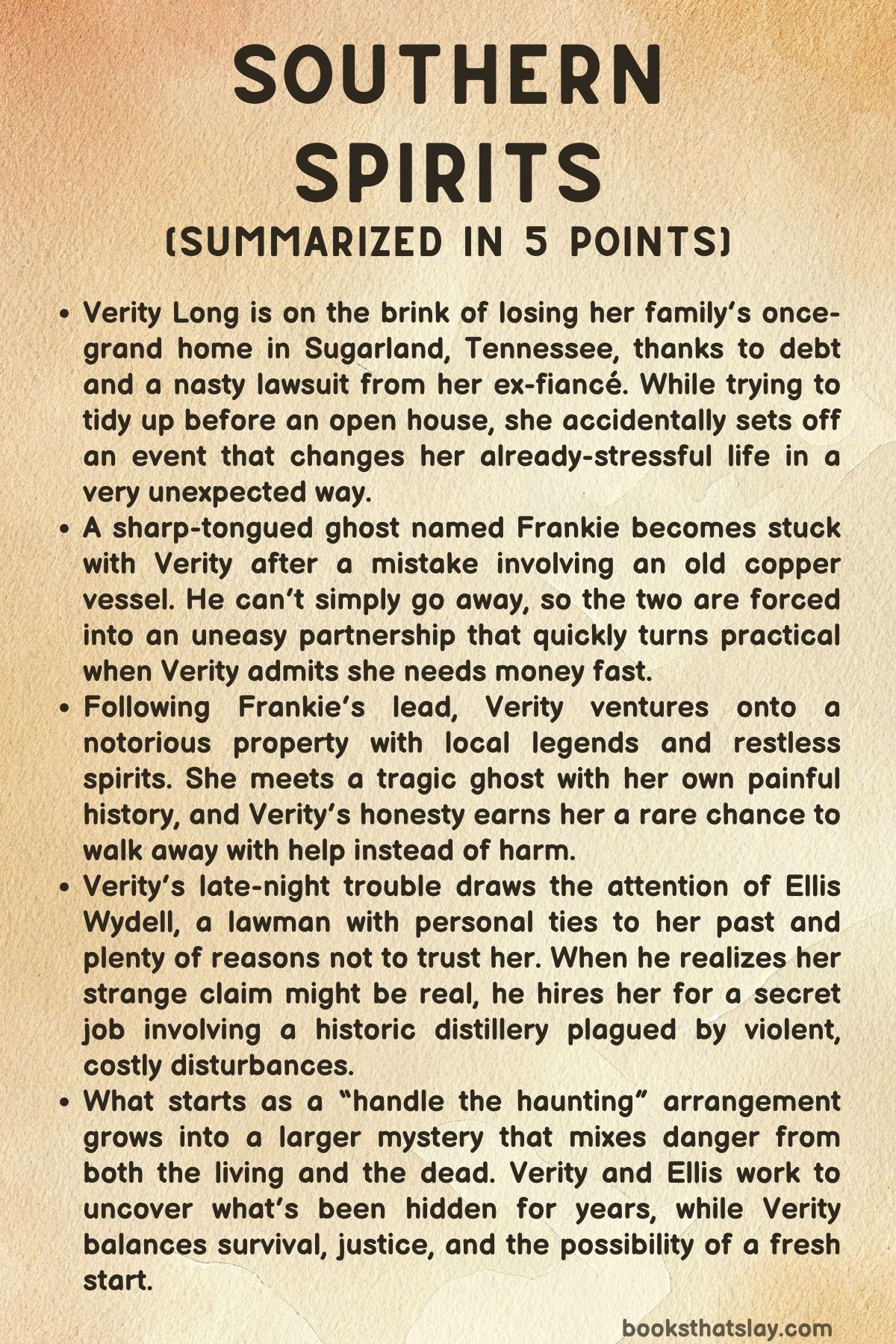
The last thing she needs is a ghost—especially one she accidentally traps on her property by dumping out a dented copper urn. But Frankie, a loudmouthed gangster spirit, won’t go quietly. When Verity discovers she can see and speak to the dead, she gets pulled into a hidden world of restless spirits, buried secrets, and one case that turns deadly.
Summary
Verity Long is living in what used to be a proud, beautiful antebellum home in Sugarland, Tennessee, but now it’s almost empty. An estate sale has stripped the place down to bare rooms, and the bank is closing in.
Verity is more than twenty thousand dollars in debt, and much of that comes from a lawsuit filed by her ex-fiancé, Beau Wydell. Verity called off their wedding, and Beau has spent the time since then doing everything he can to punish her—financially and socially.
Her best friend, Lauralee, comes over to keep her company in the hollowed-out house. They drink wine, complain about Beau, and try to make jokes out of a situation that isn’t funny.
The one odd object still sitting on the mantel is a heavy, battered copper vessel Beau once gave Verity, claiming it was a valuable heirloom. Lauralee points out the painted scene on it looks crude and suggestive, and the two of them laugh at the thought of town gossips finding it during the open house scheduled for the next day.
After Lauralee leaves, Verity decides to clean the ugly thing. She drags it outside, dumps the dirt inside onto her grandmother’s rose bushes, and hoses the vessel out.
She drops a rose bloom into it afterward, mostly out of habit and half out of guilt, because the house feels like it’s slipping away from her and she still talks to her late grandmother in her head. Her pet skunk, Lucy, seems uneasy, and the house begins to creak and shift in a way that makes Verity feel watched.
Inside the kitchen, the air feels wrong. Verity lights a candle and speaks aloud, asking if her grandmother is upset.
A male voice answers—from the copper vessel—telling her she’s not going anywhere. The back door slams and locks by itself.
Then a ghost appears: a tall man in a 1920s suit and Panama hat, with a bullet hole in his forehead. He introduces himself as Frankie the German, and he is furious.
Frankie explains that the dirt Verity dumped was his ashes. By scattering them into the soil, she accidentally bound his spirit to her property.
Now he’s stuck, and he blames her. Verity tries to force him out, but Frankie insists she can’t.
He demands she fix what she did by getting his ashes out of the ground, but Verity points out she hosed the remains into the dirt, making it impossible to collect. Frankie refuses to leave her alone, and as they argue, Verity learns he is connected to the Wydell family—Beau’s great-great-uncle.
The resemblance in attitude suddenly makes an ugly kind of sense.
Verity admits what really ended her wedding. Beau groped her sister Melody the night before the ceremony, then tried to deny it.
When Verity refused to go through with the marriage, Beau acted as if she had no right to say no. After she walked away, he filed suit, trashed her reputation, and helped push her toward financial ruin.
Frankie claims he knows a way Verity can get the money she needs. Years ago, a woman named Maisie Hatcher’s husband allegedly hid a large stash of cash on the Hatcher property after winning big on a horse bet.
He died before retrieving it, and Maisie has searched for it ever since. Frankie remembers details: it’s stored in a wooden box carved with a tree on the lid.
He wants Verity to sneak onto the land and take it. Verity refuses to steal from an elderly woman who has already suffered, and instead decides that if she finds the money, she’ll return it and ask for help legally—either a reward or a loan.
Frankie doesn’t like it, but he agrees.
Because a small amount of his ashes remains in the copper vessel, Frankie can travel with Verity only if she carries it. Verity shoves the urn into a grocery bag, loads up her old Cadillac, and drives with an invisible gangster spirit as her unwanted passenger.
Frankie guides her down an unsettling back road through an abandoned area that feels like a ghost town. They reach the old Hatcher homestead, known locally as the haunted house on the hill and tied to the story of “Jilted Josephine.”
Inside, Frankie uses a limited trick that allows Verity to see the ghostly version of the place. The air shifts, and the house fills with pale, shimmering outlines of furniture that isn’t there in the real world.
A ghostly hound dog appears as a guard. Frankie distracts the dog so Verity can search upstairs, but he admits he doesn’t know the precise hiding spot.
Verity pushes through thick, clinging cobwebs that feel too real. Upstairs she finds a hallway with three doors, and one of them glows with a cold warning.
The first two are locked. The glowing door opens by itself.
Inside is a noose hanging from the ceiling and the ghost of a young woman, Josephine, standing as if trapped in the moment of her execution. Josephine orders Verity to leave, but Verity talks to her instead, explaining her own ruined wedding and betrayal.
The shared pain gets Josephine to listen. Josephine explains she was abandoned when her fiancé chose to marry his cousin for money, and afterward her mother punished her in death as well as in life.
Josephine reveals the hound dog, Fritz, obeys her. She also mentions a strange man who previously tore up part of the floor near where she died.
When Verity admits she’s desperate to find hidden money to save her home, Josephine agrees to let her take it and points her to the right place. Verity pries up a floorboard and finds small bones and the carved wooden box Frankie described.
But as soon as she grabs it, Josephine’s mother’s spirit attacks in a burst of rage. Frankie appears shouting for Verity to run.
Verity races downstairs and bolts out the front door—only to have shotgun blasts rip into the house and the ground near her feet. In panic, she drops the box.
A living voice screams at her to get off the property. Maisie Hatcher stands there holding a shotgun.
Verity raises her hands and tries to explain. At first she lies, claiming she came to look for her grandmother’s lost locket.
A silver necklace lands nearby—thrown from the upstairs window by Josephine. Maisie lowers the gun a fraction, recognizing Verity as someone connected to her old neighbor, Verity’s grandmother.
Verity picks up the necklace, and Maisie reacts oddly, admitting she couldn’t see it until Verity held it. Verity suggests Maisie speak kindly to Josephine when she walks her land.
Maisie, confused but shaken, awkwardly waves up at the window.
Then Verity does the honest thing. She hands Maisie the wooden box.
It’s packed with bundled twenty-dollar bills. Maisie is overwhelmed.
The money could save her farm and cover long-standing medical bills. Verity tries to walk away without asking for anything, but the truth comes out: she’s about to lose her own home.
She needs twenty thousand, or at least three thousand to delay a legal judgment. Maisie can’t spare twenty thousand, but she agrees to lend Verity three thousand on the spot and presses the cash into her hands.
That’s when the police arrive.
Sheriff’s deputy Ellis Graham Wydell steps out, responding to reports of gunshots and trespassing. Ellis is Beau’s brother—exactly the kind of trouble Verity doesn’t want.
He questions them hard, suspicious of why Verity is on the property after midnight and why Maisie is handing her money. Verity refuses to reveal the ghost situation.
Ellis escorts her to his patrol car while he speaks privately to Maisie.
Sitting in the back seat, Verity gets a new shock: Frankie appears beside her, warning her to run. Then another ghost shows up in the front seat—Vernon Hale, a dead deputy and Ellis’s uncle.
Hale assumes Verity is a manipulator and insults her, calling her a gold digger who dumped Beau. Frankie and Hale know each other, and their hostility suggests old history.
When Ellis returns, he releases Verity but warns her he will make sure the loan is repaid. Furious and desperate, Verity blurts out the truth—she can see ghosts—and mentions Hale smoking in Ellis’s car.
Ellis is rattled because Hale’s smoking habit is a detail Verity shouldn’t know.
The next day, Ellis returns privately with proof. He found Hale’s lighter exactly where Verity said it would be.
Ellis doesn’t want to believe, but he can’t ignore it. He offers Verity a job: he owns an old distillery property on Wilson’s Creek Road called Southern Spirits, and something unseen has been destroying equipment inside.
The damage is caught on surveillance, but no human appears. Ellis wants the problem handled quietly.
Verity asks for twenty thousand dollars in exchange—enough to save her house. Ellis agrees immediately, and they sign a written contract.
That night, Verity goes to the distillery with Frankie. The property is a cluster of old brick and wood buildings, decayed in places and newly renovated in others.
Ellis introduces a handyman named Harry and asks Verity to keep her identity and purpose private. Inside the carriage house, Verity sees the destruction: equipment smashed, metal bent, serving stations torn apart.
Frankie warns her that this isn’t a mild haunting. Moving heavy objects takes real power, and whatever is doing this is dangerous.
Ellis gets called away to his shift, leaving Verity alone until morning. Verity forces Frankie to help her see the ghostly layer of the property.
The world shifts colder and harsher. A violent force attacks—an enraged spirit throwing freezing energy, smashing lights, bending metal, and slamming Verity around.
Afterward, a different ghost appears: Colonel Clinton Maker, a Rough Rider, who identifies the attacker as a poltergeist spirit. He warns Verity not to come back and blocks access to a trapdoor in the floor, sealing it with a fear barrier before fading.
When Verity steps outside to call Ellis, headlights appear—an intruder arrives. Ellis tells her to lock the doors and wait.
Frankie manifests holding a ghostly revolver. With no safe place to hide, Verity forces open the trapdoor despite the fear barrier and climbs into the cellar as the intruder breaks in above.
In the cellar, Verity finds a hidden passage: a narrow tunnel with disturbed, moist dirt and sloppy brickwork. Ellis arrives in time, and together they investigate.
It looks like someone living is excavating the tunnel from below and also digging from above, tearing up circles of brick in the yard. Ellis decides he will handle the living threat while Verity handles the dead.
Verity and her sister Melody dig into old records and rumors. They learn the property’s history includes Prohibition-era crime and talk of stolen jewels possibly hidden nearby.
Verity visits Mayor Thad Steward, who admits he knows the tunnel exists and that it’s dangerous. He even confesses he once found a ruby brooch in a bag in a cave near the river.
He draws Verity a map and tells her not to share it with Ellis.
Verity later goes with Ellis to search near the cave. On the steep, unstable cliffs, Verity senses she’s being watched.
Colonel Maker appears, frantic, trying to warn her. As Verity reaches for a juniper bush, someone shoves her from behind.
She falls hard, crashing into Ellis, and both tumble onto the shale. It’s not an accident.
Someone tried to kill her.
Ellis is injured, and Verity drives him to the hospital, then stays with him afterward because he refuses to call anyone. In the quiet of his house, they talk more honestly.
Verity begins to see how alone Ellis is beneath his rigid control. They suspect the attacks may be connected to Ellis’s late uncle Vernon Hale, who was killed years ago in an arson-related incident where no shooter was ever found.
Verity and Ellis go to the abandoned house where Hale died and manage to summon Hale’s ghost. Hale confirms he believed he was targeted.
Before his death, he found a purse hidden on the Wilson’s Creek property containing identification belonging to Joy Sullivan, a girl missing since the 1960s. Hale pulled her file, but the purse vanished from his desk, and the one clerk who knew about it died the same night Hale did.
Hale also says he saw Joy’s ghost and watched her sink into the ground near the carriage house—into the tunnel. He warns that the poltergeist tried to bury him.
Ellis and Verity return to Wilson’s Creek. The tunnel has been opened again.
Fresh dirt shows someone has been digging deeper. Verity hears Joy’s presence pleading, and she and Ellis crawl into the unstable tunnel until they uncover a skull—Joy’s remains.
Immediately the tunnel collapses.
Verity wakes chained to the floor beside Ellis. A new brick wall blocks their exit.
Mayor Thad Steward is on the other side, calmly sealing them in. He confesses everything: he chained Joy in the tunnel decades ago and left her to die because she was pregnant and threatened his plan to marry into the Wydell family’s power.
He admits he shoved Verity off the cliff, stole Ellis’s gun, and shot Vernon Hale to stop the truth from coming out. He also framed Harry by getting him drunk and leaving him passed out without an alibi.
Steward reveals he’s been monitoring research at the library and intends to kill Melody next. Then he finishes the wall, leaving Verity and Ellis in darkness.
Verity calls desperately for help from the dead. The poltergeist energy surges, and Joy appears—cold, furious, and trapped in rage.
Verity bargains: Steward has the key to free them, and if Joy helps, Verity promises justice. Joy agrees, passes through the wall, and goes after Steward.
In the darkness, Ellis reassures Verity they’ll survive. In a charged moment of fear and closeness, they kiss.
Joy returns and drops the key into Verity’s lap.
They free themselves, smash through the fresh brickwork, crawl out, and race to stop Steward. Steward has their keys and Frankie’s urn, and Ellis’s phone is missing, but Ellis has spare keys for his Jeep.
They drive to the library and arrive as Steward is escorting Melody toward his car. Steward pulls a revolver.
In the chaos, Verity fires through Ellis’s windshield and hits Steward, stopping him. Ellis arrests Steward, and with witnesses present, Steward can’t spin his way out.
Afterward, Joy’s remains are recovered and identified. Steward is formally charged for Joy Sullivan’s murder and Vernon Hale’s murder, along with the attempted murders of Verity and Ellis.
Harry is found passed out, exactly as Steward planned. Frankie is returned, weakened from being dragged along in the urn during Steward’s escape.
When Verity returns to the distillery, the supernatural violence has eased. Colonel Maker introduces his wife, Mary, who had been too afraid to appear while Joy’s rage dominated the place.
Joy is gone, finally released after helping bring her killer to justice. Frankie’s ghostly associates celebrate in the kitchen with music and noise, treating the victory like a party.
Verity has what she fought for: the money to save her house, the truth exposed, and the feeling that the dead who needed help have been heard. Ellis and Verity talk about honoring Colonel Maker and his horse, and they admit they want to see each other outside the crisis that brought them together.
Verity leaves the property with relief—her home is safe for now, the haunting has quieted, and her life has finally shifted away from Beau’s shadow and toward something new.
Characters
Verity Long
Verity is the emotional and moral center of Southern Spirits, introduced at a point where her world has been stripped down to almost nothing—literally, in the emptied-out antebellum house and financially, in the looming debt and lawsuit. What makes her compelling is the combination of stubborn resilience and plainspoken decency: she is terrified plenty of times, but she keeps moving anyway, and she refuses to become the kind of person her circumstances could easily justify.
Even when Frankie offers an easy route—steal the hidden cash—Verity’s instinct is to do the “clean” version of the thing, to seek permission, return what isn’t hers, and ask for a fair reward. That moral line matters because the story repeatedly tempts her into gray areas: lying to protect herself, trespassing, bargaining with the dead, and eventually firing a weapon to stop a murderer.
Verity’s power to interact with ghosts is not framed as glamour; it’s inconvenient, frightening, and socially risky, yet she turns it into a tool to protect people, expose truth, and keep her home. Her romantic arc with Ellis also highlights her growth: she begins defensive and cornered, and ends capable of trusting again—not because life becomes easy, but because she proves to herself she can survive betrayal without hardening into bitterness.
Frankie the German
Frankie is a ghost who arrives like a punchline—a bullet hole, a gangster suit, a ridiculous grievance about his ashes—yet he evolves into one of the book’s most surprisingly layered figures. He begins as territorial and transactional, furious at being “grounded” and eager to exploit Verity’s desperation, but his partnership with her gradually reveals a code beneath the bluster.
Frankie is protective in an abrasive way, constantly complaining yet repeatedly showing up when she’s in danger, and his willingness to lend her his limited power suggests a bond that goes beyond convenience. His link to Beau’s family gives him narrative bite: he embodies the Wydell shadow with all its arrogance and entitlement, but he also becomes the counterexample within that same bloodline—a man capable of loyalty, humor, and even restraint.
Frankie’s limitations are also important: he can’t roam freely without his urn, he weakens when removed from a “tuned” supernatural space, and he gets hurt by stronger forces. Those constraints keep him from becoming an all-purpose fix, and they push Verity to remain the active agent.
Under the swagger, Frankie is also a story about being stuck: stuck in dirt, stuck on turf wars, stuck with old grudges—including the unresolved history with his brother’s ghost—until Verity’s choices begin to pull him into a new purpose.
Lauralee
Lauralee functions as Verity’s emotional safety line at the beginning, the friend who arrives when everything is collapsing and helps Verity stay human through humor, wine, and shared outrage. She doesn’t “solve” anything, and that’s the point—she offers presence rather than rescue, the kind of friendship that doesn’t require Verity to perform strength.
Lauralee also helps establish Verity’s social context: a small-town world where gossip is weaponized, where Beau’s smear campaign can shape public perception, and where a woman’s choices—especially refusing a wedding—carry a lasting penalty. Even if Lauralee fades from the immediate supernatural plot, she anchors the early tone: Verity isn’t alone, she’s just outmatched, and she still has relationships that reflect who she really is when the crisis isn’t shouting.
Lucy the skunk
Lucy is more than a quirky pet; she acts like a living barometer for danger and change, reacting before Verity has words for what’s happening. The skunk’s presence softens scenes that could otherwise become relentlessly tense, but it also reinforces Verity’s personality: she is someone who takes in odd, vulnerable things and makes room for them.
Lucy’s ability to slide naturally into intimate spaces—curling up on Ellis’s bed, existing unapologetically in human routines—quietly mirrors the book’s larger theme that the boundary between the strange and the ordinary is thinner than people pretend. Lucy also becomes a social test: anyone who can handle Lucy, even begrudgingly, is someone who might handle Verity’s chaotic life and unusual gift, which makes Lucy a small but telling bridge between Verity’s private world and her potential future with Ellis.
Beau Wydell
Beau is largely an offstage antagonist, but his impact saturates the story through the lawsuit, the debt, and the social damage he inflicts. What makes Beau chilling is the specific kind of entitlement he represents: he treats marriage as a contract that Verity is obligated to fulfill, and when she refuses, he punishes her as if she stole something from him.
The revelation that he groped Melody and then tried to deny it reframes him not as a jilted lover but as someone who expects women’s boundaries to yield to his status, and who relies on denial and pressure when confronted. Beau’s cruelty also isn’t random—he has resources, a family name, and social leverage, so his revenge becomes structural rather than emotional.
In that sense, Beau is the living version of the haunting: he is a past that won’t let Verity move on, a force trying to keep her trapped in shame and scarcity. Even without many direct appearances, he shapes the stakes of every choice Verity makes, because the threat is not only losing a house—it’s being forced back into a narrative Beau wrote about her.
Melody Long
Melody begins as a painful piece of Verity’s past—evidence of Beau’s betrayal and of Verity’s decision to protect her sister rather than protect appearances—and later becomes essential to the investigation. She is the character who proves that courage can look like research, persistence, and refusing to be intimidated by powerful men.
Melody’s anger when she learns Verity is working with Ellis is understandable because she sees the Wydell name as a hazard sign, and her protectiveness reads as hard-earned rather than dramatic. What’s especially significant is that Melody’s intelligence is not just background flavor; her library digging, ownership tracing, and willingness to chase the Joy Sullivan thread directly pressure the villain and raise the stakes.
That, in turn, makes her a target, which validates her importance: Melody isn’t merely the “little sister” in need of protection, she is an active force whose determination helps break a decades-old crime. Her relationship with Verity also adds texture—there is tension, fear, and blunt honesty between them—but when it matters, they move as a unit, which strengthens the story’s sense of family loyalty against public scandal.
Maisie Hatcher
Maisie first appears as a local legend—the owner of the haunted property tied to Josephine’s story—and then reveals herself as something far more grounded: a woman clinging to her land under financial pressure, hardened by years of worry and isolation. Her shotgun stance is not villainy; it’s survival, and the book uses her to complicate the “spooky old house” trope by showing the living stakes behind the folklore.
Maisie’s reaction to getting the money—relief mixed with overwhelm—humanizes her instantly, because the cash isn’t greed fuel; it’s medical bills, stability, dignity. Her willingness to lend Verity three thousand dollars is quietly generous, especially given her own fear of losing everything, and it marks a turning point for Verity too: instead of stealing, she earns trust through honesty.
Maisie also sits at the intersection of the living and the dead in an interesting way—she doesn’t see Josephine the way Verity does, but she’s still nudged into acknowledging the haunted presence with that awkward wave, suggesting that belief isn’t a switch but a series of small concessions to what you can’t explain.
Josephine
Josephine is the book’s most tragic ghost because her haunting is not just death—it’s humiliation, punishment, and a story frozen at its worst moment. The noose imagery makes her presence immediately horrifying, yet the conversation with Verity reveals that Josephine’s rage is not mindless; it is grief with nowhere to go.
Her backstory—abandoned for a wealthier match, then trapped by her mother’s cruelty—positions her as someone doubly controlled by social economics: first by a fiancé’s ambition and then by a parent enforcing punishment as if it were justice. Josephine’s shift from threatening Verity to helping her is one of the story’s key emotional pivots, because it shows what empathy can do even across death.
Verity doesn’t “fix” Josephine with magic; she reaches her by offering recognition, by naming betrayal out loud without turning it into a competition. Josephine’s loyalty bond with Fritz also matters: it gives her agency and tenderness within her horror, reminding the reader that the executed figure is still a young woman capable of attachment and choice.
Fritz
Fritz, the ghostly hound, initially reads as a classic haunted-house guard—an obstacle meant to raise the danger—and then becomes a symbol of fidelity that contrasts sharply with the betrayals driving the living plot. His obedience to Josephine underscores her authority within her own tragedy; she isn’t merely a victim on display, she commands loyalty and can grant protection.
Fritz also embodies the idea that the afterlife in Southern Spirits is not only about human grudges—attachments persist, roles persist, and love can become a kind of haunting too. The dog’s presence makes the supernatural feel domesticated in an eerie way: the same kind of devotion that comforts in life becomes frightening when it manifests as a spectral sentinel.
Ellis Graham Wydell
Ellis begins as a threat—Beau’s brother in uniform, arriving at the worst possible moment—and transforms into one of the story’s strongest supports without ever becoming soft or simple. His skepticism is practical rather than cruel; he challenges Verity because he is trained to interrogate inconsistencies, and because the situation genuinely looks incriminating.
What changes him is evidence plus character: he finds Hale’s lighter exactly where Verity says it is, and he also watches her keep choosing the harder honest path. Ellis’s decision to hire Verity is not just plot convenience; it reveals his priorities.
He wants truth, he wants his property secured, and beneath that he wants to honor the life he imagined sharing with Hale. His loneliness—seen in the sparseness of his home and his habit of carrying responsibility alone—makes his growing closeness with Verity feel earned rather than sudden.
Importantly, Ellis respects Verity’s competence: once he believes her, he treats her as a partner, dividing the problem into the living and the dead and trusting her to handle her side. His protective instincts are real, but they don’t erase her agency; instead, the relationship builds through mutual risk, shared investigation, and the kind of trust that forms when people save each other in ways that cost something.
Vernon Hale
Hale’s ghost is abrasive, judgmental, and emotionally loud, which makes him feel real rather than saintly. He assumes the worst about Verity because that assumption fits the story his family has told about her, and even in death he clings to that narrative—until the facts force cracks in it.
Hale also functions as a bridge between the haunting and the murder mystery: he isn’t just a spooky cameo, he carries critical information about Joy Sullivan and the tunnel. His confession that he suspected he’d been targeted adds weight to the idea that corruption in Sugarland isn’t merely political—it is personal, protective, and willing to kill.
Hale’s attachment to Ellis is one of unfinished mentorship and affection; Ellis renovating the distillery as a retirement project with him reveals how deep that relationship ran, and why Ellis’s pursuit of the truth is emotional as much as procedural. Hale’s helplessness as a ghost—unable to identify his killer, still trying to warn Ellis—turns him into a portrait of duty that didn’t end at death, which makes his presence both irritating and poignant.
Colonel Clinton Maker
Colonel Maker brings an older, mythic texture to the supernatural world, presenting as a disciplined soldier spirit who still thinks in terms of territory, duty, and sacrifice. His warning to Verity carries the weight of someone who understands danger on a scale she hasn’t yet encountered, and his act of sealing the trapdoor with fear suggests both power and desperation—he is not flexing, he is containing something.
The colonel is also a moral contrast to the poltergeist: where the poltergeist is raw rage and uncontrolled force, Maker is purpose and restraint, trying to protect others even when it costs him his ability to manifest. His bond with his mare Annabelle deepens him beyond “ghost mentor”; it shows affection and identity persisting in death, and it hints that the carriage house is not only a battleground but also a kind of afterlife community with its own hierarchy and rules.
Annabelle
Annabelle, the colonel’s ghostly mare, operates as a symbol of gentleness and continuity amid violence. In a location charged with anger and destruction, her presence is a quiet insistence that not all spirits are there to harm; some remain because love and habit anchor them.
Annabelle also ties the colonel to a fuller past, reminding the reader that these ghosts were once whole lives with relationships, responsibilities, and routines. The fact that Verity and Ellis later consider honoring both the colonel and the horse suggests that part of resolving a haunting is respect—not just banishment—recognizing that the dead aren’t always problems to be removed, but stories that need acknowledgment.
Mary
Mary’s late appearance is meaningful precisely because it is delayed; her absence while Joy’s poltergeist rages suggests a spirit who has learned fear and survival even after death. When the danger passes, Mary’s emergence signals that the property’s supernatural ecosystem can stabilize, and that some spirits are not aggressive but simply cautious.
She also expands Colonel Maker from lone guardian to husband, giving him emotional context and suggesting that the haunting world includes private bonds that outsiders don’t see until trust is established. Mary’s presence reinforces one of the book’s gentler ideas: resolution doesn’t only quiet the loudest ghost, it allows the quieter ones to exist without hiding.
Harry
Harry is designed to look suspicious in the way many mystery narratives use marginalized characters: he is withdrawn, has limited social power, and is conveniently near the trouble. The story uses that suspicion to test Verity and Ellis—especially Verity, who is sharp enough to see patterns but human enough to grasp at an explanation when scared.
Harry ultimately represents how easily the vulnerable can be used as cover by the powerful, which becomes explicit once the framing is revealed. His connection to the Good Samaritan House, his quiet labor on the property, and his lack of a strong voice in town make him an easy scapegoat for someone like Steward.
When Verity later apologizes for suspecting him, it matters because it shows she doesn’t just chase truth for her own benefit; she’s willing to name her mistakes and repair harm, which is part of what makes her different from the people who weaponize narratives.
Mayor Thad Steward
Steward is the most dangerous kind of villain in Southern Spirits because he blends public authority with private brutality, using reputation and civic power as camouflage. His earlier presentation—politically annoyed, minimizing the haunting, offering selective help while asking for secrecy—sets him up as a manipulator who controls information flows, including the town’s “official” version of reality.
His crimes are rooted in entitlement and image management: Joy Sullivan is not simply killed, she is imprisoned and erased because her pregnancy threatens his plan to marry into the Wydell power structure. The way he monitors library research and preemptively plans to kill Melody shows a modern, systematic cruelty—he is not reacting in panic; he is maintaining a narrative.
Even his war injury is revealed as exaggerated for sympathy and cover, reinforcing the theme that his identity is a constructed performance. Steward’s attempted burial of Verity and Ellis is both literal and symbolic: he tries to seal problems behind a wall and mortar them into silence, the same way he sealed Joy’s life out of public view for decades.
Joy Sullivan
Joy is the haunting’s heart and the mystery’s tragedy, a figure whose suffering transforms into the poltergeist energy that terrorizes the property. Her rage is portrayed as both frightening and morally legible: she is not evil; she is trapped in the emotional physics of what was done to her, and that trapped fury becomes a force that attacks the living because it has nowhere else to go.
The story treats Joy’s release as conditional on justice and recognition, not on being “defeated,” which gives her agency even after death. When she retrieves the key and helps Verity and Ellis escape, Joy becomes more than a victim—she becomes a rescuer, someone who chooses to intervene once the living finally understand her story and promise to expose it.
Her movement “to the light” after the truth is revealed frames the supernatural not as random horror but as unfinished human reality demanding witness; Joy’s peace arrives only when the lies surrounding her are broken open in public.
Genevieve Wydell
Genevieve’s role is indirect but structurally important because she sits in the ownership chain that connects the distillery property to the Wydell family and to Steward’s long influence. Her presence signals how property, divorce, inheritance, and family politics create the environment where secrets can be hidden and protected over decades.
Even without direct scenes, Genevieve represents a form of power that operates quietly through paperwork and social standing, and her link in the chain helps explain why the property’s history is tangled with both privilege and concealment.
Merle
Merle appears as a small, chilling detail in the cover-up machinery: the records clerk who is one of the only people who might have known what Hale discovered, and who dies the same night. That coincidence reads like the footprint of a system rather than a lone act, reinforcing how Steward’s power can reach into “ordinary” roles that keep truth documented—or buried.
Merle’s brief mention emphasizes a core tension of the book: knowledge is dangerous in Sugarland when it threatens the wrong person, and even the mundane work of filing and record-keeping can become a battleground.
Themes
Home, Inheritance, and the Cost of Staying
Verity’s fight to keep Southern Spirits rooted in her grandmother’s house is never only about a building; it is about what a home represents when grief, pride, memory, and community expectations pile on top of debt. The house begins as a symbol of family continuity and personal identity, but the estate sale strips it down to bare rooms that feel like public proof of private failure.
Verity’s urgency is sharpened by the fact that the house is “once-grand,” meaning the town likely reads the decline as a kind of social story about her worth and her choices. That external pressure turns the house into a stage where people project judgments: Beau’s lawsuit and gossip campaign become tools to push her out, not just financially but socially.
Verity’s determination to stay is also complicated by the fact that the house is tied to her grandmother’s presence, and the boundary between memory and haunting blurs quickly. When she speaks into the dark kitchen and something answers back, the home becomes a place where the past literally responds, refuses to be boxed up, and demands a reckoning.
The theme deepens because the house is not saved by a neat miracle but by messy negotiations, favors, and risk. The loan from Maisie buys time, and the job from Ellis turns Verity’s survival into paid labor that forces her to use a new, unwanted skill.
Keeping the house requires her to accept help, tolerate scrutiny, and step into danger repeatedly. In that sense, “staying” is not passive loyalty; it is work that tests her ethics, her nerve, and her willingness to be seen as strange.
The story treats home as something you defend with choices that shape who you become, not as a sentimental backdrop.
Women’s Reputation, Social Punishment, and the Price of Saying No
Verity’s broken engagement is framed by the town and Beau’s family as a scandal, but the narrative makes clear that the real offense is her refusal to accept betrayal and keep quiet. Calling off the wedding is a boundary she sets after Beau’s behavior toward her sister, yet the consequences fall heavily on her: a lawsuit, a smear campaign, and an atmosphere where people treat her like the one who caused harm.
The theme shows how quickly “respectability” becomes a weapon, especially in a small town where stories harden into labels. Verity is forced to calculate what she can say and when, because telling the full truth may not protect her; it may simply give others new material to twist.
That is why she initially lies to Maisie about the locket and why she tries to dodge Ellis’s interrogation. Those lies are not proof of bad character so much as evidence of the social trap she is in.
The parallel with Josephine is blunt and painful: Josephine is punished not only by a fiancé who chooses wealth and status over her, but also by a mother who turns abandonment into a moral failing and enforces it even after death. Verity’s empathy in that room comes from lived knowledge of being judged for refusing a role that would have harmed her.
The story also exposes how men in power use institutional tools to control women’s choices. Beau uses the legal system and public narrative to retaliate.
Mayor Steward uses civic authority and family alliances to cover a long history of violence. Even Ellis, who becomes an ally and love interest, initially approaches Verity from a place of suspicion colored by family loyalty and assumptions about women who “take” from others.
Over time, Verity’s insistence on truth—spoken to a ghost, then to a deputy, then in front of witnesses—becomes a form of self-rescue. The theme argues that a woman’s “no” is treated as a disruption that invites punishment, and it tracks how Verity survives by holding that no anyway, then building a life where it cannot be erased.
Justice That the Living Failed to Deliver
A central tension in Southern Spirits is that formal justice has gaps wide enough for entire lives to disappear inside them. Joy Sullivan’s missing-person story sits buried under decades of silence, and Officer Hale’s death is treated as closed in practice even without answers.
The town functions as if unresolved crimes are simply unfortunate events that time can smooth over, which is exactly what people like Steward rely on. He counts on forgetfulness, on deference to office, on fear of scandal, and on the assumption that a powerful family connection can outlast truth.
The supernatural element does not replace justice; it exposes where justice stopped. Hale’s ghost becomes a witness who cannot be intimidated, but even he is limited—he knows pieces, he suspects, he warns, yet he cannot finish the work alone.
Joy’s spirit carries rage not because she is naturally violent, but because she is trapped inside an outcome the living allowed to stand. Her transformation into a destructive force reads like the emotional physics of injustice: when a person is denied recognition, grief and anger don’t vanish, they intensify.
Verity and Ellis become a bridge between worlds not just because they can hear ghosts, but because they are willing to act on what they learn. The tunnel under the distillery is both literal and symbolic: a hidden route that connects respectable property to buried crime, linking public prosperity to private harm.
Steward’s plan to brick Verity and Ellis into that space shows how violence persists through control of narrative and evidence—he does not only want them dead, he wants them unfindable. The eventual arrest is satisfying because it requires multiple kinds of courage: Verity’s willingness to be disbelieved, Ellis’s willingness to accept that his family’s legacy includes rot, and Joy’s willingness to help the living even after what was done to her.
The theme suggests that justice is not automatic and not guaranteed by titles; it is something people must choose to pursue, even when the truth threatens reputations and long-standing power structures.
Power, Corruption, and Respectability as Cover
The story repeatedly shows that respectability can be used to disguise predation. Mayor Steward is not a shadowy outsider; he is a civic figure with relationships and history in the town, and he uses that position to keep others off-balance.
His polite manner while sealing a brick wall around two people is horrifying precisely because it reveals how cruelty can wear a calm face when the perpetrator believes he is untouchable. His motivations are tied to ambition and social climbing: controlling Joy, eliminating threats, and aligning himself with the Wydells.
That link matters because it suggests corruption is not just personal; it is networked. Families, offices, and institutions create an environment where certain people are assumed credible and others are assumed disposable.
The distillery property itself becomes a monument to that kind of hidden structure. It is marketed and restored, labeled with heritage and nostalgia, while underneath it sits a tunnel associated with illegal activity, buried evidence, and desperate digging.
That contrast mirrors the town’s tendency to celebrate surface history while ignoring who was harmed in the making of it. Steward’s manipulation of Harry is another example of how power chooses convenient scapegoats: he exploits someone with fewer resources and less credibility, knowing that suspicion will stick.
The Wydell name carries similar weight. Beau can leverage family influence to punish Verity for refusing him, and Ellis must wrestle with what it means to serve justice while carrying that surname.
Even Vernon Hale’s ghost reflects the legacy of law enforcement entangled with family loyalty; his presence in the patrol car is a reminder that “the law” is also made of flawed people and inherited biases. By the end, the theme lands on a grim insight: corruption thrives when communities prefer a clean story over a true one.
Steward survives for decades because people find it easier to believe in his public image than to look closely at what disappears around him. The narrative doesn’t treat exposure as simple; it takes danger, evidence, and public confrontation.
Respectability is shown as a costume that can protect monsters until someone is willing to tear it.
Bargains, Ethics, and What Survival Makes You Consider
Verity’s financial crisis forces her into moral decisions that are not abstract. When Frankie offers a route to hidden money, the temptation is immediate because the need is immediate.
The theme works because Verity is not portrayed as a saint who never wavers, nor as someone who becomes ruthless; she is someone who has to think through what she can live with. Her refusal to steal from Maisie is a turning point that defines her survival as principled rather than predatory.
Importantly, she does not decide this because consequences might catch her, but because she recognizes that taking from another struggling person would damage her sense of self. The story then tests that choice by making the “ethical option” still risky and humiliating.
She has to ask for help, admit vulnerability, and accept a smaller amount than she needs. Later, when Ellis offers a paid agreement, she names her price directly—twenty thousand dollars—without apology.
That moment shows an evolution: she stops treating her needs as shameful and starts treating them as facts. The supernatural partnership with Frankie also belongs in this theme because it is a constant negotiation.
Frankie is helpful but self-interested, demanding, and invasive. Verity cannot simply accept his assistance as a gift; she must manage him, set boundaries, and decide when to use power that feels wrong to her.
The poltergeist problem escalates the ethical stakes further, because it connects personal survival to community safety. Verity’s choice to return to the property after being attacked is not only about money, but also about preventing further harm and uncovering the truth about Joy.
Her survival becomes tied to other people’s survival. Even small decisions—hiding information from Ellis, then later telling him; suspecting Harry, then apologizing—are part of the same moral terrain.
The theme insists that ethics are not neat rules applied from a safe distance. They are decisions made while scared, broke, and pressured, and they reveal character through what someone refuses to do, even when refusal costs them.
Trauma, Trust, and Learning to Be Safe With Someone
Verity begins the story carrying relationship trauma that shapes how she reads every interaction with the Wydell family. Beau’s betrayal is not only sexual misconduct and emotional coercion; it is the shock of realizing someone close to her was capable of violating her family and then trying to force compliance through shame.
That history makes Ellis’s presence dangerous in Verity’s mind, regardless of his individual behavior. When he questions her outside Maisie’s property, his authority and family connection combine into a familiar threat: being judged, cornered, and disbelieved.
The theme develops as Ellis gradually earns trust in specific, concrete ways. He returns to verify what she said about Hale, he offers a formal agreement rather than vague promises, and he shows concern for her safety after the intruder arrives.
His trust-building is not perfect—he leaves her alone at the property, he stays skeptical longer than she would like—but the story treats trust as something that grows through actions, not declarations. Verity also learns to trust herself again.
Speaking openly about seeing ghosts risks being labeled unstable, and Verity’s fear of that label is rooted in how her community already frames her. Each time she insists on what she knows—about spirits, about danger, about the tunnel—she repairs a piece of confidence that Beau tried to strip away.
The near-death moments accelerate intimacy in a way that still feels grounded: after the cliff attack and later the burial attempt, survival creates a space where emotional defenses drop because the stakes are too real for performance. The kiss in the darkness is less a sudden romance cliché and more a sign that both of them are reaching for proof of life and connection while facing a man who expects them to disappear.
The theme also highlights loneliness as a form of quiet trauma. Ellis’s sparse home, his lack of food, and his solitary routines suggest a life narrowed by duty, loss, and guardedness.
Verity’s domestic gestures—bringing groceries, cooking, covering him with a quilt—aren’t just cute romance beats; they are a language of care that rebuilds safety. By the end, the possibility of dating is meaningful because it happens after truth is faced, not before.
Trust is framed as earned in the aftermath of danger, when both people have seen the worst of what power can do and still choose honesty.
The Past Refusing Silence
Ghosts in Southern Spirits are not decorative scares; they are evidence that the past keeps demanding attention when it has been mishandled. Frankie’s arrival is triggered by something almost absurd—ashes dumped into rose bushes—yet the consequence is serious: Verity’s life is suddenly crowded by a history she didn’t ask for.
Josephine’s haunting shows how personal betrayal can harden into an endless loop of suffering when no one offers compassion or repair. Colonel Maker’s warnings show another side: a spirit tied to duty and protection, trying to prevent harm even when his strength is limited.
Joy’s presence is the clearest statement of the theme. Her pain is not metaphorical; it is connected to a body hidden underground and a story deliberately erased.
The tunnel, the trapdoor, and the disturbed dirt show how the past is physically embedded beneath present-day property and profit. People are literally digging it up for treasure while trying to keep the truth buried.
Verity’s ability to “tune” into the ghostly world becomes a responsibility because it forces her to acknowledge what others prefer to ignore. The theme also shows that the past can be manipulated.
Steward tries to control what is remembered by controlling evidence, intimidating curiosity, and planning new violence against Melody for researching old newspapers. That detail matters because it shows memory as a battleground.
Research, records, and stories are not neutral; they can threaten power. When Joy finally helps Verity and Ellis escape and then moves on, the story suggests that release comes when truth is surfaced and wrongdoing is named in the living world.
The haunting calms not because the supernatural is defeated by force, but because the underlying harm is confronted. In the end, the past does not disappear; it changes role.
Frankie remains, the colonel and Mary remain, but they are no longer shouting through destruction. The theme argues that peace is possible when the past is treated with honesty rather than denial, and when the living stop asking history to stay quiet for their convenience.