Spellcaster by Jaymin Eve Summary, Characters and Themes
Spellcaster by Jaymin Eve is a contemporary fantasy romance set in a hidden magical America, following a late-blooming young witch who discovers she’s far more dangerous—and desired—than anyone expected. Twenty-two-year-old Paisley Hallistar has just come into her magic, but her powers are messy, her affinity is unclear, and her dreams are fixated on a man she can’t name.
When she’s unexpectedly accepted to elite Weatherstone College, Paisley steps into a world of rival families, strict coven politics, and dark creatures stalking the campus. At the center is Logan Kingston, a feared spellcaster tied to her past and to a feud that could destroy them both.
Summary
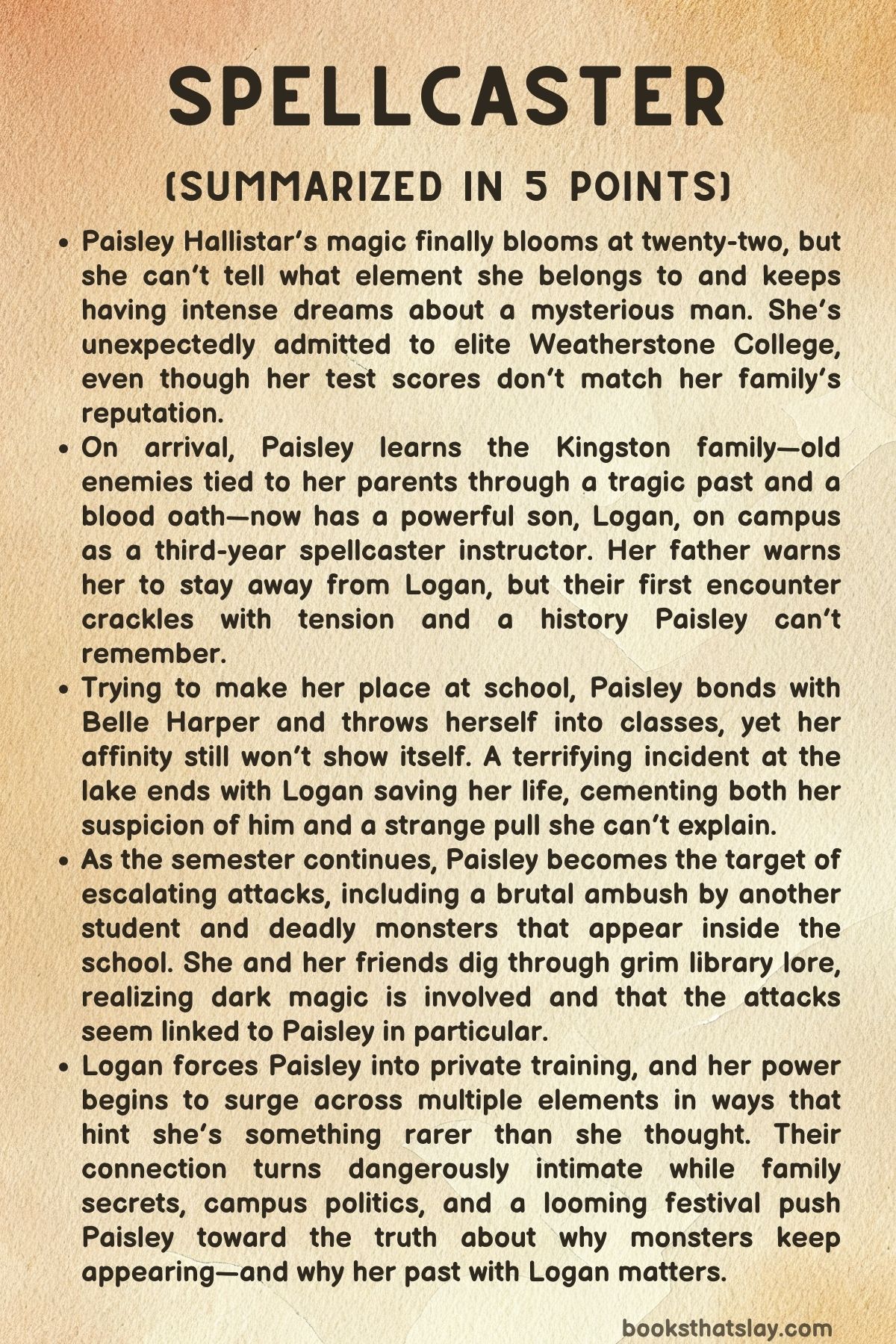
Paisley Hallistar is twenty-two when her magic finally blooms, later than almost everyone she knows. The rush of power feels real, but she can’t shape it, can’t sense what element she belongs to, and can’t explain the vivid sexual dreams that keep pulling her toward a faceless man.
Her family is legendary in magical circles—high status, strong abilities, and deep coven ties—so Paisley has grown up hearing how gifted her siblings are while quietly worrying she’s the odd one out. Life changes overnight when her mother, Beth, announces that Paisley has been accepted to Weatherstone College in New York, the most prestigious magic school in the country.
Paisley is baffled because her entrance results were average, but her parents insist this is her chance to find her place.
Her father, Tom, escorts her to the iron-gated campus that practically hums with old power. In the registrar’s office, Ms. White hands Paisley her schedules and rules, then casually mentions Headmaster Gregor’s message: a third-year spellcaster named Logan Kingston is transferring in from Italy and will be teaching special classes. The moment Tom hears the name Kingston, he panics and tries to take Paisley back home.
Outside, he explains why. Years earlier, Tom and Rafael Kingston were close friends until a tragedy shattered everything.
Rafael’s wife, Isabel, died on a hike after a mysterious spell went wrong while she was with Beth. Rafael blamed Beth for Isabel’s death, and the families split.
The fallout hardened into a bitter blood oath between the two men. Tom believes Logan may have come to Weatherstone to hurt the Hallistars, and he orders Paisley to avoid him completely.
Paisley refuses to leave. She needs the school to discover her affinity, earn her coven future, and prove she isn’t a disappointment.
Tom reluctantly lets her stay, casting protective wards around her dorm before leaving to argue the matter with Beth. Paisley moves into Florence Wing, trying to steady her nerves.
Soon her siblings arrive—twins Jenna and Alice, and brothers Trevor and Jensen—determined to support her. They remind Paisley that even if her power is late, it’s still hers, and she isn’t alone.
On the way to the welcome ceremony, the siblings pass Aura Hall and the curtained entry to Nightrealm, the warlock dorm. Two warlocks step out, and behind them stands Logan Kingston.
He’s older, tall, radiating authority, and so powerful the air seems to tighten around him. Trevor recognizes him instantly.
Logan blocks the group, taunting the Hallistars about their pride and calling Paisley his “best friend. ” He speaks like they share history, asking why she was hidden and whether she remembers their last days together.
Paisley is shaken by his icy green eyes and by the strange pull she feels toward him. With a final “Precious,” Logan walks away, leaving Paisley rattled and her siblings furious.
The first days of classes are rough. Paisley befriends Belle Harper, a confident water elemental with High Council family connections.
In Elemental 101, Professor Damone teaches the five elements—air, water, fire, earth, and metal—and begins affinity testing. Most students feel an immediate draw, but Paisley senses almost nothing.
Earth is silent in her hands, water doesn’t answer, fire flickers faintly, and metal sparks weakly. Even air refuses to respond when Professor Damone tests her directly.
Paisley tries to hide her embarrassment, but the emptiness stings. Damone tells her not to panic; some blooms settle slowly.
Paisley clings to that hope.
During a water training session at the lake, Paisley finally feels something. The water thrums around her, and her hands glow beneath the surface.
She swims deeper, chasing the sensation—until something clamps onto her ankles and drags her down. Freezing darkness closes in.
She flails, flashes light, and sees a clawed shape. Just as she’s about to drown, a burst of lightning erupts below, and a stronger force hauls her upward inside an air bubble.
Paisley blacks out and wakes to find Logan Kingston holding her at the surface. He coldly states he saved her and that she now owes him.
Her father arrives furious, threatening to pull her out of Weatherstone, but Paisley insists on staying. The school promises to investigate the attack.
After a few quieter weeks, Paisley adjusts to student life. She, Belle, and new friends Sara Collier and Haley Michaels form a tight group.
At the full-moon party, Belle pushes Paisley toward Marcus Lofting, a charming freshman with rare multi-element talent. Paisley works up the courage to approach him, but he’s already talking to someone else.
Later, Belle returns bruised from an iron spell attack by Annabeth, a bitter air elemental seeking revenge on Belle’s family. Paisley escorts Belle to healers, angry that the school feels dangerous even before her affinity has formed.
On her way back alone, Paisley is ambushed. A burlap bag drops over her head, she’s knocked out, and air magic dumps her in the graveyard.
Her attacker is a third-year warlock she recognizes from Logan’s circle, a sneering boy she nicknames Weasel. He says Paisley is an irritation and that Logan will appreciate her removal.
He chokes her with air and repeatedly slams her into the ground, intending to kill her. Other students arrive in time to scare him off, and Paisley is carried to the healing wing with fractured ribs and internal bleeding.
Her family demands answers, and her father warns that one more incident will end her time at Weatherstone.
Paisley becomes convinced something darker is happening. She researches monster-summoning and nightmare magic, learning that only a mage drawing on dark energy can pull creatures from unreachable planes or shape fear into flesh.
Her friends initially doubt her until screams tear through Aura Hall. A massive black, armored mantis-like monster attacks students, resisting spells and killing a warlock in front of everyone.
Logan charges in and obliterates the creature with raw spellcaster force. The campus locks down.
Headmaster Gregor announces an investigation, elders and magical military arrive, and an energy blanket is considered to restrict power. Paisley’s friends apologize for dismissing her fears and help her build defensive thorns using a complicated ritual and apothecary herbs.
During a weekend visit home for the Moon Goddess festival, Paisley finds her late grandmother’s old boxes. Inside are crystal necklaces and notes about stones that boost, protect, or call power.
Paisley takes the crystals back to school, still certain Logan is hiding something. She tails him for days and finds nothing.
Exhausted and stubborn, she waits outside Nightrealm at midnight wearing the crystals and carrying a thorn. She wakes to glowing hands and a new monster with antlers and a single huge eye.
It wounds her badly, but she stabs it with the thorn and staggers into Nightrealm, collapsing at Logan’s door.
Logan heals her in his room with overwhelming spellcaster energy. The crystals react violently when he touches them, and he removes them before continuing.
As their magic mingles, desire hits both of them like a spell. Paisley kisses him, and he gives in, taking her to completion while finishing her healing.
Afterward, he shuts down emotionally, insisting the monsters are not his work. He believes they are being called, not created, and he orders Paisley to train with him and his ally Noah so she can control what she is becoming.
Training at the lake reveals how fast Paisley is growing. Logan pushes her to use instinctive power instead of relying on chants.
Paisley secretly uses her crystals as a boost and manages to flip Logan upside down and bind him to a tree, proving she can access serious strength. Campus life turns chaotic again during the Blue Harvest Moon Festival.
Bootleg witch wine circulates, Paisley gets drunk, and she passes out while Logan carries her home. Overnight, the chapel burns down in a magically enhanced fire.
Students are injured, parts of the library are damaged, and Tom Hallistar is suspended without pay after someone reports he knew about the wine. The punishment threatens the family’s ability to pay their coven tithe, and Paisley hears her parents planning for the possibility of losing coven protection altogether.
Back at school, Paisley struggles between clearing her father’s name and preparing for assessments. Professor Damone notices Paisley’s rapid progress and assigns Marcus—now newly claimed as a spellcaster—to shadow her.
Logan insists Paisley uses him as her trigger, and when he touches her, their power merges so intensely that Paisley parts the lake by accident. Marcus concludes she is likely Weatherstone’s third spellcaster.
Logan hints that Paisley and he were bound to an “endgame” since she was four, then disappears off campus to deal with his father Rafael, whom even Noah warns is dangerous.
Paisley’s final assessment confirms her potential. She shows solid control across elements and succeeds in alchemy, leaving assessors stunned.
On Halloween, the energy blanket drops and wild All Hallows power floods the grounds. Paisley meets Logan at the graveyard, and he takes her to his ancestor’s grave.
He says Rafael wants her destroyed, that Rafael didn’t arrange Tom’s suspension, and that the real enemy might be someone Paisley trusts. Before he can explain more, monsters begin appearing one after another, stronger each time Paisley rages at their unseen maker.
Logan realizes the truth: Paisley herself is calling them. He forces her to connect to his power and use her crystals, and together they destroy the creatures.
Beth suddenly appears, pulled by Paisley’s uncontrolled calling. Logan labels Beth a demon-witch and claims Paisley belongs to him.
He gives Beth one month before he comes for Paisley, then vanishes. Beth portals Paisley home to Tom.
Shocked and frightened, Paisley demands answers. Her parents finally agree to explain everything in the morning and hand her a forbidden text—The Reapers of Purgatory—telling her to read it first, because the truth about her mother, her own magic, and the monsters she summons is far bigger than she imagined.
Characters
Paisley Hallistar
Paisley is the emotional and narrative center of Spellcaster, entering Weatherstone at twenty-two with a late magical bloom and a bruised sense of inadequacy compared to her high-achieving family. Her core conflict is identity: she craves proof that she belongs in the elite magical world, yet she can’t sense an affinity and feels “less than” at the very place designed to reveal it.
That insecurity fuels her stubbornness—she refuses to leave Weatherstone despite real danger, not out of recklessness but out of a deep need to claim a life that isn’t defined by her family’s shadow. Paisley’s defining trait is her instinct to protect, visible when she intervenes for Belle without dependable magic and later when she keeps researching monsters despite exhaustion and fear.
Her arc steadily shifts from passive uncertainty to active power: she moves from being tested by elements with no response to instinctively channeling magic, summoning thorns, and ultimately realizing she might be the one calling monsters. The erotic dreams and intense bond with Logan complicate her growth, forcing her to reckon with desire, trust, and agency.
By the end, Paisley stands at a terrifying threshold—discovering that her power is vast, intertwined with Logan’s, and tied to family secrets she doesn’t yet understand.
Logan Kingston
Logan is built as both threat and gravitational force—the transfer spellcaster wrapped in family feud, icy charisma, and immense, almost frightening control. He arrives with an aura of danger that’s partly real and partly weaponized; he’s not simply cruel but uses intimidation as a shield and a tool, especially around the Hallistars.
His history with Paisley is the emotional key to his character: he speaks to her as if they share something preordained, and the language he uses (“Precious,” “endgame”) suggests a bond older and deeper than she remembers. Logan’s internal tension comes from being caught between inherited loyalty to Rafael and a private, growing attachment to Paisley; he saves her repeatedly, trains her, and blocks others from harming her, yet refuses to be vulnerable about why.
His power is portrayed as overwhelming rather than intricate—he disintegrates monsters through raw force—and that simplicity mirrors his psychology: he pushes forward, dominates situations, and avoids messy emotional explanations. The romance scene in his room reveals another layer, where duty and restraint collapse under shared energy, hinting that his emotional defenses are thinner with Paisley than he wants to admit.
By the graveyard confrontation, Logan functions as a reluctant truth-bearer, trying to warn her that betrayal is near and that her own power is dangerous, while still holding back crucial details, suggesting a man who knows too much and fears the cost of saying it aloud.
Beth Hallistar
Beth embodies the buried past of Spellcaster—a mother who appears gentle and grounded but is clearly the keeper of a secret that could fracture everything. Her long retreat from magic after Isabel’s death suggests trauma layered with guilt, not just grief, and her protective instincts toward Paisley are colored by fear of what Paisley might become or inherit.
Beth’s sudden appearance at the graveyard, summoned by Paisley, exposes her as something more than a retired witch; Logan’s accusation that she is a “demon-witch” reframes her entire history and implies she carries a stigmatized or forbidden nature. What makes Beth compelling is the contrast between her domestic warmth and the storm she represents—she loves her family fiercely, yet has withheld the truth for years, possibly to keep them safe or to keep a shameful lineage hidden.
Her final act—portaling Paisley home, promising explanations, and giving her The Reapers of Purgatory—positions her as both guardian and gatekeeper to the next stage of Paisley’s understanding.
Tom Hallistar
Tom is the family’s stabilizing force and Paisley’s primary protector, defined by a pragmatic fear that comes from experience rather than cowardice. His bond and blood oath with Rafael have carved a constant readiness into him; from the moment he hears Logan is at Weatherstone, his instinct is to flee, not because he doubts Paisley but because he knows what vendettas can do.
Tom’s love is action-oriented: he wards her dorm, escorts her, storms to the lake after her near-drowning, and later risks everything to hold back the magically enhanced chapel fire. The suspension hits him not only professionally but existentially, because coven membership is tied to survival and dignity, and his fear of losing it is fear of failing his family.
Tom also represents the moral center of the Hallistars—he believes in rules, safety, and community—and that makes him vulnerable to political scapegoating by powerful families. His arc in these summaries is less about change and more about pressure, showing a good man cornered by old feuds and new conspiracies.
Jenna Hallistar
Jenna, one of Paisley’s older twin sisters, is the strategist and quiet commander of the siblings, the one who enforces restraint when Logan provokes them and who keeps Paisley tethered to practical reality. She carries the confidence of someone close to graduating and already recognized as elite within their world, yet she doesn’t weaponize that status against Paisley; instead she uses it to reassure and shield her.
Jenna’s bond with her familiar Morris, the bear, emphasizes her grounded strength and capacity for fierce loyalty. She also represents the future the Hallistars want—stable coven placement near home—which makes her protective stance toward Paisley partly affectionate and partly a fear of losing family cohesion.
Her calmness is not detachment; it’s discipline born from knowing how dangerous strong magic politics can be.
Alice Hallistar
Alice mirrors Jenna in capability and devotion but feels softer in outward energy, balancing Jenna’s command with comfort. Her familiar Simon, the sheep, underscores a nurturing side and a preference for harmony.
Alice serves as emotional shelter for Paisley during the chaos—talking about graduation and covens in a way that normalizes the future and reminds Paisley she has a place in it. The twins together function as a symbol of belonging; their covenant-style closeness highlights what Paisley longs for—competence paired with unconditional acceptance.
Trevor Hallistar
Trevor is the teasing, high-status sibling whose swagger hides real vigilance. His “Hottest Warlock” reputation and playful theft of breakfast make him an easy comic presence, but he’s also sharply attuned to threats, instantly recognizing Logan and wanting to confront him.
Trevor’s history with Logan adds texture to the feud; he remembers Logan as an older boy who once watched over Paisley, which complicates Trevor’s hostility with confusion and grudging memory. His appearance alongside Paisley at key moments—after the party injury, during escort duties—shows a brother who uses humor as armor while still placing himself between Paisley and danger.
The revelation that he has a girlfriend subtly humanizes him further, suggesting he’s building a life beyond family drama even as he remains fiercely loyal within it.
Jensen Hallistar
Jensen plays the role of steadfast guardian, quieter than Trevor but equally protective. He is the brother who walks Paisley back to her dorm on the first night, grounding her with reminders and concern.
Jensen’s personality is expressed through consistency rather than flair: he’s the sibling who adds stability to Paisley’s emotional turbulence and reinforces the family’s united front after her graveyard attack. His presence contributes to the sense that Paisley is loved not as a disappointing outlier but as the youngest worth protecting at any cost.
Belle Harper
Belle is Paisley’s first real anchor at Weatherstone, a water elemental whose warmth and social ease contrast Paisley’s anxious uncertainty. Her backstory—daughter of a High Council member, target of Annabeth’s resentment—gives her political weight while keeping her personally vulnerable, creating a friendship that is both affectionate and strategically important.
Belle’s enthusiasm for magic and her ready sense of belonging sharpen Paisley’s feelings of exclusion early on, yet Belle never wields that against her; instead she pulls Paisley into companionship, parties, class routines, and eventually into shared defense work. When Belle finally witnesses a monster attack, her shift from skepticism to solidarity deepens her character, showing she can admit she was wrong and step up.
Belle embodies loyal friendship in a world of factional threats, but she also reflects the danger of privilege—her family status is part of what makes her a target, and by aligning with Paisley she accepts that risk.
Sara Collier
Sara is part of the trio that rounds out Paisley’s friend group, marked more by her function as a stabilizing peer than by distinct magical identity in these summaries. She initially underestimates Paisley’s fears, reflecting the broader student body’s denial, but once the hallway monster kills Gerard, she pivots into action, helping research dark magic and participating in the thorn ritual.
Sara’s character therefore represents the shift from innocence to wartime footing at Weatherstone—she becomes a friend who chooses belief over convenience and backs it with labor and loyalty.
Haley Michaels
Haley adds a playful, pop-culture softness to the group, shown in her romance paperback gift and her role as the least drunk caretaker during the festival. She, like Sara, moves from mild dismissal of Paisley’s paranoia to active partnership, helping with research and protective vows.
Haley’s steady sobriety in a reckless scene hints at practicality under her bubbly surface, and her presence helps keep Paisley connected to ordinary teenage-freshman life even as that life is invaded by monsters and conspiracies.
Marcus Lofting
Marcus begins as a promising freshman who impresses staff with multi-element talent, then rapidly ascends to newly claimed spellcaster status, making him a foil to Paisley’s slower, stranger awakening. His demeanor is encouraging rather than competitive: he tells Paisley she may surprise people and later shadows her in an official capacity without belittling her.
Marcus functions as a lens for institutional recognition—Professor Damone assigns him to assess Paisley, and his conclusion that she is a spellcaster validates what Paisley herself isn’t ready to name. He also briefly occupies romantic potential, nudged by Belle, but his role stays more situational than intimate, emphasizing that Paisley’s true emotional and magical trigger lies elsewhere.
Marcus stands for what spellcaster identity looks like when it’s cleanly recognized, highlighting how unusual Paisley’s path is.
Annabeth
Annabeth is a blonde air-elemental whose cruelty is rooted in grievance and helplessness. Her father’s firing for corruption sparks her vendetta against Belle, and she translates that social humiliation into physical dominance, attacking a weaker target in private.
Annabeth’s violence isn’t portrayed as monstrous power but as petty, vindictive harm, making her an embodiment of how politics trickle down into everyday cruelty. Her later assault on Belle with an iron attack spell shows escalation and recklessness, suggesting someone who feels her life is already ruined and therefore has little to lose.
Annabeth isn’t the central villain, but she helps define the school’s climate: even without dark magic, students weaponize status and resentment.
Walter (“Weasel”)
Walter, nicknamed Weasel by Paisley, is the most direct human threat in these sections and a key indicator of conspiratorial rot inside Weatherstone. His beady-eyed presence among Logan’s circle and his later solo attempt to murder Paisley in the graveyard reveal a cowardly predator who hides behind perceived allegiance to power.
Walter’s justification is thin—Paisley is an “annoyance” and Kingston will thank him—which paints him as someone desperate for status through violence rather than driven by ideology. His use of air magic to choke and slam Paisley reflects sadism plus calculation, and his subsequent disappearance, rather than immediate arrest, suggests he is protected or extracted by larger forces.
Walter is a signal that the feud has metastasized into something darker and more organized.
Headmaster Gregor
Headmaster Gregor operates as Weatherstone’s institutional spine, authoritative but under siege. His speeches emphasize safety, coven discovery, and rule enforcement, yet the repeated attacks show the limits of his control.
Gregor’s refusal to expel the Hallistars under political pressure indicates moral resolve and an understanding of the school as a protective space, not a battlefield for family feuds. At the same time, his willingness to consider an energy blanket shows pragmatic desperation; he has to balance liberty, power detection, and survival.
Gregor thus symbolizes the tension between the school’s ideals and its crumbling security.
Rafael Kingston
Rafael exists mostly as a looming absence, but every mention sharpens him into the saga’s long-term antagonist. He is defined by obsession, grief turned to vengeance, and the blood oath that binds him to Tom.
Isabel’s death—and his conviction that Beth caused it—drives his hatred, but the extremity of that hatred suggests deeper knowledge about Beth’s nature and the kind of magic involved. Rafael’s influence reaches Weatherstone indirectly, through fear, logistics, and possibly through the external feeding of dark magic to students.
The fact that Logan is off campus helping him reinforces Rafael’s pull on his son’s life, marking him as both a political force and a personal tyrant in Logan’s world.
Isabel Kingston
Though dead, Isabel is central to the emotional architecture of the story. Her mysterious death on a hike with Beth is the ignition point of the feud, and the uncertainty around what truly happened keeps her presence alive as a question mark over every character’s motive.
Isabel represents lost love, but also the possibility that a darker truth about demon-witches and forbidden power has been hidden for years. She is less a character in action and more a haunting catalyst.
Professor Damone
Professor Damone, an air elemental, is a rigorous educator who becomes an early authority on Paisley’s anomaly. Her testing is clinical but not cruel; she cannot find an affinity in Paisley, yet she instructs her not to panic and later recognizes her rapid growth across elements.
Damone’s decision to assign Marcus to shadow Paisley shows a teacher invested in both evaluation and protection. She represents Weatherstone at its best: skeptical, structured, but open to the possibility that magic doesn’t always present in familiar ways.
Professor Mordock
Professor Mordock, the water elemental instructor, embodies elemental training as both revelation and danger. His insistence that students enter a freezing lake under magical protection is harsh but consistent with a school that expects power to be earned through discomfort.
Mordock’s class is where Paisley first truly feels magic and where her near-drowning becomes a pivotal trauma. His role after the incident is also institutional—he pulls her ashore and triggers an investigation—placing him between nurturing teacher and stern gatekeeper of a dangerous discipline.
Madam Craney
Madam Craney, the apothecary caretaker, is a minor but telling character who grounds the magical world in craft and tradition. By supplying herbs for the defensive ritual and praising Logan as a hero, she reinforces the school’s communal response to crisis while also reflecting how quickly narratives form around power.
She is the sort of adult who doesn’t dismiss students’ fear, offering practical help rather than political commentary.
Noah
Noah appears mostly in Logan’s orbit, positioned as a quieter counterpart who bridges Logan and Paisley. His agreement to train Paisley, and his warning that Rafael is dangerous, frame him as more transparent than Logan and perhaps more conflicted about Kingston loyalties.
Noah’s function is that of a stabilizer—someone close enough to the storm to know its truth, yet willing to protect Paisley by sharing guarded information.
Ms. White
Ms. White, the registrar, is an early-worldbuilding figure, formal and procedural, introducing Paisley to Weatherstone’s structure.
Her delivery of Headmaster Gregor’s message about Logan’s transfer accidentally catalyzes Tom’s panic, illustrating how institutional neutrality can unleash private wars. She represents the school’s administrative face: polite, rule-bound, and unaware of the dangerous histories walking through her office.
Gerard Donovan
Gerard Donovan, the third-year necromancer killed by the praying-mantis monster, is defined in death as much as in life. His gruesome end is the story’s turning point from personal threat to communal terror, proving Paisley’s suspicions and forcing the school to confront that dark magic is not theoretical.
Gerard becomes a symbolic casualty, marking Weatherstone as a battleground rather than a sanctuary.
Rose Writworth and Francesca Ancot
Rose Writworth and Francesca Ancot are historical founders whose necromantic defiance forms the ideological bedrock of Weatherstone. Their flight from persecution and willingness to delve into darker energies to secure respect mirror the modern crisis: the school was born from danger, ambition, and a flirtation with the forbidden.
They function as thematic echoes, suggesting that the boundary between sanctioned power and dark power has always been thin at Weatherstone.
The Hallistar Siblings as a Unit
While each sibling has distinct traits, collectively they operate as Paisley’s armor and her mirror. Their excellence intensifies her insecurity, but their unified protection constantly tells her she is not a mistake to be hidden but family to be defended.
Their presence also highlights the Hallistars’ political visibility; they move through Weatherstone not as ordinary students but as a clan with reputation, allies, and enemies. As a unit, they embody legacy—both its warmth and its weight—and their closeness is a counterpoint to the fractured, oath-bound Kingston family.
Themes
Identity, Affinity, and Self-Worth
Paisley’s entrance into Weatherstone happens at the exact moment her sense of self is least stable. She arrives carrying the label of a famous family while privately feeling like the weak link, and the gap between how others see her and how she sees herself creates constant pressure.
Her unknown affinity isn’t just a magical problem; it becomes a daily reminder that she doesn’t fit the Hallistar standard. Every classroom test that yields nothing reinforces a fear that her bloom was a mistake or a delay that might never resolve.
What makes this theme rich is that progress for Paisley is emotional before it is elemental. She keeps showing up to spaces where she expects to fail, and her persistence is the first real expression of power.
Even when she finally senses magic in the lake, the moment is immediately tied to danger, suggesting that discovering who she is will not be safe or simple.
Weatherstone itself works like a mirror. The school promises that affinities will reveal identity and lead to covens, but for Paisley that promise is conditional, controlled by elders, tests, and social hierarchies.
Her family’s protectiveness also complicates her self-worth. Their love is real, but it can feel like a vote of no confidence, especially when her father threatens removal after each crisis.
Paisley’s growing ability across multiple elements pushes her toward the spellcaster category, yet she still doubts her right to occupy that space. The theme lands hardest when her power erupts only through Logan’s trigger.
That dynamic forces her to ask whether her strength is truly hers or something unlocked by another person. The answer the story leans toward is that identity can be delayed, messy, and externally challenged without being invalid.
Paisley’s path suggests that self-worth is not proven by instant mastery but by the willingness to face uncertainty and still claim a place in the world.
Legacy, Family Bonds, and the Weight of History
Family legacy in Spellcaster operates like invisible gravity. The Hallistars walk around with reputations that open doors and attract threats, and Paisley feels both outcomes at once.
Her acceptance into Weatherstone despite average scores doesn’t read as luck; it reads as legacy working behind the scenes. That advantage quickly becomes another pressure point because it deepens her belief that she hasn’t earned what she’s been given.
Her siblings’ presence on campus shows a second side of legacy: support. They function as protectors, defenders, and emotional anchors, reminding Paisley that family isn’t only a name but also a network that shows up in real time.
Their bond is warm and playful, yet the story keeps stressing how love inside a powerful family can turn into surveillance, especially when danger rises.
The older generation adds the heavier layer. The blood oath between Tom and Rafael tells us that history in this world doesn’t fade; it accumulates.
A single tragedy—Isabel’s death—creates a feud that shapes Paisley’s entire future without her consent. Beth’s withdrawal from magic after the event makes legacy feel like injury passed down, not pride.
Paisley inherits consequences she doesn’t fully understand, and the adults’ secrecy keeps her trapped inside a story she didn’t write. This is why the discovery of her grandmother’s crystals and letters matters.
They represent buried family truth waiting to surface, implying that the Hallistars’ past includes more than what her parents have admitted.
The coven system strengthens the theme by tying survival to heritage. The looming tithe deadline after Tom’s suspension shows that legacy is economic and political as well as emotional.
The family’s fear of losing coven protection reveals how much of their security depends on belonging to structures built long before Paisley was born. Through all of this, the narrative suggests that family bonds can be both shelter and chain.
Paisley must learn when to lean on legacy and when to step outside it, because understanding her future requires confronting the history that has already claimed parts of her life.
Power, Corruption, and the Politics of Magical Institutions
Weatherstone is presented as a place of discovery, but it also operates as a tightly managed political machine. From the first assembly, safety rules and punishment frameworks imply that power is expected to be dangerous and therefore controlled.
That control isn’t neutral. Students with clear affinities and strong family names move quickly into advanced tracks, while those without them are left waiting for validation.
Paisley’s early isolation in Elemental 101 shows how institutions quietly sort people into worthy and unworthy categories. Even friendly professors participate in that system through testing and placement that define students’ futures in ways that feel final, even at the start of school.
Corruption enters the story in both personal and structural forms. Annabeth’s violence toward Belle is tied to her father’s firing for corruption, suggesting that political disgrace in one generation spills into cruelty in the next.
The magical High Council looms in the background as an authority that can reshape lives through employment, reputation, and access to coven safety. When Tom is suspended after the chapel fire, the disproportionate punishment reveals institutional bias.
Evidence is unclear, yet a powerful family’s complaint nearly destroys an entire household. The school’s willingness to consider an energy blanket—limiting everyone’s magic for safety—shows another political reflex: collective restriction because leadership cannot locate the real culprit.
The blanket would protect the institution’s appearance of control even if it harms innocent students’ growth.
The monsters intensify this theme by exposing the gap between official order and actual security. Weatherstone’s legacy includes necromancy and risk-taking to gain respect, which hints that the school was founded on a bargain with dangerous forces.
The present crisis echoes that history; dark magic returns, and the institution reacts with assemblies and investigations that feel reactive rather than visionary. Paisley and her friends do more meaningful defense work in secret than the school manages publicly.
Logan’s ability to erase a monster instantly highlights power inequality as well. Some power is so overwhelming that rules barely apply to it, while others are punished harshly for far less.
Through these layers, the novel argues that institutions don’t just teach power—they shape who is allowed to wield it, who gets blamed when it goes wrong, and whose safety is treated as negotiable.
Desire, Bonds, and the Risk of Emotional Dependence
Paisley’s erotic dreams begin before she even reaches Weatherstone, which makes desire feel like prophecy rather than choice. The faceless man in those dreams turning out to be Logan ties attraction to fate and memory, not simple romance.
This theme isn’t only about sexual awakening; it’s about how emotional and physical bonds can become channels for magic and control. Paisley’s power consistently spikes in Logan’s presence, and the story makes that link thrilling while also unsettling.
Training scenes at the lake show her frustration with the idea that her strongest self might require another person’s touch. Her desire for Logan is genuine, but it also becomes tangled with her need to understand her own identity, which creates a risk that affection might slide into dependence.
Logan embodies that tension. He is both rescuer and threat, teacher and possible enemy.
Their history is hinted at as something decided when Paisley was four, making their connection feel pre-arranged in ways that reduce her agency. When she collapses at his door after stabbing the antlered monster, the scene merges survival with intimacy.
Healing becomes inseparable from arousal, and the moment is framed as irresistible rather than fully chosen. That framing points to the theme’s darker edge: if desire is triggered by shared magic, then consent and clarity can be clouded by power chemistry.
At the same time, the bond pushes Paisley toward growth. Logan challenges her to use instinctive magic instead of hiding behind chants, and she begins to prove that she can fight him, surprise him, and walk away on her own terms.
Their connection is not a simple rescue fantasy; it is a battleground where Paisley learns to negotiate desire without surrendering autonomy. The narrative keeps asking whether love and power can coexist without one consuming the other.
Paisley’s future depends on answering that question, because her bond with Logan is clearly part of her magical structure, yet the story warns that any bond framed as destiny can also be used as a leash.
Fear, Trauma, and the Turning Point from Victim to Agent
Danger arrives early for Paisley, and it escalates fast enough that fear becomes part of her daily environment. The graveyard attack is a clear trauma marker: she is hunted, brutalized, and nearly killed in a place tied to death and legacy.
Afterward her body heals, but her mind doesn’t return to baseline. She begins scanning hallways for threats, interpreting shadows as sentient danger, and losing sleep.
The story treats this fear as rational because it is validated by repeated monster attacks. Trauma here isn’t defined by one event; it’s defined by a pattern that teaches Paisley her world is unsafe and her safety cannot be delegated to authority figures.
What makes this theme compelling is that trauma doesn’t freeze her—it sharpens her. Paisley turns to research, learning about dark magic and the mechanics of nightmare creation.
The library becomes her coping tool, a way to translate terror into knowledge. Her friends’ initial dismissal and later apology highlight a realistic social dimension of trauma: people who haven’t experienced the threat often minimize it until reality forces belief.
When Belle and the others join her in defensive spellwork, their friendship becomes part of Paisley’s recovery. She is no longer isolated with fear, and that shared commitment gives her emotional grounding.
The theme reaches a turning point when Paisley realizes she is the one calling the monsters. That revelation reframes her from target to source, not in a guilty sense but in an empowered one.
Her emotional state—especially fury—creates consequences in the physical world. Trauma has been shaping her, but it has also been shaping her magic.
Logan’s insistence that she connect to his power and use crystals to stop the creatures shows a shift from helplessness to strategy. She is forced to own the truth that her feelings matter, not just internally but cosmically.
By the end of the provided summary, fear is no longer only something done to her; it is something she must learn to manage so it doesn’t become a weapon against everyone around her. The narrative suggests that agency is not the absence of trauma but the decision to act while carrying it, and to turn survival into a kind of authority over one’s own story.