Storm Tide by Paul Doiron Summary, Characters and Themes
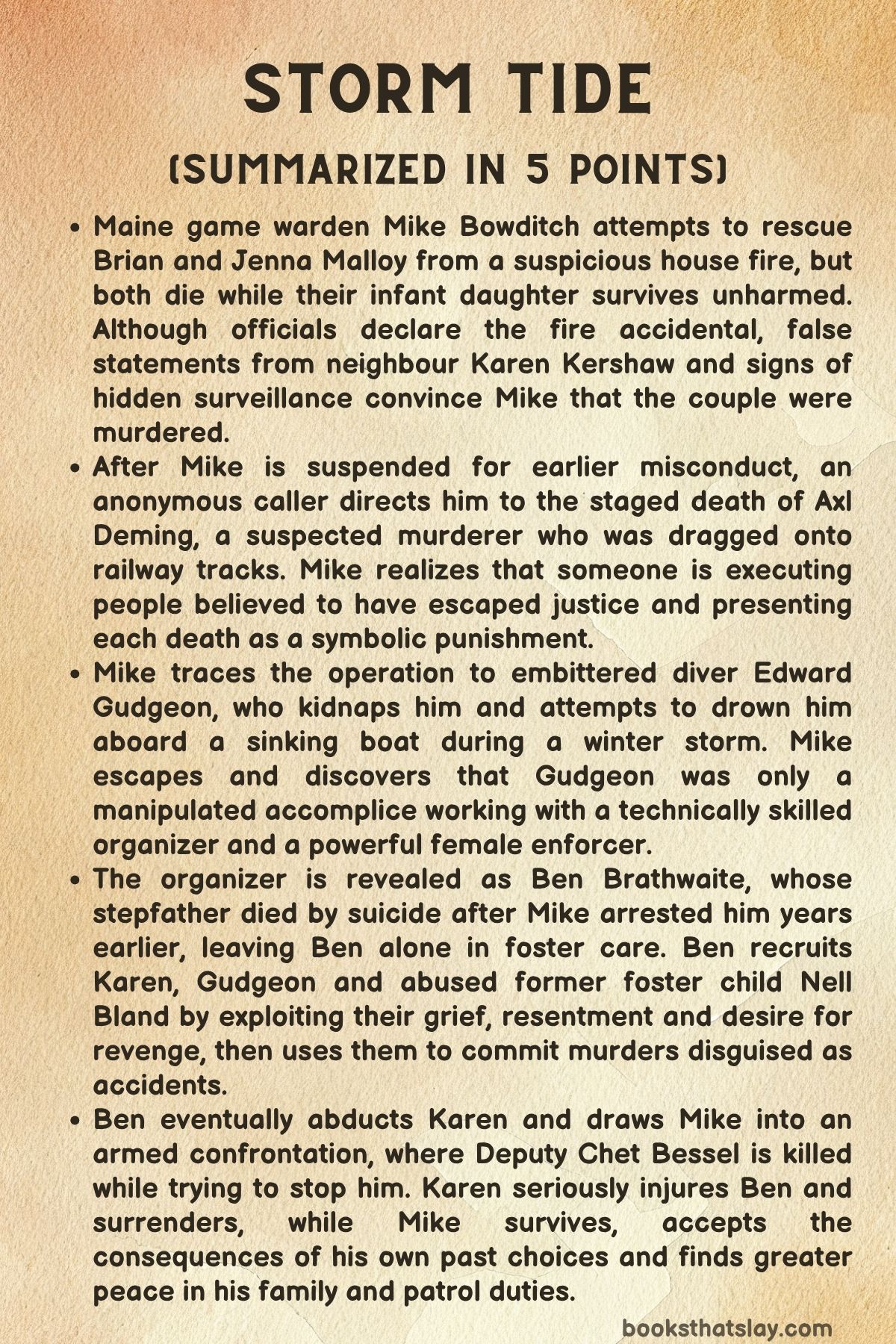
Storm Tide (Mike Bowditch #16) is a crime thriller by Paul Doiron centred on Maine game warden Mike Bowditch, whose instinct for pursuing danger repeatedly places his career, marriage and life at risk. What begins with a fatal house fire develops into an investigation involving staged deaths, hidden surveillance, damaged former foster children and a man seeking revenge for an event from Mike’s past.
The book combines a murder mystery with an examination of justice, guilt, fatherhood and personal responsibility. Its isolated forests, frozen rivers, stormy coastline and remote islands create a dangerous setting in which official authority often arrives too late and moral certainty remains difficult to find.
Summary
Maine game warden Mike Bowditch is the first officer to reach a burning house near Belfast. A neighbour, Karen Kershaw, stands outside holding the unharmed infant daughter of Brian and Jenna Malloy, while Brian has returned to the house in an attempt to rescue his wife.
Mike soaks himself and a blanket in a pond before approaching the flames. Brian emerges badly burned, and although Mike drags him away from the building, he dies on the lawn while Jenna remains trapped inside.
The Malloys are already notorious because Brian had been suspected of abducting and murdering Liam, his young son from a previous relationship. Investigators believed Jenna had helped him establish a false alibi, but there had never been enough evidence to prosecute either of them.
Detective Sergeant Delphine Cruz warns Mike not to involve himself in the investigation. Mike has recently been demoted after pursuing a fugitive across the Canadian border, and another violation could end his career.
Despite the warning, several details trouble him. The baby survived without injury, Brian escaped long enough to carry her outside, and the expensive house burned with unusual speed.
Mike also learns that Karen openly hated the Malloys and had tried to prevent them from building in the neighbourhood. When he visits her farmhouse, she claims she smelled smoke and saw the fire from her bedroom, but the wind direction and surrounding ridge make both statements impossible.
Karen panics when Mike challenges her account and runs across a flooded field. She falls into a dangerous stream, and Mike risks his life to rescue her, only to have her falsely accuse him of releasing his wolf hybrid, Shadow, to chase her.
Karen soon retracts the accusation in a letter and abruptly leaves Maine. Meanwhile, an anonymous caller uses a false poaching report to direct Mike toward the Malloy property, where Mike and former warden Kathy Frost discover cigar butts at a hidden observation point.
A drone watches them from above before disappearing. Nevertheless, the fire marshal concludes that an electrical fault in a dryer caused the blaze, officially classifying the Malloys’ deaths as accidental.
The threatening incidents continue after Mike is suspended without pay for his earlier misconduct. His pregnant wife, Stacey, is followed by a large person driving a white van with a stolen licence plate, and Mike receives a message directing him to the scene of a fatal railway collision.
The victim appears to have committed suicide by lying on the tracks, but marks on his boots show that he was dragged there. Warden Jeremy Bard recognizes the dead man as Axl Deming, who had been suspected, along with his brother Shayn, of raping and murdering a teenage girl named Emily Crockett.
A miniature boxcar has been left beside Axl’s body as a symbolic marker. Mike recognizes a possible pattern: people believed to have escaped legal punishment are being killed in ways chosen to represent their crimes or identities.
Bard secretly removes the boxcar because he had promised Shayn that he would watch over Axl. His decision exposes how guilt and personal loyalty can lead officers to conceal evidence even when they understand the damage such choices may cause.
The white van links Axl’s death to the person who followed Stacey. Mike becomes convinced that at least two people are involved: a technically skilled organizer responsible for spoofed calls, drones and surveillance, and a physically imposing partner who transports and controls the victims.
His search leads him to Edward Gudgeon, a bitter commercial diver whom Mike once investigated for cutting rival fishermen’s traplines. At Gudgeon’s isolated home, Mike finds the same sweet-smelling cigars discovered near the Malloy property.
Gudgeon speaks approvingly of violence against people whom the courts have failed to punish. He captures Mike, binds him with natural-fibre restraints and takes him aboard his boat, intending to sink it during a winter storm and escape using diving equipment.
While imprisoned below deck, Mike realizes why the restraints matter. Bamboo and cotton restraints would burn away in a house fire, leaving little evidence that Brian and Jenna had been tied up before the blaze.
Brian must have freed himself, carried his daughter outside and returned for Jenna. Gudgeon’s surprise at Brian’s escape suggests that another conspirator restrained the Malloys and managed the fire.
Mike cuts himself free with broken glass as the boat begins sinking. He escapes into the freezing sea and swims toward a tidal bar, where he sees a massive figure waiting beside the white van before the vehicle disappears.
Gudgeon apparently drowns during his escape. Mike survives and reaches the hospital shortly after Stacey gives birth to their son, Charles, an experience that forces him to confront how his repeated pursuit of danger affects his family.
Investigators later recover a violent manifesto from Gudgeon’s computer, but its polished language does not resemble the way he spoke. Mike suspects that someone else wrote or influenced it and used Gudgeon’s anger to turn him into a participant and possible scapegoat.
The threat remains active. Hidden trail cameras appear around Mike’s home, and footage shows a huge masked person deliberately approaching the property.
Stacey notices that the figure may be a woman rather than a man. Mike’s friends help strengthen the house, but the surveillance proves that the conspirators know where his wife, baby and dog live.
The investigation changes direction when Mike considers whether the known murders were preceded by killings committed for the benefit of individual conspirators. Gudgeon had shown deep hostility toward Father Lucien Thibodeaux, a retired priest who died in an apparently accidental electrical incident.
Mike suspects that Gudgeon had been abused by the priest and that the organizer killed Thibodeaux to gain his loyalty. The same person may have manipulated the electrical system in the Malloy home to create another convincing accident.
At the bed-and-breakfast near the Malloy property, Mike learns that an information-technology specialist named Ben Brathwaite was staying there during the fire. Ben drives a gray Honda Mike has seen near several important locations and has the technical skills required for electronic surveillance, number spoofing and sabotage.
When Mike hears Ben’s voice over the phone, he recognizes him as the anonymous caller. Ben calmly presents himself to the police as an innocent citizen being harassed by an unstable suspended officer, using Mike’s record of violence and rule-breaking to weaken the accusations against him.
Ben cannot be arrested because the evidence remains circumstantial. Soon afterward, Mike is lured to a motel room rented in Ben’s name and attacked by the enormous accomplice.
The attacker is revealed to be a young woman of exceptional size and strength. She nearly kills Mike before they crash through a window, after which she escapes in Karen Kershaw’s vehicle.
Police discover that the white van has been burned at Karen’s farm. Ben continues denying any connection to Karen, Gudgeon or the attacker, relying on legal procedure and Mike’s damaged reputation to protect himself.
The woman later appears on Philbrook Island, where Karen’s family owns a remote cottage. Mike travels there with his friend Billy Cronk and Billy’s twelve-year-old son, Brady, after a false report suggests someone is occupying the property.
The woman swims to Billy’s boat, shoots Brady and Billy, and fights Billy in the water. Billy forces her beneath the surface but suffers a serious gunshot wound, while Mike races the boat back to shore and succeeds in getting both father and son medical treatment.
Billy survives, and the attacker’s body is identified as Nell Bland. Nell endured severe childhood abuse, mental illness, unstable foster placements and years of isolation, making her vulnerable to manipulation by someone who offered protection and revenge.
Mike eventually discovers his own connection to Ben. Years earlier, he arrested Ben’s intoxicated stepfather, Keith Young, for dangerous boating and intended to file charges that would destroy Young’s livelihood.
Mike had been emotionally distracted because his mother was dying, while Jeremy Bard treated Young and the teenage Ben with additional harshness. Young later died by suicide, leaving Ben alone and sending him into foster care.
Karen had worked as a social worker in the same region and had once handled both Ben and Nell. She had tried unsuccessfully to protect Nell from her abusive mother and her mother’s boyfriend, Carl Crouch, and had told Nell that she might need to defend herself because the authorities could not be trusted.
Nell’s mother and Crouch later died from carbon-monoxide poisoning in what appeared to be an accident. Mike concludes that Ben killed them, earning Nell’s absolute loyalty in the same way he earned Gudgeon’s loyalty by killing the priest.
Karen eventually admits that she asked Ben and Nell to frighten the Malloys away. Her grief over the deaths of her husband and daughter had turned into hatred toward the Malloys, whom she regarded as murderers living freely while innocent people suffered.
Ben and Nell went far beyond intimidation. Karen accepted the rescued baby during the fire, lied about how she discovered the blaze and fled because she feared both prosecution and Ben.
Ben later visits Mike’s home unarmed, provoking Mike while Stacey holds him at gunpoint. He threatens Shadow indirectly, injures his own mouth and makes Deputy Chet Bessel believe that Mike has struck him.
Because of Mike’s past behaviour, Ben can repeatedly create situations in which the visible evidence supports his version. His true power comes from understanding how institutions respond to appearances and how easily Mike can be pushed toward anger.
Karen returns to Maine but disappears again after visiting her farmhouse. Mike notices vehicle tracks made by Ben’s worn tyres and follows them to a crashed Honda in a beaver pond.
Karen has deliberately crashed the vehicle and escaped into the woods, while the injured Ben follows her with a competition pistol. Mike reaches them as Ben prepares to shoot her.
During the confrontation, Ben admits that the language of organized vigilantism was largely a tool used to control Karen, Nell and Gudgeon. His deeper purpose was revenge against Mike for the arrest, humiliation and eventual death of Keith Young.
Ben believes Mike destroyed his family and then escaped every consequence because he wore a badge. He forces Mike to listen while he shoots Karen in the leg and hand, intending to make Mike surrender himself in exchange for her life.
Deputy Bessel approaches and orders Ben to lower the gun. Ben shoots him through the throat, killing him almost instantly.
Mike and Ben exchange fire, but Ben damages Mike’s weapon and prepares to kill him. Karen, despite her wounds, attacks Ben with a rock and crushes his skull before he can fire the final shot.
Karen then considers killing Ben or herself. Mike persuades her to put down the gun by telling her that imprisonment and guilt do not remove her ability to choose what kind of person she will be from that moment onward.
Ben survives with a severe brain injury, and Karen is taken into custody. Bessel is honoured for courageously entering the confrontation and saving Mike’s life, correcting Mike’s earlier suspicion that the deputy might have been connected to the conspiracy.
The full investigation establishes that Ben recruited damaged people by identifying their deepest injuries and secretly killing those they hated. These acts created powerful feelings of gratitude, fear and obligation that allowed him to direct later crimes while keeping himself at a distance.
Mike continues to question whether greater mercy toward Keith Young might have prevented everything that followed. Stacey reminds him that enforcing the law against a dangerously intoxicated man was justified and that no one can know how a different decision would have changed Ben’s life.
Mike is ultimately reinstated as a game warden but does not regain his investigator position. Instead of treating the decision as another defeat, he accepts patrol work and finds greater peace in the wilderness, his marriage and his new role as a father.
Characters
Mike Bowditch
Mike Bowditch is the central character and moral centre of Storm Tide, although his choices frequently place him outside the limits of official authority. He is courageous, observant and intensely committed to protecting others, but those same qualities become dangerous when they are joined with impatience, anger and a belief that he must personally uncover every hidden truth.
His instinct is always to move toward danger, whether he is entering a burning building, diving into a flooded stream, escaping a sinking boat or confronting an armed killer. These actions reveal genuine selflessness, yet they also show how easily he treats his own survival as less important than solving a case or rescuing another person.
Mike’s conflict is not simply between duty and misconduct. He must decide whether good intentions excuse methods that endanger his wife, child, friends and career, especially when his disregard for procedure makes truthful accusations harder for others to believe.
Fatherhood gradually changes his understanding of responsibility. The birth of Charles forces him to recognize that courage is not limited to dramatic acts of rescue; it also includes remaining present, accepting limits and refusing to leave loved ones carrying the consequences of his decisions.
His final acceptance of patrol work demonstrates growth. He does not lose his investigative ability, but he becomes less dependent on rank, recognition and professional advancement as proof of his worth.
Stacey Stevens Bowditch
Stacey is Mike’s emotional equal rather than a passive partner waiting at home. She understands his courage, temper, professional instincts and capacity for self-destruction, which allows her to challenge him without reducing him to his mistakes.
Her pregnancy and Charles’s birth make the consequences of Mike’s recklessness immediate. She does not ask him to abandon his calling, but she insists that marriage and fatherhood create obligations that cannot always be placed behind the demands of an investigation.
Stacey also contributes directly to solving the case. She studies surveillance footage, researches Ben’s background, recognizes that the masked enforcer may be a woman and connects several suspicious deaths to the conspirators’ personal histories.
Her confrontation with Ben shows considerable courage and discipline. Even while holding him at gunpoint, she listens to Mike’s warning not to let Ben provoke an action that could be presented as unjustified violence.
Stacey’s strongest quality is her ability to see Mike clearly without accepting Ben’s interpretation of him. She knows that Mike carries anger and loneliness, but she also recognizes that his guilt, doubt and love are evidence of conscience rather than proof that he is secretly cruel.
Ben Brathwaite
Ben Brathwaite is the principal antagonist of Storm Tide, but his danger comes less from physical strength than from intelligence, patience and psychological control. He understands technology, surveillance, firearms, legal procedure and human vulnerability, allowing him to create crimes that resemble accidents while directing suspicion toward other people.
His hatred of Mike originates in the arrest of Keith Young. As a teenager, Ben watched his stepfather beg for mercy, lose his future and later die by suicide, and he interpreted Mike’s lawful but severe response as an act of personal destruction.
Rather than confronting Mike directly, Ben spends years building a system of revenge. He identifies wounded and isolated people, kills the individuals they blame for their suffering and then converts their gratitude into loyalty.
His relationships with Nell, Gudgeon and Karen are therefore based on emotional debt rather than friendship. He gives each person the illusion of justice while quietly turning them into tools that can carry out violence, absorb blame or die before revealing his role.
Ben also understands that Mike’s history is his greatest weakness. By provoking him in front of witnesses, entering police stations voluntarily and presenting himself as a victim, he uses lawful systems more effectively than those attempting to arrest him.
Karen Kershaw
Karen is one of the book’s most morally conflicted characters. She begins as a grieving neighbour whose false account of the Malloy fire raises suspicion, but her behaviour is eventually connected to professional failure, personal loss and destructive loyalty.
As a social worker, Karen tried to protect Nell from severe abuse but failed within a system that required evidence the frightened child would not provide. Her final advice that Nell should defend herself becomes a source of lasting guilt because Karen later interprets Nell’s violence as an extension of her own words.
The deaths of Karen’s daughter and husband deepen her bitterness. She resents the Malloys for continuing to live comfortably while Liam remains missing, and this resentment allows her to justify asking Ben and Nell to frighten them.
Karen claims that she never intended murder, yet she knowingly involved people capable of serious violence. Her acceptance of the baby, false statement, support for Nell and continued protection of Ben make her responsible even if she did not design the fire.
Her attack on Ben saves Mike, but it does not erase her earlier choices. Her final decision to surrender rather than kill him or herself represents the first time she fully rejects the control that guilt, grief and fear have exercised over her life.
Nell Bland
Nell Bland is both a violent criminal and a product of extreme neglect. Her childhood is defined by sexual abuse, physical brutality, an unstable mother, failed foster placements and repeated proof that adults and institutions cannot keep her safe.
Karen’s inability to remove her from danger leaves Nell with the belief that survival depends entirely on personal force. Ben strengthens this belief by killing her abusers and presenting himself as the one person willing to deliver the protection she had been denied.
Her loyalty to Ben is therefore emotional, almost absolute and deeply tragic. She becomes his enforcer because she interprets his violence as rescue and her own violence as repayment.
Nell’s enormous size, steroid use and fighting ability make her terrifying, but her physical power hides profound psychological dependence. She can overpower Mike and Billy, yet she remains controlled by a man who understands her need to belong.
Her death in the water reflects the final consequence of that manipulation. She dies protecting a cause that was never truly hers and a man who regarded her as a useful instrument rather than a person deserving recovery.
Edward Gudgeon
Edward Gudgeon is driven by resentment, wounded pride and the need to imagine himself as intellectually superior to the institutions that punished him. Losing his commercial licence after Mike exposed his illegal conduct becomes proof, in his mind, that government targets men like him while protecting worse offenders.
His possible abuse by Father Thibodeaux gives his anger a deeper source. When Ben arranges the priest’s death, Gudgeon interprets the act as a form of justice and becomes willing to assist Ben’s campaign.
Gudgeon adopts grand political and philosophical language, but much of it has been supplied or encouraged by Ben. His drinking, impulsiveness and need for admiration reveal that he is not the disciplined organizer he wishes to appear to be.
His plan to drown Mike shows both ingenuity and recklessness. He understands boats, currents and diving, but his pride allows Mike to provoke him into revealing information and making mistakes.
Gudgeon is responsible for his actions, yet he is also another example of Ben’s method. His unresolved trauma and grievance are converted into loyalty, violence and eventual death.
Chet Bessel
Chet Bessel initially appears hostile and possibly corrupt. His act of spitting near Brian Malloy’s body, his stern attitude toward Mike and his repeated presence during critical events encourage suspicion.
His deeper role is connected to trust and professional integrity. Chet believes that authority depends not only on making correct decisions but also on behaving in a way that allows others to trust what an officer says.
This principle explains his frustration with Mike. He recognizes Mike’s intelligence and courage, yet he also sees that repeated rule-breaking damages the credibility needed when accusations must be judged without complete evidence.
Chet’s death proves that his moral seriousness is genuine. He enters the armed confrontation, orders Ben to surrender and is killed while attempting to protect Karen and Mike.
His sacrifice forces Mike to reconsider the assumptions he made about him. Chet becomes an example of quiet courage grounded in duty rather than personal glory.
Billy Cronk
Billy Cronk is loyal, brave and intensely protective of the people he considers family. He responds to threats with practical preparation, weapons and a willingness to stand beside Mike even when official authorities remain uncertain.
His decision to bring Brady to Philbrook Island reveals his most serious weakness. Billy believes courage must be learned through experience, but he underestimates the possibility that the assignment is part of Ben’s campaign.
When Nell attacks the boat, Billy fights her in the water despite being shot. His determination saves Brady and Mike, although it nearly costs him his life.
Billy’s later guilt is as important as his physical courage. He understands that his confidence exposed his son to violence, mirroring Mike’s growing awareness that bravery without caution can become another form of irresponsibility.
His survival allows the book to show the difficult aftermath of heroism. Recovery involves pain, dependence and accepting that a courageous act does not erase the mistake that made it necessary.
Charley Stevens
Charley Stevens acts as Mike’s mentor, father figure and moral guide. As a retired game warden, he understands the instincts that drive Mike, but age and experience have taught him to recognize dangers that Mike often ignores.
He repeatedly reminds Mike that Stacey and Charles need more than a fearless protector. They need a husband and father who respects the value of his own life.
Charley assists the investigation through observation, professional contacts and practical knowledge. He does not blindly approve of Mike’s choices, but he refuses to abandon him when official authority is unavailable.
His advice carries weight because it comes from shared experience rather than judgment from a distance. Charley knows the pressure of law enforcement and therefore understands that restraint can require more strength than immediate action.
Delphine Cruz
Delphine Cruz represents disciplined criminal investigation and the limits of evidence. She often clashes with Mike because his conclusions are based on patterns, instincts and unofficial actions that cannot immediately support arrest or prosecution.
Her caution is not indifference. She is responsible for protecting the integrity of the investigation, and Mike’s interference repeatedly risks contaminating interviews, evidence and future court proceedings.
Cruz gradually accepts that Mike’s theory has merit as the links among the fire, railway death, surveillance and conspirators become stronger. Even then, she refuses to treat suspicion as proof.
Her relationship with Mike is defined by professional conflict mixed with reluctant respect. She recognizes his exceptional investigative ability while understanding that his refusal to follow procedure may damage the very cases he hopes to solve.
Jeremy Bard
Jeremy Bard is a harsh and compromised officer whose aggressive reputation initially makes him difficult to trust. His concealment of the miniature boxcar demonstrates his willingness to place private loyalty above legal duty.
Bard’s actions are motivated by guilt toward Shayn Deming and shame over his failure to protect Axl. He removes evidence not to aid a murderer but to hide a promise he could not fulfil.
His similarity to Mike is important. Both men have histories of believing that personal intentions justify violations of procedure, although Bard’s decline shows how destructive that belief can become.
After leaving the Warden Service, Bard becomes physically diminished and emotionally defeated. His condition gives Mike a possible image of his own future if anger, pride and misconduct continue to define his identity.
Kathy Frost
Kathy Frost is a skilled former warden whose tracking experience and disciplined thinking provide a valuable balance to Mike’s instincts. She helps locate the cigar butts, examine surveillance around Mike’s home and follow the final trail with her cadaver dog, Maple.
Kathy consistently warns Mike not to convert theories into facts before evidence supports them. Her caution differs from Cruz’s institutional restraint because it comes from friendship and shared field experience.
She trusts Mike’s abilities but does not encourage his recklessness. Her presence shows that loyalty can include disagreement, correction and a refusal to support dangerous assumptions.
Shadow
Shadow, Mike’s wolf hybrid, reflects the tension between loyalty and wildness that also exists within Mike. He is protective, powerful and closely attached to the family, yet everyone understands that instinct remains part of his nature.
Karen’s false accusation that Mike used Shadow as a weapon threatens both of them. Later, Ben’s suggestion that poisoned roadkill could kill the animal reveals how carefully he has studied Mike’s emotional attachments.
Shadow’s cautious acceptance of Charles carries symbolic importance. The animal’s ability to respond gently to the baby suggests that strength and restraint can exist together, a lesson Mike is still learning.
Brian and Jenna Malloy
Brian and Jenna Malloy remain morally uncertain because they die before the truth about Liam can be established. Their public behaviour and suspicious alibi make them appear guilty, but suspicion is never converted into legal proof.
Brian’s final actions complicate the image of him as entirely selfish or cruel. After freeing himself from restraint, he saves his infant daughter and returns to the burning house for Jenna, knowing that he may not survive.
This act does not prove innocence regarding Liam, but it shows that a person suspected of terrible wrongdoing can still love and sacrifice. Their deaths therefore expose the danger of allowing public belief to become a substitute for judgment.
Crystal Emmons
Crystal Emmons is Liam’s mother and one of the unseen victims of both the suspected abduction and the vigilante murders. Her struggles with addiction make it easier for others to question her, but they do not lessen the loss of her child.
Brian’s death removes her final chance to obtain information through criminal pressure or a civil case. The vigilantes claim to punish people on behalf of victims, yet their actions deny Crystal the answers and legal recognition she needs.
Her situation reveals the selfishness hidden inside Ben’s version of justice. The executions satisfy the anger of the killers while leaving the people most directly harmed without truth, testimony or closure.
Aimee Cronk
Aimee Cronk combines emotional strength with practical intelligence. When Billy and Brady are injured, she controls her fear long enough to organize the family, contact authorities and direct Mike toward the necessary actions.
She also provides a critical investigative insight by asking whether the conspiracy began with a murder that personally benefited one of its members. This redirects attention toward the priest’s death and the earlier killings of Nell’s abusers.
Aimee’s reasoning demonstrates that important discoveries do not come only from law-enforcement training. Her ability to question the assumptions shared by the investigators helps reveal how Ben recruited and controlled his followers.
Themes
Justice, Vigilantism and Moral Authority
The killings are committed against people believed to have escaped legal punishment, creating an uncomfortable conflict between emotional satisfaction and lawful justice. Brian and Jenna are suspected in Liam’s disappearance, Axl Deming is suspected of participating in Emily Crockett’s murder, and Father Thibodeaux may have abused Gudgeon, yet none of these suspicions gives another person the moral authority to decide guilt and impose death.
Storm Tide shows that vigilantism does not restore what victims have lost. Crystal receives no answer about Liam, Emily’s family gains no lawful acknowledgment, and the hidden deaths prevent evidence from being examined in court.
Ben presents murder as a correction to institutional failure, but his actions are ultimately centred on control and personal revenge. He chooses victims, methods and accomplices according to his own needs while pretending to act for a broader moral purpose.
Mike’s position adds complexity because he also bends rules when he believes official systems are moving too slowly. The difference between him and Ben lies partly in intent and restraint, but the book repeatedly warns that certainty in one’s own righteousness can become dangerous.
Law is shown as imperfect, slow and vulnerable to appearances. Even so, its demand for evidence protects society from people who confuse suspicion, anger and personal pain with unquestionable truth.
Grief, Trauma and Manipulation
Grief does not remain a private emotion in the story. It changes perception, weakens judgment and creates openings that Ben uses to control people who already feel abandoned by families, institutions or society.
Karen’s grief over her daughter and husband becomes resentment toward the Malloys. Instead of processing her loss, she begins measuring the continued existence of others against the lives taken from her, making punishment feel like an acceptable response to emotional unfairness.
Nell’s childhood trauma leaves her unable to trust ordinary protection. When Ben kills her abusers, he becomes the embodiment of the rescue she had always wanted, allowing him to convert gratitude into obedience.
Gudgeon’s anger toward the priest, professional authorities and Mike serves a similar purpose. Ben does not need to create hatred in his followers; he finds hatred that already exists, validates it and gives it a target.
Ben himself is shaped by the death of Keith Young and the collapse of his family. His suffering explains the origin of his revenge but does not excuse the years of planning, manipulation and murder that follow.
The book therefore distinguishes between understanding trauma and absolving harmful behaviour. Pain can explain why a person becomes vulnerable to violence, but every character remains responsible for the choices made after that pain.
Fatherhood, Family and Responsibility
Mike’s approaching fatherhood changes the meaning of risk throughout the story. Before Charles is born, Mike often treats his life as something he may spend freely in service of strangers, justice or professional duty.
Stacey forces him to see that his life no longer belongs only to him. Every burning building, violent confrontation and unofficial investigation carries the possibility of leaving his child without a father and his wife to face the consequences alone.
Brian Malloy’s final act offers a complicated image of fatherhood. Whatever he may have done to Liam, he saves his infant daughter and returns for Jenna, revealing a capacity for love that does not fit neatly with his public image.
Billy’s decision to bring Brady to Philbrook Island provides another warning. His desire to teach courage exposes his son to a conflict Billy did not fully understand, showing how parental confidence can become dangerous when it ignores uncertainty.
Ben’s revenge also begins with the loss of a parental figure. Keith Young’s death leaves him without family, but Ben responds by creating relationships based on obligation, fear and violence rather than genuine care.
By the end, Mike understands that protecting a family is not limited to confronting threats. It also requires presence, patience, humility and a willingness to choose ordinary responsibility over dramatic danger.
Reputation, Procedure and the Burden of the Past
Mike’s past conduct affects whether anyone believes him in the present. His shootings, unauthorized pursuit, demotion and history of ignoring orders give Ben the perfect material for portraying him as unstable, violent and obsessed.
This creates one of the story’s central frustrations: Mike is often correct, but correctness alone cannot repair lost credibility. When evidence is incomplete, investigators must judge his claims partly through the reputation he has built.
Ben understands this weakness and repeatedly constructs situations in which visible appearances support his version. He enters police custody voluntarily, provokes Mike in front of witnesses and injures himself at the exact moment an officer arrives.
Procedure becomes both protection and obstacle. It prevents officers from arresting Ben without evidence, yet it also limits the power of a clever accuser to destroy someone solely through suspicion.
Chet Bessel embodies the argument that trustworthy authority depends on consistent conduct. His warnings to Mike are not attempts to obstruct justice but reminders that rules preserve the credibility needed when facts are disputed.
The past cannot be undone, but it can be acknowledged. Mike’s final growth begins when he stops treating every professional consequence as an injustice and accepts that solving the case does not erase the damage caused by his earlier choices.