Strange Buildings Summary, Characters and Themes
Strange Buildings by Uketsu is a mystery novel built from interviews, floor plans, documents, old memories, and unsettling domestic spaces. Its horror does not come from monsters, but from rooms that should not exist, doors moved for reasons no one explains, and houses shaped by guilt, abuse, profit, and belief.
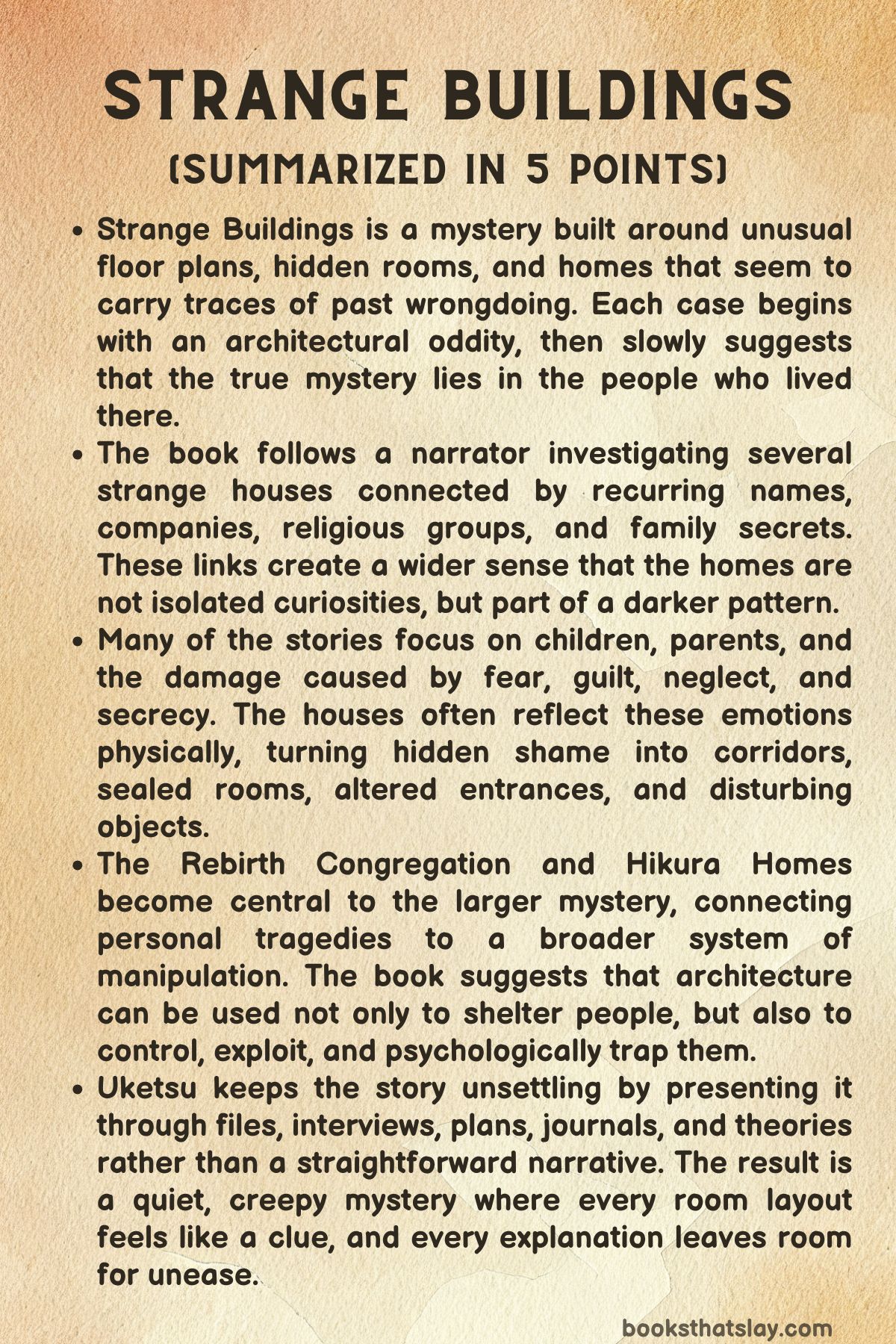
Each case begins with an architectural oddity, then opens onto a human secret. The book slowly reveals a network involving Hikura Homes, Housemaker Misaki, and the Rebirth Congregation, showing how homes can preserve trauma as clearly as any diary or confession.
Summary
Strange Buildings is arranged as a chain of investigations into unusual homes and the crimes, accidents, and family secrets hidden inside them. The narrator gathers floor plans, testimonies, articles, journals, and interviews, and each file appears at first to be a separate mystery.
As the cases build, however, repeated names and patterns point toward a larger system involving Hikura Homes, Housemaker Misaki, the Rebirth Congregation, and the disturbing idea that buildings can be shaped to express guilt, sin, memory, and control.
The first case begins with Yayoi Negishi, who asks the narrator about a dead-end hallway in her childhood home. The hallway has no clear function, and Yayoi connects it to the strange atmosphere in which she grew up.
Her mother was cold, frightened, and intensely protective, especially about the main road outside the house. Yayoi remembers a damaged doll missing one arm and one leg, and she begins to imagine that the house may have been altered after the death of a twin sibling.
In her mind, the useless hallway might be the remains of a room meant for that lost child.
The narrator investigates and rejects this theory. The explanation seems more ordinary, though still sad.
During the home’s construction, a boy named Yunosuke Kasuga was killed by a Housemaker Misaki truck near the site. After the accident, the front door was moved away from the road, leaving the original entrance area as a meaningless corridor.
The change suggests that Yayoi’s mother was not simply cruel or irrational, but terrified of losing her daughter to the same road. Yet the case ends with a darker detail: years later, Yayoi’s mother tried to pay for Yayoi’s own bedroom to be removed.
The discovery leaves her motives uncertain and turns a simple architectural oddity into a sign of deeper fear.
The next file concerns the Tsuhara family murders. Tatsuyuki Iimura, a forensic cleaner, gives the narrator the house’s floor plan.
The home was a cheap Hikura Homes model with poor air circulation, little privacy, cramped rooms, and awkward movement between spaces. A sixteen-year-old boy was accused of killing his mother, grandmother, and younger brother.
At first, the house seems only to provide the stage for the crime. But the narrator studies the scene more closely and begins to doubt the official account.
The grandmother was found with her eyes closed, suggesting someone may have shut them after death. The boy also had many cuts, which may not fit the image of a simple attacker.
The narrator considers another possibility: the mother, worn down by family strain, may have killed the grandmother first, and the son may have been injured while trying to stop her before the deaths of his mother and brother. The house’s bad design becomes part of the emotional pressure that may have helped produce the tragedy.
Another thread reaches back to 1938, when Uki Mizunashi described finding a strange watermill in the woods. It had no running water, a hidden moving wall, a shrine-like area, and the body of a “female egret” inside.
Years later, Kenji Hirauchi buys a house in Nagano that is marked on a dark-history map as the site where a woman’s body was once found. Research connects the land to the Azuma family and to a maid named Okinu, who may have run away after an affair.
Hirauchi’s house contains a strangely thick-walled room, and a neighbor explains that the building was first a one-storey structure before later additions. The narrator realizes that the house was not merely built on the site of the old watermill.
It was built around it, preserving the old structure like a secret organ inside a newer body.
The wider pattern becomes clearer through a tabloid article about the Rebirth Congregation. The group is supported by Masahiko Hikura, and its central figure, Midori Hikari, known as the Holy Mother, is missing one arm and one leg.
The Hall of Rebirth is designed in the shape of her body. Wealthy believers are brought there overnight, made to sleep, and then sold plans or homes connected to the idea of rebirth.
This strange practice ties architecture to religious manipulation and suggests that certain houses are being designed not for comfort, but as ritual objects.
The narrator then encounters the journal of Naruki Mitsuhashi. Naruki briefly experiences kindness at “Uncle’s house,” but is later taken away by his mother and her partner, Eiji.
He is abused, starved, locked in a closet, and eventually dies from neglect. His story connects to another interview, this time with Chie Kasahara.
Chie’s father once used a string-phone setup between rooms, and Chie suspects he may have killed their neighbor, Mrs. Matsue, during a fire while pretending to speak to Chie. Her father later dies by suicide in a house where one room has been removed.
Among his belongings is a photograph of Naruki, linking him to the boy’s fate.
The Matsue fire becomes even less certain when Hiroki Matsue, who survived it as a child, tells his version. His father sent him to call the fire brigade while going back into the house to find Hiroki’s mother.
Both parents died. Hiroki reveals that his mother’s body was found hidden in a closet with kerosene nearby.
He believes his father killed her, tried to make it look like suicide, and then died when the fire spread faster than expected. Hiroki also knows the narrator has not been fully honest about his investigation, because Chie warned him.
He scares the narrator by pretending he may kill him, but his real aim is to push him toward the truth.
Another important witness is Akemi Nishiharu, an elderly izakaya owner. She describes a harsh childhood, escape to Tokyo, work as a nightclub hostess, the birth of her son Mitsuru, financial failure, and her capture by yakuza after falling into debt.
She and Mitsuru are taken to an “okito,” where they live with Yaeko, a woman missing her left arm, and Yaeko’s eleven-year-old daughter. Akemi says Yaeko was gentle and saved Mitsuru from being hit by a car, losing her right leg.
Later, a wealthy young man named Hikura pays Yaeko’s debt and takes Yaeko and her daughter away. Akemi eventually clears her own debt and escapes with Mitsuru.
The narrator also investigates Ren Iruma, who remembers discovering a hidden room in his childhood home after a dizzy spell. The narrator connects this memory to the 2004 Chuetsu Earthquake, reasoning that the quake may have opened a concealed door.
In Iruma’s house, they find the hidden space between the hallway and kitchen. A mechanism using a sliding metal plate and a strong magnet appears to have been built by Iruma’s father, who worked with rare earth metals.
Inside is a wooden doll of a woman missing her left arm and right leg. Its shape matches the house’s layout and resembles the Holy Mother, further tying ordinary homes to the Rebirth Congregation.
The narrator brings eleven files to Kurihara, who assembles the larger explanation. The Hall of Rebirth was designed as the Holy Mother’s body, and believers slept in a room representing her womb so they could be symbolically born again.
The cult targeted parents carrying guilt over children born from affairs, teaching them that these children carried sin. Hikura Homes profited by selling expensive renovations that remade members’ houses into versions of the Hall, often including hidden shrine rooms and dolls shaped like the Holy Mother.
Kurihara also reinterprets the Kasahara, Naruki, and Matsue cases. He argues that Mr. Kasahara had an affair with Mrs. Matsue and found her suicide note after she killed herself, likely because she was pregnant with his child.
Mr. Matsue then discovered the body and note, hid her in the closet, and set the fire to conceal both the pregnancy and the affair. Kasahara’s guilt later led him to the Rebirth Congregation, where he tried to save Naruki, another child connected to him.
When Naruki died from neglect, Kasahara blamed the Holy Mother and killed himself in his altered house.
The final revelations return to Akemi and Hikura. The narrator realizes Akemi’s account is incomplete and confronts Mitsuru.
Mitsuru explains that the “okito” was actually a child-prostitution operation and that he, not Akemi, was being sold. He also admits he stepped into traffic on purpose, wanting to die, and that Yaeko lost her leg saving him.
Hikura’s interest in Yaeko now looks less noble: he likely wanted her daughter, later married her, and used Yaeko as the model for the cult’s Holy Mother.
At the end, Mitsuko, Hikura’s granddaughter, confesses the family’s final secret. She helped cause Yaeko’s death by hiding her prosthetic leg after being pressured by relatives.
For years, she protected herself with a gentler version of the memory, imagining that she returned the leg. The truth is harsher: Yaeko died because Mitsuko did not help her.
Across all the cases, Strange Buildings shows houses as containers for shame. Walls are moved, rooms are sealed, and floor plans are reshaped, but the truth remains inside, waiting for someone to notice the space that should not be there.
Characters
The Narrator
The narrator is the central investigating presence in Strange Buildings, but he is not a traditional detective who confidently controls the truth from the beginning. He works more like a cautious observer, collecting floor plans, interviews, memories, rumors, and physical clues until patterns begin to appear.
His strength lies in noticing architectural oddities that other people either dismiss or misunderstand, such as useless corridors, hidden rooms, strange wall thicknesses, and rooms shaped around symbolic bodies. At the same time, he is often dependent on other people’s memories, which makes his understanding incomplete and sometimes vulnerable to manipulation.
His role in the book is important because he represents the reader’s gradual movement from isolated mysteries toward a larger, disturbing structure of abuse, guilt, cult influence, and family secrecy.
Kurihara
Kurihara is the most analytical figure in the book and functions as the person who turns scattered cases into a coherent theory. While the narrator gathers evidence, Kurihara is able to interpret the hidden logic behind the buildings and connect emotional motives to architectural design.
He understands that the strange houses are not simply unusual homes but symbolic spaces created from guilt, religious manipulation, and commercial exploitation. His analysis of the Hall of Rebirth and the cult-remodelled homes reveals the deeper horror of the story: people’s private shame was turned into a business model.
Kurihara’s importance comes from his ability to see both the practical and psychological dimensions of the mystery, making him one of the clearest voices of explanation in the book.
Yayoi Negishi
Yayoi Negishi is one of the earliest characters through whom the book explores the relationship between childhood memory and hidden family trauma. She approaches the narrator because of a strange dead-end hallway in her childhood home, and her interpretation of the space is shaped by fear, confusion, and the emotional distance between herself and her mother.
At first, she imagines that the hallway might be connected to a dead twin, which shows how children often create explanations for mysteries when adults refuse to speak honestly. Yayoi is not simply curious about architecture; she is trying to understand why her mother treated her with such harsh protectiveness.
Her character reflects the pain of growing up inside a house where the physical layout preserves a secret that the family never fully names.
Yayoi’s Mother
Yayoi’s mother is a complicated figure because her behavior can be read as both protective and deeply disturbing. Her fear of the main road appears to come from the death of Yunosuke Kasuga during the construction of the house, and this helps explain her anxiety about Yayoi’s safety.
She seems to have redirected the house away from the site of the accident, turning the original entrance into a useless corridor and transforming the home into a monument to fear. However, the later revelation that she tried to pay for the removal of Yayoi’s own bedroom makes her much more unsettling.
She is not only a frightened mother but someone whose love may have been contaminated by obsession, guilt, or a belief that altering the house could alter fate itself.
Yunosuke Kasuga
Yunosuke Kasuga is a character who appears only through the consequences of his death, yet his presence shapes the first case powerfully. He was killed by a Housemaker Misaki truck outside the house, and this accident becomes the hidden source of the architectural change that puzzles Yayoi years later.
He functions as a buried trauma inside the home’s history, the kind of dead child whose absence silently reorganizes the lives of the living. Even though he is not active in the story, the memory of his death exposes how houses can preserve violence in disguised forms.
His character also begins the book’s repeated pattern of children being harmed by adult negligence, secrecy, or institutional power.
Housemaker Misaki
Housemaker Misaki is important less as an individual character and more as a corporate presence tied to concealment, explanation, and unease. The company provides the rational explanation for the strange hallway in Yayoi’s childhood home, but its role in the accident involving Yunosuke Kasuga also places it at the origin of the trauma.
The company represents a world where construction, money, and damage are closely connected. Even when it appears to clarify one mystery, it leaves another behind, especially when it reveals that Yayoi’s mother later wanted to remove Yayoi’s bedroom.
Housemaker Misaki therefore becomes part of the larger pattern in which homes are not neutral shelters but commercial objects shaped by fear, guilt, and hidden histories.
Tatsuyuki Iimura
Tatsuyuki Iimura, the forensic cleaner connected to the Tsuhara family murders, brings a practical and grim perspective into the book. His work places him directly in contact with the aftermath of death, and his knowledge of the house’s floor plan helps the narrator reconsider the official version of the crime.
He is not presented as an emotional center of the story, but he is crucial because he provides the material evidence that allows the narrator to think beyond the surface accusation against the teenage son. His role shows how people who clean, inspect, or repair houses may become silent witnesses to tragedies that families and authorities prefer to simplify.
Through him, the Tsuhara home becomes not just a crime scene but a badly designed domestic pressure cooker.
The Sixteen-Year-Old Tsuhara Son
The sixteen-year-old Tsuhara son is initially framed as the murderer of his mother, grandmother, and younger brother, but the book complicates that accusation. The narrator’s later interpretation suggests that the boy may not have been the monster the official story made him out to be.
His many cuts imply that he could have been trying to intervene, possibly attempting to stop his mother after she killed the grandmother. This makes him a tragic figure trapped inside a home filled with stress, cramped rooms, poor ventilation, and emotional suffocation.
His character reflects one of the book’s recurring ideas: the truth of a family tragedy is often more painful and morally complex than the clean explanation offered afterward.
The Tsuhara Mother
The Tsuhara mother is portrayed as a woman who may have been pushed beyond endurance by domestic pressure and family conflict. If the narrator’s reconstruction is correct, she killed the grandmother first, not as part of a simple murderous rampage but after years of accumulated stress.
Her character is disturbing because she embodies the way ordinary domestic life can become unbearable when a house offers no privacy, comfort, or emotional escape. The poor design of the Hikura Homes floor plan becomes inseparable from her possible breakdown.
She is not excused by the book, but she is presented as someone whose violence may have emerged from a long collapse rather than sudden evil.
The Tsuhara Grandmother
The Tsuhara grandmother is a quiet but important figure in the Tsuhara case because the condition of her body changes the interpretation of the crime. The detail that her eyes were closed suggests intimacy, remorse, or a different sequence of events than the official accusation against the son.
She represents the older generation whose presence in a cramped family space may have contributed to tension, even though the book does not reduce her to a villain. Her death becomes the key that allows the narrator to question the accepted story.
In this way, she is less developed through personality than through what her death reveals about family pressure and hidden conflict.
The Younger Tsuhara Brother
The younger Tsuhara brother is one of the most vulnerable victims in the book. He appears mainly as a child caught in the violence of adults and older family members, unable to understand or escape the collapse around him.
His death intensifies the tragedy of the Tsuhara case because it shows that the consequences of domestic breakdown fall most cruelly on those with the least power. He also mirrors other endangered children in the story, including Yayoi, Naruki, Mitsuru, and Yunosuke.
His character reinforces the book’s repeated concern with children living inside spaces designed or controlled by damaged adults.
Uki Mizunashi
Uki Mizunashi is the character who introduces one of the book’s strangest and most symbolic structures: the watermill with no water. His discovery in 1938 feels almost like a ghost story, but it later becomes an important clue to a real architectural and historical mystery.
Uki’s role is that of the accidental witness, someone who sees something impossible-looking before its meaning can be understood. The hidden moving wall, shrine, and dead “female egret” connect him to the older layer of the conspiracy and to the way buildings can conceal bodies, rituals, and shame.
His character helps expand the book beyond modern houses into a longer history of hidden violence.
Kenji Hirauchi
Kenji Hirauchi is important because his house becomes a bridge between the old watermill mystery and the modern pattern of strange homes. By buying a property marked on a dark-history map, he enters a space already burdened by rumor and death.
His discovery of a suspiciously thick-walled room shows how the past can be physically preserved inside a later renovation. Hirauchi himself is not presented as guilty or sinister; instead, he is a homeowner who unknowingly lives inside an inherited crime scene.
His character shows how people can occupy houses without understanding what those houses were built around, both literally and morally.
Okinu
Okinu, the maid connected to the old Azuma family, is one of the book’s shadowy historical figures. She may have fled after an affair, but the uncertainty around her fate makes her more haunting than clear.
Her possible connection to the corpse found in 1938 suggests that she may have been punished, hidden, or erased because of sexual scandal and social hierarchy. Okinu represents women whose lives are controlled by powerful households and then rewritten through rumor.
Her character adds a historical dimension to the book’s treatment of shame, showing that the concealment of bodies and secrets is not only a modern pattern but an older social habit.
The Azuma Family
The Azuma family stands behind the watermill mystery as a symbol of old power, secrecy, and reputation. Their connection to Okinu suggests a world where servants, women, and socially vulnerable people could disappear behind family honor.
Even though the family is not explored through one fully developed individual, its presence matters because it links architecture to status and concealment. The watermill and later house built around it imply that the Azuma family’s secrets were not simply forgotten but physically enclosed.
As a collective character, the family represents the old roots of the book’s central horror: respectable homes can be built around acts of cruelty.
Midori Hikari
Midori Hikari, the Holy Mother of the Rebirth Congregation, is one of the most symbolically important figures in Strange Buildings. Missing one arm and one leg, she becomes the human model for the Hall of Rebirth’s floor plan, turning her injured body into a sacred architectural design.
Her image is used to sell the idea of spiritual rebirth, especially to wealthy believers burdened by guilt. Yet the later revelations suggest that the Holy Mother’s identity is tied to Yaeko, a woman who suffered exploitation and bodily loss before being absorbed into Hikura’s world.
Midori Hikari is therefore both a religious icon and a victim whose damaged body is transformed into doctrine, architecture, and profit.
Yaeko
Yaeko is one of the most tragic characters in the book because her kindness is repeatedly exploited by others. At the okito, she is already missing her left arm, and she later loses her right leg while saving Mitsuru from being hit by a car.
This act shows her instinctive compassion, especially toward a child who has been pushed into despair. Her later removal by Hikura appears at first like rescue, but the larger truth suggests that she was turned into the Holy Mother and used as the living foundation of a cult.
Yaeko’s character is painful because she gives protection to others, yet no one truly protects her. Her body becomes a symbol for other people’s beliefs, guilt, and greed.
Masahiko Hikura
Masahiko Hikura is one of the most morally corrupt and powerful figures in the book. As the supporter of the Rebirth Congregation and the force behind Hikura Homes, he connects religion, architecture, and profit into a single predatory system.
His genius lies not in faith but in manipulation: he understands how guilt can be sold back to people as salvation. Through expensive renovations and symbolic floor plans, he turns private shame into a business.
His relationship with Yaeko and her daughter further darkens him, suggesting that his interest in “rescue” may have been driven by possession and exploitation rather than compassion. Hikura represents institutional evil disguised as spiritual purpose and domestic respectability.
The Rebirth Congregation
The Rebirth Congregation functions almost like a collective character in the book. It offers believers a ritual of purification, but its real power comes from identifying vulnerable people and deepening their guilt.
The cult convinces parents that children born from affairs carry “sin,” then sells them symbolic architectural solutions through Hikura Homes. Its central building, the Hall of Rebirth, turns the Holy Mother’s body into a sacred map, making worshippers sleep inside a space that represents her womb.
The congregation is frightening because it does not merely deceive people with doctrine; it reshapes their homes and family relationships. It invades private life through both belief and construction.
Naruki Mitsuhashi
Naruki Mitsuhashi is one of the most heartbreaking children in the book. His journal shows that he briefly experienced safety at “Uncle’s house,” only to be dragged back into abuse by his mother and Eiji.
His imprisonment in a closet, starvation, and death by neglect make him a devastating example of how adults fail children while hiding cruelty inside ordinary domestic spaces. Naruki’s story is especially important because it connects personal abuse to the larger cult narrative through Mr Kasahara.
He is not only a victim of his immediate household but also of a broader world in which guilt, secrecy, and adult selfishness repeatedly destroy children. His character gives the book some of its deepest emotional weight.
Naruki’s Mother
Naruki’s mother is a deeply disturbing figure because she is directly involved in the neglect and abuse that leads to her son’s death. She takes Naruki away from the temporary safety of “Uncle’s house” and returns him to a life of confinement, hunger, and fear.
Her character represents the failure of maternal protection in its most brutal form. Unlike some other parents in the book, whose harmful actions are mixed with fear or guilt, Naruki’s mother appears primarily as someone who chooses an abusive household over her child’s survival.
She adds to the book’s bleak portrait of families as places where children can be trapped rather than protected.
Eiji
Eiji is one of the clearest abusers in the book. As Naruki’s mother’s partner, he helps create the environment of terror, confinement, and neglect that destroys Naruki.
He is not psychologically complicated in the way some other characters are; his role is to embody direct domestic cruelty. His presence shows how easily a violent adult can dominate a household when others enable or ignore the abuse.
Eiji’s character also sharpens the contrast between the temporary safety Naruki finds elsewhere and the horror of the home to which he is returned. In a book filled with symbolic architecture, Eiji represents the plain human brutality that often hides behind closed doors.
Chie Kasahara
Chie Kasahara is a character shaped by memory, suspicion, and the burden of possibly misunderstanding her own father. Her recollection of the string-phone setup and the fire leads her to suspect that her father may have murdered Mrs Matsue while pretending to speak to her.
This makes her childhood home another space of uncertainty, where a child’s memory becomes evidence but not certainty. Chie’s warning to Hiroki also shows that she is not passive; she actively tries to influence the investigation and protect the truth as she understands it.
Her character is important because she embodies the difficulty of reconstructing family history when love, fear, and suspicion are tangled together.
Mr Kasahara
Mr Kasahara is one of the most morally complex figures in the book. Kurihara’s interpretation suggests that he had an affair with Mrs Matsue and was overwhelmed by guilt after her suicide, especially if she was pregnant with his child.
His later involvement with the Rebirth Congregation seems to come from a desire to cleanse or repair that guilt, but the cult only distorts him further. His connection to Naruki is especially tragic because he appears to have tried to “save” another child linked to him, only for Naruki to die from neglect.
Mr Kasahara’s suicide in a cult-remodelled house suggests a man destroyed by guilt, manipulation, and his inability to protect the children and women harmed by his choices.
Mrs Matsue
Mrs Matsue is a tragic figure whose death lies at the center of several conflicting interpretations. She may have died by suicide after becoming pregnant through an affair with Mr Kasahara, and her hidden body becomes the secret around which the later fire narrative is built.
Her character is mostly reconstructed by others, which makes her absence feel especially painful. She is spoken about through suspicion, guilt, and concealment rather than through her own voice.
In the book, she represents women whose suffering is hidden by men trying to protect themselves from scandal. Her death exposes how shame can lead not only to tragedy but also to further lies that damage surviving children.
Hiroki Matsue
Hiroki Matsue is a survivor marked by the fire that killed both of his parents. As a child, he was sent to call the fire brigade, while his father went back inside, supposedly to rescue his mother.
As an adult, Hiroki rejects the simpler story and believes his father murdered his mother, staged the scene as suicide, and then died when the fire spread too quickly. His confrontation with the narrator is tense because he briefly makes himself seem dangerous, but his real goal is to force a deeper investigation.
Hiroki is important because he shows how survivors can live for years with an explanation that is unofficial but emotionally certain. His character adds moral pressure to the investigation by insisting that unresolved truth still matters.
Mr Matsue
Mr Matsue is presented through competing suspicions, but Kurihara’s theory makes him a key figure in the concealment of Mrs Matsue’s death. If he found his wife’s body and suicide note, then hid her in the closet and set the fire, his actions were driven by the desire to erase pregnancy, affair, and scandal.
This makes him a man more concerned with controlling appearances than honoring the dead. Yet he may also have died because his attempt at concealment went wrong, turning his staged fire into his own death sentence.
Mr Matsue represents another form of domestic corruption: the husband who responds to betrayal and shame not with truth, but with erasure.
Akemi Nishiharu
Akemi Nishiharu is one of the book’s most layered storytellers. Her life is marked by childhood abuse, flight, exploitation, debt, and survival, but her account is also shaped by omission and self-protection.
She presents the okito as a place where she and Mitsuru lived beside Yaeko, but the later correction reveals that she concealed the fact that Mitsuru was the one being sold in a child-prostitution operation. This does not make Akemi simple or purely deceitful; instead, it shows a woman trying to survive unbearable shame and trauma by reshaping memory into something less direct.
Her character captures the book’s larger concern with stories that are not exactly false but are arranged to protect the speaker from the full horror of the truth.
Mitsuru
Mitsuru is a deeply damaged character whose truth changes the meaning of Akemi’s story. As a child, he was not merely present at the okito; he was being exploited, and his attempt to walk into traffic reveals the depth of his despair.
Yaeko’s sacrifice in saving him becomes one of the book’s clearest acts of compassion, but it also burdens Mitsuru with the knowledge that his wish to die cost her a leg. As an adult, he becomes the person who corrects Akemi’s softened version of events.
His character is important because he exposes how trauma is often hidden by family narratives, and how children who survive exploitation may carry both guilt and truth long after the adults around them have rewritten the past.
Ren Iruma
Ren Iruma is another character whose childhood memory leads to the discovery of a hidden architectural truth. His recollection of finding a concealed room after a dizzy spell seems strange until the narrator connects it to the 2004 Chuetsu Earthquake.
Ren’s importance lies in the way his memory preserves a physical clue that the house itself tried to hide. The hidden room, mechanism, magnet, and doll connect his family home to the cult’s symbolic architecture.
Ren is not portrayed as responsible for the secret; he is someone who unknowingly grew up inside a house altered by forces larger than himself. His character reinforces the book’s idea that children often perceive the truth of a home before they can understand it.
Ren Iruma’s Father
Ren Iruma’s father is significant because he likely designed the hidden-room mechanism using his knowledge of rare earth metals. His technical skill makes the concealed space possible, suggesting either direct involvement with the cult’s architectural practices or at least cooperation with its symbolic demands.
He is a figure who turns engineering knowledge into secrecy. The magnetic mechanism is not just a clever device; it is part of a larger pattern in which adults build hidden spaces around guilt, worship, and fear.
His character shows how professional expertise can become morally dangerous when used to conceal rather than protect.
Mitsuko Hikura
Mitsuko Hikura is one of the most tragic late revelations in Strange Buildings because her guilt comes from an action committed under family pressure when she was young. She admits that she hid Yaeko’s prosthetic leg and that this helped cause her grandmother’s death.
Her invented kinder memory, in which she returned the leg, shows how unbearable the truth was for her. Mitsuko is not portrayed as a simple villain; she is someone shaped by a powerful family system that pushed her into cruelty and then left her to live with the consequences.
Her confession is devastating because it reveals how the Hikura family’s corruption did not only harm outsiders but also damaged its own descendants.
Hikura’s Wife / Yaeko’s Daughter
Yaeko’s daughter is a quiet but important figure because Hikura’s interest in Yaeko may actually have been driven by his desire for the daughter. She becomes part of the hidden family line that connects Yaeko, Hikura, and Mitsuko.
Although she is not described in great detail, her role matters because it suggests that Hikura’s apparent rescue of Yaeko was not selfless. She represents the way vulnerable women and girls are absorbed into powerful households under the appearance of protection.
Her character also links the cult’s public worship of the Holy Mother to private exploitation inside the Hikura family.
Themes
Architecture as a Record of Buried Violence
In Strange Buildings, houses do not function as neutral settings; they become physical records of fear, guilt, exploitation, and murder. A hallway that seems useless, a room that has been removed, a thick wall, a hidden shrine, or a strange floor plan all suggest that buildings can preserve truths people try to erase.
The homes are shaped by accidents, cover-ups, cult beliefs, and private shame, so architecture becomes a kind of silent witness. The most disturbing part is that these spaces are often ordinary from the outside.
Cheap family houses, childhood homes, and renovated rooms appear normal until their plans are examined closely. This creates a strong sense that violence is not always visible through blood or direct evidence; it can be built into walls, corridors, entrances, and sealed rooms.
The repeated connection between design and crime shows how people use buildings to hide what they cannot openly face, but the structure itself continues to expose them.
Family Guilt and the Damage Passed to Children
Parents and children are repeatedly bound together by guilt, secrecy, and harm. Adults who are supposed to protect children instead pass their fear, shame, or violence onto them.
Yayoi’s mother may seem protective at first, but the later detail about removing Yayoi’s room suggests a more troubling relationship between love, control, and fear. Naruki’s story is even harsher, showing a child briefly reaching safety before being dragged back into abuse and neglect.
Other families are shaped by affairs, unwanted children, suicide, and attempts to hide pregnancy or parentage. The children in these cases often inherit consequences they did not create.
They are treated as reminders of adult sin, evidence of betrayal, or burdens to be controlled. This theme is especially painful because the harm is not limited to one generation.
A parent’s secret can distort a child’s home, identity, and memory, making family history feel less like protection and more like a trap.
False Narratives and the Unstable Nature of Truth
The investigations show how easily people create stories to survive, excuse themselves, or make horror easier to understand. Yayoi imagines a dead twin because that explanation gives shape to her mother’s behavior, but the truth shifts as new evidence appears.
Chie suspects one version of the fire, Hiroki offers another, and Kurihara later builds a more complex possibility from scattered details. Akemi’s account also changes when Mitsuru reveals what was truly happening at the okito.
These revisions do not simply create plot twists; they show that truth is often damaged by shame, trauma, fear, and self-protection. People remember selectively, lie to others, and sometimes lie to themselves because the full truth is unbearable.
In Strange Buildings, investigation means stripping away comforting explanations without always reaching complete certainty. The unresolved elements matter because they reflect how real secrets work: evidence can point in one direction, memory in another, and guilt can reshape both.
Exploitation Through Faith, Design, and Wealth
The Rebirth Congregation turns personal guilt into a business model, using spiritual language to control vulnerable people and profit from them. Parents burdened by affairs, secret children, or family shame are persuaded that their homes and children carry moral corruption.
Instead of offering healing, the cult sells symbolic rebirth through architecture, renovations, floor plans, hidden rooms, and body-shaped designs based on the Holy Mother. This makes faith feel less like belief and more like manipulation.
Hikura Homes benefits from fear by turning private suffering into expensive construction work. The Holy Mother herself is also exploited, as her disabled body becomes a sacred pattern for buildings and rituals.
The theme becomes darker when Yaeko’s past is revealed, because her suffering is transformed into religious spectacle by people with money and power. The cult’s cruelty lies in how it converts trauma into doctrine, then converts doctrine into profit, leaving damaged families even more trapped than before.