Strange Girls Summary, Characters and Themes
Strange Girls by Sarvat Hasin is a novel about friendship, desire, authorship, memory, and the uneasy question of who owns a shared past. Set between university life and adult reunions, it follows Ava and Aliya, two women whose connection once shaped the way they saw themselves and the world.
Their bond is creative, intimate, competitive, and often painful. Years later, when Aliya turns that history into a novel, Ava is forced to face old wounds and the fear of being turned into material. The book asks what happens when love, ambition, and betrayal come from the same place.
Summary
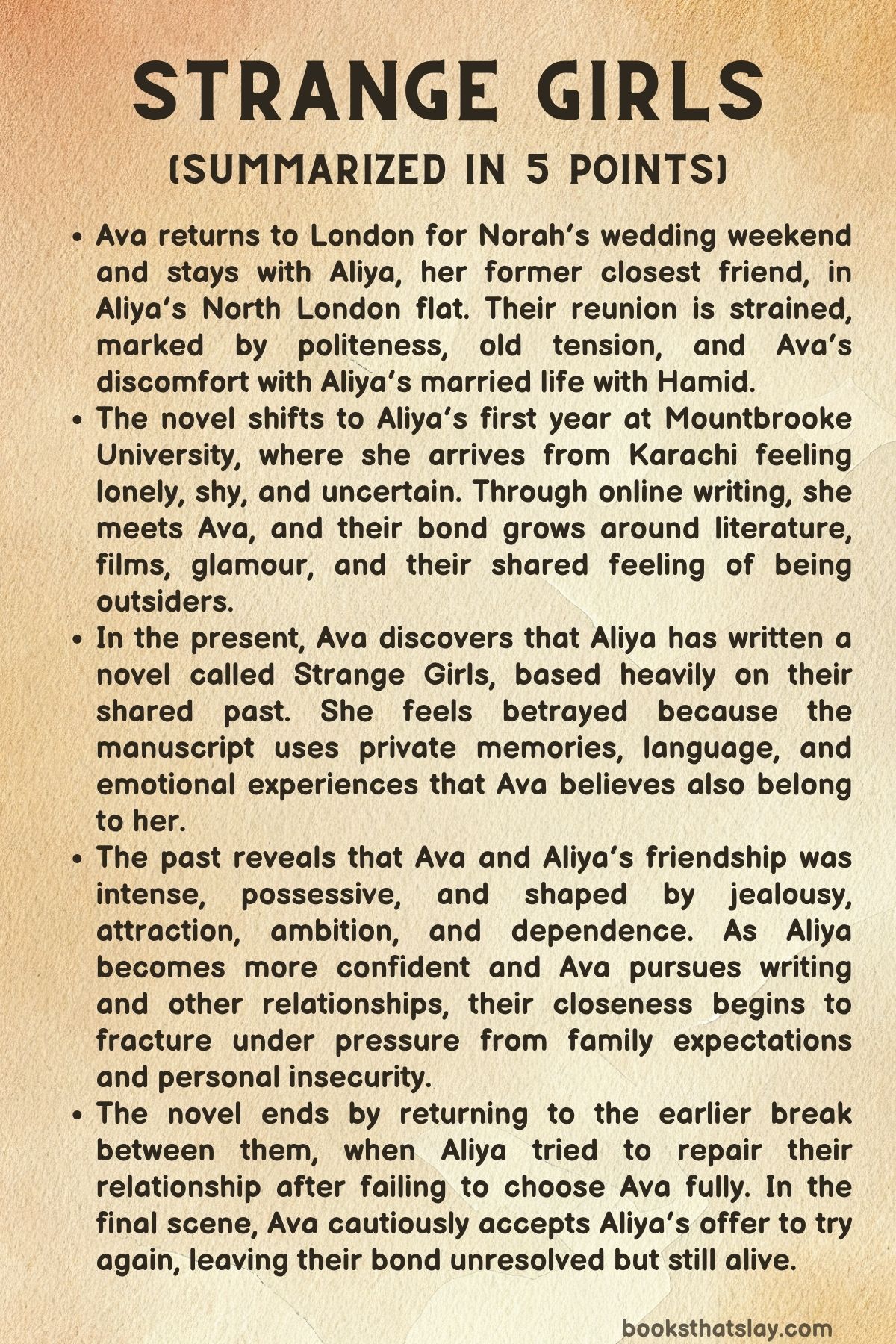
Ava returns to London for Norah’s wedding weekend, but the trip is charged with more than social obligation. She is staying with Aliya, once her closest friend and now a distant figure whose life has moved on without her.
Their meeting is awkward before it even begins. Ava arrives at Aliya’s North London flat and waits outside in the heat until a neighbor lets her in.
When Aliya comes home, the two women speak politely, but their manners only make the distance between them more obvious. They know too much about each other to behave like strangers, yet too much has happened for them to act like friends.
Inside Aliya’s flat, Ava notices every sign of Aliya’s married life with Hamid. The neat rooms, domestic objects, and sense of order make Ava feel like an intruder in a place she once imagined she might have belonged.
Aliya’s life seems settled, adult, and carefully arranged. Ava, by contrast, feels restless and unsettled.
The visit immediately brings back the old imbalance between them: affection mixed with envy, familiarity mixed with resentment.
The story moves back to Aliya’s first year at Mountbrooke University. Aliya has come from Karachi and feels lost in England.
She is lonely, shy, and uncertain of how to exist among people who seem louder, freer, and more confident than she is. Her roommate, social pressures, family expectations, and the rules of Muslim Society all leave her feeling watched and out of place.
She does not know how to speak easily, how to belong, or how to become the version of herself she senses might be possible.
Aliya begins posting stories online, where writing gives her a private way to test a different self. There she attracts the attention of a mysterious writer using the name AvaLovelace.
Their messages quickly become important to her. Ava is bold, clever, theatrical, and full of references to books, films, old glamour, and private jokes.
When they meet in person, Ava becomes the center of Aliya’s university life. Together, they create a shared identity around being “Strange Girls,” young women who feel separate from ordinary expectations and who want their lives to be more intense, more beautiful, and more meaningful than the lives around them.
Their friendship becomes the defining relationship of Aliya’s student years. Ava encourages Aliya to take risks, to drink, to go to parties, to write with more confidence, and to see herself as someone who can desire and be desired.
Aliya is drawn into Ava’s world, where everything feels sharper and more alive. They spend more time together, share language and ideas, and eventually move into a shabby student house with Norah and Hina.
The house becomes a space of youth, invention, mess, ambition, and emotional confusion.
As Aliya and Ava grow closer, their bond becomes harder to name. It is friendship, but it is also more demanding than ordinary friendship.
There is desire in it, dependence in it, and a need for recognition that neither of them fully understands. Aliya becomes braver through Ava, but she also becomes more vulnerable to Ava’s approval.
Ava wants loyalty and closeness, yet she also wants to be admired as a writer and as someone exceptional. Their connection gives both of them power, but it also gives each of them ways to hurt the other.
In the present, Ava meets Hamid and immediately dislikes how naturally he fits into Aliya’s life. He belongs where Ava no longer does.
During dinner, Ava learns that Aliya has written a novel, one that has not yet been publicly announced. This discovery unsettles her.
Later, while in Aliya’s home, Ava finds the manuscript in Aliya’s study. Its title is Strange Girls.
She reads it without permission and quickly realizes that the book is built from the private world she and Aliya once shared.
The manuscript contains memories, phrases, emotional patterns, and intimate details that Ava feels are partly hers. It is not simply that Aliya has written about the past; she has taken the shared language of their friendship and shaped it into art before Ava could.
Ava feels exposed, stolen from, and replaced. The title itself feels like a claim over something that once belonged to both of them.
Aliya has not only survived their old rupture; she has turned it into a novel and, apparently, into success.
The past continues to show the growing pressure between them. Ava completes a novel and becomes involved with an older Danish writer, which disturbs Aliya.
Aliya is jealous, though she cannot always admit what kind of jealousy it is. She wants to be central to Ava, but Ava’s ambitions and attachments pull her elsewhere.
At the same time, Aliya’s family obligations remain powerful. Her life is shaped by expectations Ava does not fully understand and often resents.
Ava wants total loyalty; Aliya wants freedom, but also safety, approval, and a way to keep all parts of herself intact.
Their friendship grows unstable under the weight of ambition, sexuality, family duty, and emotional need. Both women want to be chosen.
Both want to be seen as special. Both are writers, which makes the question of ownership even more complicated.
Their lives feed their fiction, and their fiction feeds their sense of self. When love and rivalry occupy the same space, neither of them knows how to protect the other from harm.
During Norah’s wedding events in the present, the tension finally breaks. After drinking and smoking with Aliya in Soho, Ava confronts her about the manuscript.
Aliya insists that the book is fiction, not memoir. She argues that their past belonged to both of them and that she had the right to use it.
Ava cannot accept this easily. She feels that Aliya has exposed her without warning and has turned private experience into public material.
Beneath the argument is an even sharper pain: Aliya wrote the story first. Aliya succeeded where Ava has struggled.
The next day, Ava and Aliya speak again in Aliya’s garden. The conversation is calmer, but it does not repair what has been damaged.
They can name parts of the hurt, but naming is not the same as healing. Ava leaves London and returns to Glasgow.
She visits her ill mother and tries to persuade herself that Aliya’s novel cannot really injure her. Yet the book has already reopened the past.
It has reminded her of the person she was with Aliya and of the future that never happened.
The later memories reveal the old break between them. After university, Ava and Aliya try to begin adult life in London.
Ava works at Foyles, while Aliya stays with her khala and takes an internship. They talk about moving in together and building a life in which they remain central to each other.
For Ava, this plan matters deeply. For Aliya, it is frightening because it means defying family expectations and choosing a form of closeness she has long been trained to keep hidden or secondary.
Aliya delays. She cannot act quickly enough.
Ava, already hurt and emotionally fragile, experiences the delay as abandonment. She cuts Aliya off.
Aliya responds with desperate messages and letters, apologizing for the hurt she has caused and even for plagiarism, as though the boundaries between writing, borrowing, loving, and betraying have collapsed. She eventually travels to Scotland without warning to see Ava.
In a café, Aliya asks Ava to try again. She says she wants them to live together, to stop treating their bond as something lesser, and to admit how central they are to each other’s lives.
Ava knows that trying again will not make them safe. She warns Aliya that they will still hurt each other.
But she also accepts the offer. The story closes in that earlier moment of uncertain hope, with Aliya offering Ava a biscuit and Ava agreeing to try.
By ending in the past rather than the present, Strange Girls leaves the relationship suspended between repair and damage. The reader already knows that the reconciliation did not last in any simple way.
Still, the final moment matters because it shows why the bond remained powerful enough to haunt both women years later. Ava and Aliya’s relationship was never easy to define, but it shaped their identities, their writing, and their ideas of love.
The novel becomes a story about friendship as a creative force, but also as a source of rivalry and loss. It asks whether shared memories can ever be owned by one person, and whether turning life into fiction is an act of survival, betrayal, or both.
Characters
Ava
Ava is one of the most emotionally intense and wounded characters in Strange Girls. She returns to London carrying years of unresolved hurt, and her visit immediately shows how much her connection with Aliya still matters to her, even though she tries to act detached.
Ava is sharp, observant, and deeply sensitive to small signs of exclusion. Aliya’s flat, her marriage, her domestic routine, and Hamid’s presence all make Ava feel as if she has been replaced by a life that no longer has room for her.
Her resentment does not come only from jealousy, but from grief: she once believed that she and Aliya belonged to each other in a rare, private way, and now she is forced to see that Aliya has built a world without her.
Ava’s relationship with writing is central to her character. She is imaginative, literary, and ambitious, but she is also blocked by comparison and disappointment.
In the past, she appears as the more daring figure, the mysterious online writer who draws Aliya out of silence and into self-expression. She gives Aliya language, confidence, and a new way of seeing herself.
Yet in the present, the balance has shifted. Aliya has written the novel first, and this wounds Ava because it feels like a theft of memory, intimacy, and artistic possibility.
Her anger over the manuscript is therefore not just about privacy; it is also about failure, ownership, and the fear that Aliya has turned their shared life into art while Ava has been left behind.
Ava is possessive, but her possessiveness comes from vulnerability. She wants to be chosen completely, without hesitation or compromise.
This makes her bond with Aliya passionate and magnetic, but also fragile. When Aliya cannot immediately defy her family or define their relationship openly, Ava experiences it as abandonment.
She cuts Aliya off not because she no longer cares, but because caring has become unbearable. Ava’s harshness often protects a softer and more frightened self.
She fears being secondary, being forgotten, and being used as material rather than loved as a person.
By the end of the story, Ava remains unresolved but not closed off. The final earlier scene, where she agrees to try again with Aliya, reveals her capacity for tenderness beneath her bitterness.
She knows they will hurt each other again, yet she accepts the possibility of rebuilding. This makes Ava a tragic and complex figure in the book: someone who longs for intimacy but is terrified by its risks, someone who wants to write but feels outwritten, and someone whose anger is inseparable from love.
Aliya
Aliya is the emotional and creative center of the story. She begins as a lonely student arriving from Karachi at Mountbrooke University, uncertain of herself and unsure how to move through English university life.
At first, she is quiet, isolated, and overwhelmed by the social codes around her. She struggles with her roommate, with expectations from her family, and with the pressures of belonging to a particular cultural and religious world.
Her early silence is important because it shows how carefully she has been trained to contain herself. She is not empty or passive; she is full of thoughts and desires that she has not yet learned how to express.
Ava’s arrival in Aliya’s life transforms her. Through their online exchanges and later their intense friendship, Aliya becomes braver, more expressive, and more willing to explore parts of herself she had kept hidden.
She drinks, goes to parties, writes, reads, watches films, and allows herself to imagine a life beyond the expectations set for her. Her bond with Ava gives her permission to become strange, artistic, desiring, and defiant.
At the same time, Aliya’s growth is complicated because she often depends on Ava to access this freer version of herself. Their friendship becomes a source of liberation, but also a source of pressure and emotional danger.
Aliya is not simply innocent in the conflict between the two women. She is loving, but she can also be evasive.
She wants Ava, but she also wants safety, family approval, and a stable place in the world. Her hesitation hurts Ava because Aliya often cannot act with the same total commitment that Ava demands.
This tension makes Aliya morally complicated. She is caught between desire and duty, between artistic freedom and inherited obligation, between the life she imagines with Ava and the life her family can understand.
Her inability to choose clearly causes pain, but the book presents that inability as human rather than cruel.
In the present, Aliya has become more composed and outwardly successful. She has a neat London flat, a husband, and a forthcoming novel.
Yet this apparent stability hides unresolved guilt and unfinished emotional business. Her novel forces the question of whether she has transformed shared intimacy into personal achievement.
When she insists that the book is fiction and that their shared life belonged to both of them, she is defending her right to create, but she is also avoiding the full emotional cost of what she has done. Aliya is therefore a character shaped by transformation: she grows from silence into authorship, but that authorship is haunted by the person who helped her find her voice.
Norah
Norah functions as both a social anchor and a reminder of the world that continues around Ava and Aliya’s unresolved bond. Her wedding weekend brings Ava back to London and creates the occasion for the present-day reunion.
Although she is not at the emotional center of the conflict, her presence is important because she represents continuity from the university years into adulthood. She once lived with Aliya, Ava, and Hina in the student house, meaning she witnessed the environment in which their friendship deepened and became more complicated.
Norah’s wedding also contrasts with Ava and Aliya’s unfinished relationship. While Norah is entering a socially recognized form of commitment, Ava and Aliya remain trapped in a connection that was never fully named, settled, or publicly understood.
The wedding events force them into shared spaces where they must perform normal friendship while carrying a history that is anything but simple. Norah’s role is therefore structural as well as emotional: she gathers the characters together, but she also highlights how far Ava and Aliya have drifted from the possibility of uncomplicated closeness.
As a character, Norah seems to belong to the shared past without being consumed by it in the same way Ava and Aliya are. She is part of the student world of intimacy, experimentation, and chosen family, but in the present she has moved forward into marriage and celebration.
This makes her a quiet contrast to Ava, who feels stuck, and to Aliya, who has moved forward but not without betrayal and guilt. Norah’s importance lies in the way her life event exposes the emotional stagnation of others.
Hina
Hina is part of the university household that shapes Aliya and Ava’s younger lives. Like Norah, she belongs to the student circle that surrounds the central friendship.
Her presence in the shared house suggests a world of female companionship, experimentation, domestic chaos, and emotional formation. The shabby student house becomes a place where identities are tested, and Hina is part of that atmosphere.
Although Hina does not dominate the main emotional conflict, she helps create the social background against which Aliya and Ava’s bond becomes more intense. Living with others should make their friendship part of a wider group, but instead their connection becomes increasingly private and possessive.
Hina’s presence therefore helps show how unusual Ava and Aliya’s relationship is. They are not simply two friends among many; even within a shared household, they form a charged inner world of their own.
Hina also represents the ordinary movement of student life, where friendships, houses, parties, and experiments with independence shape young adulthood. Against this ordinary background, Ava and Aliya’s attachment appears more consuming.
Hina’s role may be quieter, but she helps define the environment that allows the central relationship to grow, blur, and eventually become painful.
Hamid
Hamid represents Aliya’s present life and the adulthood Ava finds difficult to accept. He belongs naturally in Aliya’s North London flat, and this ease unsettles Ava.
To Ava, Hamid is not merely Aliya’s husband; he is evidence that Aliya has chosen a life that excludes her. His presence makes visible the years that Ava has missed and the domestic intimacy she no longer shares with Aliya.
Even ordinary details about him become painful because they prove that someone else now occupies the central place Ava once wanted.
Hamid’s character is important because he does not need to behave cruelly to threaten Ava. His threat lies in his normality.
He fits into Aliya’s life without the drama, secrecy, and emotional extremity that marked Ava’s bond with her. In that sense, he represents stability, social acceptance, and the kind of future Aliya may have chosen because it is livable.
For Ava, however, this stability feels like betrayal. Hamid’s existence forces her to confront the possibility that her relationship with Aliya, however intense, was not the life Aliya ultimately chose to preserve.
At the same time, Hamid is not presented simply as an enemy. He is more a symbol of the distance between past and present.
Through him, the story shows how adulthood can turn old intimacies into ghosts. He makes Aliya’s transformation visible, and he makes Ava’s displacement impossible to ignore.
Aliya’s Family
Aliya’s family plays a powerful role even when individual family members remain in the background. They represent obligation, cultural expectation, and the pressure to remain legible within a familiar social world.
From her first year at university, Aliya feels the weight of what her family expects from her. These expectations affect how she behaves, what she permits herself to want, and how openly she can live.
Her family is not simply an external obstacle; their influence has already shaped her inner life.
The family’s importance becomes especially clear when Aliya and Ava try to imagine adult life together in London. Aliya wants to move in with Ava, but she cannot bring herself to defy her family quickly enough.
This delay becomes devastating because Ava reads it as proof that Aliya will never choose her fully. For Aliya, the problem is not a lack of feeling, but a conflict between feeling and duty.
Her family’s expectations make love and independence costly.
Aliya’s family therefore deepens the book’s exploration of divided identity. Aliya is not only choosing between people; she is choosing between versions of herself.
One version remains tied to Karachi, family approval, and inherited rules. Another version is the strange, desiring, literary self that Ava helps awaken.
The tragedy is that Aliya cannot easily separate these selves, and the people around her are hurt by that conflict.
Aliya’s Khala
Aliya’s khala represents family support, but also family supervision. When Aliya stays with her in London while working an internship, the arrangement shows that Aliya’s adult independence is still partly contained within family structures.
She is in London, working and beginning a professional life, yet she is not fully free in the way Ava wants her to be. Her khala’s home becomes a sign of the compromise Aliya often makes: she moves outward, but not entirely away.
The khala’s presence is important because it helps explain Aliya’s hesitation. Ava may see Aliya’s delay as cowardice or rejection, but the family network around Aliya makes every act of independence more complicated.
Staying with her khala reflects the practical and emotional realities Aliya must navigate. She cannot simply step into a life with Ava without consequences.
This does not erase Ava’s pain, but it makes Aliya’s failure more understandable.
As a supporting character, the khala helps ground the story in the pressures of family belonging. She does not need to be central to the plot to matter.
Her role shows that Aliya’s choices are never made in isolation; they are shaped by people, expectations, and loyalties that Ava cannot fully control.
Ava’s Mother
Ava’s mother appears through Ava’s return to Glasgow and her visit to her ill mother. Her illness adds another layer to Ava’s emotional state.
Ava is not only dealing with Aliya’s novel and the pain of their past; she is also returning to a family situation marked by sickness and vulnerability. This helps explain the heaviness Ava carries.
Her life outside Aliya is not easy or triumphant, and the visit to her mother emphasizes her loneliness.
Ava’s mother also connects Ava to a different kind of duty. While Aliya is shaped by family expectation in relation to culture, marriage, and respectability, Ava is shaped by the burden of care and illness.
This parallel matters because both women are constrained by families, though in different ways. Ava may accuse Aliya of choosing family over her, but Ava too has a life marked by obligations and pain beyond the central relationship.
The mother’s role is quiet but emotionally revealing. She shows that Ava’s anger is not only about Aliya; it comes from a broader sense of disappointment and exhaustion.
Ava’s return to Glasgow after the confrontation feels like a retreat into an older sadness. Her mother’s illness makes that sadness more concrete and reminds the reader that Ava’s vulnerability exists beyond romance, friendship, and art.
The Danish Writer
The older Danish writer is significant because he introduces jealousy, ambition, and sexual uncertainty into Ava and Aliya’s relationship. Ava’s involvement with him unsettles Aliya because it threatens the special world the two women have built together.
Until then, Ava has seemed central to Aliya’s awakening, but the Danish writer shows that Ava has other desires, other ambitions, and other sources of validation. This makes Aliya feel displaced.
He also represents the literary world Ava wants to enter. His age and status suggest experience, authority, and artistic recognition.
Ava’s connection with him is therefore not only romantic or sexual; it is tied to her desire to be seen as a writer. For Aliya, this is doubly painful because it touches both intimacy and ambition.
She is jealous of his closeness to Ava, but also of the literary confidence and access he seems to offer.
The Danish writer’s role is to disturb the closed circuit between Ava and Aliya. His presence proves that their bond, however intense, cannot remain untouched by the outside world.
He exposes the insecurity beneath their friendship and helps push their relationship toward possessiveness, comparison, and hurt.
Aliya’s Roommate
Aliya’s roommate belongs to the early university phase of the story and helps reveal Aliya’s loneliness. The difficulty Aliya has with her roommate shows how alienated she feels when she first arrives at Mountbrooke.
University is supposed to offer friendship and freedom, but for Aliya it initially brings discomfort, silence, and social uncertainty. The roommate represents the ordinary social world that Aliya cannot easily enter.
This character matters because the failure of that early living arrangement makes Ava’s arrival feel even more powerful. Ava does not simply become a friend; she becomes the person who understands Aliya when others do not.
The contrast between the roommate and Ava highlights why Aliya becomes so attached so quickly. Ava offers recognition, glamour, language, and intensity where Aliya has previously found awkwardness.
The roommate is therefore a minor but useful figure. Through her, the book shows Aliya before transformation: isolated, unsure, and unable to belong.
This makes Aliya’s later boldness more meaningful, because it grows out of an earlier condition of near invisibility.
Aliya’s Neighbor
Aliya’s neighbor appears briefly when Ava waits outside in the heat and is let into the building. Though minor, the neighbor helps establish the discomfort of Ava’s present-day return.
Ava is not welcomed directly by Aliya at first; she enters through someone else’s help, which subtly reinforces her sense of being out of place. The moment captures the awkwardness of returning to a life where one used to belong but no longer has an obvious right of entry.
The neighbor also emphasizes Aliya’s settled domestic environment. Aliya has a flat, neighbors, routines, and a life organized around marriage and adulthood.
Ava enters that world as a visitor, not as an intimate. This small interaction quietly prepares the emotional atmosphere of the present-day sections: Ava is close enough to come back, but distant enough to wait outside.
As a character, the neighbor is not psychologically developed, but the function is important. The neighbor’s brief role helps show Ava’s displacement before Aliya even appears.
The tension of the visit begins not with a dramatic argument, but with a locked door, heat, waiting, and the uncomfortable fact that Ava no longer naturally belongs inside Aliya’s life.
AvaLovelace
AvaLovelace is the online identity through which Ava first enters Aliya’s imagination. This name matters because it presents Ava as mysterious, literary, and alluring before she becomes fully real to Aliya.
Through this persona, Ava reaches Aliya at a moment when Aliya feels lonely and nearly voiceless. Their messages become a private space where Aliya can experiment with thought, feeling, and self-expression.
As an online presence, AvaLovelace blurs the line between person and performance. Ava does not simply introduce herself; she creates an atmosphere around herself.
This makes her especially powerful to Aliya, who is drawn to the glamour and strangeness of the identity. The persona allows Ava to become almost fictional before she becomes physically present, which is fitting in a story so concerned with writing, memory, and the transformation of life into art.
AvaLovelace also foreshadows the later conflict over authorship. From the beginning, Ava and Aliya know each other through writing, invention, and self-presentation.
Their intimacy is built through language before it is lived in person. This makes the later dispute over Aliya’s novel especially painful, because their relationship has always existed partly as text.
AvaLovelace is therefore not just a username; it is the first form of the bond that will later become both creative source and emotional wound.
Themes
Female Friendship and Emotional Possession
Ava and Aliya’s bond grows from loneliness, shared imagination, and the thrill of being understood without explanation. Their friendship is not casual companionship; it becomes a private world with its own language, references, rituals, and emotional rules.
For Aliya, Ava represents freedom from fear, family pressure, and silence. For Ava, Aliya becomes proof that she can be needed completely.
This makes their closeness powerful, but also dangerous, because affection begins to carry the weight of ownership. Each wants to be chosen above other people, other duties, and other futures.
When Hamid, family expectations, literary success, and adult life enter the space between them, both women experience these changes as forms of betrayal. The friendship matters so deeply because it once gave them identity, confidence, and shelter.
Yet the same intensity makes separation almost impossible to manage. Strange Girls presents friendship as something capable of saving people from isolation while also making them vulnerable to jealousy, dependence, and resentment.
Writing, Ownership, and Betrayal
Aliya’s manuscript turns memory into art, but it also turns private experience into something public, controlled, and profitable. Ava’s anger is not only about being represented without permission; it is also about seeing shared moments shaped by someone else’s voice.
The conflict raises a difficult question: who owns a life lived together? Aliya believes fiction transforms reality and that their past belongs to both of them.
Ava feels that Aliya has taken emotional material that was never freely offered for publication. The wound becomes sharper because writing was central to both women’s identities.
Their friendship began through stories, online messages, books, and literary ambition, so authorship is never just professional success; it is personal power. Aliya’s novel forces Ava to face the painful fact that Aliya has written first, succeeded first, and fixed their past into a version Ava cannot control.
The act of writing becomes both confession and theft, both artistic survival and emotional betrayal.
Identity, Freedom, and Family Expectation
Aliya’s journey is shaped by the pressure of living between personal desire and inherited duty. At university, she arrives quiet, unsure, and burdened by expectations from family, culture, religion, and community.
Ava’s presence allows her to test new versions of herself: writer, friend, lover, drinker, rebel, and independent adult. Yet this freedom is never simple, because Aliya cannot fully escape the claims of family respectability and belonging.
Her hesitation to move in with Ava after university shows how deeply those obligations still control her choices. Ava reads this hesitation as cowardice and abandonment, while Aliya experiences it as fear, conflict, and emotional paralysis.
The theme is not presented as a simple choice between tradition and freedom. Instead, Aliya’s struggle shows how identity is made under pressure from many sides.
She wants to be loyal to her family and honest about her desires, but the two demands seem impossible to satisfy at once.
Memory, Jealousy, and the Past’s Unfinished Power
The past does not remain safely behind Ava and Aliya; it returns through rooms, objects, conversations, manuscripts, and old habits of feeling. Their present-day awkwardness shows that time has not healed the relationship so much as covered it with politeness.
Ava’s visit to Aliya’s married home makes her feel replaced by a life that appears orderly, adult, and closed to her. Hamid becomes painful not simply because he is Aliya’s husband, but because he represents a future Ava was not part of.
Jealousy in the story is therefore tied to memory. Ava is jealous of Aliya’s marriage, her novel, her confidence, and her ability to appear settled.
Aliya, meanwhile, is still haunted by guilt, longing, and the fear that she has used Ava’s life to complete her own. Their old reconciliation at the end feels fragile because it belongs to an earlier moment, before the later damage fully forms.
The past remains alive because neither woman has truly stopped needing recognition from the other.