Summer Staycation Summary, Characters and Themes
Summer Staycation by Sarah Grunder Ruiz is a contemporary romantic story about two people whose ideas of a satisfying life initially seem almost opposite.
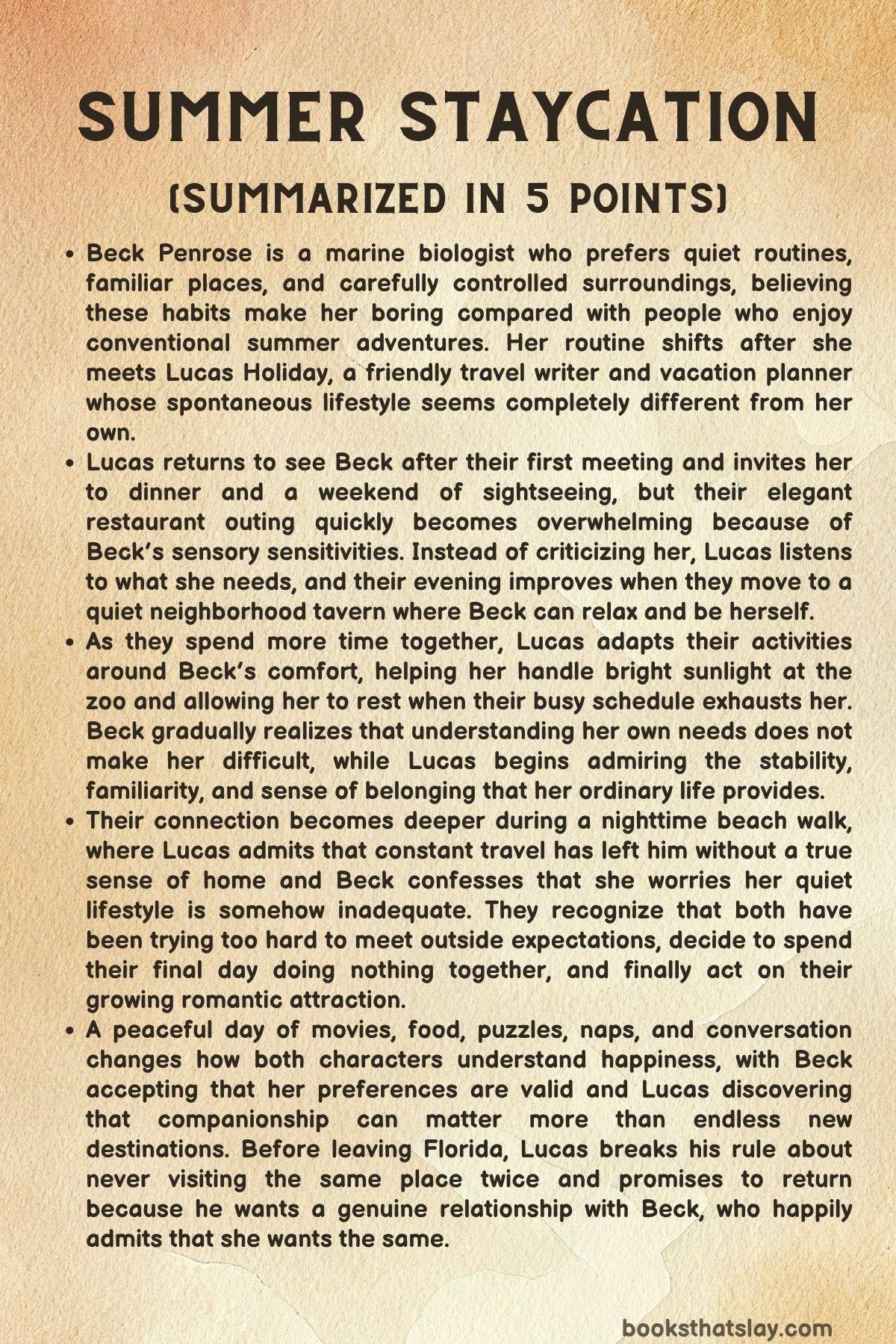
Beck Penrose is a marine biologist who prefers routine, quiet spaces, familiar food, and carefully controlled surroundings, while Lucas Holiday makes his living constantly traveling and creating vacation experiences. Their chance meeting turns into an unexpectedly revealing weekend in which Beck begins questioning the belief that she is boring or difficult, and Lucas confronts how lonely a life of endless movement has become. Their growing attraction develops through accommodation, honesty, humor, and the discovery that happiness does not need to resemble anyone else’s version of adventure.
Summary
Beck Penrose has little enthusiasm for summer. Although she works as a marine biologist at a marine life center in Florida, she dislikes many things associated with conventional beach vacations: heat, crowds, sand, wet clothes, and the general disruption of comfortable routines.
Her mornings are similarly predictable, including a regular order of black iced coffee at the Tortuga Café. Beck thinks of herself as boring, yet she has largely accepted the controlled and peaceful life she has created around work, familiar habits, and environments that do not overwhelm her.
That routine changes when a stranger ahead of her in the café offers to buy her drink because he is participating in a pay-it-forward chain. Beck unexpectedly decides to make the occasion count by abandoning her regular coffee and ordering a coconut coffee frappé, treating the change as a minor rebellion against what she calls “boring Beck.”
The stranger is Lucas Holiday, an attractive, friendly traveler whose direct way of communicating soon makes Beck unusually comfortable. They joke about turtles, talk about Beck’s work, and discuss her intense dislike of getting sand off wet feet, and Lucas responds to her unusual observations with amusement rather than judgment.
Lucas’s lifestyle appears almost designed to contrast with Beck’s. He operates a vacation-planning website and constantly moves between hotels, restaurants, beaches, museums, attractions, and new destinations, creating the kind of exciting life Beck assumes other people value.
However, Lucas has begun recognizing that constant novelty carries its own cost. He rarely returns to the same place, has no real home base, and experiences most remarkable destinations alone, leaving him increasingly conscious of how temporary his life has become.
Unable to stop thinking about Beck, Lucas returns to the marine life center the next morning. He finally admits that he came because he wanted to see her, and after she repays his earlier generosity by buying his coffee, he asks her to have dinner with him and possibly join him in some of his planned sightseeing.
Beck agrees to dinner, leaving the rest of the weekend open depending on how their first outing goes. Their decision begins what initially seems likely to be a typical vacation weekend but gradually becomes something much more personal.
Lucas chooses an elegant oceanfront restaurant for dinner, believing it should provide an ideal evening. For Beck, however, practically every feature of the environment becomes uncomfortable: the chair, silverware noises, surrounding conversations, wind, clothing, and other sensory details steadily wear her down.
She tries to hide the extent of her discomfort because she wants to appear flexible and enjoyable company. Eventually she retreats to the restroom, puts in earplugs, and returns hoping she can manage the situation without ruining Lucas’s plans.
Lucas notices that something is wrong and asks Beck directly rather than forcing her to continue pretending. Beck explains that sounds, textures, lighting, clothing, and certain environments can become overwhelming for her, describing herself as difficult and picky because she has learned to interpret her needs as personal flaws.
Lucas rejects that description. He tells Beck that she seems highly self-aware rather than difficult and points out that his work has taught him that different people enjoy different things, so there is no reason their evening must follow somebody else’s definition of fun.
Instead of staying at the restaurant, Beck changes clothes and takes Lucas to a quiet neighborhood tavern where she feels comfortable. Once there, her personality opens up, their teasing becomes easier, and the evening extends into hours of conversation about travel, food, television, bad dates, turtles, and their lives.
Lucas notices the contrast between his existence and Beck’s. The tavern staff know her, she has familiar places and routines, and even though he has visited countless impressive destinations, he realizes that he possesses almost none of the ordinary familiarity she takes for granted.
The next day they visit the zoo. Beck forgets her sunglasses and struggles with the Florida brightness until Lucas finds an enormous hat and oversized sunglasses that fit over her prescription glasses, choosing practical comfort over concern about how ridiculous the combination might look.
The gesture strengthens their connection because Lucas begins treating Beck’s needs as information rather than inconvenience. He discovers that helping her shape an activity around her own comfort gives him genuine satisfaction, much as his career is supposed to help travelers enjoy experiences according to their preferences.
Their time at the zoo also gives Lucas another glimpse of Beck when she is fully engaged. She becomes enthusiastic about animals, especially turtles and tortoises, and launches into scientific explanations about their differences and about invasive red-eared sliders.
Lucas does not understand everything she explains, but technical comprehension matters less to him than seeing her excitement. His attention shows Beck that she does not need to simplify herself to remain interesting to someone else.
Their increasingly packed weekend eventually catches up with Beck. After lunch and another hotel stop, she waits for Lucas while he handles work, lies down to watch the Weather Channel, and accidentally sleeps for about four hours.
When she wakes, Beck is embarrassed because they have missed both a museum visit and a dinner reservation. Lucas has deliberately allowed her to sleep, however, because it was obvious that she needed the rest, and he has already created an alternative plan involving Taco Bell and a nighttime visit to the beach.
The nighttime beach suits Beck far better than the conventional daytime version. There are fewer people, the light is softer, and the atmosphere allows her to enjoy walking beside Lucas while looking for turtle nests.
Their physical closeness increases as their hands brush and Lucas eventually takes hers. The quiet surroundings also make room for a more serious conversation about what each of them considers home and what kind of life they actually want.
Lucas admits that he does not know where home is for him. Growing up in a military family accustomed him to frequent moves, and his adult career initially allowed him to transform movement into freedom, but the same pattern has eventually left him feeling as though he is temporary everywhere.
Beck, meanwhile, has been questioning whether her preference for ordinary routines means she is living inadequately. Nearing thirty has made her more conscious of social expectations involving travel, parties, large groups of friends, and constant excitement, even though her genuine vision of happiness looks very similar to the quiet life she already has.
A brief misunderstanding exposes how much both have been trying to meet imagined expectations. When Beck says she does not want to go out the next day, Lucas initially thinks she no longer wants his company, but Beck explains that she wants to spend time with him without having to keep doing activities.
Lucas understands immediately. They agree that their final day together will involve essentially nothing, acknowledging that neither of them actually needs an elaborate itinerary to enjoy the other’s company, and their growing attraction finally leads to a kiss.
Back at Beck’s apartment, her feelings become harder for her to ignore. Knowing that Lucas will soon leave Florida, she worries that excessive caution will leave her regretting an opportunity she genuinely wanted to take.
Beck therefore creates another “backup plan” and invites Lucas to stay rather than return to his hotel. Lucas understands what she is asking but continues respecting her ability to establish the pace and boundaries of their time together, accepting the invitation without pressuring her further.
Their final day becomes almost the complete opposite of Lucas’s original itinerary. They stay inside Beck’s apartment, watch favorite movies, order food, work on puzzles, rest, and take naps, abandoning the assumption that memorable time together requires scheduled attractions.
For Beck, the quiet day confirms something important about her identity. Lucas’s acceptance has helped her understand that her preferences do not make her boring, picky, or inadequate, and that knowing the conditions under which she feels comfortable is a form of self-knowledge rather than a defect.
Lucas reaches an equally significant conclusion when Beck again asks about his ideal vacation. After years spent visiting places other people dream of seeing, he realizes that doing nothing on Beck’s couch may be closer to what he actually wants because it provides the familiarity, companionship, and ease his travels have been missing.
Their weekend therefore changes the meaning of adventure for both of them. Beck learns that novelty can be enjoyable when she is free to experience it on her own terms, while Lucas discovers that staying still can offer something constant movement never has.
The approaching end of his trip still creates an obvious problem because Lucas normally never visits the same destination twice. Rather than allowing that personal rule to separate them, he proposes changing it and tells Beck that he wants to return to Florida the following month.
Beck initially struggles to understand why Lucas would revisit her when the world offers him endless new destinations. His answer is simple: she is worth returning for, and he wants the opportunity to know her beyond a single weekend.
Beck admits that she wants the same thing. As Lucas prepares to book another flight, their relationship remains new and uncertain, but both have already made choices that would have seemed unlikely only days earlier: Beck is allowing meaningful change into her carefully ordered world, and Lucas is choosing to return instead of automatically moving on.
Characters
Beck Penrose
Beck Penrose is the central emotional perspective of Summer Staycation, and much of her development concerns the difference between understanding herself and judging herself. She knows exactly which noises, textures, clothes, lighting conditions, foods, social situations, and environments make her comfortable, yet she has absorbed the belief that these preferences make her difficult, picky, or boring.
Her life is consequently organized around predictability, but the book never presents that organization as emptiness. Beck has meaningful scientific work, strong enthusiasm for marine life, familiar places, personal interests, a comfortable home, and routines that genuinely satisfy her; the problem is that she has begun comparing these things against cultural ideas about what an exciting adult life is supposed to look like.
Approaching thirty intensifies that insecurity. Beck wonders whether she should want more travel, parties, friendships, spontaneity, and conventional adventure, even though her honest vision of a good future remains close to what she already has.
Lucas becomes important because he does not simply encourage Beck to tolerate discomfort in the name of growth. In Summer Staycation, his presence instead helps her separate genuine experimentation from self-erasure, allowing her to try new experiences while still changing environments, wearing earplugs, resting when exhausted, or choosing the nighttime beach over the daytime version.
Beck’s romantic development is similarly tied to agency. She chooses whether to continue seeing Lucas, tells him what environments work for her, clarifies that she wants his company without constant activities, initiates the possibility of him staying overnight, and ultimately admits that she wants him to return.
Her transformation therefore does not turn her into a radically different person. She becomes more accepting of the person she already was, recognizing that being self-aware and selective does not prevent her from being funny, interesting, adventurous, desirable, or capable of change.
Lucas Holiday
Lucas Holiday initially appears to represent everything Beck believes she is not. His career revolves around vacations, travel, tourist attractions, hotels, restaurants, beaches, museums, and new experiences, giving him a lifestyle that might easily be mistaken for permanent excitement.
Yet Summer Staycation gradually reveals that Lucas’s freedom is accompanied by a serious absence of belonging. Because he rarely revisits destinations and has no fixed home, almost every part of his life is temporary, and his childhood in a military family has made constant movement familiar long before it became his profession.
Lucas’s strongest quality is his willingness to adjust his assumptions when Beck tells him what she needs. He does not interpret the failed restaurant experience as Beck ruining the evening; instead, he asks what would actually make her comfortable and accepts that successful recreation cannot be defined by one universal standard.
That attitude continues through small actions such as finding shade, buying oversized sunglasses, letting Beck sleep through planned activities, replacing reservations with simpler alternatives, and agreeing to spend an entire day doing almost nothing. These actions matter because Lucas does not treat accommodation as sacrifice but gradually recognizes it as a more personal form of care.
His relationship with Beck also changes the way he evaluates his own life. In Summer Staycation, Lucas becomes increasingly envious of the very things that might appear ordinary from the outside: regular establishments, familiar staff, a comfortable apartment, repeated routines, and the certainty of having somewhere to return.
His decision to revisit Florida therefore represents more than romantic persistence. It is a direct rejection of the rule that has structured his adult identity, because returning to Beck means accepting repetition, attachment, and the possibility that remaining connected to one person may offer more satisfaction than constantly discovering somewhere new.
Boris
Boris is Beck’s sea turtle companion at the marine life center and functions as an unusual but meaningful presence in Summer Staycation. Beck jokingly treats him as a best friend and even consults him before agreeing to dinner with Lucas, which immediately communicates both her affection for marine animals and the distinctive humor underlying her reserved personality.
Boris also represents the part of Beck’s life where she never questions whether her interests are acceptable. Around her work and turtles, she is knowledgeable, enthusiastic, and confident, whereas in social or romantic situations she is far more likely to wonder whether she is behaving correctly.
The contrast becomes important because Lucas is introduced to Beck partly through Boris. Instead of dismissing her strong attachment to turtles or finding her scientific enthusiasm excessive, Lucas participates in the humor and later listens patiently when she becomes excited about turtles, tortoises, nesting, environmental conditions, and invasive species.
Boris therefore helps connect Beck’s professional identity with her emerging romantic life. He represents stability and familiarity, but he does not prevent change; instead, Lucas’s willingness to enter this familiar part of Beck’s world helps demonstrate that a new relationship does not have to replace the interests, habits, and attachments that already make her life meaningful.
Themes
Self-Acceptance Versus Social Expectations
Beck’s conflict comes largely from the distance between what genuinely makes her happy and what she believes adulthood is supposed to look like. She enjoys routine, quiet evenings, familiar establishments, comfortable clothing, predictable food, puzzles, television, scientific work, and environments where her senses are not constantly challenged, yet she has learned to describe these preferences using negative labels.
Approaching thirty increases the pressure because Beck imagines that a properly interesting life should involve travel, parties, large groups of friends, constant activity, and spontaneous experiences. Her dissatisfaction is therefore not primarily caused by her actual circumstances but by measuring them against an external standard.
Summer Staycation challenges that standard without arguing that people should never leave their comfort zones. Beck does try new food, goes sightseeing, visits the zoo, spends time with someone she barely knows, explores romantic feelings, and makes unusually bold choices, but her most positive experiences occur when she is allowed to adjust those situations rather than suppress herself.
By the end, her growth comes from changing the judgment attached to her preferences rather than eliminating the preferences themselves. She begins understanding that self-knowledge can coexist with experimentation and that there is no moral value in enduring discomfort simply to resemble somebody else’s idea of an adventurous person.
Lucas reinforces this development because he sees qualities in Beck that she has misidentified as faults. His acceptance helps her recognize that comfort, routine, and selectiveness can form a satisfying life when they represent conscious choices rather than fear.
Accommodation as a Form of Care
Lucas repeatedly demonstrates affection not by persuading Beck to overcome her needs but by taking those needs seriously. When the elegant restaurant becomes overwhelming, he does not insist that she remain because the reservation is expensive or because the setting is conventionally romantic; he asks where she would actually prefer to eat.
That same pattern appears throughout their weekend. Lucas finds visual protection when the bright sun bothers Beck, gives her space to rest when activity exhausts her, adapts abandoned plans rather than making her feel guilty, and willingly replaces scheduled entertainment with a quiet day at her apartment.
These gestures create trust because Beck is accustomed to interpreting accommodation as evidence that she is inconvenient. Lucas changes the emotional meaning of adjustment by treating it as ordinary information required to make shared experiences enjoyable.
The theme also avoids presenting Lucas as someone who always knows what Beck needs without being told. Communication remains essential: Beck explains her sensory preferences, identifies environments she likes, clarifies misunderstandings, and increasingly states what she wants instead of expecting Lucas to guess.
Their compatibility therefore develops through cooperation rather than rescue. Beck becomes more confident about expressing her needs, while Lucas becomes increasingly attentive to the difference between planning what should be enjoyable and learning what a particular person actually enjoys.
Care in the story is consequently practical as well as romantic. It appears in earplugs, clothing changes, quiet restaurants, shade, naps, backup plans, and the freedom to abandon an itinerary without treating the change as failure.
Movement, Home, and Belonging
Lucas has spent much of his life moving. Childhood in a military family made relocation normal, and adulthood allowed him to turn that instability into a career, giving constant travel the appearance of independence and unlimited possibility.
Over time, however, the advantages of movement have become inseparable from loneliness. Lucas sees extraordinary places but has few recurring establishments, no fixed home, and little sense that any destination contains people or routines waiting specifically for him.
Beck initially views her rooted life as evidence that she lacks adventure, while Lucas increasingly sees that same stability as something valuable. The neighborhood tavern where employees recognize her, her carefully arranged apartment, and even her preference for ordinary routines expose him to a form of permanence that his travel-centered existence cannot provide.
Summer Staycation therefore creates an intentional reversal between its protagonists. Beck begins the story wondering whether she should move outward into a larger, more exciting life, while Lucas gradually realizes that his own life may need greater repetition and attachment.
Their relationship does not require either person to completely abandon the life they know. Instead, each begins questioning an extreme assumption: Beck that staying rooted equals stagnation, and Lucas that returning somewhere means sacrificing freedom.
Lucas’s promise to return to Florida becomes the clearest expression of this change. Repetition, once incompatible with the identity he has built, becomes meaningful because returning now means choosing someone rather than merely revisiting a destination.
Redefining Adventure and Fun
The story repeatedly contrasts conventional ideas of recreation with the experiences that genuinely satisfy Beck and Lucas. Elegant restaurants, busy tourist schedules, museums, beach activities, and carefully arranged itineraries initially appear to represent the obvious ingredients of a successful vacation, yet several of these plans leave Beck uncomfortable or exhausted.
The simpler alternatives repeatedly become more meaningful. A quiet tavern leads to hours of conversation, Taco Bell becomes part of a memorable evening, a nighttime beach walk gives them privacy and comfort, and an unscheduled day involving movies, food, puzzles, and naps becomes Lucas’s possible answer to the question of his ideal vacation.
This contrast does not dismiss tourism or novelty as meaningless. Lucas enjoys travel, and Beck discovers that she can enjoy unfamiliar experiences, especially when they are adapted to her needs.
Instead, the book questions the assumption that fun can be objectively ranked according to expense, excitement, popularity, or the number of activities completed. An experience becomes valuable because of how the people involved actually feel while having it.
That realization changes both protagonists. Beck stops judging quiet pleasures as proof that she is boring, while Lucas recognizes that an impressive itinerary cannot substitute for companionship, rest, familiarity, and emotional connection.
Adventure ultimately becomes personal rather than performative. For Beck it can mean ordering an unfamiliar coffee or inviting Lucas to stay, while for Lucas the more radical choice may be returning somewhere he has already been because a person there has finally given him a reason to come back.