Sundered Summary, Characters and Themes
Sundered by Bethany Adams is a fantasy romance set across connected realms where magic depends on clean energy and stable borders. Lyr, a Moranaian duke and warrior, is trying to heal from an iron-tainted wound while protecting his newly discovered daughter, Arlyn, and keeping his estate safe from an assassin he can’t identify
At the same time, a spreading corruption from surface Earth begins poisoning magic itself, collapsing cities and forcing uneasy alliances. When an Alfheim delegation arrives through the Veil—bringing a young guide named Meli who feels inexplicably tied to Lyr—the personal and political stakes collide, pushing them toward war, rescue, and hard choices. It’s the 2nd book in the Return of the Elves series.
Summary
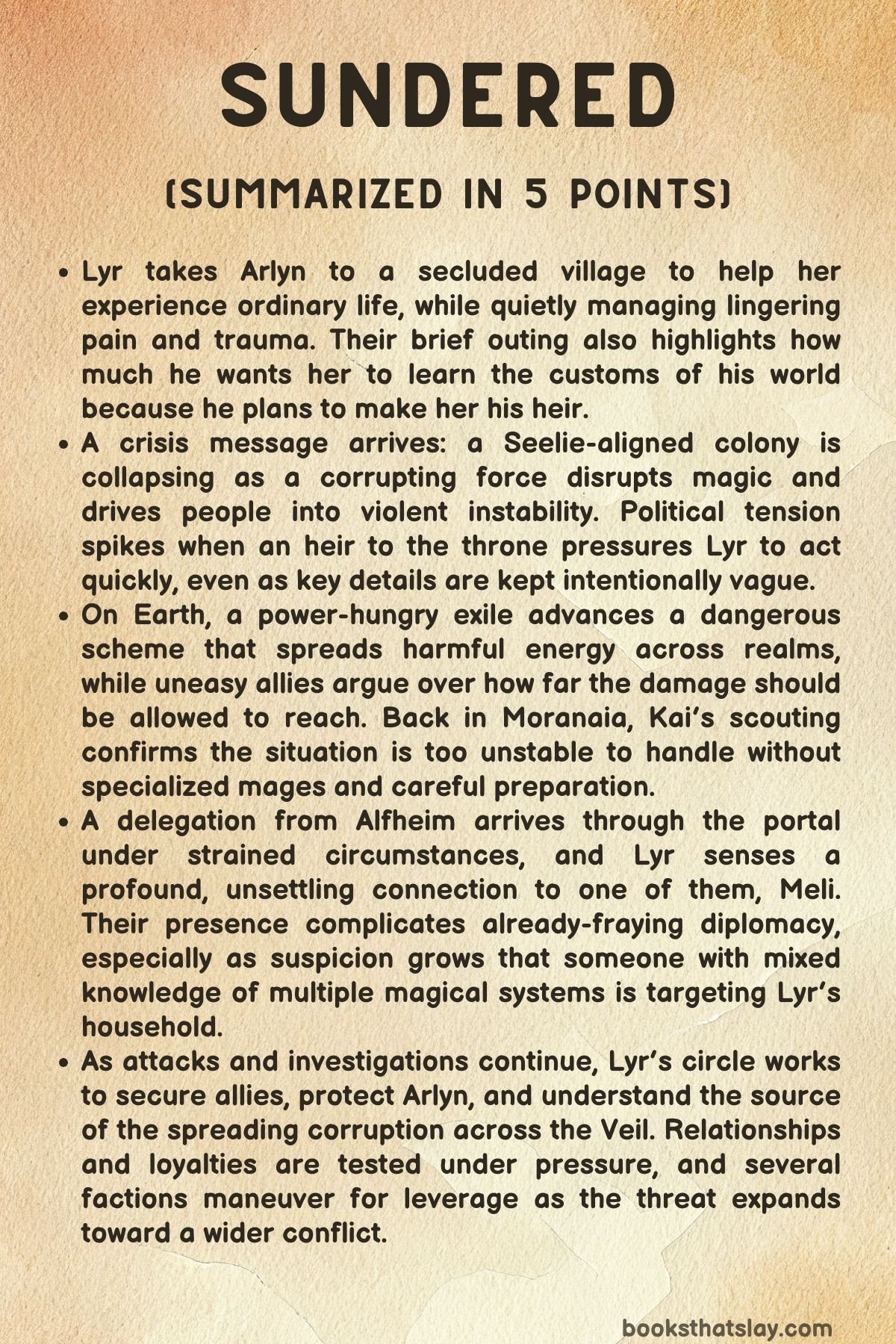
Lyr brings Arlyn to Telerdai, a village hidden in the forest, hoping to give her a brief taste of ordinary life. He is still weak from a chest wound, but he hides it because Arlyn would insist on returning home if she knew how badly he feels.
In a bowyer’s shop they meet Leren, and Lyr gently coaches Arlyn through formal introductions, explaining that he intends to name her his heir. Arlyn relaxes as she talks about differences between her Earth upbringing and Moranaia’s crafting.
The calm breaks when a box spills peresten arrowheads and tools. The sound jolts Lyr into a sharp, private panic that hints at past captivity and torture.
Before Arlyn can press him, an urgent message pulls them back to the estate.
A messenger from Queen Etora of Neor arrives with catastrophic news. Poisoned energy from surface Earth has crossed the barriers into Neor, stopping magic from replenishing and pushing people into madness.
Violence erupted in weeks, and the city has fallen into chaos after the healthy fled and the sick were quarantined. Neor begs for Moranaian help to contain the danger.
Lyr is furious that the Seelie court refuses to assist and blames humans instead. The situation grows more tense when Prince Ralan, heir to Moranaia’s throne and a powerful seer, steps in and orders Lyr to act immediately.
Lyr objects that such intervention should go through the king, but Ralan insists his authority is enough and claims that revealing the true culprit would force choices that lead to worse outcomes. Lyr agrees to send support, but demands Ralan confront the king about acting in secret.
At home, Lyr’s stress deepens as he watches his mother, Lynia, struggle with a serious injury. Dinner talk turns to a scouting mission into Neor led by Kai—Lyr’s close friend and Arlyn’s mate.
Lyr insists Arlyn will stay behind. Arlyn tries to reassure him she has learned caution, but admits trouble keeps finding her anyway.
Lyr takes the remark hard and withdraws, and Arlyn begins to recognize that his composure is being held together by effort and fear.
On Earth, the source of the poisoning becomes clearer. Kien, an exiled prince determined to seize Moranaia’s throne, is building a spell framework in the Great Smoky Mountains that corrupts Earth’s energy fields.
His Sidhe associates are alarmed because the corruption is leaking into their realms. Naomh confronts Kien and warns him to keep the poison from spreading below.
Kien, however, is focused on power and control, furious that a previous attempt to kill Lyr failed.
Kai leads a small team into Neor and immediately finds the city hostile: violent magic flares, the air feels wrong, and the group cannot safely draw energy in poisoned conditions. They retreat, noticing that even the Veil is growing unstable, making travel dangerous.
Far from Moranaia, Meli, a young elf from Alfheim with little status and weak magic, is ordered to guide an ambassador through the Veil based on ancient instructions to seek long-lost kin in Moranai lands. She is frightened and belittled by those around her, but she goes anyway with minimal supplies and a knife.
A high mage gives the party protective items, including a binding spell that keeps them linked to their supply cart. Meli follows an emerald trail only she seems able to sense—one that matches the strange eyes that have haunted her dreams since infancy.
Back at the estate, Lyr pushes himself too hard. He works obsessively on changing iron’s polarity because iron fragments left in his wound are draining him and worsening his nightmares.
Arlyn senses something else too: a brief pulse of foreign energy that feels like Earth, separate from the estate’s shielding. Soon after, Lyr’s sparring match with Prince Teyark turns dangerous when Lyr’s power falters.
A small child, Eri—Ralan’s daughter—appears and warns Lyr to duck. An iron dagger strikes the tree behind him.
The assassin escapes, but the crest on the dagger matches earlier attacks, confirming the threat has returned.
During a tense gathering, Arlyn reveals an important clue: she can detect the attacker’s signature when their concealment drops, and the energy feels like Earth. Selia, a skilled mage, suspects an illusionist and begins working with Arlyn on wards to detect the signature.
Meanwhile, Meli’s Alfheim delegation finally reaches the Moranaian portal. Lyr witnesses them enter—four women and one man, led by a flame-haired attendant named Pol who radiates unsettling power.
When a young blond woman steps forward, Lyr is hit with a soul-level pull that feels like the bond he once shared with his dead soulmate, Aimee. Before he can understand it, Pol lashes out with a spell that knocks Meli unconscious and forces through Lyr’s defenses, leaving Lyr in pain.
When Lyr wakes, he can suddenly understand the newcomers’ speech, and Pol seems pleased by the result. Lyr welcomes them formally as Duke of Braelyn, but keeps them housed under guard for “safety,” wary of Pol and the timing of their arrival.
The healer Lial confronts Lyr about his injury and removes iron fragments from near his heart, restoring his strength and reducing the drain on his magic. Lyr also ensures his blood cannot be used for blood magic.
As Meli recovers, she and Lyr speak privately. She admits she has seen his eyes in dreams all her life and doesn’t know why.
Lyr explains Moranaian soulbonding and begins to suspect Alfheim’s concept of “soul companions” is related. The connection between them intensifies into mutual desire, but Meli panics, convinced she has no value and no future if she returns home.
At a formal reception, the ambassador Teronver insults Moranaia and publicly demeans Meli. Lyr refuses to negotiate through prejudice and makes it clear that if Alfheim wants help, Meli will be the point of contact.
Eventually, Meli chooses herself: she rejects Teronver’s control and asks to stay in Moranaia. Lyr accepts her as a citizen under his protection, knowing the political fallout will be real.
The crisis worsens when Kai returns from Neor with survivors—and proof of massacre. Neor has not merely collapsed; it has been systematically slaughtered by a Sidhe army tied to the Seelie court, and children were intentionally left alive so Moranaia would learn the truth.
Lyr confronts Seelie lord Meren through a mirror. Meren admits the Seelie “handled it” and refuses to answer for the killings.
Lyr breaks off negotiations and warns that proof of Seelie assassins could mean war.
While Moranaia scrambles to respond, Arlyn and Kai vanish in the Veil. Lyr gathers a rescue party including the princes, and Meli is asked to guide them using her runes.
Though the mists terrify her, she follows the rune-cast trail and leads them to a hidden Sidhe estate. Inside, Arlyn wakes trapped in stone alongside an unconscious Kai.
Sidhe lords question her about Kien, implying they need him and may trade Arlyn to force Moranaia’s cooperation. Arlyn and Kai manage to break their enchanted restraints, but Arlyn grows sick and weak, as if the Earth corruption is clinging to her blood.
The rescue escalates into confrontation. Lyr’s group fights through guards while Ralan uses mind magic to force a path to the lowest levels.
Arlyn and Kai reach a chamber where Naomh and Caolte confront them. Naomh challenges Kai, and during the duel Naomh notices a necklace that triggers recognition.
The truth breaks open: Kai is Naomh’s son. Kai reveals his mother was imprisoned and killed, and that Allafon claimed Kai as his own.
The discovery flips the balance. Naomh offers peace, heals Kai’s wound, and insists the Moranaian party will be treated as guests rather than enemies.
As they retreat toward the portal, Kien ambushes them, using illusion and a steel blade to seize Meli. He tries to bargain with Lyr, offering a way to restore Aimee’s memories for a price, then demands they submit and bring him to Moranaia.
Meli quietly reveals she is not harmed by iron. When Caolte attacks Kien with fire, Meli stabs Kien and breaks free, running back to Lyr.
Ralan orders no pursuit, insisting chasing Kien leads to worse outcomes, and Kien escapes through the portal.
Kai gets everyone home, but Arlyn is still failing. They rush to the fairy pond, where the fairy Nia identifies Arlyn’s condition as foul earth poisoning clinging to Moranaian blood.
Several fairies combine their power to cleanse her. Arlyn wakes confused but stronger, and Nia orders rest to complete the healing.
In the aftermath, Lyr receives word that Alfheim is now facing breaches of dark energy and rising panic, and that leadership there may be changing. Meli, newly free from Alfheim’s judgment, begins to imagine a life built on her own choices, even as her bond with Lyr remains uncertain.
Arlyn and Meli talk openly, easing the tension between them and choosing to move forward as friends. Lyr returns to governance and to the painful places he avoided, determined to bring Kien to justice and prepare for the next wave of conflict—aid for Alfheim, repair of the poisoning that began on Earth, and the complicated alliance forming with Naomh as war threatens the realms.
Characters
Lyrnis “Lyr” of Braelyn
Lyr is the emotional and political center of Sundered. He moves through the story as a duke, warrior, and strategist, but the defining tension in his character is how often he tries to lead while privately falling apart.
His unhealed chest wound and the iron fragments near his heart are not just physical problems; they mirror the way trauma keeps interrupting his ability to feel safe, rest, and trust his own strength. He is fiercely protective of Arlyn and consistently chooses her stability over his own comfort, hiding pain so she will not panic or sacrifice her “normal life” to take care of him.
At the same time, his sense of responsibility has become almost punishing, and he repeatedly frames crises as personal failures, especially when confronted by consequences tied to his household’s past treachery. What makes him compelling is that he is not merely a noble hero reacting to threats; he is a man trying to rebuild a shattered inner world while holding together a realm where diplomacy, assassination, and magical catastrophe collide.
His growing bond with Meli becomes a rare space where he is tempted to want something for himself, yet even that desire quickly becomes tangled with duty, negotiation, and the fear of repeating old grief.
Arlyn
Arlyn enters the narrative as “newly found daughter,” but she rapidly becomes a catalyst for change in everyone around her. She is both vulnerable and unusually perceptive, especially in the way she senses foreign energies and detects threats others miss.
Her growth is marked by a push and pull between the life Lyr wants to give her (structure, social practice, safety) and the reality that danger keeps orbiting her, whether through politics, portals, or the deeper mystery of Earth-tainted magic. She demonstrates an instinct for problem-solving that is moral as well as practical; when confronted with the maddened Neorans, her first impulse is not containment through killing but pursuit of healing and a cure, and she actively seeks expertise rather than pretending competence she does not yet have.
Her sensitivity to the “Earth” signature is one of her most important narrative functions, because it places her at the intersection of worlds and makes her a living alarm system for threats that blend human and fae magic. Even her relationship dynamics show evolution: she can tease, challenge, and comfort, but she also feels guilt when she thinks she has wounded Lyr emotionally, revealing a deepening awareness of the costs of her words and the fragility of the people protecting her.
Kai
Kai is defined by steadiness under pressure, yet his arc reveals that his stability was built on missing truths. He acts as Lyr’s close friend, a tactical leader, and Arlyn’s mate, balancing affection with a soldier’s practicality when missions turn dire.
His first expedition to Neor highlights his professionalism: he recognizes the team’s limits in poisoned conditions and chooses retreat rather than a heroic disaster. Later, the massacre in Neor forces him into the most brutal kind of leadership, triaging survivors and carrying the burden of what he sees back to Moranaia.
The revelation that he is Naomh’s son reframes his entire identity: the man who has been loyal to Moranaia all his life is suddenly the product of Sidhe violence and Allafon’s crimes, and that twist explains both the resonance he feels with Sidhe enchantment and the deeper political risk attached to his existence. Despite that upheaval, Kai’s defining trait remains his commitment to protect Arlyn and serve the greater good, even when it means negotiating with enemies, swallowing anger, or carrying grief that is not fully his to begin with.
Lynia “Laiala”
Lynia, also referred to as Laiala, functions as the household’s moral anchor and the story’s clearest voice against self-destruction through guilt. Her shattered spine and painful recovery create an image of visible suffering that contrasts sharply with Lyr’s hidden wounds, and that contrast becomes a powerful tool in their relationship.
She refuses to let Lyr romanticize responsibility into self-blame, and she names uncomfortable truths: that failures were distributed across generations, that corruption hid itself, and that even those closest could be deceived. Her insistence that Lyr is not responsible for “the whole world” is not gentle comfort; it is a command for him to stop using guilt as a substitute for grief.
She also embodies resilience, choosing to return to the library despite trauma and pushing herself toward research and life rather than retreat. When she rebukes Lyr publicly, it signals that love in this household is not indulgence; it is accountability designed to keep the protector from becoming his own undoing.
Prince Ralan
Ralan is power wrapped in restraint, a seer who leverages prophecy like a weapon but refuses to reveal its blade. He exerts authority decisively, ordering action without waiting for formal approval and insisting that timing and ignorance are necessary to prevent worse futures.
That position makes him both invaluable and infuriating: he saves lives through urgency and foresight, yet he destabilizes trust by withholding reasons, names, and full accountability. His relationship with Lyr is a clash of leadership philosophies, where Lyr demands transparency and proper channels while Ralan prioritizes outcomes and survivability.
He is also complicated by fatherhood; Eri becomes both his vulnerability and his check, warning him not to overreach prophecy and reminding him that seeing is not the same as controlling. Even when he orders the group not to pursue Kien, he is not simply being cautious; he is choosing the least catastrophic branch of reality, which makes him a character whose ethics are inseparable from prediction.
Eri
Eri is a child whose calm certainty unsettles adults, and that unsettling quality is exactly her narrative power. She speaks mind-to-mind, disregards protocol, and inserts herself into lethal moments with the confidence of someone who has already seen the outcome.
Her warning saves Lyr from an iron dagger, and her later guidance shapes choices that prevent worse futures, but she is never written as a simple prophecy device. Her presence raises a harder question: what does childhood look like when knowledge arrives before experience, and when adults treat a child’s certainty as both sacred and dangerous.
She also becomes a moral limiter for Ralan, cautioning him against overstating visions, which suggests she understands the fragility of interpretation even more than some of the grown seers around her. Eri’s insistence that certain people must not go to certain wars frames her as someone already carrying the weight of multiple conflicts, not just the one currently visible.
Prince Teyark
Teyark is a pressure point where family loyalty, court politics, and personal pride converge. He pushes Ralan to return to court to soothe anxious nobles, reminding everyone that stability is not only about winning battles but also about being seen in the right places.
His sparring challenge to Lyr reads on the surface like bravado, but it also functions as a test: he is measuring the duke’s readiness, strength, and honesty in a moment when hidden weakness could endanger everyone. Teyark’s willingness to engage directly, physically, and politically makes him a foil to Ralan’s more cryptic leadership style.
He is not portrayed as cruel; he is portrayed as forceful, the kind of man who believes that duty is proven through action and presence rather than visions and explanations.
Corath
Corath arrives as Teyark’s newly found soulbonded, but he quickly proves he is more than a romantic attachment. His identity as a master artisan-mage with metal matters because the story’s core magical crisis repeatedly intersects with materials: iron’s disruption, enchanted cloaks, peresten shackles, and layered spellwork.
Corath’s offer to assist in analyzing enchantments positions him as an intellectual and technical asset, someone who can translate magical theory into workable solutions. Socially, his presence also softens the princes’ world; as a soulbonded partner, he represents the intimate stakes behind political power, reminding the household that alliances are not only treaties but also people bound together in ways that can be exploited or defended.
Selia
Selia operates as a disciplined protector and a bridge between raw talent and practical defense. She trains Arlyn, not only in combat readiness but in understanding the estate’s layered shielding, turning Arlyn’s sensitivity into usable knowledge rather than fear.
Selia’s suspicion that an illusionist could be Moranaian shows her realism: she does not romanticize “their kind” as inherently trustworthy, and she is willing to look inward for betrayal. Her role in examining the cloak highlights competence mixed with caution; she triggers a trap because the work is deliberately layered to punish curiosity, and she adjusts quickly, linking minds with Corath and Arlyn to parse the blend of Sidhe and Moranaian techniques.
She represents the story’s theme that security is not a wall but an evolving craft, dependent on collaboration and the humility to admit when you need help.
Iren
Iren is present more as part of the household’s leadership circle than as an individually spotlighted actor, but that placement matters. The inclusion of Iren in high-stakes discussions signals trust and rank within Braelyn’s internal structure.
Iren’s narrative function is to reinforce that Lyr’s household is not a one-man command; it is a community of skilled people who must coordinate under pressure, especially when threats involve cloaks, portals, and enemies who may already be inside their boundaries.
Kera
Kera, Lyr’s assistant, exemplifies the unseen infrastructure that keeps a realm functioning. Her urgent mental message interrupts a rare attempt at peace and normalcy, pulling Lyr back into crisis management and reminding the reader that leadership is never off-duty.
Kera’s role underscores how communication, intelligence, and rapid relay of information are as critical as swordplay in this world, especially when portals connect disasters across realms.
Leren
Leren, the bowyer of Telerdai, provides a grounded counterpoint to court intrigue and battlefield trauma. His workshop, spellwork, and careful social etiquette demonstrate the rhythm of everyday craftsmanship in Moranaia, and his interaction with Arlyn becomes an early lesson in belonging: she is not only learning combat tools, she is learning how to be recognized as someone with a future in this society.
Leren’s calm professionalism also contrasts with Lyr’s internal panic, making the bowyer’s shop the place where trauma leaks through the cracks of politeness. In that sense, Leren is less about plot and more about atmosphere: he represents the normal life Lyr desperately wants Arlyn to taste.
Areth
Areth, Leren’s teenage daughter, appears briefly but leaves a sharp mark because her mundane accident triggers Lyr’s captivity flashback. She becomes an accidental mirror for how trauma can turn harmless sounds into catastrophic memories.
Her presence also reinforces the theme that war and political violence ripple outward into ordinary spaces, impacting people who never asked to be part of larger conflicts.
Oberin Tesore
Oberin is the face of Neor’s desperation and the messenger who forces Moranaia to look beyond its own walls. He arrives bearing catastrophic news and an urgent request for aid, but he also carries political danger: his mention of leaked negotiations about returning to Earth exposes fractures in secrecy and trust.
Oberin’s function is to make the crisis immediate, embodied, and personal, not an abstract report. He is the kind of character who shows how quickly a realm can fall when magic fails and fear takes over, turning a distant problem into a moral test for those with power.
Queen Etora of Neor
Etora is present through report rather than direct action, but her choices define Neor’s final days before collapse. Her flight with the remaining healthy, contrasted with the king’s quarantine of the sick, frames her as a ruler making triage decisions under impossible conditions.
She symbolizes leadership under magical famine: when replenishment fails, governance becomes survival management, and every choice leaves someone behind. Even off-page, she anchors the tragedy of Neor by reminding us that the city’s fall was not a single battle but a chain of desperate decisions overwhelmed by escalating madness and violence.
King of Neor
The king is defined by containment and sacrifice, choosing quarantine as Etora flees. That decision can be read as duty or as despair, but either way it positions him as the ruler who stayed with the doomed population while the remnants of leadership escaped.
His role deepens the sense that Neor’s catastrophe is a civic unraveling, not merely an invasion, even before the later revelation of systematic slaughter.
Kien
Kien is the architect of corruption and one of the clearest embodiments of predatory ambition in Sundered. He is not driven by ideology so much as entitlement and cruelty, viewing both Earth and Moranaia as prizes to be taken through spellwork, fear, and spectacle.
His poisoning framework is an act of territorial domination that treats entire realms like experimental ground, and his willingness to decapitate, torture, and manipulate followers reveals a leader who rules by manufactured horror. Importantly, he is also strategic: he understands the political value of secrets, the leverage of stolen memories, and the destabilizing power of mixed magics.
When he offers Lyr the possibility of restored memories of Aimee, it is not compassion; it is a calculated attempt to buy submission using grief as currency. Kien is terrifying not only because of power but because of adaptability, slipping through portals, using illusion, and retreating when the future branches against him.
Allafon
Allafon is the shadow that lingers after death, a figure whose corruption and failed actions create continuing consequences. He is described as a pawn who botched a major attempt against Lyr, but later revelations suggest a deeper rot: imprisonment, exploitation, and the violent manipulation of Elerie’s life.
Allafon’s character function is to show that betrayal is not always a foreign invasion; sometimes it grows inside a household, hidden behind roles and familiarity until it becomes catastrophic. Even when he is not present, the damage he caused continues to reshape identities, alliances, and trust.
Naomh
Naomh is a Sidhe lord caught between alliance, resentment, and an unexpectedly personal reckoning. He confronts Kien because the poisoning threatens Sidhe realms, revealing a pragmatic self-interest, but his arc takes a sharp turn when he discovers Kai is his son.
That revelation forces him to confront the consequences of past violence and the reality that Moranaia’s loyal warrior is also his blood. Naomh’s insistence on a blade duel initially frames him as prideful and territorial, yet his immediate shift to healing and hospitality after recognizing the necklace shows a man capable of abrupt moral recalibration when truth becomes undeniable.
He is not written as purely noble or purely villainous; he is a political creature whose honor is real but conditional, and whose capacity for peace is awakened by personal accountability rather than abstract diplomacy.
Caolte
Caolte operates as both threat and restraint within Sidhe politics. His early silent warning to Kien establishes him as dangerous, but his later confrontation with Meren reveals that his danger is not random violence; it is enforcement of boundaries and oaths.
He seems more willing than Naomh to entertain the possibility that Moranaians are not the true enemy, and he notes shifts in “land pressure,” suggesting an awareness of environmental or magical signals beyond immediate politics. In the rescue sequence, he is decisive and aggressive against Kien, acting as the kind of ally who does not waste time on negotiation when a predator is cornered.
Caolte’s complexity lies in how he can be both enforcer and skeptic, loyal to his people yet capable of recognizing when their leadership has crossed lines that endanger everyone.
Lord Meren
Meren embodies institutional coldness and the dangers of moral certainty. He dismisses Neor as sovereign business, rationalizes slaughter as necessary elimination, and treats oaths as flexible depending on which queen they were sworn to.
His stance is chilling because it frames atrocity as governance, turning massacre into policy. Meren is also a destabilizer: his actions provoke potential war with Moranaia and fracture Sidhe unity, drawing condemnation even from Caolte.
He represents the story’s warning that power without empathy will always find reasons to excuse cruelty, especially when victims can be labeled contaminated, mad, or inconvenient.
Meli of Alfheim
Meli begins as scorned, low-ranked, and terrified, yet she carries a stubborn core that gradually becomes leadership. Her journey through the Veil is not heroic because she feels brave; it is heroic because she continues while afraid, hungry, and undermined, clinging to an emerald thread that feels like destiny but could just as easily be madness.
Her runes reveal that she is more than what Alfheim labeled her, and the way the runes “pull” her mind suggests she is tapping into something ancestral and structural, not merely a learned skill. Socially, Meli’s arc is about reclaiming personhood: she stops accepting abuse, rejects Teronver’s authority, and chooses citizenship in Moranaia, even though she fears she is “Unfavorable” and worthless by her homeland’s standards.
Her bond with Lyr is simultaneously romantic and existential, forcing her to consider whether her life has been shaped by fate, reincarnation, or something deeper that she cannot yet name. Her decisive act of stabbing Kien is the moment she stops being a guided pawn in other people’s plots and becomes an agent who can change outcomes with her own hands.
Pol
Pol is charm sharpened into menace, flamboyant on the surface yet consistently aligned with control. He pressures Meli, manipulates her runes, and later demonstrates power by knocking her unconscious and forcing through Lyr’s shields, signaling that his playful persona masks serious magical capability.
Pol’s hints about a connection to an “Ancient One” and his refusal of healing assessment keep him framed as an unknown variable, possibly a long-game player with motives that do not match any single realm’s interests. He is the kind of character whose usefulness is undeniable but whose presence makes every room less safe, because the reader can feel that he is always deciding what role others will play.
Lady Teronver
Teronver embodies aristocratic cruelty disguised as diplomacy. She belittles Meli, insults Moranaia’s competence, and treats negotiations as a stage to reaffirm Alfheim’s superiority rather than to solve a shared crisis.
Her disdain is not merely personal; it is cultural weaponry, reinforcing Alfheim’s rigid hierarchy and the way it discards those deemed “Unfavorable.” When she panics at being sent back in disgrace, her fear exposes how much of her confidence was propped up by status and appearances. Teronver’s expulsion is narratively satisfying because it is not just punishment; it is a rejection of a political model where power is exercised through humiliation and control.
High Mage Vionafer
Vionafer is one of Alfheim’s most pragmatic forces, a high-ranking figure who equips Meli with protective tools and contingency plans even while the culture scorns her. The protected crystal, the enchanted binding necklace, and the hidden beacon reflect Vionafer’s understanding that ideology will not keep people alive in the Veil.
Later, her warning about dark energy breaching Alfheim shows her as a truth-bearer who is willing to acknowledge collapse and change, even hinting at a shift in leadership. Vionafer represents competent authority: not sentimental, not cruel, but focused on survival, preparation, and the acceptance that old stability may be ending.
Freyr
Freyr appears primarily as a distant kingly will shaping Alfheim’s actions, ordering Vionafer and driving the delegation’s mission. Even without direct scenes, he functions as the symbol of a realm at the edge of upheaval, where the old order is pressured by dark energy, panic, and the need for outside aid.
The suggestion that Alfheim may soon have a new king positions Freyr as either a leader being replaced by necessity or a figure caught in a political storm that will redefine the realm.
Lial
Lial is the healer who forces reality onto leaders who would rather work themselves to death. By confronting Lyr’s hidden injury and physically extracting iron from near his heart, Lial becomes the agent of both bodily healing and narrative honesty.
The removal of iron does more than restore strength; it breaks a cycle where Lyr’s pain, nightmares, and dwindling power were feeding each other. Lial’s sealing and transmutation of Lyr’s blood also shows a healer who thinks beyond medicine into security, anticipating blood magic risks and treating the duke’s body as both person and strategic vulnerability.
Niesanelalli “Nia”
Nia is the face of fairy power in the story, and she is defined by boundaries as much as by magic. She welcomes Arlyn and Meli as “blood-souls,” acknowledges the poisoned-energy crisis, and yet refuses to help Alfheim, citing ancient rejection and the fairies’ binding “by blood.” Her refusal makes her morally complex: she is not evil, but she is not universally benevolent either, and she treats history as obligation rather than something that can be renegotiated through current suffering.
At the same time, she offers Meli a deeply personal riddle about belonging, suggesting that the most important answers are not political bargains but truths inside identity. When she heals Arlyn’s earth poisoning, her power reads as both awe-inspiring and conditional, reinforcing the theme that salvation in this world is never free of lineage, vows, and price.
Eradisel
Eradisel, the sacred tree of the Veil, serves as an oracle of a different kind than seers: ancient, impartial, and devastatingly direct. By telling Lyr that Aimee is not traveling the mists and will never be found there, Eradisel closes a door Lyr has emotionally kept ajar.
This moment is not only about information; it is about grief being forced into a new shape, where hope must be replaced by acceptance. Eradisel’s role reinforces that the Veil is not merely a place to traverse; it is a living system with knowledge and will, capable of answering questions that characters are not ready to hear.
Aimee
Aimee is absent in body but present as a gravitational force on Lyr’s heart and choices. She represents a prior soulbond that shaped him, and the uncertainty around her fate fuels both longing and vulnerability, which Kien later tries to exploit as leverage.
The shock Lyr feels when encountering someone who echoes that soul-level pull reveals that Aimee’s memory is not simply romantic nostalgia; it is a spiritual imprint that still influences how he recognizes connection, loss, and possibility. Aimee’s narrative function is to keep love tied to grief, and to show how unresolved bonds can become both strength and weakness in political warfare.
Elerie
Elerie appears through revelation, yet her story becomes one of the darkest moral indictments in the narrative. She is the woman Naomh says he gave a necklace to, later revealed to have been imprisoned and exploited by Allafon until she bore a child, then killed.
Her presence reframes Kai’s life as the product of violence and theft, and it also reframes the broader conflict: political struggles are not only fought through armies and spells but through crimes committed against individual bodies. Elerie’s absence is a wound that becomes visible only when the truth emerges, and that truth forces multiple characters to confront complicity, ignorance, and the price of hidden evil.
Patrick, Nicholas, and Beckett
These three figures illustrate the mechanics of Kien’s rule: followers, victims, and disposable tools. Patrick, as a half-Sidhe follower ordered to display a severed head, shows how Kien manufactures loyalty by dragging subordinates into complicity.
Nicholas, kept for future torture, demonstrates Kien’s preference for domination over simple killing, and Beckett’s execution functions as spectacle, reinforcing fear as governance. They are not central characters, but they sharpen the portrait of Kien’s camp as an ecosystem of cruelty.
Telien
Telien is invoked in Lynia/Laiala’s confrontation with Lyr as a key origin point in the chain of disasters. Even without detailed scenes, Telien’s mention matters because it reframes blame: the story repeatedly insists that catastrophe has multiple roots, including earlier choices and neglected duties.
Telien functions as a reminder that history is not background decoration in Sundered; it is an active force that current characters must reckon with.
Megelien
Megelien is referenced as part of how Eri “sees,” suggesting an ancestral or mystical source behind her prophetic clarity. Even as a mostly offstage presence, Megelien adds depth to the seer lineage and implies that prophecy in this world is not solely personal talent but also inheritance, influence, and perhaps an external guide shaping what Eri can perceive and how she interprets it.
Themes
Wounded leadership and the cost of carrying responsibility
Lyr’s authority is never presented as comfortable power; it is a constant strain shaped by injury, fear, and the expectation that he will keep everyone else steady even when he is not. He moves through daily life with iron fragments near his heart, hiding pain from Arlyn so she can experience something close to ordinary, then forcing himself into combat practice while his body and magic fail.
That choice is not framed as simple bravery; it shows a leader who equates vigilance with worth, and who worries that any softness will invite disaster. His guilt is not abstract, either.
He watches his mother struggle with a shattered spine, and her presence becomes a living reminder that political failures and personal losses are linked in his mind. When Lynia rebukes him for losing control in front of the household, it exposes the tension between a leader’s private panic and the public steadiness everyone needs from him.
This theme gains weight because the crises are layered: assassination attempts, Neor’s collapse, poisoned magic crossing borders, and political pressure from princes who expect immediate action. Lyr is pulled between protocol and necessity when Ralan orders help for Neor without the king’s approval.
Even when Lyr agrees to act, he demands accountability, showing that leadership in this world is not only action but also restraint and process. Yet the narrative keeps returning to the emotional bill that comes due.
Lyr’s nightmares, his startled reaction to the arrowheads, and his obsession with “iron conversion” all show a mind trying to solve trauma through control. The book treats leadership as a condition that can worsen psychological wounds: people project salvation onto the person with the title, while that person privately fears he is improvising in the dark.
The result is a portrait of leadership that is both necessary and damaging, where protecting others often means postponing one’s own healing until it becomes impossible to ignore.
Trauma, memory, and the body as a battlefield
Pain in Sundered is not limited to recollection; it lives in reflexes, physical reactions, and the way magic responds to fear. Lyr’s panic at the sight and sound of peresten arrowheads is a clear example of trauma as involuntary return: his mind snaps back to captivity, chains, and helplessness without permission.
He tries to recover quickly, but the moment matters because it happens in front of Arlyn, the person he is trying to reassure and train for a future of responsibility. The book treats trauma as something that can be hidden but not erased, and it shows how secrecy becomes a secondary burden.
Lyr’s decision to mask his suffering protects his daughter in the short term, yet it also isolates him, because the more he performs strength, the less room he has to admit that he is struggling.
The body becomes the clearest proof that trauma is ongoing. Iron fragments near Lyr’s heart drain his energy and keep him from healing, turning injury into a persistent sabotage of both magic and sleep.
The removal scene with Lial emphasizes that recovery requires confrontation, not willpower. Lyr cannot simply “push through” when the cause is lodged inside him, and the fact that his blood must be sealed and altered afterward underscores a world where even healing carries risk.
Trauma also echoes beyond Lyr. Neor’s “madness” caused by poisoned energy is a mass version of the same idea: contamination turns minds volatile, and the resulting violence is described as a breakdown of social order and self-control.
Arlyn’s earth poisoning later makes the theme intimate again, showing that even someone young and resilient can be brought down by a force that clings to blood and identity.
Memory becomes contested territory as well. Kien’s offer to restore memories of Aimee in exchange for submission highlights how grief can be exploited, and how the desire to reclaim the past can become a weapon pointed at the vulnerable.
Lyr’s recognition of Meli through a soul-level pull complicates the boundary between memory and present reality, suggesting that what feels like “remembering” may actually be a new connection that carries old emotional force. Throughout, the narrative treats trauma as something that changes perception: it sharpens threat detection, distorts decisions, and makes ordinary objects—iron, tools, a dagger crest—symbols that trigger survival responses.
Healing, when it appears, is practical and relational rather than inspirational: it comes through intervention, truth-telling, and being forced to stop pretending the past is over.
Identity, belonging, and the politics of blood
Belonging in Sundered is never only personal; it is governed by lineage, treaties, and who gets counted as “ours.” Arlyn’s position as Lyr’s newly found daughter is immediately tied to inheritance and formal speech, which turns a parent-child bond into a political project. Lyr’s encouragement of Arlyn’s social practice is affectionate, but it also shows how quickly a person’s identity becomes an institution in a noble household.
Arlyn herself sits in a complicated place: she senses Earth-signature energy and can detect cloaked intruders in a way full fae cannot, suggesting that mixed heritage is not merely a social label but a different relationship to magic. That difference makes her valuable and vulnerable at the same time, because it can protect the estate while also marking her as a target.
Meli’s arc intensifies the theme by showing belonging as something withheld and policed. In Alfheim she is treated as disposable, mocked for lacking magic, and threatened with exile as “Unfavorable.” Her value is defined by a narrow standard, and even when she discovers divining ability, she believes it will not change the judgment already written onto her name.
The moment she chooses to remain in Moranaia becomes an act of self-definition, but it is also a diplomatic rupture, because Alfheim’s representative frames her departure as dishonor. Lyr’s response—welcoming her under Moranaian tradition—shows a different political philosophy: citizenship can be granted by contribution and choice, not only by birth or elite approval.
Even then, her safety depends on power structures, guards, towers, and negotiated terms, which means belonging is still conditional, just conditional in a kinder direction.
The fairies sharpen this theme with their strict rule of help “by blood.” Nia’s refusal to aid Alfheim, while agreeing to act for Moranaia, reveals how ancient grievances become present policy. The phrase “blood-souls” implies that kinship here is metaphysical and inherited, not just cultural.
Yet Nia’s question to Meli—“Are you, really?”—introduces doubt about the categories everyone relies on. It suggests that identity may have hidden truths that overturn official histories, and that a person’s “home” might be a misclassification sustained by tradition.
The theme therefore operates on two levels: intimate longing to belong, and geopolitical systems that decide who qualifies. The result is a world where the self is constantly negotiated between what one feels, what others claim, and what blood and magic declare.
Corruption, contamination, and the ethics of survival
The central crisis is not a conventional invasion; it is poisoning that spreads through barriers and destabilizes minds, magic, and the Veil itself. The terror of this theme comes from its invisibility and its moral pressure.
In Neor, poisoned energies prevent replenishment of magic and drive people into madness, creating conditions where violence feels inevitable and containment starts to resemble execution. Kai’s scouting retreat makes clear that even skilled warriors become powerless when the environment itself cannot support their magic.
Later, the fall of Neor is revealed as systematic slaughter by a Sidhe army, and the deliberate choice to leave children alive turns the massacre into a message. That detail reframes survival as something manipulated by political actors, not merely the result of chaos.
Ethical conflict emerges when Arlyn recoils from the idea of killing the maddened and insists on seeking a cure. Her impulse introduces a crucial question: when contamination changes a person’s behavior, is the “solution” to remove the threat or to restore the person?
The narrative does not treat her response as naive; it becomes a strategic direction, leading them to consult Lial and later to seek fairy help. The fairies’ healing of Arlyn shows that cure is possible, but it also emphasizes that cures are selective and governed by rules, not universally available.
That uneven access makes the ethics harder, because it means some communities will be saved while others are abandoned under the logic of ancient loyalty.
Corruption also appears as intentional moral decay, not only environmental sickness. Kien’s project on Earth is designed to poison energy fields, and his cruelty toward captives and followers shows a worldview where suffering is fuel for ambition.
His alliance with Sidhe figures, and the discovery that the cloak involved both Sidhe and Moranaian enchantment, creates a broader picture: contamination is both magical pollution and political betrayal. Survival choices become ethically compromised when leaders like Meren rationalize slaughter as eliminating those who “succumbed.” That logic treats people as damaged goods and frames mass killing as cleanliness, which mirrors the theme of poisoning in a grim way: corruption spreads not only through energy but through arguments that make cruelty sound necessary.
The book repeatedly forces characters to decide whether survival means hardening into that logic or resisting it even when resistance is slower, riskier, and dependent on fragile alliances.
Secrecy, prophecy, and the tension between knowledge and agency
Information in Sundered is portrayed as dangerous currency. Ralan’s refusal to name who is responsible, claiming that knowledge would force worse actions, places prophecy in direct conflict with consent and accountability.
He uses future sight as justification for withholding, while Lyr experiences that withholding as manipulation, especially when orders are given without involving the king. This creates a political structure where the person with visions can override institutions, and everyone else must act on partial explanations.
The theme is not simply “prophecy is mysterious”; it is about how privileged knowledge can erode trust. When Ralan insists timing matters and avoids specifics, he forces allies to gamble with lives based on faith in his interpretation.
Eri complicates this further by demonstrating prophecy as immediate, practical intervention: she tells Lyr to duck, and an iron dagger strikes the tree behind him. Her calm confidence unsettles adults because it collapses the line between child and authority.
Teyark’s explanation that she is Ralan’s seer daughter shows how prophetic power becomes a family asset, almost a political inheritance. Yet the narrative also highlights the costs: Eri warns Ralan not to overstate prophecy, implying that certainty can become arrogance and that visions can mislead.
Ralan ordering “no pursuit” of Kien because futures worsen is another moment where prophecy restricts agency. Characters must accept that some apparently sensible actions are forbidden by unseen consequences, which is psychologically frustrating and ethically fraught.
Secrecy mirrors prophecy as a more ordinary form of controlled knowledge. Negotiations about returning to Earth leak, revealing that even high-level plans cannot be fully contained.
Lyr hides his injuries, hides iron experimentation, and hides fear, while enemies hide behind cloaks and mixed spellwork. The cloak itself becomes a symbol of this theme: layered magic that conceals identity and creates false perceptions.
When Arlyn explains she can detect the intruder once the cloak drops, it suggests that truth exists in flashes and signatures rather than stable visibility. The theme therefore positions agency as something constantly negotiated against missing information.
Characters act under uncertainty, and both prophecy and secrecy can be used either to protect or to dominate. The book’s tension comes from the same question appearing repeatedly in different forms: who gets to know, who gets to decide, and what is lost when decisions are made without shared understanding.