Sweet Little Hearts Summary, Characters and Themes
Sweet Little Hearts by Shanora Williams is a contemporary romance about a woman who’s tired of love’s damage—and a widowed NBA star who’s trying to be strong for his little girl while quietly falling apart. Octavia takes a live-in nanny job in Atlanta to help her family, expecting long hours and a difficult boss, not a child who clings to her instantly or a father whose guarded intensity hides real pain.
As Octavia and Javier clash, bond, and blur boundaries, the story follows trust rebuilt in small, risky steps—under the pressure of grief, family needs, and an unexpected threat to the life they’re starting to share.
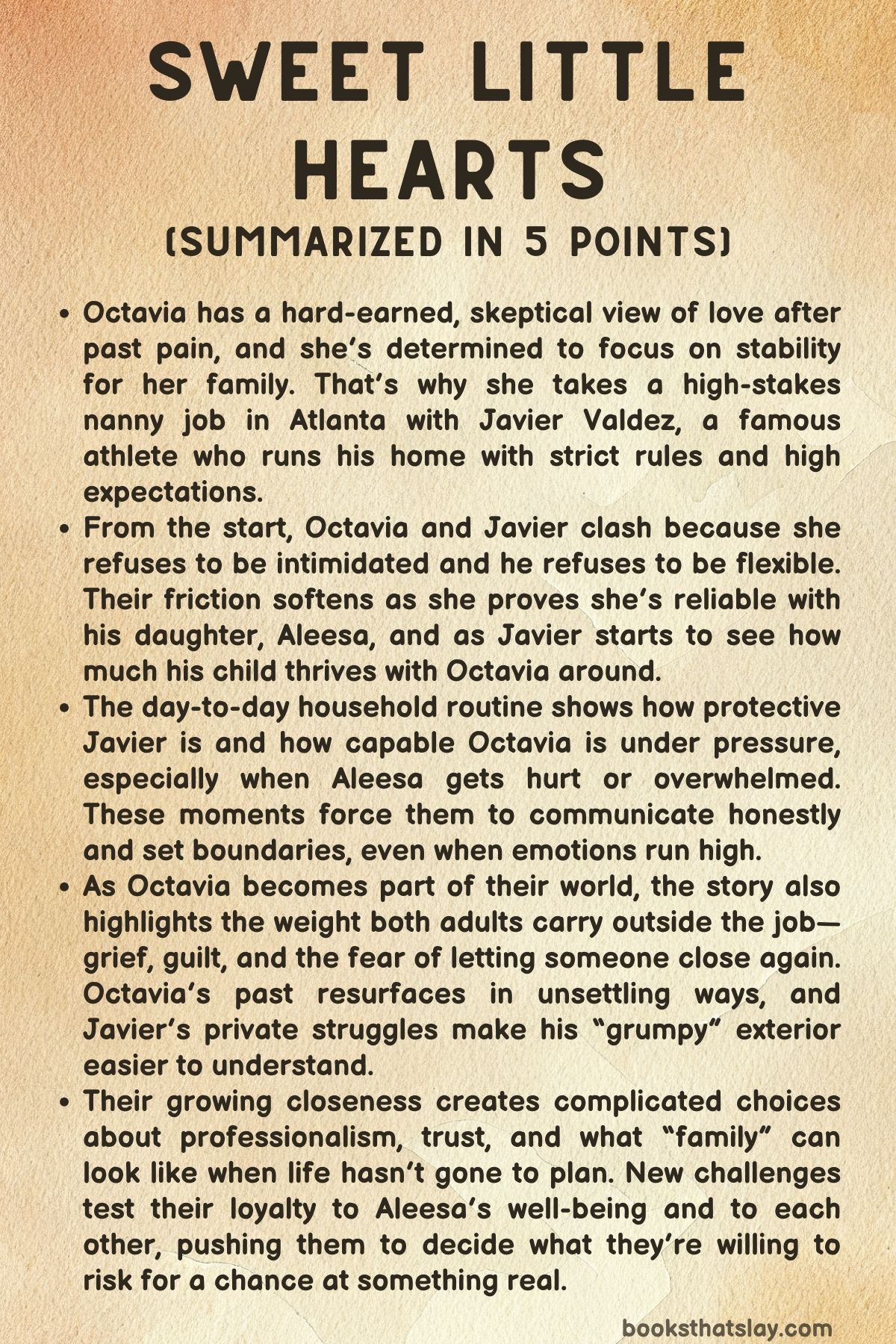
Summary
Octavia has learned the hard way that love isn’t automatically kind. Looking back, she remembers believing that any love was worth celebrating, until repeated hurt taught her how quickly “love” can turn controlling and cruel.
That history has left her suspicious of commitment and tired of trusting people who don’t deserve it. Still, she can’t afford to live only on caution.
Her family needs her. Money is tight, and her younger brother Abraham’s therapy is a constant expense.
When a high-paying nanny position opens up in Atlanta, Octavia takes it, even though the employer has a reputation for being difficult: Javier Valdez, an NBA player known for his fierce protectiveness over his daughter, Aleesa.
Octavia drives four hours to Atlanta while her sister Davina warns her to keep her head down and not poke at Javier’s temper. Octavia needs this job, so she promises she’ll be careful.
When she arrives at Javier’s estate, the first thing she sees is a tall, scowling man wearing a pink unicorn headband—proof he’d been playing with his little girl just minutes earlier. The contrast is almost funny: the hard-edged celebrity athlete paired with the goofy accessory.
Before Octavia can get her bearings, Aleesa runs to her, hugs her like they already know each other, and begs her to play.
Inside the house, Octavia notices a wedding photo and realizes Javier was married. That detail, combined with the way he tightens whenever family comes up, suggests a private history he doesn’t want to revisit.
The interview is tense from the start. Javier is blunt and demanding, checking her certifications and challenging her motives.
He outlines strict expectations: complete discretion, dependable routines, and total commitment, including travel, activities, meals, and exercise for Aleesa. He pushes hard, as if testing whether Octavia will crack or run.
He also judges her quickly, acting as though she’s not serious enough to be trusted with his child.
Octavia refuses to shrink. She answers him with sarcasm and nerve, even teasing that he could be dangerous and telling him to prove he isn’t.
Their friction turns into a verbal standoff until Aleesa interrupts, declares she wants Octavia, and tries to pull her away from the adults. Aleesa’s instant attachment forces Javier’s hand.
He hires Octavia on the spot but warns her she gets one mistake—one—before he fires her. He offers her the guesthouse so she doesn’t waste money on a hotel.
While Octavia plays with Aleesa, the child quietly admits her father is often mad. Octavia decides she’ll do the job well and enjoy Aleesa, even if Javier stays stubborn and prickly.
Months pass, and Octavia becomes part of the household’s daily rhythm. Mornings are messy: spilled juice, sticky hands, food in hair, and the endless energy of a preschooler.
Octavia handles it with patience and humor, guiding Aleesa through manners and routines without crushing her spirit. Aleesa, delighted by Octavia, gives her father a nickname that sticks—“GG,” short for “Grumpy Giant.” Javier dislikes the chaos and pushes for tidiness, structure, and punctuality.
He and Octavia argue over small things like clothing, schedules, and whether he can show up to Aleesa’s dance activities. Yet beneath the bickering, Octavia notices how much he wants to be present, and Javier can’t ignore how much Aleesa thrives with Octavia’s care.
From Javier’s point of view, hiring Octavia sometimes feels like inviting a storm into his carefully controlled world. She challenges him, makes jokes at his expense, and refuses to treat him like a king because he’s famous.
But she’s also excellent with Aleesa—reliable, attentive, and deeply tuned in to what the child needs. Javier’s guilt grows as basketball obligations pull him away.
Teammates notice he seems distracted, and friends tease him about his obvious interest in his daughter’s nanny. Javier insists that line can’t be crossed.
He tells himself Octavia is off-limits because Aleesa depends on her.
The fragile peace breaks when Aleesa gets hurt during dance class and ends up with a noticeable bump. Octavia informs Javier promptly, but he panics and rushes home, consumed by fear.
His reaction isn’t calm concern; it’s harsh accusation. He interrogates Octavia and acts as though she failed, even though it was an accident.
Octavia stands her ground, telling him he’s being unreasonable and overbearing. Javier, overwhelmed, says they don’t see things the same way and implies he made a mistake hiring her.
The words cut. Octavia retreats to the guesthouse in tears, her mind flashing back to her ex, Luther, a man who hurt her and manipulated her, and she wonders if she’s once again stuck under someone else’s anger and control.
The next day, Octavia keeps her distance. Javier’s guilt shows up everywhere: he plays badly, feels off, and can’t stop thinking about how unfair he was.
Late at night, he finds Octavia asleep beside Aleesa, holding the child protectively. The sight forces him to face what he already knows—Octavia isn’t careless with his daughter.
Javier stops Octavia before she can disappear into the guesthouse and offers a real apology. He admits he lashed out because he hates seeing Aleesa hurt and because he feels like he’s failing her by not always being there.
Octavia accepts, reassures him that Aleesa is safe with her, and their familiar teasing returns. Javier asks for her help planning Aleesa’s upcoming fourth birthday, and Octavia agrees.
As summer approaches, Octavia finds comfort in the guesthouse, the first place that feels truly hers. She takes pride in doing well, not just for the money but because Aleesa has become important to her.
When she takes on the birthday planning, Javier tries to control the details, but Octavia pushes him to accept help without seeing it as weakness. Javier, stunned by her steadiness, begins to rely on her emotionally in a way he hasn’t allowed before.
Around this time, Octavia receives an email from Luther claiming he moved to Atlanta after seeing her on TV at a basketball game. The message rattles her.
She deletes it, tries to act unbothered, and then hates herself for checking his social media anyway. She wants to believe he’s changed, but her instincts don’t trust him.
A turning point comes when Aleesa gets sick after one of Javier’s exhausting games. Octavia soothes the child, gives her medicine, and settles her down.
Aleesa eventually falls asleep against her father, and Javier’s composure finally cracks. He admits how scared he is of failing, and he confesses a darker thought he carries: that he sometimes wishes he had died instead of his wife, Eloise.
Octavia shares her own experiences with grief, telling him loss doesn’t mean he’s broken beyond repair. She reminds him that Aleesa needs her dad, not a perfect version of him.
Javier’s grief surfaces again in recurring nightmares about Eloise’s death and the traumatic birth that took her life, and the anniversary season makes everything sharper.
As Javier’s team advances, Octavia brings Aleesa to games and watches how Javier searches the stands for his daughter, grounding himself in her presence. Javier surprises Octavia with a thoughtful gift: a copy of Parable of the Sower, tied to the fact that Octavia was named after Octavia E. Butler.
The gesture shakes her. It’s a small sign that he sees her as more than an employee.
Aleesa’s mermaid-themed birthday party becomes a showcase of how much Octavia has done for this family. It’s elaborate and joyful, and it also exposes Javier’s raw edges.
A parent makes a cruel comment implying a child needs two parents, and Octavia steps in firmly, defending Javier and shutting down the judgment without apology. Later, Octavia overhears Javier’s mother Paola and sister Catalina discussing his unresolved grief and how he refuses to speak about Eloise.
When Octavia finds Javier alone, he admits he isn’t okay and fears Octavia will eventually leave like other nannies have. She promises she’s staying, and the promise matters more than either of them expects.
With more free time in the off-season, Octavia tries to reclaim a normal personal life and goes on a date. Javier’s reaction is immediate and telling.
He inserts himself into the moment under the cover of being a “friend,” and the date collapses into awkwardness. The jealousy forces the truth into the open: Javier wants Octavia, and Octavia feels the pull too.
What starts as anger and confrontation shifts into an impulsive choice, and they cross the boundary they’ve been circling for months. Afterward, they agree to keep it private, aware of how complicated it is with Aleesa and the job.
Octavia confesses the situation to Davina, expecting judgment, but Davina challenges her to stop treating happiness like a trap. Soon, the family travels to New York with Aleesa, and the closeness makes avoidance impossible.
Octavia and Javier finally talk honestly about the tension. They agree to stop forcing labels and to take things as they come, without pretending they feel nothing.
But the risk becomes visible when Paola catches signs that something is going on. Catalina is blunt and oddly supportive, while Paola warns Octavia not to manipulate Javier or take advantage of his grief.
She also hints that Javier was hurt badly in his marriage, suggesting there’s more to the story than Octavia knows.
Back home, that hidden past arrives at the front door. A man named Rafael Acosta shows up—Eloise’s former affair partner—and claims Aleesa might be his biological daughter.
He says he has already filed for a paternity test and is seeking custody rights. Javier’s rage nearly takes over, but he has to hold himself together when Aleesa appears.
After Rafael leaves, Javier spirals, snapping at Octavia and shutting down, then later returning with a shaken apology. Octavia recognizes his fear beneath the anger and refuses to abandon him.
Javier finally tells Octavia the full truth: during his NBA travel, Eloise became lonely, started working, and had an affair with her boss, Rafael. Eloise confessed after becoming pregnant and insisted she ended it.
Javier believed Aleesa was his. Then Eloise died from hemorrhaging the day Aleesa was born, leaving Javier with grief, guilt, and a constant sense that the ground can fall away at any time.
Octavia listens, comforts him, and commits to supporting him through the court fight. She makes it clear she loves Aleesa and will stand with Javier, not as an employee forced to endure him, but as someone who has become central to their lives.
Javier, finally honest with himself, admits Octavia is no longer “just the nanny.” She’s becoming his anchor, and he’s ready—terrified, but ready—to fight for his daughter and for the love he didn’t think he deserved.
Characters
Octavia Klein
In Sweet Little Hearts, Octavia is introduced as someone whose idea of love was shaped early by disillusionment, learning that affection can look beautiful on the surface while hiding harm underneath. That history explains why she enters Javier’s world with both grit and guardedness: she needs the job badly for her family, but she refuses to shrink herself to fit anyone’s mood, especially a man who tries to intimidate first and understand later.
Her voice is sharp, funny, and intentionally provocative, and that sarcasm is not just personality but armor—she uses it to keep emotional distance, to test people’s boundaries, and to make sure she is not being controlled again. At the same time, her softness shows most clearly in caregiving: she becomes Aleesa’s anchor, builds routines, teaches manners and steadiness, and offers warmth without becoming permissive, which is exactly what makes her so indispensable.
Octavia’s internal conflict is the book’s romantic engine—she craves safety and devotion but distrusts them, and when Javier begins to offer the kind of protection that is not possessive but present, she is pulled between instinctively running and daring to stay. Her past with Luther makes this tension sharper: she knows what manipulation looks like, so she keeps trying to define her connection with Javier as “not serious,” even when her emotions and her actions contradict that claim.
Over time, her character grows not by becoming less wary, but by learning the difference between danger and vulnerability, and by choosing intimacy with clearer eyes rather than naive hope.
Javier Valdez
Javier in Sweet Little Hearts is built from contradiction: he is outwardly powerful and controlled, yet privately ruled by grief, guilt, and fear of failing the one person he cannot afford to lose. His first impression—stern, demanding, suspicious—makes him seem like someone who equates authority with safety, and in a way he does: after Eloise’s death, he tries to parent and live as if strictness can prevent catastrophe from repeating.
His protectiveness of Aleesa often spills into harshness toward others, especially the people closest to the problem, which is why he lashes out at Octavia when Aleesa gets hurt and why previous nannies could not last. What makes Javier compelling is that his anger is rarely about ego; it is the panic of a man who still relives the worst day of his life and believes he will always be one mistake away from losing everything again.
The recurring nightmare and the annual spiral around Eloise’s death show that his success does not insulate him from trauma, and his guilt is both emotional and moral—he questions what he missed, what he should have noticed, whether he deserves to be okay. Octavia destabilizes his carefully managed world because she does not fear him, and because Aleesa loves her so completely that Javier cannot dismiss her without harming his child.
That forces him into growth: he apologizes, admits his fear, asks for help, and slowly learns that being present matters more than being perfect. His jealousy and possessiveness appear once he realizes he wants Octavia not as a fantasy but as a real partner, yet the story also shows him trying to respect her boundaries because he knows what coercion looks like, and he refuses to become that.
The arrival of Rafael triggers his deepest wound—betrayal entwined with bereavement—and Javier’s reaction reveals that his “grumpiness” has always been a defense against being powerless again; the moment he chooses to let Octavia stand beside him anyway, he shifts from solitary survival into shared life.
Aleesa Valdez
Aleesa is not written as background sweetness; she functions as the emotional truth-teller of the household, revealing what adults try to hide. Her messiness, big feelings, and constant need for play aren’t just cute details but proof that life continues even when grief tries to freeze it, and her joyful chaos forces Javier to confront the fact that parenting cannot be managed like a schedule.
She intuitively reads the emotional weather—calling her father “GG” for “Grumpy Giant,” whispering that “Daddy’s mad,” clinging when she senses tension—and that sensitivity makes her the bridge between Javier and Octavia, because she responds to sincerity faster than adults do. Aleesa’s attachment to Octavia is immediate and intense, which underscores both Octavia’s gift for caregiving and the child’s hunger for consistent warmth in a home dominated by a father who loves deeply but struggles to show it gently.
She also becomes the stake in every conflict: Octavia cannot tolerate disrespect because the job involves Aleesa’s safety, and Javier cannot tolerate uncertainty because Aleesa is his heart outside his body. As the story progresses, Aleesa represents a kind of innocence that is not ignorant but resilient; she is the reason Javier must learn to accept help, and the reason Octavia’s love is never purely romantic, because her bond with Aleesa is a commitment that changes what “walking away” would cost.
Davina
Davina is Octavia’s stabilizer and reality check, filling the role of protective sister without becoming controlling. She is practical about consequences—warning Octavia about Javier’s reputation, pushing her to be careful with Luther, insisting on legal steps like a restraining order—and her bluntness comes from love rather than judgment.
Davina also provides emotional permission: she challenges Octavia’s reflex to preemptively sabotage happiness, calling out how Octavia uses boundaries as both safety and avoidance. Because Davina is planning her own wedding and still carries grief from losing a first husband, she understands both commitment and loss, which gives her advice weight—she is not romanticizing love, she is advocating for it with eyes open.
In the narrative, Davina’s presence keeps Octavia connected to her original motivations—family responsibility and survival—so that Octavia’s relationship with Javier cannot be reduced to fantasy; it has to fit into real life, real fear, and real healing.
Abraham
Abraham is largely off-page, but he shapes Octavia’s choices in a decisive way: he is the reason the job matters beyond pride, and the reason Octavia is willing to endure discomfort to secure stability. His autism and need for therapy make Octavia’s financial pressure concrete, turning what could have been a simple workplace romance setup into a situation where leaving is not just emotional but economically dangerous.
Abraham’s presence also quietly highlights one of Octavia’s defining traits—she is a caretaker by nature, not because she is self-sacrificing to a fault, but because her love expresses itself through responsibility. That quality parallels Javier’s devotion to Aleesa, making Abraham part of the thematic mirror: both leads are shaped by protecting someone vulnerable, and that shared instinct becomes one of the few places where they immediately understand each other.
Luther
Luther embodies the toxic love Octavia describes at the start, functioning as both antagonist and psychological shadow rather than a constant on-page threat. His email, his relocation, his ability to find her contact information, and the later escalation that brings police involvement all reinforce the same pattern: he violates boundaries while presenting himself as changed, using “regret,” religion, and a cleaned-up life as a costume meant to re-enter her world.
What makes him dangerous is not overt violence in these summaries but entitlement—the assumption that he deserves access to Octavia because he wants it, and the belief that a new job or a new persona should erase old harm. Luther’s reappearance tests Octavia’s growth: she does not romanticize his return, yet her momentary curiosity on social media shows how trauma can blur certainty, tempting a person to wonder if the pain was a misunderstanding.
More importantly, Luther becomes the contrast that clarifies Javier’s appeal—Octavia is learning to distinguish a man who uses control to keep her small from a man who is learning, imperfectly, to love without possession.
Eloise Valdez
Eloise is physically absent but emotionally dominant, existing as memory, trauma, and unresolved truth. She is not simply idealized; the story allows complexity through the affair and the secrecy around Aleesa’s paternity, which means Eloise is tied to both Javier’s greatest love and his greatest humiliation.
Her death during childbirth is the origin point of Javier’s fear, and the nightmare Javier relives shows how grief can trap someone in an impossible choice they never truly had the power to make. Eloise also functions as the silent third presence in Javier’s emerging relationship with Octavia, because Javier’s loyalty to Eloise’s memory competes with his need to move forward, and because the betrayal complicates how he trusts his own judgment.
Even without many direct scenes, Eloise’s role is pivotal: she is the reason Javier hardens, the reason his family tiptoes around the topic, and the reason Rafael’s return detonates so violently—her past decisions continue to restructure the present.
Deke
Deke plays the role of Javier’s emotional counterweight, the friend who sees past the celebrity armor and refuses to let Javier drown quietly. He is observant enough to notice distraction, bold enough to tease, and loyal enough to intervene when the media pokes at Javier’s pain, using humor as a shield in public so Javier can keep dignity intact.
Privately, Deke offers Javier the kind of advice that grief-stricken people rarely give themselves—stop punishing yourself, start forgiving yourself—which positions him as both confidant and conscience. His presence also normalizes Javier’s humanity; around Deke, Javier is not only the intense single father or the guarded star, but a man allowed to be tired, irrational, and scared.
By showing up at Aleesa’s party and blending into the family environment, Deke reinforces the idea that Javier is not alone, even when he feels like he is.
Paola Valdez
Paola is a protective matriarch whose love expresses itself as scrutiny, especially when she senses the nanny arrangement shifting into something intimate. Her anxiety on flights and her fussing over Aleesa show warmth and vulnerability, but when it comes to Octavia she becomes sharp, not because she dislikes Octavia personally, but because she fears opportunism and emotional fallout for her son.
Paola’s confrontation frames the relationship as “unprofessional,” and that word choice reveals how she tries to impose order on uncertainty—if she can label it, she can control the damage. Yet her warning not to break Javier’s heart “again” hints that she knows more about Javier and Eloise than is said aloud, and that her protectiveness is rooted in history, not paranoia.
Paola ultimately represents the family gatekeeping Octavia must face: to love Javier is also to step into the shadow of Eloise’s story and prove she is not another person who will abandon or betray him.
Catalina Valdez
Catalina serves as a contrasting family voice to Paola, more direct, more playful, and less threatened by change. She teases Javier about how he looks at Octavia and later questions Octavia bluntly, but her bluntness carries acceptance rather than accusation; she reads the situation quickly and treats it as a positive shift in Javier’s emotional life.
Catalina also helps expose the unspoken family tension around grief, because her comments make it clear everyone sees Javier’s pain and everyone has their own method of coping with it—some by policing, some by nudging, some by joking. By telling Javier she thinks Octavia is good for him, Catalina functions as an internal ally for the romance, validating that what is happening is not only desire but healing.
Rafael Acosta
Rafael arrives as a living embodiment of the betrayal and chaos Javier has spent years trying to lock away. His claim that Aleesa might be his child is not just a legal threat; it attacks Javier’s identity as a father, reopening the wounds of Eloise’s affair and transforming grief into fury.
Rafael’s presence forces the story into high-stakes territory where love is no longer only personal but protective—Octavia’s bond with Aleesa becomes politically relevant, and Javier’s worst fear of losing his daughter becomes tangible. He also functions as a narrative accelerant: by forcing Javier to finally explain the truth about Eloise, Rafael drags secrets into daylight and makes emotional honesty unavoidable.
Even if Rafael frames his actions as rights or truth-seeking, the impact is destabilizing, and his entrance exposes how fragile Javier’s carefully rebuilt life has been beneath the surface.
Gianna
Gianna is a smaller but revealing figure who represents social judgment aimed at single parents, especially in spaces that pretend to be polite. Her pointed comment about children needing both parents is less about advice and more about superiority, and the moment exists to show how Javier is repeatedly forced to defend his family not only against private trauma but against public cruelty.
Octavia’s sharp shutdown of Gianna highlights one of Octavia’s key roles in the household: she protects Javier and Aleesa socially as well as practically, refusing to let them be shamed. Gianna’s brief presence therefore reinforces the theme that grief does not happen in isolation; it is constantly aggravated by outsiders who think they are entitled to comment on what a family should look like.
Terry
Terry is not a true romantic rival so much as a catalyst that exposes what Javier is trying to deny. The date itself underscores Octavia’s attempt to keep her life separate and to prove to herself she is not emotionally invested in Javier, while Terry’s chaotic personal situation and quick exit show how flimsy that attempt is in practice.
Javier’s interruption—public smile, private possessiveness—turns Terry into a mirror: Octavia sees in real time that Javier’s feelings are not theoretical, and Javier sees that Octavia is not waiting around in a paused life just because he is conflicted. Terry’s role matters because it pushes the relationship across a line neither of them can pretend is accidental afterward.
Themes
Love After Harm and the Fear of Repeating the Past
Octavia’s understanding of love is shaped less by romance and more by survival. She carries a history where affection wasn’t simply imperfect, it was weaponized—made conditional, turned into manipulation, and used to shrink her sense of choice.
That background makes her alert to early warning signs but also angry at herself for ever missing them, which creates a double bind: she wants connection, yet she distrusts her own judgment when connection appears. In Sweet Little Hearts, that tension shows up in how quickly she puts up guardrails around anything that feels emotionally real.
She can handle banter, she can handle attraction, and she can even handle intimacy, but the moment it begins to resemble commitment or dependence, her instincts tell her to cut it down to size. That is why she tries to label what happens with Javier as “just for fun,” not because she believes it, but because a smaller label feels safer.
The theme is not only about recovering from an abusive partner; it is about how abuse leaves behind rules that feel like wisdom. Octavia treats distance as self-respect, emotional minimalism as maturity, and refusing hope as intelligence.
The story keeps testing those rules through Javier’s steadiness with Aleesa and through moments where he shows remorse instead of retaliation. Octavia’s growth comes from recognizing that safety is not the absence of risk; it is the presence of accountability.
Javier does not become trustworthy because he is powerful or charming; he becomes trustworthy when he apologizes, explains, and changes his behavior. Even then, Octavia’s fear does not vanish, because trauma does not disappear on command.
What changes is her willingness to let her present be different from her past, without needing certainty first. The narrative treats trust as something built through repeated proof, not promised through chemistry, and it shows how healing requires tolerating vulnerability long enough to see whether the other person actually handles it with care.
Grief, Guilt, and the Cost of Unprocessed Pain
Javier’s harshness is not written as a simple personality trait; it reads like a coping strategy built around loss that never got fully metabolized. His grief is both personal and operational: he mourns his wife, but he also mourns the version of fatherhood he expected, the family structure he thought his daughter would have, and the sense of control he lost the day tragedy reshaped his life.
That is why his protectiveness can become excessive and why small incidents—like Aleesa getting hurt during a routine activity—trigger a disproportionate reaction. The emotional logic is clear: if he can prevent harm, he can rewrite the story; if he cannot prevent harm, then he failed again.
The recurring nightmare functions like a private courtroom where he is always on trial, always arriving too late, always forced to choose, and always punished by what he cannot fix. This theme becomes sharper when outside voices press on the most sensitive bruise—reporters referencing the death date, strangers implying his daughter needs two parents, and eventually Rafael’s arrival reopening betrayal and uncertainty in one blow.
The story shows that grief rarely stays in the lane of sadness; it spills into anger, control, suspicion, and self-criticism. Javier’s guilt also makes intimacy feel dangerous, because happiness can read like disloyalty to the person he lost.
Yet the narrative refuses to make grief a permanent excuse. Javier is allowed to hurt, but he is also expected to take responsibility for how his hurt lands on others.
His apology after lashing out at Octavia becomes a turning point because it separates pain from permission. The theme ultimately argues that unprocessed grief does not only imprison the bereaved; it radiates outward, shaping a child’s emotional climate and pushing away support systems that could help.
When Javier finally speaks honestly about his fear, his regret, and the complicated truth about his marriage, the story frames that honesty as an act of care toward Aleesa and toward Octavia. Healing begins not with forgetting Eloise, but with letting memory exist without using it as a shield against the living.
Parenthood, Protection, and the Pressure to Be Enough
Aleesa is more than a child character; she is the emotional center that forces every adult choice to carry real consequences. Javier’s identity is anchored in being her protector, yet his career requires long absences and public performance, which intensifies his fear that he is failing her even when he provides materially.
That conflict turns everyday parenting into a moral scorecard: if Aleesa cries, he assumes he did something wrong; if she gets hurt, he assumes he wasn’t vigilant enough; if she looks happy with Octavia, he feels gratitude and threat at the same time. Octavia’s role complicates that further because she becomes a stable presence in Aleesa’s routines—food, manners, scheduling, comfort, sleep—and stability is what Aleesa responds to.
The theme explores the tenderness and discomfort of that arrangement. Javier needs help, but needing help can feel like admitting weakness.
Octavia offers help, but offering help can slide into carrying more than she should. Aleesa’s attachment to Octavia highlights a truth many parents wrestle with: love is not diminished by being shared, but insecurity can make it feel that way.
The story also critiques how outsiders judge families, especially single-parent families. Casual comments at social events become pressure points, and what is presented as “concern” often reads as stigma.
In response, Javier becomes even more guarded, as if privacy could protect them from judgment. The theme becomes most intense when paternity and custody are threatened.
Suddenly, protection is not just emotional or physical—it becomes legal and existential. Javier’s fury at Rafael is not only about betrayal; it is about the fear of losing the one person who gives his life coherence.
Octavia’s reaction matters here because she chooses Aleesa’s wellbeing over her own comfort, even after Javier snaps at her. That choice doesn’t erase power imbalances or emotional risk, but it shows what responsible love looks like in a family that is still being formed.
The narrative insists that “being enough” is not a solitary project. Aleesa thrives not because Javier becomes perfect, but because he allows a supportive network—Octavia, Deke, Paola, Catalina—to exist around her, even when it bruises his pride.
Boundaries, Power, and the Ethics of Care
The relationship between employer and caregiver carries built-in imbalance: money, housing, job security, and authority sit on one side, while emotional labor and constant availability sit on the other. Sweet Little Hearts does not ignore that reality; it uses it as friction.
Javier’s “one strike” framing early on makes the power dynamic explicit, and Octavia’s sarcasm becomes a way to resist being reduced to a replaceable employee. Over time, the household runs smoothly largely because of Octavia’s competence, but competence does not automatically grant safety.
When conflict happens, Octavia is reminded how quickly her position can be questioned, and that vulnerability echoes her earlier experiences with control in romantic relationships. The story also shows how intimacy can blur boundaries in ways that feel thrilling but also destabilizing.
Javier’s jealousy, his public performance at the restaurant, and his later insistence on secrecy reflect competing impulses: he wants closeness, but he fears exposure; he wants her, but he also wants to keep the structure that lets him feel in control. Octavia, meanwhile, tries to manage risk by setting rules that protect her heart and her livelihood at the same time, but those two goals sometimes conflict.
The theme becomes sharper through the presence of Javier’s family. Paola’s suspicion is not only moral judgment; it is a protective response to the possibility that someone with less power could be harmed or could harm.
Her warning frames the relationship as a potential exploitation in either direction, which is what makes it uncomfortable and realistic. Catalina’s openness provides contrast, suggesting that the relationship may be healthy, but only if it is handled with honesty and respect.
The narrative treats boundaries not as rigid walls but as necessary agreements that must be renegotiated when circumstances change. It also suggests that care work is often undervalued until it is threatened.
Javier’s fear that Octavia might leave is both romantic and practical—without her, the household’s emotional stability collapses. By placing love inside a workplace structure, the story asks whether devotion can remain ethical when one person controls the other’s housing and employment.
The answer it gestures toward is conditional: it can, but only if accountability is stronger than desire and if the person with institutional power actively chooses restraint, transparency, and respect.
Family Duty, Financial Strain, and the Search for a Home That Feels Like Yours
Octavia’s decision-making is never only about herself. She takes the job because her family needs money, because her younger brother needs therapy, and because survival often requires compromise before it allows choice.
That context gives her ambition a different emotional texture: it is not about status, it is about stability. The theme shows how financial pressure can trap people in arrangements that are demanding, isolating, or emotionally risky, even when the job appears glamorous from the outside.
Living on Javier’s property in the guesthouse captures that contradiction. The space is provided by his wealth, yet it becomes the first place that feels like it belongs to Octavia.
That detail matters because it reveals what she has been missing: not luxury, but ownership over her own peace. The guesthouse symbolizes independence inside dependence—she is close enough to be on call, yet separate enough to breathe.
Her attachment to that space reflects how people who have lived through instability often bond deeply with the first environment that offers predictability. The theme also looks at how family duty can delay emotional development.
Octavia’s energy goes toward others—Aleesa’s routines, Abraham’s therapy needs, Davina’s support—so her own desires become something she negotiates rather than claims. When Luther resurfaces, the threat is not only personal; it threatens her family’s stability and her carefully built sense of safety.
Filing for a restraining order becomes part of reclaiming control, a step that says: my life is not open for past harm to re-enter. Javier has his own version of family duty.
His fame and money do not free him from obligation; they add scrutiny and distance. He wants to be present for Aleesa, but his career schedules his absence, and that creates guilt that he tries to pay down with control.
The narrative places two versions of responsibility side by side: Octavia’s responsibility is scarcity-driven, Javier’s is grief-driven, and both are trying to create a home where a child can feel secure. In the end, “home” becomes less about property and more about relational safety—the ability to rest, to be believed, to be cared for without strings.