Sworn to Silence Summary, Characters and Themes
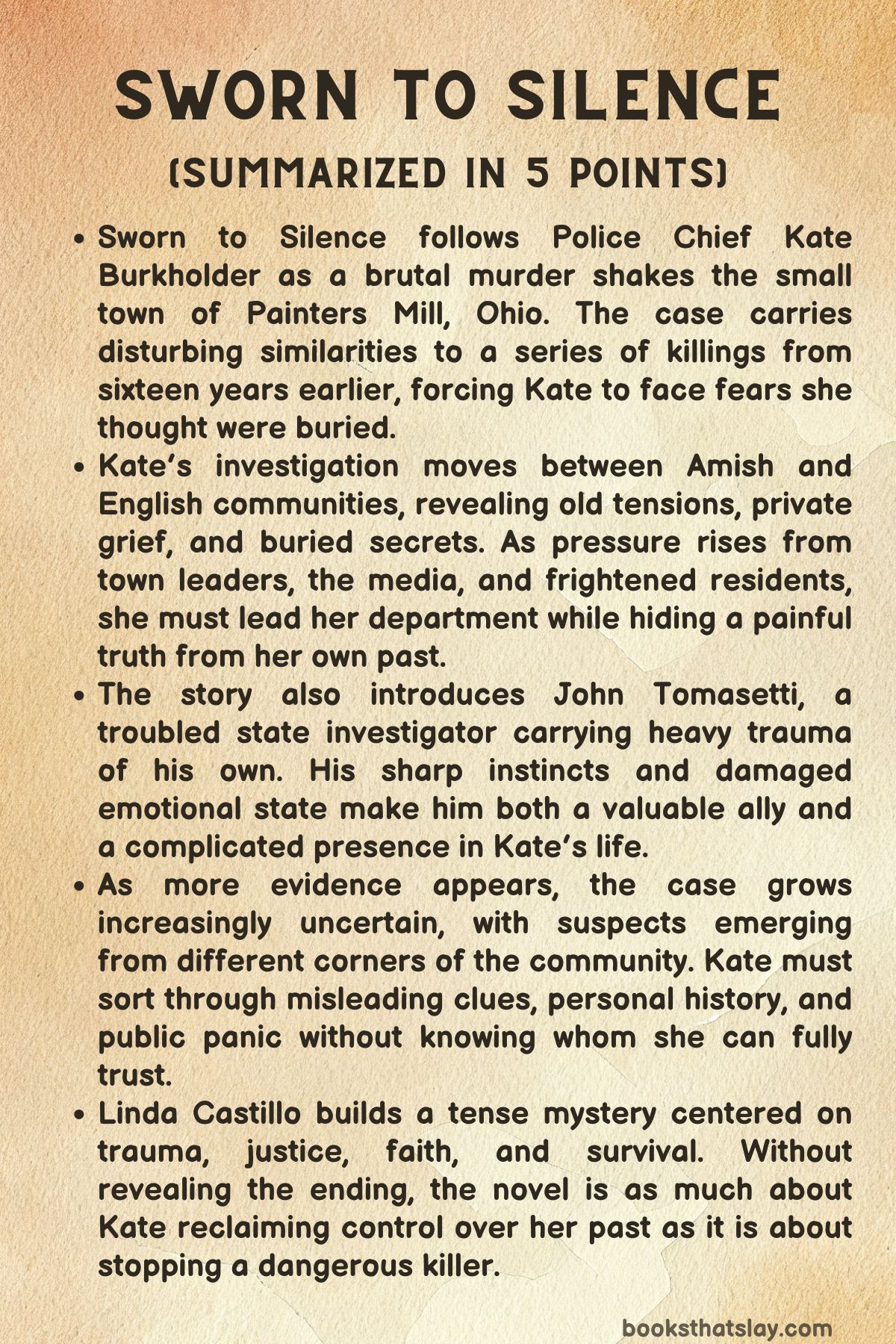
Sworn to Silence by Linda Castillo is a crime thriller set in Painters Mill, Ohio, a small town divided between Amish tradition and modern life. The novel introduces Kate Burkholder, a police chief with a hidden past that connects her to a series of brutal killings once believed to be over.
When a young woman is found murdered in a way that mirrors old crimes, Kate must face both a dangerous investigation and the trauma she has buried for years. The book combines police procedure, psychological tension, and personal secrets, building a story about justice, survival, and the cost of silence. It’s the first book of the Kate Burkholder series.
Summary
In Sworn to Silence, the story opens with the terrifying final moments of a young woman held captive by a sadistic attacker. She is trapped in darkness, naked, bound, tortured, raped, and left with no hope of rescue.
Her killer shocks her, cuts her, chains her upside down, and finally slashes her throat. As she bleeds to death, her mind escapes to a memory of a warm Florida beach, a sharp contrast to the cruelty of her death.
The murder investigation begins in Painters Mill, Ohio, when Officer T.J. Banks responds to a routine call about loose cows near the Stutz farm. While working in the snow, he notices a woman’s shoe, drag marks, and blood leading into a field.
Following the trail, he discovers the body of a young woman near some trees. He calls dispatcher Mona for help, and Police Chief Kate Burkholder is summoned to the scene.
Kate arrives and quickly realizes the case is deeply disturbing. The victim has been bound, sexually assaulted, tortured, and killed with a precise cut to the throat.
Acting coroner Doc Coblentz finds a Roman numeral, XXIII, carved into the woman’s abdomen. This detail shocks both him and Kate because it resembles the old Slaughterhouse Murders, a series of killings that took place sixteen years earlier.
In those cases, four women were raped, tortured, hung upside down, drained of blood, and marked with Roman numerals.
The similarity troubles Kate for a private reason. As a teenager, she was attacked by Daniel Lapp, the man she believes was responsible for the old murders.
During that attack, she shot him. Her Amish family covered up the killing and hid his body, protecting Kate but leaving her with a secret that shaped the rest of her life.
Now, with a new victim killed in the same manner, Kate fears either Daniel somehow survived or someone else knows details that were never released to the public.
The victim is identified as Amanda Horner, a twenty-one-year-old woman whose mother, Belinda, reports her missing. Kate and Officer Glock Maddox visit Belinda and break the news.
Belinda is devastated and tells them Amanda had gone out with her friend Connie Spencer to a club called the Brass Rail. She also mentions Amanda’s former boyfriend, Donny Beck.
Kate questions Connie, who says she and Amanda drank, played pool, and talked to people at the club, but Connie left alone around midnight after losing track of Amanda.
Kate begins organizing the investigation from the police station. She creates a command center, brings auxiliary officer Pickles Shumaker back on duty, and assigns her small team to follow leads.
T.J. checks recent condom purchases because the medical examiner believes the killer used one. Glock looks into people seen at the Brass Rail.
Several names emerge, including Donny Beck, Scott Brower, and Patrick Ewell.
At the same time, BCI agent John Tomasetti is sent to Painters Mill. Tomasetti is a damaged man struggling with alcohol and prescription drugs after the murder of his wife and daughters.
His superiors see him as a liability and hope this assignment will push him into failure. Instead, Tomasetti studies the evidence and becomes an uneasy but important partner for Kate.
He believes the current killer is not a copycat because the Roman numeral carvings were never made public.
Kate secretly searches for Daniel Lapp’s remains with her brother Jacob at the abandoned Wilbur Seed Company grain elevator. They dig through the frozen ground but find only a buried dog.
The failure leaves Kate shaken. She also confronts Daniel’s father, Benjamin Lapp, who denies knowing anything about his son’s whereabouts.
Kate searches law enforcement databases and drinks vodka to steady herself, showing how badly the case is pulling her back into the past.
The investigation expands. Kate questions Donny Beck and believes his grief over Amanda is real.
He says Amanda ended their relationship because she planned to return to college. His alibi places him in Columbus with his family.
Kate then questions Scott Brower, a violent mechanic who was at the Brass Rail. Brower becomes hostile, insults Glock, tries to run, and punches Kate before being subdued.
Drugs are found on him, but he does not clearly fit the killer.
Pressure builds after another missing woman is connected to the case. At a press conference, Kate faces reporters, angry citizens, town officials, and Sheriff Nathan Detrick.
She confirms only limited details, while Detrick handles the crowd with confidence. Afterward, Ezra and Bonnie Augspurger, Amish parents from Kate’s childhood, report that their daughter Ellen has been missing.
Kate fears Ellen may be the second unidentified victim. A mole on the body confirms the truth, and the Augspurgers identify their daughter from a morgue photograph.
Tomasetti grows suspicious of Kate after learning that Bishop Troyer received an anonymous note claiming Kate knows who the killer is. The note was written by Kate’s sister Sarah, who believes Daniel Lapp may still be alive.
Soon after, Kate responds to another loose cow call near the first murder scene and spots a figure near the field. She chases him through the woods, but he attacks her with a club and escapes by snowmobile.
A possible suspect appears in Dwayne Starkey, a convicted sex offender who works at a slaughterhouse. Kate and Tomasetti question him, but although he is crude and unpleasant, he does not fit the organized nature of the crimes.
Then another body is found by a young girl skating at Miller’s Pond. The victim is Brenda Johnston, daughter of councilman Norm Johnston.
She has been mutilated, and Doc Coblentz believes she may have still been alive during part of the attack. The town’s fear turns into anger, and Norm blames Kate for not stopping the killer.
Kate finally follows Sarah’s clue that Daniel was put “in the hole.” She returns to the grain elevator and searches the boot pit, where she finds skeletal remains. Daniel Lapp is dead.
Before she can process what this means, Tomasetti appears, having followed her, and catches her at the scene. Kate’s secret comes out, and she loses her job as chief of police.
Even after being fired, Kate keeps investigating from home. Pickles secretly sends her snowmobile registration information, and Tomasetti arranges for her to receive VICAP material.
Meanwhile, Sheriff Detrick arrests Amish farmer Jonas Hershberger after blood and possible evidence from Brenda’s murder are found on his property. Kate immediately doubts Jonas is guilty.
She remembers him as gentle, and she knows he does not drive or use motorized vehicles, which clashes with the killer’s use of a snowmobile.
Kate starts searching for murders with similar details outside Ohio. She finds old cases in Alaska involving Roman numeral carvings.
A retired Fairbanks detective confirms the connection. Kate then discovers that Nathan Detrick worked as a hunting guide in Alaska at the time and had found one of the bodies.
More links follow: he sold a home in 1994, owns a blue Yamaha snowmobile, moved from Alaska to Dayton after the Alaska murders, and lived near other similar murders in Kentucky and Indiana. The pattern points to Detrick as the real killer.
Mona calls Kate to the station after Jonas supposedly tries to hang himself. Speaking Pennsylvania Dutch, Jonas tells Kate that Detrick attacked him and staged the suicide attempt.
Detrick then handcuffs Kate, accuses her of being drunk, and throws her out. Soon after, Detrick learns that Kate is investigating him.
He pulls her over in the snow, breaks her car window, stuns her, binds her, and locks her in the trunk. Kate manages to escape into the cabin, sound the horn, and hide her phone, but Detrick captures her again and takes her to an abandoned farmhouse.
There, Detrick admits he framed Jonas and plans to make Kate’s death look like an accident or suicide. Kate fights fiercely, breaks his nose, kicks him into a kerosene heater, and starts a fire, but he overpowers her and nearly strangles her.
Tomasetti and Kate’s officers search for her. Tomasetti breaks into Detrick’s house, finds trophies from the victims, and confirms he is the killer.
He tracks Kate to the farmhouse and shoots Detrick before he can kill her.
Two days later, Kate is reinstated as police chief. Detrick survives and is expected to stand trial, while FBI and BCI investigators begin connecting him to many other cold cases.
Kate returns to the station bruised but alive, welcomed by Mona, Glock, and Pickles. The case has forced her to confront her past, but it has also proved her strength, her instincts, and her loyalty to the people of Painters Mill.
Characters
Kate Burkholder
Kate Burkholder is the central figure of Sworn to Silence and the emotional force that holds the investigation together. As police chief of Painters Mill, she is intelligent, disciplined, observant, and deeply committed to protecting the town, but she is also carrying a secret that makes the case intensely personal.
Her Amish childhood, her rape by Daniel Lapp, and her act of killing him when she was fourteen shape nearly every decision she makes. Kate is not simply investigating a murderer; she is being forced to reopen the most painful part of her own past.
This gives her character unusual depth because her strength is inseparable from her trauma. She is brave and capable, but she is also secretive, defensive, and at times self-destructive, especially when she turns to alcohol or refuses to fully trust the people around her.
Kate’s greatest conflict comes from the tension between her public role and her private history. As chief, she must be rational, transparent, and accountable, yet the old Slaughterhouse Killer details threaten to expose the truth about Daniel Lapp and the hidden body.
Her fear that Daniel may still be alive clouds her judgment at first, but it also drives her forward. What makes Kate compelling is that she does not solve the case because she is emotionally untouched by it; she solves it despite being wounded by it.
Her instinctive defense of Jonas Hershberger shows that she has not lost her moral clarity, even when the town and the authorities turn against her. By the end of the story, Kate’s survival and reinstatement represent more than professional vindication.
They show her reclaiming authority over both the investigation and the past that has haunted her for years.
John Tomasetti
John Tomasetti is a damaged but highly skilled investigator whose personal darkness mirrors Kate’s own. He enters the book as a BCI agent whose career is nearly ruined by grief, addiction, rage, and reckless behavior after the murders of his wife and daughters.
His superiors do not send him to Painters Mill because they believe in him; they send him because they expect him to fail. This makes Tomasetti a tragic and morally complicated character from the start.
He is sharp, experienced, and perceptive, but he is also unstable and haunted by the violence done to his family.
Tomasetti’s relationship with Kate develops because they recognize each other’s wounds. He sees that she is hiding something, and although his suspicion creates tension, he is also drawn to her resilience.
His own confession about kidnapping, torturing, and killing Con Vespian reveals how far grief has pushed him beyond the boundaries of lawful justice. This does not make him simple or heroic in a clean sense; instead, it makes him a man who understands evil because he has both suffered from it and committed it.
In the climax, Tomasetti’s determination saves Kate’s life, but his importance is not limited to the rescue. He represents the possibility of connection between two people who have been shaped by violence and who may never be fully whole, but who can still act with courage and loyalty.
Sheriff Nathan Detrick
Nathan Detrick is one of the most deceptive and dangerous characters in the story because he hides his brutality beneath authority, confidence, and public respectability. At first, he appears to be a competent law-enforcement figure who handles the press and the public better than Kate.
His calmness, political ease, and professional image make him seem like a stabilizing force during the crisis. This public mask is essential to his character because his power depends on being trusted.
He is not an obvious outsider or a visibly unstable man; he is someone who has learned how to move through respectable society while secretly committing monstrous acts.
Detrick’s true nature is revealed through his pattern of sadistic murders, his framing of Jonas Hershberger, and his attack on Kate. He is controlled, calculating, and highly manipulative.
The planted evidence against Jonas shows that he understands both police procedure and public prejudice well enough to redirect suspicion toward an innocent Amish man. His use of his badge makes him especially disturbing because he weaponizes the very system meant to protect people.
Detrick’s character embodies hidden corruption and predatory power. He is frightening not only because he kills, but because he knows how to appear trustworthy while doing it.
Amanda Horner
Amanda Horner is the first identified modern victim, and her death brings the horror of the killer’s violence into the present. Although she appears mainly through the investigation and the memories of others, she is not treated as merely a plot device.
She is described as a young woman with a life, relationships, plans, and people who loved her. Her night at the Brass Rail, her friendship with Connie, and her recent breakup with Donny Beck help create the sense of an ordinary life violently interrupted.
Amanda’s character matters because her murder forces Kate and the department to confront the possibility that the old nightmare has returned. Through Belinda’s grief and Donny’s sorrow, Amanda becomes more than the body found in the snow.
She represents innocence destroyed, and her death exposes the vulnerability of young women in a town that believed the worst violence was long past. The brutality done to her also establishes the killer’s ritualistic cruelty and raises the stakes for every character involved in the investigation.
Ellen Augspurger
Ellen Augspurger is another victim whose identity deepens the emotional and cultural weight of the case. As the missing Amish daughter of Ezra and Bonnie Augspurger, she connects the murders directly to the Amish community Kate once belonged to.
Her parents’ delayed realization that she is missing reflects the quieter rhythms and assumptions of their world, where a daughter’s absence might first be understood as a visit rather than a crime. When Kate confirms Ellen’s death, the tragedy becomes especially painful because it draws together Kate’s present police role and her former Amish identity.
Ellen’s significance lies in how her death affects the community’s fear and Kate’s sense of responsibility. Her murder suggests that no boundary protects anyone: not English society, not Amish society, not youth, innocence, or family.
Through Ellen, the story shows how violence invades even the most sheltered spaces. She also intensifies the pressure on Kate because the Amish families look to her not only as chief but as someone who once belonged to them and understands their grief.
Brenda Johnston
Brenda Johnston’s death escalates the case and brings the terror into the political center of Painters Mill. As the daughter of councilman Norm Johnston, her murder makes the investigation even more public and more personally explosive for the town’s leadership.
Her body is discovered by Cori Srinvassen, which adds another layer of trauma because a child is exposed to the killer’s savagery. Brenda’s death is especially horrific because Doc Coblentz indicates she may have still been alive during part of the mutilation.
Brenda’s character, like the other victims, is largely seen through the aftermath of violence, but her role is powerful. Her murder destroys any illusion that the killer’s crimes are isolated or fading.
It pushes Norm Johnston into grief and rage, and it increases pressure on Kate from officials and citizens who want immediate answers. Brenda becomes the victim whose death helps drive the town toward panic and makes Kate’s eventual firing more likely.
Her presence in the story reveals how quickly public grief can turn into blame when fear overwhelms trust.
T.J. Banks
T.J. Banks is a young officer whose discovery of Amanda Horner’s body pulls the police department into the central murder investigation. He is inexperienced compared with Kate and Glock, and his decision to roll the body over while checking for signs of life contaminates the scene, but this mistake comes from shock and human concern rather than carelessness.
T.J. is portrayed as sincere, shaken, and eager to do his job well. His reaction to the body shows that he is still emotionally vulnerable in the face of extreme violence.
As the case develops, T.J. becomes a useful and loyal member of Kate’s team. He follows leads, checks condom sales, helps identify Patrick Ewell, and responds when Kate is attacked near the crime scene.
His character reflects the ordinary working side of small-town policing: patrol calls, evidence follow-up, and the pressure of being suddenly caught in a serial murder investigation. T.J. may not have Kate’s experience or Tomasetti’s darkness, but his reliability and willingness to keep working under fear make him important to the department’s survival.
Mona
Mona is the dispatcher and one of the steady supporting presences in the police station. She is often the voice connecting officers to emergencies, suspects, tips, and each other.
Her role may seem practical, but in a police story, that practical role is crucial. She is part of the nervous system of the investigation, moving information quickly and keeping the department functioning while the town is under pressure.
Mona also shows loyalty to Kate at key moments. Even when Kate has been fired and the official structure is unstable, Mona remains emotionally aligned with the people trying to find the truth.
Her transfer of the Indiana officer’s call to Detrick unintentionally alerts him, but that mistake reflects the danger of not knowing who the real killer is. By the end, Mona’s welcome when Kate returns to the station helps restore a sense of home, teamwork, and institutional trust after Detrick’s betrayal.
Rupert “Glock” Maddox
Rupert “Glock” Maddox is one of Kate’s most dependable officers. He is experienced, practical, and loyal, often serving as the grounded presence beside Kate during the investigation.
At the first crime scene, he helps process evidence and assess the limited clues available. Later, he works background checks, questions suspects, and supports Kate during confrontations such as the arrest of Scott Brower.
His steadiness matters because Kate is under immense personal strain, and Glock gives the department a sense of competence and continuity.
Glock’s character also reveals the strain placed on officers working in a frightened town. He is not presented as flashy or emotionally dramatic; his value lies in his reliability.
He continues to help Kate even when the case becomes politically dangerous and even after her firing, bringing her information about Jonas Hershberger’s arrest. His loyalty is not blind, but it is rooted in trust.
Glock represents the kind of colleague Kate needs most: someone who respects her instincts, keeps working the evidence, and does not abandon her when power shifts against her.
Pickles Shumaker
Pickles Shumaker is an auxiliary officer whose personality brings a rough, unconventional energy to the police team. Kate brings him back on duty because the department needs help, and he becomes a useful part of the investigation.
He is not polished in the way outside investigators might be, but his local knowledge and willingness to assist make him valuable. His nickname and manner give him a memorable presence among the supporting officers.
Pickles’s most important contribution comes after Kate is fired, when he secretly sends her snowmobile registration information. This act shows both courage and loyalty.
He understands that official authority has shifted, but he also senses that Kate is still pursuing the truth. By helping her outside formal channels, Pickles becomes part of the informal network that keeps the real investigation alive.
His character reinforces the idea that justice in the story depends not only on rank, but on personal integrity.
Skidmore
Skidmore, often called Skid, is another member of Kate’s police team. He participates in the investigation and later joins the search for Kate when she is abducted by Detrick.
His role is less deeply explored than Glock’s or T.J.’s, but he contributes to the sense of a small department stretched beyond its usual limits. Skid is part of the collective effort that surrounds Kate and helps bring the case to its conclusion.
Skid’s importance lies in teamwork. The investigation cannot be solved by Kate alone, even though her insight is central.
Officers like Skid help create the network of action needed in a crisis: searching, responding, following leads, and standing with the department when the truth becomes dangerous. His presence adds realism to the police setting because major cases depend on many working officers, not just the lead investigator.
Doc Coblentz
Doc Coblentz is the acting coroner, and his medical observations provide some of the most important evidence in the case. He recognizes the similarities between the current murders and the old Slaughterhouse Killer crimes, especially the method of death, the torture, and the Roman numerals carved into the victims.
His calm but disturbed responses show that he understands the significance of what he is seeing. He is professional, direct, and deeply affected by the brutality inflicted on the victims.
Coblentz’s character helps establish the seriousness of the killer’s pattern. He is not simply describing injuries; he is helping Kate understand the ritual, precision, and sadism behind the murders.
His insistence that Amanda’s death matches the old cases intensifies Kate’s fear and forces her to confront the hidden truth about Daniel Lapp. Through Doc Coblentz, the physical evidence becomes emotionally and historically charged.
Jacob Burkholder
Jacob Burkholder is Kate’s brother and one of the key links to her Amish past. He knows about Daniel Lapp, the shooting, and the family’s role in hiding what happened.
His relationship with Kate is strained by silence, guilt, resentment, and unresolved trauma. When Kate asks for his help finding Daniel’s remains, Jacob first resists, showing how deeply the family has buried not only the body but the truth itself.
Jacob is a complicated character because he is both protective and hurtful. His admission that he once saw Kate smile at Daniel devastates her because it suggests suspicion or blame, even after what Daniel did to her.
This moment exposes the cruel confusion that often surrounds trauma, especially when victims are judged through distorted memories or assumptions. Yet Jacob does eventually help Kate search, which shows that he is not without conscience.
He represents the burden of family secrets and the damage caused when silence replaces healing.
Sarah Burkholder
Sarah Burkholder, Kate’s sister, is another character shaped by fear of the past. She believes Daniel Lapp may still be alive and is frightened enough to write the anonymous note to Bishop Troyer claiming Kate knows who the killer is.
Sarah’s actions create serious consequences for Kate, but they come from panic rather than malice. She is convinced that the hidden family history is connected to the new murders, and she wants the truth exposed before more women die.
Sarah’s role is important because she forces Kate closer to the truth about Daniel’s body. Her revelation that their father said Daniel was put “in the hole” leads Kate to discover the remains and finally confirm that Daniel is dead.
Sarah represents the way trauma spreads through a family, affecting even those who were not the central victim. Her fear, suspicion, and guilt make her a painful but necessary presence in Kate’s journey toward clarity.
Daniel Lapp
Daniel Lapp is physically absent from the present action, but his shadow hangs over much of the book. Sixteen years earlier, he raped Kate when she was fourteen, and she shot him in self-defense.
Because his body was hidden, his possible survival becomes Kate’s private terror when the new murders resemble the old Slaughterhouse Killer crimes. Daniel represents the unresolved past: the violence Kate endured, the secret her family buried, and the fear that evil once escaped punishment.
Even after Kate learns Daniel is dead, his importance remains. He is the false answer that Kate must move beyond in order to see the real killer.
His role shows how trauma can distort the present, making old horrors feel alive even when they are buried. Daniel’s character is central not because he is the current murderer, but because Kate’s belief in his possible return reveals how deeply he damaged her life.
Benjamin Lapp
Benjamin Lapp is Daniel Lapp’s father, and Kate visits him while searching for proof of Daniel’s fate. He denies knowing where Daniel is and says he has not seen him since the summer he disappeared.
His home offers Kate no evidence that Daniel is alive. Benjamin’s role is brief but meaningful because he belongs to the unresolved circle of Daniel’s disappearance.
Benjamin represents the silence surrounding the old crime. Whether he is ignorant, evasive, or simply resigned, his presence reminds Kate that Daniel’s disappearance affected more than one family.
He also reflects the limits of Kate’s investigation into the past: some people will not or cannot give her the answers she needs. His character contributes to the atmosphere of secrecy that surrounds Painters Mill’s old wounds.
Belinda Horner
Belinda Horner is Amanda’s mother, and her grief gives the first murder its emotional weight. When she reports Amanda missing, she still exists in the painful space between fear and hope.
Kate’s confirmation of Amanda’s death destroys that hope, and Belinda’s insistence that there must be a mistake is a deeply human reaction. She cannot immediately accept that her daughter has become the victim found in the snow.
Belinda’s character shows the personal devastation behind the investigation. For the police, Amanda’s death becomes evidence, leads, timelines, and suspect interviews, but for Belinda it is the loss of a child.
Her memories of Amanda’s final night and her mention of Connie and Donny help the investigation move forward, but her primary role is emotional. She reminds the reader that each victim leaves behind a family forced to absorb unbearable news.
Connie Spencer
Connie Spencer is Amanda Horner’s friend and one of the last people to see her alive. She works at LaDonna’s Diner and tells Kate that she and Amanda went to the Brass Rail, drank, played pool, and spoke with several people before Connie left around midnight.
Connie’s account helps establish Amanda’s final known movements and introduces possible suspects connected to the bar.
Connie is important because she represents the ordinary social world Amanda belonged to before the murder. Her presence shows Amanda as a young woman with friends, nightlife, and personal choices, rather than only as a victim.
Connie’s inability to find Amanda before leaving also adds a painful note of guilt and helplessness. She did not know that an ordinary night out would become the beginning of a murder investigation.
Donny Beck
Donny Beck is Amanda’s former boyfriend and an early person of interest. Because Amanda had recently ended their relationship, he seems like a possible suspect, but Kate’s interview reveals a grieving young man rather than a killer.
He admits that he loved Amanda and was hurt by the breakup, but his alibi and emotional response suggest innocence. His grief appears genuine to Kate.
Donny’s character functions as a contrast to the actual murderer. He has motive in the superficial investigative sense, but he lacks the coldness, planning, and sadism behind the crimes.
Through Donny, the story shows how police work must examine intimate relationships without mistaking ordinary heartbreak for murderous violence. He also helps humanize Amanda by showing that she was loved and that her death leaves emotional wreckage behind.
Scott Brower
Scott Brower is a mechanic with a violent record who becomes a suspect because he was at the Brass Rail. His hostility, evasiveness, racism toward Glock, and attempt to flee make him look dangerous.
When Kate chases him and he punches her, he confirms that he is violent and willing to resist police. The meth found on him further marks him as criminally involved, though not necessarily connected to the murders.
Brower’s role is to show the difference between a violent low-level offender and the organized serial killer Kate is hunting. He is aggressive, crude, and suspicious, but his behavior does not match the careful ritual of the murders.
His character adds tension and action to the investigation while also reminding the reader that not every frightening man in a murder inquiry is the murderer. He is guilty of something, but not of the central evil.
Patrick Ewell
Patrick Ewell becomes a lead when T.J. identifies him as the cash buyer of lubricated condoms near the time of Amanda’s murder. Because the killer may have used a condom, Patrick’s purchase places him under suspicion.
He also lives near where Amanda’s body was found, making the lead more urgent for Kate.
Patrick’s importance is mainly investigative. He represents the kind of clue that might appear promising but must be tested against the larger pattern.
In a case filled with fear and public pressure, details like condom purchases, locations, and timing can either reveal the killer or pull police toward false leads. Patrick’s character adds to the widening suspect field Kate must manage while trying not to lose sight of the true profile.
Isaac and Anna Stutz
Isaac and Anna Stutz are the Amish couple whose field contains Amanda Horner’s body. Their ordinary farm becomes the site of horror, and their fear immediately connects the new murder to the old Slaughterhouse Killer crimes.
Isaac’s question about whether “he” is back shows that the old murders remain alive in local memory, especially among those who lived through them.
The Stutzes represent the frightened community surrounding the investigation. They are not central suspects or major actors, but their presence shows how violence invades peaceful rural spaces.
Their field, their animals, and their quiet life are disrupted by a crime that seems almost ritualistically placed. Through them, the book captures the way murder changes not only the victim’s family but also everyone whose home becomes part of the crime scene.
Ezra and Bonnie Augspurger
Ezra and Bonnie Augspurger are Ellen’s Amish parents, and their grief is quiet, dignified, and devastating. They approach Kate after the press conference because their daughter has been missing for two and a half weeks.
Their initial belief that Ellen might have gone to Columbus reflects both hope and the assumptions of a close family community. When they identify her body, their loss becomes one of the most painful moments in the story.
Their insistence on taking their buggy to the hospital despite the freezing weather shows their commitment to their way of life even in crisis. They also connect Kate to her childhood and to the Amish world she left behind.
Through Ezra and Bonnie, the story shows grief filtered through faith, tradition, and restraint. Their suffering is not loud, but it is profound.
Dwayne Starkey
Dwayne Starkey is a convicted sex offender who works at a slaughterhouse, making him an obvious suspect when the murders appear connected to the old Slaughterhouse Killer pattern. His crude behavior, filthy farmhouse, and evasive manner make him disturbing, and Kate and Tomasetti push him hard during questioning.
On the surface, he seems to fit the public image of a monster.
Yet Starkey ultimately does not match the killer’s profile. His size, intelligence level, lifestyle, and general disorganization do not align with the controlled, careful, media-aware murderer Tomasetti describes.
Starkey’s character demonstrates how prejudice and surface details can mislead an investigation. He is unpleasant and possibly dangerous in other ways, but he is not the architect of the ritual killings.
His presence helps sharpen the distinction between obvious suspicion and actual evidence.
Cori Srinvassen
Cori Srinvassen is the eighth-grade girl who discovers Brenda Johnston’s body while skating at Miller’s Pond. Her role is brief but emotionally significant because she is a child forced into contact with extreme violence.
She sees a snowmobile leaving and then finds what she first thinks is a garbage bag, only to discover something horrifying.
Cori’s character shows the wider damage caused by the killer. The victims are not the only ones harmed; innocent bystanders are traumatized as well.
Her discovery also gives the investigation an important clue involving the snowmobile, which later becomes central to understanding the killer’s movements. Cori represents innocence abruptly broken by the reality of adult evil.
Norm Johnston
Norm Johnston is Brenda’s father and a councilman, which makes his grief both personal and public. When his daughter is murdered, he reacts with devastation and anger, eventually blaming Kate for not bringing in outside help sooner.
His response is harsh, but it comes from a father’s unbearable loss. He needs someone to blame because the truth is too horrific to process.
Norm’s character also reflects the political pressure surrounding Kate. As a councilman, his pain carries institutional weight, and his anger contributes to the sense that Kate’s leadership is failing.
He is not simply a grieving parent; he is a public figure whose grief affects the direction of the investigation and the town’s trust in Kate. Through Norm, the story shows how personal tragedy can become political force.
Jonas Hershberger
Jonas Hershberger is the innocent Amish farmer framed by Detrick. Blood and incriminating evidence are found on his farm, and Sheriff Detrick arrests him, making it appear that the case has been solved.
Kate immediately doubts his guilt because she remembers him as gentle and because the evidence does not fit what she knows about the killer’s use of a snowmobile and modern mobility.
Jonas is important because his arrest exposes both Detrick’s cunning and the vulnerability of an outsider community. As an Amish man, Jonas is an easy target for planted evidence and public suspicion.
His attempted hanging is staged by Detrick, turning him from suspect into victim. Kate’s certainty about his innocence becomes one of her clearest moral moments.
She trusts her knowledge of character when the evidence appears overwhelming, and that trust helps uncover the truth.
James Hershberger
James Hershberger is Jonas’s brother, and he insists that Jonas is innocent. He explains that blood on the farm could easily come from butchering, which challenges the apparently damning evidence.
His defense of Jonas gives Kate an important perspective from inside the Amish farming world and supports her suspicion that the case against Jonas is too convenient.
James’s role is rooted in loyalty and common sense. He understands his brother’s character and the practical realities of farm life.
In a case where evidence is being manipulated, James helps remind Kate that context matters. What looks sinister to outsiders may have an ordinary explanation within a rural Amish setting.
Mayor Auggie Brock
Mayor Auggie Brock is part of the political environment surrounding the investigation. His late call to Tomasetti about Bishop Troyer receiving an anonymous note creates suspicion around Kate.
Brock’s role shows how rumor, fear, and politics begin to interfere with police work as the murders intensify.
Auggie is not presented as the main antagonist, but he contributes to the pressure closing in on Kate. As mayor, he is concerned with public confidence and institutional control.
His involvement reflects the town’s anxiety and the way leaders respond when citizens believe the police chief may be hiding something. He helps create the atmosphere that makes Kate increasingly isolated.
Bishop Troyer
Bishop Troyer is the religious authority who receives Sarah’s anonymous note claiming that Kate knows who the murderer is. His role is small but significant because he stands at the intersection of the Amish community, moral authority, and buried secrets.
The fact that Sarah sends the note to him suggests that she sees the matter not only as criminal but as spiritual and communal.
Bishop Troyer’s presence shows how the Amish community processes fear through its own structures of trust. He becomes a conduit through which hidden family trauma enters the public investigation.
Even without taking major direct action, he helps move suspicion toward Kate and forces the buried past closer to exposure.
Jason Rummel
Jason Rummel is one of Tomasetti’s superiors at BCI. He is involved in the decision to send Tomasetti to Painters Mill, not out of confidence but as a way to place him under pressure.
Rummel sees Tomasetti as a liability because of his failed drug test, absences, addiction, and emotional instability.
Rummel’s character represents institutional calculation. He is not necessarily wrong that Tomasetti is unstable, but his motive is less about healing or justice than about creating grounds to remove him.
Through Rummel, the book shows how bureaucracies manage damaged employees, sometimes with cold practicality rather than compassion.
Ruth Bogart
Ruth Bogart, like Jason Rummel, is part of the BCI leadership that views Tomasetti as a professional problem. She helps discuss assigning him to Painters Mill because the case may expose his weaknesses and justify firing him.
Her role adds to the sense that Tomasetti is being set up to fail before he even arrives.
Ruth’s character helps define the institutional world outside Painters Mill. She represents professional skepticism toward a man whose trauma has made him unreliable.
While her concerns may be understandable, the decision to use the case as a test of failure makes the agency appear politically and emotionally detached. Her presence sharpens Tomasetti’s outsider status.
Lois
Lois works at the police station and helps Kate organize the investigation by clearing a room for a command center. Her role is administrative, but it matters because the department must quickly shift from ordinary small-town policing into a coordinated serial murder investigation.
Lois helps create the structure the team needs to manage information, assignments, and evidence.
Lois represents the often unseen labor that keeps a police department functioning. While officers search scenes and question suspects, people like Lois make the workspace usable and help the investigation become organized.
Her contribution is quiet but necessary.
Con Vespian
Con Vespian is the crime boss responsible for the murders of Tomasetti’s wife and daughters. Though he is not part of the Painters Mill murders, he is essential to understanding Tomasetti.
Vespian represents the evil that destroyed Tomasetti’s family and shattered his faith in lawful justice. When the justice system fails, Tomasetti takes revenge by kidnapping, torturing, and killing him.
Vespian’s role is important because he explains Tomasetti’s moral damage. He is the reason Tomasetti abuses substances, misses work, resists retirement, and carries a darkness that others can sense.
Vespian does not need much page presence to matter; his violence echoes through Tomasetti’s every action. He is the ghost behind Tomasetti’s grief, rage, and need for redemption.
LaDonna
LaDonna is connected to LaDonna’s Diner, where Connie Spencer works. Although she does not play a major active role in the investigation, the diner itself is part of the local social landscape.
It is one of the places Kate visits while tracing Amanda’s final movements and speaking to people who knew her.
LaDonna’s importance is mainly atmospheric. Characters like her help build Painters Mill as a lived-in town made up of workplaces, farms, bars, churches, and families.
The diner setting reminds the reader that the murder investigation unfolds not in isolation but within a community where ordinary routines continue under the shadow of fear.
Themes
Trauma, Secrecy, and the Burden of Survival
Kate Burkholder’s present is shaped by a violent past she has never fully escaped. Her secret about Daniel Lapp is not just a hidden fact; it controls how she investigates, how she trusts others, and how she sees herself.
In Sworn to Silence, trauma is shown as something that survives long after the original violence ends. Kate is a capable police chief, but the new murders force her back into the fear, shame, and rage of her youth.
Her silence protects her family and her reputation, yet it also isolates her and weakens her judgment. The investigation becomes personal because every clue seems to threaten the wall she has built around her past.
The theme shows that survival is not the same as healing. Kate has lived, worked, and gained authority, but she still carries the emotional weight of what was done to her and what she did in response.
Her journey suggests that buried truth has power until it is faced openly.
Justice and the Failure of Authority
Justice in the novel is not simple, because the people responsible for protecting others are often damaged, compromised, or wrong. Kate wants justice for the murdered women, but her own secret limits her honesty.
Tomasetti is skilled and perceptive, yet his past shows that grief pushed him outside the law. Detrick represents the most disturbing failure of authority because he uses his position to hide his crimes, frame an innocent man, and control the investigation.
This theme is powerful because it questions whether badges, titles, and official systems always lead to truth. The arrest of Jonas Hershberger shows how easily justice can be redirected toward convenience when evidence appears to fit.
Kate’s refusal to accept the easy answer becomes essential. The novel suggests that justice depends not only on procedure but also on moral courage.
Real justice requires doubt, persistence, and the willingness to challenge people who appear respectable or powerful.
Identity, Belonging, and Life Between Two Worlds
Kate’s identity is divided between her Amish upbringing and her role as police chief in a modern town. She understands the Amish community deeply, including its language, values, fears, and silence, but she no longer fully belongs to it.
At the same time, her past makes her different from many of the officers and officials around her. This creates a constant tension in how she works and how others judge her.
Her knowledge of Amish life helps her understand people like Jonas and the Augspurgers, but it also brings old wounds and family conflict back into her life. The theme of belonging is especially clear in her relationships with Jacob and Sarah, where family loyalty is mixed with blame, fear, and resentment.
Kate’s position between two cultures becomes both a strength and a burden. She can move between communities, but she pays for that ability with loneliness and suspicion from both sides.
Violence Against Women and the Need to Hear the Victims
The murders are brutal, but the story does not treat the victims as only evidence in a case. Amanda, Ellen, Brenda, and the earlier women represent lives cut short by a killer who tries to reduce them to objects of control.
The repeated pattern of torture, carving, and display shows a desire not only to kill but to dominate and erase personhood. Against this, the investigation works to restore identity: names are confirmed, families are notified, histories are gathered, and connections are traced.
Sworn to Silence presents violence against women as both physical and symbolic, because the killer’s acts are meant to create fear across the whole community. Kate’s response is shaped by her own experience of sexual violence, which makes the case painfully personal.
Her determination gives the victims weight and dignity. The theme suggests that solving such crimes is not only about catching a murderer; it is also about refusing to let cruelty define the dead.