Tantrum by Rachel Eve Moulton Summary, Characters and Themes
Tantrum by Rachel Eve Moulton is a dark, surreal exploration of motherhood, trauma, and inherited rage. Set against the harsh backdrop of the desert, it follows Thea, a mother struggling with exhaustion, guilt, and the haunting sense that her infant daughter, Lucia, is not what she seems.
Blurring the lines between psychological horror and mythic allegory, the novel dissects the generational cycles of female pain and repression. Through a mix of domestic dread, supernatural undertones, and raw introspection, Moulton portrays a mother confronting her deepest fears—both of her child and of herself—in a world where love and monstrosity are inseparable.
Summary
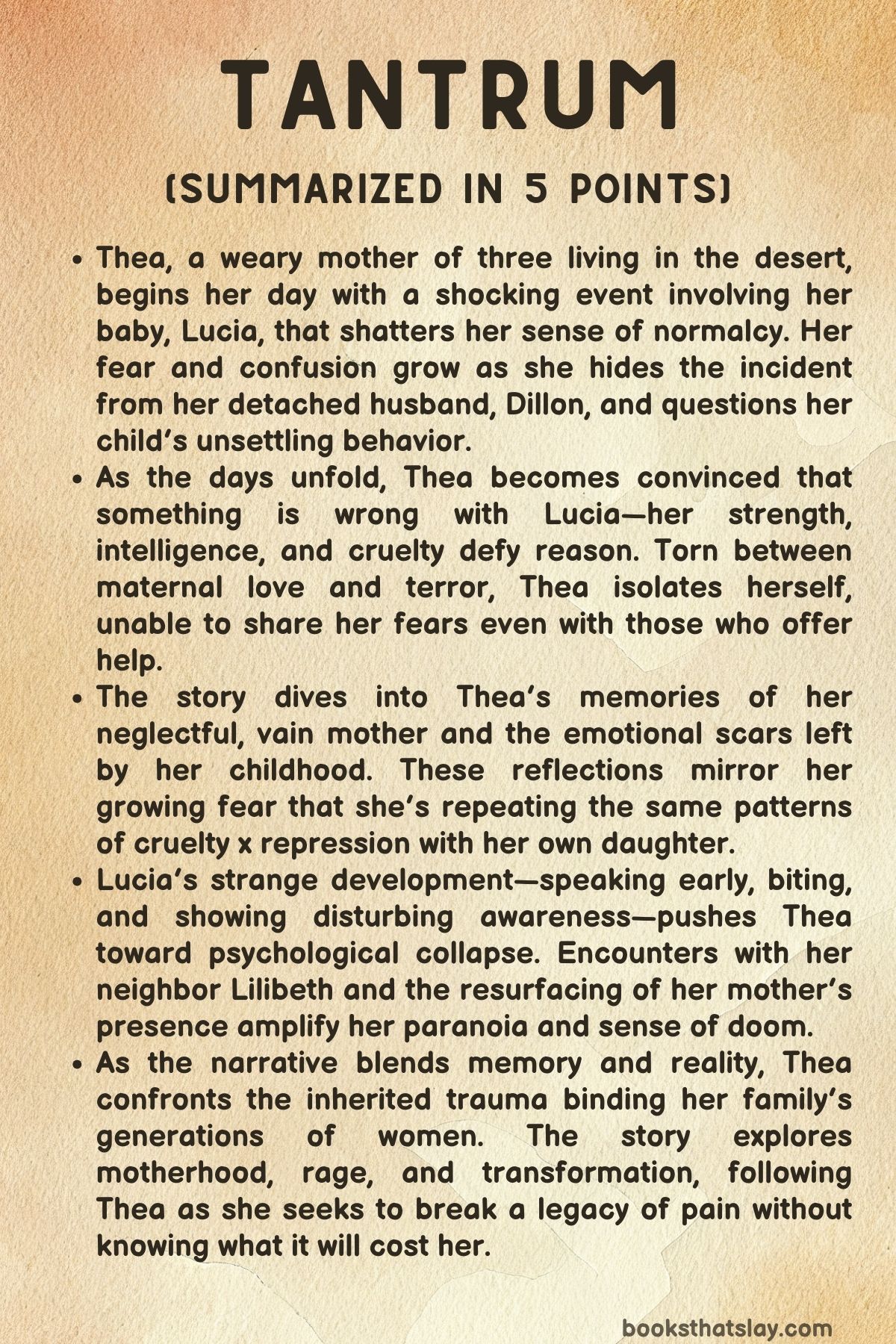
The story begins with Thea, a 42-year-old mother of three—Jeremy, Sebastian, and baby Lucia—living in isolation with her husband Dillon in a desert home. The morning starts ordinarily, but soon unravels into horror when Thea takes Lucia to collect eggs and watches, horrified, as the infant brutally decapitates a chicken.
Stunned, she hides the evidence and bathes Lucia, her mind reeling with disbelief. Thea begins to suspect that something unnatural resides within her child.
Lucia appears normal to others—charming, healthy—but Thea senses a cruel intelligence and strength beneath her baby’s innocent face.
Thea calls Tori, the doula who assisted during Lucia’s birth, hoping for guidance. But she cannot articulate her terror.
Tori mistakes Thea’s anxiety for postpartum depression, suggesting rest and herbal treatments. Thea hangs up without confessing the truth.
Memories of her childhood intrude—her narcissistic, neglectful mother who valued beauty above love and left her daughter scarred with insecurity. When Dillon mentions that Thea’s mother has been injured and might need help, Thea’s resentment erupts.
She accuses him of falling for her mother’s manipulations and fears she is becoming like the woman she despises.
Later, as Thea takes a walk with Sebastian and Lucia, she meets Lilibeth, her nosy neighbor and former therapist. Their strained conversation is interrupted when Lucia bites Sebastian and nearly gouges his eye.
To Thea’s horror, Lucia speaks her first words—“I eat”—though she is only three months old. Lilibeth, disturbed, implies that Lucia’s behavior may not be Thea’s fault.
But Thea, defensive and terrified, denies any problem. When Lucia calls herself “Coyote,” echoing the predator Lilibeth had mentioned earlier, Thea feels dread settle in.
Her daughter, she realizes, is naming herself the hunter in their family.
As days pass, Thea struggles with exhaustion and alienation. She lists female villains to entertain Lucia—Harley Quinn, Medusa, Maleficent—drawn to their power and rage.
These moments reveal Thea’s complicated fascination with women who refuse to conform. Her memories drift to her bleak childhood in Albuquerque’s “War Zone,” where she grew up trapped behind barred windows with her neglectful mother and a stream of abusive men.
Thea identifies with fictional villains because, like them, she was vilified for her anger and desire for control. Now, as a mother, she feels that same judgment closing in.
Her unease with Lucia deepens. Dillon remains tender and patient, the opposite of Thea’s volatility, but she feels isolated from his calmness.
One afternoon, she retrieves boxes her mother had sent years ago. Inside, she finds photos of herself taken by her mother—proof that her mother always controlled the narrative of her life.
Furious at the manipulation, Thea spirals into an argument with Dillon about memory, identity, and parenthood. When Lucia suddenly walks at thirteen weeks old, Dillon celebrates while Thea recoils in terror.
Her scream shatters the moment, and she wrecks the bedroom before falling silent again.
Later, she notices Lucia gnawing through her crib. When Thea examines her mouth, she discovers multiple rows of adult teeth and a split uvula.
Lucia spits out her baby teeth and speaks in eerie fragments: “I you. You me.
We more. ” Thea’s fear transforms into the realization that Lucia embodies something ancient and primal—a reflection of herself.
Memories surface: as a child, Thea had once attacked a classmate and bitten a teacher. Her mother forced her to suppress this memory, commanding her to “bury it until you forget it was even there.
” Thea begins to see how repression has shaped her entire life.
Trapped in a locked room with Lucia while Dillon seeks help, Thea’s sanity unravels. Lucia’s laughter merges with her own inner voice.
When Dillon slides old photos under the door, Thea and Lucia are pulled into a surreal, dreamlike realm constructed from her memories. They journey through distorted versions of her childhood homes, each containing scenes of abuse and neglect.
In each place, Lucia devours the abusers—Thea’s mother’s boyfriends and other figures of trauma—literally consuming the pain Thea has carried for decades. Each act of devouring frees Thea from a burden but also weakens Lucia, whose body begins to erupt with sharp spikes.
Thea realizes she has passed her suffering onto her daughter. In a final act of love and desperation, she urges Lucia to consume her instead—to end the cycle of inherited rage.
Lucia obeys, swallowing her whole.
Inside Lucia’s body, Thea finds herself surrounded by splintered bones—remnants of the men Lucia had eaten. Determined to protect her daughter, she organizes and clears them, building a protective structure within Lucia’s belly.
From this strange vantage, she hears her family outside. Weeks have passed.
Her mother has moved into the neighborhood, asserting control and belittling Dillon, claiming Thea is unstable. Dillon resists her interference but remains kind, tending to the children.
Thea watches, feeling the slow healing of both Lucia and herself.
Eventually, Thea dreams—or experiences—a rebirth. She crawls out of Lucia’s body and awakens in the desert beside a pile of half-digested bones.
Lilibeth finds her and tells her she’s been missing for 21 days. As they walk home, Thea learns her mother has been staying with Dillon.
When they arrive, her mother is about to crush a lizard, an echo of her cruelty. Inside, mother and daughter finally confront each other.
Thea demands truth: what happened in her childhood, why she was restrained and silenced. Her mother evades, manipulates, and finally confesses to horrific acts—grinding down Thea’s teeth, tying her jaw shut, and even consuming Thea’s father.
She insists she did these things to suppress what Thea was “capable of,” revealing that monstrosity runs in their bloodline.
The confrontation turns violent. The mother’s face splits, revealing rows of teeth.
Dillon and the children appear in the doorway as Thea’s mother lunges at Dillon. Thea unleashes her own monstrous side, tearing her mother away and swallowing her whole before vomiting her back out into the sand and banishing her.
Exhausted, she returns to the porch, expecting rejection. Instead, Dillon gathers her into the family, insisting that love and understanding can coexist with their strangeness.
Thea, still afraid, warns that she and Lucia might hurt them, but Dillon’s unwavering belief grounds her. Holding Lucia, Thea feels the family knit itself back together, not in denial of their monstrous inheritance, but in full acknowledgment of it.
Tantrum closes on this note of uneasy peace—Thea no longer running from the darkness within her but accepting it as part of her humanity. Through the blending of horror, myth, and realism, the novel becomes a fierce meditation on motherhood, rage, and the painful inheritance passed from one generation of women to the next.
Characters
Thea
At the heart of Tantrum stands Thea, a forty-two-year-old mother whose inner turmoil drives the novel’s psychological and supernatural undercurrents. Thea is portrayed as a complex woman haunted by her past, struggling under the weight of generational trauma, guilt, and suppressed rage.
Once a filmmaker with ambition and independence, she now lives isolated in the desert, defined by domestic fatigue and a fractured sense of self. Her exhaustion is not merely physical but existential—each day feels like a battle against her own mind and the monstrous manifestations of her fears.
Thea’s relationship with her daughter Lucia becomes the central metaphor for her buried anger and inherited pain. Her terror of Lucia is entwined with self-loathing, as she recognizes her daughter’s cruelty as a reflection of her own suppressed instincts.
Through Thea, the novel explores the boundaries between maternal love and horror, sanity and breakdown, victimhood and monstrosity. Her ultimate act—allowing herself to be consumed by Lucia—symbolizes both surrender and salvation: a desperate attempt to end the cycle of abuse passed from mother to daughter.
Emerging reborn, Thea reclaims her agency and embraces the monstrous parts of herself, transforming terror into empowerment.
Lucia
Lucia, the newborn daughter, is both literal child and symbolic force in Tantrum. She embodies the unfiltered, primal inheritance of Thea’s rage and trauma.
From her first moments—decapitating a chicken with her bare hands—to her eerily precocious speech and violent intelligence, Lucia transcends the boundaries of humanity. Her supernatural nature operates as an allegory for inherited pain: she consumes the world’s cruelty, reflecting the horrors her mother endured.
Yet she is not a mere villain or demon; Lucia represents transformation and reclamation. When she devours Thea’s past abusers, she acts as an avenger and purifier, metabolizing generations of female suffering.
Her relationship with Thea oscillates between hostility and intimacy, terror and tenderness. Lucia’s final act of consuming her mother, and later being healed from within, marks the reconciliation of mother and daughter—the merging of trauma and renewal.
Through Lucia, the novel questions what it means to be born from pain, and whether monstrosity can coexist with love.
Dillon
Dillon serves as the novel’s grounding force, a figure of calm and conventional goodness amid the chaos. As Thea’s husband, he is loving, patient, and often oblivious to the darkness consuming his wife and daughter.
His practical kindness contrasts sharply with Thea’s volatility, but it also reveals a gendered blindness to female suffering. Dillon represents a world that expects women to manage pain quietly, to remain nurturing even while unraveling.
His distance is not malicious but emblematic of a man’s inability to truly perceive the invisible labor and emotional toll of motherhood. Still, Dillon’s faith in Thea—especially at the story’s conclusion—anchors the novel’s message of redemption.
His choice to stand by her after witnessing her monstrous transformation demonstrates a radical acceptance of imperfection, love, and survival. Dillon’s steady presence redefines partnership not as rescue but as recognition.
Lilibeth
Lilibeth, the intrusive yet empathetic neighbor and former therapist, functions as a moral and emotional mirror to Thea. Initially portrayed as meddlesome, Lilibeth evolves into a figure of compassion and grounded wisdom.
She sees what others refuse to—Lucia’s unsettling intelligence and Thea’s unraveling psyche—but responds with understanding rather than condemnation. Her blunt honesty and refusal to romanticize motherhood provide a counterpoint to Thea’s internalized shame.
When she calls Thea’s mother an “asshole” and urges her to trust those who truly love her, Lilibeth becomes the voice of reason and self-preservation. Symbolically, she represents community, empathy, and the possibility of healing beyond isolation.
Her presence reaffirms that survival requires acknowledgment of one’s darkness rather than its denial.
Jeremy and Sebastian
Thea’s sons, Jeremy and Sebastian, serve as emblems of innocence, caught in the crossfire of their mother’s inner conflict. Their presence contrasts sharply with Lucia’s monstrous vitality, highlighting the fragile normalcy Thea clings to.
Jeremy, the eldest, carries the quiet sensitivity of a child aware that something is wrong, while Sebastian’s youthful vulnerability—his injury at Lucia’s hands—embodies the collateral damage of suppressed familial pain. Through them, the novel underscores the generational stakes of trauma: the fear that harm will perpetuate, that innocence cannot survive proximity to inherited darkness.
Yet, in the story’s conclusion, the boys’ inclusion in the family’s reconstitution symbolizes hope—the possibility that cycles of violence can be acknowledged and transformed without consuming love itself.
Themes
Motherhood and Fear of Inheritance
In Tantrum, motherhood is portrayed as both an act of love and a haunting confrontation with one’s own history. Thea’s fear of Lucia is inseparable from her fear of herself and her mother.
The novel dismantles the idealized notion of maternal instinct, showing instead a mother torn between devotion and horror, tenderness and revulsion. Thea’s relationship with her daughter becomes a psychological battleground where she wrestles with the possibility that monstrosity can be inherited—not just genetically but emotionally and spiritually.
Lucia, with her premature intelligence and violent behavior, embodies everything Thea has tried to repress: rage, shame, and the unacknowledged trauma from her abusive upbringing. Thea’s maternal anxiety deepens when she recognizes echoes of her mother’s cruelty in her own behavior, realizing that love and harm can coexist in the same gesture.
Through this tension, the book questions whether motherhood is an act of creation or repetition—whether a mother gives life to a child or merely reanimates the ghosts of her own wounds. Thea’s final act of allowing Lucia to devour her becomes both literal and symbolic, representing a surrender to the cyclical nature of inheritance.
Yet it is also an act of radical love, as she sacrifices herself to cleanse her daughter of the pain that has passed through generations. In the end, Tantrum portrays motherhood as an identity forged in contradictions—nurture entangled with destruction, protection with surrender, and the desperate hope of breaking free from what one inevitably passes on.
Female Rage and Suppression
The undercurrent of rage that runs through Tantrum is raw, physical, and deeply gendered. Thea’s anger, long buried beneath domestic routines and maternal expectations, finds its reflection in Lucia’s ferocity.
Thea’s fascination with female villains—Harley Quinn, Medusa, Maleficent—signals her suppressed longing for agency in a world that punishes women who express anger. The novel suggests that female rage, when unacknowledged, mutates into guilt or madness.
Thea’s mother represents the older generation’s form of repression: she masks cruelty with vanity and control, turning self-loathing outward through emotional abuse. Thea, in turn, internalizes this suppression, policing her own impulses until they manifest through Lucia’s monstrous behavior.
Lucia’s violence, then, becomes the embodiment of Thea’s unspoken fury—a physical manifestation of every emotion she has been told to hide. When Thea finally confronts her mother, the act of swallowing her is not merely an expression of violence but of reclamation.
She consumes the source of her silencing, reclaiming a voice that had been stolen by generations of patriarchal and maternal control. The narrative portrays rage as a purgative force rather than a corrupting one, a necessary eruption for transformation.
By refusing to sanitize anger, Tantrum redefines it as truth-telling—a confrontation with injustice and pain that, once acknowledged, can lead to healing.
Trauma and Memory
Memory in Tantrum is unreliable, fragmented, and deeply sensory. Thea’s recollections of her abusive childhood blur with her hallucinations, creating a landscape where the past constantly intrudes upon the present.
The physical setting—an isolated desert home—acts as an externalization of Thea’s psyche, barren yet simmering with buried heat. Trauma in this story is not something that resides in the past; it exists in the body, shaping Thea’s reactions to her children and husband.
The supernatural elements, such as Lucia’s monstrous growth and the surreal journey through Thea’s memories, serve as metaphors for how trauma refuses to remain buried. Lucia’s consumption of Thea’s abusers literalizes the psychological process of confronting and “digesting” past pain.
Yet the horror of the act underscores that healing is never clean—it damages the vessel that carries it. Thea’s mother’s attempts to suppress her daughter’s “capabilities” through physical restraints and dental mutilation show how trauma is perpetuated by those who cannot face their own.
Thea’s eventual confrontation with her mother represents an attempt to reclaim her memories from distortion, to separate what was real from what was imposed. By the end, memory becomes both a prison and a path to liberation: only by walking through the grotesque architecture of her past can Thea imagine a future that is not dictated by it.
Cycles of Abuse and Transformation
The pattern of harm in Tantrum flows through generations of women—Thea’s mother, Thea herself, and Lucia—each inheriting and reshaping the violence of the one before. The novel examines how cycles of abuse are perpetuated not through intent but through silence, shame, and survival mechanisms that become destructive over time.
Thea’s mother’s cruelty stems from her own warped sense of control; she sees her daughter as both a rival and a reflection, trying to suppress her power to prevent her from “becoming” what she herself could not control. Thea’s life as an adult mirrors this conditioning—she strives for calm and obedience, only to erupt in moments of uncontrollable rage.
Lucia’s birth breaks the rhythm of repression. Her monstrousness, rather than being an external evil, represents the mutation of generational trauma into physical form.
Through Lucia, the novel forces Thea to confront not just her mother’s abuse but her own participation in the cycle. Transformation occurs not through denial but through acceptance of one’s darker nature.
When Thea allows Lucia to devour her, it marks the first act of agency untainted by fear—a conscious choice to absorb and release the lineage of violence. The book closes with a fragile vision of renewal: a family that, though scarred, chooses connection over exile.
Tantrum transforms the horror of inheritance into an acknowledgment that breaking a cycle does not erase the past—it redefines what can be carried forward.
Identity and the Self
Thea’s struggle in Tantrum is not only maternal or moral but existential. Her life oscillates between the woman she once was—a filmmaker with creative autonomy—and the person she has become: a mother lost in the domestic expanse of isolation.
The desert mirrors her erasure, vast and silent, while her daughter’s unnatural intelligence mirrors her suppressed potential. Thea’s identity fractures under the weight of roles—wife, mother, daughter, victim—and the boundaries between them collapse as the story progresses.
Her relationship with Dillon, who remains kind but emotionally peripheral, reinforces her invisibility; she becomes a shadow in her own household. Lucia, paradoxically, restores her sense of identity by forcing her to confront it.
Thea’s fear that “Lucia is her” exposes the novel’s central question: whether the self is something we create or something inherited. Through her journey inside Lucia’s body and memories, Thea rediscovers pieces of herself buried beneath years of repression and guilt.
Emerging reborn, she is not purified but integrated—her rage, love, and pain coexisting within a single consciousness. The ending, where Dillon affirms his choice to stay, signals that identity in Tantrum is not about escaping one’s nature but embracing its totality.
It is an act of survival through self-recognition, a declaration that even the monstrous parts of the self can be loved.