Tea and Alchemy Summary, Characters and Themes
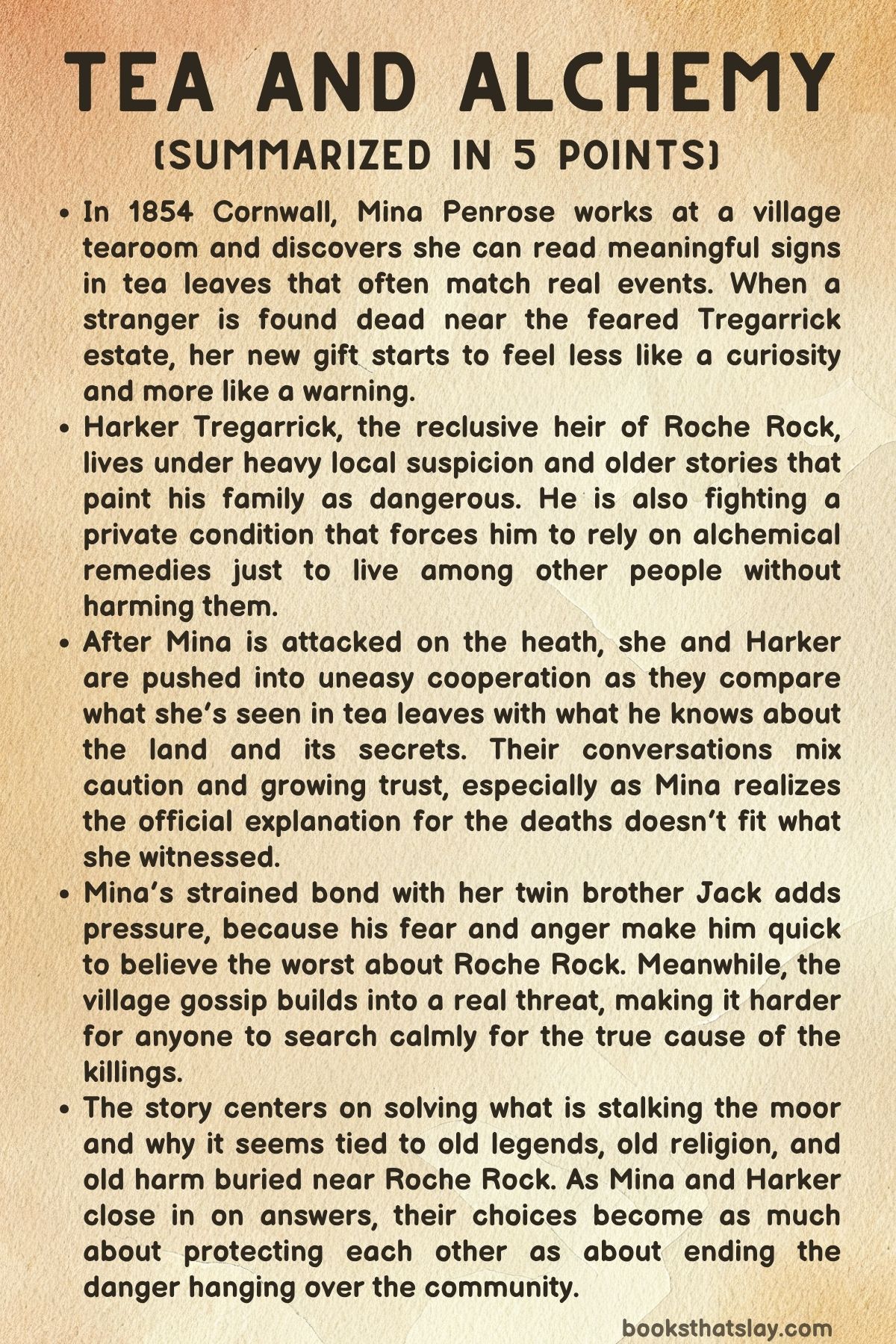
Tea and Alchemy by Sharon Lynn Fisher is a gothic romance with a supernatural mystery at its core. At storm-battered Roche Rock in 1854 Cornwall, Mina Penrose, a young woman working at a village tearoom, discovers she can read tea leaves—and the signs she sees begin to match real danger.
Harker Tregarrick, the isolated master of Roche Rock, lives under a family curse that makes him crave blood, kept barely in check by his own alchemical “vital essence.” When deaths on the moor stir old fears about the “Wolf of Roche Rock,” Mina’s gift and Harker’s secret collide, pushing them toward trust, risk, and a fight for freedom.
Summary
In late September 1854, Harker Tregarrick stands inside the chapel-fortress of Roche Rock and listens to the world beyond its walls. He can’t see the road clearly from where he is, but he senses far more than ordinary people ever could: the salt of the sea in the distance, the blood moving inside passersby, and—most distracting of all—the scent of a young woman who walks past his estate nearly every day.
Her smell is distinct and steady, and it unsettles him because it makes him want something he spends his life refusing to take. Harker comes from a line marked by a dangerous inheritance.
He has a thirst that can turn deadly, and he survives by drinking a concoction he calls a “vital essence,” an alchemical medicine designed to dull his hunger and keep the people of Roche safe from him. It helps, but it does not cure him.
The villagers have their own explanation for his distance: old rumors about the “Wolf of Roche Rock,” a monster story anchored in fear and half-glimpsed shapes in the fog.
On October 2, Mina Penrose works at The Magpie tearoom in the village of Roche. She lives modestly, carrying grief and loneliness after her parents’ deaths, and sharing a cottage with her twin brother Jack.
Mina’s world has recently widened because Mrs. Moyle, the tearoom’s owner, has been teaching her to read and write. Mina also has a private secret she doesn’t fully understand: she has started seeing clear pictures in used tea leaves, images that sometimes show up before matching events in real life.
That day, after a rush of harvest-season customers, she clears a table where a quiet stranger had eaten and read a newspaper. When Mina checks the teapot, she finds the leaves arranged into shapes that look like a magpie and a blade.
The second image leaves her uneasy. Mrs. Moyle recognizes Mina’s gift as tea-leaf reading and gives it a name—tasseography—though she can’t tell Mina exactly why the leaves are becoming so sharp and specific.
As dusk falls and mist rolls in, Mina walks home with leftover scones in her basket. Her route passes near the boundary of the Tregarrick estate, where hedges and old walls turn the landscape into narrow corridors of shadow.
The fog thickens, and she notices movement near the roadside. She finds a man lying facedown, his hat crushed, his eyes open and staring.
Blood marks his cheek. Mina recognizes him as the stranger from the tearoom.
She calls for help, but no one answers, and panic drives her back toward The Magpie.
Constable Hilliard arrives and questions Mina while Mrs. Moyle listens. Mina says she didn’t see anyone nearby, though she thought she glimpsed something like a stag in the mist.
Hilliard studies the wound and remarks that it looks ragged, more like teeth than a blade. Another man arrives—a clerk named Gibbs—with a leather case found on the heath.
Papers inside identify the dead man as Henry Roscoe, the solicitor to Harker Tregarrick of Roche Rock. Hilliard decides to visit Roche Rock that night, believing Roscoe likely met Tregarrick shortly before his death.
Jack arrives at the tearoom, furious and frightened by the danger Mina encountered. He demands she quit her job immediately.
Mina refuses, clinging to the one place that has brought her purpose and the beginnings of learning. Their argument ends unresolved, leaving Mina trapped between her need for independence and Jack’s tightening control.
The next day, Mina goes to work anyway, even bringing a small knife for protection. Gossip spreads quickly.
Customers speak of wild animals, curses, and Roche Rock. Mrs. Moyle tells Mina that Hilliard believes Roscoe met with Tregarrick, and that officials are leaning toward the idea of an animal attack, though they are confused by certain details—especially the odd lack of blood at the scene.
Then Mina sees the man the village fears. Harker Tregarrick arrives at The Magpie and sits quietly at the same window table Roscoe used, reading a heavy book.
He looks younger than Mina expected, and stranger: pale, sharply composed, wearing tinted spectacles, with lips so dark they seem bruised. He tells Mina he knows she found Roscoe.
His voice and manner suggest he is used to controlling what people learn about him. Mina reacts with anger at his implied authority over her movements.
When he leaves, Mina checks his teapot and sees a wolf’s head in the leaves. Mrs. Moyle confirms it resembles a wolf or dog and urges Mina to be cautious.
Back at Roche Rock, Harker is shaken. Going into the village cost him more control than he wants to admit.
Mina’s presence—the pull of her blood, the closeness of her living warmth—nearly overwhelms him even with his vital essence. He also carries a darker worry: he has stayed silent about what truly happened to Roscoe.
He let the “rabid dog” story spread because it protected him. He fears the consequences if the truth surfaces.
A day later, Mina ventures onto Tregarrick land toward a birchwood. She speaks with a poacher boy who says the master is rarely seen and the boys run if they catch sight of him.
Mina sits by a pool on a flat stone that reminds her of her mother and breaks down in the rain. A magpie appears and takes a crumb from her hand.
Fog rises. Someone calls her name.
When she turns, something strikes her from behind.
Harker finds Mina unconscious near the pool, her bonnet floating nearby. The scent of fresh blood hits him like a blow.
For a moment his body reacts faster than his mind, and he has to fight not to feed. He sees a tall shadowy figure retreating into the fog—something with an unnatural shape, not fully human, and disturbingly familiar.
Harker realizes Mina was attacked by a predator like himself, and he believes it would have killed her if he hadn’t driven it off. He carries Mina into Roche Rock, struggling with his hunger and with a new, urgent fear: there is another blood-drinker in the area.
Mina wakes inside the chapel-fortress, confused by the strange light and rich, old-fashioned furnishings. Harker appears calm but guarded.
He gives her water and an herbal wash to prevent infection, and he brings tea. He burns frankincense, claiming it purifies the air.
Mina questions him about what attacked her and whether it connects to Roscoe’s death. Harker avoids full answers, but his evasions only deepen Mina’s suspicion that the village’s “dog” story is false.
When Mina cuts her finger accidentally, Harker’s reaction is immediate and alarming. He turns pale, retreats sharply, and struggles to steady himself.
Mina realizes blood affects him in a way that goes beyond squeamishness.
Harker insists on escorting her home through worsening weather. They walk together through thunder and hail, holding hands for safety as the path turns slick.
At Mina’s cottage, Harker urges her to wear a cross for protection. Mina agrees, not because she has suddenly become devout, but because she senses the danger is real.
Their fragile moment ends when Jack appears, drunk and furious. Harker introduces himself and lies, saying Mina merely fell and struck her head.
He hides the truth about Roche Rock and the attack. After he leaves, Jack explodes with accusations, repeating rumors that Harker killed Roscoe and pointing out strange details that make the official story feel staged.
He forbids Mina from leaving the house without permission.
Mina refuses to surrender her life. She continues working at The Magpie, but weakness and anxiety catch up with her, and Mrs. Moyle sends her home to rest.
Still restless, Mina seeks answers. She visits the tavern called The Wolf’s Head and questions the publican about the estate’s stories.
He confirms the name is old and tied to long-standing fear of Roche Rock. Now, with Roscoe dead and suspicion rising, people are ready to blame the master of the estate for anything.
Mina has nightmares of a mob led by Jack closing in on Harker.
Mina’s tea leaves keep warning her. She sees wolf imagery again, and she decides she can’t stay away from Roche Rock.
She brings food to Harker and forces a confrontation. Harker tries to frighten her off, insisting she must never return because the estate—and he himself—are dangerous.
Mina refuses to be dismissed. He finally takes her to his laboratory and reveals the truth: he is a vampire, bound to blood hunger.
He explains his vital essence, a distilled herbal spirit meant to replace blood and blunt his senses. He insists he did not kill Roscoe.
He believes another vampire attacked Roscoe and later targeted Mina. He also admits his past is stained with uncertainty, including the possibility that he killed someone long ago when he first changed.
Mina offers him something unexpected: help. She tells him about her tea-leaf visions and her belief that warnings can be used to prevent harm.
Harker, frightened of his own desire for her, reacts harshly. When Mina grabs his sleeve, trying to stop him from shutting her out, Harker loses control for a moment.
He presses her against him, bares her throat, and lets his sharp teeth touch her skin. Mina feels her body respond in a drugged, heavy way that scares her as much as it draws her in.
A part of her mind fights to stay awake and resist. Harker pulls back before he bites, shaken by how close he came to crossing a line.
Soon Mina sees something worse than Harker. After reading tea leaves and finding signs of a candle and a cross, she falls asleep outside and wakes to animals panicking.
Fog gathers near her garden, and within it stands a towering figure crowned with branch-like antlers, eyes glowing faintly. It vanishes, but Mina is certain it is tied to the deaths.
Another body is found nearby, and suspicion hardens against Harker. Mina tries to write him a letter but can barely manage the words.
Jack’s behavior grows more erratic, fueled by alcohol and fear, and Mina worries he will walk into the dark and not return.
Mina seeks help from Father Kelly and learns Jack has been asking about old stories and a painting in the church bell tower. Mina goes to see it and recognizes the creature she has seen: a branch-crowned demon with a long jaw and teeth, with Roche Rock painted behind it and bodies scattered in a scene of slaughter.
Near the painting, someone has scratched a word: “Goosevar.” Mina takes this to Harker. He recognizes it as Cornish for “blood-drinker.” They realize the village’s wolf stories may be a cover for something older and worse than rumor.
Goosevar returns more aggressively, using fog and strange music to lure Mina toward the heath in a trance-like state. Harker sees her in danger and rushes into the vapor.
He finds Goosevar looming over her and pulls Mina away. In the fog, Harker is struck by a vivid vision of himself and Mina bound together in marriage.
Mina later sees a ring shape in her tea leaves, matching the same omen. Together they piece out a terrifying theory: Goosevar may be a parasite-like force attached to the Tregarrick line, hiding through generations by binding itself to one man at a time.
If it wants a new host, it may need Mina and Harker to marry and produce a child—creating the next vessel for the curse.
They consider desperate options. Harker thinks about returning to controlled feeding to stay strong enough to fight.
Mina refuses to let him face it alone. Their bond deepens, and they perform a quiet handfasting on the heath, claiming each other in the simplest way they can.
But danger follows immediately. Jack appears with a pistol and fires at Harker.
Harker falls, blood spreading through his clothes. Mina is forced to face how far Jack has drifted from the brother she remembers, and how easily fear can become violence.
Mina and Harker shelter together at Mina’s cottage. Jack disappears again.
Harker tries to put his affairs in order as if he expects to die, which Mina won’t accept. In a quiet night, Harker plays Mina’s father’s fiddle, and the sound breaks through Mina’s grief in a way words cannot.
In the morning, Mina asks about Harker’s former violin teacher, Ruby Rowe. Harker reveals Ruby taught him for years, until he discovered his father had been feeding on her.
After Harker’s own change and a humiliating, painful unraveling of his life, Ruby vanished. He never learned what happened to her, and the uncertainty has haunted him.
At the church, Father Kelly agrees to marry Mina and Harker quickly after ensuring Mina is not being coerced. They investigate the old painting again and notice marks that suggest roses played a role in defeating Goosevar in the past.
News arrives of remains found near the pool. Mina fears Jack is dead, but the body seems older.
Mina and Harker rush to the site with Constable Hilliard and the poacher boy. In the water, they find a red jasper cross necklace.
Nearby lies a skeleton. Harker recognizes the necklace as Ruby Rowe’s.
The truth lands hard: Ruby never left Roche Rock. Goosevar killed her long ago by the pool, hiding her fate in silence and fog.
Before anyone can respond properly, the boy disturbs stones near the pool and exposes Goosevar’s hiding place. The creature erupts into the open, snarling and violent.
The constable fires but is knocked into the water. Mina throws her cross to Harker.
Harker drives the cross into Goosevar’s mouth, burning it from within, but Goosevar retaliates, breaking Harker’s ribs and hurling him aside.
Then Jack returns—changed by terror and guilt, but finally seeing the true enemy. He has a bow and arrows made from sweetbriar stalks, guided by the old clue hidden in the church art.
Father Kelly arrives carrying a large wooden cross, joined by the publican and his wolfhound. Jack fires again and again.
One arrow drives into Goosevar’s eye. The creature collapses.
They burn the body until it is ash, refusing to leave any remnant that could keep the curse alive.
In the aftermath, Harker feels a profound shift. The constant pull of blood fades.
He can no longer smell Mina’s life as a temptation. He realizes Goosevar’s death has broken something fundamental, freeing him from the hunger that defined his existence.
Jack apologizes to Mina, acknowledging Harker was not the killer and that his own fear nearly destroyed what he loved. Harker shares the fuller history: Goosevar once fed on pregnant women and used its own blood and influence to heal and make victims forget, creating bonds that sustained the curse through the Tregarrick line.
With Goosevar destroyed and burned, that threat is ended.
Seventeen days later, after the banns are read, Father Kelly marries Mina and Harker beside Mina’s parents’ graves. The old wheel cross is moved back to Roche Rock to stand guard over the place where Goosevar was burned.
Ruby Rowe is finally buried in the Tregarrick graveyard. Mina and Harker celebrate at The Magpie with Mrs. Moyle and Jack, and the village slowly begins to accept them.
Magpies appear—two together—and Mina calls it “two for joy,” as she and Harker step into a future no longer shaped by Goosevar’s shadow.
Characters
Harker Tregarrick
Harker Tregarrick is shaped by contradiction: he is both predator and protector, a man raised inside a fortress of inherited secrecy who has tried to turn monstrosity into responsibility. Living at Roche Rock, he has spent years constructing a narrow moral life around containment, using alchemical “vital essence” to blunt a hunger that he believes is his own bloodline’s curse.
What makes him compelling is not simply that he is a vampire, but that he refuses the easy absolution of “it’s in my nature” while also refusing the fantasy that he can be entirely safe. He manages people at a distance through agents, hides behind tinted spectacles and formality, and keeps the village at arm’s length because he understands that intimacy and routine contact increase risk.
Yet his isolation is not only self-protection; it is also penance, a way to pay for what the Tregarricks have historically done and for what he fears he might do again if he slips.
Mina’s presence fractures the system he has built. She is not just “temptation” in a sensual sense; she is a moral complication, a person whose safety becomes impossible to guarantee once he notices her, and whose independence he cannot control without becoming the very kind of tyrant-monster the rumors already imagine.
Harker’s protectiveness, therefore, is never pure. It is threaded with fear, desire, guilt, and a deep need to be seen as something other than the “Wolf of Roche Rock.” His early decision to allow the authorities to accept the animal-attack explanation for Mr. Roscoe’s death shows a survival instinct that borders on cowardice, but it is also a grim calculation: telling the truth would not necessarily save lives, it would more likely trigger panic and violence.
This willingness to manipulate the narrative is one of his darker traits, and it reveals how practiced he is at choosing the lesser evil while still accumulating moral debt.
His alchemy is also a psychological portrait. The “vital essence” is not a cure; it is a controlled compromise, a symbol of Harker’s preference for restraint, method, and self-discipline over indulgence.
It suggests a mind that believes in systems, in craft, in the possibility that knowledge can civilize the monstrous. That belief becomes both his strength and his vulnerability, because it blinds him at first to the idea that the real horror might not be him at all, but Goosevar as a parasitic force working through his family line.
When the truth emerges, Harker’s identity crisis intensifies: he is forced to consider that the worst parts of “the curse” were not evidence of his inherent nature but evidence of a predator wearing his lineage like a cloak. The relief he experiences after Goosevar’s death is therefore not just physical freedom from bloodlust; it is the unshackling of shame that never entirely belonged to him.
Harker’s love story with Mina is built on boundaries and negotiations rather than sweeping ease. He repeatedly tries to push her away, not because he lacks feeling, but because he believes love makes him dangerous.
This is why the relationship matters thematically: Mina does not redeem him by “taming the beast,” and he does not rescue her into a safer life. Instead, they choose each other while fully acknowledging risk, and that choice is what breaks the generational trap Goosevar depends on.
By the end of Tea and Alchemy, Harker becomes a man who can finally imagine a future not defined by management of appetite, and that freedom allows his tenderness and artistry—seen in his careful herbal preparations, his ritual attention to purification and protection, and his connection to music—to exist without being constantly undercut by predation.
Mina Penrose
Mina Penrose begins as someone whose life has been narrowed by grief, poverty, and her brother’s anxious control, yet she carries an unusually vivid interior world that refuses to stay small. Her work at The Magpie tearoom is not merely employment; it is identity, community, and the first steady space where she is treated as capable rather than burdensome.
Mrs. Moyle teaching her to read and write is crucial to Mina’s character because it frames her as someone actively building herself in adulthood, not someone passively waiting to be saved. Her hunger is for meaning and agency, and the story makes that hunger as powerful as any supernatural thirst.
Her tasseography is the outward sign of that inner intensity. Mina’s tea-leaf visions function like a developing language: at first they are unsettling symbols she cannot fully interpret, but over time they become part intuition, part warning system, part way of asserting that what she perceives matters even when the village dismisses her.
The fact that she sees patterns that later align with events puts her in the role of witness, but the more important detail is her response to witnessing. Mina does not treat her visions as a reason to surrender to fate; she treats them as evidence that she must act, investigate, and protect.
When she sees the wolf’s head in Harker’s leaves, her fear does not translate into avoidance alone—it also becomes curiosity, moral testing, and an insistence on confronting the truth directly.
Mina’s courage is textured, not heroic in a glossy way. She is frightened often—of the corpse she finds, of fog and silence, of being alone with Harker in a place everyone calls cursed—but she keeps moving anyway.
That persistence is tied to loneliness. Mina’s parents’ deaths leave her emotionally unmoored, and Jack’s grief hardens into possessiveness that makes home feel like a cage.
The result is that Mina clings to work and to chosen relationships as proof that she still has a life worth directing. Even her decision to carry a small knife shows a pragmatic, working-class bravery: she prepares for danger without romanticizing it.
Her relationship with Harker is compelling because she refuses the simplest narratives about him. Mina recognizes the threat he represents, yet she also recognizes his self-control and pain, and she will not let the village’s folklore substitute for evidence.
This is not naïveté; it is ethical stubbornness. Mina holds open the possibility that someone can be dangerous and still be trying, that a rumor can be emotionally satisfying and still be wrong.
That stance puts her at odds with Jack and with the community’s hunger for a scapegoat, and it positions her as the story’s moral center: she insists on distinguishing fear from truth even when fear is socially convenient.
Mina’s emotional arc is also about desire and consent under supernatural pressure. When Harker nearly bites her, the moment is charged with attraction and danger, and Mina’s internal resistance matters because it shows she is never simply a mesmerized victim.
Later, when Goosevar exerts a trance-like pull that draws her onto the heath, the contrast is sharp: Harker struggles against appetite but still treats Mina as a person who must choose, while Goosevar treats her as material for inheritance, breeding, and transfer. Mina’s eventual handfasting with Harker is therefore not just romance; it is defiance against being turned into a vessel for a curse.
By the end of Tea and Alchemy, Mina’s gifts, courage, and insistence on truth help dismantle a generational horror, and she steps into marriage not as escape but as a deliberate partnership shaped by shared knowledge and hard-won freedom.
Jack Penrose
Jack Penrose is a portrait of grief that curdles into control. As Mina’s twin and only remaining family, he attaches his identity to the role of protector so completely that Mina’s autonomy begins to look, to him, like betrayal.
His insistence that she quit The Magpie and stay home is fueled by genuine fear—fear of violence on the road, fear of gossip, fear of losing her the way he lost their parents—but the fear expresses itself as domination. Jack does not ask Mina what she wants; he declares what she will do.
That pattern makes him emotionally believable and difficult, because it is both love and harm at once.
Alcohol becomes his blunt instrument for coping and also a catalyst for escalation. When Jack appears drunk and furious at the cottage, his anger reads like panic wearing the mask of righteousness.
He clings to the most available explanation for the murders—Harker as monster—because it gives his fear a target he can fight. The rumors about the “Wolf of Roche Rock” offer Jack a story where violence can be justified as prevention, and his mind chooses that story because uncertainty is unbearable.
The strange details he notices—body outside the wall, bag inside, lack of blood—show that he is not stupid; he is observant. But his interpretation is shaped by emotion more than reason, and once he commits to the belief that Harker is guilty, every ambiguity becomes proof.
Jack’s most defining moment is shooting Harker. That act is horrifying, but it is also the culmination of his internal logic: if Mina’s safety is the highest good, then any perceived threat becomes killable.
The tragedy is that Jack’s devotion strips Mina of personhood; he does not protect her choices, he protects his need to keep her. Yet Jack is not written as a flat villain, because later he returns with weapons designed to kill Goosevar and participates directly in stopping the true predator.
This shift suggests that Jack’s violence was never purely cruelty; it was misdirected desperation, and once the real enemy is visible, his courage becomes useful rather than destructive.
There is also something eerie about Jack’s absences and disorientation. He keeps appearing and vanishing, glancing into shadows as if hunted or influenced, and he struggles to explain where he has been.
That pattern implies Goosevar’s reach extends into Jack’s mind and behavior, making him both an agent and a casualty of the curse’s manipulation. His eventual apology and acceptance of Harker’s innocence matter because they show Jack reclaiming moral clarity after being trapped in fear.
By the end, Jack remains a man marked by grief and capable of dangerous certainty, but he also becomes someone who can change when confronted with truth, and that change repairs the sibling bond enough for Mina’s future to include him rather than be defined by escaping him.
Mrs. Moyle
Mrs. Moyle serves as the steady hearth of Roche village and as Mina’s first true mentor. She offers practical kindness—employment, food, structure—but her deeper gift is education, the patient act of teaching Mina to read and write.
That choice shifts Mina’s life trajectory, and it marks Mrs. Moyle as someone who believes knowledge is a form of safety. In a story full of secrets, she is one of the few characters whose influence is openly benevolent and grounded in everyday work.
Her reaction to Mina’s tea-leaf visions is revealing. Mrs. Moyle does not mock or sensationalize; she names the practice as tasseography and explains it with calm authority, as though giving Mina a tool rather than a superstition.
That approach matters because it legitimizes Mina’s perception without pushing her into hysteria. Mrs. Moyle can be skeptical of monster tales and still take fear seriously, warning that village panic can become its own danger.
She understands communities the way a shopkeeper does: she knows gossip spreads faster than facts, and she knows how quickly suspicion can turn into violence.
Mrs. Moyle is also the keeper of social boundaries. She is not naïve about Roche Rock; she has heard the stories and watches Harker’s presence in her tearoom with a wary eye.
Yet she does not become a lynchpin of persecution. Instead, she tries to keep Mina safe without stripping her of independence, a contrast to Jack’s method.
In many ways, she models a healthier form of protection: attentive, realistic, and respectful. By the end, her tearoom becomes a site of reconciliation and community acceptance, and that outcome reflects Mrs. Moyle’s quiet power—she helps shape the village’s emotional weather, steering it away from cruelty when she can.
Constable Mr. Hilliard
Constable Hilliard represents institutional reason under pressure, a man trying to do his job in a landscape where folklore and fear distort every clue. He questions Mina carefully after the first death, notes the wound’s ragged nature, and consults evidence like the solicitor’s papers rather than relying on rumors.
His willingness to visit Roche Rock directly shows a practical courage, because he understands that avoiding the estate would be easier but less responsible.
What distinguishes Hilliard is his openness to Mina’s concerns even when she lacks social power. He takes her seriously when she warns that the village may decide on guilt too quickly, and he invites her to report future encounters.
That is a subtle but important form of respect: he treats Mina as a witness rather than as a hysterical girl, and he recognizes that public certainty can sabotage justice. At the same time, he is limited by the frameworks available to him.
The “animal attack” conclusion shows how quickly rational systems can reach for the nearest ordinary explanation when faced with the extraordinary.
Hilliard’s confrontation with Goosevar exposes both his bravery and his helplessness. He is physically outmatched and nearly killed, reminding the reader that law and order cannot always protect people from forces that do not play by human rules.
Yet his presence still matters because it anchors the story’s social reality: without him, the village’s fear would have fewer checks, and Mina would have fewer avenues to be heard. He embodies the fragile bridge between communal panic and measured truth.
Henry Roscoe
Henry Roscoe appears briefly, but his death functions like a stone dropped into still water, sending ripples through every relationship and rumor in the novel. As Harker’s solicitor, Roscoe represents the thin line of normal human bureaucracy that connects Roche Rock to the outside world: paperwork, correspondence, law, and the modern mechanisms that keep an old estate functioning.
His quiet demeanor in The Magpie and his neat respectability make him an ideal victim for the story’s opening horror because his ordinary humanity underscores how unnatural the violence is.
Roscoe’s murder also exposes Harker’s most precarious vulnerability. Harker lets the “rabid dog” story stand to protect himself, and Roscoe becomes the price of that silence, whether or not Harker is directly responsible.
The unsettling lack of blood at the scene and the displaced belongings turn Roscoe into a mystery rather than just a casualty, a set of contradictions that feed Jack’s suspicions and the village’s appetite for the Wolf of Roche Rock narrative. Even in absence, Roscoe serves as evidence that something is feeding and hiding, and his death forces the characters to choose between truth-seeking and blame.
Father Kelly
Father Kelly is both spiritual authority and local historian, a man whose role places him at the intersection of faith, folklore, and community stability. He initially tries to separate old stories from present murders, which reads as pastoral caution: he does not want superstition to ignite violence.
Yet he also carries the memory of the village in tangible form, guiding Mina to the bell-tower painting and acknowledging that Jack has come to him with fear. He becomes the conduit through which the past re-enters the present, not as abstract myth but as a visual record of something that looks exactly like the creature haunting the heath.
What makes Father Kelly effective is that he does not use religion as mere comfort; he uses it as a tool. Crosses become practical weapons, and the churchyard becomes a space where truth can be spoken under a kind of moral witness.
When Mina and Harker seek to marry, Father Kelly interrogates consent and ensures Mina is not being forced, which highlights his ethical seriousness. He then accelerates the banns, indicating that he understands urgency and is willing to bend routine in service of protection.
In the climax, Father Kelly’s large wooden cross becomes part of the coordinated response against Goosevar. This is where his character crystallizes: he is a priest who accepts that evil may be literal and that faith, in this context, is not just prayer but action.
By the end, he stands for the possibility that tradition can be used to defend rather than to persecute, helping the community turn fear into solidarity.
Mr. Couch
Mr. Couch, the publican of The Wolf’s Head, functions as the village’s storyteller and informal archivist of rumor. His tavern, named for local fears, is a place where narratives are reinforced and traded, and he understands the cultural weight Roche Rock carries.
When Mina questions him, he confirms how deeply the wolf stories run and how quickly Roscoe’s death has reactivated them. He is not simply spreading gossip; he is reflecting the community’s collective psyche, where myth provides an explanation that feels emotionally satisfying.
His later role in the confrontation with Goosevar suggests that he is not merely a passive voice in the crowd. He shows up when it matters, and his presence implies a shift from fearful talk to protective action.
Mr. Couch represents how communities can pivot: the same social networks that amplify suspicion can also mobilize resistance when the true threat becomes undeniable. He embodies the social engine of the village—dangerous when it runs on panic, valuable when it runs on shared purpose.
Ruby Rowe
Ruby Rowe is the story’s haunting absence, a woman whose fate reveals how long the curse has been feeding in the margins of Roche Rock. As Harker’s violin teacher, Ruby represents gentleness, art, and a kind of intimacy that once reached into Harker’s isolated life.
Her relationship with him is crucial because it shows that even before Mina, Harker had experienced care and mentorship that made him more human in spirit, even as his family’s predation surrounded him. When Ruby vanishes from his life, Harker carries unresolved guilt and uncertainty that deepen his self-disgust, because he cannot be sure what happened to her or what his family did.
The discovery of Ruby’s remains by the pool transforms her from mystery into indictment—not of Harker, but of Goosevar’s long violence. Ruby’s red jasper cross pendant becomes a poignant symbol: she carried protection, yet protection was not enough against a predator embedded in the land and the lineage.
Her death also reconfigures Harker’s self-narrative. The possibility that he killed someone during his early change has weighed on him, and learning that Goosevar killed Ruby offers him a bitter relief: it does not erase his darkness, but it removes one of the most personal, corrosive uncertainties.
Ruby’s role is to show the true cost of the curse across time and to turn Harker’s private shame into a solvable history rather than an eternal stain.
Goosevar
Goosevar is horror with intelligence, a predator that operates less like a lone monster and more like a parasitic inheritance system. The name itself, understood as “blood-drinker,” frames it as an archetype rooted in local language and memory, and the church painting confirms it has haunted Roche Rock for generations.
Its branch-crowned, antler-like silhouette and fog-bound presence give it the feel of something half-creature, half-environment, as though it belongs to the heath and the ruins as much as to any body. That visual design matters psychologically: Goosevar is not just a threat that appears, it is a threat that seeps in, blurring boundaries between landscape and predator.
Its most frightening quality is manipulation. Goosevar does not merely kill; it lures, enthralls, and engineers conditions for continuation.
The implication that it binds itself to one man in each Tregarrick generation reframes the “family curse” as an exploitation strategy, turning the Tregarricks into both collaborators and victims across time. The idea that it seeks a new host through marriage and childbearing makes its violence reproductive and future-oriented, which is why the romance plot becomes inseparable from the horror plot.
Goosevar weaponizes intimacy, turning love, legacy, and family formation into mechanisms of transfer.
Goosevar also functions as a mirror that clarifies character. Against it, Harker’s restraint looks heroic rather than merely tormented, because Goosevar is appetite without conscience.
Against it, Jack’s fear becomes easier to understand, because Goosevar’s existence justifies the kind of terror that could break someone’s judgment. Against it, Mina’s insistence on truth becomes urgent, because guessing wrong results in bloodshed and scapegoating.
When Goosevar dies—burned, pierced, and forced to face symbols of protection—it is not only the removal of a monster; it is the collapse of a story that has controlled the village for generations. Goosevar is the embodiment of inherited violence and the way it disguises itself as family fate until someone names it and fights it directly.
Jeremy Martin
Jeremy Martin, the poacher boy, is a small but important figure because he shows how Roche Rock’s legend shapes even the children. His casual knowledge—where boys poach, when to run, how rarely the master appears—demonstrates that fear of the estate is part of daily life, not a dramatic rumor reserved for adults.
Jeremy’s willingness to talk with Mina also shows her place in the village: she is approachable, someone younger people can trust, which contrasts with how powerless she feels at home with Jack.
Jeremy’s accidental role in uncovering Goosevar’s hiding place is a sharp illustration of how ordinary curiosity can collide with ancient horror. He does not seek evil; he stumbles into it the way communities often stumble into the buried truths under their own legends.
That makes him thematically significant: the young, unburdened by elaborate myth-making, can expose what adults have tiptoed around for years. Jeremy represents the village’s living present—the new generation that will inherit either the fear or the freedom created by the adults’ choices.
Dolly
Dolly, Mr. Couch’s wolfhound, works as both practical ally and symbolic counterpoint to the “Wolf of Roche Rock” myth. Where the rumor paints a wolfish predator at the estate, Dolly is an actual canine presence aligned with protection and community, complicating the emotional shorthand that equates “wolf” with evil.
Her injury and survival in the final confrontation emphasize that fighting Goosevar costs something even for those who are not central protagonists. Dolly’s presence reinforces the story’s insistence that courage is communal: humans arrive with crosses and arrows, and even an animal stands its ground.
Dolly quietly helps reclaim the wolf symbol from fear and return it to something closer to loyalty and defense.
Themes
Inherited curse, personal responsibility, and chosen restraint
In Tea and Alchemy, the danger surrounding Harker is not framed as a simple monster problem but as a long, exhausting negotiation between inheritance and choice. He lives inside a structure built to keep people out and to keep his own nature contained, and the routines he follows are shaped by the fear of what happens if he ever stops managing himself.
His “vital essence” matters here not only as a pseudo-scientific solution but as a daily discipline: he has created a substitute that reduces harm without pretending the harm is gone. That distinction keeps the story grounded in accountability rather than wish fulfillment.
He knows he can still fail, and he knows a failure would not be an accident that happens to someone else; it would be an act he commits. The community’s safety depends on the quiet, uncelebrated work of not giving in—choosing isolation, controlling access, editing the truth, and accepting loneliness as the cost of keeping others alive.
When deaths begin to occur near his land, the pressure changes from private management to public consequence. Even when he does not commit the killings, his decision to allow a convenient explanation to spread shows how protecting the village can slide into protecting himself.
The theme becomes sharper once Mina enters the equation, because attraction increases both risk and moral clarity. Her blood is a trigger, yet her presence also tests whether restraint is real or just circumstance.
The story treats restraint as an active moral practice, not a personality trait: Harker’s identity is defined by the constant question of whether he will treat his need as permission. That is why the later shift—when the compulsion finally lifts—lands as more than relief.
It reframes the earlier years as genuine effort under pressure, and it also highlights the tragedy that a family line can be shaped by a burden one person never consented to carry.
Knowledge, interpretation, and the limits of certainty
Mina’s tea-leaf visions introduce a form of knowledge that is real enough to matter but unreliable enough to create stress rather than comfort. What she sees often arrives as shapes without instructions: a dagger-like sign that does not identify whose hand holds it, a ring that forecasts a binding without revealing whether it is rescue or trap, a candle and a cross that suggest hope beside suffering without telling her what to do next.
That ambiguity is the point. The narrative uses her growing skill with signs to show how people reach for patterns when institutions cannot protect them.
The constable investigates, the surgeon can examine wounds, and the village can gossip, but none of those tools can explain the full shape of the threat. Mina’s method does not replace reason; it expands the field of evidence.
She observes correlations, tests her impressions against events, and learns the difference between seeing a warning and knowing a plan. The tension between information and action becomes constant: she can sense danger and still be vulnerable to it, and she can suspect the truth and still be pressured into silence by fear, social hierarchy, and her brother’s control.
The theme also shows up in the way knowledge is stored in the community. A wall painting, a scratched word, an old tavern name, and inherited rumors preserve memory across generations, but only in fragments.
People repeat the story of the “Wolf of Roche Rock” because it offers a simple explanation with a clear target, while the real cause is stranger and harder to admit. The result is that knowledge can both illuminate and mislead.
Mina’s gift becomes valuable not because it is flawless, but because it insists that the obvious answer might be wrong. By forcing characters to act under partial information, the novel makes interpretation a moral issue: believing the wrong story can create a mob, while admitting uncertainty can keep the search for truth alive long enough to save someone.
Love as risk, agency, and negotiated trust
The relationship between Mina and Harker develops in a space where affection cannot be separated from danger. Their connection begins with unease and friction—Mina resents being warned as if she were a child, and Harker tries to control distance because he does not trust himself.
That imbalance could have turned Mina into a passive figure, but the story repeatedly gives her agency: she chooses to return to work, chooses to investigate, chooses to confront Harker, and chooses to keep asking questions even when he tries to shut the conversation down. Love here is not romantic softness; it is a series of decisions made under risk.
Mina’s attraction does not erase her caution, and Harker’s attraction does not excuse his secrecy. Their trust is negotiated in steps: he carries her to safety but withholds the truth; she challenges him but also protects him from a crowd ready to blame.
The most unsettling moment comes when Harker presses his teeth to her neck and she feels her body slip toward surrender. That scene matters because it shows how desire can resemble coercion when power is uneven, even if the person holding power is terrified of using it.
Mina’s resistance—small but present—keeps the moment from being romanticized as destiny. It becomes a warning about what happens when longing overrides consent, and it sets a standard that later scenes must meet.
Their eventual commitment functions as both refuge and strategy, because the external threat tries to force a binding for its own ends. That pressure complicates the idea of marriage as a simple happy resolution; it becomes a battleground over whether Mina and Harker can define their bond on their own terms.
The theme reaches its strongest form when love requires public consequences: the village’s suspicion, Jack’s rage, and the danger of being turned into symbols rather than people. By the end, trust is earned through shared action—standing together during violence, choosing honesty, and building a future that is not based on fear.
Love becomes a practice of protecting each other’s personhood, not a spell that makes danger disappear.
Community fear, scapegoating, and the politics of rumor
The village’s reaction to the killings shows how communities handle threat when they lack clear facts and feel powerless. Fear spreads quickly because it offers a sense of control: if there is a single villain, then avoiding him feels like safety.
Harker’s isolation and the long history of rumors make him the easiest target, especially once bodies are found near his land and the wounds suggest something animalistic. The story pays attention to how these narratives form.
People gather in the tearoom and the tavern, trade details, and shape those details into certainty. The oddities—no blood at the scene, a bag found elsewhere, a body positioned near the estate—are not treated as puzzles that demand careful inquiry.
Instead, they are absorbed into a preexisting suspicion, because suspicion is emotionally satisfying. Jack’s arc intensifies this theme.
His protectiveness turns into control, then into obsession, and his certainty hardens under the influence of drink and rumor. He becomes a portrait of how personal grief and social panic can fuse into a dangerous moral confidence: he believes he is defending Mina, yet he repeatedly makes choices that isolate her and increase her risk.
The constable represents the fragile alternative: method, patience, and willingness to keep investigating even when public opinion wants closure. Mrs. Moyle adds another layer by recognizing how fear can become its own weapon; once a village decides on a culprit, the search for truth becomes secondary to the need for a story that settles nerves.
The theme is not simply “people gossip.” It is about how fear reorganizes social relationships—who is listened to, who is believed, who is treated as fully human. Harker is wealthy and powerful in status yet vulnerable as an outsider; Mina is socially ordinary yet becomes central because she witnessed events and keeps moving between spaces.
The final confrontation does not just defeat a creature; it also interrupts the village’s momentum toward blaming the wrong person. The community’s later acceptance of Mina and Harker is meaningful because it suggests a repaired social fabric: not perfect, but capable of learning.
The true horror is not only the predator in the fog, but also how quickly ordinary people can decide they already know the answer—and how costly that certainty can be.