Tell Me Everything Summary, Characters and Themes | Elizabeth Strout
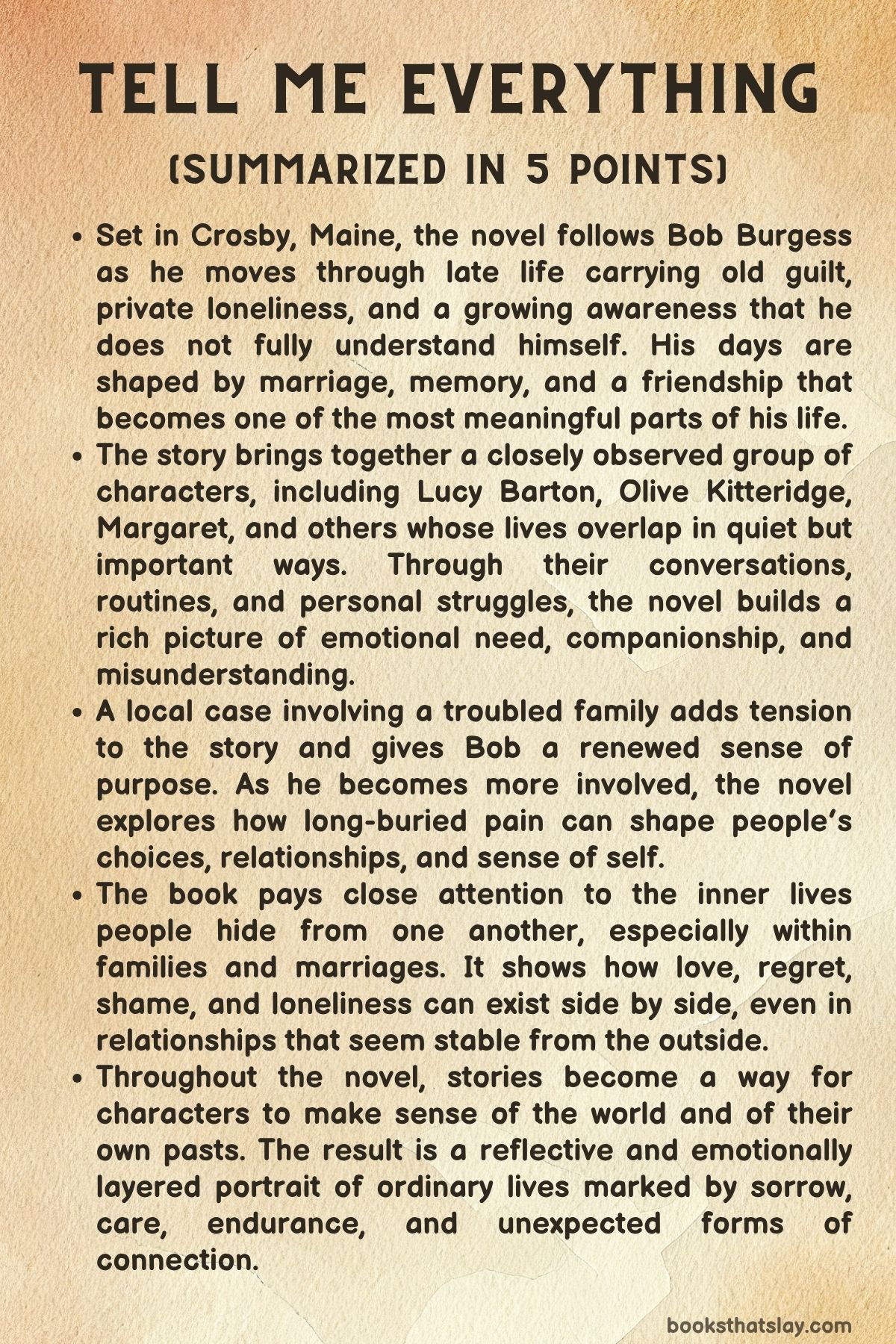
Tell Me Everything by Elizabeth Strout is a quiet, searching novel set in Crosby, Maine, where ordinary days carry the weight of memory, regret, and human need. The story centers on Bob Burgess, a retired lawyer moving through late life with more uncertainty than he admits, while his bond with writer Lucy Barton deepens into a source of comfort, recognition, and emotional risk.
Around them, Strout gathers familiar lives marked by loneliness, damage, endurance, and unexpected tenderness. The novel asks how people carry pain, how they misread one another, and how love can exist in forms that do not fit easy labels.
Summary
In Crosby, Maine, Bob Burgess moves through a season of inward unrest. He is respected in town, married to Margaret, and mostly retired from law, yet he lives with old guilt and a persistent sense that he has never fully understood himself.
As a child, he was believed to have caused the accident that killed his father, and that burden shaped his life. Bob finds his deepest sense of ease not at home but during long walks with Lucy Barton, a writer from New York who now lives in Crosby with her former husband, William.
Their friendship becomes one of the novel’s central emotional currents. They listen to each other with unusual care, and in those walks Bob feels known in a way that is rare for him.
Lucy also forms a connection with Olive Kitteridge, who is older, blunt, and often difficult, yet drawn to people’s hidden lives. Olive tells Lucy stories from her family and from the town, including one about her mother’s youthful love for another man before marriage.
That discovery leads Olive and Lucy to reflect on the unseen presences that can linger inside a marriage and inside a life. Their talks establish one of the book’s main ideas: people carry whole emotional histories that others may never see.
At the same time, a troubling local case begins to take shape. Gloria Beach, a harsh, feared woman from town, disappears.
Months later, her body is found in a submerged car. Suspicion falls on her son Matt, a socially isolated man who lived with her and had little contact with the world beyond their house.
Bob takes the case, partly because Matt’s vulnerability stirs something old in him. When he visits Matt, Bob is struck by his innocence, his loneliness, and his quiet devotion to a mother who was difficult and often cruel.
Bob also discovers that Matt is a gifted painter whose work centers on pregnant women, images that expose a tenderness and artistic seriousness no one around him seems to value.
As Bob investigates, the Beach family history opens in painful layers. Gloria’s own life was full of violation, shame, and misery from an early age.
Her daughter Diana escaped into a professional life elsewhere, while Matt remained behind, tied to the house and to Gloria’s care. Bob comes to see that the case is not simply about guilt or innocence in a legal sense.
It is about damage passing through generations, about what abuse does to a family, and about the ways people survive by becoming hard, secretive, or cut off.
Alongside the mystery, the novel follows the emotional movement of several lives. Bob’s first wife, Pam, reenters the story in crisis.
She has been drinking in secret, her marriage has broken under betrayal, and she no longer knows what to do with herself. Bob offers practical care rather than drama, urging her toward recovery and a more honest life.
Pam’s struggle with addiction and relapse becomes another example of the book’s steady attention to private suffering. Recovery is shown not as triumph but as repetition, shame, effort, and the chance of beginning again.
Bob’s brother Jim is also in turmoil. Their relationship has always been complicated by cruelty and silence, and Jim finally reveals that the story Bob carried for years about their father’s death may not be true.
Jim’s wife Helen is dying, and her illness throws the whole family into grief and reckoning. After Helen’s death, Jim’s pain grows more visible, especially in his broken relationship with his son Larry.
Bob tries to help, partly because Helen asked him to, but also because he still longs for some repair inside his own family. What he finds instead is that forgiveness and understanding do not arrive on command.
Families can remain bound by love and injury at the same time.
Meanwhile, Bob’s marriage to Margaret begins to shift. Margaret is a minister, composed and admired in public, but Bob slowly admits to himself that she often does not really hear him.
A fight exposes years of imbalance in their marriage, and he realizes how much of himself he has kept silent. Margaret, shaken by this, begins to look at herself more honestly.
Threatened in her work by church politics, she becomes less performative and more sincere, and her sermons deepen. Their marriage does not become simple, but it becomes more truthful.
Bob sees both her limitations and her capacity to change.
Bob’s bond with Lucy intensifies during all this. Though both insist, outwardly and inwardly, that they are friends, the relationship carries love, dependency, and longing.
Lucy offers Bob language for things he has barely known how to name. She sees the fear beneath his brother’s bullying, the tenderness beneath Bob’s reserve, and the loneliness beneath much of ordinary life.
Bob comes to understand that he is in love with her. Yet their connection is also unstable, because it exists inside limits neither fully states.
Lucy is lonely in her own way, bruised by distance from her daughters and by lifelong habits of emotional hunger. She tells stories to Olive about fleeting moments of human contact, trying to make sense of why such small exchanges can matter so much.
Again and again, the novel returns to the truth that people are desperate to be seen.
The Beach case finally breaks open when Diana becomes central to it. Bob’s instincts sharpen after an encounter with her, and the truth emerges: Diana killed Gloria and then died by suicide before arrest.
Her act is tied to childhood sexual abuse by her father, Gloria’s failure to protect her, and a lifetime of carrying unbearable pain. Matt had suspected the truth but said nothing.
When Bob reads Gloria’s journals and Diana’s note, the story becomes less a crime puzzle than a record of how people are deformed by humiliation, violence, and abandonment. Bob stays with Matt through the aftermath, offering company, structure, and care.
He protects Matt from self-destruction, takes his paintings seriously, and helps him begin to imagine a future beyond grief and suspicion.
This care for Matt changes Bob. He begins to act more openly from compassion, without shame about it.
Margaret responds warmly to Matt’s work, and together she and Bob encourage him. Bit by bit, Matt starts to believe he may have a place in the world.
Late in the novel, Bob and Lucy’s relationship reaches a necessary turning point. Their conversations become strained, and a break opens between them just as William and Lucy decide to marry again.
Bob is heartsick, but the engagement also brings a kind of clarity. What he and Lucy shared was real, but it cannot become a full affair or a new life.
Lucy later tells Olive that she did love Bob, and that seeing his ridiculous haircut made her love him more but also showed her that nothing beyond what they already had should happen. In her understanding, love does not need to possess or destroy in order to be real.
It can remain love without becoming a different arrangement.
By the end, life in Crosby continues in its ordinary outward form, but many lives have shifted. Margaret and Bob find a more grounded version of their marriage.
Jim and Larry make a faint movement toward reconciliation. Pam keeps trying to rebuild.
Matt begins dating and moves toward healing. Bob resumes walking with Lucy, and though it is still painful, it becomes gentler.
He starts to accept his own age, his own face, and his own life.
The novel closes not with grand resolution but with a broader understanding. People suffer, often in ways no one around them fully knows.
Yet they also keep reaching toward one another through stories, acts of care, shared silence, and imperfect love. That, finally, is what holds the book together: the belief that connection may be fragile and incomplete, but it is still what makes life bearable.
Characters
Bob Burgess
Bob Burgess stands at the center of the novel as a man who appears stable, respected, and settled, yet is inwardly full of doubt, buried pain, and unmet emotional needs. Much of his adult life has been shaped by the belief that he caused his father’s death as a child, and that old guilt has trained him to live carefully, absorb hurt quietly, and avoid anger whenever possible.
He is decent almost to a fault, someone who notices suffering quickly in other people and often feels responsible for easing it. This instinct makes him a good lawyer and an even more revealing observer of human damage.
His care for Mrs. Hasselbeck, his attention to Pam’s crisis, and his commitment to Matt all show a man who keeps offering steadiness to others even when he does not feel steady himself.
Bob’s emotional life becomes more exposed through his friendship with Lucy. With her, he feels heard in a way he does not experience elsewhere, and that feeling changes him.
He begins to recognize how lonely he has been inside his marriage and how much of himself has gone unspoken for years. His attachment to Lucy is not just romantic longing; it is also relief, recognition, and the discovery of a more honest self.
At the same time, Bob is not idealized. He can be passive, avoidant, and overly dependent on emotional validation from the person who seems to understand him best.
His love for Lucy reveals both his tenderness and his confusion, since he wants the comfort of closeness without fully facing the consequences of what that closeness means.
His work on Matt’s case deepens the portrait of him. Bob takes the case not only out of professional curiosity but because Matt’s position touches an old wound in him.
He sees in Matt another life shaped by accusation, silence, and the danger of being misread. As the case unfolds, Bob becomes more than a lawyer; he becomes a protector, witness, and substitute source of care.
That role brings out his finest qualities, especially his patience, moral seriousness, and refusal to reduce people to their worst acts or worst suspicions.
By the end, Bob becomes a man with fewer illusions. He sees his marriage more clearly, understands that love can exist without possession, and begins to accept that no final explanation will solve the mystery of his own past.
His growth is quiet but meaningful. He does not become transformed into a new person.
Instead, he arrives at a gentler acceptance of himself, his age, his limits, and the mixed nature of human attachment.
Lucy Barton
Lucy Barton is one of the most emotionally perceptive figures in the novel, yet she is also one of the loneliest. She moves through the world with sensitivity to tiny gestures, passing moments, and almost invisible forms of connection.
Where other people might dismiss a brief exchange as meaningless, Lucy experiences it as proof that lives can touch one another in ways that matter. This gives her character an unusual softness, but it also reveals how hungry she remains for recognition and warmth.
She is someone who feels deeply and remembers deeply, and that inward life shapes both her stories and her relationships.
Lucy’s strength lies in her ability to see beneath surfaces. She understands fear beneath cruelty, pain beneath silence, and longing beneath awkwardness.
With Bob, she gives language to truths he has only half known. She recognizes the fear inside Jim’s bullying, the deeper loneliness in Bob’s life, and the emotional cost of living among people who do not fully attend to one another.
Her gift is not simply kindness. It is interpretation.
She listens closely enough to make sense of emotional patterns that others miss.
Yet Lucy is not presented as morally flawless or endlessly serene. She can be self-absorbed in subtle ways, abrupt in social exchanges, and caught inside her own emotional weather.
Her distance from her daughters hurts her deeply, and that pain feeds a recurring insecurity about whether she embarrasses people, burdens them, or drives them away. Her bond with Bob gives her comfort, but it also reveals the complexity of her own heart.
She loves William in one way, Bob in another, and understands that both loves are real even if they lead to different futures. One of the most important things about Lucy is that she does not treat love as a simple category.
For her, human feeling is layered, contradictory, and difficult to confine within ordinary rules.
Her conversations with Olive show another side of her mind. Lucy uses stories to approach questions she cannot answer directly.
Again and again, she circles around loneliness, meaning, suffering, and love, not to solve them but to hold them up to the light. She is both vulnerable and intellectually alive, a person trying to make sense of life without flattening its mysteries.
In Tell Me Everything, Lucy becomes a vessel for the novel’s belief that fleeting emotional truth can matter as much as dramatic action.
Olive Kitteridge
Olive Kitteridge brings force, bluntness, and moral unpredictability to the novel. She is rude at times, unsentimental, and often difficult to please, yet she has a piercing intelligence about human weakness.
Olive does not perform warmth in a conventional way, but she notices more than most people and carries old hurts with great force. Her presence adds a hard-edged honesty to the emotional world of the book.
When she tells stories, they are not polished lessons. They are fragments of life that contain regret, compromise, disappointment, and buried devotion.
Olive’s relationship with Lucy is one of the most interesting pairings in the novel because the two women differ so much in style while sharing a deep concern with hidden inner lives. Olive can initially seem dismissive of Lucy’s sensitivity, but she is also drawn to it.
Their conversations become a meeting place between two forms of intelligence: Olive’s rough practicality and Lucy’s emotional openness. Through the stories Olive tells about her mother, Janice Tucker, Pauline, Muddy Wilson, and others, she emerges as someone who has spent a lifetime observing how people live alongside loss.
She is also a character haunted by mortality. Her friend Isabelle’s threatened departure stirs panic, anger, and despair in her, showing how dependent she is on attachment even while she often resists tenderness.
Olive’s passing thought of death during that period reveals the depth of her loneliness and the shadow her father’s suicide still casts over her. She understands, perhaps better than anyone, that despair can appear inside ordinary life without warning.
What makes Olive memorable is the tension between harshness and insight. She can be ungenerous, but she can also cut directly to the truth.
By the end, her reading of Bob and Lucy is especially important. She sees that what passed between them was real but not meant to destroy their existing lives.
Her final reflections on suffering, attachment, and the world’s strange hold on us give her the weight of a witness who has earned her authority through long experience.
Margaret Estaver
Margaret begins as a figure who could easily be misunderstood as merely composed, capable, and somewhat self-involved, but the novel gradually gives her fuller depth. As a minister, she is used to occupying a public role in which poise and conviction matter.
That public self has, over time, created distance inside her marriage. Bob feels that she often speaks without listening and moves through shared life without real curiosity about his inner experience.
Early on, Margaret seems unable to grasp the seriousness of what Bob is feeling, and that failure becomes central to the strain between them.
What makes Margaret compelling is that she is not frozen in that role. Once conflict breaks open the marriage, she is forced into self-recognition.
Bob’s accusation that she is self-absorbed shakes her, and instead of dismissing it entirely, she slowly begins to change. The novel treats this shift with care.
Margaret does not suddenly become ideal or perfectly self-aware. She remains guarded, proud, and at times difficult to trust.
But she does start to listen more fully, and that change affects not only her marriage but also her work. Her sermons become less polished and more sincere, suggesting that personal humility has made her spiritually more truthful.
Margaret also represents a different kind of loneliness from Bob’s. She has likely assumed for years that competence and love were enough to sustain a marriage, only to discover that she has misread the emotional structure of her own life.
That realization is painful because it threatens her identity as a good partner and a good person. Her response to Matt’s paintings and her later warmth toward Bob show that she is capable of generosity once she becomes less defended.
In the end, Margaret is important because she prevents the emotional story from collapsing into a simple contrast between wife and beloved friend. She is not a barrier to feeling but a person with her own blind spots, pride, vulnerability, and capacity for renewal.
Her marriage with Bob survives not because it was secretly perfect but because both people are forced into a more honest version of it.
William
William serves as a steady but complicated presence in Lucy’s life. He is her former husband, later her husband again, and his role in the novel rests on his enduring bond with her.
He can seem practical, protective, and at times mildly oblivious, especially in the ways he speaks about caring for Lucy. His manner suggests a man who believes he understands his place in her life and wants to hold onto that place through usefulness, loyalty, and familiarity.
Yet the novel also hints that this protectiveness may carry its own imbalance, as if Lucy is sometimes seen as someone to be managed rather than fully met.
Still, William is not shown as cruel or shallow. He remains present, devoted in his own way, and genuinely connected to Lucy through shared history.
Their remarriage matters because it reflects something lasting between them, not simply habit or convenience. He belongs to the structure of Lucy’s life, and she belongs to his.
That fact does not erase the emotional significance of her bond with Bob, but it helps explain why Lucy ultimately returns to William. Their relationship is less about dramatic passion than about endurance, history, and a form of companionship that has survived fracture.
William also highlights one of the novel’s central truths: love does not arrive in only one form. His place in Lucy’s life may lack the emotional revelation she experiences with Bob, but it has its own legitimacy.
He is part of the book’s larger vision that attachment can be imperfect, asymmetrical, and still real.
Jim Burgess
Jim Burgess is one of the most damaged and difficult characters in the novel. He is Bob’s older brother, a man shaped by guilt, defensiveness, and long habits of cruelty.
For much of his life, he has used mockery and dominance to protect himself from feelings he cannot bear. His confession that he may have had a role in the accident that killed their father recasts years of behavior.
His bullying of Bob begins to look like a lifelong attempt to manage unbearable guilt by keeping emotional vulnerability at a distance.
Jim’s grief after Helen’s death breaks something open in him. He becomes less armored, more erratic, and more visibly wounded.
The grief is not confined to the loss of his wife; it seems to release all the other unresolved emotional failures in his life, especially his estrangement from Larry. Jim wants forgiveness, but he lacks the emotional training to seek it clearly or gracefully.
He can still be offensive, childish, and defensive even in moments that call for tenderness. That contradiction makes him painfully human.
He is not redeemed by grief, but grief exposes the frightened person beneath the aggression.
His relationship with Bob is one of the most emotionally rich strands in the novel. Jim both depends on and resents Bob.
He trusts him enough to confess things he cannot say to others, yet he has spent decades making Bob smaller. Their bond is steeped in family history, mutual suffering, and a closeness that cannot be expressed cleanly.
Jim’s warning to Bob about Lucy is especially revealing. It shows that even in his broken state, he recognizes danger when he sees it.
He understands that naming certain truths can shatter a life.
Jim’s tragedy is that self-knowledge arrives late and only partially. He begins to understand himself, but not in time to undo much of the damage he has caused.
Even so, the novel allows him dignity by refusing to reduce him to villainy. He is deeply flawed, but he is also a man carrying burdens that have deformed him from the inside.
Pam
Pam brings another kind of reckoning into the novel through her struggle with addiction, humiliation, and the collapse of the life she thought she had. As Bob’s first wife, she reappears not as a nostalgic figure but as someone in the middle of personal ruin.
Her drinking has become secretive and compulsive, her marriage has been violated by betrayal, and she feels emptied out by loneliness and social performance. Her crisis is presented with unusual clarity.
She is not simply drinking too much; she is trying to survive a life that has come to feel false, loveless, and emotionally uninhabitable.
What makes Pam compelling is her honesty once she begins to face herself. She is ashamed, frightened, and often disoriented, but she is also willing to admit the depth of her need.
Her recovery is shown with realism rather than sentimentality. She finds help, relapses, starts again, and slowly learns that change requires more than outrage at other people’s betrayals.
It also requires a new relationship to herself. Her efforts to reconnect with her son and rethink her marriage show a woman trying to rebuild after discovering how fragile her identity really was.
Pam also serves as a contrast to Bob’s emotional style. Where Bob is quiet and restrained, Pam is more visibly undone.
Yet the two share a capacity for loneliness and a history of looking composed while suffering in secret. Their continued friendship suggests a mature bond that no longer depends on romance.
Through Pam, the novel explores how collapse can become the beginning of a truer life.
Matt Beach
Matt Beach is one of the most moving characters in the novel because he exists at the intersection of suspicion, vulnerability, and hidden talent. At first glance he seems like the kind of local outsider people easily misunderstand: isolated, awkward, living with his mother, and rumored to be strange because of his paintings of pregnant women.
Yet when Bob meets him, what stands out is not menace but innocence. Matt is lonely almost beyond language.
He has no phone because he has no one to call, no ordinary social life, and no confidence that anyone will care whether he is safe.
His devotion to Gloria is one of the novel’s most painful emotional knots. He knows she was difficult and that others hated her, but he also understands her through the intimacy of care.
She raised him, tended him through illness, and remained the central fact of his life. That love does not cancel her cruelty, nor does it make him blind.
Instead, it shows how attachment can persist even when family life has been warped by fear and damage. Matt’s inability to speak openly about Diana’s guilt and the family’s history comes from this same emotional entanglement.
He has lived too close to pain for too long.
As an artist, Matt reveals a rich inner life that the town has overlooked. His paintings are serious, skillful, and full of feeling.
They suggest a sensitivity he cannot easily express in words. The novel wisely refuses to make his art into a gimmick or pathology.
Instead, it becomes one of the clearest signs that he has always been more than the role others assigned to him. Bob’s recognition of this matters enormously.
To be taken seriously by another person gives Matt a path back into life.
His growth in the latter part of the novel is quiet but deeply hopeful. Therapy, Bob’s companionship, Margaret’s affirmation, and the chance of romantic interest all help him begin to imagine himself as someone who can join the world rather than stand outside it.
He remains fragile, but the fragility is no longer identical with doom. He becomes one of the clearest examples of the novel’s faith that care can alter a life.
Gloria Beach
Gloria Beach is one of the book’s most tragic figures because the more the reader learns about her, the less possible it becomes to see her simply as a cruel mother or hated local woman. She is both of those things in the eyes of many people, but her life story reveals layer after layer of exploitation, shame, and abandonment.
She grows up in a brutal emotional world, gives birth young under horrifying circumstances, and enters adult life carrying self-loathing so deep that it shapes her whole manner. Her meanness is real, but it is also the outward face of a person who has never escaped degradation.
Gloria’s relationship with her children is defined by damage she cannot master. She can care for Matt devotedly, especially during his illness, yet still poison the emotional life of the household.
Her treatment of Diana is even more devastating because it joins resentment, denial, and moral cruelty. Instead of protecting her daughter, Gloria repeats the logic of shame that has governed her own life.
She becomes both victim and participant in a destructive cycle.
What gives Gloria depth is that the novel does not excuse her, yet it refuses easy condemnation. Her journals reveal a woman who hated herself profoundly and could not convert suffering into wisdom or kindness.
She is a portrait of what happens when a life is shaped by unhealed violation and no meaningful rescue ever arrives. Her death matters not only because it drives the plot, but because it exposes how many lives were organized around her pain.
Diana Beach
Diana Beach is one of the most haunting characters because her outward competence conceals a life structured around buried trauma. She becomes a guidance counselor, someone who helps younger people find language and direction, and that choice suggests both survival and displacement.
She has built a life away from home, but she has never been free of what happened there. Her father’s sexual abuse, Gloria’s failure to protect her, and the atmosphere of rage and shame in the household remain active forces inside her.
The revelation that Diana killed Gloria is shocking, but the novel does not present it as sudden madness. Instead, it emerges as the result of pain carried for decades, pain that becomes unbearable when fresh betrayal enters her life through her husband’s affair.
The emotional logic is devastating. She has lived by enduring, by moving forward, by functioning.
But endurance has limits. Once she is pushed past them, old injury and present humiliation collapse into one unbearable fact.
Diana’s suicide note and the final understanding of her life turn her from a distant figure into one of the novel’s clearest examples of how the past can remain violently alive inside a person. She is not reduced to murderer or victim alone.
She is a woman who survived for years under impossible inner conditions and then reached a point where she could no longer carry the weight. Her story gives the novel much of its moral seriousness, because it insists that buried damage does not disappear simply because a life looks orderly from the outside.
Susan Olson
Susan Olson offers a form of toughness that differs from Olive’s or Margaret’s. She is sharp, practical, observant, and not easily sentimental.
As Bob’s sister, she shares the family history that has shaped the Burgess siblings, but she has responded to it in her own way, with skepticism and blunt clarity. She remembers the Beach family from childhood with no softness, and her instinctive understanding of cruelty often proves accurate.
She is someone who has lived long enough to recognize damaged people without dressing them up in false innocence.
Her relationship with Gerry reveals another side of her. Beneath the wit and reserve, there is hesitation, old hurt, and the possibility of connection that neither of them quite knows how to claim.
Susan’s scenes often show how adulthood can still be shaped by youthful history, especially in a small place where memory clings to people. She is not a character of grand emotional speeches, but she provides grounding.
She sees things clearly, says more than others are willing to say, and remains one of the people holding the social world together through attention and common sense.
Katherine Caskey
Katherine Caskey plays a smaller but significant role as a figure of steadiness, emotional intelligence, and humane professionalism. Bob feels comforted by her presence, and that response reveals something important about her character.
She is physically affectionate without being invasive, perceptive without being theatrical, and capable of asking the sort of question that opens a person’s thinking rather than closing it down. Her role in helping Bob reconsider the story of his father’s death is especially important because she introduces uncertainty where guilt had become fixed identity.
Katherine also becomes a point of support for Matt, suggesting her broader symbolic function in the novel. She represents the possibility that careful listening and thoughtful intervention can redirect a life.
She is not dramatized heavily, but her calm intelligence has moral weight. She stands for a kind of adult competence that does not dominate others but quietly helps them bear what they have carried alone.
Mrs. Hasselbeck
Mrs. Hasselbeck may seem peripheral, yet she is an important part of the novel’s emotional texture. She is elderly, demanding, comic in places, and also vulnerable in ways that Bob feels almost physically.
His errands for her and his habit of watering down her gin place him in a role that is part caretaker, part witness to decline. Through her, the novel explores age not as noble wisdom but as a mixture of dependence, indignity, appetite, memory, and stubborn personality.
What makes her matter is the way she draws out Bob’s compassion and exhaustion. His moments with her reveal how caregiving can be intimate, frustrating, and morally uncertain all at once.
She also remains vividly herself, still capable of gossip, confession, and self-display. In that sense, she reflects one of the novel’s broader insights: people do not become simpler as they age.
They remain crowded with history, desire, pettiness, and need.
Charlene Bibber
Charlene Bibber represents ordinary companionship shaped by class, politics, and emotional need. Her friendship with Lucy develops through shared work at the food pantry, and the connection shows Lucy’s ability to cross social differences in search of real human contact.
Charlene is not intellectual or reflective in the same way Lucy is, but she is open, talkative, and responsive in ways that make companionship possible. Her life contains financial pressure, isolation, and the practical hardships of small-town living.
Her eventual withdrawal from Lucy after beginning a new romance is handled with quiet realism. Charlene is not cruel; she is simply pulled into another emotional center of gravity.
That shift reveals how friendships can fade not because they were false, but because life rearranges loyalties and attention. Charlene’s character also helps locate the novel in a social world beyond the more introspective main figures.
She carries the texture of everyday compromise, making her a useful reminder that loneliness and longing are not confined to the most articulate people.
Helen
Helen, though absent for much of the novel because of illness and then death, exerts strong moral influence. She is one of the few people who seems to have understood both Jim’s weakness and Bob’s reliability without distorting either one.
Her final request that Bob help Jim and Larry carries great emotional force because it reveals her role as one of the last stabilizing presences in that family. Her death unmoors Jim and sets off a series of confrontations that expose old wounds.
Helen matters because she seems to have been a person of emotional maturity in a family otherwise marked by defensiveness and miscommunication. Even in absence, she remains a measure of what care, patience, and responsibility can look like.
Her children’s grief and Bob’s loyalty to her wishes show how deeply she was valued.
Larry
Larry is important because he embodies the injury that can pass from one generation to the next even in lives that appear outwardly more fortunate. As Jim’s son, he has grown up with emotional damage of a subtler but still painful kind.
He is not burdened by the same forms of deprivation or abuse seen elsewhere in the novel, yet he carries the wounds of having a difficult father whose behavior often mixed cruelty, immaturity, and emotional absence.
After his accident, Larry becomes more exposed, and Jim’s frantic care opens a brief window for change. But Larry’s rejection of Jim after learning more of the family past shows how hard it is to respond with mercy when one has long been hurt.
He wants moral clarity, a clean distinction between good and evil, because ambiguity asks too much of him emotionally. His eventual brief gesture toward Jim suggests that reconciliation may begin not with understanding everything, but with the smallest sign that feeling has not died completely.
Addie Beal
Addie Beal appears through Lucy’s recollection, yet she becomes central to the novel’s meditation on the question of what a life means. Addie is charismatic, troubled, needy, talented, and shadowed by likely abuse, emotional confusion, and eventual addiction.
Her life is not organized into triumph or redemption. Instead, it seems to flare brightly and then end too soon, leaving behind the painful question of what, if anything, its shape amounted to.
That question is exactly why Addie matters. She resists easy interpretation.
She was loved, damaged, theatrical, vulnerable, and self-destructive. Lucy cannot reduce her to a lesson, and Olive finally responds with the harshest and perhaps truest answer: people suffer.
Addie’s story becomes a test case for whether meaning must be grand or whether being here, affecting others, receiving and giving love imperfectly, is enough. In Tell Me Everything, Addie’s remembered life opens the novel’s largest philosophical question without closing it.
Pauline
Pauline appears in one of Olive’s stories and functions as a study in the persistence of old feeling. Her youthful love for a married fisherman continues to live inside her across decades, marriage, widowhood, and age.
What makes her memorable is not the scale of her actions but the endurance of a private emotional truth that never fully disappears. She is a reminder that a person may live a respectable, complete-looking life while carrying another story entirely within.
Her importance lies in what she reveals about memory and desire. The self is never only the life others can see.
Pauline’s brief return to the island and her visible emotion afterward suggest that some attachments do not die; they simply become part of the hidden architecture of a person.
Janice Tucker
Janice Tucker emerges through Olive’s storytelling as an example of a life built on quiet endurance and moral absorption. She is a woman who takes in the hidden irregularities, sadness, and secret arrangements around her and continues living with a kind of plain acceptance.
Her marriage contains unspoken truths, and yet she navigates it without spectacle, resentment, or self-dramatization. Lucy’s description of her as someone who spent her life carrying other people’s burdens captures the unusual dignity of her character.
Janice matters because she expands the novel’s idea of love beyond romance and confession. Her life suggests that care may consist not in purity or honesty at all times, but in the patient, unglamorous acceptance of human imperfection.
She is a portrait of emotional labor carried without applause.
Muddy Wilson
Muddy Wilson is another of Olive’s remembered figures, and his importance lies in the way he embodies restless grief. After losing his first wife, he seems to spend the rest of his life trying, unsuccessfully, to recover something that cannot be recovered.
His later relationships never stabilize him, and his movements from marriage to marriage suggest a man driven less by desire for novelty than by inability to live with absence.
His final declaration of love to Olive complicates him further. It suggests that longing can attach itself in surprising ways and that people may not fully understand their own emotional histories until very late.
Muddy represents a life shaped by repeated attempts to mend an original break, only to learn that some losses cannot be repaired through substitution.
Isabelle Goodrow
Isabelle Goodrow is important not because of dramatic action but because she reveals Olive’s capacity for attachment. Their friendship is one of the deepest emotional ties in Olive’s later life, and the threat of separation pushes Olive into panic, anger, and near despair.
Isabelle’s possible move shows how devastating old age can be when even the few sustaining connections one has are at risk.
Her role helps show that friendship, especially in later life, can carry the emotional force often assigned only to family or romance. Isabelle’s continued presence matters because she anchors Olive in the world.
Through her, the novel honors companionship as one of the forms love can take.
Avery Mason
Avery Mason has a comparatively small role, but she represents institutional pressure, vanity, and the petty forms of power that can wound a person’s sense of worth. Her conflict with Margaret pushes Margaret into a more vulnerable and genuine mode of being.
Avery is less a fully developed psychological portrait than a force that tests another character. Even so, she matters because the novel understands that not all damage comes from grand tragedy.
Sometimes it comes from rivalry, social control, and the threat of humiliation in public life.
Thomas Beach
In Tell Me Everything, Thomas remains somewhat distant, yet his distance is itself meaningful. As Gloria’s eldest child and later a psychiatrist, he appears to be the sibling who escaped most thoroughly by leaving and severing contact.
That severance suggests both self-protection and the limits of endurance. He is important because his absence speaks volumes.
Some family histories do not produce confrontation or healing. They produce flight.
Thomas stands for the cost of survival through distance.
Sara, Olive’s Mother
Sara, as Olive describes her, is a figure shaped by disappointed love, difficult marriage, and emotional hardness. Her life becomes important not simply as background but as one more example of the hidden emotional stories beneath ordinary family history.
The fact that she may have named her children after the imagined future she once planned with another man gives her character a melancholy power. She lived outwardly within one marriage while inwardly still marked by another lost possibility.
Sara helps the novel insist that bitterness, coldness, and dissatisfaction do not arise from nowhere. They may be expressions of an earlier life never fully relinquished.
That does not excuse the harm she causes, but it deepens her beyond stereotype.
Themes
The Many Forms of Love
Love in Tell Me Everything is presented as something far wider than romance, and that breadth gives the novel much of its emotional force. The relationships in the story show that love can be tender, burdensome, sustaining, misdirected, or restrained, yet still remain real.
Bob’s connection with Lucy is one of the clearest examples of this idea. What passes between them is not simply desire, though desire is certainly part of it.
Their bond grows from attention, recognition, and the relief of feeling heard. Bob experiences Lucy as someone who understands the hidden parts of him, and that understanding becomes deeply intimate.
Yet the novel refuses to frame their connection as the only valid form of love. Lucy’s renewed marriage to William, Bob’s enduring tie to Margaret, Olive’s devotion to Isabelle, and Bob’s protective care for Matt all expand the meaning of love beyond one emotional script.
This broad treatment matters because the novel is interested in how people remain attached even when those attachments do not fit simple categories. Love here is not always clean, mutual in the same degree, or easy to explain.
It can exist alongside marriage, regret, resentment, memory, and longing. It can survive disappointment.
It can appear in the desire to help someone stay alive, in the effort to understand another person’s suffering, or in the willingness to sit with another person’s pain without trying to control it. Bob’s care for Matt is especially revealing in this respect.
He becomes lawyer, guardian, witness, and emotional anchor, and the seriousness of that care carries a force equal to any love story in the novel.
The novel also suggests that mature love often involves limits. Bob and Lucy’s relationship gains much of its meaning from what it does not become.
Their love matters not because it overturns their lives but because it changes how they see themselves and each other. Lucy’s later understanding that love can be real without needing to become possession or betrayal gives the novel one of its deepest insights.
The story argues that love is not diminished by taking an unexpected form. Instead, it becomes more truthful when it is allowed to exist as recognition, care, loyalty, friendship, or sorrow.
That view gives the emotional world of the novel its unusual richness.
Loneliness and the Desire to Be Known
The emotional climate of the novel is shaped by loneliness, not as a temporary mood but as a permanent condition of being human. Nearly every major character carries some form of private isolation, and the novel returns again and again to the painful fact that people are only partially visible to one another.
Lucy speaks most openly about this, especially in the way she notices brief moments of connection that others might dismiss. A kind remark from a stranger, a fleeting conversation, or an exchange of feeling can take on immense significance for her because she lives with a constant awareness of how alone people are.
Her stories are often attempts to honor those moments when the wall between one life and another briefly thins.
Bob’s loneliness is quieter but equally important. Outwardly, he is socially respected, married, and integrated into town life.
Inwardly, he feels that very few people really hear him. His walks with Lucy become so meaningful because they offer him something rare: emotional recognition.
The novel makes clear that loneliness is not solved by marriage, community standing, or long familiarity. A person can spend years beside others and still feel unseen.
Bob’s growing awareness of the limitations in his marriage to Margaret comes from this truth. It is not simply that Margaret fails him in dramatic ways.
It is that she often does not enter the inner space where his life is actually being lived.
Olive’s story also deepens this theme. Her roughness and severity might seem, at first, to protect her from loneliness, but the novel shows that she is as vulnerable to it as anyone.
Her attachment to Isabelle reveals how much she depends on connection, even while she often resists the softer language of need. When she fears losing Isabelle, her despair exposes the depth of her solitude.
Similarly, Matt’s life shows loneliness in its most extreme form. He has almost no social world, no easy language for intimacy, and no assurance that anyone will look after him.
His isolation is not just emotional; it is structural.
What gives the theme its force is that the novel does not imagine loneliness can be permanently cured. Instead, it suggests that human life is made bearable by moments of being known, even if those moments are partial and brief.
A walk, a story, a gesture of care, or a shared silence may not remove loneliness, but it can interrupt it. That interruption is treated as precious.
The novel’s emotional wisdom lies in accepting that complete understanding is impossible while still insisting that the effort to reach one another matters immensely.
The Long Afterlife of Trauma
Pain from the past is never locked away safely in this novel. It remains active inside the present, shaping decisions, relationships, self-perception, and even the stories people tell about themselves.
The most obvious examples come from the Beach family, where abuse, humiliation, and secrecy have marked several generations. Gloria’s life is defined by early violation, shame, and emotional degradation, and that damage does not remain confined to her own experience.
It reaches her children, especially Diana, whose childhood sexual abuse and her mother’s failure to protect her become central facts of her life. Diana’s eventual act of violence is not treated as a sudden break from reason but as the delayed eruption of trauma carried for decades.
The novel insists that what is buried does not disappear. It waits, changes form, and may reappear under pressure.
Bob’s life offers another version of this theme. His childhood belief that he caused his father’s death has shaped his entire emotional structure.
He becomes someone deeply uncomfortable with anger, quick to feel guilt, and prone to taking responsibility for the suffering around him. Even when the story of his father’s death becomes less certain, the effect of that belief remains.
Trauma here is shown not only as memory but as identity. It influences how Bob loves, how he works, and what kinds of people he feels drawn to help.
His care for Matt is partly legal, partly moral, and partly rooted in an old, unresolved kinship with the accused child he once was.
Lucy, too, carries a childhood marked by poverty, abuse, and emotional confusion. Although the events of her early life are not the main plot of this novel, her sensitivity to loneliness and her need for connection are clearly linked to that background.
The same is true in different ways for Olive, whose father’s suicide continues to echo through her later life, especially when she feels abandoned or close to despair.
What is especially striking is that trauma is not presented as an exceptional condition affecting only a few broken people. It is treated as something woven into ordinary social life, often hidden beneath routine, politeness, and work.
Characters continue functioning, marrying, parenting, joking, and aging while carrying histories that remain unfinished inside them. The novel does not offer neat healing.
Some people begin to recover, some remain trapped, and some cannot survive the weight of what they have endured. Yet there is also an important counterpoint: being witnessed can matter.
Bob’s presence in Matt’s life, Katherine’s listening, Lucy’s understanding, and even Olive’s rough but honest attention all suggest that trauma may not be erased, but it can be met with something other than silence.
Stories as a Way of Understanding Life
Stories are not decorative in this novel; they are one of the main ways people think, remember, connect, and endure. Again and again, characters tell one another stories that seem, at first glance, indirect or unrelated.
Olive tells Lucy about her mother, Janice Tucker, Pauline, and Muddy Wilson. Lucy tells Olive about strangers, old acquaintances, and fleeting encounters that affected her deeply.
These stories do not operate as tidy lessons with obvious morals. Instead, they function as emotional probes.
Characters use them to circle questions they cannot answer directly: What does love mean? Why do people continue living after disappointment?
What is the value of a damaged life? Why do some experiences stay with us forever while others vanish?
This use of storytelling is crucial because the novel understands that direct explanation often fails. People do not always know what they feel in straightforward terms.
A story about another person becomes a way of approaching one’s own hidden thoughts. When Olive tells Lucy about the old love in her mother’s life, she is not only speaking about her mother.
She is also revealing something about memory, marriage, and the ghosts that remain in a person long after circumstances change. When Lucy tells stories of brief human contact, she is expressing her belief that connection, however small, can redeem a day or reveal something essential about existence.
These stories become a language for what ordinary conversation cannot easily hold.
The theme matters also because the novel is filled with characters who are trying to make meaning without forcing life into false order. Lucy’s question about Addie Beal, asking what the point of that life was, captures the deepest tension in the book.
Some stories resist usefulness. Some lives do not produce clear moral conclusions.
Olive’s answer, that people suffer, is harsh, but it is also part of the book’s honesty. Storytelling here is not about imposing comforting shape on experience.
It is about bearing witness to complexity.
At the same time, stories create community. They allow one person to hand something to another: a memory, a burden, an interpretation, a form of care.
Lucy’s final gift of a story to Olive is therefore deeply meaningful. It is not just recollection; it is an offering of trust and understanding.
In Tell Me Everything, stories are how people try to make life legible, even when life remains resistant to complete explanation. They do not solve suffering, but they help transform private feeling into something shared, and that act of sharing becomes one of the novel’s quiet forms of grace.