Tempting Venom Summary, Characters and Themes
Tempting Venom (Vipers #3) by Rina Kent is a dark contemporary romance centered on two rival hockey players whose hostility conceals an intense emotional connection.
Marcus Osborn comes from poverty and rejection, while Preston Armstrong belongs to a powerful family whose wealth cannot protect him from trauma, mental illness, or loneliness. Their relationship develops through competition, dominance, secrecy, jealousy, and carefully negotiated trust. The book addresses childhood abuse, family neglect, sexuality, psychological survival, and the difference between desired pain and uncontrolled harm. Beneath its violent world, the story follows two damaged young men who learn that love requires honesty, responsibility, treatment, and the courage to remain alive.
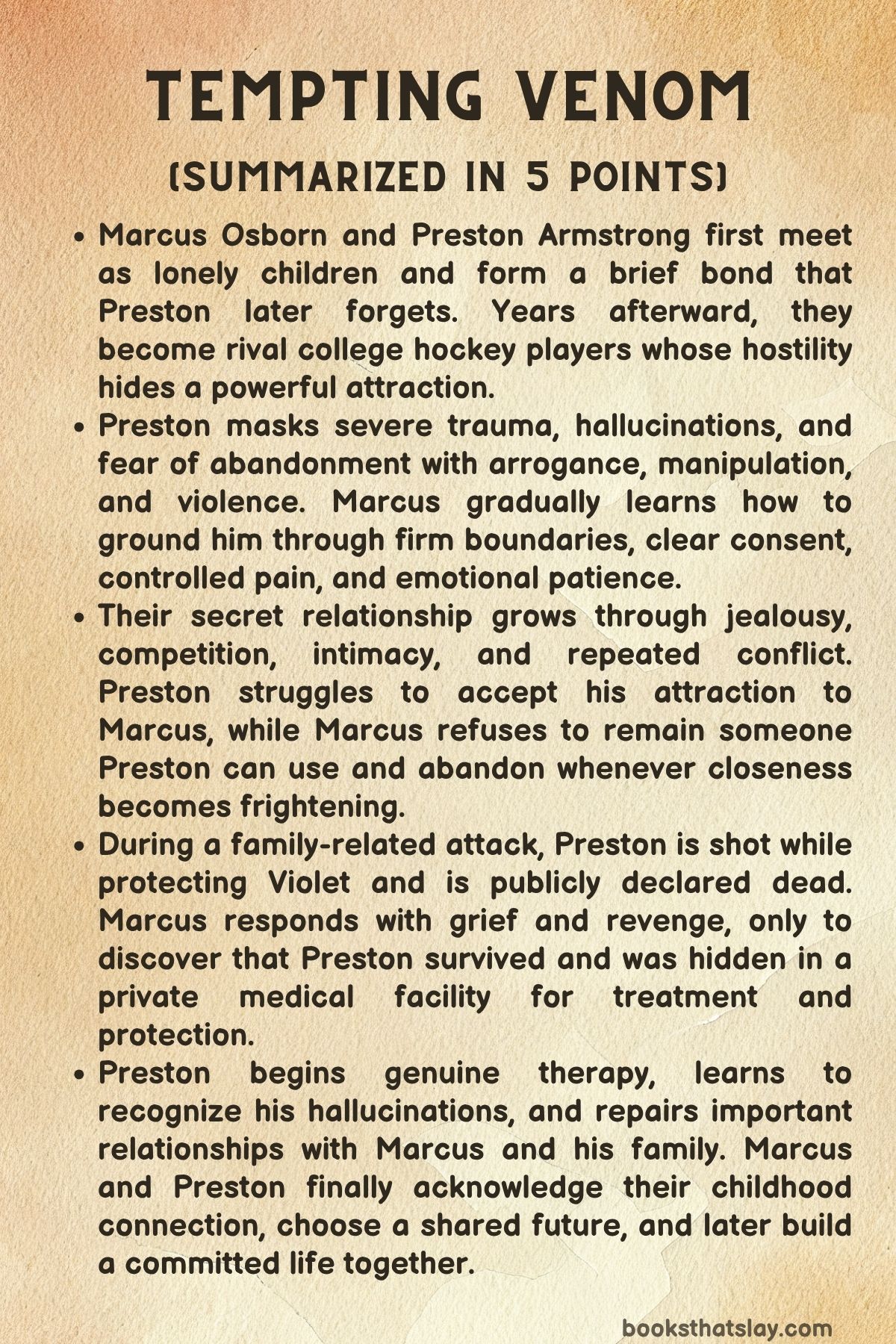
Summary
Seven-year-old Marcus Osborn already understands that he is unwanted by his father, Andrew, even before he hears Andrew openly admit it. After Andrew fails to attend Marcus’s birthday, Marcus’s mother, June, takes him to the Osborn mansion and confronts Andrew, but the conversation only confirms that Andrew considers money an adequate substitute for affection.
While wandering through the garden, Marcus meets Preston Armstrong, a beautiful blond boy sitting in a tree. Both children are troubled by their parents’ broken relationships, and they promise to become rich enough to care for their mothers; Preston gives Marcus mango candies, Marcus places an orange daisy behind Preston’s ear, and the brief meeting becomes a treasured memory for Marcus even though Preston later forgets it.
Years later, Marcus and Preston are captains of rival college hockey teams. Preston plays left wing for the Graystone University Vipers and is famous for studying his opponents’ weaknesses, provoking them with cruel remarks, and drawing penalties that give his team an advantage.
Marcus captains the Stanton River College Wolves and remains unusually resistant to Preston’s psychological tactics. During a heated game, Marcus calls Preston his fairy prince, promises to claim his attention, and begins following him across the ice until Preston loses control, attacks him, receives a severe penalty, and watches Marcus lead the Wolves to victory.
The defeat is especially damaging because Preston’s identity depends upon controlling every situation. His wealthy family has raised him within Vencor, a secret and violent organization dominated by Graystone Ridge’s founding families, and his father, Lawrence Armstrong, expects discipline, obedience, and strength from him.
Preston also lives with serious psychological symptoms, takes prescribed medication, and experiences disturbing episodes connected to childhood trauma. He hides these struggles beneath arrogance, cruelty, sexual confidence, and calculated violence, while privately believing that pain is the only reliable way to feel present and powerful.
After the game, Preston enters the Wolves’ arena, destroys Marcus’s equipment, and wears his skates while drinking whiskey and using painkillers. Marcus finds him injured and intoxicated, and their confrontation moves dangerously close to physical intimacy until a touch near Preston’s neck triggers panic, causing him to punch Marcus and escape.
Preston later steals Marcus’s motorcycle, drawing them into a series of threatening and increasingly suggestive messages. During a violent Vencor hunt in the Armstrong forest, Marcus secretly follows Preston and discovers that blood, danger, and physical control do not frighten him away from Preston but instead deepen his fascination.
Their fight in the forest reveals that Preston responds to controlled pain with relief and desire. Marcus recognizes that Preston needs a form of surrender that does not resemble helplessness, while Preston realizes that Marcus can dominate him without losing awareness of his condition or ignoring his limits.
A private hockey wager gives Marcus permission to touch Preston after Marcus defeats him. Inside the penalty box, Marcus makes Preston count, communicate, and remain focused, but the tenderness that follows awakens memories of abuse, and Preston responds by attacking Marcus and running away.
Despite the fear, the encounters continue. Marcus learns that gentleness can trigger Preston while structured commands and controlled pain can keep him grounded, and he establishes clear rules, active consent, and a safe word before allowing their physical relationship to develop.
For Preston, surrender becomes a temporary escape from the exhausting need to control every person and situation. For Marcus, the arrangement becomes more than attraction because he wants to understand Preston’s episodes, protect his boundaries, and care for the person hidden beneath his polished performance.
Marcus initially has another motive for approaching Preston. As Andrew Osborn’s unacknowledged son, he wants information about the founding families and hopes to use Preston as a weakness in Vencor, but his strategy loses importance as jealousy, protectiveness, and genuine attachment take over.
The Osborn family continues attempting to claim Marcus because the deaths of Andrew’s recognized sons have made him a valuable heir. Serena Osborn reveals that the family carries a hereditary blood disorder and once created a child known as Patient X for biological compatibility, confirming Marcus’s belief that the Osborns treat children as resources rather than human beings.
Preston becomes visibly jealous whenever Marcus spends time with another person. Although he repeatedly insists that he is straight and treats Marcus as a temporary source of entertainment, his physical reactions, possessive outbursts, secret compliments, and protective gestures reveal that his attachment is becoming impossible to deny.
Marcus refuses to accept an arrangement based only on sex and violence. He wants conversation, exclusivity, honesty, aftercare, and time together outside their encounters, but Preston’s fear of emotional dependence makes him withdraw whenever their relationship begins to feel secure.
Their conflict becomes critical on the anniversary of the death of Preston’s mother, Valérie. Intoxicated, hallucinating, and overwhelmed by memories, Preston accidentally sets fire to his car near a cliff and remains beside it as though he has accepted death.
Marcus understands the danger during a phone call and reaches Preston before the car explodes. He pulls him away, helps him breathe, and holds his attention until Preston kisses him desperately, discovering that Marcus’s presence can quiet his mind more effectively than violence, medication, or denial.
The rescue gives Preston a reason to consider recovery, but it does not immediately remove his defenses. He continues hiding Marcus from his friends Jude and Kane, denying the seriousness of their connection, and reacting with jealousy whenever someone else receives Marcus’s attention.
Marcus eventually establishes conditions for continuing their relationship. They will be exclusive, Preston will stop disappearing without explanation, and their meetings will no longer depend entirely on threats or public confrontations.
Preston accepts the rules while pretending that he is simply making another claim of ownership. At Marcus’s modest childhood home, however, he encounters the warmth of June’s care and becomes painfully aware that Marcus possessed something the Armstrong fortune never gave him: a home where affection was ordinary and dependable.
A nightmare later causes Preston to wake with his hands around Marcus’s throat. Instead of condemning him, Marcus remains calm until Preston recognizes him, forcing Preston to confront the possibility that someone can witness his most dangerous symptoms and still choose to stay.
Preston finally explains that secrecy is not based only on shame. Vencor has punished same-sex relationships with death, and public exposure could require Lawrence to discipline or even kill his own son.
Marcus agrees to protect their privacy but refuses to be treated as a hidden mistake in private. As they share meals, sleep beside one another, and discuss family, the relationship begins offering Preston companionship and domestic security in addition to physical release.
Preston’s fear of this closeness repeatedly causes him to push Marcus away. When Marcus stops answering him, Preston waits outside in the rain for hours, sending messages that move from insults and threats to desperate promises that he will give Marcus anything in exchange for a response.
Their reunion leads to their first fully intimate night together. Marcus proceeds patiently, maintains eye contact, checks Preston’s comfort, and allows him to experience vulnerability without dissociation, mockery, or force.
The emotional consequences frighten Preston more than the physical experience. He leaves after convincing himself that Marcus deserves someone less unstable, while Marcus feels abandoned after sharing a degree of intimacy he has never offered anyone else.
They reconnect, and Preston eventually discloses his diagnoses, hallucinations, violent impulses, and fear that his mind makes him unworthy of love. Marcus does not dismiss the danger, but he refuses to define Preston entirely by his condition and asks him to stay alive.
June unexpectedly discovers their relationship and welcomes Preston without judgment. During breakfast, she recalls that Marcus once wanted to marry the golden-haired boy from Andrew’s garden, bringing Preston close to recovering the forgotten childhood memory that has shaped Marcus’s feelings for years.
As Preston’s attachment grows, his mental condition worsens. His therapist, Dr. Duret, appears to abandon him, Marcus ends their relationship after another disappearance, and Preston burns one of Lawrence’s cars in an attempt to provoke proof that his father still cares.
Lawrence’s alarm reveals that Dr. Duret and the punishing associate Lenin are not real people in Preston’s present life. Before Preston can understand the full truth, he assumes that his family intends to institutionalize him and writes Marcus a letter explaining his history.
During a picnic, gunmen attack Violet, who is revealed to be Lawrence’s hidden half-sister and therefore a threat to the Armstrong family structure. Exhausted by his hallucinations and convinced that everyone would be safer without him, Preston steps in front of a bullet meant for Violet.
Marcus catches him and begs him to remain conscious, but Preston appears to die after surgery. Marcus reads Preston’s letter and learns that Claude, Valérie’s boyfriend, sexually abused Preston when he was seven, while a teacher abused him again at boarding school when he was eleven.
The letter explains that Preston survived by mentally separating from his body. It also reveals that Valérie died by suicide after discovering the abuse, leading Preston to believe that exposing his suffering destroys the people who love him.
Dr. Duret is a hallucination created from memories of Valérie and Dr. Fenwick, while Lenin represents another hallucination through which Preston explains injuries he often inflicts upon himself. Pain keeps him present because tenderness, praise, and certain touches remind him of Claude’s methods.
Believing Preston dead, Marcus dedicates himself to revenge. He identifies and kills the people connected to the shooting, including Marguerite Armstrong, who arranged the attack because Violet’s existence threatened the established family order.
Marcus nearly follows Preston into death before Lawrence reveals that Preston survived. His death and funeral were staged so he could receive private treatment, remain protected from further attacks, and help expose those responsible.
In treatment, Preston begins distinguishing hallucinations from reality and understands that his symptoms developed as survival responses rather than proof that he is beyond help. Lawrence finally explains that Valérie loved him, acknowledges his own failures, promises not to abandon him, and accepts that Marcus is an essential part of Preston’s life.
When Preston reunites with Marcus, they confess their love and promise to communicate rather than disappear. Marcus explains their childhood meeting and the meaning of his orange-daisy tattoo, while Preston remembers the imaginary friend he once called Daisy and realizes that the memory belonged to Marcus.
Preston chooses to continue treatment and live for himself as well as for their future. Marcus continues his hockey career, Preston builds a life beyond family obligations, and they gradually become open with the people closest to them.
A year later, they live together in New York and manage their relationship through communication, consent, medical treatment, and mutual protection. When Preston declares that Marcus will become his husband, Marcus accepts, completing the promise that began when two lonely children met in a garden.
Characters
Marcus Osborn
In Tempting Venom, Marcus Osborn is introduced as a neglected child who learns early that love cannot be expected from his biological father. Andrew’s rejection creates anger and ambition in him, but June’s devotion prevents that rejection from destroying his ability to care for another person.
As an adult, Marcus is disciplined, observant, physically powerful, and emotionally controlled. His skill as a defensive hockey player reflects his larger personality because he studies danger, absorbs pressure, and waits for the correct moment to respond.
His initial interest in Preston contains an element of strategy. Marcus wants access to Vencor and information that might help him fight the Osborn family, yet his willingness to use Preston weakens as he recognizes the depth of Preston’s suffering.
Marcus’s dominance is not presented as uncontrolled aggression. He insists upon consent, rules, communication, and a safe word, and he learns that his responsibility is to distinguish between the pain Preston chooses and the abuse that once removed Preston’s ability to choose.
His possessiveness can still become dangerous. Marcus wants Preston’s exclusive attention, reacts strongly to jealousy, invades Preston’s privacy, and carries out a violent revenge campaign after believing Preston has died.
At the same time, he becomes one of the few people who refuses to abandon Preston during hallucinations, dissociation, aggression, or shame. Marcus’s development lies in moving from conquest and revenge toward commitment, patience, and a shared future.
Preston Armstrong
Preston Armstrong is the emotional and psychological center of Tempting Venom. He appears arrogant, charming, theatrical, cruel, and highly intelligent, but these traits also function as defenses that prevent others from identifying the frightened child beneath his confidence.
He has learned to control conversations by identifying weaknesses and attacking them first. On the hockey rink, this makes him an effective provocateur, while in his personal life it allows him to create distance before anyone can reject, pity, or expose him.
His childhood abuse profoundly shapes his relationship with touch, praise, tenderness, and power. Gentle words can resemble the methods used by Claude, while controlled pain keeps him aware of his body and separates consensual surrender from forced helplessness.
Preston’s mental health conditions are serious and sometimes dangerous. He experiences hallucinations, dissociation, manic behavior, psychotic symptoms, violent impulses, and suicidal thoughts, but the book does not reduce him to a diagnosis or suggest that romantic love alone can cure him.
His relationship with Marcus gives him a reason to pursue treatment, yet recovery only begins when Preston decides to identify hallucinations, communicate honestly, accept medical care, and stop treating disappearance as protection. His choice to live eventually becomes a personal commitment rather than an obligation imposed by others.
Preston’s capacity for love is often expressed indirectly. He repairs the Wolves’ facilities, improves Marcus’s working conditions, rejects other partners, protects June from being targeted, adores Miley, and risks himself for Violet while pretending that these actions are merely practical.
His greatest conflict is not simply accepting attraction to another man. It is accepting that being known does not always lead to punishment and that dependence, when chosen responsibly, does not have to become captivity.
June
June is Marcus’s emotional foundation and the clearest example of dependable parental love in the book. She raises him with limited resources, protects him from Andrew’s rejection, works as a head nurse, and provides a home in which affection is expressed through ordinary care rather than wealth or status.
Her influence explains why Marcus can recognize neglect without believing that all relationships must be neglectful. Even when he becomes violent and possessive, the values he learned from June encourage him to feed, protect, reassure, and remain present for Preston.
June also offers Preston a form of acceptance he has never received from the Armstrong household. She does not interrogate or condemn him when she discovers him in Marcus’s home, and her calm welcome gives him a brief experience of family life without performance or fear.
Her character is not powerful because she controls institutions. Her strength comes from consistency, moral clarity, hard work, and her refusal to make love dependent upon obedience.
Andrew Osborn
Andrew is Marcus’s biological father and one of the earliest sources of emotional injury in the story. His insistence that financial support fulfills his parental responsibility reveals a worldview in which money, bloodlines, and utility matter more than affection.
His rejection teaches Marcus to distrust the Osborn family, particularly when Andrew later tries to claim him as an heir. Marcus correctly recognizes that Andrew’s interest increases only when family deaths make his unacknowledged son politically and biologically valuable.
Andrew is not entirely without complexity. He later claims that distance partly protected Marcus from becoming a biological resource for the Osborn family, but this explanation does not erase the cruelty Marcus heard as a child or Andrew’s failure to provide honest protection.
His character represents the damage caused when a parent substitutes strategy for intimacy. Even actions that may have had protective motives become harmful because Andrew refuses to communicate, accept responsibility, or treat Marcus as a son rather than an asset.
Lawrence Armstrong
Lawrence initially appears to be an intimidating and emotionally absent father whose expectations contribute to Preston’s instability. Preston believes Lawrence orders his punishments, ignores his suffering, and values the Armstrong legacy more than his son’s emotional safety.
The later revelation complicates this image. Some of the punishments Preston attributes to Lawrence’s associate Lenin are connected to hallucinations and self-inflicted injuries, meaning Lawrence is not responsible for every act Preston believes he authorized.
However, Lawrence still bears responsibility for failing to recognize the severity of Preston’s symptoms and for creating a household in which his son expects discipline rather than comfort. His controlled manner leaves Preston desperate enough to destroy property simply to provoke evidence that his father still cares.
His eventual honesty about Valérie, Claude, treatment, and the staged death marks a major change in their relationship. Lawrence assures Preston that he will not discard him, accepts Marcus’s importance, and offers him freedom from the Armstrong identity without making freedom equivalent to abandonment.
Miley Armstrong
Miley is Preston’s young half-sister and one of the few people he loves without defensive calculation. His tenderness toward her reveals that his cruelty is not his only natural response and that he is capable of patient, protective affection.
She also represents innocence within the cold Armstrong household. By bringing Preston food, skating with him, teasing him about Marcus, and openly expressing affection, she creates moments in which he can behave like a caring brother instead of an heir under observation.
Preston’s devotion to Miley strengthens his desire to protect vulnerable people from the environment that damaged him. Her presence also gives his recovery a wider purpose, since remaining alive allows him to continue being the protective figure he wished he had possessed as a child.
Jude Callahan
Jude is one of Preston’s closest friends and belongs to the small group that has witnessed his most dangerous episodes. His familiarity with Preston’s behavior allows him to intervene physically when necessary without treating Preston as disposable.
He is protective, suspicious, and willing to use force, particularly when he believes Marcus may be exploiting Preston. His initial hostility toward their relationship comes less from prejudice than from distrust of a rival who has repeatedly fought and provoked his friend.
Jude’s loyalty also has limits because friendship cannot provide the professional treatment Preston needs. Even so, his continued presence proves that Preston has not successfully driven away everyone who knows his capacity for violence.
His eventual willingness to tolerate Marcus reflects a practical acceptance of Preston’s choice. Jude does not need to admire Marcus, but he recognizes that Marcus helps Preston feel safe and demands that this safety never be abused.
Kane Davenport
Kane is a team captain, a close friend of Preston, and another person accustomed to managing his instability. He is observant enough to recognize patterns in Preston’s behavior and decisive enough to stop an episode before it causes greater harm.
Compared with Preston’s flamboyant aggression, Kane often functions as a stabilizing force. He does not always understand the private connection between Preston and Marcus, but he notices more than Preston expects and appears less shocked by the eventual revelation.
Kane’s friendship shows that care can involve boundaries as well as comfort. Knocking Preston unconscious during a dangerous escalation is harsh, yet it is presented as an emergency response from someone who understands that allowing Preston unlimited freedom can place everyone at risk.
Serena Osborn
Serena is intelligent, politically calculating, and deeply connected to the Osborn succession struggle. She assists Marcus when his interests align with hers, but her support is never entirely generous.
She wants Marcus close enough to stabilize the family yet weak enough to remain under her influence. Her information about Patient X and the family’s hereditary illness exposes the Osborns’ history of treating children as biological and corporate resources.
Serena therefore serves as both informant and manipulator. She gives Marcus essential knowledge, but her involvement in family deaths and power struggles confirms that she belongs to the same system he distrusts.
Her character demonstrates how survival inside a corrupt family can lead a person to reproduce its methods. She understands the danger of the Osborn structure, yet she continues using secrecy, threat, and strategic sacrifice to preserve her position.
Valérie
Valérie, Preston’s mother, exists through memory, hallucination, grief, and the explanations supplied by others. Preston remembers her as loving but also associates her death with his disclosure of abuse, causing him to believe that his pain destroys the people who care about him.
When she discovers Claude’s actions, she attacks him and comforts Preston. Her subsequent suicide, however, leaves her son with an unbearable conclusion that speaking honestly was responsible for her death.
Lawrence later reveals that Valérie had survived sexual abuse herself and was overwhelmed by guilt and unresolved trauma. This context explains her actions without removing the devastating effect they have on Preston.
The final dream in which she apologizes helps Preston begin separating her love from the accusations generated by his hallucinations. She remains a tragic figure, but her memory gradually changes from a sentence of guilt into evidence that both mother and son were harmed by violence neither created.
Claude Lavoie
Claude is the primary abuser in Preston’s childhood and the source of many of his adult triggers. He gains access through Valérie, uses grooming and threats, and teaches Preston to associate praise, beauty, secrecy, and affectionate language with exploitation.
His manipulation extends beyond physical abuse. By convincing Preston that disclosure will cause abandonment, Claude creates a belief that continues controlling Preston long after the abuse ends.
Claude’s actions influence Preston’s dissociation, fear of tenderness, need for control, and preference for pain that keeps him anchored in the present. The later revelation that Lawrence captured and punished him provides revenge, but it cannot reverse the psychological damage.
Dr. Fenwick
Dr. Fenwick is the real medical professional involved in Preston’s long-term treatment. Unlike the hallucinated figures, he offers explanations that help Preston recognize symptoms without treating him as morally worthless.
His approach frames hallucinations and dissociation as survival mechanisms that can be identified and managed. This allows Preston to move away from the belief that every symptom proves he is permanently defective.
Dr. Fenwick also represents the limits of romance as treatment. Marcus can provide grounding and emotional support, but professional care, medication management, and sustained psychological work remain necessary for Preston’s recovery.
Dr. Duret
Dr. Duret initially appears to be Preston’s therapist and the person to whom he confesses violent behavior, attraction, fear, and memories. The later revelation that she is a hallucination changes the meaning of every apparent session.
She is created from Preston’s memories of Valérie and Dr. Fenwick, allowing his mind to construct a figure who can question him while also repeating his fear of abandonment. When she appears to leave, the event produces an intense breakdown because it recreates the loss he expects from every important relationship.
Dr. Duret therefore represents both Preston’s awareness that he needs help and his inability to trust that help will remain available. Recognizing her as a hallucination becomes an important step toward separating internal fear from external reality.
Lenin
Lenin is presented as Lawrence’s threatening associate who enforces punishment and uses Miley’s safety to control Preston. The revelation that he is a hallucination forces Preston and the reader to reconsider the source of many injuries.
Through Lenin, Preston gives an external identity to self-punishment, fear, and internalized authority. Believing that someone else ordered the violence protects him from recognizing the extent to which trauma has taught him to harm himself.
Lenin’s disappearance during treatment does not mean Preston’s past has been erased. It indicates that he has begun identifying the figure as a product of his mind instead of accepting every command or threat as physical reality.
Lilith Armstrong
Lilith is Preston’s stepmother and a source of emotional humiliation within the Armstrong home. She initially pretends to offer maternal affection, then mocks Preston’s need for love and discusses removing him from the household.
Her behavior reinforces his belief that tenderness is a performance designed to expose weakness. Because she identifies and ridicules his longing for a mother, Preston learns to hide need beneath arrogance and aggression.
Lilith also demonstrates that emotional abuse does not require physical violence. Her contempt contributes to an environment where Preston possesses enormous material privilege but little confidence that anyone’s affection is genuine.
Violet
Violet is connected to the Armstrong family as Lawrence’s hidden half-sister. Her existence threatens established power arrangements because she represents an unacknowledged branch of the family and a possible challenge to those protecting their position.
Preston notices the clues to her identity shortly before gunmen attack her. His decision to take the bullet intended for Violet reveals both his protective instinct and his suicidal exhaustion.
Violet therefore becomes part of Preston’s crisis without being responsible for it. Saving her is heroic, but the act is also complicated by his temporary willingness to die, making it an expression of courage mixed with self-abandonment.
Dahlia
Dahlia functions mainly as a friend and social connection whose presence exposes jealousy between Marcus and Preston. Marcus deliberately appears with her because he knows Preston will react, using her presence to test the truth behind Preston’s indifference.
She also appears during events involving Violet and the wider Graystone social circle. Although she is not given the same psychological development as the central characters, her role helps reveal how poorly Marcus and Preston conceal their possessiveness.
Marguerite Armstrong
Marguerite is responsible for organizing the attack on Violet because Violet’s existence threatens the Armstrong family structure. Her willingness to arrange murder demonstrates the extreme measures taken to preserve inheritance, legitimacy, and control.
She embodies the most ruthless aspect of the founding-family system. Human life has value only when it supports the accepted order, and violence becomes an administrative tool for protecting status.
Marcus eventually kills Marguerite during his revenge campaign. Her death completes his punishment of those involved in Preston’s shooting, though it does not resolve the grief and despair that nearly lead him to destroy himself.
Lyra
Lyra acts as a representative of the Osborn family when she offers Marcus property, shares, and payment of his debts. The offer appears generous but is designed to purchase cooperation and secure his place within the family structure.
Her role illustrates how the Osborns use financial power instead of emotional responsibility. Marcus’s refusal shows that he will not allow wealth to redefine Andrew’s rejection or turn his mother’s suffering into a negotiable expense.
Jenna
Jenna works with or socializes around Marcus at the mechanic’s shop and has a warm interaction with him. Her brief presence is important because it provokes Preston into publicly claiming Marcus.
She does not function as a serious romantic rival. Instead, Preston’s response to her reveals that his possessiveness has become stronger than his ability to maintain the appearance of indifference.
Hayes
Hayes gives Marcus the letter Preston wrote before the shooting. This action provides Marcus with the information Preston could not communicate aloud and changes Marcus’s understanding of the apparent death.
Through Hayes, the private record of Preston’s abuse, hallucinations, guilt, and love reaches the person for whom it was intended. His role is limited, but the delivery of the letter becomes a major turning point in Marcus’s grief and revenge.
Julian Callahan
Julian is Jude’s older brother and is mentioned as one of the people connected to Preston’s long-term treatment. His presence suggests that Jude’s family has been involved in helping manage Preston’s condition for years.
Although the book provides limited direct development, Julian contributes to the network of people who possess knowledge of Preston’s history. This reinforces the fact that Preston’s struggles existed long before Marcus entered his adult life.
Leo Osborn
Leo is Andrew’s sick son and the reason Preston is present at the Osborn estate during his childhood meeting with Marcus. His illness connects the personal encounter between the boys to the wider medical history of the Osborn family.
The limited information about Leo prevents a full psychological portrait. Even so, his existence helps establish the family’s concern with hereditary disease, heirs, compatibility, and the survival of its recognized children.
Richardson
Richardson is a Wolves player whom Preston attempts to provoke by mentioning a former girlfriend. The incident demonstrates Preston’s method of researching personal vulnerabilities and using emotional pain as a tactical weapon.
Marcus’s intervention prevents Richardson from becoming the focus of Preston’s manipulation. Richardson therefore helps establish the contrast between ordinary opponents, who are vulnerable to Preston’s tactics, and Marcus, who can redirect the attack back toward him.
Cyrus
Cyrus is eventually identified as the surviving Patient X, the child believed to have died in a laboratory fire. His survival proves that the official Osborn history contains deliberate lies and concealed victims.
Although he remains outside the central romance, Cyrus expands the moral scope of the family conflict. Marcus is not the only child whose identity and body were controlled by the Osborns, and Cyrus represents another life shaped by decisions made before he could consent.
Themes
Trauma, Memory, and Survival
Trauma in Tempting Venom does not remain safely contained in the past. It appears through Preston’s hallucinations, dissociation, panic responses, self-inflicted injuries, attraction to controlled pain, fear of tenderness, and conviction that disclosure will destroy anyone who loves him.
His memories are not always presented as clear and reliable records. Dr. Duret and Lenin appear real to him, while Valérie’s image accuses him of causing her death, showing how guilt and psychosis can reshape memory until internal fear is experienced as external fact.
The story also separates survival from complete recovery. Preston survived abuse by mentally distancing himself from his body, becoming aggressive, and taking control of violent situations, but the same defenses that once protected him later threaten his relationships and his life.
Treatment requires him to respect the original purpose of these responses without continuing to obey them blindly. Recognizing a hallucination does not erase the fear it represents, and choosing life does not immediately remove suicidal thoughts, nightmares, or violent impulses.
Marcus supports this process by grounding Preston in the present, but he cannot replace professional care. Preston’s progress depends upon medication, therapy, family honesty, communication, and his own decision to participate in recovery.
Control, Consent, and Chosen Vulnerability
Control governs Preston’s public identity. He manipulates opponents, predicts reactions, dominates conversations, uses cruelty before others can use it against him, and presents himself as someone who cannot be embarrassed or emotionally injured.
His desire to surrender to Marcus appears contradictory only until the difference between abuse and consent becomes clear. Claude removed choice, used tenderness as manipulation, and made Preston powerless, while Marcus requires him to communicate, count, request, refuse, and use a safe word.
Chosen surrender therefore becomes an active form of control. Preston determines whom he trusts, what he permits, and when an encounter must stop, even when Marcus takes the dominant role.
Marcus must also learn that desire does not grant unlimited authority. His possessiveness, jealousy, threats, and attempts to force emotional honesty sometimes place pressure on Preston, making boundaries and continuing consent essential.
Vulnerability eventually extends beyond physical encounters. Preston must admit jealousy, disclose diagnoses, remain after intimacy, ask for reassurance, and explain why secrecy is necessary.
Marcus must reveal his emotional needs, acknowledge that he can be hurt, and refuse arrangements that reduce him to a temporary source of relief. Their relationship becomes sustainable only when both men understand that power without responsibility repeats harm, while power negotiated through trust can create safety.
Family, Inheritance, and Belonging
Family names provide wealth, influence, and danger rather than dependable care. The Osborns and Armstrongs treat heirs as parts of a political structure, measuring children through bloodlines, succession, biological usefulness, reputation, and obedience.
Marcus is rejected when Andrew does not need him and pursued when the deaths of recognized heirs make him valuable. Preston is raised as an Armstrong successor but feels emotionally disposable, demonstrating that acknowledgment within a powerful family does not guarantee love.
Patient X presents the most extreme example of inherited identity becoming bodily ownership. A child is created for compatibility, hidden behind an official death, and treated as a solution to another heir’s illness.
Against these structures, June’s home offers a different definition of family. Its value comes from food, conversation, photographs, concern, and the confidence that affection will remain present after conflict.
Preston gradually forms a chosen family involving Marcus, June, Miley, Jude, Kane, and eventually a more honest relationship with Lawrence. These connections do not require him to become harmless, easy, or socially acceptable before receiving care.
Belonging is therefore shown as a continuing practice rather than a legal or biological fact. It is created when people remain accountable to one another, protect without controlling, communicate after harm, and refuse to turn love into a reward for perfect behavior.
Love, Responsibility, and the Choice to Live
Love initially appears to Marcus and Preston as possession. Each wants exclusive access to the other, reacts aggressively to jealousy, and uses threats or provocation to force attention.
Their early bond is intense but unstable because desire is easier for both men to admit than emotional dependence. Marcus can demand Preston’s body before openly admitting that silence hurts him, while Preston can claim Marcus in public yet still run when intimacy creates the possibility of abandonment.
The apparent death changes the meaning of their connection. Marcus discovers the private acts through which Preston improved his life, while Preston later learns that his death nearly destroyed the person who had begged him to remain alive.
Love cannot be reduced to rescue because Marcus does not cure Preston, and Preston cannot give Marcus permanent emotional certainty. Instead, love creates responsibilities that both men must consciously accept.
Preston chooses treatment, learns to identify hallucinations, promises to communicate, and begins living for reasons that include but are not limited to Marcus. Marcus agrees to support recovery without treating Preston as helpless, while also establishing boundaries when Preston disappears or denies their bond.
Their final commitment carries meaning because it is made after both have seen the danger of confusing love with sacrifice. They choose a shared life not because pain has ended, but because remaining present has become more important than escaping it.