Ten Thousand Light Years from Okay Summary, Characters and Themes
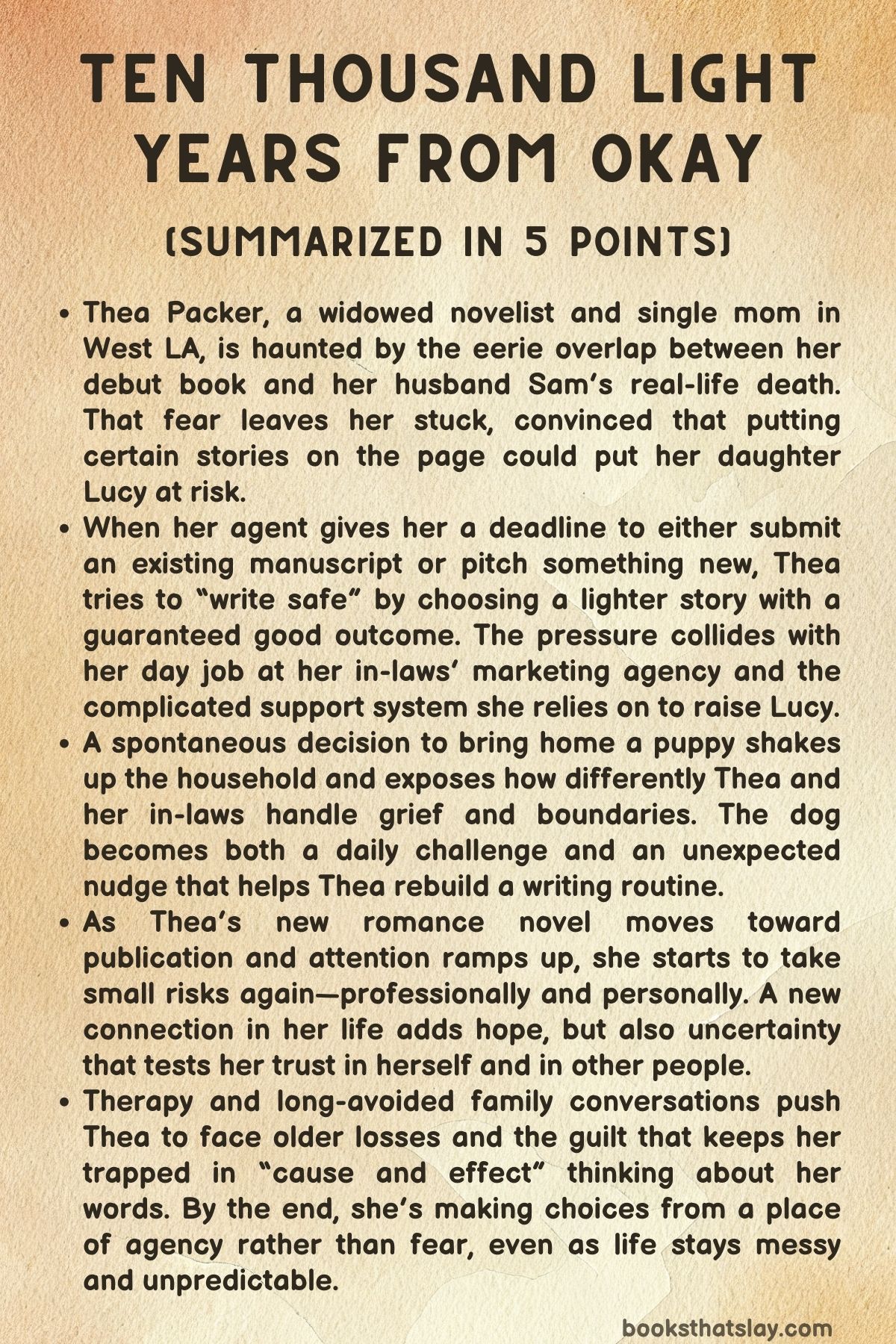
Ten Thousand Light Years from Okay by Tracy Dobmeier and Wendy Katzman is a contemporary novel about grief, fear, and the strange ways people try to regain control after life changes in an instant. Thea Packer is a widowed writer raising her preschool daughter, Lucy, while living in her in-laws’ orbit in West LA.
After a cruel coincidence between her debut novel and her husband’s sudden death, Thea becomes convinced her writing can shape reality—and that belief traps her. When she tries to publish again, new success collides with fresh chaos, forcing her to face the past, question what she “knows,” and choose a future that isn’t built on superstition.
Summary
Thea Packer takes her three-year-old daughter, Lucy, to a new independent bookstore in West Los Angeles. Thea quietly scans the shelves for her own debut novel, published years earlier under her maiden name, and feels a familiar sting when it isn’t there.
A bookstore clerk recognizes the title and, without meaning to hurt her, references the public tragedy attached to it: the author’s husband died in the same way a husband dies in the novel. Lucy, with a child’s blunt honesty, announces that her own father was hit by a car.
Thea rushes her outside, shaken by how quickly the past can become public again.
Four years earlier, Thea’s husband Sam had been a rising tennis star. On the day Sam learned Thea was pregnant, he was thrilled.
They went to their first ultrasound, heard the heartbeat, and drove home floating on the kind of happiness that makes you think the world is safe. Later that afternoon, Sam left the guesthouse for what should have been training.
Instead, he went for a run and was struck and killed by a car driven by a woman who suffered a sudden seizure. Thea identified his body at the morgue and never fully recovered from the shock.
The timing turned brutal in another way: Thea’s debut novel had recently been released, and its plot included a husband killed by a car while running. The internet erupted with conspiracy theories and ugly accusations.
Thea, already drowning in grief, absorbed the backlash and began believing something she could not prove but could not stop fearing—that her writing might “make” terrible things happen. Since then, she has avoided publishing again, even though writing is the one part of herself that still feels like hers.
Now, after the bookstore incident, the urge to write returns, but it comes with panic. Thea works at a marketing agency owned by her in-laws, Rebecca and William Packer.
At night, after Lucy sleeps, Thea tries to think of a “safe” book idea and finds her mind locked. She wakes from a nightmare in which she writes about an old tennis scandal—surely harmless, since it already happened—only to watch the imagined consequences erase Lucy from existence.
Terrified, she checks Lucy’s room and ends up clinging to her daughter as if holding on hard enough could keep tragedy away.
At work, Thea’s agent Harper Davies calls repeatedly. Thea is already under pressure: her boss humiliates her in a meeting over something as small as a semicolon, insisting it makes copy sound unfriendly.
When Thea finally answers Harper, Harper is blunt. Thea has a completed manuscript, Call of the Void, and a publisher is still interested.
But Thea refuses to let it go out because it involves a child disappearing. She can’t bear to write—or publish—anything that might tempt fate.
Harper gives her an ultimatum: within a week, either allow the sale of Call of the Void or provide a new book proposal, or Harper will walk away.
Thea and Lucy live in a guesthouse on the Packers’ property. William adores Lucy and is eager to shape her into a tennis prodigy, while Rebecca keeps tight control over the household’s emotional temperature.
Thea’s own parents are distant, marked by old grief from the death of Thea’s sister Callie when they were children. At family dinner, Thea admits she still misses Sam and mentions Harper’s demand.
Rebecca later implies that writing is indulgent and risks bringing back public scrutiny. Thea reveals a lawyer once warned that even the perception of a lawsuit could make people question her role in Sam’s death, and that doubt has never stopped echoing.
Rebecca urges her to focus on the stable life she has now, but Thea privately decides she will publish again.
Her best friend Frannie, alarmed by how stuck Thea is, pushes her to move out and get therapy. Thea dodges the conversation by making an impulsive decision: Lucy will get a dog.
It’s a distraction, a promise, and a desperate attempt to create joy on command.
As Harper’s deadline nears, Thea’s anxiety spikes. One night Lucy asks for a bedtime story, and Thea invents a sweet tale with a happy ending.
Lucy is delighted. Thea latches onto the idea that maybe she can protect her world by writing something that ends well.
She stays up all night building a romance pitch: a husband vanishes, then returns years later to his wife and the child he has never met. Harper likes the concept but sets strict conditions—keep it more tender than explicit, and do not make the hero a tennis player.
She also demands a draft within six months.
Thea struggles to begin until the dog plan becomes real. Frannie drives her to pick up a beagle puppy.
Lucy instantly names him “Sam. The.
Dog!” Thea freezes at the name, but Lucy insists it’s different: he’s a dog, not a person. Then Lucy adds the real reason—if the dog is named Sam and lives with them, maybe Thea won’t be so sad about Daddy being dead.
The comment lands like a small, precise bruise.
When Rebecca and William discover the puppy, Rebecca is furious—about the surprise, the responsibility, and especially the name. She argues it disrespects Sam’s memory and says Thea talks about Sam too much, turning the guesthouse into a museum.
Thea defends herself: she wants Lucy to know her father, to feel that he mattered. Underneath the argument is a deeper fight about grief—how much is allowed, how it should look, and who gets to decide.
Soon after, Thea finds the puppy chewing a toy astronaut and takes it as a sign she can finally write. She launches into a punishing routine: writing at dawn, squeezing scenes between meetings, and relying on the Packers to handle Lucy’s tennis schedule.
Months later, she finishes a romance about an astronaut, Zach, and a writer, Tallulah. After many rejections, a niche publisher offers a small advance, a quick publishing timeline, and a new title: Love You to Mars and Back.
Thea keeps the news quiet for as long as she can.
When Rebecca finally finds out, she panics. Seeing the back-cover description—a pregnant writer whose astronaut husband is presumed dead, then returns five years later—Rebecca fears a repeat of the earlier public storm and worries Thea is trying to rewrite her own life on the page.
Thea insists she wrote the book to confront her fear, not to resurrect Sam, and points out it ends happily. William supports her, and Rebecca reluctantly agrees, though she remains uneasy.
At the launch event, Thea tries to keep everything controlled and calm. Then the Packers surprise her by taking Lucy to Florida for two weeks—theme parks, tennis camp, the works—leaving Thea suddenly alone.
With rare freedom, Thea takes the dog to the park and meets a charming man named Max who claims to be an astronaut. He’s attentive and confident, and their date at Griffith Observatory feels almost normal.
They talk honestly: Thea admits she is a widow with a child; Max shares he lost his best friend in an accident. A second date turns into Disneyland and repeated rides on Space Mountain, and Thea feels her life opening in a direction she did not plan.
Then Max begins to disappear. Rebecca grows suspicious and digs for proof.
A background check finds no record of “Maxwell Q. Smith,” and even Thea’s own attempts to find his online presence start failing. The LinkedIn profile she saw is gone.
A NASA image link breaks. The necklace he gave her vanishes.
Soon, rumors spread online that Thea invented an astronaut boyfriend as a marketing stunt. Publicists demand she produce him.
Thea can’t.
Frannie investigates Max’s phone number and learns it came from a burner app. Thea realizes she has sent intimate photos to someone she cannot identify.
Her anxiety escalates into isolation. Lucy becomes caught in the fallout too—bullied at tennis camp, confused by adult tension.
Rebecca and William, frightened by Thea’s talk about “manifesting” and by the missing boyfriend, threaten legal action: if Thea won’t verify Max and see a professional, they may petition for temporary guardianship of Lucy.
Terrified, Thea meets a family law attorney who warns that the situation could paint her as unstable and invite intrusive evaluations. He advises a private investigator and urges Thea to begin therapy to show cooperation.
Desperate, Thea finds a psychologist with the same name as a therapist character from her book—Dr. Leticia Field—and books an appointment.
In therapy, Thea finally names the pattern driving her: she believes her words cause real-world outcomes. She tells Dr. Field how, as a teenager, she published a short story about parents divorcing after a child’s death—and then her parents announced their divorce soon afterward.
Dr. Field pushes deeper until Thea admits the secret she has carried since age twelve: her sister Callie died after choking on a jawbreaker, and Thea had texted Callie earlier that day, impatient and cruel, saying “I’ll kill you” if she was late. Thea has treated that text like a curse ever since.
Dr. Field calls it magical thinking and assigns hard homework: talk to Thea’s mother and learn the real reason for the divorce.
Thea drives to Berkeley to confront her mother, a math professor who has built a life around strict control. Thea asks if her story caused the divorce.
Her mother says no. Then she reveals the truth: the separation papers were filed the morning Callie died, and the mall trip was meant to soften the blow before telling the girls that night.
The divorce didn’t begin after Thea’s story; it was delayed, complicated, and shaped by parents trying—and failing—to hold things together. When Thea confesses the text, her mother says she already knew and tells Thea, firmly, that Callie’s death was not Thea’s fault.
Her mother admits she avoids saying Callie’s name because it lets her pretend the worst moment never happened.
Soon after, the “astronaut” resurfaces through texts, confessing he lied. His real name is Max Keene, and he catfished Thea by borrowing a persona he thought she would trust.
He claims he has been offered the starring role as Zach in the film adaptation of her book, framing the deception as twisted “marketing.” Thea blocks him in fury. The humiliation stings, but it also forces her to see how fear and longing made her vulnerable.
At a later book event, the audience unexpectedly supports Thea, with people sharing their own experiences of being deceived. Outside, Thea meets Rosa, Sam’s former housekeeper, who reveals the truth Thea has craved for years: Rosa saw evidence of Thea’s pregnancy before Sam died and overheard a fight between Rebecca and Sam.
Rebecca urged Sam that Thea should end the pregnancy so he could focus on tennis. Sam stormed out—then went on the run where he was killed.
Rosa says Rebecca silenced her afterward, paid her to disappear, and lied about what happened.
Thea confronts Rebecca and William at the agency. William is shattered; he never knew.
Rebecca breaks down and admits she lied when the police arrived because she couldn’t face what she had said to Sam. William, furious at the betrayal and the years of controlled grief, tells Rebecca to leave.
Thea quits working for Rebecca and begins rebuilding her life on her own terms, no longer trapped inside someone else’s version of “stability.”
As Lucy starts kindergarten, the world becomes wider again. Thea sends Rebecca a photo of Lucy’s first day, a small olive branch that suggests the family can change without pretending nothing happened.
Thea finally decides she will stop living as if she can prevent disaster by controlling stories. She tells Harper to sell Call of the Void.
The book goes to auction, sparks a bidding war, and Thea commits to moving forward, accepting that outcomes can’t be engineered by fear.
Eighteen months later, Thea attends the premiere of the movie based on her romance novel with Lucy, Frannie, her mother, Harper, and new friends—including Noah, the neighbor who supported her during the guardianship scare. Rebecca and William arrive together, showing slow progress after therapy and hard conversations.
During an onstage moment, Max attempts a public apology and asks Thea for another chance. Thea doesn’t reward the spectacle.
She says she is already happy and won’t be pulled into a grand gesture—but she leaves the smallest opening with a cautious “Maybe,” choosing her own pace, her own boundaries, and a future shaped by decisions rather than superstition.
Characters
Thea Packer (T. J. Newhouse)
Thea is the emotional and thematic engine of Ten Thousand Light Years from Okay, a woman whose identity has been split into competing selves: grieving widow, anxious mother, and once-promising novelist who now fears her own imagination. Her defining struggle is “magical thinking”—the belief that her words can cause real-world harm—which intensifies after Sam’s death mirrors the plot of her debut novel and turns her creativity into something that feels dangerous.
As a mother, Thea is tender and deeply attuned to Lucy’s emotional world, but she also carries a constant dread that any misstep—especially anything tied to writing—could cost her child. Her arc is not simply about publishing again; it’s about reclaiming agency over the stories she tells herself: that she is cursed, that she is responsible, that grief must be managed through control.
By the end, Thea’s growth comes from accepting uncertainty rather than trying to outrun it—choosing therapy, facing buried family trauma, confronting the true catalyst behind Sam’s final run, and ultimately deciding to write anyway, even without guarantees.
Lucy Packer
Lucy is small but potent: the story’s clearest representation of truth spoken without the filters adults use to protect themselves. Her blunt announcements—about her father’s death, about what she wants, about naming the puppy—repeatedly puncture the careful emotional packaging the adults rely on.
Lucy’s decision to name the dog “Sam The Dog” is not childish randomness; it is her intuitive attempt to heal her mother by creating a living, lovable presence that can coexist with loss. She functions as both motivation and mirror for Thea: Lucy needs stability, but she also forces Thea to confront how grief shapes the household’s daily language, rituals, and silences.
Even when Lucy is unaware of the adult chaos—rumors online, guardianship threats—she absorbs the consequences socially and emotionally, which raises the stakes and exposes how public narratives can become private harm. Ultimately, Lucy embodies the future Thea is fighting for: a life that remembers without being trapped.
Sam Packer
Sam exists largely through absence, memory, and the gravitational pull of unfinished questions, yet he remains vividly present as the family’s emotional reference point. In Thea’s recollection, Sam is affectionate, joyful, and supportive—someone who meets pregnancy news with immediate love and makes their future feel simple and bright.
After his death, Sam becomes more than a person; he becomes a symbol that different characters use for different needs: a shrine for Thea, a legacy for William, a wound Rebecca tries to cauterize through control, and a story Lucy wants access to. The revelation about Sam’s final run complicates his role without diminishing him—he becomes the hinge between love and pressure, between chosen adulthood and the demands of ambition imposed by others.
Sam’s presence in the narrative is also Thea’s greatest temptation: to write fiction as resurrection. The story’s emotional maturity shows in how it lets Sam remain beloved while still allowing Thea to live forward.
Rebecca Packer
Rebecca is one of the novel’s most layered figures: a woman whose grief curdles into management, whose fear of losing control masquerades as practicality, and whose love for her son expresses itself in harsh, misguided decisions. On the surface, she is the disapproving gatekeeper—skeptical of Thea’s writing, alarmed by attention, quick to judge choices like the dog and the name.
Underneath, she is a person who has trapped her grief in a sealed container, convinced that acknowledging certain truths will destroy the fragile structure holding the family together. Her most devastating trait is not cruelty but denial: she rewrites reality to survive, and that rewriting harms everyone, including herself.
When the truth emerges about what she said to Sam before his death, Rebecca’s character shifts from antagonist energy to tragic accountability—someone forced to face that “protection” can become a form of violence. Her later progress suggests she is not beyond repair, but only if she stops controlling the narrative and starts living in the truth.
William Packer
William is the steady counterweight to Rebecca’s volatility, a figure whose grief expresses itself through presence and devotion rather than control. He channels love into action—supporting Lucy’s routines, bonding through tennis, and offering Thea practical help without making her feel like a burden.
Importantly, William’s warmth does not mean passivity; when the truth about Sam surfaces, he responds with real moral clarity and emotional honesty, refusing to let grief be managed through lies any longer. His reaction exposes how much Rebecca’s secrecy has constrained everyone’s ability to mourn, and it also shows William’s capacity to change the family system rather than preserve it.
He becomes, in many ways, the first adult to fully validate Thea’s reality: not the public rumor version, not the “unstable writer” caricature, but the woman who deserves to know the truth and make her own choices.
Frannie
Frannie is Thea’s chosen-family anchor: blunt, funny, occasionally chaotic, but consistently loyal in the way that matters—showing up, pushing back, and refusing to let Thea disappear into fear. She functions as both pressure and permission: she pressures Thea to move out, to date, to stop letting the Packers define her life, and she also gives Thea permission to be messy, angry, and overwhelmed without treating her like she’s broken.
Frannie’s support is not always gentle; it is often inconveniently honest, especially when she warns Thea not to use writing as a way to resurrect Sam. In the crisis with Max, Frannie becomes pragmatic and protective, helping investigate, securing legal support through her family, and staying emotionally present when Thea feels humiliated.
She also represents forward motion—life still offering laughter, friendship, and possibility even when grief insists the story ended years ago.
Harper Davies
Harper is the embodiment of the publishing world’s pressure: relevance, speed, marketability, and the insistence that art must become product on schedule. Her ultimatum forces the plot into motion, but her role is more complex than simple villainy.
Harper understands Thea’s talent and wants to build her career, yet she often treats Thea’s fears as obstacles to manage rather than wounds to respect. The tension between them highlights a central conflict of the novel: what happens when private trauma collides with public consumption.
Even when Harper pushes relentlessly, she is also the one who believes Thea can return, sell, succeed, and matter again—belief that becomes a lifeline once Thea decides she wants her voice back. Harper’s interest in Call of the Void underscores the story’s ironic challenge: Thea cannot control how fiction is received, but refusing to write also becomes a kind of surrender.
Max (also known as Zach / Max Keene)
Max is the novel’s most destabilizing figure because he weaponizes wonder—the exact thing Thea is terrified of. He arrives like a “proof” that Thea’s happy-ending strategy works: an astronaut appearing right after she publishes a romance about an astronaut husband returning.
That coincidence taps directly into her magical thinking and makes him feel less like a man and more like fate. His charm is real enough to create intimacy, but his deception—burner number, vanishing online trail, false identity—turns romance into psychological threat and public humiliation.
Max’s later reappearance reframes him again: not as supernatural validation, but as a flawed, opportunistic person willing to use spectacle and marketing logic to rewrite his own wrongdoing into a grand gesture. Thea’s response at the premiere is crucial: she refuses to be swept into another narrative written by someone else.
Max becomes a test of boundaries—whether Thea can desire something without surrendering control of her reality—and the story positions “Maybe” not as surrender, but as Thea choosing the pace and terms.
Bronwyn
Bronwyn represents a different kind of storytelling power: publicity, framing, and damage control. She is professional, strategic, and constantly aware of how narratives spread online, which makes her both useful and unsettling to Thea.
Bronwyn’s approach to the launch event—keeping things “safe,” limiting risky conversational territory—mirrors Thea’s own attempt to control outcomes through careful narrative choices. When rumors about Max explode, Bronwyn’s concern is less emotional than tactical: proof, optics, containment.
That contrast is important; it shows Thea how quickly private life can become public content, and how even supportive professionals can unintentionally reinforce the feeling that Thea’s life is something to manage rather than live.
Dr. Leticia Field
Dr. Field is the character who gives Thea a vocabulary for her private terror, turning what feels like prophecy into a recognizable psychological pattern. She does not treat Thea’s fear with mockery; instead, she respects the emotional logic while challenging the faulty causation Thea has clung to for years.
By naming magical thinking and assigning a task that forces Thea to confront her mother, Dr. Field becomes the catalyst for the story’s deepest healing: not romantic healing, not career validation, but the dismantling of a belief system built on guilt. Dr. Field’s presence also reframes writing itself: not as a curse, but as a human attempt to process pain.
Therapy becomes the bridge between story and reality—helping Thea see that words can wound, but they are not omnipotent.
Callie
Callie is the silent center of Thea’s oldest wound, the origin point of Thea’s belief that language can kill. Though Callie appears only through memory, her influence shapes Thea’s adulthood in profound ways: the compulsion to control outcomes, the terror of saying the wrong thing, the instinct to treat coincidence as proof of causation.
The detail of the text message—casual, impatient, cruel in the careless way children can be—becomes the emotional seed of lifelong guilt. Callie’s role is not to be a tragedy prop; she is the person Thea loved, envied, fought with, and lost, and the story’s emotional power comes from letting that loss be both accidental and unbearable without assigning Thea supernatural blame.
When Thea finally speaks the truth and hears that her mother already knew, Callie becomes the doorway to release: grief acknowledged instead of managed through silence.
Rosa
Rosa is the novel’s truth-bearer, a character whose long silence reveals how power operates inside families—especially families with money, reputation, and an instinct to control narratives. Her reappearance is devastating not because she brings gossip, but because she brings the missing puzzle piece Thea has lived without: the “why” behind Sam’s run.
Rosa’s story shows the cost of enforced secrecy: she was pressured, paid off, and threatened into disappearance, and Thea was left to rot inside uncertainty while conspiracy theories fed on the gap. Rosa’s decision to speak after seeing Thea’s public wish gives her moral weight; she chooses the risk of truth over the comfort of disappearance.
She also rehumanizes Sam in a new way—showing that in the hours before he died, he was caught in conflict, love, and pressure, not in some unknowable fate Thea caused.
Tim Kelley
Tim is a pragmatic figure who translates emotional chaos into legal reality, clarifying the stakes without sensationalizing them. He becomes a mirror for how Thea might be perceived: not as the full person she is, but as a “narrator” whose reliability is now under suspicion because of public statements, missing evidence, and the Max situation.
His advice—de-escalation, therapy, a private investigator—pushes Thea toward grounded action instead of spiraling interpretation. Tim’s presence highlights a key theme: when your life becomes a public narrative, institutions respond to the narrative, not the nuance.
Noah Karlen
Noah is a gentle parallel to Thea: another widowed parent navigating grief while raising children, but doing so through community and steady responsibility rather than magical thinking. His willingness to help with childcare is simple kindness that contrasts sharply with the conditional support Thea feels from the Packers during conflict.
Noah’s background as an ER doctor subtly reinforces the novel’s grounding in reality—death is not poetic, not authored, not symbolic; it happens. His shared experience makes him a quiet reminder to Thea that surviving loss does not require controlling the universe, and his potential connection with Frannie hints at the story’s wider belief in rebuilding, not just enduring.
Coach Martin
Coach Martin is a smaller presence, but he represents the structured world the Packers want Lucy to inherit: discipline, repetition, future-oriented ambition. He is part of the environment where William tries to keep Sam “alive” through tennis, sometimes slipping into projecting legacy onto a child too young to carry it.
Coach Martin’s role helps frame the tension between healthy routine and inherited pressure—whether Lucy’s life is allowed to be her own, or becomes a memorial project.
Drew
Drew is present mainly through Max’s confession, functioning as a narrative counterpoint: the grief Max claims to carry, and the trauma he uses to build intimacy with Thea. Whether or not every detail is trustworthy, Drew’s death story reveals how grief can become currency in relationships—something offered to earn trust.
Drew also reflects the novel’s recurring motif of sudden accidents and overpasses and roads: the randomness that Thea tries to tame with causation.
Caitlin Cabot
Caitlin represents the glossy, impersonal machine of adaptation—how deeply personal work becomes entertainment, branding, and publicity strategy. Her casting alongside Max intensifies the sense that Thea’s life is being re-authored by strangers for profit.
Caitlin herself is less a villain than a symbol of distance: she can flirt onstage, play Tallulah, and enjoy the spectacle without paying the emotional costs that Thea pays.
Eloise and Mirabelle
Eloise and Mirabelle appear briefly but serve an important social function: they show how adult reputation spills into a child’s world. The canceled sleepover hits Thea like proof that her notoriety is poisoning Lucy’s normal life, and the lack of explanation is its own cruelty—polite exclusion that leaves a child confused and a parent spiraling.
Their presence underscores that the novel’s conflict is not only internal or romantic; it is also about belonging, community judgment, and the fear that Lucy will inherit consequences she didn’t choose.
Themes
Grief that refuses to stay private
Thea’s everyday life is built around managing absence, not just remembering it. The guesthouse functions like a protected container where she can keep Sam present through photos, trophies, and routines, but that same container also prevents grief from changing shape.
The tension shows up in small moments that are socially uncomfortable—Lucy blurting out how her father died, the bookstore clerk recognizing the tragedy, Rebecca recoiling at the dog’s name—because grief keeps pushing into public space no matter how carefully Thea tries to stage-manage it. Thea’s relationships become organized around who can tolerate which version of her loss: William can handle memory as love, Rebecca can handle memory only when it is controlled, and Thea’s own parents retreat because their grief has its own locked rooms.
The story doesn’t treat grief as a single emotion; it behaves more like weather that shifts and returns. Thea’s grief spikes when her work is mocked, when book publicity rises, when Lucy’s social world wobbles, and when “freedom” arrives in the form of Lucy’s trip to Florida—because relief itself can trigger mourning.
Even the dog becomes a grief object with a pulse: Lucy’s naming logic is childlike but emotionally precise—keep a version of Sam nearby so her mother’s sadness might loosen. What makes this theme land is that grief isn’t only about Sam.
Callie’s death sits underneath everything, shaping Thea’s sense of danger and responsibility long before Sam’s accident. When Thea finally hears that her parents had already filed separation papers the morning Callie died, it cracks the timeline she has been living inside for years.
That revelation is not a “twist” so much as a correction that allows grief to move from self-punishment toward something closer to mourning. By the end, grief is still present, but it no longer dictates every decision, and that shift becomes a kind of survival skill rather than a miracle cure.
Magical thinking and the hunger for control
Thea’s fear is not simply that bad things happen; it’s that she causes them by describing them. That belief system turns writing into a high-stakes moral risk, where imagination feels like a loaded weapon.
The trauma of Sam’s death landing so close to the plot of her debut novel acts like a “confirmation” event that makes the fear hard to shake, especially when the internet builds conspiracy stories that mirror her own worst thoughts. Once that pattern is established, Thea’s mind starts scanning for proof: a nightmare where Lucy vanishes because of a new book; a chewed astronaut toy that feels like permission; the sudden appearance of a man claiming to be an astronaut right when her romance novel hits the world.
These moments show how magical thinking can mimic intuition. Thea interprets coincidence as causation because causation is emotionally simpler: if she can cause things, she can prevent them.
That logic drives her refusal to publish Call of the Void, her obsession with “safe” plots, and her attempt to guarantee happiness by choosing a romance structure that returns the missing husband. What’s striking is how the theme spreads beyond writing.
Thea tries to control publicity through avoidance, tries to control risk through background checks and verification rituals, tries to control social fallout by curating what Lucy sees and hears, and tries to control her own pain by staying in the Packers’ orbit where daily life is predictable. Therapy reframes this as a pattern rather than a prophecy.
Dr. Field’s label—magical thinking—doesn’t dismiss Thea; it gives her a framework for why her brain keeps doing this. The confrontation with her mother then supplies the missing corrective information: Thea’s story did not cause the divorce, and her text did not kill Callie.
That doesn’t erase guilt, but it reduces the false power Thea has handed to her own words. The final decision to let Harper sell Call of the Void is the theme’s turning point: she stops trying to purchase safety by shrinking her life.
She accepts that outcomes can’t be engineered by superstition, and that living requires tolerating uncertainty without turning it into a crime she committed.
Storytelling as survival and as risk
Writing is not a hobby for Thea; it’s a core identity that has been turned into a source of fear. The marketing job’s hostility to style—the semicolon humiliation—signals a world where language is treated as a tool for selling rather than meaning-making, and it mirrors Thea’s deeper anxiety that words are dangerous.
Her agent Harper, meanwhile, represents the market’s impatience: relevance requires output, and output requires emotional exposure. Thea is squeezed between two versions of language-as-utility: corporate content that must be bland, and publishing that must be profitable.
Her solution is to treat story as a safety mechanism. She tries to engineer a plot that cannot harm anyone because it ends happily, as if genre rules can function like protective gear.
That move reveals how storytelling becomes a coping strategy: she is trying to rewrite reality into something that doesn’t punish her for wanting love. The choice of an astronaut hero isn’t random.
It creates distance from tennis, from Sam, from the exact details that feel cursed, while still carrying the emotional structure she can’t stop reaching for: a partner presumed lost, then returned. The eventual catfishing incident twists this theme in a painful way.
Thea’s book constructs an astronaut romance, and then a man appears performing “astronaut” as a role, using narrative techniques—mystery, scarcity, grand gestures—to hook her. The same human hunger that makes fiction comforting also makes her vulnerable to someone who can weaponize story in real life.
Yet the book’s success also becomes evidence that story can be a lifeline rather than a threat. The supportive audience member who shares her own experience helps shift the frame from humiliation to community, from “Thea is cursed” to “bad things happen and people recover.” The film adaptation amplifies the public spectacle, but it also closes a loop: Thea learns that others will co-opt her work for their own agendas, and she can still choose how she responds.
In the final scene, she refuses to be swept up by Max’s performative redemption, which is another kind of script. She keeps authorship over her own life by responding on her terms.
That’s the story’s clearest argument about storytelling: it can heal when it helps you face reality, and it can harm when it becomes a substitute for reality or a tool someone else uses to direct your choices.
Reputation, the internet, and being turned into a narrative
Thea’s life demonstrates how modern public life can become a hostile form of storytelling, where strangers assemble meaning out of coincidence and then treat it as truth. After her first novel echoed Sam’s death, conspiracy theories made her into a suspect rather than a mourner.
Years later, the cycle repeats: rumors about her “astronaut boyfriend” spread online, and the logic is the same—people prefer a sensational explanation to an ordinary one. This theme shows how reputation isn’t just social; it becomes infrastructural.
Publicists advise photo ops, bookstores protect footage, background checks become relevant, legal threats gain teeth, and even other parents quietly adjust access to their children. The internet doesn’t simply gossip; it changes what institutions are willing to do and how safe a person feels moving through daily life.
Thea’s attempts to manage this—avoiding publicity, using her married name, deleting messages, obsessively checking Amazon rankings—reveal the exhausting labor of living under attention. She wants to be an author without being a character in other people’s stories, but the culture around her keeps casting her.
Even the marketing around the film adaptation leans into deception because it sells, showing how commerce rewards narrative twists regardless of personal cost. The theme becomes most painful when Thea realizes she may have been manipulated by someone who understood this ecosystem: a burner number, vanishing traces, a performance designed to be unprovable.
Her fear of being disbelieved is rational because she has already seen how quickly public opinion will label her unstable. That’s why the “unreliable narrator” language from her lawyer hits so hard; it isn’t a literary idea anymore, it’s a legal risk and a social stigma.
The later scenes offer a counterweight without pretending the internet becomes kind. The supportive audience at the Venice event suggests that communal spaces can still resist the cruelest narratives, and that people who have been embarrassed can still find solidarity.
Thea’s final approach isn’t to “win” against the internet; it’s to stop letting its stories dictate her choices. By choosing therapy, confronting family truth, and continuing to publish, she refuses to live as a defense strategy.
The theme ultimately exposes a modern trap: when the world turns you into a narrative, the only stable ground is deciding which parts of your life you will author yourself, even if other people keep writing around you.
.