The 21 Balloons Summary, Characters and Themes
The 21 Balloons by William Pene du Bois is a whimsical adventure that blends tall tale, satire, and gentle social commentary. Framed as the public account of a retired professor’s astonishing journey, the story follows William Waterman Sherman, who sets out in a homemade balloon seeking solitude and discovery.
Instead, he stumbles upon a hidden society on the volcanic island of Krakatoa, where twenty families live in extraordinary comfort, funded by secret diamond mines and governed by an imaginative culinary system. With humor and invention, the novel celebrates curiosity, ingenuity, and the enduring appeal of exploration for its own sake.
Summary
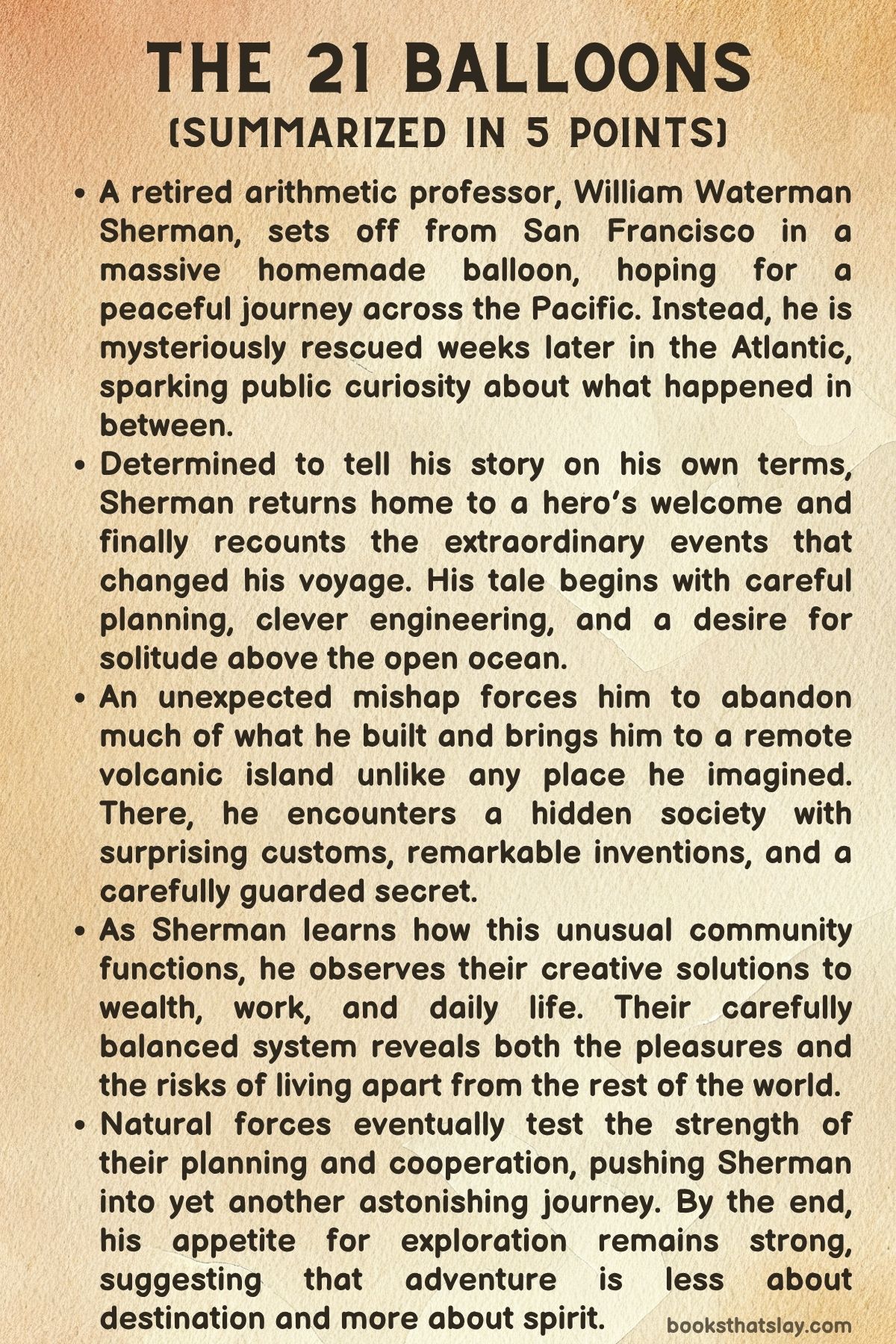
In August 1883, Professor William Waterman Sherman, a sixty-six-year-old retired teacher of arithmetic from San Francisco, launches himself into the sky in a giant balloon of his own design. His aim is simple: to cross the Pacific Ocean alone and enjoy a long, peaceful journey.
Sherman has grown weary of classrooms full of mischievous students and dreams of quiet days reading, observing the sea, and drifting wherever the wind may take him.
Three weeks later, however, he is discovered in the Atlantic Ocean, clinging to debris and a cluster of twenty deflated balloons. A passing ship rescues him.
News spreads rapidly: how did a man who departed from California end up in the wrong ocean with so many balloons? Though reporters, officials, and even the President of the United States demand an explanation, Sherman refuses to tell his story until he can present it properly to the Western American Explorers’ Club in San Francisco.
He is escorted home in triumph, greeted by cheering crowds, elaborate decorations, and countless balloons lining the streets.
At last, propped comfortably onstage before a packed audience, Sherman begins his account.
He describes how he commissioned an enormous silk-and-rubber balloon capable of carrying not just a basket but a small, lightweight house. The house contains everything necessary for comfortable travel: furniture made of bamboo and balsa wood, a porch for observation, a fishing rod, a water-distilling device, and carefully planned supplies.
Instead of discarding sandbags to gain altitude, he throws out garbage as he consumes provisions, keeping the craft light and efficient.
The first days of flight are peaceful. Sherman reads, naps, and watches the ocean below.
The nights are calm, and he delights in the solitude he long desired. After a week, he spots land: a volcanic island rising from the sea.
Disappointed that his grand Pacific crossing has ended so quickly, he drifts toward it.
Trouble strikes when seagulls swarm his balloon. One bird pierces the silk while fighting over scraps of food.
The balloon begins losing gas, and Sherman desperately throws belongings overboard to lighten the load. Sharks gather below as his supplies splash into the sea.
In a last effort, he cuts away the entire basket house, sacrificing his floating home to save himself. Clinging to the deflating balloon, he is dragged across water and sand before finally collapsing on a beach.
When he awakens, he finds himself on Krakatoa. A well-dressed man calling himself Mr. F. greets him and explains that the island is home to a secret community.
Sherman soon learns that he cannot leave; the residents must protect their privacy at all costs.
Mr. F. reveals the island’s extraordinary secret: vast diamond mines hidden within the volcano. Years earlier, a shipwrecked sailor named Mr. M. discovered these riches.
Realizing that flooding the world market with diamonds would destroy their value, he carefully recruited nineteen other families—people with creative talents—and brought them to the island. Together, they devised a system to maintain both wealth and harmony.
The twenty families each built a magnificent home inspired by different national styles—French palaces, British cottages, Chinese pagodas, Moroccan marvels. Yet the true genius of their society lies in its culinary government.
Each family operates a restaurant representing a different cuisine, named alphabetically from A to T. Every day corresponds to a letter, and all residents dine at the designated restaurant. In this way, each family works only once every twenty days yet enjoys variety and abundance.
Greed fades because every family ultimately regains equal shares in the diamond mines.
Sherman is astonished by both the elegance and absurdity of this arrangement. The islanders spend much of their time refining architecture and inventing mechanical novelties.
In Mr. M.’s home, beds circulate sheets through hidden washing devices, furniture moves by electric power, and rooms transform at the pull of a lever. The children, full of energy, design amusements such as a balloon-powered merry-go-round that lifts riders into the sky before depositing them gently at sea for a sailing race back to shore.
Despite the charm of island life, danger is never far away. The volcano rumbles frequently.
The residents have prepared an emergency escape system: a massive wooden platform attached to twenty balloons, capable of lifting all eighty residents and their supplies into the air within minutes. Each family possesses parachutes for eventual descent.
The platform is carefully engineered, with calculated lifting power far exceeding the combined weight of passengers and structure.
One day, as Sherman lectures the community about events back in San Francisco, the tremors grow violent. Cracks split the walls, and panic erupts.
The long-feared disaster has arrived. Families race to their homes for parachutes while children fill balloons with hydrogen.
Houses collapse as lava and ash surge upward. Sherman attempts to retrieve diamonds from the mine but realizes survival is more urgent.
He barely reaches the platform before it rises into the air. The island below is engulfed in fire.
As they pass over the crater, a column of hot air traps them above the volcano for hours. When they finally drift clear, Krakatoa explodes in a series of deafening blasts.
A towering cloud of ash swallows the sky, hurling debris and diamonds alike into the atmosphere.
Carried westward by powerful currents, the balloon platform travels across Java and beyond. One by one, families parachute down when they find suitable land.
Sherman remains aboard because he lacks a parachute. The F family volunteers to stay with him until the final descent.
For days they drift across continents—India, Persia, Europe—managing the balloons and rationing food. At last, near Belgium, the final family jumps.
Sherman alone must bring the platform down. Exhausted, he struggles to detach the hoses controlling the balloons.
He misses his chance to land near England and finally manages to crash the platform into the sea in the Atlantic. By extraordinary luck, he is rescued shortly afterward.
Concluding his tale before the Explorers’ Club, Sherman reveals that he has kept a pair of diamond cufflinks. He intends to sell them, build a new balloon equipped with protection against seagulls, and resume his travels—this time determined to remain aloft for a full year.
Thus ends the astonishing account of Professor Sherman’s unintended journey around the world, a voyage shaped by chance, ingenuity, community, and the enduring human desire to rise into the sky simply because it is there.
Characters
Professor William Waterman Sherman
Professor Sherman is the steady center of The 21 Balloons, and much of the book’s humor works because he approaches unbelievable events with a practical, orderly mind. At sixty-six, he believes retirement should bring peace, privacy, and control over his own time, which is why balloon travel appeals to him: he can start when he likes, stop when he likes, and avoid the everyday noise of other people.
That desire for independence shapes his choices throughout the story, from designing a self-contained “basket house” to insisting on telling his tale only to his own club. He is loyal to personal codes of honor, yet he also bends the truth when it suits survival, such as when he claims expertise in balloon aeronautics to avoid being turned into a schoolteacher again.
As an observer, he is curious without being sentimental, impressed by invention but quick to question whether convenience is always worth it. Even when he loses his home in the sky, gets trapped on a secret island, and faces a disaster on a massive scale, he keeps his focus on problem-solving.
By the end, Sherman’s optimism returns in the form of a new plan—proof that his defining trait is not caution, but persistence paired with a belief that the world is still full of surprises worth chasing.
Mr. F.
Mr. F. is Sherman’s guide to Krakatoa’s hidden society and one of the clearest examples of how the islanders combine sophistication with strict self-protection. He carries himself like a polished European gentleman, insisting on correct dress and manners even in the middle of a jungle, which signals how strongly the community values civilization as a chosen identity rather than something tied to geography.
At the same time, he is blunt about the rules: the secret must stay secret, and outsiders cannot simply come and go. Mr. F. is also the book’s main voice for the island’s philosophy about wealth—diamonds are useful only when kept scarce, and comfort depends on restraint, coordination, and discretion.
He balances hospitality with vigilance, welcoming Sherman as a “perpetual guest” while making it clear that the community will defend itself if necessary. As a parent, he is patient and amused by the children’s daring inventions, and he participates in them enough to show he is not merely an administrator of manners.
His decision to have his family remain with Sherman at the end highlights another side of him: loyalty that shows up through action, not speeches, and a willingness to take on risk for the sake of someone who has become part of their unusual world.
Mr. M.
Mr. M. is the founder and practical architect of Krakatoa’s society, the person who turns a wild discovery into a functioning community. As the lone survivor of a shipwreck who finds diamond mines, he could have tried to grab wealth and vanish, but he instead builds a plan that depends on people, systems, and long-term stability.
His leadership style is decisive and sometimes stern, especially in moments of crisis, and that firmness feels earned because the island’s safety relies on coordination. He understands both economics and human nature: he anticipates greed, knows how it can fracture a group, and channels competition into something safer through the restaurant system.
When disaster strikes, he becomes a commander—assigning tasks, rationing food, and managing the terrifying logistics of the balloon platform. He also shows realism about sacrifice: families must separate, parachute away, and leave others to handle the platform, because everyone staying together would invite collapse.
Mr. M. is not portrayed as a warm, intimate figure, but as a builder of structures—social, mechanical, and moral—who keeps a community alive by insisting on rules when fear and chaos could easily erase them.
Mrs. M.
Mrs. M. represents the domestic intelligence that supports Krakatoa’s grand ideas and makes them livable. While Mr. M. is associated with founding and command, Mrs. M. is strongly linked to craft, household order, and the way comfort is engineered into everyday life.
Her home is filled with complex mechanisms—cleaning systems, movable furnishings, clever devices—that show how creativity on the island is often directed toward improving daily routines. She is also attentive to the emotional weather of the community; when Sherman needs a parachute, she agrees to make one with calm confidence, treating preparedness as a normal responsibility rather than a dramatic gesture.
Her reactions to the more extreme inventions—especially the unsettling speed and unpredictability of powered furniture—add an important note of caution, suggesting that not all progress feels like progress to the people who must live with it. Mrs. M. helps define Krakatoa as more than a boys’ workshop of contraptions; it is a place where elegance, work, and safety are quietly maintained by those who understand that survival depends on details.
F-1
F-1, Mr. F.’s son, is a portrait of childhood daring shaped by a community where ballooning is not a legend but a weekend activity. He speaks with the casual confidence of someone raised around hydrogen valves, ropes, and sky travel, and his calm acceptance of risk reveals how normalized danger has become on the island.
During the balloon merry-go-round flight, F-1’s matter-of-fact explanation that they might simply fly away shows both the thrill-seeking mindset of the children and the thin line between play and catastrophe. Yet F-1 is not reckless in a thoughtless way; he knows how to release gas to balance altitude and understands procedures, which suggests that Krakatoa’s children learn through responsibility as much as amusement.
His brief comment that the volcano’s activity might be a “bad sign” gives him surprising perceptiveness, hinting that beneath the excitement he can read the island’s moods. F-1’s role emphasizes that the island’s ingenuity is being passed forward, and that the next generation has absorbed both the skills and the risks of living beside a volcano with balloons always ready.
M-1 and M-2
M-1 and M-2 function as vivid representatives of the island’s children as a group—energetic, mechanically curious, and socially confident. In Mr. M.’s house, they move effortlessly between play and participation, clearing tables, managing transforming furniture, and treating complex systems as normal parts of life.
Their delight in electric-powered chairs and couches shows how technology on Krakatoa becomes a toy before it becomes a tool, which is both charming and slightly alarming. At the same time, their competence suggests that the children are not indulged in idleness; they are expected to contribute and are trusted with real responsibilities, especially during group projects.
Through them, the story shows a community where learning comes less from formal schooling and more from building, experimenting, and cooperating. They also highlight one of the book’s subtle tensions: a world so comfortable and self-contained that it risks turning even powerful inventions into distractions—until reality, in the form of the volcano, demands maturity at speed.
Captain of the SS Cunningham
The ship’s captain is the first outside authority figure to encounter Sherman after the catastrophe and serves as the practical lens through which the wider world reacts to the mystery. He is observant, cautious, and appropriately skeptical, recording details in his log and noting strange sights such as the red furnace among the debris.
He respects Sherman’s refusal to speak, even while being fascinated by the story, and his decision to sell what he knows to a newspaper also marks him as a realist operating within the systems of publicity and profit. The captain’s role matters because he bridges Sherman’s private adventure and the public frenzy that follows, showing how quickly a personal journey becomes a spectacle once newspapers and officials get involved.
He is not portrayed as cruel or exploitative, but as someone who understands that information has value, and that the world will not wait patiently for answers.
The Ship’s Doctor
The doctor aboard the rescue ship represents steady care and professional duty in the middle of absurd circumstances. His main function in the narrative is to keep Sherman alive and stable after the wreck and to participate in the attempt to learn the professor’s story.
The doctor’s presence reinforces that Sherman’s condition is genuinely serious, which raises the stakes and prevents the adventure from feeling like pure fantasy without consequence. At the same time, the doctor’s willingness to be part of increasingly desperate efforts to extract information reflects how irresistible Sherman’s mystery becomes even to people trained to prioritize ethics and restraint.
He embodies the tension between compassion and curiosity: he helps Sherman recover, yet he also wants the answer to the question everyone is asking. That dual role makes him a subtle reminder that even reasonable adults can be pulled into irrational behavior when the promise of a sensational secret is dangled in front of them.
The Ship’s Chef
The chef is a smaller but memorable figure who adds warmth and comic practicality to the rescue sequence. In a crisis, feeding someone and restoring routine can be as important as medicine, and the chef’s role highlights that kind of grounded care.
Along with the captain and doctor, the chef becomes part of the first audience for Sherman’s silence, representing how every kind of person—not only journalists or explorers—can be captivated by an unexplained event. The chef’s inclusion also reinforces one of the book’s recurring ideas: comfort and food are not trivial luxuries but central organizing forces, whether on a rescue ship or on Krakatoa with its restaurant-based society.
Even when the story is focused on balloons and diamonds, the presence of a chef reminds the reader that survival is often about ordinary human needs handled well.
The Mayor of San Francisco
The mayor embodies civic pride and the desire to turn Sherman into a symbol. He treats Sherman’s return not simply as a personal homecoming but as a public triumph that belongs to the city, organizing ceremonies, decorations, and a grand procession.
His enthusiasm is sincere, but it also shows how public officials can amplify spectacle, especially when it reflects well on their community. The mayor’s attention swings between genuine concern for Sherman’s health and eagerness for the story that will excite the crowd.
He represents the social machinery that takes over when fame arrives: keys to the city, speeches, banners, and the pressure to perform. The mayor also helps frame the Explorers’ Club event as theater as much as testimony, which fits the book’s tone—big adventures are celebrated not just for what happened, but for how well they can be presented.
The President of the United States
The President appears briefly but serves an important symbolic purpose: he shows the scale of Sherman’s fame and how quickly a strange story can rise from local curiosity to national attention. By offering a personal train to rush Sherman across the country, the President legitimizes the adventure in the public mind, treating it as an event of national interest rather than a private mishap.
His respectful acceptance of Sherman’s “honor” in keeping silent until he speaks to his club also reinforces Sherman’s image as a principled man, strengthening the myth around him. The President is less a developed individual than a marker of how the entire country becomes a stage for Sherman’s return, with power and ceremony mobilized around a single unexplained tale.
Joseph Tomes
Joseph Tomes represents competitive ambition and the comic side of technological showmanship. As a rival balloon businessman who feels excluded from the city’s celebration of Sherman, he tries to reclaim attention with a flashy balloon-buggy designed to carry the hero through the streets.
Tomes is inventive and determined, but his judgment is weak, and his pride makes him careless—lighting a cigar near hydrogen balloons turns his grand idea into a humiliating disaster. He illustrates a theme the book returns to through Krakatoa’s machines as well: invention is impressive, but it demands respect for basic realities.
Tomes wants credit more than he wants safety, and his brief storyline serves as a humorous warning about mixing ego with engineering. He also provides contrast to the Krakatoans, whose technology is playful yet built into a disciplined system, while Tomes’s technology exists mainly to impress an audience.
Mr. A through Mr. T
The island’s twenty restaurant families are often introduced as a collective rather than as distinct personalities, and that choice is part of the point: Krakatoa’s society works because individual ego is softened in favor of shared structure. Each family expresses identity through cuisine, architecture, and the pride of hosting, turning competition into artistry rather than conflict.
Together, they represent different forms of creativity—cooking, design, engineering, and organization—channeled into a community that has everything it needs yet avoids the trap of limitless consumption. Their greatest shared trait is disciplined secrecy; they travel outward in carefully controlled ways, sell diamonds in tiny quantities, and take elaborate precautions to prevent discovery.
When the volcano erupts, their collective character becomes clearest: they are capable of rapid coordination, mutual aid, and painful separation, showing that their comfort has not made them helpless. As a group, the A–T families embody the book’s central experiment—what happens when wealth is managed by rules, imagination, and cooperation instead of by endless accumulation.
Themes
Exploration and the Desire for Freedom
Professor Sherman’s decision to rise into the sky at the age of sixty-six reflects more than a taste for adventure; it expresses a lifelong hunger for autonomy. In The 21 Balloons, travel is presented as an act of self-definition.
Sherman does not seek speed or records. He wants distance from routine, from noise, and from obligation.
His balloon becomes a floating declaration that a person can choose not only a destination but a way of moving through the world. The contrast between direct, efficient travel and drifting travel highlights this idea.
Sherman prefers the second kind because it leaves room for surprise, accident, and reflection.
This theme continues once he lands on Krakatoa. The islanders, too, have structured their lives around freedom—freedom from economic anxiety, from social competition, and from outside interference.
They build a society that allows them to work infrequently and spend much of their time on creative pursuits. Yet their freedom is conditional.
They must protect their secret, restrict diamond sales, and remain alert to the volcano’s threat. Exploration, then, is shown as both liberating and risky.
Sherman’s balloon grants him solitude but also nearly kills him. The islanders’ choice to settle on a remote volcanic island grants privacy but ties their fate to unstable ground.
By the end, even after catastrophe, Sherman plans to fly again. The desire to explore is not extinguished by danger.
Instead, it seems strengthened by it. The novel suggests that freedom is not the absence of risk but the willingness to accept uncertainty in exchange for possibility.
Wealth, Value, and the Control of Greed
The diamond mines beneath Krakatoa create a setting where unimaginable wealth is available, yet the community’s survival depends on refusing to exploit it fully. The islanders understand that value is not inherent in objects but shaped by scarcity and perception.
If they flood the market with diamonds, the stones will become worthless. Their prosperity depends on restraint, discipline, and secrecy.
This insight transforms the island from a fantasy of unlimited riches into a study of economic balance.
At first, greed threatens to divide them. Each family desires a greater share of the mines, and competition emerges.
The restaurant system becomes the solution. By rotating dining responsibilities and linking identity to cuisine rather than ownership, the community redirects rivalry into craftsmanship.
Cooking becomes the acceptable outlet for pride. Over time, this arrangement restores equality in mine shares and diffuses resentment.
Wealth remains present but no longer dominates social life.
The eruption of Krakatoa underscores how fragile material wealth truly is. Billions of dollars’ worth of diamonds vanish in a single explosion.
The stones that once symbolized stability and luxury are revealed as temporary advantages against nature’s force. What ultimately carries the community forward is not treasure but cooperation and planning.
In this way, the book questions conventional measures of success. Wealth without moderation leads to collapse, while carefully managed abundance can sustain harmony—at least until forces beyond human control intervene.
Ingenuity, Technology, and the Limits of Progress
Mechanical invention fills the island with wonder. Beds clean themselves, furniture glides across floors, rooms transform with hidden levers, and children build balloon-powered rides that lift them into the sky.
Innovation is treated with admiration, yet also with humor. Some devices are brilliant; others are excessive or unsettling.
The electric chairs that hurl their occupant through a window illustrate how progress can surprise its creators.
Sherman, trained in arithmetic and logic, appreciates clever design but questions whether every new mechanism improves life. On an island that already provides comfort and leisure, do automated sheets and moving couches serve a true need?
The contrast between his practical balloon house and the island’s elaborate contraptions highlights two philosophies of invention. Sherman builds for independence and survival.
The Krakatoans build for novelty, beauty, and competition. Both approaches demonstrate human creativity, yet they reveal different priorities.
The ultimate technological achievement—the giant balloon life raft—stands apart. It is not decorative but essential.
Calculated carefully to exceed the total weight of passengers and platform, it represents disciplined engineering. When disaster strikes, it works.
The same hydrogen that fuels children’s games becomes the means of survival. Technology, then, is neither praised nor criticized outright.
Its value depends on purpose, foresight, and respect for natural forces. Progress without caution invites chaos; progress guided by planning offers hope.
Community, Order, and Survival
Life on Krakatoa is structured around rules that transform isolation into stability. The alphabetical restaurant system, the shared calendar, and the equal distribution of labor prevent resentment from festering.
Identity is shaped by participation rather than hierarchy. Each family hosts meals only once every twenty days, ensuring that no one is overburdened and everyone enjoys variety.
This arrangement fosters interdependence. No household can function alone.
The community’s unity becomes most visible during crisis. When the volcano begins to tear the island apart, hesitation disappears.
Parents retrieve parachutes, children fill balloons, food is gathered, and the platform rises within minutes. Years of planning are tested in a single afternoon.
The eruption does not create order; it reveals whether order already exists. Because the islanders have rehearsed cooperation through everyday routines, they respond with remarkable coordination.
Even so, survival demands painful separation. Families must jump at different moments, trusting that they will land safely and rebuild elsewhere.
The platform continues westward, shedding passengers until only Sherman remains. The structure that once symbolized collective safety becomes a vehicle of dispersal.
Community ensures survival, but it cannot guarantee permanence. Homes burn, diamonds scatter, and families descend into unknown lands.
The novel presents community not as a shield against loss but as the means through which people face loss together. Order does not eliminate danger; it prepares people to endure it.