The 31st Trick-or-Treater Summary, Characters and Themes
The 31st Trick-or-Treater by Ben Farthing is a small-town Halloween horror novel about loss, obsession, and the way a community can fracture when fear has no clear target. Set in Maple Creek, it follows the Wilson family after Bob’s daughter Mary disappears on Halloween along with many other children.
A year later, kids begin reappearing in impossible ways, and strange pink light, turnip lanterns, and escalating “pranks” point to something beyond ordinary crime. As parents, police, and children chase answers, the town is pulled toward another Halloween night that may decide who comes home—and who doesn’t.
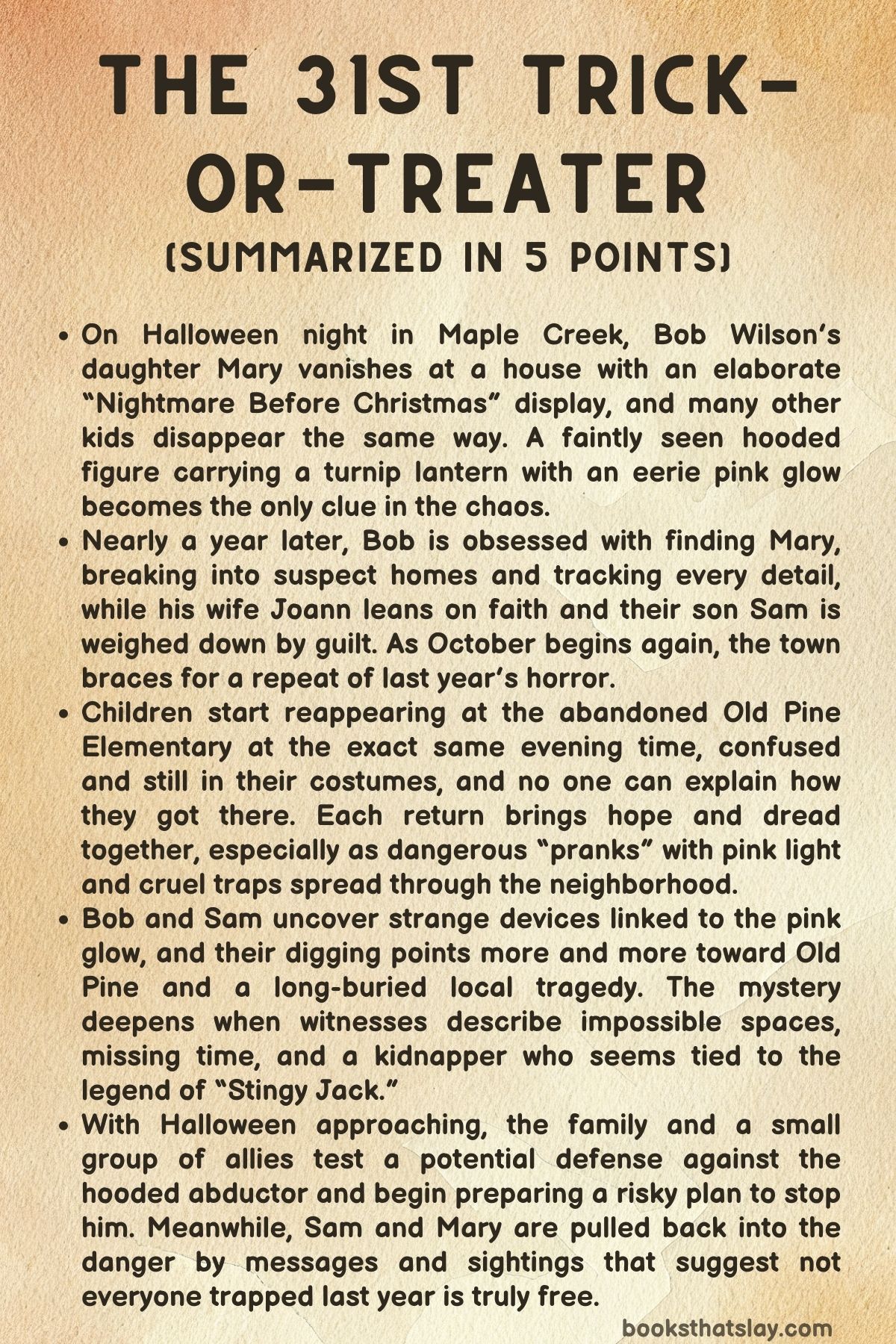
Summary
On Halloween night in Maple Creek, Bob Wilson takes his children trick-or-treating. His son Sam is dressed as Optimus Prime, four-year-old Mary is a witch, and toddler Emily is Asha.
The street is crowded with families and decorated houses. Mary spots a home with an enormous “Nightmare Before Christmas” display and dashes ahead.
Bob pauses to manage Sam and Emily, who are tired and lagging behind. When he looks up again, Mary is gone.
Her hat sits abandoned on the porch. Bob searches the yard in panic while a homeowner in a Santa costume and nearby parents insist she couldn’t have been taken inside.
Within minutes, cries spread along the block as other parents realize their children are missing too. Sam briefly notices a slim, hooded young man walking away with a turnip jack-o-lantern glowing an unnatural pink, but no one else seems to see him.
Eleven months pass. The disappearances remain unsolved, and Maple Creek lives with a raw, quiet terror.
Bob refuses to accept that Mary is dead. While his wife Joann turns toward church for comfort, Bob spends nights stalking the neighborhood, building files on the houses where children vanished, watching windows, and sneaking into homes when he thinks they’re empty.
His obsession has made him a local spectacle; he posts theories on YouTube and attracts followers who share tips. Officer Karl Cooper, a neighbor and quiet supporter, warns Bob that police presence is heavier as October approaches.
Bob focuses on Sariah Fisher’s house, next to the porch where Mary disappeared. From outside, he spots a basement window showing a carefully built Halloween model village laid out like Maple Creek itself, down to streets and houses, as if someone has recreated the town in miniature.
Before he can break in, a police spotlight sweeps the yard and he slips away.
On October 2, Sam—now nine, burdened by guilt for losing sight of Mary—comes home to a strange silence. The television flickers on by itself, showing a tiny video window of a bare classroom.
A hooded figure in an orange sweatshirt appears inside that feed holding a turnip lantern that shines pink. The light seems to reach through the screen and creep over Sam’s body.
He hides his face until the glow blinks out and the TV goes dark. That evening, a McDonald’s worker named Michelle spots a crying girl in doctor scrubs leaving Old Pine Elementary, a long-abandoned school that once hosted a haunted attraction called Crimson Corridors.
Michelle recognizes the child as one of last year’s missing trick-or-treaters and calls police.
On October 3, news spreads that the returned girl is Debbie Meyers. Bob rushes to Old Pine, where parents swarm behind police tape.
Officers say nobody saw Debbie arrive, and cameras across the street capture no car or person dropping her off. That night, Officer PJ Freeman hears pounding at the chained front doors and finds another missing child, Mark Calton, still in his dinosaur costume, shaken but alive.
On October 4, a third child reappears inside the school, a boy in a pirate outfit. The town’s hope rises and twists into dread.
That same day, two sisters, Lauren and Rachel, find a jack-o-lantern on their porch with a note promising a surprise. Lauren reaches inside and a mousetrap rigged with a razor blade snaps her finger, seriously injuring her.
The police suspect a dangerous prankster has joined the chaos. Sam’s friend Jeremy visits and, when their TV fails to turn on, they locate a small turnip hiding a glass lens among Joann’s books.
Sam peers through it and sees a faint pink flicker within. He keeps the turnip, unsettled but curious.
Bob begins tracking a pattern: each evening around 7:30, another child seems to return at Old Pine. Believing Mary might be next, he and Joann join neighbors in the rain on October 4.
The police refuse to let anyone close. A ninja-costumed child appears behind the glass, recognized as Calvin Mitchel.
As officers open the doors and his mother rushes forward, Calvin collapses on the sidewalk, lifeless. The crowd’s fragile hope breaks into screams.
On October 5, another child, Wendy Rusher, returns alive at 7:31 p. m.
, but the room she comes from is instantly empty again. That night, neighbor Richard Stoutly encounters a sheet-ghost decoration rigged with acid that burns his hand, adding to the sense that someone is tormenting the town.
Early October 6, Bob sneaks toward Old Pine with bolt cutters, and Joann insists on coming. They see a bobbing pink light in the woods like the kidnapper’s lantern.
Bob chases it and loses it, but finds an orange bag of candy mixed with button batteries. Police later connect this to the “pranks.
Sam and Jeremy follow their own thread. Jeremy recalls seeing the pink glow last summer in an elderly woman’s yard while she buried her cat.
They sneak into her shed and discover a bucketlike projector that can cast classroom images and pink light. Online, another kid, Walter, admits he saw similar pink light at Old Pine during Crimson Corridors before the kidnappings.
Sam becomes convinced the school is the center of everything.
On October 9, Sam skips school and tries to break into Old Pine. Jeremy and Walter follow.
After Sam fails to cut a thick chain, Walter smashes the door handle, and the boys slip inside. Their search ends in disaster: later Bob is found injured and arrested when a corpse is discovered sealed behind a wall in the school.
In the hospital on October 15, Bob is questioned relentlessly. He claims he guessed the body’s location.
Officer Randy offers to keep suspicion off him if Bob stops investigating. Bob agrees only because Sam has vanished.
Released on October 16, Bob learns more children are returning, but Sam is still missing. A viewer identifies the corpse as Martin Donovan, a teen who ran away in 2002 from the house at 7349 Clearbark Circle.
Bob and Joann stake out the address and meet Wanda Donovan, Martin’s mother, who seems terrified and unstable, insisting Martin is alive and “at school. ” After she crashes her car and raves about a hooded man stalking her, Bob suspects she is another victim rather than the culprit.
On October 19, Bob and Joann break into Wanda’s shed. Pink glow blooms across the yard.
A scream comes from the house. Wanda recoils from something unseen and falls down the stairs, badly injured.
Bob rushes upstairs and finds a locked door opening into a space of pink darkness that feels far bigger than the house should allow. Inside, he hears many children’s voices.
A hooded figure approaches, carrying a turnip lantern. When the hood lowers, Bob sees Martin Donovan—young, alive, and wrong in a way he can’t explain.
A shove knocks Bob back, and Sam tumbles out onto him, sobbing that Mary is still “in there. ” The strange doorway vanishes into a normal wall.
Police arrive and find Sam but no intruder. Sam describes stairs inside Old Pine leading to a pink-fog hillside where missing children are gathered, unable to leave unless a doorway stays open.
Adults search the school and see nothing.
Mary’s perspective appears briefly: she and her best friend Sofia survive on the foggy hillside, sleeping in flattened grass and listening for Sam’s voice, hoping he will find a way back to them before the hooded lantern-bearer returns.
By October 26, Mary has been recovered, though many children remain missing. She tells Bob the kidnapper calls himself “Jack o’ the Lantern” and “Stingy Jack.
” Bob’s online group connects this to folklore about a wandering spirit warded off by jack-o-lanterns. Bob tests the idea outside Sariah Fisher’s house on October 28.
Martin appears with his pink turnip lantern, but when Bob holds up a lit pumpkin jack-o-lantern, Martin stops, unable to cross while the lantern is actively held. Bob forms a plan: on Halloween, people will stand around Old Pine holding lit pumpkins to trap Martin inside and force the remaining children out.
They recruit volunteers—parents, church friends, YouTube followers—but numbers feel too small. Bob posts a public plea for locals to come with carved pumpkins.
Police warn against arson threats, and Officer Karl says he will bring the only lighter to avoid trouble. Sam, still crushed by guilt over Walter’s disappearance, receives texts from Walter saying not to trust what happens if he “comes home.
On Halloween night, a huge crowd gathers at Old Pine with pumpkins. At Polly’s home, where Sam, Mary, and Emily are supposed to stay safe, Walter texts again that he is trapped with Sofia and the door is closing tonight.
Sam runs for the school; Mary follows to help her friend; Polly chases after them with Emily.
At Old Pine, Bob and Joann arrive to find a furious mob and many viewers. When Bob reaches Karl for the lighter, Karl coldly denies knowing him, and his phone shows no record of their messages.
Bob realizes Martin has been impersonating Karl online to inflame the town and lure adults to the school. Pink light erupts inside.
The mob surges through the doors into the fog. Bob and Joann fight their way in and find Sam and Mary descending the hidden staircase.
In the fog below, Martin taunts the children with lies about Walter and Sofia. Bob and Joann shout the truth and pull their kids back as Martin is blocked by their approaching jack-o-lanterns.
A few adults retreat with them, including Walter’s father and the Chester brothers, but most of the mob has already vanished deeper into the pink world. Outside, the glow fades, implying Martin has taken the adults into the same limbo once meant for children.
The Wilsons reunite with Polly and Emily and leave, shaken but together, as Maple Creek faces a new, terrible cost for trying to end the nightmare.
Characters
Bob Wilson
Bob is the emotional and narrative engine of The 31st Trick-or-Treater. He begins as an ordinary father enjoying Halloween with his kids, and the abrupt loss of Mary fractures him into someone who can’t accept uncertainty.
Eleven months later, grief has transformed into obsession: he prowls at night, catalogs evidence, breaks into houses, and builds a YouTube sleuth persona that both fuels his hope and isolates him from normal life. What makes Bob compelling is the way his love becomes a kind of violence against himself—every risk, every sleepless stakeout, every reckless decision is powered by the same parental devotion that once kept his family safe.
Yet Bob isn’t just a frantic detective; he’s also capable of learning and adapting, as seen when he accepts folklore clues, tests the jack-o-lantern defense, and pivots to a communal strategy for Halloween. His arc is a slow shift from solitary obsession to collective action, while still remaining haunted by guilt, distrust of authority, and the fear that his hope will be punished again.
Joann Wilson
Joann represents a different survival path through the same trauma. Where Bob turns outward into investigation and confrontation, she turns inward toward faith, community, and a disciplined effort to keep the family from collapsing.
Her church involvement isn’t portrayed as a simple “answer,” but as a coping structure that gives her language for grief and a circle of support Bob lacks. Joann often plays the role of brake on Bob’s impulsiveness, insisting on caution, insisting they follow leads rather than explode into them, and pushing him to see consequences beyond his own desperation.
At the same time, she isn’t passive or naïve: she searches Old Pine herself, joins Bob on dangerous break-ins, and eventually accepts that the phenomenon may be supernatural. Her strength is quiet but unyielding, and her arc traces the movement from faith as comfort to faith as action—organizing volunteers, recruiting lantern bearers, and choosing to fight for children beyond her own.
Sam Wilson
Sam is the story’s key viewpoint among the children and the one most defined by survivor’s guilt. He was there when Mary vanished, and that memory hardens into a belief that he failed her, making his anxiety and anger feel earned rather than melodramatic.
Sam’s encounters with the pink light and the broadcasted hooded figure bring horror directly into the domestic space, forcing him to grow up in a world where even the living room can be a doorway to threat. He oscillates between frightened kid and determined rescuer, and the shift is believable because it’s driven by love for his sister and by the need to repair what he thinks he broke.
His choice to enter Old Pine with Jeremy and Walter is reckless, but it is also the clearest sign of his courage. Even after returning, he remains psychologically bruised, still hearing the pull of the hillside, still desperate to rescue Mary and Sofia.
Sam ultimately embodies the costs of trauma on a child who is forced into agency before he is ready.
Mary Wilson
Mary’s disappearance launches the novel, but her character deepens most through what she endures in the pink-fog limbo and how she comes back changed. She is first shown as impulsive, excited, and trusting—the kind of kid who runs ahead to the coolest house on the block—and that innocence makes her abduction feel especially cruel.
In the hillside realm, Mary survives by anchoring herself to hope, friendship, and the belief that family will come, which makes her more emotionally resilient than her young age suggests. Her relationship with Sofia reveals her capacity for loyalty and leadership; she comforts her friend, accepts blame, and chooses action instead of despair.
After returning, Mary carries rare knowledge—names like “Jack o’ the Lantern” and “Stingy Jack”—but she delivers it not as a prophet, just as a child repeating what she heard. That contrast makes her both vulnerable and vital.
Mary’s arc is less about solving the mystery and more about endurance: she is the symbol of what can be stolen from a family, and what stubborn love might still restore.
Emily Wilson
Emily is very young, which limits her direct involvement in the mystery, but her presence is emotionally important. She represents normal childhood continuing under the shadow of horror—watching cartoons, needing tea boiled, dressing up for Halloween—while her family fractures around her.
Emily sharpens the stakes for Bob and Joann because she is a reminder that parenting doesn’t pause for grief. Her innocence also mirrors what Mary lost and what the parents are terrified of losing again.
Even without major plot actions, Emily functions as the quiet heartbeat of the household, grounding scenes in ordinary life and making the supernatural threat feel even more invasive.
Jeremy Appleman
Jeremy is Sam’s best friend and the story’s clearest example of how curiosity can be both brave and dangerous. He is more cautious than Sam at first, often reacting with fear to the pink-light evidence, but he still follows Sam into places that frighten him because friendship outweighs self-preservation.
Jeremy’s importance grows when he shares his own sighting history and helps connect Wanda’s shed to Old Pine, proving he isn’t just a sidekick but a co-investigator with his own memory and logic. His arc holds a subtle sadness: like Sam, he is a child pulled early into a world of secrets, and by the time adults start listening, he has already seen too much.
Jeremy represents loyalty under stress and the way trauma spreads through peer bonds, not just family ones.
Walter (friend of Sam and Jeremy)
Walter functions as both witness and warning. His admission that he saw the hooded figure and pink glow during the Crimson Corridors attraction positions him as the boy with the missing puzzle piece—someone who can validate Sam’s fears when adults won’t.
Later, his disappearance turns him into the cost of Sam’s mission and a focal point of collective rage through his father Paul. Walter’s text messages on Halloween are the cruelest emotional trap in the book because they exploit his friendship with Sam and Mary’s attachment to Sofia.
Even when he is physically “safe,” his communication shows how the kidnapper manipulates identity and trust. Walter’s role is less about who he is moment-to-moment and more about what he represents: the vulnerability of children to both danger and deceit, and the way a single missing friend can tilt an entire town toward violence.
Martin Donovan / “Thirty-First Trick-or-Treater” / “Stingy Jack”
Martin is the central antagonist, and the book sustains his horror by keeping both his humanity and his monstrosity in tension. He is introduced as a slender hooded figure with a turnip lantern glowing unnatural pink—a visual that becomes a signature of dread—and later revealed as the long-missing teenage runaway who somehow never aged in the limbo space.
Martin’s self-naming as “Jack o’ the Lantern” and “Stingy Jack” links him to folklore about wandering spirits, but his behavior shows something more actively predatory than a mere ghost. He doesn’t simply abduct; he stages returns with precision, punctures hope by sending Calvin back dead, and engineers cruel “pranks” that injure townspeople, building fear and rage like kindling.
His impersonation of Officer Karl online reveals a strategic mind that understands modern surveillance culture, social media trust, and mob psychology. Martin’s true power isn’t only supernatural space-bending—it is manipulation.
He turns the town into a weapon against itself, demonstrating that the scariest monster is one who can make victims help widen the trap.
Wanda Donovan
Wanda is a tragic figure caught between grief and delusion. She lives in a house tied to the mystery, with her son’s room preserved like a shrine, and she moves through the story in a state of frantic denial that feels less like villainy and more like psychological collapse.
Her belief that Martin is alive and at school mirrors Bob’s belief about Mary, creating a painful symmetry between parent and “suspect. ” The crash, her terror of an unseen stalker, and her eventual fall down the stairs underline that Wanda is not orchestrating events but being hunted or haunted by them.
She functions as a living doorway to the past: her home is where the pink room opens, where Martin “returns,” and where Bob finally confronts the impossible. Wanda’s role complicates the moral map of the novel, reminding readers that blame is rarely clean when grief and the supernatural intersect.
Officer Karl Cooper
Karl is the neighbor-cop whose presence initially offers Bob a fragile tether to official reality. He warns Bob about patrols and seems like a grounded, if wary, ally.
That credibility makes the later revelation—Martin impersonating Karl online—especially destabilizing. Karl becomes a symbol of how trust can be sabotaged by the antagonist; even a familiar face and uniform can be turned into bait.
His insistence on controlling the lighter on Halloween also shows the limits of law enforcement in a supernatural crisis: he’s trying to prevent arson and chaos, but he can’t predict that the real threat is psychological and otherworldly. Karl is not deeply explored in private life, but his function is precise: he is the good-faith authority figure whose identity is stolen to fracture the town.
Officer PJ Freeman
PJ is the police character most directly scarred by the impossible. His discovery of children materializing on surveillance undermines the rational framework that policing relies on, and his reactions feel humane rather than plot-mechanical.
He tries to search rooms, to trace entry points, to fit the events into procedure, but the mystery refuses order. PJ represents the honest law-and-evidence mindset confronted with phenomena that don’t leave footprints.
This makes him a quiet bridge between the community’s fear and the institutional struggle to respond without losing legitimacy.
Officer Randy and Detective Otto
Randy is defined by pragmatism. He doubts Bob’s stories yet recognizes that relentless suspicion won’t solve the case, so he offers a deal to keep Bob out of jail in exchange for cooperation.
His stance suggests a weary professional trying to manage chaos rather than win a moral contest. Detective Otto, meanwhile, is the narrative face of investigative authority once the supernatural evidence becomes unavoidable.
He listens to Sam, agrees to be guided to the supposed stairs, and remains careful in what he believes. Otto’s restraint is crucial; he doesn’t dismiss the child outright, but he doesn’t validate what he can’t see either.
Together, Randy and Otto represent the law’s slow, imperfect adaptation—the human side of institutions trying to stay sane in a town where doors open into pink fog.
Sariah Fisher
Sariah is a shadow-presence tied to suspicion and the geography of disappearance. Her house stands next to where Mary vanished, and her basement’s Halloween model village replicating Maple Creek gives her a cold, unsettling aura.
Yet the story doesn’t confirm her guilt; instead, she functions as part of the misdirection and paranoia that grief produces. Sariah is an example of how trauma makes ordinary neighbors look like monsters, which is exactly the psychological environment Martin exploits.
Michelle
Michelle is a small but pivotal moral actor. She doesn’t know the town’s full horror, but when she sees the crying child in scrubs at Old Pine, she reacts with empathy and urgency rather than denial.
Her call to police is one of the first cracks in the mystery’s wall, and it frames her as an outsider who does the right thing without needing personal stakes. Michelle embodies the theme that rescue sometimes begins with someone simply choosing to believe their own eyes.
Sofia Fuentes
Sofia is the emotional mirror to Mary within the limbo space. Her grief at being “left,” her dependence on Mary’s reassurance, and her willingness to follow Sam’s voice show a child trying to stabilize reality through friendship.
Sofia’s existence widens Mary’s story beyond the Wilson family, clarifying that every missing child has another child clinging to them for survival. She also becomes the lure Martin uses on Halloween, which highlights her narrative role as both victim and motivator.
Sofia matters because she makes the stakes communal; Mary’s rescue doesn’t end the horror while Sofia remains trapped.
Paul Keller
Paul is a father shaped by rage instead of hope. His son Walter’s disappearance hardens him into someone ready to retaliate, and his fury hints at how close Maple Creek is to turning violent even without Martin’s prodding.
Paul’s presence adds pressure to Bob’s plans because he represents the town’s combustible grief. When only a few adults turn back from the pink fog, Paul’s choice to keep going shows how vengeance can override self-preservation.
He is a portrait of parental love curdling into wrath, and through him the novel warns how easily victims can be steered toward catastrophe.
Tina Mitchel, Cass Meyers, Carlos Fuentes, Polly, and other parents/neighbors
These supporting adults form the town’s emotional ecosystem. Tina’s frantic rush to Calvin and the crushing shock of his death illustrate how hope can be weaponized; Cass’s protective shutdown of Debbie’s memories shows the instinct to shield children even when answers are needed; Carlos’s decision to join the lantern ring demonstrates a parent choosing collective courage over private despair.
Polly provides temporary safety for the Wilson kids and represents the last island of normal family warmth on Halloween night. The neighbors harmed by “pranks,” like Richard Stoutly, Lauren, Rachel, and Kenny Moon, convey the spreading radius of terror, showing that Martin’s influence isn’t confined to abducted children but bleeds into the whole community.
Together, these characters don’t just decorate the plot—they turn Maple Creek into a living portrait of shared grief, fear, and the thin line between solidarity and mob violence.
Themes
Grief, Obsession, and the Shape of Hope
Bob’s life after Mary’s disappearance is defined by the way grief mutates when there is no body, no certainty, and no story the mind can finish. He is stuck in an unfinished sentence, and the novel shows how that kind of loss produces a hope that is both sustaining and corrosive.
His nightly prowls, his files, and his break-ins are not framed as heroic detective work so much as a desperate attempt to force reality to make sense. The absence of closure turns him into someone who must act, even when action is self-destructive.
The town mirrors this, too: parents cling to ritual—gathering at Old Pine each evening, counting minutes, staring at doors—because ritual gives grief a schedule. When children begin returning, hope does not arrive as relief; it arrives as pressure.
Every return becomes a new timer, a new comparison, a new reason to fear that the next door opening will bring either salvation or a corpse. Calvin’s limp body on the sidewalk is the emotional hinge of the book: hope is revealed as a gamble with a cost, and the crowd’s collective faith doesn’t break cleanly—it warps into rage, suspicion, and the need to blame.
Bob’s relationship with Joann intensifies this theme. She turns to church, trying to live with uncertainty, while he tries to conquer it.
Their marriage becomes a case study in how people grieve differently but still collide over the same wound. Sam’s guilt also sits inside this structure of hope: he wants certainty that Mary is alive because the alternative feels like a verdict on his own failure.
The 31st Trick-or-Treater treats hope not as a bright virtue but as an engine that can power love, obsession, denial, or courage depending on who is holding it. That complexity makes grief feel real: it is not a single emotion, but a landscape people get lost in, and sometimes build homes inside.
Childhood Vulnerability and the Burden of Being Believed
The book is saturated with the idea that children are the first to see danger and the last to be trusted about it. Sam’s early glimpse of the hooded figure with the pink-lit turnip lantern is a quiet warning that becomes tragically important later, yet in the moment it is dismissed as a child’s Halloween fantasy.
This pattern repeats: the TV’s strange broadcast, the hidden turnip lens, the pink glow in Wanda’s shed, even Sam’s clear directions to the desk-cubby doorway at Old Pine. Sam is constantly asked to translate terrifying experiences into adult language, and adults constantly fail to accept the translation.
The result is a layered vulnerability. There is the obvious physical vulnerability of children being taken, kept in costume, and returned without explanation.
But there is also a social and psychological vulnerability: their reality is fragile because the people meant to protect them filter it through disbelief. Mary’s perspective on the pink-fog hillside makes this even sharper.
She keeps herself steady by clinging to friendship and to the idea that Sam will come back. Her survival depends less on brute force and more on imagination, loyalty, and trust—qualities adults often treat as childish, yet here they are life-preserving.
The children’s costumes become symbols of this tension. Costumes are supposed to be play, but they become uniforms of captivity.
The kids return still wearing them, suggesting they were frozen in the moment of their disappearance, stuck in a child’s world while adults aged into despair and violence. Sam, meanwhile, is pushed prematurely into adulthood by guilt and responsibility.
He sneaks into dangerous places, carries tools as if he were a worker, and tries to rescue others because adults won’t or can’t. The theme reaches a painful clarity on Halloween’s final night: Martin weaponizes Sam’s sense of responsibility through false texts about Walter and Sofia.
He understands that children are easiest to control through the love they feel for each other. The 31st Trick-or-Treater is unsparing about how childhood can be both resilient and exposed, and it argues that listening to children is not sentimental kindness but a necessary form of protection.
Community Fear, Moral Panic, and the Drift Toward Violence
Maple Creek’s transformation from a cheerful Halloween neighborhood into a paranoid collective shows how fear spreads socially, not just individually. The kidnappings dismantle the town’s shared assumptions about safety, and once those assumptions crack, every strange event is interpreted as proof of a hidden enemy.
The pranks—razor mousetraps, acid-coated ghost sheets, animated ribbons—are crucial to this theme because they blur the line between human cruelty and supernatural threat. The townspeople do not know what kind of danger they face, so they begin treating all danger as the same.
This collapses nuance. People want a single culprit, a single story, and a single solution.
Bob’s YouTube presence accelerates that drift. His investigations give frightened parents a narrative to hold, and his online audience provides a chorus that can affirm or inflame suspicion.
When the police fail to provide clear answers, informal authority rises in its place: rumor, vigilante logic, and public anger. The nightly gatherings at Old Pine feel like community solidarity at first, but they harden into spectacle.
Each return is consumed by the crowd as a public event, meaning individual families are forced to grieve in front of neighbors who are already rehearsing their own grief. Calvin’s death is the spark that turns fear into moral panic.
After that, the town is no longer waiting for children to come home; it is waiting to strike back. Paul Keller’s hints about retaliation and the police warning about arson are signs that a community can become dangerous even while trying to be protective.
The Halloween finale is a devastating payoff: the mob that storms Old Pine believes it is acting in righteous defense, but it is precisely that belief that makes Martin’s trap possible. He manipulates their anger, impersonates Karl online, and uses their readiness for violence to lure them into the pink fog.
The town’s moral certainty becomes his tool. The implication that the adults vanish into the same limbo once used for children is not just a plot twist; it is a moral mirror.
The community that could not restrain its fear loses itself to the very thing it sought to destroy. The 31st Trick-or-Treater presents fear as a public contagion, and it warns that when a town replaces patience and care with rage and shortcuts, it becomes a partner in its own tragedy.
Seeing, Not-Seeing, and the Problem of Reality
From the first disappearance onward, the story keeps returning to disputes over what is real. Bob sees Mary vanish; other parents swear she couldn’t have been pulled inside.
Sam sees the hooded figure; no one else does. PJ watches a child appear on camera “as if he materialized,” and even that evidence fails to settle the argument because it violates normal logic.
Reality in the book is not a shared floor everyone stands on; it is a set of competing perceptions that can’t be reconciled. The pink light functions as a visual shorthand for this problem.
It is everywhere—TV screens, turnip lenses, sheds, classrooms, foggy hillsides—yet it remains elusive to anyone not directly targeted by it. Adults interpret it through the framework they already trust: pranks, psychological breakdowns, criminal conspiracies.
Children interpret it through sensation and immediate stakes. Both groups are sincere, and both are incomplete.
Wanda Donovan’s storyline highlights the cruelty and confusion of that gap. She believes her runaway son is alive at school, not because she is foolish, but because the world keeps giving her evidence that doesn’t fit ordinary rules.
Her terror is the terror of being trapped between grief and an impossible hope, much like Bob. The pink room behind the locked door makes the theme literal: a space that seems larger than the house, full of voices, existing only for some witnesses and vanishing for others.
The desk cubby that appears “impossibly deep” is another version of that idea—an ordinary object that transforms into a doorway depending on who looks. This unstable reality pressures the characters into choices.
Bob lies to police because the truth sounds insane. Joann can’t fully commit to Bob’s claims until she sees pink light directly.
Sam is treated as unreliable until crisis forces adults to follow him anyway. Even the folklore explanation about Stingy Jack shows how people search for an interpretive frame that can make the unbelievable livable.
The 31st Trick-or-Treater uses horror elements to explore a very human question: what happens to relationships, institutions, and self-trust when reality stops being consensual? The result is not just suspense; it is a portrait of how easily a community fractures when people cannot agree on what they have seen.
Folklore, Ritual, and the Struggle to Control the Uncontrollable
Halloween in Maple Creek begins as a community ritual designed to make fear playful. Costumes, candy routes, porch lights, and neighborhood displays are all ways of rehearsing danger inside rules.
After the kidnappings, that ritual becomes a battlefield over control. Bob and Joann’s search for meaning pushes them toward folklore, not as decoration but as a possible operating manual for survival.
When Mary reports that Martin calls himself Stingy Jack and Jack o’ the Lantern, the story shifts into a space where old tales might explain present terror. The sleuth group’s identification of Stingy Jack and the traditional role of jack-o-lanterns as warding devices turns uncertainty into strategy.
Importantly, the book doesn’t present folklore as magical comfort. It presents it as a human tool for organizing chaos.
People reach for stories that predate them because those stories offer rules. If the world is broken, maybe the old rules still work.
The lantern test at Sariah Fisher’s house proves that ritual can have teeth: the lit pumpkin held in Bob’s hands physically stops Martin. But the detail that it works only when actively held matters.
Ritual is not passive protection; it requires participation, courage, and presence. The Halloween plan to surround Old Pine with lantern-holders is the community’s attempt to rebuild a safe circle through shared action.
Yet even that is vulnerable to manipulation, because ritual without trust collapses. Martin exploits the town’s reliance on messages, symbols, and crowd behavior by impersonating Karl and feeding the mob a story that fits their expectations.
He becomes a perverse mirror of Halloween tradition: a “trick-or-treater” who takes instead of gives, who arrives as the final participant in a game that kills the rules of the game. The ending suggests that ritual can guard against darkness only if it doesn’t slide into fanaticism.
The lantern circle never forms because rage interrupts cooperation. In that sense, folklore is both a lifeline and a test.
The characters must decide whether they are using ritual to protect each other or to justify violence. The 31st Trick-or-Treater treats folklore as a living system of meaning that shapes behavior in crisis.
It shows how people borrow the past when modern explanations fail, and it asks whether shared ritual can still save a community that no longer trusts itself.