The 5AM Club Summary | Robin Sharma
The 5 AM Club: Own Your Morning. Elevate Your Life. by Robin Sharma is a motivational fable built around a simple idea: the way you start your day shapes the quality of your life. Instead of presenting the program as a straight handbook, Sharma wraps his methods inside a fast-moving story about three strangers who meet at a personal growth event and end up on an unexpected learning journey.
Through their conversations, setbacks, and daily practice, the book explores early rising, focus, habit-building, rest, and inner discipline as tools for better work, stronger health, and a calmer mind.
Summary
A successful tech entrepreneur arrives at a breaking point. In her late thirties, she has built a respected company, only to watch powerful insiders maneuver to remove her from leadership.
The betrayal shakes her confidence and leaves her questioning her value, her judgment, and even whether she wants to keep living. While sitting with these thoughts, she notices a ticket to a personal optimization conference.
Normally she would dismiss such events, but with little to lose, she decides to attend, hoping for anything that might shift her outlook.
At the conference, a famous elderly speaker known as the Spellbinder addresses the crowd. His message is blunt: people waste their talent by surrendering their days to distraction, shallow habits, and constant digital noise.
He argues that greatness is not reserved for a gifted few; it becomes possible when people stop making excuses, accept that meaningful change is difficult, and do the work anyway. He speaks with emotion, reminding the audience that many people give up on their dreams early and then spend decades going through the motions.
The entrepreneur listens closely, feeling as if the talk is aimed directly at her. The Spellbinder pushes the audience to face their fear, to stop blaming circumstances, and to reclaim control of their time and attention.
Mid-speech, he begins coughing heavily and collapses on stage, leaving the crowd stunned and uncertain about his condition.
Afterward, the entrepreneur tries to blend in, not wanting anyone to sense how fragile she feels. She strikes up a conversation with an artist who attends the event to fight his own pattern of self-sabotage.
The artist is sharp, rebellious, and allergic to conventional rules, yet he’s hungry for a life that feels more real than the safe, repetitive path he’s been following. A third figure joins them: a disheveled man who appears unhoused.
The entrepreneur and the artist react with suspicion, especially when he claims he has made fortunes and has learned from the Spellbinder for years. His expensive watch hints that there may be more to him than his appearance suggests.
The three discuss the Spellbinder’s ideas, especially the cost of constant online engagement and the importance of using technology intentionally rather than compulsively. The artist admits he recorded the speech so he can study it later, brushing off objections about rules.
The entrepreneur, still guarded, feels her mood lift slightly as the conversation becomes more animated. The unhoused man speaks with unusual authority about excellence and leadership, and he urges them to “own” their mornings as a foundation for everything else.
He describes the early hours as a private training ground where discipline is built while the world sleeps.
As the venue empties, the trio remains behind, still talking. The unhoused man’s words keep landing, and the entrepreneur begins revealing more about her crisis at work.
The discussion turns toward legacy, aging, and the way people begin to feel time more sharply as they approach midlife. The entrepreneur shares a painful parallel: her father, once successful, was forced out of his own company and later died by suicide.
The similarity to her current situation frightens her, because she recognizes the same mental path forming in herself. The artist senses there is deeper pain beneath her controlled exterior.
Meanwhile, the recorded audio from the Spellbinder plays again, and the unhoused man reacts with intense emotion, as if the speaker means far more to him than he is saying.
Then the unhoused man makes an extraordinary offer. He invites the entrepreneur and the artist to his private island compound near Mauritius to learn a specific morning method and the deeper philosophy behind it.
He promises structure, training, and a setting designed for change. He claims his approach is supported by neuroscience and habit science, and he frames the trip not as a motivational high but as a practical process for transformation.
The departure time is nonnegotiable: 5:00 a.m. The next morning, the entrepreneur and the artist hesitate. Doubt creeps in as they wait outside the conference venue, wondering if they are making a reckless decision.
A luxury car arrives with a driver who explains that the “unhoused” appearance was intentional—an exercise meant to teach humility. The man is introduced as Stone Riley, one of the wealthiest people in the world, known for an early investment that became massive.
Reassured, they proceed.
They fly on Riley’s jet, marked with the symbol “5AC,” and land in Mauritius. Another driver escorts them through villages and shares a local legend about honoring one’s word, reinforcing the theme of integrity and follow-through.
Riley’s property is beautiful and calm, but the main residence is surprisingly simple. On the porch overlooking the ocean, they see someone they never expected: the Spellbinder.
The entrepreneur is shocked and blurts out her credentials, then finally admits the truth—she was close to ending her life, but the Spellbinder’s words gave her hope. He responds kindly, insisting she deserves credit for choosing a different direction.
He explains that people fail to reach their potential because they choose distraction over depth and comfort over growth. He also warns that financial success alone is a thin measure of a life; someone can be rich and still feel empty.
True success, he argues, includes character, inner strength, and service. He mentions Riley’s long mentorship with him and hints at hard chapters in Riley’s life, including a serious illness that strengthened their bond.
Before parting, the Spellbinder instructs the guests to meet Riley at 5:00 a.m. the next day.
At dawn, Riley arrives looking entirely different—clean-shaven, energetic, and unmistakably like the powerful figure he is. He shares his background, explains that the Spellbinder taught him the 5 a.m. habit, and begins outlining the framework they will learn. During this first morning, the entrepreneur receives a terrifying message: a death threat tied to her company, demanding she step aside.
Riley responds immediately, calling security and treating the threat as real. The entrepreneur is shaken, but she also feels protected and supported in a way she hasn’t felt in a long time.
As the lessons continue over the following days, Riley introduces mental models about focus, depth, and mastery. He contrasts a shallow, distracted approach to life with a detail-driven approach that values rigor and craft.
He uses examples of small failures causing enormous consequences to show why attention matters. He also addresses relationships, acknowledging that intense ambition can isolate people if they forget how to stay emotionally present.
The entrepreneur and the artist grow closer, drawn together by shared vulnerability and the sense that they are finally choosing their lives on purpose rather than by default.
Riley then expands the training into a broader philosophy of time. He challenges them to face mortality and to treat each day as irreplaceable.
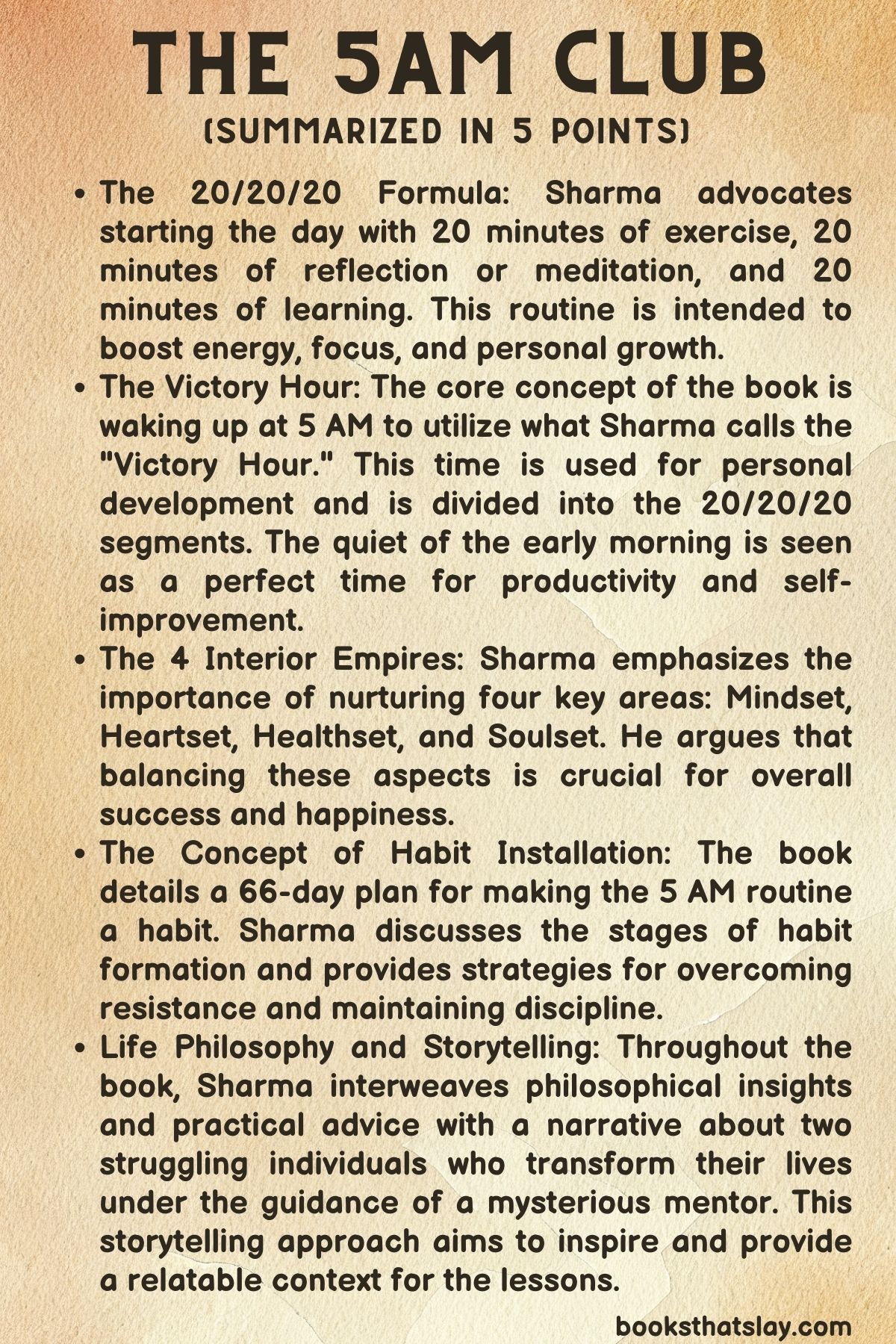
He outlines core practices: reducing distraction, strengthening self-identity through disciplined routines, and building the inner foundations that support outer achievement. He teaches a four-part approach to developing mindset, emotional resilience, physical health, and spiritual steadiness, emphasizing that real performance is sustained by the person you become inside, not just by the outcomes you chase.
He also introduces “day stacking,” the idea that small daily wins, repeated patiently, create major change.
The journey becomes global. Riley takes them to Agra, arranging early access to the Taj Mahal to make a point about long-term commitment and the patience behind great achievements.
He teaches how habits form, describing a cycle that begins with struggle and eventually becomes automatic through repetition. The entrepreneur begins reframing her anger toward her rivals, recognizing that carrying resentment keeps her trapped.
She chooses forgiveness, not as approval of what happened, but as a way to free herself. Riley’s health, however, keeps showing cracks—coughing fits, pain, moments where he seems to rely on pills—yet he keeps teaching.
In Rome, Riley finally presents the core morning method: a one-hour routine beginning at 5:00 a.m., broken into three focused twenty-minute blocks. First, intense movement to wake the body and reduce stress.
Second, quiet reflection to sharpen clarity and stabilize emotions. Third, concentrated learning or planning—often through journaling—to guide the day with intention rather than reaction.
He offers practical tips for waking early, including removing screens from the bedroom and using a simple alarm clock. The method is positioned as a daily system for building focus, calm, fitness, and creative output.
The Spellbinder returns with instruction on sleep and evening routines, emphasizing that morning excellence depends on night discipline. He describes the benefits of strong sleep habits and recommends protecting evenings from device overload.
Riley reinforces the idea that personal growth is built through consistent routines, step by step, and he gives them tools for planning a strong day.
Time passes, and the entrepreneur’s life begins changing rapidly. She becomes fitter, clearer, and more productive.
Her relationship with the artist deepens, and they become engaged. But danger follows them.
In São Paulo, violence erupts when attackers confront them over her company. Riley’s security responds, chaos breaks out, and the artist briefly goes missing.
The entrepreneur refuses to abandon him and courageously de-escalates a deadly moment, saving his life by appealing to the attacker’s humanity.
Afterward, Riley reveals he has taken decisive action: he bought the equity in her company, stripping power from the investors who tried to push her out. It’s both a rescue and a lesson—use power to protect what matters, and do it with precision.
Riley also gives them a set of productivity and focus tactics meant to support lifelong creativity and consistent output.
Back in South Africa, Riley teaches the importance of balancing intense work with deep recovery. He explains that growth requires both stress and rest, just as the body strengthens after recovery from training.
He speaks more openly about joy, wonder, and the need to stay connected to what makes life feel meaningful. He leaves them with letters and symbolic objects meant to remind them of his principles long after the journey ends.
His farewells carry a quiet sadness, suggesting he knows his time is limited.
Their final visit takes them to Robben Island, where the Spellbinder uses Nelson Mandela’s story to teach character and leadership. He outlines virtues—bravery, forgiveness, integrity, understanding, sincerity, politeness, humility—and frames them as the human qualities that turn achievement into legacy.
The entrepreneur and the artist leave not only with a morning method, but with a larger code for how to live.
Years later, the entrepreneur and the artist are thriving. They’ve carried the early rising practice into a new lifestyle, using it to strengthen their work, health, and relationship.
Riley dies months after their last major lesson, leaving his Mauritius property to them and revealing he also had a daughter, who was with him at the end along with the Spellbinder. The entrepreneur and the artist continue the mission by helping others who are close to giving up, passing on what they learned: build your days with intention, protect your focus, and start by owning the first hour.
Key Figures and Characterizations
The Entrepreneur
The Entrepreneur is the emotional core of The 5 AM Club. She begins the story as a high-achieving but deeply fractured individual.
Outwardly successful, she has built a respected technology company, yet internally she feels betrayed, exhausted, and stripped of purpose as her board moves to remove her. Her contemplation of suicide reveals how fragile identity can become when it is rooted almost entirely in professional status.
She is intelligent, disciplined, and capable, but her sense of self has narrowed to achievement and validation. This collapse of identity forces her to confront unresolved trauma, especially her father’s suicide under similar professional humiliation.
Throughout the journey, she transforms from someone defined by fear and anger into someone grounded in clarity and forgiveness. Her development is marked by increasing emotional honesty, physical renewal, and a redefinition of leadership.
By the end, she embodies resilience, not because her circumstances vanish, but because she changes her internal narrative and daily structure.
The Artist
The Artist represents unrealized creative potential restrained by self-doubt and social conditioning. Unlike the Entrepreneur, he is not publicly powerful, but he carries a quieter dissatisfaction with mediocrity.
His rebellious streak, visible in his disregard for rules and conventional paths, masks insecurity and a fear of committing fully to his gifts. His recurring dream about losing his childhood imagination symbolizes the cost of conformity.
He struggles with self-sabotage, often hiding behind irony or detachment instead of risking genuine effort. Over time, exposure to the 5 a.m.
discipline pushes him toward seriousness about his craft. His growth is not about becoming someone else, but about reclaiming the boldness he once had as a child.
Emotionally, he becomes a stabilizing force for the Entrepreneur, offering affection and vulnerability rather than competition. His arc shows that creativity flourishes when structure supports it, and that discipline does not suppress artistry but strengthens it.
Stone Riley
Stone Riley is the catalytic force of the narrative, functioning as mentor, protector, and living example of the philosophy he teaches. Initially disguised as an unhoused eccentric, he tests perception and challenges superficial judgment.
His reveal as a billionaire investor reframes him as a man who has achieved external success yet remains anchored in humility and service. Riley’s character blends charisma, mysticism, and pragmatic discipline.
He believes in rigorous morning routines, focused attention, and structured growth, but he also speaks about joy, wonder, and emotional connection. His battle with illness adds depth to his teachings; urgency and fragility underpin his insistence on using time wisely.
Riley’s wealth gives him power, but he consistently frames power as a tool for stewardship rather than ego. His purchase of the Entrepreneur’s company equity demonstrates decisive loyalty and strategic thinking.
Ultimately, Riley symbolizes mastery balanced with humanity. His approaching death reinforces the book’s core message: time is limited, so each morning must be used deliberately.
The Spellbinder
The Spellbinder serves as the philosophical architect behind the 5 a.m. method.
As an elderly motivational teacher, he embodies wisdom earned through decades of guiding others. His collapse at the conference introduces vulnerability into what could otherwise be a purely inspirational figure.
He does not present himself as invincible; instead, he emphasizes that greatness requires sacrifice and persistence. The Spellbinder focuses less on tactics and more on identity and character.
He challenges audiences to confront distraction, fear, and self-deception. His worldview extends beyond productivity to moral strength, highlighting virtues such as forgiveness and humility.
He represents the bridge between ambition and conscience. Where Riley operationalizes the ideas into routines and systems, the Spellbinder roots them in philosophy and moral responsibility.
His presence at key moments underscores continuity, as if he is the guardian of a tradition that passes from mentor to student across generations.
The Chauffeurs and Security Team
Though minor in narrative focus, the chauffeurs and security personnel reinforce Riley’s credibility and values. Their professionalism and respect toward him reveal his leadership style indirectly.
They speak of him as principled and disciplined, suggesting that his influence extends beyond wealth into culture and conduct. The careful driving, the emphasis on honoring one’s word, and the swift response to threats all illustrate an environment built on order and integrity.
These characters function symbolically as evidence that Riley’s philosophy is not theoretical; it shapes real systems and behaviors around him.
The Entrepreneur’s Father
The Entrepreneur’s father, though absent in the present timeline, exerts a powerful psychological influence. His professional success followed by forced removal and eventual suicide creates a shadow that hangs over his daughter’s life.
He represents both inspiration and warning. His fate becomes the mirror she fears stepping into.
Through him, the narrative examines how unresolved trauma and pride can distort perception and narrow options during crisis. As she progresses through the teachings, her reinterpretation of her father’s story shifts from inevitability to cautionary tale.
Forgiveness toward her rivals becomes intertwined with forgiving the legacy of despair she inherited. In this way, the father’s character deepens the theme of breaking destructive cycles.
Vanessa Riley
Vanessa, Riley’s late wife, appears mainly through recollection, yet her influence is essential to understanding him. She grounds his success in love and partnership rather than ambition alone.
Her death shapes Riley’s later life, intensifying his devotion to purpose while also revealing his vulnerability to grief. Through Vanessa, the narrative underscores that achievement without connection is hollow.
Riley’s refusal to seek another partner after her passing suggests loyalty and unresolved longing, reinforcing the human cost that can accompany extraordinary drive.
The Corporate Antagonists
The unnamed investors and aggressors connected to the Entrepreneur’s company represent forces of greed, fear, and control. They are not deeply individualized, but their role is thematic rather than personal.
They embody the darker side of ambition and the high-stakes world of corporate power. Their threats escalate from professional maneuvering to physical danger, raising the tension of the story.
Against them, the Entrepreneur must choose courage over retreat. These antagonists highlight the contrast between external power struggles and internal mastery, reinforcing the idea that control over one’s morning and mindset is the first defense against chaos.
Nelson Mandela (Symbolic Figure)
Although not an active character in the plot, Nelson Mandela functions symbolically during the visit to Robben Island. His endurance, forgiveness, and integrity serve as a real-world model of moral leadership.
He anchors the teachings in historical reality, showing that discipline and character are not abstract concepts but lived virtues that can change nations. Through his example, the Entrepreneur and the Artist are invited to see their lives as platforms for legacy rather than mere success.
Together, these characters create a layered exploration of ambition, discipline, trauma, mentorship, and renewal, each embodying a different dimension of the philosophy at the heart of the story.
Analysis of Themes
Mastery of Time Through Intentional Mornings
Control over the first hour of the day functions as the structural backbone of The 5 AM Club. The narrative argues that time is not merely something to be managed but something to be honored.
The early morning, before the world imposes its demands, becomes a private arena for mental conditioning, emotional regulation, and strategic focus. Rising at 5:00 a.m.
is not presented as a productivity gimmick but as a psychological reset that positions the individual ahead of distraction and reactive living. By dividing the first hour into exercise, reflection, and focused growth, the routine addresses the body, mind, and professional identity in a deliberate sequence.
This rhythm transforms mornings from rushed beginnings into disciplined preparation.
The theme expands beyond efficiency. The Entrepreneur’s crisis demonstrates what happens when time is surrendered to chaos and external pressure.
Her identity erodes because she reacts constantly rather than acting with intention. The 5 a.m. structure reverses this pattern by giving her a daily anchor. Time becomes something she shapes rather than something that overwhelms her.
The insistence on removing digital devices from the bedroom reinforces the idea that boundaries are necessary for autonomy. The morning ritual becomes symbolic of reclaiming sovereignty over one’s attention, and by extension, one’s life.
Through repeated practice, time management evolves into self-respect. Each dawn represents a decision to build rather than drift.
Identity, Self-Concept, and Personal Narrative
Personal transformation in the story is rooted in the reconstruction of self-identity. The Entrepreneur initially defines herself through her company’s success.
When that foundation cracks, her entire sense of worth collapses. The teachings she encounters emphasize that behavior aligns with self-concept.
If someone believes they are ordinary, fragile, or defeated, their actions will mirror that belief. This alignment becomes a form of self-fulfilling prophecy.
By changing internal narratives, individuals can shift the trajectory of their lives. The morning discipline is designed to interrupt negative mental scripts before they harden into habitual defeat.
The Artist’s arc reinforces this theme from another angle. His dream of abandoning childhood ambition shows how identity is shaped by external voices that encourage safety over courage.
He learns that reclaiming creative boldness requires confronting internalized doubt. The theme suggests that excellence is not merely skill-based but belief-based.
Habits serve as evidence of a new identity being constructed. Each early rise reinforces the self-image of someone disciplined and capable.
Over time, these small affirmations accumulate, replacing fragile self-perception with earned confidence. The Entrepreneur’s forgiveness of her rivals marks a crucial shift in narrative.
She no longer sees herself as a victim of betrayal but as an autonomous leader choosing growth over resentment. Identity becomes less about status and more about character, resilience, and conscious decision-making.
Discipline, Habit Formation, and Neuroplastic Growth
Habit formation is presented as both a scientific process and a moral commitment. The story repeatedly stresses that excellence is less about inspiration and more about repetition.
Through explanations of neuroplasticity, the brain is described as adaptable and responsive to consistent effort. Just as muscles strengthen through strain and recovery, mental pathways strengthen through deliberate routine.
The concept of a 66-day habit arc illustrates that discomfort is not a sign of failure but a predictable stage of installation. Many people abandon change during the most energy-intensive phase, mistaking resistance for impossibility.
The Entrepreneur’s transformation depends on moving beyond temporary motivation toward structured repetition. Exercise reduces stress hormones, reflection stabilizes emotion, and journaling sharpens clarity.
These actions are simple in isolation, but their power lies in sustained execution. The theme reframes discipline as freedom rather than restriction.
By mastering small daily behaviors, individuals reduce the cognitive load of decision-making and create mental space for creativity and strategy. The narrative also acknowledges that discipline includes rest.
Sleep rituals and recovery cycles are emphasized as essential for peak performance. Growth requires alternating intensity and restoration.
Through these systems, habit becomes a form of self-authorship, gradually replacing chaotic patterns with intentional ones.
Legacy, Mortality, and Meaningful Achievement
Awareness of mortality shapes the emotional gravity of the story. The Entrepreneur’s fear of repeating her father’s tragic end forces her to confront how quickly identity can collapse under pressure.
Riley’s visible illness adds urgency to his teachings, reminding his students that time is finite and unpredictable. The visits to historical sites and figures reinforce that true achievement extends beyond wealth or status.
Legacy is defined by character, service, and the impact left on others.
The story contrasts superficial success with enduring influence. Financial triumph alone does not guarantee fulfillment.
Riley’s wealth gains meaning because he uses it to mentor, protect, and empower others. The Entrepreneur’s company regains stability not simply through acquisition but through her renewed sense of purpose.
Mandela’s example highlights forgiveness and moral courage as pathways to lasting significance. The recurring phrase about elevating life underscores that legacy is built through daily conduct rather than grand gestures.
This theme reframes ambition. Rather than chasing recognition, the characters are encouraged to cultivate virtues that outlive them.
The early morning ritual becomes a preparation for living deliberately so that when life ends, it reflects intentional choices rather than reactive survival. Mortality, rather than producing despair, becomes a motivator for depth, gratitude, and ethical leadership.