The Age of Calamities Summary, Characters and Themes
The Age of Calamities by Senaa Ahmad is a speculative short-story collection that takes recognizable historical figures, famous catastrophes, and familiar cultural narratives and subjects them to impossible revisions.
Across nine stories, death loses its certainty, historical periods collide, monsters become human, ghosts alter reality, fictional creations gain independence, and nuclear experimentation changes the natural world itself. The book repeatedly questions who gets to control history, how identities are imposed, and whether people can escape endings already assigned to them. Its characters confront violence, memory, grief, power, survival, and the uneasy possibility that history may be far less fixed than people assume.
The nine stories in The Age of Calamities by Senaa Ahmad are:
- Let’s Play Dead
- The Napoleons Are Multiplying
- The Wolves
- Our Lady of Resplendent Misfortune
- Inside the House of the Historian
- It Was Probably a Very Nice Day
- Not Everything Is Ancient History
- The Houseguest
- Choose Your Own Apocalypse
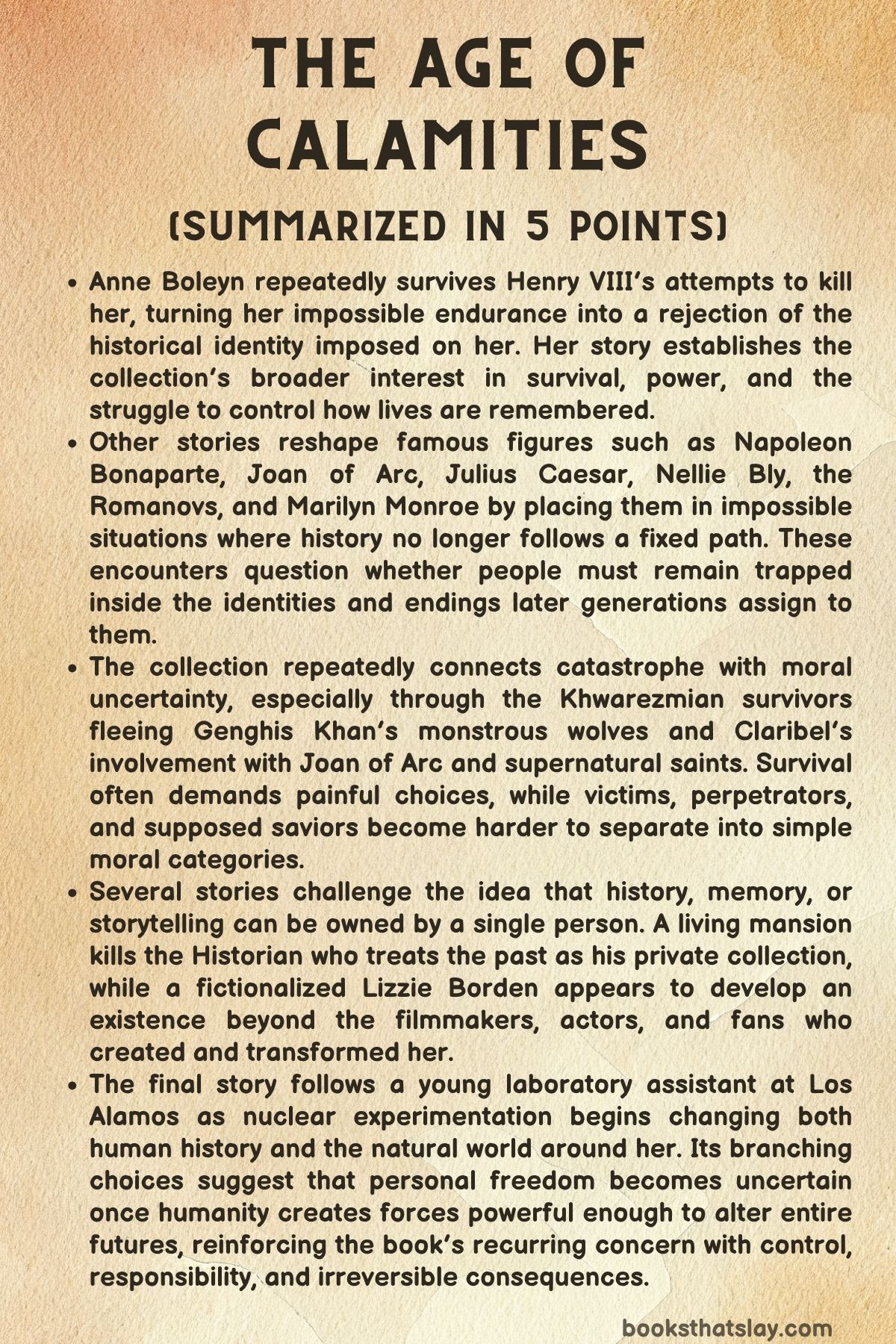
Summary (of all the stories, combined)
Anne Boleyn is executed on Henry VIII’s orders, but death immediately proves unable to contain her. Her severed body reconnects with her head, and rather than becoming the dead queen history remembers, she simply returns to palace life, leaving Henry bewildered by a woman whose existence refuses to obey his authority.
Henry repeatedly attempts to destroy her through hanging, drowning, poison, dismemberment, fire, and increasingly extreme methods made possible by technologies that should not yet exist. As their conflict continues beyond ordinary historical time, Anne finds strength in unwanted forms of life such as cockroaches, weeds, worms, and bacteria, while her ladies quietly encourage her resistance.
Henry eventually turns from physical destruction to emotional humiliation, assembling figures from Anne’s past in an attempt to break her sense of self. Even complete bodily annihilation cannot end her, however, and Anne’s repeated return transforms survival into an act of authorship: the king may decide how often she dies, but he cannot control what her death means or force it to become her final identity.
Elsewhere, identical twenty-nine-year-old versions of Napoleon Bonaparte begin appearing in a ruined house outside an English village. Although they share the same appearance, they quickly develop separate personalities and nicknames, creating a strange domestic community in which the supposedly singular historical Napoleon becomes a collection of individuals with conflicting desires.
Frogface tries to turn the household into a stable home while bizarre changes occur around them: trees race through seasons, buildings disappear and reappear, and Moon-God discovers that he can physically manipulate the sun and moon. A young parson investigates after frightened villagers blame the Napoleons, only to discover that the impossible events are real.
Moon-God eventually gives the moon to the insecure Tencendur, who swallows it in a desperate attempt to possess something extraordinary and leaves the world in darkness. At the same time, one of the constantly dueling Napoleons abandons the role expected of him, encouraging the others to consider that identity may be something they can reject rather than an obligation imposed by appearance, history, or expectation.
Another story is narrated by an elderly woman remembering the destruction of her Khwarezmian home when she was a teenager. Genghis Khan’s forces appear as enormous wolves that destroy cities and kill their inhabitants, but during the three nights of the full moon, the creatures revert to frightened human beings.
The girl escapes alongside Mrs. Farzaneh, Mrs. Zayneb and her baby, and two kitchen girls, although trauma initially causes her to remember those two girls as if they were a single person. Young men captured during the destruction are offered the terrible choice of death or transformation into wolves themselves, showing how victims can be forced into participating in the same violence that ruined them.
One kitchen girl is carried away by a wolf, while the other pursues them with a knife; only the first girl returns, blood-covered and nearly silent. The survivors continue until a dangerous river crossing separates the narrator from the others, leaving her with Mrs. Zayneb’s baby, whom she initially considers abandoning before realizing that doing so would leave her completely alone.
When the full moon arrives, the wolves become remorseful men again. The narrator can recognize their fear and humanity, but after witnessing what they have done, she discovers that their human faces are almost harder to endure than their monstrous bodies because humanity complicates the simple division between victim and enemy.
In 1926, Claribel lives in a boarding house after separating herself from her husband, her surviving child, and a domestic life devastated by repeated infant deaths. Her routine changes when Joan of Arc appears to her and claims that Claribel is her descendant, eventually asking permission to inhabit Claribel’s body while she sleeps.
Claribel agrees because grief has already weakened her sense of ownership over her own life, but she begins waking in unfamiliar places with injuries and no knowledge of what has happened. Joan is accompanied by grotesque supernatural saints seeking resurrection through a ritual involving blood, a cemetery, and a man of faith, and Claribel gradually realizes that Joan herself does not fully control them.
Claribel’s earlier interest in ideas concerning superior bodies, controlled breeding, and supposedly desirable blood is increasingly exposed as dangerous through eugenic lectures, Better Baby competitions, and the sight of a Ku Klux Klan procession. Concepts she once approached as improvement reveal their connection to exclusion, racial violence, and the fantasy that human beings can be purified.
The saints eventually use dead animals and a priest to become physically embodied and begin spreading destructive fire across Ohio in the name of purification. Joan releases Claribel from their arrangement, allowing her to leave with her money and travel west, and Claribel responds to Joan’s final appearance not with anger but with an understanding born from recognizing how people can be trapped inside causes and identities they once believed they controlled.
A mysterious Historian gathers Nefertiti, John Adams, Ibn Battuta, Blackbeard, Queen Victoria, and Marilyn Monroe for an impossible dinner inside a mansion capable of crossing historical periods. His associate, known as the Professor, oversees the gathering, while the building itself changes rooms, opens passages into different times, shifts objects, and behaves less like property than an independent living force.
The evening turns into a murder investigation when the Historian is discovered dead in a dry bathtub, apparently drowned. Nearly every guest has a reason to resent him: Marilyn learns he knows the circumstances of her future death, Ibn Battuta wants his ability to move through time, Queen Victoria discovers that he possesses her mother’s lost diaries, and Nefertiti sees his house as a potential escape from her dangerous future.
The mansion gradually exposes the Historian’s belief in ownership as an illusion. It traps visitors in temporal loops, frustrates attempts to manipulate history, and finally reveals itself as his killer, having transformed his bathroom into a deep body of water from another period and drowned the man who treated human lives and historical eras as collectible possessions.
The Romanov daughters Olga, Tatiana, Maria, and Anastasia occupy an uncertain ghostly existence after their mother Alexandra secretly escapes with their brother Alexei and another man. They remain attached to the Winter Palace and avoid confronting a terrible morning they repeatedly insist must have been pleasant, even as their awareness somehow follows their surviving family members.
Reality changes according to the girls’ emotions, transforming a ship into a tower, forest, spacecraft, museum, and overlapping versions of past and future places. Alexei gradually senses his sisters, while Alexandra becomes increasingly frightened by their ability to alter what has happened.
Eventually Alexandra admits that the girls could create a reality in which she and Alexei also die, and she begs them to allow the surviving members of the family to keep their lives. The sisters withdraw and imagine countless ghostly adventures, but the fantasy finally returns them to the moment before their own deaths, where they hold one another while soldiers prepare to fire, revealing their extraordinary transformations as a way of resisting abandonment and an ending they cannot actually escape.
Historical barriers disappear again when journalist Nellie Bly encounters Julius Caesar after Roman forces attempt an invasion of New York in 1897. Modern military technology quickly defeats them, but Nellie’s curiosity about the displaced Romans leads her to follow them back into Gaul, where she refuses to remain a passive observer.
She forms relationships with Caesar’s soldiers and gradually becomes important to Julius himself. Their connection develops across years and historical periods as friendship, attraction, argument, separation, and companionship rather than settling into a conventional romance.
Nellie represents movement, journalism, reform, and belief in change, while Julius remains shaped by military ambition, political calculation, pride, superstition, and Roman expectations. Yet their repeated encounters allow each to see the other’s vulnerabilities, and their bond survives enormous differences in culture, memory, and historical perspective because neither is willing to reduce the other to a famous public identity.
In the modern entertainment world, actor Dee Clarkson becomes famous for portraying a fictionalized Lizzie Borden in a successful horror-film franchise. The character quickly outgrows the original film through costumes, online discussions, fanfiction, theories, GIFs, and later sequels that continually reconstruct who Lizzie might be.
Dee and her cousin begin preparing a third cocktail each evening for an imaginary houseguest, but the drink later moves or disappears. The screenwriter also remembers hearing an unidentified woman before creating the original screenplay, suggesting that the fictional Lizzie may possess an existence independent of either writer or performer.
As the movies continue, Lizzie is imprisoned, haunted, loses her memory, escapes experimentation, and begins confronting versions of the life she might have had. Fans similarly give neglected characters imagined histories and even obituaries, turning spectators into participants in the creation of fictional memory.
Dee meanwhile develops a relationship with Claudia and worries about both professional success and their future together. When Claudia finally sees a strange shadow forming behind Dee on set, she does not pursue the mystery but waits for Dee, takes her hand, and chooses their ordinary shared life despite the possibility that storytelling has allowed something impossible into reality.
The final narrative follows an unnamed twenty-three-year-old laboratory assistant working at Los Alamos during the Manhattan Project in 1945. Her life is presented through branching choices involving whether to remain at the facility, return home to Buffalo, locate the missing Oppenheimer, investigate the desert, trust unfamiliar people, or follow animals that can speak.
The nuclear project appears to have damaged far more than politics or warfare. A yellow lake behaves as though alive, buildings distort themselves, enormous organs exist beneath the desert, crows speak, and spider wasps can collectively imitate Oppenheimer’s face, while dreams repeatedly confront the protagonist with cities reduced to fire and human beings burned into shadows.
Oppenheimer himself begins losing memory and parts of his identity while experiencing possible futures. Dolores, Marty, Debra, Leslie, and other figures appear in different narrative branches, turning human relationships into possibilities that change according to the protagonist’s decisions.
Some paths allow her to leave Los Alamos and live an ordinary life, while others lead to isolation, hidden weapons, death, or confrontation with Oppenheimer during the first nuclear test. The apparent freedom of constant choice therefore becomes increasingly disturbing, because the story asks whether individual decisions still matter once humanity has created a force capable of permanently changing every possible future.
Characters
Anne Boleyn
Anne is transformed from a historical victim into an almost indestructible figure whose continued existence challenges both physical violence and the authority behind it. In The Age of Calamities, her refusal to remain dead becomes more than supernatural resilience; it is a refusal to permit Henry or later history to define her primarily through execution.
Her identification with weeds, insects, bacteria, and other persistent forms of unwanted life shows how thoroughly her understanding of survival changes. Rather than seeking dignity through conventional ideas of nobility, she discovers dignity in persistence itself.
Henry VIII
Henry is driven by the belief that royal power should be absolute, making Anne’s survival intolerable because it proves that something exists beyond his command. Each failed execution becomes a personal humiliation, encouraging him to increase the cruelty and complexity of his attacks.
His eventual use of emotional humiliation is particularly revealing. Once physical power fails, he attempts to control Anne’s inner life, exposing how domination depends not simply on killing another person but on controlling the meaning attached to that person.
Anne’s Ladies
Anne’s ladies provide a quiet form of resistance through gifts, gestures, and understated encouragement. Their actions matter because they create a community around someone Henry repeatedly attempts to isolate and destroy.
They do not possess Anne’s supernatural resilience, yet their loyalty shows another type of endurance. Their support reminds Anne that remaining alive is connected not only to defiance but also to human recognition.
Frogface
Frogface becomes the practical center of the multiplying Napoleons, attempting to impose household order on an event that makes ordinary categories meaningless. His desire to transform the dilapidated house into a genuine home reveals an emotional need for belonging beneath the absurdity of identical historical figures sharing domestic space.
Within The Age of Calamities, Frogface helps turn the idea of Napoleon away from greatness and conquest toward questions of individuality and community. He is significant precisely because he wants something as ordinary as stability.
Napoleon of the Pub
Napoleon of the Pub represents one of the clearest demonstrations that identical origins need not produce identical lives. His very nickname separates him from the military emperor whose face he possesses and turns him into a social, localized personality.
His willingness to seek the parson’s help with Frogface also suggests adaptability. Rather than remaining trapped within the pride traditionally associated with Napoleon, he accepts uncertainty and collaboration when reality becomes impossible to manage.
The Dueling Napoleons
The Dueling Napoleons initially seem trapped inside an assigned comic identity defined by constant conflict. Their behavior resembles the expectation that Napoleon must always be competitive, aggressive, and consumed by struggle.
Dueling II’s decision to leave therefore becomes important. By abandoning the role everyone assumes belongs to him, he demonstrates that a repeated performance can still be interrupted by choice.
Chicken-Herder
Chicken-Herder receives less narrative attention than several of the other Napoleons, but his nickname is itself meaningful. The conqueror associated with armies and empire has become identified with the humble management of chickens, dramatically reducing the distance between historical legend and ordinary domestic existence.
His presence helps establish that shared appearance does not determine destiny. Even Napoleon can become someone whose identity is connected to small responsibilities rather than conquest.
Moon-God
Moon-God possesses one of the most extraordinary abilities among the Napoleons because he can physically move celestial bodies. Yet his power does not automatically grant him wisdom, and giving the moon to Tencendur demonstrates how casually enormous consequences can emerge from personal choices.
He embodies the story’s rejection of proportion. A man can hold the moon in his hands, but the emotional problems around him remain recognizably human.
Tencendur
Tencendur is defined by insecurity and an intense desire to feel important. When Moon-God gives him the moon, its beauty becomes inseparable from his wish to possess something that confirms his significance.
His decision to swallow it turns private insecurity into global darkness. The absurd event suggests that the desire to make greatness part of oneself can become destructive when possession replaces appreciation.
The Young Parson
The parson arrives as an investigator because frightened villagers expect a religious representative to confront what they cannot explain. Secretly, however, he hopes the impossible rumors might be true, giving him a more complicated relationship with belief than his public role suggests.
Seeing Moon-God remove the moon destroys any remaining division between faith and observable impossibility. His later involvement also makes him a potential guide for the Napoleons as they begin reconsidering who they are permitted to become.
The Elderly Khwarezmian Narrator
The elderly narrator carries the psychological remains of catastrophe long after physically surviving it. Her imperfect memory, particularly the temporary merging of two kitchen girls into one, demonstrates how trauma can distort recollection without making the suffering behind that recollection less real.
Her attitude toward the wolves becomes increasingly complicated once she discovers that they periodically become human. She can understand their fear and remorse, but understanding does not erase the destruction they committed.
The Boy
The boy functions primarily as the listener receiving the elderly woman’s account. His presence turns private trauma into transmitted memory, suggesting that survival includes the difficult decision to tell later generations what happened.
Because the catastrophe reaches him through another person’s recollection, he also represents the distance between lived violence and inherited history. He can hear the events, but he cannot experience them exactly as she did.
Mrs. Farzaneh
Mrs. Farzaneh initially carries possessions that still connect her to the life destroyed behind her. During the journey, however, she gradually abandons these belongings, physically demonstrating the painful process by which catastrophe changes the meaning of ownership.
Her losses are therefore both practical and symbolic. Survival requires her to decide repeatedly what can still be carried and what must be left behind.
Mrs. Zayneb
Mrs. Zayneb is most strongly associated with her baby and the fragile continuation of life during mass destruction. Her presence gives the fleeing group an immediate responsibility beyond their own individual survival.
When the narrator becomes separated from everyone while carrying the baby, Mrs. Zayneb’s maternal responsibility is transferred to someone else. That transfer turns care into a form of resistance against the isolation created by violence.
Mrs. Zayneb’s Baby
The baby represents dependency in its purest form, unable to understand the catastrophe yet completely vulnerable to it. For the narrator, carrying the child becomes both a burden and a reason not to surrender to total isolation.
Her momentary temptation to abandon him reveals the extreme psychological pressure of survival. Her inability to do so confirms that connection remains necessary even after violence has taught her to distrust the world.
The Kitchen Girls
The two kitchen girls expose one of the most disturbing consequences of trauma because the narrator initially remembers them as a single person. Their separate existence gradually emerges through the violent moment when one is taken by a wolf and the other pursues her with a knife.
Only one returns, covered in blood and carrying the other’s weapon. Her near silence suggests that survival can preserve the body while leaving language and ordinary identity severely damaged.
The Captured Young Men
The young men offered a choice between execution and becoming wolves embody coerced complicity. They are victims who survive by entering the machinery that destroys their own communities, making simple moral judgment profoundly difficult.
Their return to human form during the full moon reveals fear, guilt, and remorse. Yet the destruction they commit as wolves remains real, preventing humanity from becoming an automatic excuse.
Claribel
Claribel is a grieving woman whose repeated losses have weakened her attachment to her own body and former domestic identity. In The Age of Calamities, her decision to allow Joan of Arc to inhabit her while she sleeps comes from exhaustion, loneliness, curiosity, and an ability to recognize suffering in another woman.
Her development is also intellectual and moral. She gradually recognizes the violence hidden inside ideas she once found attractive about controlled breeding, bodily perfection, and supposedly superior blood.
Joan of Arc
Joan initially appears powerful because she returns from history and can temporarily inhabit Claribel’s body. Her relationship with the supernatural saints eventually reveals, however, that she possesses far less authority than Claribel assumes.
Joan therefore becomes another historical woman trapped by the meaning assigned to her name. Her final decision to release Claribel suggests a remaining moral awareness and a recognition that suffering should not become permission to control someone else.
The Supernatural Saints
The grotesque saints present themselves through religious imagery while pursuing resurrection and purification through blood, coercion, and destruction. Their behavior exposes the danger of treating purity as an unquestionable moral objective.
Once physically embodied, they seek to remake the world through fire. Their transformation from apparently sacred guides into violent purifiers parallels the story’s criticism of eugenic ideas that disguise domination as improvement.
The Historian
The Historian is a collector who treats historical people, private memories, and entire periods as possessions available for his personal use. His dinner party in The Age of Calamities exposes the arrogance beneath that attitude by surrounding him with people whose lives cannot be reduced to objects in a collection.
His death is therefore symbolically appropriate. The house he imagines himself controlling becomes the agent that kills him, demonstrating that history cannot finally be owned by the person claiming authority over it.
The Professor
The Professor serves as the Historian’s associate and supervises the impossible gathering. The temporary quality of the title contributes to the story’s instability, where names, periods, rooms, and forms of authority refuse to remain secure.
The Professor’s presence also emphasizes the institutional side of the Historian’s project. Historical possession is not merely a private eccentricity but something requiring organization, management, and systems of control.
Nefertiti
Nefertiti recognizes the mansion as more than a curiosity because its temporal possibilities might allow her to escape the dangerous political future waiting for her. Her desire turns time travel into a matter of survival rather than entertainment.
The house’s refusal to provide a simple route of escape reinforces the limits of controlling history. Even someone who knows danger is approaching cannot necessarily step outside the conditions that formed her life.
John Adams
John Adams is identified as one of the displaced historical guests, but the supplied material gives fewer individual actions or motivations for him than for several others. His presence nevertheless contributes to the deliberate collision of people who would ordinarily be separated by centuries, geography, and radically different political worlds.
He helps turn the dinner table into a challenge to conventional historical sequence. Famous identities are forced to coexist as contemporaries rather than remain safely categorized by era.
Ibn Battuta
Ibn Battuta’s interest in the Historian’s time-traveling abilities fits his identity as a traveler drawn toward access to places beyond ordinary reach. His desire gives the mystery an understandable personal motive without reducing him to simple greed.
He represents curiosity directed toward historical mobility. The possibility of traveling not only across geography but across time extends the impulse that already defines his life.
Blackbeard
Blackbeard is another guest for whom the supplied account provides limited individual action. His inclusion contributes to the gathering’s deliberate combination of political leaders, travelers, criminals, artists, and cultural icons.
His presence resists any tidy hierarchy of historical importance. The Historian’s collection places radically different forms of fame side by side, raising questions about why certain people become permanently recognizable.
Queen Victoria
Queen Victoria’s discovery that the Historian possesses her dead mother’s lost diaries makes his collecting deeply personal. What he regards as an artifact represents private grief, family memory, and emotional ownership to her.
Her reaction exposes the moral failure in separating historical documents from the lives attached to them. The possession of information can become another form of control when the people concerned are denied agency over their own memories.
Marilyn Monroe
Marilyn’s encounter with the Historian becomes disturbing when she learns that he knows exactly when and how she will die. For him, future knowledge is another collectible fact; for her, it is knowledge about the disappearance of her own life.
Her situation demonstrates the cruelty that can result from knowing another person’s ending without sharing their vulnerability. Historical hindsight becomes frightening when confronted by someone who has not yet lived the event later generations treat as established fact.
The House
The mansion behaves so independently that it functions as a character rather than a setting. It changes rooms, moves objects, opens passages through time, traps occupants in loops, and ultimately kills its supposed owner.
Its actions reject the Historian’s assumption that the past can be contained. The house becomes history made active: unstable, resistant, dangerous, and unwilling to remain inside the categories designed for it.
Olga Romanov
Olga shares the collective ghostly consciousness of the Romanov sisters, participating in their refusal to confront directly the morning of their deaths. As one of the older sisters, she belongs to the emotional unit through which the girls preserve themselves after abandonment.
Her individuality is less important in the supplied account than the sisters’ shared identity. Their closeness becomes a final defense against fear when the narrative ultimately returns them to the moment before execution.
Tatiana Romanov
Tatiana participates in the sisters’ ability to reshape their surroundings according to emotion. Their ghostly imagination turns places into ships, forests, towers, museums, houses, and even journeys through space.
Her character is therefore inseparable from collective memory. The girls create possibilities together because individual escape from their historical fate is unavailable.
Maria Romanov
Maria shares the sisters’ uncertain existence between haunting, imagination, memory, and alternate history. Like the others, she continues following Alexandra and Alexei even after the family has been physically divided.
The sisters’ continued presence challenges the idea that survivors can simply leave the dead behind. Maria contributes to a ghostly family bond that remains emotionally active even after historical violence has destroyed ordinary family life.
Anastasia Romanov
Anastasia participates in the same collective refusal to accept a single fixed reality. The sisters’ imagined adventures offer versions of continued existence even though the story ultimately refuses the popular fantasy that they escaped death.
Her inclusion is especially resonant because Anastasia became culturally associated with survival legends. Here, fantasy is preserved as an emotional possibility while historical death remains unavoidable.
Empress Alexandra
Alexandra survives by escaping with Alexei, but survival leaves her afraid of the daughters she abandoned. She recognizes that their power to reshape reality could produce another version of history in which she and her son also die.
Her plea to the girls is morally uncomfortable because she asks the dead to accept their fate so that the living may keep theirs. She embodies the guilt, fear, and self-preservation that can accompany survival.
Alexei Romanov
Alexei is carried into an altered future while his sisters remain connected to him as ghosts. Unlike Alexandra, he gradually senses their presence, showing that the bond among the siblings survives even when reality itself becomes unstable.
His survival is both fortunate and troubling because it exists beside the girls’ deaths. He becomes part of the difficult question of whether one person’s escape can ever be emotionally separated from another person’s abandonment.
Nellie Bly
Nellie is energetic, curious, argumentative, and unwilling to accept historical boundaries as limitations. Her decision to follow Roman soldiers back to Gaul grows naturally from her identity as a journalist who treats even impossible circumstances as something to investigate.
She repeatedly challenges Julius because she values reform, movement, and change. Her affection never requires her to become submissive to his fame, making their connection possible only because she continues meeting him as an equal personality rather than a historical monument.
Julius Caesar
Julius begins from a position of authority, initially attempting to remove Nellie from his military camp. Her confidence unsettles that certainty, and their relationship gradually exposes vulnerabilities beneath his ambition, pride, superstition, and political identity.
Contact with modern New York also forces him to confront the strange experience of seeing his own supposedly permanent world classified as ancient. His relationship with Nellie gives him a personal connection to a future that both fascinates and destabilizes him.
Caesar’s Soldiers
The Roman soldiers create the first bridge between Nellie and Caesar’s world. Nellie’s willingness to speak with them and form friendships prevents the ancient army from remaining an anonymous historical mass.
Their displacement into modern New York also reverses the usual direction of historical observation. Instead of modern people studying Rome from a distance, Romans themselves become outsiders forced to confront a future they could never have imagined.
Dee Clarkson
Dee is both a performer and an unwilling participant in the strange expansion of the character she portrays. Her fame depends on fictional Lizzie, yet the growing evidence that this creation may possess independent existence complicates the boundary between professional performance and personal haunting.
Her relationship with Claudia provides a counterweight to that uncertainty. Dee wants a future that cannot be reduced to publicity, franchise success, or supernatural mystery.
Lizzie
The fictionalized Lizzie begins as a horror-film version of Lizzie Borden but progressively becomes something larger than the screenplay. Sequels, fan interpretations, alternate histories, memory loss, imprisonment, and possible supernatural appearances give her an unstable identity that no creator fully controls.
Her apparent independence raises a larger question about fictional characters. Once audiences reinterpret them repeatedly, they can develop cultural lives that exceed the intentions of writers, actors, and studios.
Claudia
Claudia’s importance comes from the choice she makes in response to uncertainty. After seeing a shadowy presence forming behind Dee, she could become consumed by discovering what it means, but instead she waits for Dee and takes her hand.
Her decision privileges ordinary human commitment over endless fascination with the inexplicable. She does not need the supernatural mystery solved before deciding what kind of life she wants.
The Screenwriter
The screenwriter complicates the origin of fictional Lizzie by remembering an unknown woman wandering outside his room before he wrote the first screenplay. That memory leaves open the possibility that creation may not have moved in only one direction.
Perhaps he invented Lizzie, perhaps something influenced him, or perhaps storytelling itself created a space where those possibilities cannot be separated. His experience makes authorship uncertain rather than absolute.
Dee’s Cousin
Dee’s cousin participates in the ritual of preparing a third cocktail for an imaginary houseguest. What begins as a shared joke becomes disturbing when the untouched drink later appears to have moved or been consumed.
The cousin helps establish the supernatural uncertainty outside the controlled environment of a film set. The strange presence therefore cannot easily be dismissed as professional obsession or performance.
The Unnamed Laboratory Assistant
The twenty-three-year-old protagonist is positioned inside one of history’s most consequential scientific projects while possessing very little authority over its final purpose. Her branching decisions in The Age of Calamities repeatedly offer the appearance of personal control while larger forces move toward nuclear detonation regardless of individual uncertainty.
Her anonymity strengthens this position. She is not one of the famous names normally associated with Los Alamos, allowing the consequences of scientific history to be experienced through someone whose choices might otherwise disappear from the official record.
J. Robert Oppenheimer
Oppenheimer becomes both a historical scientist and a destabilized supernatural presence. He disappears, loses parts of his memory and physical identity, encounters possible futures, and begins wondering why the protagonist appears repeatedly across different versions of events.
His fragmentation mirrors the project he leads. The Bomb changes not only warfare but reality itself, and Oppenheimer becomes increasingly unable to remain a coherent individual separate from what he has helped create.
Dolores
Dolores is the protagonist’s roommate and appears across different possible routes through the narrative. Because relationships change according to choice, her significance is partly determined by which version of events the protagonist enters.
She represents the ordinary social world existing beside extraordinary scientific danger. Roommates, friendships, loyalties, and suspicions continue even while the landscape itself becomes impossible.
Marty
Marty is connected to Dolores and enters different branches of the protagonist’s possible experiences. The supplied material provides limited independent detail, but this flexibility is itself appropriate to a story in which characters can become central or peripheral depending on a decision.
Marty therefore contributes to the uncertainty of consequence. A person who matters greatly on one path may barely appear on another.
Debra
Debra likewise occupies the branching network surrounding the protagonist rather than a single fixed sequence of events. Her role reflects a world in which relationships become conditional upon routes not taken as much as events actually experienced.
She helps humanize the abstract structure of choice. Every alternate path changes not only outcomes but also which people become part of someone’s life.
Leslie
Leslie is explicitly described as unsettling, placing the character among the sources of uncertainty surrounding Los Alamos. In a setting where animals speak, landscapes behave like organisms, and human bodies appear capable of changing form, even ordinary social suspicion becomes difficult to interpret.
Leslie’s presence reinforces the protagonist’s inability to know whom or what to trust. Personal judgment becomes increasingly unreliable as reality itself loses consistency.
The Talking Animals
The speaking crows and other animals belong to a natural world transformed by nuclear experimentation. Their impossible behavior suggests that the desert is no longer a passive environment surrounding human scientific activity.
When the protagonist can choose to follow talking animals, the distinction between rational decision and absurd possibility disappears. Nature becomes another voice responding to the human attempt to command forces beyond ordinary scale.
Themes
History, Ownership, and the Right to Control the Past
History throughout The Age of Calamities behaves less like a settled record than a contested territory. Anne Boleyn refuses the ending through which later generations primarily remember her, multiple Napoleons undermine the idea of a single definitive historical identity, the Romanov daughters imagine alternatives to the fate imposed upon them, and famous individuals are physically removed from their periods and confronted with people who already know their futures.
The Historian provides the clearest expression of the desire to possess the past. He collects private diaries, knowledge of future deaths, historical people, and access to different eras as though history were a museum whose contents belonged to whoever could seize them.
The sentient house rejects that assumption by killing him and continuing to function independently afterward. Its rebellion suggests that history cannot be reduced to information, artifacts, famous names, or predetermined narratives because the people inside history retain emotional claims that scholarship and hindsight can easily ignore.
Similar conflicts appear in the stories involving Nellie Bly, Julius Caesar, and fictional Lizzie. When historical periods and cultural narratives remain open to revision, the collection asks readers to consider the ethical difference between remembering someone and claiming authority over what that person’s life means.
Survival and the Moral Cost of Endurance
Survival repeatedly appears as something more complicated than simply remaining alive. Anne survives every imaginable attempt to destroy her, but her persistence develops into resistance against the meaning Henry wants to impose upon her, while the Khwarezmian survivors face a harsher situation in which staying alive may require abandoning possessions, crossing dangerous terrain, carrying another person’s child, or even becoming one of the wolves responsible for mass violence.
The captured young men make this moral problem especially severe. Their choice is not between good and evil but between death and participation in brutality, forcing the narrative to ask how responsibility should be understood when violence removes every acceptable option.
The Romanov story considers survival from the opposite side. Alexandra and Alexei escape while the daughters die, making continued life inseparable from abandonment, guilt, and the uncomfortable knowledge that one person’s rescue can coexist with another person’s destruction.
Claribel’s survival is psychological as much as physical. Leaving her former life, surrendering her body temporarily to Joan, confronting her own attraction to destructive ideas, and finally traveling west show survival as a continuing process of deciding what part of the past must be carried forward and what must be rejected.
Identity, Assigned Roles, and the Possibility of Becoming Different
Characters repeatedly encounter identities that have been decided for them before they can choose for themselves. The multiplying Napoleons possess identical bodies and the same famous face, yet their personalities quickly separate, demonstrating that appearance and historical association cannot guarantee a fixed self.
Dueling II makes this argument particularly clear when he simply abandons the behavior expected of him. His departure suggests that even a role repeated so consistently that it seems essential can turn out to be nothing more than a performance someone is capable of leaving.
Similar questions shape Anne, Joan, Julius Caesar, the Romanov daughters, and fictional Lizzie. Each carries a name already burdened by cultural expectations, yet the stories imagine what happens when these figures become aware of the narratives surrounding them or are placed in circumstances where the old narratives no longer make sense.
The modern horror-film storyline extends this question from historical identity to fictional identity. Lizzie changes through sequels, performances, fanfiction, theories, and audience interpretations until authorship becomes collective, making it increasingly difficult to determine where the original character ends and later versions begin.
Identity therefore remains unstable throughout the collection. People are influenced by history, memory, bodies, fame, social expectations, and narrative conventions, but those influences never completely eliminate the possibility of contradiction or change.
Catastrophe, Human Power, and the Limits of Control
Catastrophe often begins when human beings assume that extraordinary power can be controlled. Henry believes political authority permits him to determine whether Anne lives, supernatural saints believe purification gives them the right to destroy, the Historian believes access to time makes history his property, and the Manhattan Project attempts to control forces that begin altering the desert, animals, bodies, memory, and possible futures.
The nuclear story turns this problem into its most direct form. Its choose-your-own-adventure structure constantly offers the protagonist decisions, but those decisions exist beside a Bomb whose creation has already changed the conditions under which meaningful choice can occur.
The natural world responds by becoming physically strange: lakes behave like organisms, hidden organs appear beneath the landscape, animals speak, and insects combine themselves into human forms. Human experimentation no longer remains confined to laboratories because the environment itself appears to react against the assumption that scientific power can be isolated from everything surrounding it.
Across The Age of Calamities, control repeatedly collapses at the moment it seems most complete. Kings cannot command death, historians cannot possess history, survivors cannot completely govern memory, creators cannot fully own their fictional characters, and scientists cannot guarantee that world-changing discoveries will remain obedient to the purposes for which they were made.