The Alchemist by Ben Jonson Summary, Characters and Themes
The Alchemist by Ben Jonson, is a sharp comic work about greed, deception, and self-delusion in plague-era London. It follows a servant named Face who uses his master’s empty house to run confidence tricks with Subtle and Dol Common.
Their victims come from different social and religious backgrounds, but all share the same weakness: they want more than reason can justify. The work is less about magic than about human appetite, showing how easily people can be cheated when their desires are stronger than their judgment.
Summary
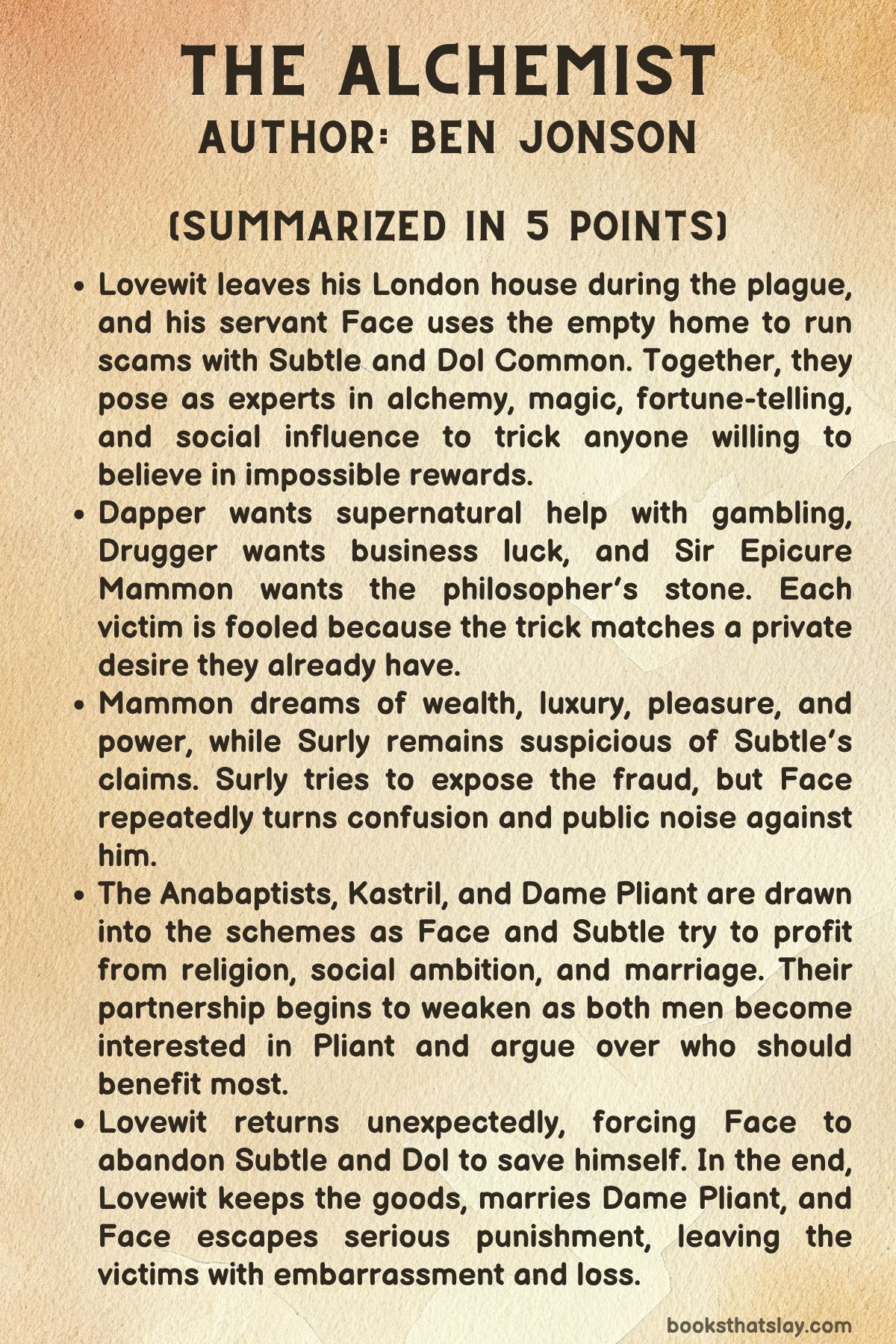
The Alchemist begins in London during a time of plague, when Lovewit has left his home to escape infection. His absence gives his servant Jeremy, better known during the fraud as Face, the chance to turn the house into a center of cheating and false promises.
Face joins with Subtle, a con man pretending to be a learned alchemist, and Dol Common, who assists them by playing different roles whenever needed. The three have agreed to work together and divide whatever they gain, but their partnership is unstable from the beginning.
Face and Subtle argue over who deserves more credit for their success, while Dol tries to keep them quiet enough to avoid attracting the neighbors. Their business depends on secrecy, timing, and performance, and any open quarrel could ruin them.
Their first victim is Dapper, a clerk who wants supernatural help with gambling. Face and Subtle quickly recognize his weakness and design a trick around it.
Subtle pretends he can summon a familiar spirit for him, while Face guides the conversation so that Dapper believes he is favored by the Queen of Fairy. Dapper is told to prepare himself through strange rituals, and he is made to pay money before receiving anything.
The fraud works because Dapper already wants to believe that some hidden power can give him easy winnings. Face and Subtle do not need to convince him from nothing; they only need to shape his existing desire into a profitable lie.
Next comes Abel Drugger, a tobacconist who wants advice about arranging his shop for good fortune. Subtle claims to read signs from Drugger’s face and hand, then gives him elaborate instructions about where to place items in his shop.
Drugger is simple, trusting, and anxious to succeed, so he accepts the advice as wisdom. He pays the men and asks for lucky and unlucky days for business.
Face and Subtle also learn from him about a young widow, Dame Pliant, whose brother Kastril controls her movements. This information gives them a new opportunity, because Pliant’s money and marriage prospects make her valuable prey.
The largest and most absurd target is Sir Epicure Mammon, a wealthy knight who believes Subtle can produce the philosopher’s stone. Mammon dreams of endless wealth, restored youth, cures for disease, and a life of extreme luxury.
At first, he presents his future use of the stone as generous and noble, promising to help the sick and poor. Yet his fantasies soon reveal vanity, lust, and appetite.
He imagines rare foods, costly decorations, sexual power, and a life free from ordinary moral limits. His companion Surly is deeply skeptical and repeatedly questions the claims being made, but Mammon is too excited by his own dreams to listen.
Face and Subtle exploit this blindness, encouraging him to send over metal goods that can supposedly be turned into gold.
Subtle performs the role of holy, secretive, learned alchemist with confidence. He tells Mammon that purity is necessary for the stone to succeed, even though Mammon himself is not pure at all.
The excuse allows Subtle to present himself as the proper maker of the stone while Mammon remains the buyer who will enjoy its results. Whenever doubt appears, Subtle answers with complicated language, obscure terms, and claims about hidden knowledge.
Surly sees through this performance and argues that such language is designed to confuse people. Still, Mammon continues to believe, especially when Dol appears and catches his attention.
Face then invents a story that Dol is a noblewoman with unstable moods, not a sex worker, and Mammon becomes eager to meet her privately.
The trio’s fraud grows larger as Ananias and Tribulation Wholesome, representatives of the Anabaptists, become involved. Their religious language suggests moral seriousness, but they too are driven by ambition and greed.
They want the philosopher’s stone to strengthen their movement and increase their power. Ananias is suspicious of Subtle’s language and methods, calling them ungodly, but Wholesome is more practical.
He believes that even questionable people can be useful if they help advance the cause. Subtle manipulates both men by speaking about the stone’s potential benefits, then tempts them with the possibility of counterfeiting foreign coins.
Their moral objections fade when profit and power come into view.
Meanwhile, Dapper returns for his promised meeting with the Queen of Fairy. Face and Subtle blindfold him, search him, take more of his possessions, and then use a bracelet from an old lover as an excuse to delay the meeting.
They shut him away and tell him to remain silent. His treatment shows how completely he has surrendered his judgment.
The more ridiculous the rituals become, the more he accepts them, because admitting the fraud would also mean admitting his own foolishness.
Kastril and Dame Pliant then enter the scheme. Kastril wants to learn how to quarrel like a fashionable man, and Face convinces him that Subtle can teach him the art of argument and social aggression.
Kastril mistakes rudeness for sophistication and is easily impressed by anything that seems connected to status. Pliant, true to her name, is easily guided by others.
Both Face and Subtle become interested in marrying her, not from love, but because she represents money and advancement. Their partnership begins to weaken further as each man wants the widow for himself.
Surly, still determined to expose the fraud, returns disguised as a Spanish nobleman. Face and Subtle assume he cannot understand English and insult him openly while planning how to use him in their schemes.
Since Dol is occupied with Mammon, they decide to present Pliant to the supposed Spaniard. Kastril pushes his sister toward the match, and Pliant resists at first but gives in under pressure.
Surly then reveals himself to her privately, explaining that he is trying to catch the cheats. He also expresses interest in marrying her himself.
For a moment, it seems as though the fraud may collapse.
Face, however, proves quick and resourceful. When Surly exposes himself, Face turns Kastril, Drugger, and others against him by presenting Surly as the imposter.
Kastril enjoys quarrelling so much that he barely listens to reason. Drugger is made to support the lie, and Ananias’s arrival adds to the confusion.
Surly is driven away despite being one of the few people who understands the truth. The scene shows how easily public noise can defeat clear evidence when people are already committed to their own foolishness.
Mammon’s downfall is staged through another performance. Dol pretends to suffer a strange fit while with him, and Face blames Mammon for triggering it.
Subtle then appears and accuses Mammon of sinful behavior, claiming that his attempt to seduce the supposed noblewoman has ruined the work on the philosopher’s stone. An explosion is heard, and Face reports that the alchemical process has been destroyed.
Mammon, believing himself guilty, accepts the loss and even agrees to pay more money in compensation. His greed made him a victim, but his lust and shame make him easier to dismiss.
The fraud finally comes under real threat when Lovewit returns unexpectedly. The neighbors tell him that many strange visitors have entered his house during his absence.
Face quickly changes back into Jeremy, the obedient servant, and tries to convince his master that the neighbors are mistaken. This lie becomes harder to maintain as Surly, Mammon, Kastril, Ananias, Wholesome, and others return, demanding answers and property.
Dapper’s voice from inside the house nearly exposes everything. Caught between lies, Face chooses survival.
He confesses enough to Lovewit to protect himself and offers his master a share of the gains, including the chance to marry Dame Pliant.
Lovewit proves more amused and opportunistic than morally outraged. Instead of punishing Face fully, he accepts the benefits of the fraud.
Subtle and Dol are forced to flee with little or nothing, while Face secures his position by giving Lovewit control of the stolen goods and access to the widow. Lovewit marries Pliant, leaving Surly disappointed and the victims unable to recover what they have lost.
Mammon cannot prove his claim to the goods, the Anabaptists cannot claim them either, Drugger is dismissed, and Kastril is impressed enough by Lovewit’s firmness to accept the marriage.
The ending is comic but morally unsettling. Face escapes serious punishment, Lovewit profits from wrongdoing, and the victims receive little justice.
Yet the outcome also fits the world the play has shown from the beginning. Nearly everyone is driven by desire: money, pleasure, power, status, luck, or control.
Face, Subtle, and Dol are cheats, but their victims are not innocent in any simple way. They are fooled because they want impossible rewards.
The story becomes a harsh joke about human weakness, showing that fraud succeeds wherever greed is ready to believe.
Characters
Face
Face is the central engine of deception in the play, and his greatest strength is adaptability. As Jeremy, he is Lovewit’s servant, but when his master is away, he becomes Captain Face, a bold operator who manages visitors, invents stories, changes costumes, and keeps the schemes moving.
He understands people quickly and knows how to speak to each victim in the language that victim wants to hear. With Dapper, he encourages dreams of gambling luck; with Drugger, he offers business success; with Mammon, he supports fantasies of wealth and pleasure; with Kastril, he sells the image of fashionable aggression.
Face is not the most learned member of the group, but he is the best improviser. His survival depends on speed, nerve, and social intelligence.
In The Alchemist, he also represents the kind of servant who temporarily overturns household order when authority is absent. Yet he is not a rebel with a noble purpose.
He wants profit and advantage. His betrayal of Subtle and Dol at the end shows that loyalty matters to him only while it is useful.
When Lovewit returns, Face instantly changes sides, offering his master the stolen goods and Dame Pliant as a way to save himself. He is comic, clever, and morally hollow, and his success makes the ending deliberately uncomfortable.
Subtle
Subtle is the false scholar of the play, a con man whose power lies in performance, specialized language, and the appearance of hidden knowledge. He presents himself as an alchemist, astrologer, fortune reader, and spiritual expert, depending on what each victim needs.
His speech is full of technical terms, grand claims, and mysterious explanations that make him sound learned to people who cannot test what he says. Subtle’s name suits him because his fraud often depends on mental pressure rather than simple lying.
He makes his victims feel that they are being admitted into secret knowledge, and that doubt is a sign of ignorance. With Mammon, he uses alchemical language to protect the fraud from direct questioning.
With the Anabaptists, he turns religious ambition toward greed. With Drugger, he transforms ordinary shop advice into mystical instruction.
Still, Subtle is not as controlled as he pretends to be. He is vain, irritable, and resentful of Face.
He believes he contributes more than the others and deserves more authority. His rivalry with Face over Dame Pliant exposes his greed and insecurity.
By the end of The Alchemist, Subtle loses because he cannot adapt as quickly as Face when Lovewit returns. His learning is a mask, but that mask cannot protect him once the household’s real master reappears.
Dol Common
Dol Common is essential to the fraud, even though Face and Subtle often treat her as secondary. She performs roles that the men cannot perform, especially when a scheme requires feminine allure, social disguise, or theatrical distraction.
Her name marks her as sexually available in the eyes of the play’s world, but her function is more complex than that label suggests. She is practical, alert, and often more aware of danger than the men.
At the beginning, she stops Face and Subtle from ruining the whole business through loud arguments. Later, she plays the noblewoman for Mammon and the Queen of Fairy for Dapper, shifting tone and behavior to match the needs of the trick.
Dol’s intelligence lies in timing and control. She knows how to withhold, tease, confuse, and perform madness when necessary.
At the same time, she is trapped within the same unstable criminal partnership as the others. She depends on Face and Subtle, but they also depend on her.
Her anger when Face turns the goods over to Lovewit is justified, because she realizes she has been outmaneuvered. In the play, Dol shows how performance can become a survival skill, especially for a woman with few secure forms of power.
She is a cheat, but she is also one of the clearest readers of risk.
Lovewit
Lovewit is absent for much of the book, yet his return changes everything. He begins as the respectable householder who has left London to escape plague, but his final actions reveal that he is not simply a moral authority restoring order.
When he comes back, he is angry and confused by the neighbors’ reports, and he initially expects obedience from Jeremy. Once he learns the truth, however, he becomes less interested in justice than in advantage.
Face offers him a share of the stolen goods and the chance to marry Dame Pliant, and Lovewit accepts. His name suggests a man who enjoys wit, jokes, and cleverness, and this quality helps explain why he does not respond with strict punishment.
He sees the comic opportunity in the situation and turns it to his benefit. Lovewit’s marriage to Pliant also shows how legal respectability can absorb the profits of fraud.
He did not design the schemes, but he benefits from them once they are exposed. In The Alchemist, Lovewit complicates the idea of justice.
The criminal household is not replaced by pure moral order; instead, the master of the house takes control of the winnings and makes them socially acceptable.
Sir Epicure Mammon
Sir Epicure Mammon is one of the play’s most memorable victims because his imagination is so excessive. He believes the philosopher’s stone will give him limitless wealth, health, youth, and pleasure.
At first, he speaks as if he will use this power generously, curing disease and helping others. Very quickly, however, his fantasies reveal a far more selfish nature.
He dreams of luxury, rare foods, sexual conquest, expensive surroundings, and power over other men. His name captures both appetite and greed.
Mammon is not fooled because he is stupid in a simple sense; he is fooled because he wants the false promise to be true so badly that skepticism becomes unbearable to him. Surly repeatedly challenges the claims about alchemy, but Mammon rejects these warnings because they threaten his dream.
His attraction to Dol further exposes his lack of discipline. When Subtle accuses him of ruining the alchemical work through lust, Mammon accepts the blame because it fits his own guilty conscience.
He leaves defeated, not because anyone has proved the truth to him, but because shame makes him easier to control. Mammon represents the danger of imagination when it is governed by appetite rather than judgment.
Surly
Surly functions as the play’s main skeptic, and much of his role is to expose the absurdity that other characters accept. He doubts Subtle’s alchemical claims, questions Mammon’s evidence, sees Dol more clearly than Mammon does, and later returns in disguise to catch the cheats.
His name suggests roughness and unpleasant bluntness, and he is not always charming, but his suspicions are usually correct. Surly understands that specialized language can be used to hide emptiness, and he recognizes fraud where others see opportunity.
Yet he is not a perfect moral hero. His plan to expose Face and Subtle involves disguise and manipulation of his own, and his interest in Dame Pliant complicates his motives.
He wants justice, but he also wants personal reward. His failure is important because truth alone is not enough in the social world of the story.
When he reveals himself, Face quickly turns the crowd against him. Kastril’s love of quarrelling, Drugger’s obedience, and Ananias’s prejudice all help silence the one man who has seen through the fraud.
Surly’s defeat shows how easily clear judgment can lose when surrounded by noise, desire, and group foolishness.
Dapper
Dapper is a clerk whose weakness is his desire for gambling success. He wants a familiar spirit that will help him win, and this makes him an easy target for Face and Subtle.
His dreams are smaller than Mammon’s, but they arise from the same basic flaw: he wants reward without discipline, chance without risk, and success through secret advantage. Dapper’s gullibility is comic because he accepts increasingly ridiculous instructions.
He is blindfolded, searched, robbed of his belongings, fed strange objects, and shut away while waiting for the Queen of Fairy. Yet he continues to believe because the promise of luck has captured him.
Dapper also shows how fraud can work through ritual. The stranger the preparation becomes, the more special he feels, as though he is being prepared for an extraordinary gift.
His willingness to obey gives Face and Subtle control over his body, money, and time. By the end, he has been humiliated, but he still does not fully understand the scale of the trick.
He is a comic portrait of superstition tied to greed, a man who wants fortune to bend toward him without earning it.
Abel Drugger
Abel Drugger is a tobacconist, and his innocence makes him different from the more openly greedy victims. He wants his shop to succeed and comes to Subtle for advice about layout, signs, and unlucky days.
He is not dreaming of ruling the world or transforming metal into gold; he wants better business. Still, his trust in occult guidance makes him vulnerable.
Drugger accepts Subtle’s claims about palm-reading, forehead-reading, astrology, and lucky arrangements because he lacks confidence in his own judgment. His name suggests ordinary trade and plainness, and he often appears as someone others can easily push around.
Face and Subtle use him repeatedly: they take his money, tobacco, clothing, and assistance in deceiving others. He also becomes a tool in the conflict with Surly, supporting Face’s lie because he is told to do so.
Drugger’s connection to Dame Pliant and Kastril expands the fraud, since he brings new targets to the house without fully understanding what is happening. He is comic because he is so easily managed, but he also reflects a quieter kind of insecurity: the fear that ordinary effort is not enough, and that success requires hidden signs, lucky timing, or expert manipulation.
Tribulation Wholesome
Tribulation Wholesome is a religious elder among the Anabaptists, and his character exposes the gap between public piety and private ambition. He speaks in the language of faith, moral purpose, and communal advancement, but he is willing to cooperate with Subtle if the result benefits his movement.
Unlike Ananias, who is openly suspicious and rigid, Wholesome is flexible in a dangerous way. He can justify contact with supposedly ungodly people by claiming that holy causes sometimes require practical compromise.
This makes him especially vulnerable to Subtle, who understands how to present greed as religious opportunity. Wholesome is interested in the philosopher’s stone not merely for personal wealth, but for the power and prestige it could bring to his group.
That does not make him less greedy; it only gives his greed a collective language. His acceptance of counterfeiting foreign coins shows how quickly moral boundaries can shift when profit appears useful.
Wholesome’s name is ironic, because he is not spiritually healthy or morally clean. He represents hypocrisy dressed as strategy, and his presence broadens the play’s satire from individual greed to organized religious ambition.
Ananias
Ananias is stricter, harsher, and more openly judgmental than Tribulation Wholesome. He distrusts Subtle, objects to the language of alchemy, and repeatedly describes things as profane or ungodly.
At first, this makes him seem less corrupt than the others, since he does sense something wrong in Subtle’s world. Yet his suspicion does not protect him from greed.
Once Subtle and Wholesome begin discussing profit, coinage, and the advancement of the Anabaptist cause, Ananias becomes more willing to accept what he had condemned. His moral language turns out to be narrow rather than deep.
He objects to words, appearances, and religious associations, but he can excuse dishonest action when it serves his side. His prejudice against the Spanish disguise also helps Face defeat Surly, because Ananias reacts according to bias rather than evidence.
Ananias is therefore not a figure of true conscience. He is a satirical portrait of rigid religiosity that can denounce impurity while making peace with corruption.
His failure lies in the difference between condemning sin in speech and recognizing it in practice.
Kastril
Kastril is a young man obsessed with becoming a fashionable quarreller. He wants to learn how to argue, insult, and threaten like a gallant, and this makes him ridiculous from the moment he appears.
His idea of maturity is based on aggression and performance. He thinks social power comes from being loud, combative, and feared.
Face uses this weakness expertly, convincing him that Subtle can teach him the art of quarrelling. Kastril’s treatment of Dame Pliant also reveals his controlling nature.
He pushes her toward marriage decisions and threatens violence when she resists. Yet he is not strong in any meaningful way.
He is easily redirected by whoever performs confidence better than he does. Face turns him against Surly, and later Lovewit impresses him so much that he accepts the marriage to Pliant and even offers more money.
Kastril’s name, echoing a predatory bird, suits his restless aggression, but he is more noisy than dangerous. He represents a shallow masculine ideal in which argument replaces thought and dominance replaces judgment.
Dame Pliant
Dame Pliant is a young widow whose name signals her central trait: she is easily shaped by the wishes of others. She is not unintelligent, but she has little power in the social arrangements surrounding her.
Kastril controls her movements, Face and Subtle see her as a prize, Surly wants to rescue and marry her, and Lovewit ultimately succeeds in marrying her. Her consent is repeatedly pressured or managed by men who view her as a route to money, status, or settlement.
Pliant’s flexibility makes her comic in the structure of the story, but it also reveals how vulnerable a wealthy widow can be when others treat her as property in motion. Her brief resistance to marrying the supposed Spanish nobleman shows that she does have preferences and opinions, but those preferences are quickly overridden.
By the end, her marriage to Lovewit resolves the plot for the men, not necessarily for her as a fully heard person. She is important because she turns the fraud from a series of financial tricks into a marriage plot, showing how desire for property can attach itself to women’s bodies and futures.
Themes
Greed as a Form of Blindness
Greed in this play does not appear only as a desire for money. It takes many forms: Mammon wants limitless wealth and pleasure, Dapper wants gambling luck, Drugger wants business success through hidden knowledge, the Anabaptists want power for their movement, and Face and Subtle want profit from everyone.
What unites these desires is the willingness to believe in shortcuts. The victims are not dragged into belief against their will; they walk toward deception because the promised reward matches something they already crave.
Mammon ignores Surly’s warnings because doubt would destroy the fantasy that gives him pleasure. Dapper accepts humiliating rituals because he imagines future winnings.
Wholesome and Ananias bend religious principle once profit appears useful. Greed narrows vision until people see only the prize and not the absurdity of the path leading to it.
This is why the frauds succeed. Face, Subtle, and Dol do not create greed; they harvest it.
The play suggests that deception becomes powerful when desire has already weakened judgment. The victims lose money and dignity, but their deeper failure is the surrender of reason before the trick even begins.
Performance, Disguise, and Social Role
Identity in The Alchemist is unstable because nearly everyone can be influenced by costume, language, and role-playing. Face becomes a captain, a servant, and a mediator depending on the situation.
Subtle becomes a learned doctor, alchemist, astrologer, and spiritual authority. Dol becomes a noblewoman, a mad lady, and the Queen of Fairy.
Even Surly uses disguise when he returns as a Spanish nobleman. These performances work because society itself is shown as theatrical.
People judge by clothing, titles, tone, and confidence. Mammon believes in Subtle partly because Subtle sounds like a keeper of secret knowledge.
Kastril admires the appearance of gallantry without understanding its emptiness. Drugger trusts mystical shop advice because it is delivered with authority.
The line between fraud and accepted social behavior becomes thin. Lovewit’s final acceptance of the goods and marriage also shows that once a performance produces legal or social advantage, society may absorb it rather than reject it.
The theme is not only that con artists pretend, but that ordinary status also depends on forms of pretending. The cheats are criminals, but they succeed because the world around them already respects surfaces.
Hypocrisy and Moral Compromise
Many characters speak in moral language while acting from selfish motives. Mammon imagines charitable uses for the philosopher’s stone, but his private fantasies reveal lust, vanity, and excess.
The Anabaptists present themselves as religious reformers, yet they are ready to use alchemy, questionable trade, and counterfeiting if these things help their cause. Ananias condemns profane language but accepts corrupt possibilities when they seem profitable.
Wholesome is especially revealing because he can turn compromise into a religious strategy. He does not abandon morality openly; he rearranges it until self-interest appears justified.
Lovewit also participates in this pattern. He returns as the wronged master of the house, but once he sees how he can benefit, he chooses gain over punishment.
The play treats hypocrisy not as a rare fault but as a common human habit. People want to think of themselves as principled while still taking advantage of whatever benefits them.
Jonson’s comedy exposes this by placing characters under pressure. When money, pleasure, or status becomes available, their stated values quickly change shape.
The result is a world where moral speech remains loud, but moral action is weak.
Justice, Punishment, and Uneasy Comic Order
The ending refuses to deliver simple justice. Subtle and Dol are driven away, but Face survives and even gains from the situation.
Lovewit, who might have restored moral order, instead keeps the goods and marries Dame Pliant. Mammon loses his property, Surly loses the chance to expose everyone fully, the Anabaptists leave empty-handed, Drugger is dismissed, and Dapper’s foolishness is never corrected in any satisfying way.
This outcome is comic because confusion is resolved and the household returns to its owner, but the order restored is morally compromised. The person with legal authority benefits from the crimes committed in his absence.
The servant who ran the fraud escapes by making himself useful to his master. The victims are punished not through formal justice but through embarrassment, loss, and their inability to prove their claims.
This makes the ending sharper than a neat moral lesson would be. The play suggests that society often rewards quick adaptation more than honesty.
Justice depends not only on truth but on power, evidence, and timing. The final order is stable, but it is not pure, and that impurity is central to the comedy’s lasting bite.