The Alice Network Summary, Characters and Themes
The Alice Network by Kate Quinn is a historical novel about two women separated by time but linked by war, loss, guilt, and the search for justice. One storyline follows Eve Gardiner, a young woman recruited as a spy during World War I, while the other follows Charlie St. Clair, a pregnant American college student in 1947 who is searching for her missing cousin in France.
The book moves between espionage, trauma, family pressure, female courage, and the long shadow of betrayal. Its emotional force comes from how the past refuses to stay buried.
Summary
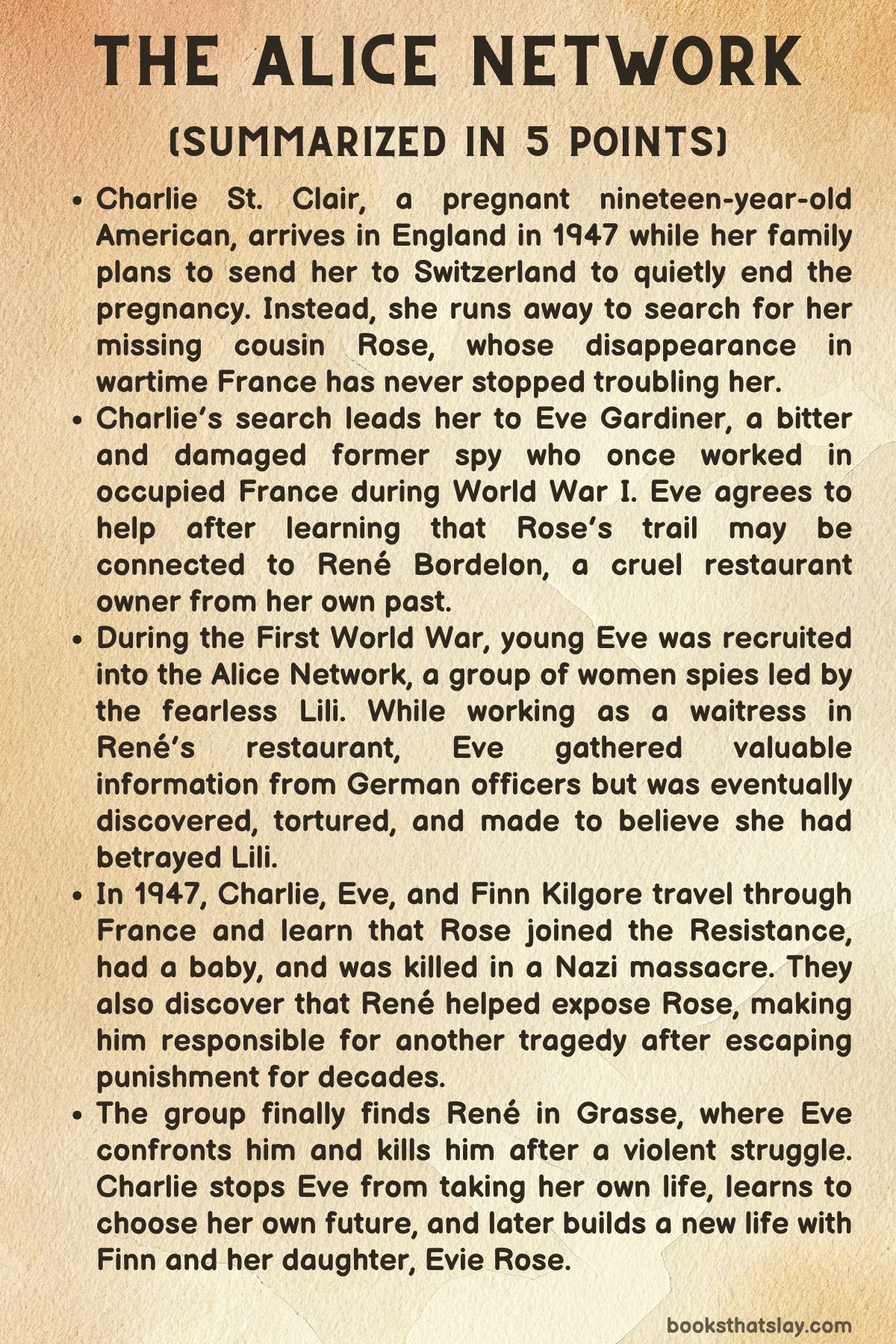
In The Alice Network, Charlotte “Charlie” St. Clair arrives in England in 1947 with her mother, but her journey is not really about the family plan laid out for her. Charlie is unmarried, pregnant, and being taken to Switzerland so the pregnancy can be ended quietly.
Her wealthy parents see her condition as a disgrace, and Charlie has been treated as if she has ruined her life. Yet she is not only thinking about herself.
She is haunted by the disappearance of her beloved cousin Rose Fournier, who vanished in France during the war. Charlie refuses to accept the family assumption that Rose is dead.
Her need to find Rose becomes a way to resist the future others have chosen for her.
Charlie escapes her mother in England and goes to London in search of Eve Gardiner, an older woman who once signed paperwork connected to Rose. When Charlie finds her, Eve is drunk, damaged, hostile, and armed.
Eve denies knowing anything useful, but when Charlie mentions that Rose worked at a restaurant called Le Lethe in Limoges, Eve reacts strongly. The name awakens something dangerous from her past.
Though she does not immediately explain herself, Eve allows Charlie to stay and eventually agrees to help, especially after seeing that the search may connect to a man she has hated for decades.
The story then returns to Eve’s youth during World War I. In 1915, Eve is a restless young typist in London who longs to do something meaningful for the war effort. She speaks French and German, can lie convincingly, and is often underestimated because of her stammer.
Captain Cecil Cameron recognizes these qualities and recruits her as a spy. Eve is trained in Folkestone and sent into German-occupied France under the identity Marguerite Le François.
Her assignment is to work as a waitress at Le Lethe in Lille, a restaurant favored by German officers, and pass along useful information to the Allied side.
Eve joins a network of female spies led by Louise de Bettignies, known by the code name Alice Dubois and affectionately called Lili. Lili is small, brave, clever, and fearless.
She teaches Eve how to survive in occupied territory, how to observe without being noticed, and how to turn men’s arrogance into a weapon against them. Another spy, Violette, also becomes part of Eve’s dangerous world.
Eve’s work at the restaurant is difficult because its owner, René Bordelon, is intelligent, predatory, and skilled at reading people. Eve soon realizes that spying under his gaze will require constant discipline.
In 1947, Charlie, Eve, and Finn Kilgore, Eve’s Scottish driver and handyman, travel through France together. Finn has his own scars from the Second World War and a prison record, but he is capable, practical, and more sensitive than he first appears.
Charlie learns that Rose had joined the French Resistance, fallen in love, become pregnant, and gone to Limoges. This mirrors Charlie’s own situation so strongly that Rose becomes not only a missing cousin but also a possible version of Charlie’s future.
Charlie imagines finding Rose alive, perhaps raising their children together and rebuilding their lives outside the judgment of their families.
As the search continues, Eve’s past becomes clearer. During the First World War, she gathered important information from German officers at Le Lethe and passed it to Lili.
Her success made her feel useful and alive. Yet René began to take an interest in her.
He wanted her as his mistress, and Eve, encouraged by Lili, agreed because intimacy with him could help her gather more intelligence. This decision cost her deeply.
Eve despised René, but she also learned that the body’s reactions could be separate from moral feeling, a truth that filled her with shame and confusion.
Eve overheard major military secrets, including information about the Kaiser’s travel and later about German plans connected to Verdun. The network’s work was brave and valuable, but danger closed in.
Lili and Eve were arrested while trying to move through German-controlled territory with intelligence. Eve was released after a soldier vouched for her, while Lili remained imprisoned.
Eve reached Allied contacts and gave her report, but when she returned to Lille, René had searched her rooms and found proof that she was a spy. He broke the bones in her hands while interrogating her, trying to force her to reveal the head of the spy network.
Drugged and tortured, Eve later believed that she had given up Lili’s real name.
That belief became the central wound of Eve’s life. Eve, Lili, and Violette were tried for espionage and sentenced to death, though Lili’s intervention secured prison sentences instead.
They were sent to prison in Germany, where hunger, sickness, cold, and cruelty wore them down. Lili eventually died after a brutal medical procedure performed without proper care.
Eve survived, but she returned from the war consumed by guilt, rage, and grief. Cameron gave her medals for her service, but she rejected the honor.
She wanted only one thing: to kill René. Cameron told her René was dead, and this false closure shaped the rest of her broken life.
In the 1947 storyline, Charlie’s search for Rose leads to devastating truth. She and Finn visit a ruined village where Rose had taken refuge with her baby.
An old survivor tells them that the Nazis massacred the village and that Rose and her little daughter, Charlotte, were among the dead. Charlie’s hope collapses.
Rose, whom she had imagined alive through all her searching, is gone. Yet the discovery does not end the journey, because Eve learns that René was connected to Rose’s death.
He had informed the Nazis that Rose was involved with the Resistance, which helped lead to the massacre.
The search for Rose becomes a hunt for René. Eve learns that René did not die after the First World War.
He survived, changed his name, collaborated again during the Second World War, and lived comfortably in France. Charlie, Finn, and Eve follow clues to Grasse, where they eventually find him.
René is old but still cruel, vain, and unrepentant. He admits that he helped cause Rose’s death because he feared she might be another spy like Eve.
His lack of remorse confirms for Charlie and Eve that he has escaped justice for too long.
After confronting him in public, Eve decides to kill René and then herself. Charlie realizes that Eve’s revenge may destroy her even after René is dead.
At the same time, Charlie receives proof from Violette that Eve never betrayed Lili. Someone else gave up Lili’s identity, and René lied to make Eve suffer.
Charlie rushes to René’s villa to stop Eve. Inside, Eve and René face each other with guns.
René shoots Eve, but Charlie distracts him and uses the bust of Baudelaire, the same object linked to Eve’s torture, to break his hand. Eve shoots René dead, but then turns the gun on herself.
Charlie stops her by striking her hand, refusing to let Eve die with René.
After René’s death, Charlie protects the group by making it appear that he was killed because of his wartime collaboration. Eve leaves soon after, needing to verify the truth about Lili and make peace with Violette.
Charlie and Finn move toward a future together. Charlie chooses to keep her baby and claim her life as her own.
In the end, Eve is alive, freer than she has been in decades, and reunited with Charlie, Finn, and Charlie’s daughter, Evie Rose. The ending does not erase the suffering of the past, but it gives its survivors a chance to live beyond it.
Characters
Charlie St. Clair
Charlie St. Clair is the emotional center of the postwar storyline and one of the clearest examples of a young woman learning to claim authority over her own life. At the beginning of The Alice Network, she is nineteen, pregnant, unmarried, and trapped under the weight of family shame.
Her parents treat her pregnancy as a social embarrassment rather than a human crisis, and Charlie has internalized some of that judgment. She calls her pregnancy a problem because that is how others have taught her to see it.
Yet her decision to search for Rose shows that she is not passive. She is frightened, grieving, and unsure, but she is also stubborn enough to leave her mother, cross countries, and follow a fragile trail of clues.
Charlie’s gift with numbers is important because it shows a mind that has always been sharper than her family allowed her to be. As the journey continues, she stops seeing herself as ruined and begins to see herself as capable.
Her grief over Rose is real, but it also helps her understand what she wants for herself and her unborn child. By the end, Charlie becomes the person who saves Eve from suicide, faces René with courage, and chooses a future based on love, agency, and self-respect rather than fear.
Eve Gardiner
Eve Gardiner is one of the most complex figures in the book because she lives as both a war hero and a woman who believes herself guilty of unforgivable betrayal. In youth, Eve is intelligent, observant, and hungry for purpose.
Her stammer causes others to underestimate her, but she turns that weakness into protection. As a spy, she has a rare ability to appear harmless while noticing everything.
Her time in Lille gives her the sense of usefulness she has always wanted, and the Alice Network becomes a place where her courage and intelligence matter. Yet the same mission also destroys much of her.
René’s torture leaves her physically maimed, but the deeper wound is psychological. He convinces her that she betrayed Lili, and that lie controls her life for more than thirty years.
Older Eve is bitter, alcoholic, violent, and isolated, but these qualities are signs of injury rather than simple hardness. Her connection with Charlie forces her back into the world of feeling, truth, and responsibility.
Eve’s final survival matters because it proves that justice does not have to end in self-destruction. When she learns she did not betray Lili, she is given back a part of herself that René had stolen.
Finn Kilgore
Finn Kilgore appears at first as Eve’s driver, handyman, and hired muscle, but he becomes much more than a supporting figure in Charlie’s journey. He is marked by the Second World War, particularly by what he witnessed while helping liberate a concentration camp.
His violence and prison record make him seem dangerous, but the book gradually reveals a man damaged by trauma rather than defined by brutality. Finn understands shame, rage, and the feeling of being unfit for ordinary life, which is why he is able to meet Charlie without judging her.
One of his most important roles is that he tells Charlie her life belongs to her. This is not a grand speech, but it gives her permission to think beyond her parents’ plans.
His romance with Charlie works because it is built not only on attraction but also on recognition. Both are trying to survive what war and grief have done to them.
Finn’s dreams of owning an auto shop also show his desire for a practical, peaceful future. He is not a perfect man, but he is loyal, protective, and willing to build something honest from the ruins of violence.
René Bordelon
René Bordelon is the chief villain of the story, and his danger comes from his intelligence as much as from his cruelty. He is not portrayed as a reckless brute.
He is controlled, elegant, observant, and deeply vain. As the owner of Le Lethe, he profits from occupation while presenting himself as cultured and refined.
His love of poetry, luxury, and fine surroundings does not soften him; instead, it makes his moral emptiness more disturbing. René sees people as objects to be used, tested, and broken.
His seduction of Eve is not romantic but strategic and possessive, a way to dominate someone he senses may be hiding something. When he discovers her work as a spy, his torture of her hands is both practical and symbolic.
He destroys the tools of her independence and then lies to poison her soul. His later role in Rose’s death proves that his cruelty was not limited to one war or one woman.
In The Alice Network, René represents the kind of evil that survives by adapting, renaming itself, and hiding behind manners. His death is not treated as simple revenge alone; it is the collapse of a man who believed he could always escape the consequences of his actions.
Lili
Lili, whose real name is Louise de Bettignies, is the guiding spirit of the wartime plot and the moral standard by which Eve measures herself. She is physically small, but her courage and mental quickness make her enormous in the lives of those around her.
Lili leads the Alice Network with daring, humor, and discipline. She understands how women are underestimated and turns that social blindness into a method of resistance.
Her relationship with Eve is part mentorship, part friendship, and part sisterhood. She teaches Eve how to think like a spy, but she also teaches her how to endure fear without surrendering to it.
Lili’s calm acceptance of danger does not mean she is careless. She knows the risks clearly and chooses to act anyway because inaction would feel like a greater betrayal.
Her forgiveness of Eve is one of the most generous acts in the story, especially because Eve cannot forgive herself. Lili’s death in prison becomes the emotional burden Eve carries for decades, but her memory also becomes a source of strength.
She remains present through the courage she inspired in others.
Violette
Violette is a significant figure because she shows another version of female endurance in wartime. She is practical, tough, and less openly warm than Lili, but her courage is never in doubt.
As a member of the spy network, she understands danger and accepts it without illusion. Her relationship with Eve becomes strained because of the belief that Eve revealed Lili’s identity, and this bitterness lasts for decades.
Yet Violette is not presented as petty or cruel. Her anger comes from grief, loyalty, and the suffering she endured.
She also plays a crucial role in uncovering the truth. When Charlie asks her to find the trial records, Violette’s willingness to help shows that part of her still cares about justice beyond personal resentment.
Her later reconciliation with Eve is important because it suggests that truth can repair what lies have damaged, even after many years. Violette’s character also reminds the reader that the Alice Network was not made of one heroic woman alone.
It was a group of women who risked arrest, torture, and death while history often left their work in the shadows.
Captain Cecil Cameron
Captain Cameron is the man who recruits Eve into espionage, but he is more than a simple handler. He recognizes Eve’s abilities when almost no one else does, and this recognition changes the course of her life.
Cameron values women as spies because he understands that their social invisibility can become an advantage. At the same time, he carries the burden of sending people into danger while remaining at a distance from the worst of what they suffer.
His affection for Eve complicates his professional role. He worries about her, tries to protect her, and later feels guilt for what happened to his agents.
Cameron is not free of weakness. His decision to tell Eve that René is dead gives her false closure and prevents her from confronting the truth earlier.
Yet he does this from a desire to spare her, not from malice. His own eventual suicide shows how deeply the war damaged those who survived in positions of command as well as those on the ground.
In the book, Cameron represents duty mixed with guilt, care mixed with control, and the moral cost of asking others to sacrifice themselves.
Rose Fournier
Rose Fournier is absent for most of the story, but her presence drives Charlie’s transformation. To Charlie, Rose represents love, loyalty, and the one family bond that felt emotionally true.
Their childhood memory at the roadside café shows why Charlie cannot abandon her. Charlie once promised not to leave Rose, and the search becomes a way of keeping that promise.
Rose’s life also mirrors Charlie’s in painful ways. Like Charlie, she becomes pregnant outside the boundaries of family approval.
Like Charlie, she is judged and pushed away. Unlike Charlie, Rose is caught in the deadly machinery of occupation and war.
Her work with the Resistance and her fate in the massacred village make her a symbol of ordinary bravery destroyed by collaboration and violence. Rose’s death is devastating because Charlie has built so much hope around finding her alive.
Yet learning the truth also forces Charlie to stop living in imagined rescue and begin making real choices. Rose’s baby, named Charlotte, deepens the emotional connection between the cousins and makes Charlie’s later daughter, Evie Rose, feel like an act of remembrance.
Mrs. St. Clair
Mrs. St. Clair represents the social world Charlie is trying to escape. She is not a villain in the same sense as René, but her behavior is shaped by class expectations, reputation, and control.
She sees Charlie’s pregnancy as a disaster to be managed quietly, and her concern is filtered through propriety rather than empathy. Her plans for Switzerland show how little space Charlie is given to make decisions about her own body and future.
Mrs. St. Clair’s attitude also reflects the wider pressure placed on women to remain respectable, silent, and obedient. She does not understand Charlie’s need to search for Rose because she does not fully understand Charlie’s grief or guilt.
By the end, when Charlie appears with Finn and a more settled plan for her life, her parents become easier to manage because Charlie has changed. Mrs. St. Clair’s power depends on Charlie’s uncertainty.
Once Charlie knows what she wants, the old rules lose much of their force.
Aunt Jeanne
Aunt Jeanne is a brief but important figure because she provides the first real confirmation that Rose’s life after the war began in pain and rejection. Her wasted appearance reflects the damage of war, loss, and family fracture.
She tells Charlie that Rose joined the Resistance, fell in love, became pregnant, and was rejected by her family. Through Jeanne, the story reveals how harshly women could be judged for choices shaped by love, war, and survival.
Her rejection of Rose also creates a direct parallel with Charlie’s situation. Charlie sees that the same kind of shame threatening her future helped push Rose into danger and isolation.
Aunt Jeanne’s role is therefore not only informational. She shows the human cost of respectability when it becomes stronger than compassion.
Themes
Women’s Courage Under Systems That Underestimate Them
The women in The Alice Network survive and resist in worlds that consistently misjudge them. Eve is dismissed because of her stammer and her gender, but those very qualities help her pass unnoticed as a spy.
Lili understands that men in power often fail to see women clearly, and she turns that blindness into a weapon. Charlie faces a different but related kind of dismissal in 1947.
Her family treats her as a ruined girl rather than a thinking person capable of making decisions. The book shows that courage is not always loud or publicly rewarded.
Sometimes it appears as a waitress listening carefully while officers talk, a young woman boarding a train against her mother’s orders, or a survivor choosing to keep living after decades of guilt. The story also avoids making courage look clean or painless.
Eve’s bravery costs her body, peace, and friendship. Lili’s courage costs her life.
Charlie’s courage requires her to face grief and abandon the fantasy that Rose can still be saved. Through these women, the story argues that being underestimated can be dangerous, but it can also create hidden forms of power.
Guilt, Memory, and the Damage Caused by Lies
Eve’s life after the First World War is shaped less by what she actually did than by what René made her believe she did. His lie that she revealed Lili’s identity becomes a psychological prison stronger than any cell.
Eve cannot accept her medals, cannot maintain ordinary relationships, and cannot forgive herself because she thinks her weakness killed the person she loved most. This theme shows how memory can be altered by trauma, especially when pain, drugs, and manipulation are involved.
Eve remembers fragments, feelings, and accusations, but she does not possess the whole truth. René understands this and uses uncertainty as another form of torture.
Charlie’s role is important because she questions the story Eve has accepted for decades. Her mathematical mind notices that something in the trial record may not add up, and her insistence on checking the facts becomes an act of rescue.
The discovery that Eve did not betray Lili does not undo the years she lost, but it changes the meaning of her survival. The book suggests that lies can deform a life, yet truth, even when it arrives late, can still return dignity to the wounded.
The Search for Justice After War
Justice in the story is complicated because official systems often fail to punish the guilty. René collaborates across two wars, destroys lives, and still manages to live comfortably under a changed name.
Rose and her child are dead, Lili is dead, and Eve has carried decades of suffering, while René continues to enjoy fine restaurants and social respect. This imbalance creates the moral pressure behind the hunt.
Eve wants revenge because lawful justice has failed. Charlie, after learning René helped cause Rose’s death, also feels the pull of vengeance.
Yet the story does not present revenge as simple satisfaction. Eve’s plan includes her own suicide, which means killing René may also complete the damage he began.
Charlie’s intervention changes the meaning of the final confrontation. René dies, but Eve is not allowed to die with him.
Justice becomes not only punishment for the guilty but also rescue for the living. The story asks whether revenge can heal trauma and answers carefully: punishment may be necessary, but it is not enough if the survivor remains trapped in the past.
Real justice must include the possibility of life afterward.
Female Autonomy, Pregnancy, and Social Judgment
Pregnancy in the book is never treated as only a private condition; it becomes a point where society, family, shame, and control meet. Charlie’s pregnancy makes her parents treat her future as something to be arranged without her full consent.
The planned trip to Switzerland shows how wealthy families can hide scandal while ignoring emotional truth. Rose’s pregnancy leads to rejection and isolation, placing her in greater danger during wartime France.
Eve’s pregnancy by René is even more painful because it comes from a relationship she entered for espionage and survival, not love. Each pregnancy reveals how little freedom women are given when their bodies no longer fit social expectations.
Yet the theme is not only about suffering. Charlie’s eventual decision to keep her child becomes a declaration of ownership over her life.
She does not make that choice because society approves; she makes it after learning what forced silence and shame did to Rose and Eve. The birth of Evie Rose at the end carries memory, defiance, and renewal.
It honors the women who were judged, harmed, or lost, while allowing Charlie to build a future beyond disgrace.