The Alienist Summary, Characters and Themes
The Alienist by Caleb Carr is a historical crime novel set in 1896 New York City, where science, policing, class prejudice, and political corruption collide during the hunt for a serial killer targeting vulnerable children. The story follows newspaper reporter John Schuyler Moore, alienist Laszlo Kreizler, secretary-turned-investigator Sara Howard, and a small team using early forensic science and psychological profiling before such methods are accepted.
The novel combines murder investigation with a sharp portrait of Gilded Age New York: its tenements, brothels, police politics, reform movements, and elite power structures. It is both a detective story and a study of how society creates, ignores, and punishes human damage.
Summary
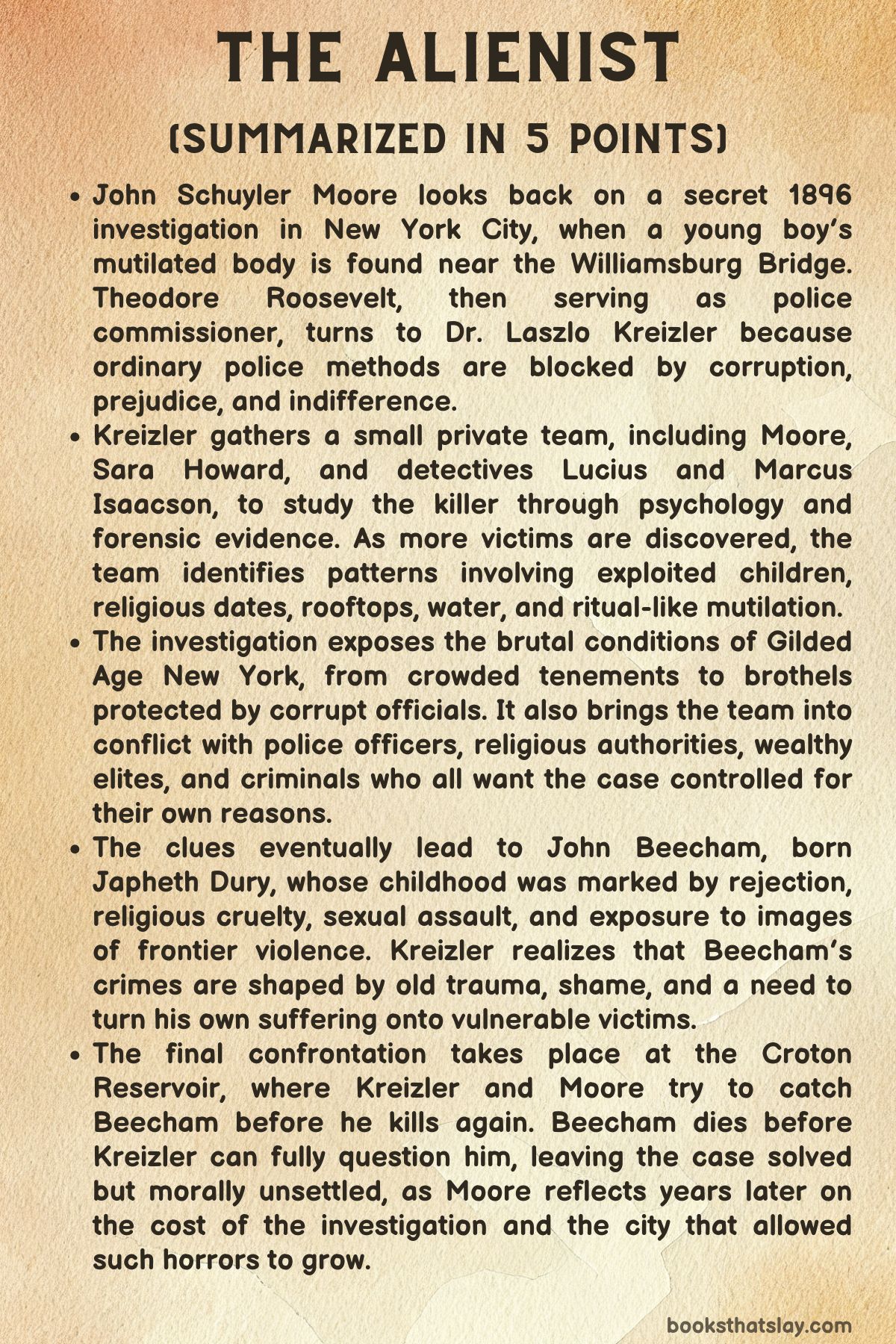
The story opens in 1919, shortly after the death of Theodore Roosevelt. John Schuyler Moore, now looking back on his life, has dinner with Dr. Laszlo Kreizler at Delmonico’s in New York City.
Their conversation returns to the spring of 1896, when Roosevelt was president of the city’s board of police commissioners and when Moore, Kreizler, Roosevelt, and a handful of others secretly worked on a murder case that was never fully made public. Moore decides that enough time has passed for him to tell the truth about what happened.
In March 1896, Moore is awakened late at night by Stevie Taggert, a young boy employed by Kreizler. Stevie takes him to the Lower East Side, near the construction site of the Williamsburg Bridge.
There Moore finds Roosevelt, several police officers, and a horrifying crime scene. A young boy named Georgio Santorelli, known in the sex trade as Gloria, has been murdered and mutilated.
The boy’s body shows signs of ritual-like violence, and the police response is cold, careless, and corrupt. Some officers treat the victim as disposable because he was poor, immigrant, and commercially exploited.
Roosevelt knows that the usual police methods will not solve the case, especially because the department is full of men who either do not care or are actively protecting old systems of power.
Kreizler, an alienist who studies mental illness and human behavior, believes the Santorelli murder may be connected to earlier killings. Years before, two children from the Zweig family were found murdered with similar mutilations.
Roosevelt reveals that other boys have recently been killed in comparable ways. Kreizler suspects that one man may be responsible for all of them.
He asks Roosevelt for a private team that can work outside the corrupt police structure. Roosevelt agrees, and the group begins a secret investigation based on a new idea: instead of searching only for direct witnesses or obvious suspects, they will try to build a psychological profile of the killer.
The team includes Moore, who serves as narrator and practical investigator; Sara Howard, Roosevelt’s secretary and the first woman employed at police headquarters; the Isaacson brothers, Lucius and Marcus, young detectives skilled in forensic science; and Kreizler himself, who directs the psychological work. Kreizler’s household also matters deeply to the story.
Stevie Taggert and Cyrus Montrose, both rescued by Kreizler after violent or troubled pasts, assist the team. Mary Palmer, Kreizler’s housekeeper, is a quiet woman who has survived severe childhood trauma and who shares a tender but complicated bond with Kreizler.
The early investigation exposes the city’s ugly social order. Moore and Sara visit the Santorelli family and learn that police officers, priests, and other men have pressured the family to remain silent.
They see the terrible conditions of tenement life and the fear that immigrant families experience when institutions meant to protect them become tools of intimidation. Moore also visits Paresis Hall, the establishment where Georgio worked, and learns that the boy never left his room on the night of the murder.
This suggests that the killer may have entered and escaped by an unusual route. Moore is drugged and nearly attacked there, but Stevie follows him and saves him.
At their headquarters on Broadway, the team studies psychology, philosophy, and criminal behavior. Kreizler teaches them to set aside simple labels such as evil or madness and instead examine how experience shapes perception and action.
This method is controversial, but it gives the team a way to interpret the murders. They begin to notice patterns: the victims are boys dressed as girls in places of sexual exploitation; the crimes occur near water; the killer removes eyes and other body parts; and the murders seem connected to religious dates.
Another boy, Ali ibn-Ghazi, known as Fatima, is murdered after being taken from the Golden Rule Pleasure Club. Evidence suggests the killer can climb buildings with great skill, entering rooms from rooftops and escaping with victims.
A small boy named Joseph tells Moore that Fatima had spoken of a kind man, a “saint,” who promised to take him away. This detail shows that the killer may lure victims by appearing gentle, even saving them in their imagination from the cruelty of the places where they are trapped.
The investigation deepens when a letter is sent to Mrs. Santorelli. It contains hateful language toward immigrants and claims responsibility for the murder.
The writer tries to sound ignorant, but Marcus Isaacson’s handwriting analysis suggests he is educated enough to fake ignorance. The team concludes that he is a practiced liar, a sadist, and someone whose adult violence is rooted in childhood.
Sara repeatedly argues that the killer’s mother may have played a central role in his psychological formation. Kreizler resists this idea because of his own painful past with a violent father, but he later realizes Sara is right to push the theory.
To understand the mind of a child killer, Kreizler and Moore visit Jesse Pomeroy in prison. Pomeroy, who tortured and murdered children when he was very young, tells them that his own mother stared at his physical deformities but would not lovingly touch him.
Kreizler realizes that rejection, humiliation, deformity, and violence may be central to the killer they are pursuing. Sara develops this further, suggesting that the murderer may have been an unwanted child, raised in poverty, watched with disgust, and shaped by a mother who resented him.
The next expected religious date passes without a murder, but on Pentecost the killer strikes again. Ernst Lohmann is taken from the Black and Tan while the team is watching nearby locations.
Cyrus is attacked, and the boy’s body is found at the Statue of Liberty. This time the killer removes the heart and only one eye.
Roosevelt’s comment about mutilations he once saw in the Dakota Badlands helps the team consider a frontier connection. At the Museum of Natural History, Kreizler consults experts on Sioux culture and learns that the mutilations resemble misunderstood fragments of frontier violence and myth rather than authentic Indigenous practice.
The killer seems to have absorbed distorted images of Indigenous violence, probably through military or frontier experience.
The case then leads the investigators beyond New York. Kreizler and Moore go to Washington, DC, while the Isaacsons travel west to investigate military records.
They discover information about a former soldier named John Beecham, discharged after he was found stabbing the corpse of a dead striker. Beecham had a facial tic, came from New Paltz, and had a history that overlaps with the story of the Dury family.
Years earlier, Reverend Victor Dury and his wife were murdered in New Paltz, and their younger son Japheth disappeared. A false story claimed Indigenous attackers had killed the parents and taken the boy west.
Kreizler and Moore visit Adam Dury, Japheth’s older brother, in Massachusetts. Adam reveals the family’s terrible history.
Their father was a harsh religious man, and their mother was cold, bitter, and disgusted by Japheth, who was conceived after marital rape. Japheth grew up unwanted and emotionally abused.
He also saw disturbing images his father brought back from frontier missionary work, including photographs of mutilated bodies. As a child, Japheth mutilated animals, and later he was sexually assaulted by a farmhand named George Beecham.
The team realizes that Japheth Dury likely became John Beecham, taking the name of his abuser and transforming himself into a version of the tormentor who had hurt him.
Soon after this discovery, the investigation becomes personally devastating. Patrick Connor, a corrupt police officer linked to those trying to stop the investigation, attacks Kreizler’s home with two thugs.
They beat Stevie while trying to learn where Kreizler and Moore have gone. Mary fights back and stabs Connor, but Connor throws her down the stairs, killing her.
Kreizler is shattered by grief and guilt. He withdraws from the case, convinced that his work has brought death to the woman he loved.
Moore, Sara, and the Isaacsons continue without him. They search for Beecham’s current identity and movements.
Their breakthrough comes when they connect him to work as a census enumerator and later as a bill collector. These jobs allowed him to enter tenements, learn about families, and move through the city without raising suspicion.
They find his former room, where evidence of animal cruelty remains, and eventually trace him to a flat in Five Points. Inside they discover a map of Manhattan’s water system, a disturbing frontier photograph, jars containing preserved eyes from many victims, and an old human heart.
The horror confirms that Beecham has killed far more than the known victims.
Then Moore finds Joseph’s body delivered to the team’s headquarters. He is crushed by guilt because the boy had tried to help him.
Kreizler briefly reappears and reminds Moore that Beecham’s facial tic disappears when he is hunting, which explains why Joseph may not have recognized him. The team believes Beecham’s next attack will occur on the Feast of St. John the Baptist.
They identify the High Bridge Aqueduct as a likely location because of its connection to water, height, and the city’s infrastructure.
Kreizler, however, secretly reaches a different conclusion. During a benefit performance at the Metropolitan Opera, he and Moore slip away with the help of Stevie and Cyrus, who serve as decoys.
Kreizler believes Beecham will choose the Croton Reservoir, a castle-like structure tied to the city’s water system. At the reservoir, they find a bound boy and are ambushed by Beecham.
Moore and Kreizler are tied up and forced to watch as Beecham prepares to kill the child. Kreizler tries to understand and control the moment, seeing that Beecham is driven less by ordinary desire than by compulsion, rage, shame, and a need to reenact what was done to him.
Connor arrives with his men, intending to kill Beecham and perhaps cover up loose ends. Beecham’s confidence collapses when Connor humiliates him.
Kreizler has planned for this too: Paul Kelly’s fighter, Eat-’Em-Up Jack McManus, appears and disables Connor’s men. Beecham is captured alive, and Kreizler begins questioning him as Japheth.
For a moment, it seems that the killer may speak openly and reveal the last pieces of his mind.
Moore, overwhelmed by anger at the dead children, nearly kills Beecham himself. Before he can act, Connor frees himself and shoots Beecham.
Sara, who has worked out the true location and followed them, shoots Connor before he can kill Moore and Kreizler. Beecham dies before Kreizler can learn everything from him.
Kreizler is devastated not because he excuses Beecham, but because he believes the dead man’s life could have revealed important truths about how society, family, trauma, and violence can produce monstrous acts.
Roosevelt arrives, and Moore and Sara initially lie to protect the secrecy of what happened. Roosevelt quickly senses something is wrong, but after learning the truth he praises their work.
The public receives a limited version: the killer has been stopped, but his identity remains hidden. In the closing frame, Moore returns to 1919 and reflects on the lives of the people involved.
Sara and the Isaacsons go on to successful careers. Cyrus marries.
Stevie grows up and opens a shop. The old Croton Reservoir is demolished and replaced by the New York Public Library.
The case remains a private memory, but for Moore it marks a defining moment when modern ideas about crime, evidence, and the human mind briefly challenged the brutality and blindness of the age.
Characters
John Schuyler Moore
John Schuyler Moore is the narrator and the reader’s main guide through The Alienist. He is a New York Times police reporter, which gives him access to both official institutions and the city’s rougher corners, but he is not a hardened detective when the case begins.
His importance lies in the way he reacts, observes, doubts, and slowly grows. At first, Moore often seems overwhelmed by what he sees: the murdered children, the poverty of the tenements, the exploitation of boys, and the cynicism of the police.
Yet his shock does not paralyze him for long. He becomes useful because he can move between social worlds.
He knows Roosevelt and Kreizler, but he can also speak with brothel owners, grieving immigrant parents, informants, and criminals. Moore’s greatest flaw is emotional impulsiveness.
He feels guilt deeply, especially after Joseph’s death, and near the end he almost kills Beecham in rage. This moment shows how close moral outrage can come to vengeance.
As a narrator looking back from 1919, Moore also carries the burden of memory. His voice is shaped by regret, admiration, grief, and the knowledge that the case changed everyone involved.
Dr. Laszlo Kreizler
Dr. Laszlo Kreizler is the intellectual center of the book and the figure whose methods give the investigation its shape. As an alienist, he believes that human behavior must be understood through experience, especially childhood experience.
This makes him radical in a society that prefers moral labels, religious explanations, or crude ideas of madness. Kreizler is brilliant, disciplined, and often fearless, but he is not emotionally neutral.
His damaged left arm, caused by his father’s violence, has shaped his own assumptions. Because of this, he first focuses too strongly on the role of a violent father and resists Sara’s argument about the mother’s importance in the killer’s development.
That resistance makes him more human and more limited than he appears. Kreizler also gathers wounded people around him: Stevie, Cyrus, and Mary are not just servants or assistants but living proof of his belief that damaged children can be helped if someone understands them.
His love for Mary reveals his tenderness, while her death exposes his vulnerability. In The Alienist, Kreizler is not presented as a flawless genius; he is a man whose insight into others is powerful but whose own pain can distort his judgment.
Sara Howard
Sara Howard is one of the strongest and most forward-looking figures in the novel. As Roosevelt’s secretary and the first woman working at police headquarters, she must fight constant assumptions about what women can do, where they belong, and how seriously they should be taken.
Sara’s intelligence is not decorative; it directly affects the investigation. She challenges Kreizler when his thinking becomes too narrow, especially on the subject of maternal influence.
Her insistence that a mother can shape a child through rejection, resentment, and emotional violence becomes essential to understanding Beecham. Sara is also brave in practical ways.
She enters dangerous neighborhoods, handles violent situations, and ultimately shoots Connor to save others. She does not behave recklessly, but she refuses to be excluded from danger simply because she is a woman.
Her relationship with Moore includes warmth, tension, and mutual respect, while her relationship with Kreizler is based on intellectual challenge. Sara represents the coming modern age in law enforcement: observant, independent, analytical, and unwilling to accept inherited limits.
Dr. Laszlo Kreizler’s Household: Stevie Taggert, Cyrus Montrose, and Mary Palmer
Stevie Taggert, Cyrus Montrose, and Mary Palmer show the personal side of Kreizler’s work. Each has survived severe damage, and each has been given shelter and purpose through Kreizler’s care.
Stevie is young, bold, and streetwise. His past with the law gives him knowledge that more privileged characters lack, and his loyalty is fierce.
He saves Moore at Paresis Hall and later suffers terribly when Connor’s men beat him for information. Cyrus is physically imposing and quiet, often serving as protector, driver, and practical support.
His own past includes violence rooted in trauma, making him another example of Kreizler’s belief that people cannot be understood apart from the conditions that formed them. Mary Palmer is the most tragic of the three.
Her difficulty with speech and her painful history make her outwardly quiet, but she possesses emotional depth, dignity, and courage. Her affection for Kreizler is gentle and restrained, and his love for her is one of the most private parts of his life.
Her death is not merely a plot shock; it breaks Kreizler’s confidence and shows that even those trying to fight violence cannot always protect the people closest to them.
Theodore Roosevelt
Theodore Roosevelt is portrayed as a reformer caught between ideals and political reality. As president of the police board, he wants to challenge corruption, modernize policing, and bring moral seriousness to public office.
He understands that the murders will not be solved by ordinary police channels because those channels are compromised by bribery, prejudice, and indifference. His willingness to involve Kreizler shows openness to new methods, even when they are unpopular.
At the same time, Roosevelt remains a man of his era. He can be impatient, proud, and shaped by some of the cultural assumptions around him.
His energy is immense, and his presence gives the team a degree of protection, but he cannot fully control the forces inside the city: corrupt police, political bosses, religious authorities, and wealthy elites all push against the investigation. Roosevelt’s role in the book is important because he links private detection to public reform.
He is not simply a famous historical cameo; he represents the struggle to make institutions serve justice rather than reputation, order, or profit.
Lucius and Marcus Isaacson
Lucius and Marcus Isaacson bring scientific method into the investigation. As Jewish detectives working in a police culture marked by prejudice and old loyalties, they stand apart from the department’s traditional power structure.
Their outsider status helps make them open to methods that other officers dismiss. Lucius is careful, medical, and precise, especially in examining bodies and interpreting wounds.
Marcus is energetic, argumentative, and fascinated by technical innovation, including fingerprinting and handwriting analysis. Together, they give the team tools that point toward the future of criminal investigation.
Their brotherly quarrels add life and humor, but their work is serious and often groundbreaking. They treat the victims’ bodies not as spectacles but as evidence that can speak for children whom society ignored in life.
The Isaacsons are essential because they balance Kreizler’s psychological theories with physical proof. In The Alienist, their presence shows that justice requires both imagination and evidence: the ability to think about motive and the discipline to test every claim against material facts.
John Beecham / Japheth Dury
John Beecham, born Japheth Dury, is the murderer at the center of the story, but the book does not reduce him to a simple monster. His crimes are horrific, and the narrative never asks the reader to excuse them.
At the same time, it asks how such a person was formed. Japheth is born into a home marked by religious severity, sexual violence, maternal rejection, poverty, shame, and frightening images of frontier mutilation.
His mother sees him as a reminder of violation, and her emotional disgust becomes one of the first mirrors through which he sees himself. His father’s harsh faith gives him a language of sin, punishment, and purification.
His later assault by George Beecham becomes another key wound, so severe that he eventually takes the abuser’s name, as if becoming the thing that harmed him. As an adult, Beecham combines planning, disguise, physical skill, and ritual violence.
His calmness while stalking victims and his collapse when mocked by Connor reveal a split between control and terror. He wants to be seen, but he cannot bear being seen as weak.
His preserved trophies and repeated mutilations show a mind trapped in reenactment, trying to master humiliation by forcing it onto others.
Patrick Connor
Patrick Connor represents the rot inside the old police system. He is not merely an unpleasant officer; he is a violent protector of corruption.
His cruelty appears in his treatment of victims, suspects, families, and eventually Kreizler’s household. Connor’s language strips vulnerable people of humanity, and his actions show how official power can become criminal when shielded by hierarchy and prejudice.
He works with thugs, intimidates grieving families, obstructs the investigation, and attacks those who threaten his position. His murder of Mary, even though it happens during a chaotic confrontation, reveals the full danger of a man who treats violence as entitlement.
Connor also serves as a disturbing contrast to Beecham. Beecham’s violence comes from deep psychological damage, while Connor’s comes from power, contempt, and impunity.
The story places both men within the same corrupt city, suggesting that brutality can come from private trauma or public authority. Connor’s death at Sara’s hands carries a form of justice, but it also shows how far the official system has failed before such justice becomes possible.
Paul Kelly
Paul Kelly is a criminal and political operator who understands New York more honestly than many respectable men do. He is charming, dangerous, and strategic.
Unlike Biff Ellison or Connor, Kelly does not rely only on open threats; he reads power, calculates advantage, and knows when to help or hinder. He stirs immigrant anger when it benefits him, pays off police, and keeps influence in neighborhoods where official authority is weak or hated.
Yet he is not portrayed as mindlessly evil. His cooperation near the end, through Jack McManus, suggests that he recognizes Beecham as a threat to the vulnerable boys of the city and perhaps to his own interests.
Kelly’s morality is practical rather than pure. He helps because it suits him, because he sees the balance of danger, and because he understands that certain predators destabilize even the criminal order.
His presence complicates the line between lawful and unlawful power. In the world of the novel, some criminals see the truth more clearly than bishops, censors, wealthy men, or police officials.
J. P. Morgan, Anthony Comstock, and the Religious Authorities
J. P. Morgan, Anthony Comstock, Bishop Potter, Archbishop Corrigan, and allied figures represent elite anxiety over social order. Morgan is powerful, controlled, and pragmatic.
He does not oppose Kreizler because of moral outrage alone; he weighs the investigation according to public stability, immigration, labor unrest, and the interests of men like himself. Comstock is more rigid and self-righteous, seeing Kreizler’s ideas as threats to family, religion, and civilization.
The bishops worry about scandal and unrest, especially if immigrant communities become convinced that their children are being ignored or sacrificed by the city’s power structure. These men show that the investigation is never only about one killer.
It threatens reputations, institutions, and accepted explanations of behavior. Kreizler’s methods imply that family, religion, poverty, and social neglect can help produce violence, and that idea frightens people who benefit from seeing crime only as individual wickedness.
Their role in the story is to pressure, contain, and redirect the truth before it disturbs the city too much.
Themes
The Birth of Modern Criminal Investigation
The investigation is built around methods that are treated as strange, risky, or even dangerous by many people in the story. Psychological profiling, fingerprinting, forensic wound analysis, handwriting study, and systematic crime-scene reasoning all stand against the older habits of policing, which depend on confessions, intimidation, political convenience, and public assumptions about guilt.
The team does not simply ask who had the opportunity to kill; they ask what kind of childhood, body, shame, skill, fantasy, and social position could produce this pattern of crimes. That shift is central to the book’s power.
The victims are poor, socially despised children, the kind of people the official system usually ignores. Modern investigation begins here as an ethical act, because careful evidence forces society to look at people it would rather erase.
The Isaacsons’ scientific work matters because it gives the dead a form of testimony, while Kreizler’s profiling gives shape to an unseen mind. Yet the novel also shows the limits of these methods.
They can identify Beecham, but they cannot save every victim, heal every wound, or force society to accept uncomfortable truths. Knowledge improves justice, but it does not make justice easy.
Childhood, Trauma, and the Making of Violence
Violence in the story is not presented as something that appears from nowhere. Again and again, the book returns to childhood as the place where fear, shame, rejection, cruelty, and desire are first organized.
Beecham’s life becomes the clearest example, but he is not the only one. Stevie, Cyrus, Mary, Jesse Pomeroy, and even Kreizler carry childhood wounds that shape their adult selves.
The difference lies in what happens after the wound. Some characters are given care, structure, and recognition; others are left alone with pain until it turns outward.
Beecham’s early life contains nearly every destructive force the investigation identifies: an unwanted birth, a mother who cannot love him, a severe religious father, poverty, isolation, sexual assault, and exposure to terrifying images of mutilation. The result is not madness in the simple sense, but a formed pattern of perception in which violence becomes communication, punishment, and self-definition.
This theme refuses easy comfort. It does not claim that suffering excuses murder, but it does argue that society cannot understand extreme violence without examining what it does to children.
The Alienist treats childhood not as innocence protected by adults, but as a battlefield adults often create.
Corruption, Class, and Institutional Self-Protection
New York’s institutions often care less about murdered children than about preserving power. The police fear embarrassment and protect their own.
Religious authorities worry about scandal. Wealthy men worry about unrest.
Brothel owners worry about money. Political operators worry about influence.
In this world, truth must fight not only ignorance but organized resistance. The victims belong to the lowest and most vulnerable parts of the city: immigrant families, tenement communities, and children forced into sexual exploitation.
Because they have little social value in the eyes of the powerful, their deaths can be dismissed, misreported, or hidden. This is why Roosevelt’s support matters, but even he cannot fully free the case from politics.
Morgan’s intervention makes clear that elite support is conditional; he wants order, not necessarily justice in its purest form. Connor shows the worst face of institutional corruption because he turns public authority into private violence.
The theme is not limited to the police. Charity workers, reformers, priests, and officials all fail in different ways when they prefer an image of morality over contact with real suffering.
The book argues that corruption is not only bribery. It is also the decision to protect reputation while vulnerable people die.
Seeing the Unseen and Hearing the Unwanted
The killer’s obsession with eyes gives this theme a disturbing physical form, but the concern runs through the entire story. To see someone truly is dangerous in the novel because real seeing creates responsibility.
The city refuses to see exploited children as children. Families refuse to see what shame and violence are doing inside their homes.
Police refuse to see victims when those victims come from despised communities. Elites refuse to see the human cost of the order that benefits them.
Beecham himself is shaped by unbearable forms of being seen: stared at with disgust, watched without love, judged through deformity and shame. He turns that wound into a ritual of taking eyes, as if trying to control the gaze that once controlled him.
Against this, the investigators practice a different kind of seeing. They look closely at bodies, rooms, letters, maps, memories, and social habits.
Sara sees what Kreizler misses about motherhood. Moore sees the humanity of boys like Joseph even when he cannot save them.
Kreizler tries to see Beecham as a whole damaged life without denying his crimes. The theme asks whether a society can survive honestly if it keeps training itself not to see the people most in need of recognition.