The American Crisis Summary and Analysis
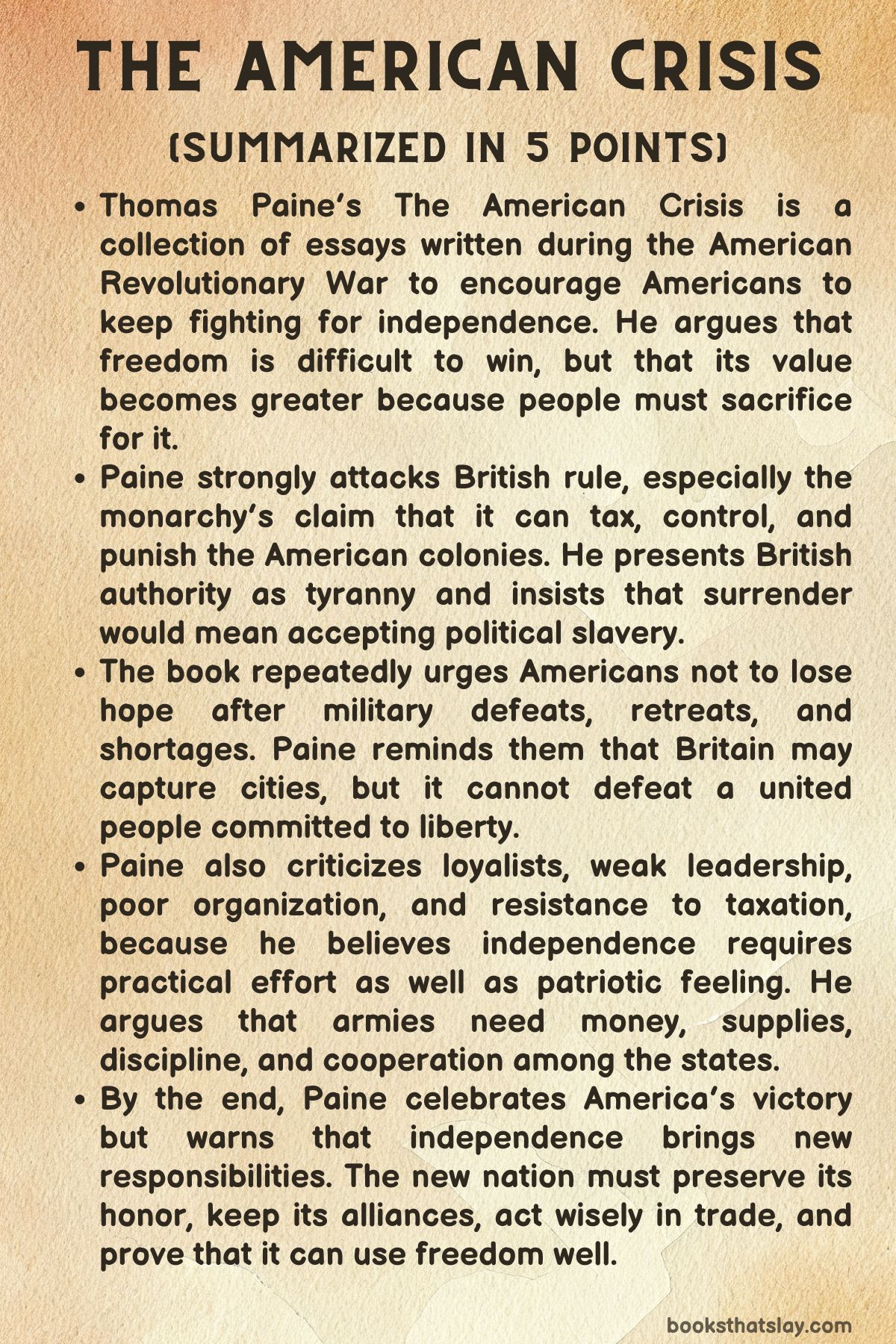
The American Crisis by Thomas Paine is a collection of political essays written during the American Revolutionary War. Rather than telling a fictional story, the book follows the emotional, military, moral, and financial struggle of America’s fight for independence.
Paine writes as a patriot, a witness, and a persuader, urging Americans to remain firm when defeat, exhaustion, fear, and doubt threaten the cause. His language is direct, forceful, and often confrontational. He attacks British rule, monarchy, loyalism, cowardice, and political compromise while defending liberty, sacrifice, unity, and national dignity.
Summary
Thomas Paine begins The American Crisis at one of the lowest moments of the American Revolution. His opening argument is that difficult times reveal the true character of a people.
Freedom, in his view, is valuable precisely because it is hard to win. Paine separates genuine patriots from those who support liberty only when it is easy or safe.
He argues that British rule is not a mild political disagreement but a form of tyranny, because Britain claims the right to tax and bind America in every possible matter. To him, such power is no different from slavery, and resisting it is not only practical but morally necessary.
Paine writes from direct experience of the war. He recalls the American retreat from Fort Lee and the weakness of the revolutionary army compared with the size and power of British forces.
The Americans are outnumbered, underprepared, and often dependent on short-term militia service. Yet Paine refuses to treat these disadvantages as reasons for surrender.
He argues that the American cause has justice on its side, and that people fighting for their homes and freedom have a strength that hired armies cannot easily defeat. He warns readers that despair is one of the enemy’s greatest weapons and insists that courage must be renewed even when events look bleak.
A major part of the book is Paine’s attack on British political authority. He addresses Lord Howe, General Howe, General Clinton, the Earl of Carlisle, the Earl of Shelburne, and the English public, often writing as though he is putting them on trial before the world.
He mocks their proclamations, rejects their offers of pardon, and exposes what he sees as the hollowness of British mercy. In his view, Britain offers forgiveness only because it is failing to conquer America by force.
He argues that Americans need no pardon for defending their natural rights, and that Britain has no moral standing to forgive the people it has injured.
Paine repeatedly argues that Britain cannot realistically conquer America. The country is too large, the people are too committed, and the British army cannot occupy every town, road, farm, and province at once.
Even if Britain captures major cities, Paine claims, this does not equal victory. The revolutionary cause lives in the people, not only in places.
When British troops occupy Philadelphia, New York, Charleston, or Savannah, Paine treats those events as serious but not final. He urges Americans to see military losses in a wider frame and to use them as reasons to organize better rather than lose hope.
The book also deals with internal American division. Paine condemns Tories, or loyalists, as people who side with a foreign power against their own country.
He argues that they should not enjoy full political rights in a nation whose independence they oppose. His criticism is severe because he sees loyalism as a direct threat to the survival of the revolution.
For Paine, neutrality is also suspicious. In a struggle between freedom and tyranny, he believes there is no honorable middle ground.
Those who refuse to support the cause, whether from fear, comfort, or self-interest, weaken the nation at the moment it most needs unity.
Paine’s criticism extends to pacifist Quakers who oppose taking up arms. He sees their refusal to fight as morally inconsistent because, in his view, they condemn American resistance while saying too little about British violence.
He does not reject peace as a goal; in fact, he often presents peace as the true purpose of American independence. But he argues that peace cannot be purchased through submission.
If Britain is allowed to rule through force, then the result will not be peace but permanent humiliation. For Paine, war is terrible, but failing to resist oppression is worse.
As the essays continue, Paine places the American Revolution within a larger global and historical setting. He compares America with ancient Greece and Rome and suggests that the new country may become even more admirable because it fights not for conquest but for liberty.
He contrasts European wars, which he says are often driven by pride, fame, and dynastic ambition, with America’s war, which he frames as defensive and moral. Paine hopes that America’s geographic separation from Europe will allow it to avoid the endless conflicts that have damaged older nations.
Independence, in this sense, is not just escape from Britain but a chance to build a different kind of political society.
The alliance with France becomes an important subject. Britain tries to present the alliance as proof that America has surrendered itself to another foreign power, but Paine rejects that charge.
He argues that the alliance is neither submission nor dependency; it is a practical relationship between nations with shared interests. He also rejects the idea that France is naturally Britain’s enemy.
To Paine, nations become enemies because of policy, jealousy, and ambition, not because nature makes them so. He criticizes Britain’s narrow view of foreign relations and presents America as more open to friendship and trade with the world.
Paine also turns his attention directly to the people of England. He argues that ordinary English citizens are being misled by their king and ministry.
They are paying enormous taxes to fund a war that brings them no real benefit. He tells them that destroying American property and reducing American prosperity only harms Britain’s own commercial future.
If America thrives as an independent nation, Britain can still benefit through trade. But if Britain continues the war, it will inherit debt, disgrace, and weakening power.
Paine even suggests that the English people should question their own government and consider reforming it.
In several essays, Paine focuses on money, taxation, and public responsibility. He knows that patriotic feeling alone cannot win a war.
Armies need supplies, payment, organization, and stable financing. He compares American and British taxation and argues that Americans are taxed far less than the British.
Because independence requires defense, he urges Americans to accept necessary taxes rather than complain about them. He supports financial measures from Congress and insists that each state must contribute fairly to the federal war effort.
At the same time, he believes public finance should be transparent. In a free country, citizens should know how money is collected and spent.
Paine’s practical side appears most clearly when he discusses conscription and military organization. He admits that volunteers and militias are useful for short bursts of action, but he does not think they are enough for a long war.
He proposes drafts and organized military service as necessary sacrifices. Freedom cannot be defended by enthusiasm alone; it requires discipline, planning, and shared burden.
Paine often reminds readers that the blessings of liberty must be earned. People who expect to enjoy freedom must be willing to protect it with labor, money, and risk.
The later essays show Paine responding to changing circumstances as Britain grows weaker and peace becomes more likely. He warns Americans not to be deceived by British negotiations.
He believes Britain may use peace talks to divide America from France or damage America’s reputation among other nations. He insists that America must keep its treaties and act honorably, because national character will matter after the war as much as military victory does during it.
A new nation must be trusted if it wants lasting respect.
One urgent episode concerns the killing of Captain Huddy and the threatened execution of Captain Asgill in retaliation. Paine treats this not simply as a military incident but as a question of justice, discipline, and the laws of war.
He condemns the murder of a prisoner and argues that Britain must hand over the guilty man rather than allow an innocent captive to suffer for another person’s crime. This episode shows Paine’s concern with moral conduct even during conflict.
He wants the American cause to remain tied to justice, not revenge without principle.
By the final essays, the Revolution has succeeded. Paine looks back on the struggle with pride and relief.
The hard times that tested American souls are over, and independence has been achieved. Yet he does not treat victory as an excuse for laziness.
America must now preserve its reputation, protect its unity, and act wisely in trade and diplomacy. Paine also reflects on his own role as a writer.
He says the revolutionary cause made him an author, and he presents his writings as a service to humanity rather than a source of personal profit. His final message is that America has won freedom, but it must now prove that it deserves and can sustain it.
Key Figures
Thomas Paine
Thomas Paine is the central voice and guiding force of the book. Although The American Crisis is not a novel with invented characters, Paine functions as the main presence because every argument, judgment, warning, and encouragement comes through his political personality.
He is passionate, severe, practical, and deeply committed to independence. He does not write like a distant observer; he writes as someone emotionally and morally invested in the outcome of the war.
His strength lies in his ability to combine moral certainty with political strategy. He can speak about freedom in grand terms, but he can also discuss taxation, military drafts, currency, and public finance with close attention to detail.
Paine’s character is shaped by urgency. He believes that hesitation can destroy a nation, and because of that, his tone often becomes confrontational.
He has little patience for cowardice, loyalism, false peace, or polite language that hides injustice. In the book, he emerges as both a revolutionary writer and a public instructor, someone trying to teach Americans how to think, sacrifice, and endure.
The American Patriots
The American patriots are presented as the moral community at the heart of the story. In The American Crisis, they are not treated as perfect or always brave; Paine often scolds them for fatigue, hesitation, weak organization, complaints about taxes, and overconfidence during quiet periods.
Yet he also sees them as the people capable of changing history. Their importance comes from their willingness to defend liberty when the cost is high.
Paine’s view of them is demanding because he believes their cause is sacred. He expects them to give money, labor, service, and courage.
They represent ordinary people being asked to rise above ordinary comfort. Their struggle is not only against British armies but against fear, selfishness, and short memory.
Paine wants them to understand that independence cannot be received passively. They must earn it through unity and discipline.
The American patriots are therefore both celebrated and corrected throughout the book, making them a collective character whose growth depends on accepting the responsibilities of freedom.
King George III
King George III appears as the symbol of British tyranny and political blindness. Paine does not treat him as a legitimate father figure or protector of the colonies; he presents him as stubborn, ignorant, and morally responsible for the suffering caused by the war.
The king’s speeches and policies become examples of a ruler trying to justify wrongdoing through royal language. Paine’s criticism of him is not limited to personality.
The king represents monarchy itself, a system Paine distrusts because it concentrates power in hereditary authority rather than consent. In the book, King George’s greatest flaw is his refusal to understand America’s resolve.
He believes power can force obedience, while Paine argues that such force only proves the justice of resistance. The king also becomes a danger to his own people, because Paine claims that the English public is being taxed and misled for a war that will ruin them.
King George is therefore both America’s enemy and Britain’s burden in The American Crisis.
British Military Commanders
The British commanders, especially Lord Howe, General Howe, General Clinton, General Carleton, and Admiral Digby, are shown as agents of an unjust empire. Paine treats them with open contempt when they issue proclamations, offer pardons, threaten destruction, or try to present British weakness as mercy.
General Howe, in particular, is accused of incompetence, cruelty, and dishonorable conduct. Paine argues that Howe missed his best chance to defeat the Americans early in the war and then turned to destructive tactics that damaged Britain’s reputation.
Lord Howe is mocked for offering pardon to people Paine believes have committed no crime. General Clinton and the Earl of Carlisle are criticized for continuing the same failed imperial logic.
Carleton and Digby receive attention because of their role in communicating peace developments, but Paine still uses them to expose confusion and mixed messaging within British policy. These commanders are not developed as private individuals; they function as public representatives of military arrogance, imperial failure, and moral evasion.
The Tories
The Tories, or American loyalists, are among the most harshly judged figures in the book. Paine sees them as people who live in America but give their loyalty to Britain, and this makes them dangerous in his eyes.
He does not present loyalism as a harmless opinion. To him, it is a betrayal of the country being born around them.
The Tories weaken morale, assist British hopes, and make unity harder at a time when survival depends on common effort. Paine’s attitude toward them is uncompromising because he believes a free political society cannot safely give power to people who prefer foreign rule.
He argues that they should not participate fully as voters or representatives because they do not identify with America’s independence. As a collective character, the Tories embody fear, dependence, and self-interest.
They are the internal enemy, not because they carry British weapons in every case, but because their loyalty gives strength to the empire America is trying to escape.
The Quakers and Pacifists
The Quakers and pacifists appear as morally complicated figures because Paine is not simply attacking peace as an ideal. He values peace, but he rejects the refusal to resist violent oppression.
His criticism of pacifist Americans centers on what he sees as imbalance. They condemn the colonists for bearing arms, but Paine believes they fail to condemn British violence with equal force.
In his view, such silence makes their pacifism appear selective and politically harmful. These figures matter because they allow Paine to examine the difference between peace and submission.
A person may dislike war, but Paine argues that refusing to defend liberty can allow greater suffering to continue. The pacifists therefore represent a challenge within the revolutionary movement: how to preserve moral principles while confronting force.
Paine answers this challenge by insisting that resistance can be a moral duty when the alternative is permanent domination.
The Continental Congress
The Continental Congress appears as the political center that must turn revolutionary feeling into organized national action. Paine supports Congress when it tries to raise funds, manage currency, and coordinate the states, but he also expects transparency and accountability from it.
Congress represents the practical side of independence. Declaring freedom is not enough; a country must finance armies, regulate money, request taxes, and report public expenses honestly.
Paine sees Congress as necessary because the individual states cannot win the war if each acts only for itself. Yet he does not want blind obedience to government.
He argues that in a free country, ordinary people should understand how public money is collected and spent. Congress therefore embodies both national unity and public responsibility.
Its success depends on cooperation from the states, trust from citizens, and honest administration. Through Congress, Paine shows that liberty needs institutions, not just emotion.
The People of England
The people of England are treated with more sympathy than the British government. Paine believes many of them are misinformed rather than naturally hostile.
They live far from the violence in America and may not fully understand what their armies and ministers have done. Paine addresses them as people who are being taxed, deceived, and harmed by their own rulers.
He tries to separate ordinary English citizens from the king and ministry, arguing that the war does not serve their real interests. In his view, they are paying for a conflict that will leave Britain weaker, poorer, and less respected.
Their role in the book is important because Paine wants the American Revolution to be understood internationally, not merely as a colonial rebellion. By speaking to the English public, he frames the conflict as part of a broader struggle between government deception and public reason.
France
France appears not as a fully developed nation-character but as an essential ally and a test of America’s diplomatic honor. Britain tries to portray the French alliance as a form of American dependency, but Paine rejects that claim.
For him, France’s support proves that America has entered the community of nations. The alliance is practical, honorable, and necessary.
France also helps Paine challenge Britain’s old assumptions about natural enemies. He argues that hostility between nations is created by policy and ambition, not by destiny.
France therefore represents the possibility of a new kind of international relationship based on shared interest rather than inherited hatred. Its presence strengthens America’s military position and gives Paine a way to argue that independence will open America to wider trade, diplomacy, and respect.
Captain Huddy, Lippencott, and Captain Asgill
Captain Huddy, Lippencott, and Captain Asgill form one of the book’s clearest moral episodes. Huddy represents the American victim of unlawful violence, a captured officer who is killed outside the proper rules of war.
Lippencott represents the breakdown of discipline and justice within the British side. His act is not treated as a private crime alone, because Paine argues that the British army’s failure to surrender him makes the institution responsible.
Captain Asgill becomes the tragic substitute, a man threatened with death for a crime he did not commit. Through these figures, Paine examines justice, retaliation, and the moral dangers of war.
He condemns murder and insists that even enemies must respect certain rules. This episode shows that Paine’s revolutionary anger does not erase his concern for lawful conduct.
He wants the guilty punished, not the innocent sacrificed.
Themes
Liberty as a Responsibility
Freedom in The American Crisis is never treated as a comfortable possession that people can enjoy without cost. Paine presents liberty as something that demands courage, payment, discipline, unity, and patience.
His famous opening claim about times that test people’s souls sets the moral standard for the entire work. The person who supports independence only during success is not enough for the cause.
Paine values the patriot who stays committed during retreat, hunger, fear, taxation, and military uncertainty. This theme is powerful because Paine refuses to separate rights from duties.
Americans have the right to resist tyranny, but they also have the duty to fund the army, accept hardship, serve when needed, and reject despair. Liberty becomes a form of public work.
It must be defended in fields, legislatures, newspapers, and tax systems. Paine’s idea of freedom is demanding because it asks people to think beyond private comfort.
The reward is not merely political independence from Britain, but dignity, self-command, and the chance to build a nation that is morally stronger than the empire it resists.
The Moral Failure of Tyranny
Paine’s attack on British rule is rooted in the belief that tyranny corrupts both the ruler and the ruled. Britain’s claim that it can tax, bind, punish, pardon, and command America is presented as a violation of natural justice.
Paine does not see British authority as a legitimate disagreement over policy; he sees it as domination supported by violence. This theme appears whenever he discusses royal speeches, military proclamations, burned property, murdered prisoners, or offers of pardon.
A government that injures people and then offers forgiveness for their resistance has reversed morality. Paine is especially forceful in showing how tyranny hides behind respectable language.
Words such as mercy, protection, loyalty, and peace are used by British officials, but Paine argues that their actions reveal cruelty, fear, and weakness. Tyranny also damages Britain itself.
The English people are taxed heavily, misled by ministers, and dragged into a war that serves pride more than public interest. Paine’s moral argument is therefore not only that America must be free, but that Britain must be judged for what its pursuit of power has made it become.
Unity and National Survival
The survival of America depends on unity across states, classes, and local interests. Paine repeatedly warns that division is one of the greatest threats to independence.
The British army is dangerous, but so are loyalism, hesitation, weak funding, selfish state politics, and public fatigue. Paine understands that a revolution cannot succeed if people think only as residents of separate colonies or states.
They must learn to act as one nation before the world fully recognizes them as one. This theme appears strongly in his discussions of Congress, taxation, conscription, and foreign trade.
Each state must contribute to the war effort, and citizens must accept that public defense costs money. Unity also has a moral meaning.
Paine wants Americans to remember that they are joined by a shared cause, not merely by geography. Their common suffering should become common resolve.
When he attacks Tories, it is because he sees divided loyalty as a danger to the whole political project. National survival, in Paine’s view, requires more than winning battles.
It requires trust, shared sacrifice, and the willingness to place the future of the country above immediate personal ease.
Public Virtue After Victory
Victory does not end Paine’s concerns; it changes them. Once independence is achieved, the new danger is that Americans may forget the discipline and moral seriousness that carried them through the war.
Paine insists that national reputation matters in peace just as courage matters in battle. A free country must keep its treaties, honor its alliances, manage its commerce wisely, and preserve its public character.
This theme is especially important in the later essays, where Paine turns from battlefield crisis to diplomacy, trade, and the responsibilities of independence. He warns that wartime suffering can harden people and weaken moral feeling, so Americans must consciously protect the ethical purpose of their revolution.
The new nation must not imitate the arrogance, suspicion, and selfish policies of old empires. It has the chance to become a different kind of power, one that values fair dealing and openness to the world.
Paine’s final vision is hopeful but not careless. Independence is a beginning, not a conclusion, and the nation’s future will depend on whether Americans can carry the virtues of sacrifice, honesty, and unity into peace.