The Art of a Lie Summary, Characters and Themes
The Art of a Lie by Laura Shepherd-Robinson is a masterful historical mystery set in 18th-century London, blending themes of deception, justice, and survival. It follows Hannah Cole, a widowed confectioner whose late husband’s murder exposes a labyrinth of lies, corruption, and hidden crimes.
When a stranger, William Devereux, enters her life offering comfort and help, Hannah becomes entangled in a dangerous web of deceit. The novel unfolds through alternating perspectives—Hannah’s and Devereux’s—revealing truths about greed, guilt, and moral compromise. Shepherd-Robinson paints a vivid portrait of Georgian society, where reputation and ruin often hang by the same fragile thread.
Summary
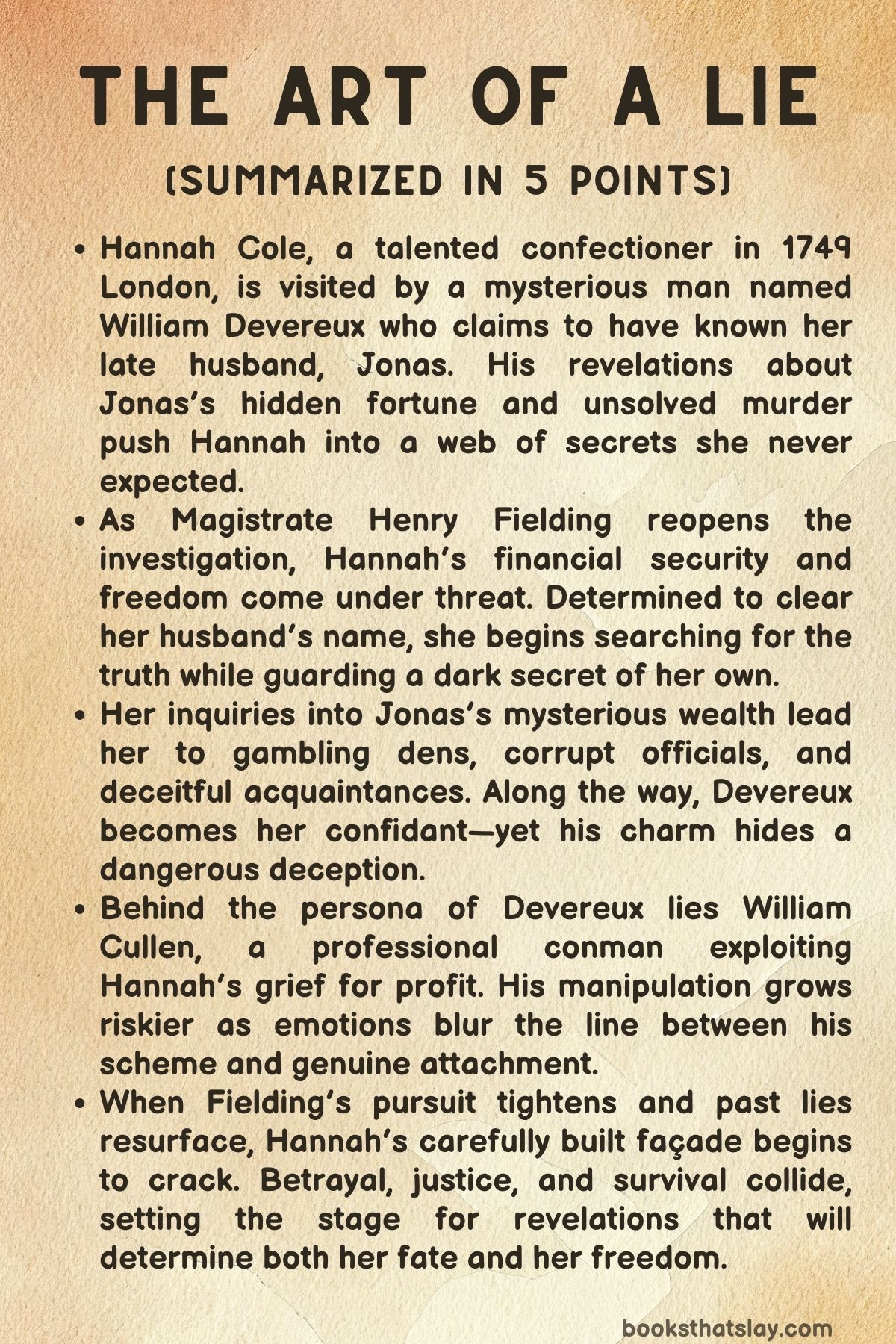
In 1749 London, Hannah Cole, a talented confectioner, manages her late husband Jonas’s shop, the Punchbowl and Pineapple. Her life changes when a refined gentleman, William Devereux, visits and reveals he knew Jonas.
He informs her of a small investment Jonas made and hands her a dividend, but also reminds her that Jonas’s death—presumed a robbery—remains unsolved. Not long after, Henry Fielding, the Chief Magistrate of Westminster, arrives to reopen the case.
He reveals Jonas had a secret fortune of over fifteen hundred pounds, hinting that his murder might have been staged to conceal criminal activity.
Hannah is shocked to learn of her husband’s wealth and begins to suspect dark dealings behind his polite facade. Daniel Cole, Jonas’s cousin and executor, confirms that Fielding has frozen the estate, suspecting Jonas of illicit profits.
The discovery leaves Hannah trapped financially, forcing her to seek the truth to reclaim her inheritance. Fielding’s investigation and her own suspicions drive her to question everyone around her, even her apprentices.
As she works to keep her business afloat, Hannah remembers her marriage: Jonas was once charming and ambitious, but became cruel and secretive. Years of abuse and betrayal ended one stormy night when, after discovering his plans to sell her family shop and flee with his mistress, she struck him with a mallet in the ice cellar—killing him in self-defense.
She disposed of the body and crafted a tale of robbery and murder. Now, Fielding’s investigation threatens to expose her.
Determined to protect herself, Hannah starts probing Jonas’s connections. The clue of a porcelain fish leads her to a secret gambling den called the Goldfish Club, a haunt of powerful men.
Devereux offers to help and grows closer to her, becoming both confidant and suitor. Together they pursue leads, meeting lords, scientists, and criminals across London.
Through her work, Hannah also rediscovers her craft, creating iced creams and confections that attract admiration from the city’s elite.
Unbeknownst to her, “William Devereux” is not who he claims to be. His real name is William Cullen, a professional con artist who targets wealthy widows by posing as a respectable gentleman.
His partnership with Mrs. Parmenter and Lord Richard Morrow supports his elaborate deceptions.
Cullen’s initial plan is to swindle Hannah of her inheritance, but her courage, intelligence, and loneliness begin to unsettle him. He pretends affection, manipulating her emotions, yet finds himself unexpectedly drawn to her strength.
Cullen’s schemes, however, are threatened by his criminal associate Patrick Musgrave, a violent underworld figure who demands a share of Hannah’s expected inheritance. At knifepoint, Musgrave forces Cullen to hand over most of it when she receives it.
Meanwhile, Cullen’s partner Tom grows weary of their crimes, planning to leave after learning his lover is pregnant. The danger intensifies as a former victim, Penelope Felton, arrives in London seeking revenge against Cullen.
Hannah’s own guilt deepens when she learns Jonas’s mistress, Annette, is pregnant. Her buried rage and grief resurface, but she finds unexpected solace in Cullen.
They begin a passionate affair, each deceiving the other—Hannah hiding murder, Cullen hiding his identity. For the first time, she feels alive and loved, but danger grows as Fielding’s inquiries close in.
Daniel Cole, bitter after Hannah rejects his romantic advances, betrays her secrets to Fielding, who now suspects her more strongly.
Cullen, under pressure from Musgrave and desperate to maintain control, stages grand gestures—introducing Hannah to a boy named Teddy, supposedly his ward, and showing her a grand house he pretends to buy. He convinces her to entrust him with money for Teddy’s future.
When Hannah overhears another man call him “William Everhart,” she begins to doubt him. Her suspicions lead her to David Thewson, a government official, where she learns more about Cullen’s past and aliases.
Fielding, now armed with witness statements and inconsistencies in Hannah’s story, summons her apprentices for questioning. Theo and Oscar, frightened, reveal clues suggesting she cleaned blood from the cellar.
Felix, the third apprentice, has disappeared. Fielding arrests Hannah, charging her with Jonas’s murder.
Cullen, panicking, bribes his way into the jail and promises to save her. She tells him that Jonas’s distinctive watch is hidden in the ice pit beneath the shop.
That night, Cullen undertakes a dangerous mission through the storm-flooded tunnels beneath London to retrieve the watch, nearly drowning in the process. He recovers it and later persuades Fielding’s lawyer to secure Hannah’s release, arguing that the apprentices’ claims are weak.
Once freed, Hannah spends a final night with Cullen, seemingly trusting him completely. She writes him a note authorizing him to collect her inheritance and asks him to protect Teddy.
When Cullen arrives at the bank the next morning, Fielding arrests him. Unbeknownst to him, Hannah has gone to the magistrate first, presenting forged letters and evidence implying Cullen—identified now as the notorious swindler William Everhart—murdered Jonas.
She has also planted Jonas’s watch in Cullen’s room, sealing his fate. Fielding, convinced, charges him with the crime.
Cullen, betrayed by the woman he deceived, faces prison. Desperate, he reaches out to his former allies for help, but they abandon him.
When his old partner Tom visits, Cullen tries to persuade him to confess, but Tom, fearing exposure, kills him in his cell and stages it as suicide.
Hannah, now free and exonerated, reopens her confectionery. The scandal fades, and fortune returns when the King’s mistress praises her famous pineapple iced cream.
Fielding visits her one final time, returning Jonas’s watch and informing her that Cullen is dead. He believes justice has been served.
Alone after his departure, Hannah reads Cullen’s last letter. He admits his ruin, explains his intent to protect her from financial harm, and expresses his love, imagining her under an Italian sunrise.
For the first time, Hannah realizes that despite all the deception, Cullen’s final act was one of redemption.
In the end, The Art of a Lie becomes a meditation on truth and falsehood. Both Hannah and Cullen build their lives upon lies—hers born of survival, his from greed—and both pay dearly.
London’s glittering veneer of progress and propriety conceals a city of moral decay. Yet, in her final solitude, Hannah endures, her art and resilience the last remaining truths in a world built on deception.
Characters
Hannah Cole
Hannah Cole stands as the central figure of The Art of a Lie, a woman both victim and architect of deception. As a confectioner in 1749 London, she embodies the contradictions of strength and vulnerability that define survival in a patriarchal society.
Hannah begins as a widow grappling with the financial and emotional aftermath of her husband Jonas’s death, believing herself caught in webs spun by others—men like Fielding and Devereux. Yet beneath her composure lies a chilling secret: she herself killed Jonas in an act that was part self-defence, part revenge.
This revelation transforms the reader’s understanding of her character. Hannah’s life becomes a delicate balancing act between guilt, survival, and the pursuit of freedom.
Her confectionery craft, especially the creation of iced cream, symbolizes her attempt to exert control over chaos—a rare realm where precision and sweetness can counterbalance the bitterness of her reality. Over the course of the novel, Hannah evolves from fearful widow to calculating manipulator, ultimately mastering the art of deceit better than the con man who sought to exploit her.
Her intelligence, resilience, and moral ambiguity make her both admirable and terrifying—a portrait of a woman remade by betrayal.
William Devereux (William Cullen / William Everhart)
William Devereux, whose real name is William Cullen, epitomizes charm weaponized into deceit. A professional con artist who preys on wealthy widows, he moves through London’s glittering world of gambling dens and drawing rooms with an actor’s grace and a predator’s instincts.
Under his assumed identity, he mirrors Hannah’s desires, reflecting back to her the qualities she longs to see in a man: respect, kindness, shared intellect. His schemes are built on empathy as performance, on emotional mimicry as a tool of theft.
Yet the brilliance of his character lies in his gradual transformation. What begins as manipulation slowly curdles into genuine affection for Hannah, a love he neither expects nor can handle.
Haunted by his own fabrications, Devereux becomes trapped in his own web of lies, unable to distinguish truth from invention. His end—betrayed by the very woman he deceived—completes his tragic arc.
In dying for crimes he did not commit, he achieves a dark redemption: the deceiver undone by love, punished for the authenticity he briefly allowed himself to feel.
Jonas Cole
Jonas Cole’s presence in the novel is ghostly yet omnipresent, haunting every action and motive that follows his death. Once a charming and ambitious apprentice who transformed Hannah’s family shop, Jonas deteriorates into a cruel, greedy husband, consumed by the hunger for wealth and influence.
His descent mirrors the moral rot of 18th-century London—where commerce, corruption, and politics intertwine. The revelation that he planned to abandon Hannah and sell her inheritance transforms him from tragic striver to villainous betrayer.
Yet even his sins are complex: his involvement with gambling clubs and political bribery reflect both his moral weakness and his desperate attempt to climb beyond his station. Jonas’s murder at Hannah’s hands is both personal vengeance and social commentary, exposing how women trapped in dependence can only reclaim agency through violence.
Though dead, Jonas remains the moral center of the novel’s deceit, the original lie from which all others spiral.
Henry Fielding
Henry Fielding, the historical magistrate reimagined in The Art of a Lie, serves as the novel’s embodiment of justice—flawed, moralizing, and driven by ambition as much as integrity. As Chief Magistrate of Westminster, he investigates Jonas’s death not merely out of duty but as a means to validate his reformist vision of a professional police force.
His pursuit of truth becomes entangled with his need for reputation, blurring the line between justice and self-promotion. Fielding’s interactions with Hannah oscillate between paternal concern and suspicion, as he senses her duplicity without fully grasping its depth.
Unlike the novel’s deceivers, his lies are institutional rather than personal—rationalized under the guise of public good. By the novel’s end, Fielding’s triumph in solving the case feels hollow: though he exposes the surface of corruption, he remains blind to the private truths beneath it.
Through him, Shepherd-Robinson critiques Enlightenment reason as another form of illusion, suggesting that the law, like deception, depends on performance.
Daniel Cole
Daniel Cole, Jonas’s cousin and executor, represents the moral uncertainty of loyalty in a world poisoned by greed. Initially portrayed as an ally to Hannah, he soon reveals possessive and self-serving impulses.
His love for her, twisted by jealousy and wounded pride, becomes yet another form of manipulation. Daniel’s belief in Jonas’s honesty falters as evidence mounts, leaving him suspended between devotion and disillusionment.
His eventual betrayal—feeding Fielding with suspicions about Hannah—marks him as both victim and perpetrator of deceit. In contrast to William Devereux’s polished falsehoods, Daniel’s deceptions are clumsy and emotional, driven by insecurity rather than design.
He serves as a mirror to the novel’s theme: that lies are not solely acts of malice, but tools for survival in a society where truth offers no safety.
Patrick Musgrave
Patrick Musgrave functions as the novel’s dark undercurrent—the embodiment of London’s criminal heart. A powerful gang leader and manipulator behind the Goldfish Club, Musgrave exerts control through fear, violence, and political corruption.
His influence extends from gaming houses to government offices, blurring distinctions between crime and commerce. Musgrave’s confrontation with William exposes the futility of moral hierarchies among liars: even the con artist must bow before organized deceit.
His ruthless pragmatism contrasts sharply with Hannah’s emotional intelligence, showing two sides of manipulation—brute coercion versus psychological finesse. Musgrave’s world is the furnace in which every character’s falsehood is forged, a reminder that in 1749 London, honesty is not a virtue but a luxury no one can afford.
Theo, Felix, and Oscar
The apprentices—Theo, Felix, and Oscar—form the chorus of innocence and corruption that surrounds Hannah’s world. Their youth and servitude render them both observers and participants in deception.
Theo’s nervousness and fabricated testimony, Felix’s mysterious disappearance, and Oscar’s revelations under pressure reveal how easily the powerless can become pawns in the schemes of others. They reflect the blurred morality of their environment: loyal yet fearful, truthful yet self-preserving.
Through them, Shepherd-Robinson underscores that deceit seeps downward from the powerful to the vulnerable, infecting even those who seem peripheral to the plot. Their presence gives the novel texture and realism, grounding its grand acts of treachery in the daily struggle for survival.
Penelope Felton and Tom
Penelope Felton and Tom serve as reflections of William’s past—embodiments of guilt, betrayal, and the moral decay of the conman’s world. Penelope, once a victim of William’s fraud, returns as an avenging spirit, her contempt exposing the cost of his manipulations.
Tom, his loyal partner turned reluctant killer, represents the tragedy of complicity: drawn into crime out of loyalty, destroyed by it out of fear. His murder of William seals the novel’s cyclical vision of deceit devouring itself.
Together, they demonstrate that in The Art of a Lie, no falsehood remains contained—each breeds new corruption until truth itself becomes indistinguishable from performance.
Themes
Deception and Self-Preservation
Throughout The Art of a Lie, deception becomes not merely a survival tool but a means of identity and agency for nearly every character. Hannah Cole’s life is built on concealment—from the secret of her husband’s murder to her calculated lies to protect her livelihood.
Her deception begins as an act of self-preservation against an abusive marriage and a patriarchal society that denies women control over property, finance, or freedom. Yet, as she continues to manipulate those around her, including Henry Fielding and William Cullen, deceit becomes inseparable from her sense of self.
Similarly, Cullen—posing as William Devereux—represents deception as art and philosophy. His entire existence depends on impersonation, his morality defined by performance and persuasion rather than truth.
The novel questions whether deceit can ever be justified when survival is at stake. In Hannah’s case, it becomes a language of necessity, one that saves her from destitution but isolates her emotionally.
The irony of the title lies in this duality—lies can be both creative and destructive, protective yet ruinous. Laura Shepherd-Robinson paints deception not as moral failure but as an adaptive mechanism shaped by social inequities, class hierarchies, and gendered vulnerability.
In a world where truth leads to ruin, falsehood becomes a lifeline. Ultimately, both Hannah and Cullen craft illusions to control narratives others would write for them, only to find themselves ensnared by the very lies they create.
Power, Gender, and Economic Dependency
The story lays bare the precarious position of women in 18th-century London, where power and survival hinge on economic control. Hannah’s occupation as a confectioner symbolizes both independence and limitation—her success depends on the indulgence of the wealthy and her ability to mask desperation with grace.
Her marriage to Jonas exposes the patriarchal legal framework that erases a woman’s autonomy; even in death, Jonas controls her fate through the frozen inheritance. Devereux’s manipulation further reflects how charm and wealth function as tools of dominance within male hands.
Hannah’s entanglement with him is not simply romantic deception—it is a negotiation between economic need and emotional vulnerability. The novel also exposes how class intersects with gender: men like Fielding wield institutional authority, while men like Jonas and Cullen exploit economic and emotional systems to exert control.
Women, denied social mobility, must maneuver through subtler, morally ambiguous channels to assert agency. By contrasting Hannah’s calculated defiance with the ruin of other women preyed upon by con artists, Shepherd-Robinson examines how patriarchy forces moral compromise.
Power, in this context, is transactional, and survival requires adopting the very manipulative tactics men use to dominate.
Guilt, Redemption, and the Weight of Morality
The moral universe of The Art of a Lie is one of shifting ethics, where guilt is not measured by law but by conscience. Hannah’s murder of Jonas is portrayed with psychological complexity—an act of liberation shadowed by enduring guilt.
She seeks redemption not through confession but through control of narrative, manipulating others to maintain her version of events. Cullen, too, exhibits flashes of conscience amid his life of fraud.
His final acts—protecting Hannah and ensuring her safety—blur the boundary between villain and savior. Both characters embody moral ambiguity; neither purely victim nor villain, they are products of a corrupt society that rewards deceit and punishes honesty.
Fielding’s investigation adds another dimension to this moral questioning. As a figure of law and reform, he represents the Enlightenment’s faith in justice, yet his biases and ambition reveal that morality itself can be performative.
The novel’s conclusion—where truth is buried under layers of strategic deceit—suggests that redemption lies not in confession but in the quiet endurance of guilt. The human capacity for self-deception becomes both a curse and a form of mercy, allowing survival in a world too unforgiving for truth.
The Illusion of Love and Emotional Exploitation
Love in The Art of a Lie operates as a form of illusion, shaped by need, loneliness, and manipulation. For Hannah, affection becomes entwined with power—the tenderness she once craved from Jonas transforms into dependency when offered by Devereux.
Her relationship with him is built on falsehood, yet it delivers genuine emotional comfort, revealing how easily sincerity and deceit can coexist. Cullen’s mastery lies in mimicking love, using empathy and shared vulnerability as instruments of control.
Yet as his feelings for Hannah deepen, the line between performance and reality dissolves. The tragedy of their bond lies in its paradox: love born from lies becomes the only truth either of them experiences.
The novel suggests that emotional exploitation often thrives in spaces where affection is scarce and trust impossible. Love, in such a world, becomes a mirror of self-deception—a reflection of what one most desires to believe.
Through Hannah and Cullen’s doomed connection, Shepherd-Robinson exposes how longing can be weaponized, how desire blinds, and how emotional truth may survive even within falsehood.
Justice, Corruption, and the Performance of Morality
Set against the backdrop of Henry Fielding’s reforms, The Art of a Lie explores the fragile boundary between justice and spectacle. The magistrate’s pursuit of Jonas’s killer is as much about social validation as truth.
His investigation reflects the contradictions of a society claiming moral progress while steeped in hypocrisy and exploitation. The institutions of law and commerce—represented by Fielding’s court, the Goldfish Club, and the financial syndicates—are all driven by appearances.
Justice, in this world, is performative: the appearance of moral order masks systemic corruption. Jonas’s secret dealings, Cullen’s scams, and Hannah’s deception all thrive in this culture of hypocrisy.
Even Fielding’s moralism cannot escape ambition and self-interest. By making truth contingent on performance, Shepherd-Robinson critiques the Enlightenment ideal of rational justice.
The law, she suggests, may expose crimes but cannot comprehend the moral truths behind them. When Hannah frames Cullen to save herself, the system accepts her lie because it fits its narrative of guilt and virtue.
Justice is achieved not through truth but through the satisfying illusion of closure—a mirror of the very artifice that defines every relationship in the novel.