The Art of Loving Summary and Analysis
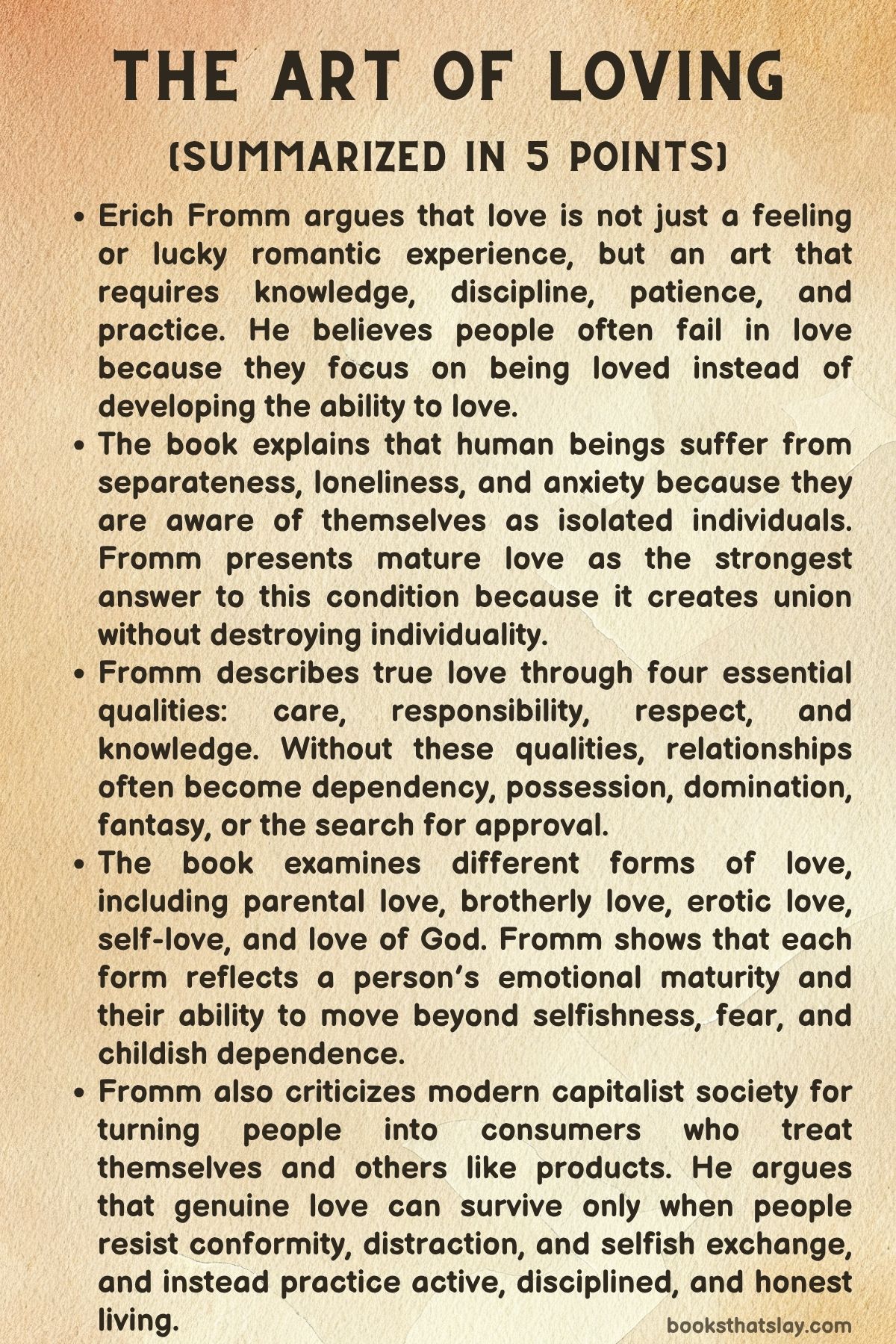
The Art of Loving by Erich Fromm is a philosophical and psychological exploration of love as a disciplined human capacity rather than a lucky emotion or romantic accident. Fromm argues that love requires knowledge, patience, maturity, courage, humility, faith, and practice, much like music, medicine, or any other art.
The book challenges modern assumptions about attraction, marriage, sexuality, self-love, parental love, and religious love, showing how consumer culture often reduces people into objects of exchange. At its core, it presents love as the answer to human loneliness and separation.
Summary
Erich Fromm begins The Art of Loving by warning readers not to expect a simple instruction manual. He does not treat love as a technique that can be mastered through quick advice or emotional shortcuts.
Instead, he presents love as one of the most difficult achievements of human life, because it depends on the development of the whole personality. A person cannot truly love without becoming more mature, disciplined, humble, courageous, faithful, and productive.
Fromm’s purpose is not to make love sound easy, but to show that its difficulty should make people take it more seriously. He writes in an accessible way because he wants the subject to be understood beyond academic circles, but he also makes it clear that love demands serious inner work.
The book’s central argument begins with the idea that love is an art. Fromm believes most people misunderstand love because they see it as a pleasant feeling that happens to them rather than as an ability that must be learned.
People often focus on how to become lovable instead of asking how they can become capable of loving. They try to improve their social appeal, attractiveness, success, charm, or usefulness, treating love as if it were a matter of being chosen.
Fromm also criticizes the belief that love depends mainly on finding the right person. In modern consumer culture, people often approach relationships like market exchanges, evaluating one another through status, appearance, personality, and social value.
A third mistake is confusing the early excitement of falling in love with the lasting condition of being in love. The first phase of attraction may feel powerful because two strangers suddenly feel close, but that intensity often fades when familiarity grows.
For Fromm, the failure of relationships comes largely from mistaking this temporary excitement for genuine love.
Fromm then connects love to the basic condition of human existence. Human beings are part of nature but also separated from it because they possess self-awareness, reason, and imagination.
Unlike animals, people know they are separate individuals. They know they are vulnerable, mortal, and alone in many essential ways.
This awareness creates deep anxiety. Human beings therefore search for ways to overcome their separateness.
Some seek temporary release through intoxication, sexual excitement, or group rituals. These experiences may briefly erase loneliness, but they do not solve it.
Others turn to conformity, losing themselves in the opinions, habits, and routines of the group. They feel less alone because they become like everyone else, but this comes at the cost of individuality.
Creative work can also unite a person with the world, but modern industrial life often weakens this kind of meaningful activity. Fromm concludes that mature love is the only full answer to separateness because it creates union while preserving individuality.
He distinguishes mature love from immature forms of attachment. Immature union often appears as dependence, domination, submission, or possession.
A person may try to escape loneliness by becoming part of another person, or by making another person part of themselves. In both cases, individuality is damaged.
Mature love is different because it allows two people to become united while remaining separate and whole. It is active, not passive.
Love is not something one falls into and then simply enjoys; it is an action and a power. Fromm identifies four elements present in genuine love: care, responsibility, respect, and knowledge.
Care means active concern for the life and growth of the loved person. Responsibility means responding to another’s needs, not through obligation imposed from outside, but through one’s own willingness.
Respect means seeing the other person as they are, not as an object to use. Knowledge means understanding the other person deeply, beyond surface impressions and selfish projections.
Fromm next examines love between parents and children. The infant begins life in a state of dependence, experiencing the mother as warmth, food, protection, and security.
At first, the child does not understand the mother as a separate person. Maternal love is experienced as unconditional: the child is loved simply for existing.
This love gives a deep sense of security, but it also carries a paradox. Because it is unconditional, the child cannot earn it, control it, or produce it.
If it is present, it feels like a blessing; if it is absent, the child is helpless before that absence. As the child grows, love gradually changes from being received to being actively given.
The mature person no longer only wants to be loved but develops the ability to love others.
Fromm contrasts motherly and fatherly love. Motherly love is unconditional and rooted in care for the child’s life and growth.
Its highest form is not possessiveness, but the willingness to help the child become independent. Fatherly love, as Fromm describes it, is more conditional and connected with guidance, discipline, expectations, and social order.
It can be lost through failure or disobedience, but it can also be gained through effort. A mature person must internalize both forms: the motherly voice that says one is loved despite failure, and the fatherly voice that calls one toward responsibility and change.
Psychological problems emerge when a person remains trapped in dependency on one side, seeking either endless unconditional care or constant approval from authority.
Fromm then discusses different objects of love. Brotherly love is the most basic form because it is love among equals and extends toward all human beings.
It is rooted in the recognition that beneath differences of talent, class, nationality, and personality, all people share the same human condition. Motherly love is unequal because the child depends on the mother, yet its mature form requires the mother to support separation rather than cling to the child.
Erotic love is exclusive, but Fromm warns that exclusivity must not become possession. True erotic love includes tenderness and commitment.
It is not merely sexual desire, nor is it the excitement of conquest. It involves a decision to love one person deeply while remaining capable of love toward humanity as a whole.
A major part of Fromm’s argument concerns self-love. He rejects the idea that loving oneself is selfish.
In his view, a person who cannot love themselves cannot truly love others either, because love is an orientation of character. Selfishness is not too much self-love but too little.
The selfish person is empty, anxious, and unable to care for their real self, so they try to compensate by taking from others. Genuine self-love includes respect for one’s own life, growth, dignity, and powers.
Fromm also examines love of God as a reflection of human maturity. He traces religious love from dependency on mother-like or father-like divine figures toward a more mature understanding in which God represents truth, love, justice, and unity rather than a personified authority used for comfort or reward.
Fromm then turns to modern Western society and argues that genuine love is rare because capitalism shapes people into market-oriented personalities. People learn to experience themselves as commodities, selling their labor, personality, attractiveness, and skills.
They also learn to consume constantly, treating happiness as the acquisition of products, entertainment, experiences, and approval. This affects relationships.
Marriage may become a partnership of convenience between two efficient people who cooperate well but remain inwardly distant. Popular ideas about love often emphasize sexual satisfaction, social compatibility, or emotional comfort, but Fromm argues that these cannot replace real intimacy.
Love is weakened when people are alienated from themselves, from others, and from meaningful work.
He identifies several false forms of love. Some people seek a mother figure in romantic partners and want unconditional care without responsibility.
Others seek fatherly approval and turn love into a search for validation. Some worship a partner as an idol, projecting their own unused powers onto that person.
Others live through sentimental love, experiencing emotion through films, songs, memories, or fantasies while avoiding real contact. Still others focus on reforming the partner instead of facing their own flaws.
Fromm also rejects the idea that love means the absence of conflict. Real conflict, when it comes from the center of each person rather than from petty irritation, can clarify truth and strengthen growth.
In the final section, Fromm discusses the practice of love. Since love is an art, it requires discipline, concentration, patience, and deep concern.
Discipline should not feel like an outside command but should become an expression of one’s own will. Concentration requires the ability to be alone, to listen, and to be fully present.
Patience resists the modern demand for speed and instant results. Sensitivity to oneself helps a person notice inner states honestly instead of denying discomfort, anger, fatigue, or sadness.
Fromm also emphasizes objectivity, humility, reason, faith, and courage. To love, one must see others as they are, not through personal fear or desire.
One must have rational faith in oneself, in others, and in human potential. Above all, love requires active living.
It cannot be limited to romantic life while the rest of one’s existence remains passive, selfish, or alienated. For Fromm, love is both a personal discipline and a social necessity, because it is the most complete answer to the problem of human separation.
Key Figures
Erich Fromm
Erich Fromm functions as the central guiding presence in the book, even though he is not a character in a fictional sense. He appears as a thinker, teacher, critic, and moral psychologist who challenges the reader’s ordinary assumptions about love.
In The Art of Loving, Fromm refuses to flatter his audience by presenting love as easy, natural, or automatic. His intellectual role is to slow the reader down and insist that love requires effort, maturity, and a changed way of living.
He combines psychology, philosophy, religion, and social criticism, but his voice remains practical because he wants the reader to connect theory with daily life. Fromm’s importance comes from his ability to expose the gap between what people say about love and how they actually behave.
He sees modern people as deeply hungry for love, yet often unwilling to practice the discipline that love demands. His character as an author is firm, humane, and demanding: he believes in human potential, but he does not excuse immaturity, passivity, or self-deception.
The Modern Individual
The modern individual is one of the most important human figures in the book because Fromm uses this figure to show why love has become so difficult. This person wants connection but is trained by society to think in terms of success, exchange, popularity, and consumption.
Instead of asking how to love, the modern individual asks how to become desirable. Instead of developing inner strength, this person tries to improve market value through appearance, charm, wealth, social position, or sexual appeal.
Fromm presents this figure as lonely but often unaware of the full depth of that loneliness. The modern individual conforms while believing themselves independent, consumes while believing themselves happy, and seeks romance while often treating partners like valuable objects.
This figure is not evil or shallow by nature; rather, the person has been shaped by a society that rewards usefulness, efficiency, and attractiveness more than care, responsibility, respect, and knowledge. The tragedy of this figure is that they want love but keep using methods that cannot produce it.
The Productive Lover
The productive lover represents Fromm’s ideal of mature human development. This figure does not love out of emptiness, panic, dependency, or the need to possess another person.
Instead, the productive lover gives from inner aliveness. Giving, for this person, is not a loss or sacrifice but an expression of strength.
The productive lover can care for another person’s growth without trying to control them, respond to another’s needs without turning responsibility into domination, respect the loved person’s individuality, and seek real knowledge of the other rather than relying on fantasy. In The Art of Loving, this figure is the opposite of the passive romantic dreamer.
The productive lover does not merely wait to be chosen, rescued, admired, or completed. This person practices love as an active orientation toward the world.
Such a figure can love one person deeply without becoming cut off from humanity, and can love others without losing self-respect. Fromm’s ideal lover is disciplined, courageous, humble, alert, and capable of being alone, because only a person who can stand as a whole self can unite with another without surrendering individuality.
The Infant and the Growing Child
The infant and growing child show how the human capacity for love develops over time. At the beginning of life, the infant is dependent and self-centered in a natural way, experiencing the mother mainly as the source of warmth, food, comfort, and protection.
The child does not yet understand others as separate beings with their own needs and inner lives. Love is first experienced passively as being loved.
This stage is essential because unconditional care gives the child a sense that existence is safe and good. As the child grows, however, Fromm shows that maturity requires a shift from receiving love to giving love.
The child begins to make gifts, create things, and think about the happiness of others. This movement marks the early growth of active love.
The child’s development matters because Fromm sees adult love as connected to whether a person can move beyond infantile dependency. A mature adult does not simply demand to be loved like a child; they become capable of caring for another person’s life and growth.
The Mother
The mother is presented as the figure of unconditional love, nourishment, protection, and affirmation. Her role in the book is not limited to biological motherhood; she represents a form of love that tells the child that life is good and that the child is loved simply for existing.
Fromm makes an important distinction between basic care and a deeper joy-giving love. A mother may feed and protect a child, but the highest form of motherly love also gives the child a sense of gladness toward life.
The mother’s greatest test arrives as the child grows independent. Immature motherly love may cling to the child, reward helplessness, or use the child to satisfy the mother’s own need to be needed.
Mature motherly love does the harder thing: it supports separation. The mother’s greatness lies in helping the child become free even though that freedom reduces the child’s dependence on her.
In this sense, Fromm treats motherly love as one of the most demanding forms of love because it requires care without possession.
The Father
The father represents guidance, discipline, expectation, judgment, and entry into the wider social world. Fromm contrasts fatherly love with motherly love by describing it as conditional.
The father’s love says, in effect, that the child is loved through achievement, obedience, responsibility, or the fulfillment of expectations. This can create anxiety, because such love can be lost.
Yet it also has a positive side because it can be earned through effort and growth. The father figure helps the child face reality beyond the protected world of early childhood.
When fatherly love is mature, it is patient, reasonable, and instructive rather than authoritarian. It gives direction without crushing independence.
When distorted, it becomes cold approval, harsh control, or a lifelong demand that the child prove worthiness. Fromm’s treatment of the father is psychologically important because he believes mature adults must internalize a healthy fatherly conscience: a voice that calls them to responsibility and correction without making them feel worthless.
The Immature Lover
The immature lover is a figure driven by need rather than genuine love. This person may say they love someone, but what they often mean is that they cannot bear loneliness, fear, insecurity, or the burden of standing alone.
Fromm’s immature lover confuses dependence with devotion and intensity with depth. Such a person may seek a partner as a substitute parent, a rescuer, a possession, an idol, or a mirror that reflects back admiration.
The immature lover may also mistake sexual excitement, sentimental emotion, or the thrill of newness for lasting love. This figure is important because Fromm does not portray failed love as merely bad luck.
He shows that many people fail in love because they enter relationships without having developed the capacity to love. The immature lover wants the rewards of love without the discipline of love.
The person may be sincere, but sincerity alone is not enough. Without care, responsibility, respect, knowledge, and inner maturity, the immature lover remains trapped in repeated disappointment.
The Alienated Consumer
The alienated consumer is Fromm’s social portrait of the person shaped by modern capitalism. This figure sees the world as something to be acquired, used, tasted, bought, watched, or consumed.
Even experiences become products. Happiness becomes the act of obtaining something new, whether it is an object, entertainment, status, or romantic attention.
The alienated consumer also treats the self as an investment, trying to improve personal market value. In relationships, this person may look for the best available partner according to social desirability, much as one might compare products.
Within The Art of Loving, this figure reveals how economic life affects emotional life. Fromm does not isolate love from society; he argues that a market-centered culture produces people who struggle to relate from the center of their being.
The alienated consumer is lonely because consumption cannot create real union. The figure may be surrounded by pleasures, choices, and contacts, yet still lack the active relatedness that genuine love requires.
The Religious Believer
The religious believer appears in different stages of maturity throughout the book. At an immature level, this figure imagines God as a protecting mother or commanding father and relates to the divine through dependency, fear, obedience, or the hope of reward.
Such a believer may use religion for comfort, success, or security without being transformed by love, justice, and truth. At a more mature level, the religious believer no longer treats God as a powerful person who exists to satisfy human wishes.
Instead, God becomes a symbol of the highest human values: unity, truth, love, and justice. Fromm’s religious believer is therefore not judged by doctrine alone but by the quality of inner development.
The mature believer practices love in life rather than merely holding correct beliefs. This figure matters because Fromm connects love of God with love of human beings.
A person’s relationship to the divine reveals their level of psychological maturity, their freedom from infantile dependence, and their ability to live by principles rather than fear.
Themes
Love as Discipline, Knowledge, and Practice
In The Art of Loving, love is treated as an ability that must be developed rather than an emotion that simply happens. Fromm challenges the popular idea that love depends mainly on luck, chemistry, attractiveness, or finding the right person.
His argument shifts attention from the object of love to the capacity of the lover. A person who has not developed maturity, discipline, humility, courage, and faith may find someone desirable, but that does not mean they can love well.
This theme is especially powerful because it opposes the modern fantasy that love should feel effortless if it is real. Fromm compares love to an art because every art requires theory, practice, patience, and ultimate concern.
A musician cannot become skilled by loving music alone, and a doctor cannot heal through good intentions alone. In the same way, a person cannot love deeply without training the self.
Fromm’s view makes love less sentimental but more meaningful. Love becomes an active way of living, not a mood.
It demands attention, responsibility, and repeated effort. This theme also explains why love fails so often: people expect lasting union while neglecting the inner work that makes such union possible.
The Pain of Separateness and the Search for Union
Human separateness stands at the center of Fromm’s understanding of love. Human beings are conscious of themselves as separate individuals, aware of mortality, isolation, vulnerability, and the limits of control.
This awareness creates anxiety so deep that people constantly search for ways to escape it. Some seek temporary release through intoxication, sexual excitement, or intense group experiences.
Others escape through conformity, reducing the pain of individuality by becoming like everyone else. Some try to find unity through work or creative activity, but modern forms of labor often prevent genuine connection between the worker and the product of work.
Fromm’s key claim is that mature love is the only answer that does not destroy the self. Immature solutions erase separateness temporarily or artificially; mature love accepts separateness while creating union across it.
This is why Fromm describes love as a paradox in which two people become one and yet remain two. The theme is not only romantic but existential.
Love matters because loneliness is not a small emotional inconvenience; it is part of the human condition. To love maturely is to answer that condition without surrendering freedom, dignity, or individuality.
The Difference Between Mature Love and Dependency
Fromm repeatedly separates genuine love from forms of attachment that imitate it. Dependency can look like love because it creates intensity, longing, and emotional need, but it often comes from fear rather than strength.
A person may cling to another, submit to another, dominate another, worship another, or demand constant reassurance from another and call that love. Fromm argues that these patterns are attempts to escape loneliness without becoming mature.
Mature love is different because it preserves both union and individuality. It does not ask one person to disappear into the other.
It does not reduce the loved person to a possession, caretaker, audience, or source of approval. This theme is especially clear in Fromm’s treatment of parent-child love and erotic love.
The child must grow from being loved to loving actively. The adult lover must move beyond the need to be completed and develop the ability to give.
Mature love contains care, responsibility, respect, and knowledge. Each element guards against dependency.
Care prevents indifference, responsibility prevents selfish withdrawal, respect prevents control, and knowledge prevents fantasy. Fromm’s analysis shows that love is not proven by need alone.
In fact, the more desperate the need, the more likely love is being replaced by dependence.
Modern Society and the Damage Done to Love
Fromm’s social criticism shows that love cannot be separated from the culture in which people live. Modern capitalist society teaches people to think in terms of markets, exchange, efficiency, consumption, and personal value.
As a result, individuals often experience themselves as commodities and judge others in the same way. Romantic choice becomes shaped by attractiveness, income, charm, social standing, and the promise of a favorable exchange.
This damages love because genuine love requires seeing a person from the center of one’s being, not as an object with market value. Modern life also encourages distraction.
People work in routines, consume entertainment, chase new possessions, and avoid solitude, yet Fromm believes the ability to be alone is essential for the ability to love. A person who cannot sit with the self will often use relationships as escape.
The culture also promotes sentimental substitutes for love through songs, films, fantasies, and idealized romance, allowing people to feel emotion without practicing real responsibility. Fromm’s criticism is demanding because he does not place all blame on private failure.
He shows that society produces habits of alienation, and these habits enter intimate life. Love can still be practiced, but it requires resistance to the values of consumption, conformity, and emotional laziness.