The Ascended Summary, Characters and Themes
The Ascended by Bree Grenwich and Parker Lennox is an epic fantasy that explores divinity, rebellion, and the struggle for freedom within a world bound by gods and destiny. Set in a universe shaped by ancient Primordials and their divine descendants, the novel follows Thais Morvaren, a young woman burdened by celestial power and hunted by the divine order that created her.
Through mythic worldbuilding and emotional depth, the story examines the cost of defiance, the corruption of power, and the bond between siblings who challenge the heavens themselves. It’s a tale of survival, love, and vengeance set against a backdrop of divine tyranny and cosmic war.
Summary
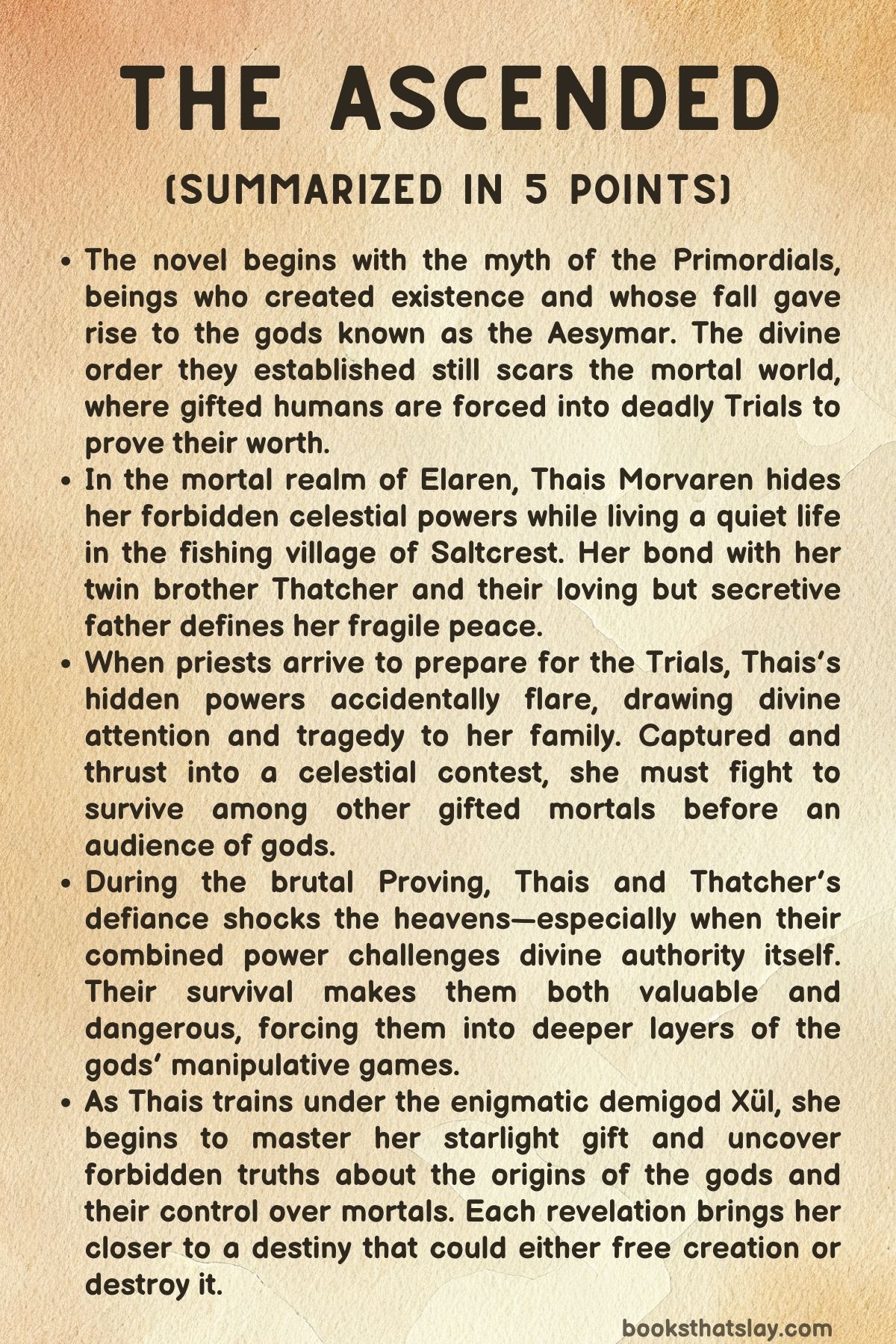
The world of The Ascended begins with the Primordials—cosmic beings whose thoughts birthed creation. From them arose the Aesymar, divine offspring who inherited their creators’ power.
Twelve of these Aesymar, led by Olinthar, rebelled against their makers in a cataclysmic divine war. The Primordials vanished, leaving Olinthar as the new King of Gods.
In the aftermath, divine energy seeped into the mortal realm, producing “blessed” mortals who manifested godlike abilities. To control them, the gods established the Trials of Ascension, brutal contests where the blessed either rose to divinity or perished.
Among the mortals lives Thais Morvaren, a fisherwoman in the coastal village of Saltcrest. She hides a dangerous secret—she can summon and shape starlight, a power marking her as divine-born.
Her adoptive father, Sulien, and twin brother, Thatcher, protect her from discovery. Their mother, a mortal once taken and broken by Olinthar, died giving birth to them, leaving the twins as children of both god and human.
Despite Thais’s desire for a simple life, fear of exposure shadows her existence.
When priests of the Aesymar arrive unexpectedly to prepare for the Trials, panic spreads through Saltcrest. The family’s fragile peace unravels as rumors of divine inspection circulate.
One night, after a forbidden tryst with Marel, Thais loses control of her powers, lighting the sky with unnatural constellations. Her display attracts divine attention.
The next day, priests storm the village and accuse Marel of sorcery. To save him, Thais reveals herself, summoning a star to prove her guilt.
The priests seize her and Thatcher, condemning Sulien for harboring the blessed. When Sulien defends them, he is executed before their eyes.
Thais collapses under grief as her world is destroyed.
She awakens in a divine prison, powerless and consumed by guilt. Her captors, the Dreamweavers—servants of the goddess Syrena—inform her she will compete in the Proving, a divine contest.
To find and save Thatcher, Thais agrees. Transformed into a figure worthy of the gods’ gaze, she enters the celestial arena alongside other gifted mortals.
The Proving begins as a supposed test of ability, but when a god named Drakor demands blood, the contest devolves into slaughter. Thais survives, mastering her starlight in combat and revealing her strength before the divine assembly.
Her victory is hollow—she only wants her brother freed.
The gods summon Thatcher, intending to test him. When Drakor tortures him, Thatcher’s buried power erupts, annihilating the god in an explosion of divine energy.
For the first time, a mortal kills a god. Horrified yet awed, the pantheon spares the twins, fascinated by their potential.
They are kept alive, trained for the full Trials of Ascension.
As Thais and Thatcher adapt to their captivity, they form a pact—to survive, learn, and one day destroy Olinthar. They train under the Dreamweavers, each chosen by divine mentors.
Thais is assigned to Xül, a cold and powerful god whose methods are both cruel and revelatory. Under his harsh tutelage, Thais confronts her fear of her own strength.
Through struggle and reluctant trust, a bond forms between them—one built on mutual recognition of power and pain. Xül pushes her beyond restraint, forcing her to embrace her full celestial potential.
She manifests seven motes of starlight—pure celestial energy orbiting her like a crown—astonishing even the gods.
Their growing closeness blurs the line between mentor and equal. Xül reveals forbidden truths about the divine hierarchy and the Sundering—the event that destroyed the Primordials and fractured creation.
He admits the gods’ history is built on betrayal and suppression. The Trials, he says, exist not to uplift mortals but to control them.
When Thais nearly dies in a brutal attack orchestrated by another Legend named Kavik, Xül saves her, furious at the betrayal and protective in a way that defies divine detachment.
As the Trials continue, Thais’s mastery grows, but so does her understanding of the gods’ corruption. She learns that Olinthar’s reign conceals a darker secret—he is possessed by the ancient Primordial Moros, whose hunger for power destroyed his kin.
When Moros’s manipulation surfaces, Thais and Thatcher find themselves at the heart of a divine conspiracy. Their defiance becomes rebellion.
During the final confrontation, Thais and Thatcher face Moros, who reveals his plan to use Thatcher’s body as a vessel. Betrayed by the goddess Elysia, Thais is gravely wounded but fights on.
As Moros begins transferring his essence into Thatcher, she disrupts the ritual with a burst of starlight, allowing her brother to awaken. Together they tear Moros from Olinthar’s body, freeing the god from corruption but unleashing chaos.
The ensuing rift threatens to consume reality. When Thatcher is pulled toward the void, Thais refuses to let go, but his final plea forces her to release him.
The rift seals, taking Thatcher with it.
Olinthar, freed but dying, calls Thais his daughter and confers his divine spark upon her. Horrified, she kills him, ending his tyranny.
When Xül and his father Morthus arrive, Thais stands over Olinthar’s corpse, shattered and empty. Morthus declares himself the new King of Gods, using the event to consolidate power.
To protect Thais from execution, he and Xül conceal her role. Xül is forced into a political marriage with Nyvora, ensuring peace among the pantheon.
Thais, now immortal and burdened with Olinthar’s divine light, retreats to the mortal world. She lives in solitude, haunted by her brother’s loss.
Decades pass. The Trials are abolished, the pantheon stabilized, but Thais remains hollow—half a soul without Thatcher.
When the seer Heron visits her, he reveals that Thatcher’s thread of fate flickered alive for seven seconds far in the future, meaning he still exists somewhere. Hope stirs within her for the first time in years.
She vows to be ready when that moment arrives.
In the void between realms, Thatcher survives. Stripped of identity, he resists Moros’s lingering presence.
When his mind begins to fade, a dark queen, Andrid Valtýr, appears and offers him a place in her realm of shadow. With his memories almost gone, Thatcher takes her hand, beginning a new existence under a new name—Aether.
Thus ends The Ascended, a story of rebellion, sacrifice, and the boundless will to defy even the gods.
Characters
Thais Morvaren
Thais stands as the emotional and moral center of The Ascended, a mortal woman burdened with divine blood and the trauma of her origins. From the very beginning, she is portrayed as both strong-willed and haunted — a fisherwoman who hides the power of the stars within her.
Her life is defined by restraint: she conceals her celestial gift to protect her loved ones, especially her adoptive father Sulien and her twin brother Thatcher. Yet beneath that restraint lies a fierce yearning — for freedom, for justice, and for vengeance against the gods who destroyed her mother’s life.
As the narrative unfolds, Thais evolves from a fearful fugitive into a celestial force of defiance. Her relationship with Xül exposes the tension between power and vulnerability; their dynamic oscillates between mentorship, intimacy, and moral challenge.
Even as she ascends toward godhood, her humanity remains intact, expressed in her grief, guilt, and devotion to Thatcher. By the novel’s end, Thais becomes both destroyer and savior — a goddess shaped by loss, whose resolve to defy divine tyranny becomes her final act of love.
Thatcher Morvaren
Thatcher’s arc mirrors and contrasts his sister’s, embodying the theme of shared divinity and divergent destiny. Initially portrayed as Thais’s teasing yet loyal twin, he represents compassion and levity within their tragic family.
Unlike Thais, Thatcher appears powerless, which makes his support of her even more selfless — he protects her despite lacking the means to fight the gods himself. However, his latent divine heritage manifests catastrophically during the Proving, when his awakening destroys the god Drakor.
This single moment transforms Thatcher from an ordinary mortal into a being of impossible consequence — a mortal who kills a god. His subsequent journey is one of trauma and loss; trapped in the void with Moros, his identity unravels, symbolizing how divine power consumes the human self.
When he reemerges as Aether under Queen Andrid Valtýr, he becomes a tragic inversion of what he once was: a soul stripped of warmth, serving in darkness. Thatcher’s character thus embodies the cost of power — the erasure of innocence and memory in exchange for survival.
Sulien
Sulien serves as the moral anchor of the early story, representing unconditional love and humanity in a world warped by divine cruelty. Though not Thais and Thatcher’s biological father, his devotion to them defines their sense of family and belonging.
His relationship with Thais is particularly poignant — a blend of paternal protectiveness and sorrow, as he knows her secret power could one day destroy her. His death, executed publicly for harboring the blessed, becomes the crucible that hardens Thais’s resolve.
Sulien’s sacrifice transforms him into a symbol of mortal resistance against divine oppression. Even in death, his memory haunts Thais, guiding her choices and grounding her morality.
Xül
Xül is a character of immense complexity — both mentor and moral mirror to Thais. As a god marked by duality, his mismatched eyes symbolize his divided nature: the godly detachment of immortality and the buried compassion of something still human.
His training of Thais blurs boundaries between discipline and desire, as he pushes her to embrace her true power by confronting her fears and emotions. Despite his cold exterior, Xül reveals vulnerability through his history of isolation and the forced political marriage that mirrors the gods’ manipulative control over fate.
His relationship with Thais evolves into a tragic bond — a love constrained by power, duty, and divinity. Xül’s ultimate decision to protect her, even at the cost of his own happiness, defines him as one of the few divine beings capable of empathy.
Olinthar / Moros
Olinthar, the King of Gods, embodies divine arrogance and corruption, his reign the direct cause of mortal suffering. Yet the revelation that he was long possessed by Moros reframes his tyranny as a manifestation of something older and darker — a Primordial hunger for domination and immortality.
Moros, as the true antagonist, personifies chaos, the devouring void that erases identity and meaning. Through him, the novel explores the cyclical nature of power: how even gods can become vessels of greater, more ancient evils.
Olinthar’s dual existence — as both father and oppressor to Thais — gives her final act of patricide profound weight. Killing him is not merely vengeance but liberation from generations of divine corruption.
Lyralei
Lyralei, the Dreamweaver who first aids Thais, functions as a guide between mortal and divine worlds. Her loyalty to Syrena and her compassion toward Thais position her as a bridge between rebellion and submission.
Throughout The Ascended, Lyralei’s warnings and quiet defiance demonstrate that even within the divine order, there are those who see its cruelty. Her enigmatic presence and partial truths add an air of mystery, suggesting deeper political and spiritual fractures among the gods.
Marel
Marel represents mortal tenderness — the fleeting simplicity that Thais yearns for but can never keep. His love for her, innocent and earnest, highlights the tragedy of her fate.
Their union beneath the stars — an act of love turned catastrophe — symbolizes the destructive consequences of divine interference in human life. Marel’s false accusation and subsequent suffering serve as the emotional trigger that forces Thais to reveal her power, forever changing her destiny.
Morthus
Morthus, the god of death and Xül’s father, is both terrifying and pragmatic. Though ruthless, he is guided by a sense of balance that contrasts sharply with Olinthar’s tyranny.
His decision to claim credit for Olinthar’s death and force Xül into marriage underscores his political cunning but also his warped sense of protection. In his actions, readers glimpse a being who understands that survival among gods requires sacrifice — even of truth and love.
Queen Andrid Valtýr
Appearing at the novel’s end, Andrid introduces a chilling expansion of the story’s mythos. As queen of a shadowed realm, she rescues Thatcher not out of mercy but necessity, offering him rebirth as Aether.
Her presence suggests a continuation of divine manipulation — an echo of Moros’s hunger in another form. Through her, the novel closes not with resolution but with a haunting promise: that power, in any realm, always seeks new vessels.
Heron
Heron, the blind god of Fate, appears as a final flicker of hope. His revelation that Thatcher’s fate briefly reawakened offers Thais — and the reader — a moment of light amid desolation.
His blindness serves as metaphorical commentary on destiny itself: that even the god who sees the threads of existence cannot fully understand or control them. Through Heron, the story suggests that even in a cosmos ruled by gods and Primordials, fate is never absolute — and love might yet transcend the divine order.
Themes
Divine Corruption and the Abuse of Power
In The Ascended, the divine order is not portrayed as a system of harmony but as a decaying hierarchy where absolute power breeds moral decay. The gods, once born from the creative will of the Primordials, have transformed divine rule into tyranny.
Olinthar, the King of Gods, represents the hypocrisy of holiness—his reign sustained by oppression, manipulation, and the destruction of mortal freedom. The Trials of Ascension, initially depicted as a sacred test, are exposed as an instrument of control designed to eliminate threats and glorify cruelty.
The narrative treats divinity not as enlightenment but as corruption masquerading as destiny. Through Thais’s eyes, the reader witnesses the grotesque disparity between the grandeur of the divine and the suffering of mortals, revealing that power without accountability only perpetuates pain.
The corruption extends beyond Olinthar; gods like Drakor and Elysia embody the sadism of immortality—those who kill or betray for spectacle. Even the institutions meant to serve the divine, such as the priesthood, are hollow mechanisms enforcing silence and fear.
By the time Thais ascends, the divine realm is shown as a rotting empire feeding on belief. Her eventual act of killing Olinthar becomes both revenge and liberation—a mortal reclaiming power stolen under the guise of holiness.
The theme underscores how authority that detaches itself from compassion becomes indistinguishable from evil, and it forces the question of whether godhood is inherently corrupting or merely reveals what mortals hide.
The Burden of Inheritance and Identity
Thais’s journey in The Ascended is deeply rooted in the tension between who she is and who she refuses to become. Born of divine and mortal blood, she embodies contradiction—a being made by violence yet capable of extraordinary creation.
Her divine heritage is both gift and curse; it gives her power but also marks her as an abomination in the eyes of those who fear her. The trauma of her mother’s death and her father’s concealment shapes her into a woman terrified of her own nature.
Every act of suppression—whether hiding her starlight or resisting divine command—mirrors the universal struggle between self-preservation and authenticity. As she grows, her identity ceases to be defined by lineage and begins to form through choice.
Yet the legacy of Olinthar remains an unshakable shadow, one that corrupts her sense of belonging even as she fights against it. The revelation that she carries his spark transforms identity into inheritance—a metaphysical chain binding her to the very order she despises.
Still, her defiance reframes legacy not as a curse to endure but as a truth to redefine. Her acceptance of her power at the cost of her humanity becomes both tragedy and triumph.
By the end, Thais’s identity exists between worlds: mortal in memory, divine in being, and human in will. The theme captures the pain of inheriting what one hates and the possibility of transforming that inheritance into resistance.
Sacrifice, Grief, and the Cost of Defiance
The novel builds its emotional foundation on the theme of loss as the price of courage. From the death of Sulien to the disappearance of Thatcher, every act of defiance exacts a cost that strips Thais of the people anchoring her to hope.
Her sacrifices are not heroic gestures made for glory but the inevitable toll of opposing a structure designed to destroy dissent. Grief becomes her constant companion, shaping her decisions and hardening her resolve.
When she confesses her identity to save Marel, she acts not out of recklessness but compassion; yet that compassion brings ruin. The gods’ cruelty turns her kindness into liability, illustrating how in a corrupted system, love becomes vulnerability.
Thatcher’s transformation into both weapon and victim deepens this cycle, forcing Thais to confront the impossible balance between saving others and surviving herself. The narrative treats defiance as a sacred act that demands blood.
Even at her most powerful moments—killing Olinthar, surviving divine battles—Thais’s triumphs are steeped in mourning. The theme exposes the human truth that every rebellion against injustice is sustained by grief.
Yet within that grief lies strength, the kind that refuses erasure. Thais’s endurance, more than her starlight, becomes the story’s ultimate form of divinity: the power to keep going when everything worth living for has been taken.
The Duality of Mortality and Divinity
Throughout The Ascended, the boundary between mortal and divine is repeatedly questioned until it dissolves entirely. The gods, despite their immortality, display envy, lust, and insecurity—flaws indistinguishable from those they condemn in mortals.
Mortality, on the other hand, is portrayed as a source of empathy and meaning. Thais’s humanity, shaped by fear, love, and loss, becomes her greatest strength against beings who have forgotten what it means to feel.
The Trials of Ascension serve as the narrative’s moral experiment: when mortals are forced to act like gods to survive, they risk losing what makes them human. Thais’s struggle lies in reconciling her celestial power with her mortal heart.
Her moments of compassion, even amid carnage, are acts of rebellion against divine detachment. When she kills Olinthar, she not only ends a reign but asserts that mortality’s fragility holds more dignity than eternal indifference.
The duality culminates in her unwanted ascension—she gains immortality but loses connection to the mortal world, her brother, and her sense of self. By contrasting the two realms, the novel argues that divinity without mortality is hollow, while mortality touched by divine courage becomes transcendent.
The theme reflects a timeless question: whether enlightenment lies in rising above humanity or embracing it completely.
Love, Connection, and the Fragility of Hope
Amid the violence and celestial politics of The Ascended, love emerges not as salvation but as endurance. It is the thread that binds Thais to life even as everything else seeks to break her.
Her relationships—with Sulien, Thatcher, Marel, and Xül—define her humanity and expose her vulnerability. Love in this world is not gentle; it is defiant, existing in the shadow of death and divinity.
Sulien’s unconditional devotion provides the moral foundation that guides her choices long after his death, while her bond with Thatcher transcends blood and mortality, forming the emotional core of the story. Their twin connection symbolizes the unity of light and shadow, creation and destruction.
The romantic tension with Xül evolves into a fragile trust, testing whether intimacy can exist between beings divided by nature and purpose. Yet every act of love in the novel is haunted by loss—proof that in a world ruled by gods, affection is rebellion.
Even when Thais becomes divine, love remains the only force that can make her feel human again. The closing moments, where she learns Thatcher’s fate is not entirely sealed, restore a flicker of hope, suggesting that love can survive even in the void between worlds.
The theme captures the paradox of existence in this universe: power isolates, but love endures, fragile yet unbreakable, like starlight in the dark.