The Astonishing Color of After Summary, Characters and Themes
The Astonishing Color of After is a young adult novel by Emily X. R. Pan about grief, family history, identity, and the strange ways memory can survive loss. The story follows Leigh Chen Sanders after her mother’s suicide, as she becomes convinced that her mother has returned as a red bird.
Her search for answers takes her from the United States to Taiwan, where hidden family wounds, cultural disconnection, and unspoken love reshape her understanding of her mother, her father, and herself. It is a story about mourning without erasing the dead.
Summary
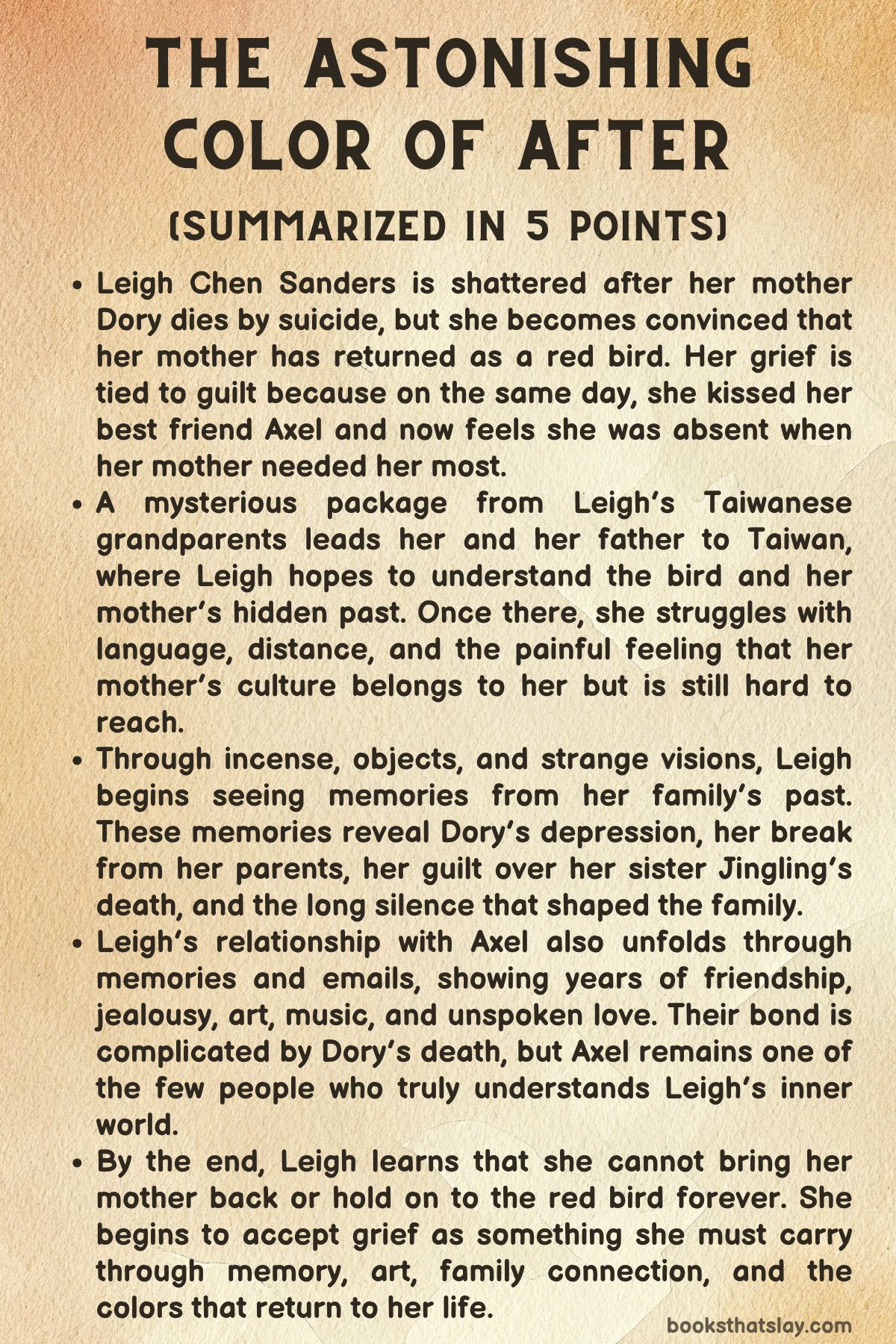
Leigh Chen Sanders is a teenage artist whose life is broken open when her mother, Dory, dies by suicide. Leigh’s first response is not acceptance but certainty: her mother has become a bird.
This belief begins after she sees a mysterious crimson bird with a long tail, hears it call her name in her mother’s voice, and receives a red feather from it. The vision comes at a terrible time, because Leigh is already carrying guilt from the day her mother died.
That same day, she and her best friend Axel finally kissed, crossing a boundary that had hovered between them for years. Instead of feeling only joy, Leigh is crushed by the thought that while she was with Axel, her mother was preparing to die.
After the funeral, Leigh’s grief becomes tightly bound to color, silence, and memory. She cannot accept the body in the casket as her mother.
To her, the real Dory is elsewhere, winged and red, waiting to be found. Leigh tries to explain this to her father Brian and to her friend Caro, but both respond with concern rather than belief.
Leigh feels misunderstood and isolated. She begins using only charcoal in her art, as if the bright world has become impossible.
At home, she tries to paint over the orange bedroom wall she once shared with her mother, but her father cannot understand why she wants to erase the colors of their old life.
The bird returns with a strange package that seems impossible. It contains Dory’s cicada necklace and a note from Leigh’s maternal grandparents in Taiwan, whom Leigh has never met.
Brian explains that Dory had cut herself off from her parents long ago and had refused to teach Leigh Mandarin or speak openly about her past. Leigh sees the package as a sign that the bird wants her to go to Taiwan.
Brian initially resists, but after a violent rush of red feathers fills their house, he agrees to take her.
In Taipei, Leigh meets her grandparents, Waipo and Waigong, but the reunion is full of distance. They speak Mandarin, and Leigh feels ashamed of how little she understands.
Her father translates, but tension grows when Leigh insists that Dory has become a bird. Brian struggles with the visit, feeling that he is breaking promises he made to Dory, and eventually leaves for Hong Kong while Leigh stays behind.
Alone with grandparents who are both family and strangers, Leigh begins moving through Taiwan in search of the bird and in search of the part of her mother that was never shared with her.
A mysterious incense box becomes Leigh’s path into memory. When she lights the incense with objects connected to her family, she enters visions from the past.
Some memories belong to her, others to her father, her mother, or her grandmother. Through these visions, Leigh sees moments of happiness: her parents together, her mother at the piano, Axel and Leigh sketching as children.
She also sees moments of pain that were hidden from her. The memories do not arrive neatly.
They overwhelm her, bringing smells, colors, ash, smoke, and voices.
As Leigh searches Taipei with her grandmother and a young woman named Feng, she learns more about Dory’s childhood. Feng speaks English and helps translate, but Leigh resents her at first.
Feng seems closer to the family than Leigh is, more able to communicate with Waipo, and more connected to Taiwan. Still, Feng becomes an important guide.
Together, they visit Dory’s favorite places: shops, markets, temples, and the university where Dory studied. Each place offers another trace of the red bird.
Leigh learns about the Buddhist belief in the forty-nine days after death, a period before the spirit moves on. This gives her search a deadline.
She believes she must find her mother before those days pass.
While in Taiwan, Leigh keeps receiving emails from Axel, though she avoids answering many of them. Their relationship has always been charged with love, confusion, jealousy, and fear.
Flashbacks show how they became close through art and music, how Axel once dated Leanne Ryan, and how Leigh hid her jealousy. Axel, who is also biracial, understands parts of Leigh’s identity that others do not.
He loved Dory as a substitute mother figure, which makes her death painful for him too. Leigh’s feelings for him deepen over time, but the timing of their kiss makes her associate their romance with loss.
Through memory, Leigh also sees her mother’s depression more fully. Dory’s illness did not begin suddenly.
It had been present in different forms for years, sometimes hidden beneath music, motherhood, and daily life. Leigh remembers hospital visits, medication, therapy, electroconvulsive treatment, and moments when she did not know how to respond to her mother’s suffering.
She wonders if she loved her mother wrongly, if she failed to notice something important, or if her father’s absences made things worse. These thoughts torment her, but the memories slowly show her that Dory’s death cannot be reduced to one person’s mistake.
The family history grows deeper when Leigh discovers that Dory had an older sister named Jingling. Jingling was obedient, responsible, and beloved, while Dory was a brilliant musician with dreams beyond the expectations placed on her.
Dory left Taiwan for the United States and fell in love with Brian, but her parents wanted her to marry someone Chinese. Their disapproval caused a painful break.
Jingling later died from an aneurysm, and Dory carried guilt because she believed she should have noticed her sister was ill. This guilt, added to the rupture with her parents, shaped Dory’s life in America.
Leigh learns that Brian had secretly written to Dory’s parents for years, sending photographs of Leigh and her artwork. He tried to keep a connection alive even when Dory refused contact.
The truth complicates Leigh’s anger toward him. Brian did fail in some ways.
He traveled often, withdrew into work, and left Dory and Leigh alone with sadness he did not know how to face. Yet he also loved them, kept Leigh’s drawings close, and carried regrets of his own.
Father and daughter slowly begin to speak more honestly.
As the forty-nine days pass, the supernatural world around Leigh intensifies. Feathers fall, rooms shift, memories collapse into ash, and the bird appears but refuses to be caught.
Leigh makes a net from her clothes, hoping the smell of home will help her mother remember, but the effort fails. Feng gently helps Leigh understand that the point may not be to catch the bird.
Perhaps Dory does not need to return in the way Leigh wants. Perhaps she needs to be remembered and released.
Near the end, Leigh’s father returns to Taipei. Leigh, Brian, and her grandparents are swept into a final storm of memory, where they see the old wounds that shaped Dory’s life: her parents’ rejection of Brian, Jingling’s death, Dory’s refusal to return, and the family’s long silence.
Leigh finally encounters her bird-mother in a vision on the moon. Dory says goodbye.
Leigh falls into darkness and later wakes after a fever, realizing that the forty-nine days have passed.
The aftermath brings difficult clarity rather than simple comfort. Leigh learns that Feng was never an ordinary living person.
Feng was connected to Jingling, whose presence had been guiding the family through grief. The name Feng means wind, and the message attached to her presence suggests that seeing loved ones in the hardest moments can be a blessing.
Leigh, her father, and her grandparents later scatter the ashes of Dory and Jingling together, uniting sisters who had been separated by death, distance, and silence.
When Leigh returns home, she finds Axel waiting. He has cared for Dory’s cat, Meimei, and has painted Leigh’s room in color.
The act restores something that grief had drained from her. Leigh and Axel finally admit their feelings and allow their friendship to become romantic.
Leigh also learns that her work has been selected for an international art show in Berlin. Her final artistic statement, centered on memory, shows that she has begun transforming grief into creation.
Leigh still carries the space left by her mother, but she no longer sees it only as emptiness. It can hold memory, color, family history, and the will to keep living.
Characters
Leigh Chen Sanders
In The Astonishing Color of After, Leigh is the central character, and her emotional life shapes the entire book. She is an artist who understands the world through color, texture, image, and sensation, so grief does not come to her as a clean explanation.
It comes as charcoal, red feathers, smoke, ash, and a bird with her mother’s voice. Leigh is both vulnerable and stubborn.
Her belief that Dory has become a bird may look like denial, but it is also her attempt to create meaning from a death that feels senseless. She is haunted by guilt because she kissed Axel on the day her mother died, and this guilt affects how she treats him, her father, and herself.
Leigh’s journey is not only about finding her mother’s spirit; it is also about finding the parts of her own identity that were kept from her. As a biracial girl disconnected from her Taiwanese heritage, she feels unfinished when she reaches Taipei.
By the end, she has not solved grief, but she has learned to live with it as part of memory, art, and love.
Dory Chen Sanders
Dory is the emotional center of The Astonishing Color of After, even though she dies before the main journey fully begins. She is remembered as a mother, pianist, daughter, sister, wife, and wounded person whose pain was never fully understood by those around her.
Dory’s depression is presented with care: it is not treated as a single bad mood or a weakness, but as a long illness shaped by personal loss, family rupture, guilt, and isolation. Her estrangement from her parents and her grief over Jingling’s death create a hidden life inside her, one that Leigh only begins to understand after Dory is gone.
Dory’s love for Leigh is real, but so is her inability to speak honestly about the past. She withholds Mandarin, her parents, and family history, believing perhaps that silence will protect her daughter.
Instead, the silence leaves Leigh searching. As the red bird, Dory becomes both presence and absence: close enough to guide Leigh, but distant enough to teach her that love cannot prevent death or force return.
Brian Sanders
Brian is a father who loves his family but often fails to stay emotionally present when they need him most. A scholar of Chinese culture, he knows Mandarin and understands Taiwan in an academic sense, yet he struggles to handle the living pain inside his own household.
His absences for work become a form of escape from Dory’s depression, and Leigh rightly confronts him for leaving her and her mother alone with fear and uncertainty. Still, Brian is not careless or cold at his core.
He keeps Leigh’s art, secretly sends letters and photographs to Dory’s parents, and carries his own guilt about the choices that shaped the family. His departure from Taipei after arguing with Waipo shows his weakness under pressure, but his later return shows his desire to face what he avoided.
Brian’s character is built on contradiction: he can translate language but not always feeling; he can study culture but still fail his own multicultural family; he can be absent and loving at once.
Axel Moreno
Axel is Leigh’s best friend, artistic partner, romantic interest, and one of the few people who understands her without needing every part of her explained. He is half Filipino and half Puerto Rican, and his mixed-race identity gives him a connection to Leigh’s sense of being seen as different.
Axel’s own mother abandoned his family, so Dory becomes an important maternal figure for him, making her death a loss he experiences deeply. His relationship with Leigh is full of affection but also miscommunication.
He dates Leanne, fails to recognize how much that hurts Leigh, and often hides behind ambiguity when his feelings become too serious. Yet he expresses himself through music, paintings, recordings, and gestures rather than direct confession.
His emails and artwork show that he is trying to reach Leigh even when she is far away emotionally and geographically. By painting Leigh’s room in color at the end, Axel shows that he understands what grief took from her and what art can restore.
Waipo, Yuanyang
Waipo, whose younger self is known as Yuanyang, is Leigh’s maternal grandmother and one of the most important figures in the book’s family history. Her life was shaped by poverty, adoption, duty, and the expectations placed on women.
As a child, she was given to another family so she could be raised to marry their son, a practice that reveals how economic pressure can turn a girl’s future into a family arrangement. Yuanyang later finds love outside that plan, but she continues to carry responsibility toward the people who raised her.
As an older woman, Waipo is stern, guarded, and burdened by regret. Her rejection of Brian and resistance to Dory’s marriage caused lasting damage, yet the book does not reduce her to a villain.
She is a mother who acted from fear of losing her daughter and then had to live with the cost. Her connection with Leigh develops slowly through food, memory, shared travel, and the painful work of translation.
Waigong
Waigong is quieter than Waipo, but his steadiness matters. He offers Leigh a gentler form of connection to her Taiwanese family.
His presence is less confrontational, and his interactions with Leigh often carry warmth through small actions rather than major speeches. When he takes her to the park, plays with her, and watches the cicada with her, he becomes part of the novel’s larger concern with change, shedding, and renewal.
Waigong represents a form of family love that is not always verbal. Because Leigh cannot easily communicate with him in Mandarin, their bond has to grow through shared attention.
He is also part of the older generation’s regret. Like Waipo, he lost Dory long before her death because of pride, fear, and silence.
His role shows that love can survive estrangement, but it cannot undo the years lost to it.
Feng, Jingling
In The Astonishing Color of After, Feng first appears to be a helpful young woman who can translate for Leigh and her grandmother, but her true meaning is far more mysterious. She is connected to Jingling, Dory’s older sister, whose death shaped Dory’s guilt and the family’s silence.
Feng’s name means wind, and she moves through the story like a guide between worlds. At first, Leigh resents her because Feng seems more Taiwanese, more fluent, and more naturally accepted by Waipo than Leigh feels herself to be.
Over time, Feng becomes one of Leigh’s most compassionate companions. She believes Leigh’s visions, understands ghosts, and helps her see that remembering may matter more than possession.
As Jingling’s presence, Feng also restores a missing branch of the family tree. She shows that the dead are not simply gone in the story’s emotional world; they remain in names, places, offerings, photographs, and the people who still need to say goodbye.
Caro
Caro is Leigh’s friend from art class, and she offers a contrast to the secrecy and emotional distance of Leigh’s home life. Through Caro, Leigh witnesses a family environment that feels open, warm, and expressive, especially in the presence of Caro’s mother and grandmother.
This makes Leigh more aware of what is missing in her own family: conversation, accessible history, and a sense of belonging that does not have to be earned through investigation. Caro is also perceptive about Leigh and Axel.
She recognizes tension between them and tries to create chances for honesty. Her role is not as central as Axel’s, but she matters because she gives Leigh a friendship outside the closed circle of grief, family secrets, and romantic confusion.
Caro’s artistic world also helps Leigh measure herself as a creator and as a person who wants to be understood.
Cheslin
Cheslin is Caro’s girlfriend and appears most clearly in the creek scene, where her ease with her own body and her relationship with Caro create an atmosphere that makes Leigh and Axel more aware of their own tension. Cheslin’s function is partly social and partly symbolic.
She belongs to a world where desire is more visible and less buried than it is between Leigh and Axel. Her confidence contrasts with Leigh’s guardedness.
Leigh often feels uncertain about what she wants and what she is allowed to want, while Cheslin seems more comfortable occupying space. Though Cheslin is a supporting character, her presence helps reveal the awkward stage Leigh and Axel are in: no longer simply friends, not yet honest lovers, and deeply afraid of naming what exists between them.
Leanne Ryan
Leanne Ryan is Axel’s former girlfriend and, for Leigh, a source of jealousy, insecurity, and comparison. Leanne does not need to be present constantly to affect Leigh’s emotional life.
Her relationship with Axel makes Leigh feel displaced, especially because Leigh believes she and Axel share something deeper than ordinary friendship. Leanne’s anger at the winter formal confirms that she also senses the bond between them, even when Axel denies it.
In that sense, Leanne is not merely an obstacle. She exposes the dishonesty and confusion in Axel and Leigh’s relationship.
Leigh’s resentment toward Leanne also shows Leigh’s immaturity at times. Rather than openly admitting what she wants, Leigh turns Leanne into a rival in her mind.
Leanne’s role pushes the romantic tension toward confrontation, even if she is not explored as deeply as the central characters.
Fred
Fred is one of the stranger supporting figures in Taiwan. He is connected to Jingling through a ghost marriage, a practice that expands Leigh’s understanding of how the living honor the dead.
Fred’s bluntness and unusual life story make him unsettling at first, but he carries important knowledge about Jingling and the spiritual atmosphere surrounding Ghost Month. Through him, Leigh learns that grief can be expressed through customs that may seem unfamiliar but are rooted in care, duty, and the desire to give peace to the dead.
Fred also helps connect Leigh to physical traces of Jingling, including hair and photographs. His role reinforces the idea that family history survives in objects, rituals, and people who may appear at the edge of the main family but still hold crucial pieces of truth.
Dr. Nagori
Dr. Nagori, Leigh’s art teacher, is important because she sees Leigh as a serious artist. Her encouragement to submit work to the international art show gives Leigh a future beyond grief and family crisis.
At the same time, Dr. Nagori’s comment that Leigh’s work lacks emotion challenges Leigh to consider whether technical skill is enough. Leigh’s art is strong, but she often uses it to control feeling rather than reveal it.
This criticism becomes meaningful as Leigh’s journey continues, because her later work is born directly from memory, pain, love, and inheritance. Dr. Nagori represents the artistic standard Leigh wants to meet, but also the pressure of being seen clearly.
She pushes Leigh toward the kind of honesty that the final Remember Series achieves.
Dr. O’Brien
Dr. O’Brien, Leigh’s therapist, is mostly present through the way others mention therapy after Dory’s death. This makes the character’s role indirect but still important.
Dr. O’Brien represents the ordinary, clinical response to grief and trauma, while Leigh is experiencing her loss through supernatural signs, visions, and artistic perception. The contrast does not mean therapy is dismissed.
By the end, Leigh agrees to continue therapy, and she asks her father to attend therapy too. Dr. O’Brien’s presence points to the fact that grief needs more than one language.
Leigh needs memory, culture, art, and spiritual experience, but she also needs care that helps her survive the aftermath in daily life.
Weston
Weston appears during the winter formal and becomes part of a painful turning point for Leigh and Axel. When he tells Leigh she is beautiful and kisses her, he gives her a first kiss she did not truly want from him.
The moment matters less because of Weston himself and more because of what it reveals about Leigh’s longing. She wanted Axel to see her, admire her, and choose her.
Instead, Axel denies that anything exists between them, and Weston steps into the emotional gap. Weston’s role is brief but significant because he becomes the person attached to Leigh’s regret over how her first kiss happened.
He also exposes how easily loneliness can push someone into a moment that feels wrong almost as soon as it occurs.
Ping
Ping belongs to Waipo’s past and represents the life that was planned for her before she chose a different future. As the son of Yuanyang’s adoptive family, he was supposed to become her husband, but his instability after his father’s death changes that path.
Ping’s presence in the family history shows how little control young women often had over their lives. Yuanyang was not raised primarily as a child with her own dreams, but as a future wife shaped for another household.
Ping also helps explain Waipo’s later seriousness. Her life began inside systems of obligation, sacrifice, and social expectation, and those systems influenced how she later judged Dory’s choices.
Gaelle
Gaelle, Caro’s grandmother, is a minor character with a meaningful effect on Leigh. Her warmth and curiosity create a family atmosphere that Leigh finds moving because it contrasts with the blocked-off spaces in her own home.
When Gaelle asks how Leigh’s parents met, she unknowingly opens a subject full of romance, secrecy, and pain. Her presence shows Leigh what family storytelling can look like when it is shared openly.
Gaelle does not carry the central burden of the plot, but she helps Leigh recognize the hunger she has for grandparents, roots, and stories that belong to her.
Mel
Mel, Caro’s mother, is part of the same open family environment that affects Leigh. Her home feels safe and expressive compared with Leigh’s increasingly tense household.
Mel’s role becomes especially important when she and Caro bring Leigh home and find Dory in distress on the kitchen floor. That moment brings Dory’s depression into view outside the immediate family, showing Leigh that the crisis cannot remain entirely private.
Mel’s presence in the scene gives it an added layer of exposure: Leigh’s home life, which has been full of things unsaid, is suddenly visible to others. As a supporting character, Mel helps frame the difference between families that speak and families that hide.
Meimei
Meimei, Dory’s cat, is not a human character, but she has emotional importance. Brian brings Meimei into the household during one of Dory’s difficult periods, and the cat helps Dory feel connected to life again.
Meimei represents the small forms of care that can matter during illness, even when they cannot cure it. After Dory’s death, Axel feeding Meimei becomes a quiet act of loyalty to both Dory and Leigh.
The cat links the before and after of the family’s life: Dory’s attempt to keep living, the home left behind, and the people who continue caring after loss.
Themes
Grief as Memory, Not Erasure
Grief in The Astonishing Color of After is not treated as a process of forgetting. Leigh begins by trying to undo pain: she wants to repaint walls, avoid Axel, reject the body in the casket, and catch the red bird before it disappears.
Her first instinct is to turn loss into a problem she can solve. Yet the story gradually changes the meaning of mourning.
The bird does not return so Leigh can possess her mother again. The visions do not give Leigh a way to reverse Dory’s death.
Instead, they teach her how much of a person remains scattered across objects, places, songs, drawings, letters, and family stories. The forty-nine-day structure gives grief a spiritual frame, but the emotional lesson is not that grief ends on a schedule.
Leigh’s mother-shaped hole remains. What changes is Leigh’s understanding of that space.
It does not have to be only an abyss. It can become a vessel for color, memory, truth, and love.
Mourning becomes the work of carrying the dead without refusing the life that continues.
Family Secrets and the Damage of Silence
Silence shapes nearly every generation of Leigh’s family. Dory refuses to speak about her parents, her sister, her childhood, or the reasons she left Taiwan.
Brian knows more than Leigh does, but he also withholds information, partly out of loyalty to Dory and partly because he does not know how to face conflict. Waipo and Waigong carry their own regrets, especially over their rejection of Brian and the loss of both daughters in different ways.
These silences are not empty; they are active forces that shape Leigh’s identity before she even understands them. Because the adults do not speak, Leigh grows up without Mandarin, without her maternal grandparents, and without a clear sense of her mother’s past.
The book shows that silence may begin as protection, but it often becomes another form of harm. Dory may believe she is shielding Leigh from pain, yet the hidden history leaves Leigh alone with confusion and guilt after her mother’s death.
Truth does not erase suffering, but it gives grief a shape that can be held.
Biracial Identity and Cultural Belonging
Leigh’s journey to Taiwan exposes the ache of belonging to a culture that is hers by inheritance but distant in daily life. In the United States, she is often treated as exotic or racially ambiguous, marked by other people’s curiosity and assumptions.
In Taiwan, she feels foreign in a different way. She does not speak Mandarin fluently, cannot easily communicate with her grandparents, and sees Feng as someone who seems to fit where she does not.
This creates a painful split: Leigh wants to claim her mother’s culture, but she feels unprepared, almost as if a door was closed before she had the chance to enter. The story does not present belonging as something Leigh gains instantly by arriving in Taiwan.
Instead, belonging grows through imperfect effort: listening, miscommunication, food, temples, family stories, names, and language practice. Leigh’s identity is not made whole by choosing one side over the other.
Her Irish Pennsylvanian father and Taiwanese mother both shape her. Her task is to accept that mixed identity can be unfinished, changing, and still real.
Art, Color, and Emotional Truth
Art is Leigh’s primary language long before she can speak openly about grief. She draws what she cannot say, sees emotions as colors, and measures the world through visual intensity.
After Dory’s death, charcoal takes over her work because color feels unreachable. This loss of color mirrors her emotional shock, but it also shows how deeply art and feeling are connected for her.
Axel’s music works in a similar way. His compositions and paintings communicate what he struggles to confess directly, especially his love for Leigh and his grief over Dory.
Dory’s piano playing also belongs to this theme, since music is where she seems most alive and most herself. The book treats art not as decoration but as evidence of inner life.
Leigh’s final Remember Series matters because it transforms private pain into form. She does not use art to escape the past; she uses it to face the past without being destroyed by it.
Color returns not because grief disappears, but because Leigh can finally let memory and emotion enter the work.