The Award by Matthew Pearl Summary, Characters and Themes
The Award by Matthew Pearl is a contemporary literary thriller set in Cambridge, Massachusetts, centered on ambition, status, and the quiet violence of wanting to belong. David Trent, a stalled young novelist, thinks his luck changes when he and his fiancée rent an apartment in the same house as Silas Hale, a famous, feared author.
David expects proximity to become opportunity. Instead, the building becomes a pressure cooker of ego, secrets, and control. As David chases recognition—publication, prizes, invitations—he keeps choosing shortcuts over honesty, until one mistake turns his dream of literary acceptance into a long, escalating nightmare.
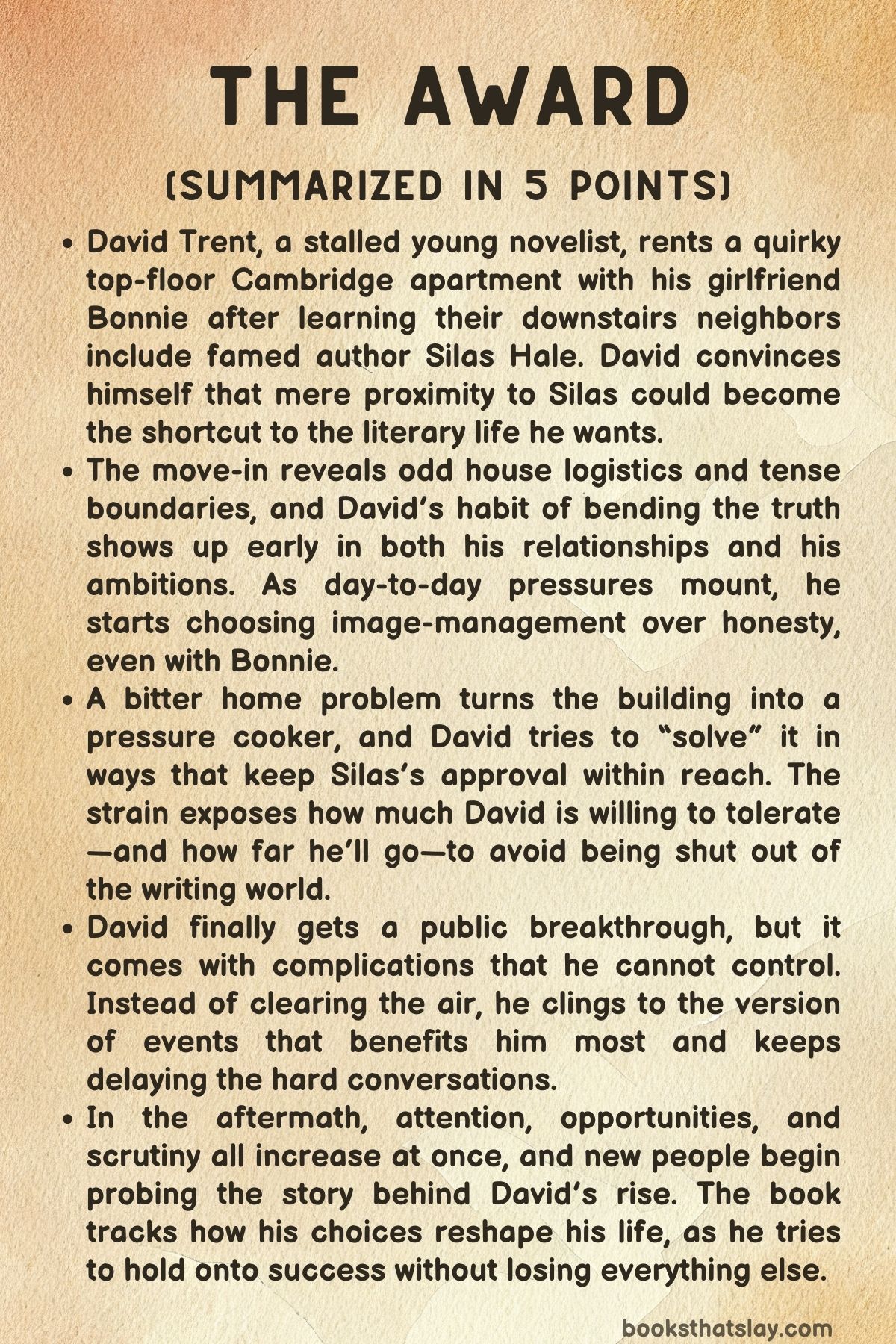
Summary
David Trent is twenty-eight, an MFA graduate who has spent years revising the same debut novel without finishing it. Apartment hunting with his girlfriend, Bonnie, he tours a bright third-floor unit in an old Victorian house at 6 Observatory Hill Road in Cambridge.
The place has a major flaw: the exterior stairs are so narrow and awkward that moving large furniture is nearly impossible. The realtor, Sharon, explains the strange solution—two trapdoors and a crawl space that allow movers to pass bulky items through the house’s interior staircase by temporarily entering the downstairs unit.
Sharon also mentions the building is split into two condo units: the top floor is owned by the Rosfelds and rented out, while the first two floors belong to celebrated novelist Silas Hale and his wife, Rebecca.
The moment David hears Silas Hale’s name, he fixates. Hale is famous, decorated, connected—the kind of writer David has imagined becoming.
David instantly assumes that living under the same roof will open doors: guidance, introductions, and a quicker route to success. Even though the rent is steep and the lease is for two years, David commits on the spot.
Unbeknownst to him, there is a warning note in the paperwork about Hale that Sharon overlooks.
In the weeks before moving, David tries to force himself into productivity. He builds rigid work habits in cafés, policing his routines as if discipline alone can manufacture talent.
His insecurity is longstanding: he worries he lacks the “something” other writers seem to possess. That anxiety is tied to a secret from years earlier.
When a prominent novelist, Melody Bradshaw, failed to send a promised recommendation for David’s MFA applications, David forged one—writing a glowing letter himself under her name and submitting it through a fake email account. He told himself he deserved what he took.
Now, he tells himself again that he is owed a break, and that Silas Hale will be the person who finally confirms it.
On move-in day, Bonnie carefully coordinates the logistics, but the process still requires access to the Hales’ floors. The Hales are away, and Sharon insists the movers be supervised inside the downstairs unit and remove their shoes.
While the movers work, David roams through the Hales’ home and snoops in Silas’s study. He opens drawers, studies scraps of notes, and notices medication—small, intimate details that make Hale feel both real and reachable.
When the movers need the trapdoor system to move furniture through the crawl space, David and Bonnie open it from above and complete the transfer.
Settled in their new apartment, David finally completes a full draft of his novel and begins querying agents. He also proposes to Bonnie with a ring he has hidden away, and she accepts.
For a moment, life feels aligned: a home, a future marriage, and a finished manuscript.
David’s first real interaction with Silas Hale shatters his fantasy. Taking out the trash, David meets Silas and receives not a welcome but a demand: their shared garbage bin is cracked and will “attract rats,” and Silas launches into a fervent rant about rats multiplying.
Wanting to keep things “neighborly,” and still hoping for goodwill, David buys a new bin, even as Bonnie questions why they are paying to satisfy a hostile neighbor.
David begins mapping the neighborhood’s social ecosystem. He befriends Antoinette Saville-Burke, an eccentric older woman across the street who fills her home with candles, performs grand hospitality, and claims deep ties to Cambridge’s literary scene.
She speaks of Silas as if she has influenced him, and she flatters David’s identity as a writer. David also runs into Brandi, a playwright, and Barnaby Masters, an arrogant writer who boasts about having studied under Silas at Harvard and treats Silas like a legend.
David tries to impress them, including by inflating his connection to Silas, and then struggles to backtrack when the lie takes on a life of its own.
Winter exposes a more immediate problem: the third-floor unit has no thermostat. The only thermostat is on the Hales’ second floor and controls heat for the whole building.
The Rosfelds refuse to address it beyond offering homespun suggestions like blankets and hot drinks. The apartment sits near 60 degrees, space heaters trip breakers, and Bonnie starts getting sick.
David sees an opening—he can ask the Hales to turn up the heat, and maybe that conversation can become a bridge to Silas.
When David knocks, Silas theatrically invites him in and dramatically encourages him to adjust the thermostat, even telling him to feel the pipes. But the friendliness turns performative and then cruel.
Silas talks about his own comforts and habits, suggests expensive repairs David should pay for, and finally makes the boundary unmistakable: he is not responsible for David’s comfort, and David is not to speak to or even look at him again. Silas turns the heat back down and ends the encounter by slamming the door.
David returns upstairs rattled, but he lies to Bonnie. He claims there must be a mechanical problem that will be fixed soon.
As days turn into weeks, David keeps lying, buying time in the hope that conflict can be avoided until he secures the professional validation he craves. He learns that if the unit drops below a legal minimum temperature, the Rosfelds could be fined, which might trigger condo-association penalties and provoke Silas.
David delays reporting anything. He convinces Bonnie to stay with her sister for stretches while he endures the cold alone, spending long hours in cafés and pretending he is managing the situation.
Meanwhile, David’s book finally sells to a small but credible imprint, Parable. The publication process is quick and largely out of David’s control, but he is thrilled to see his novel, The Crises, become real.
Bonnie hosts a celebration, yet after the initial moment, the book receives little attention. Reviews are scarce, the buzz is minimal, and David sinks into bitterness.
He becomes more obsessed with the invisible gatekeeping he believes Silas represents.
As another fall arrives, Bonnie demands the truth about the heat. David finally admits there is no repair coming—Silas simply refuses to heat the house the way they need.
Bonnie is furious not only at Silas but at David’s deception. She wants to move and confront the landlords; David refuses, arguing that angering Silas could damage his career.
The fight exposes a core fracture: David values the idea of literary acceptance more than his relationship. Bonnie calls off their engagement and moves out, urging him to leave the house and start over.
Then a letter arrives: David has supposedly won the Boston Literary Prize for Best First Novel, along with $15,250, and past winners include Silas Hale. David announces it widely, convinced it will restore his standing and bring Bonnie back.
Almost immediately, Silas’s attitude changes. Silas acknowledges David, invites him to his exclusive end-of-year party, and speaks to him as if David has become worth noticing—though he still expects David to do chores and accept small humiliations.
The truth arrives in the form of Lee Van Knox, the prize committee head. The award is a mistake: the winning book was a different debut with a similar title—Crisis by Valentina “Leni” Maldenado—and an intern copied the wrong title.
Van Knox asks David to quietly correct the record before the public announcement is fixed, offering only a token consolation. David refuses to accept this collapse.
He stalls, hoping he can force a tie or delay long enough that the correction becomes impossible.
At Silas’s party, David helps with preparations and meets Leni, who is uneasy about the literary scene and suspicious of the ways writers use one another. Van Knox appears at the party, pressing the issue.
Panicked, David flees upstairs. Van Knox follows, and their argument turns physical on the staircase.
David grabs Van Knox’s arm to stop him; Van Knox falls down the stairs and appears to die. David does not call for help.
Instead, he locks his door, drags the body upstairs, and hides it in the crawl space beneath the trapdoor system used for moving furniture. He empties Van Knox’s pockets and convinces himself the problem has been erased.
Bonnie visits briefly, senses David’s life has become colder and stranger, and leaves again without resolution. David tries to remove traces: he finds Van Knox’s bicycle and helmet, rides the bike away, and abandons it in hopes it will disappear.
He retrieves Van Knox’s phone from a coat left downstairs. Soon the Rosfelds inform David that Silas has forced them, through condo leverage and fines, to rent the unit to someone Silas chooses, pushing David out.
As David packs, Silas enters with a key, asserts control, and notices a rug covering the trapdoor. Silas demands David take it.
David rolls up the rug and leaves, and later the housekeeper hears faint sounds near the trapdoor—signs that something is wrong above.
David hides for months in rural New Hampshire, renting a room above a retired couple’s garage. He tries to wait out the danger until a writer-in-residence position in North Carolina funded by the prize money.
Then news breaks: a body has been found in a private Cambridge residence. Detective Braddox calls, and David carefully shapes his story—he met Van Knox only briefly, last saw him at the party, and moved away soon after.
Not long later, David hears that Silas Hale has been arrested for murder. The preserved cold of the crawl space and rat damage have ruined evidence, and the investigation focuses on Silas’s history of abuse and witnesses who heard party conflict.
David gives a cautious statement to prosecutors, minimizing anything that points toward himself. Yet the danger does not end.
Silas contacts David from jail and forces a meeting. In a private room, Silas tries to recruit David into proving someone else committed the crime.
He theorizes about coats, a ringing phone, and a timeline that frames David. The conversation escalates into violence—Silas attacks David—until Silas suffers a medical crisis.
David hesitates before calling for help. Silas later dies after further complications.
With Silas dead, the criminal case collapses, and David’s public career unexpectedly surges. His book is reissued, publicity expands, and Bonnie returns, attempting a cautious reconciliation.
But another threat rises: Barnaby Masters is assigned to profile David for Vanity Fair. Barnaby presents himself as friendly while signaling he has investigated David’s past.
He interviews people from David’s MFA life and dredges up the forged recommendation incident, trying to crack David’s composure.
David also faces pressure from Leni, now working at an insurance company investigating whether Silas’s death affects his life insurance payout. She believes Van Knox may have died the night of the party from an allergic reaction—possibly triggered by kiwi in champagne she served him—and fears she helped cause the death.
She has found hints that the official timeline may be wrong, but the damaged postmortem prevents certainty. She worries Barnaby’s digging will expose her and considers going to the police.
David urges her not to, and he decides to “handle” Barnaby.
David breaks into Leni’s workplace to access newly acquired materials connected to Silas, including notebooks and Post-it notes. He finds writing that points toward him—mentions of a phone, coats, and David’s name—and he destroys the most incriminating pages.
To buy time, he manipulates Leni’s travel plans to delay her return, then arranges a secret meeting with Barnaby on a footbridge, intending to kill him. Barnaby arrives with a photographer, blocking the attempt, and tells David he believes David killed Van Knox.
Barnaby claims he has pieced together a revised timeline using Bonnie’s old temperature records that could explain how the body stayed preserved.
David expects the Vanity Fair article to ruin him and flees by train, spiraling into panic. When he finally sees the magazine, he is stunned: the profile is flattering and avoids the accusation.
Barnaby sends word that the article is a “peace offering,” but the unspoken message is clear—Barnaby can still destroy David whenever he chooses.
David’s career climbs higher. Rebecca Hale recommends him for a prestigious paid role tied to Silas’s legacy at The New Yorker, giving David influence and access.
At a New York gala, Barnaby reveals what he actually wants: David must give Barnaby’s fiction a real chance at the magazine. It is a bargain built on mutual threat—Barnaby holds David’s secret, and David now holds Barnaby’s professional ambition.
Time passes, and the world reshapes itself around David’s success. Leni prepares to leave the literary scene and relocate, insisting she is done writing and wants distance from a culture she believes feeds on people.
Cambridge moves on; Observatory Hill hosts ordinary celebrations again. David signs a copy of his book for Leni, but the moment does not feel like closure.
He remains haunted by what he has done, by what others suspect, and by the knowledge that another Barnaby could always appear—someone ready to turn his carefully constructed life into evidence.
Characters
David Trent
In The Award by Matthew Pearl, David Trent is a portrait of ambition turning feral—an anxious, status-hungry MFA graduate who believes proximity to greatness can substitute for greatness itself. His defining trait is not talent or discipline so much as a volatile need to be chosen, and that need quietly licenses his worst behavior: he lies reflexively, manipulates people who love him, and interprets every social interaction as a rung on a ladder.
Even before the central crime, David’s moral baseline is already compromised—he forges a recommendation letter early in his career and later treats that transgression as proof of his entitlement rather than a warning sign. Living beneath Silas Hale becomes the perfect incubator for David’s obsession because it allows him to confuse literature with hierarchy: the “literary world” becomes, in his mind, a gated neighborhood controlled by one man, and David’s choices increasingly serve access, not art.
When the mistaken prize is dangled in front of him, the novel shows how quickly he converts luck into destiny and destiny into justification, culminating in the moment he chooses concealment over secrecy over accountability, and control over humanity. Yet David is not written as a simple villain; he is also frightened, self-pitying, and painfully self-aware in flashes, which makes his later success feel less like triumph than like contamination—fame doesn’t redeem him, it professionalizes his capacity to perform innocence while privately nursing dread.
Bonnie
Bonnie is the story’s emotional reality-check, the character most anchored in ordinary ethics and ordinary needs, which is exactly why David’s deceptions around her read as both intimate and catastrophic. She begins as a practical partner—organizing the move, planning logistics, imagining a shared future—and she treats David’s writing dream with real generosity until she realizes his dream has turned into a system where she is expected to endure discomfort and dishonesty as proof of loyalty.
The freezing apartment becomes more than a housing problem for Bonnie; it becomes the physical manifestation of David’s priorities, because he allows her health and comfort to be subordinated to his fear of displeasing Silas and his hunger for literary legitimacy. When she calls off the engagement and leaves, it isn’t impulsive melodrama but a boundary drawn against a pattern: David’s willingness to rewrite reality, gaslight her perceptions, and keep her in the dark “for their future.” Her later return is complicated rather than purely romantic—she is drawn back by affection and by the public narrative of David’s ascent, but she also becomes, unintentionally, a lever Barnaby can pull and a source of evidence that threatens David’s secrets.
By the end, Bonnie represents the unsettling possibility that love can survive betrayal without resolving it, and that reconciliation can exist alongside the quiet suspicion that the person you came back to is still hiding the most important truth.
Silas Hale
Silas Hale is fame as pathology: a celebrated novelist whose public stature masks a private world organized around dominance, grievance, and control. He weaponizes petty rules—trash bins, shoe removal, condo regulations, heat—to remind others that the house is his kingdom and everyone else is trespassing.
What makes Silas especially frightening is how effortlessly he performs different registers of power: he can be theatrically hospitable one second and explosively cruel the next, as if kindness is just another costume he can wear to disorient people. He embodies the older literary gatekeeping model that David both worships and fears, and the book uses Silas to expose how cultural prestige can protect abusive behavior, because so many people accept his rudeness as “genius” and his tantrums as “temperament.” His fixation on rats is more than eccentricity; it reflects his worldview—paranoia about contamination, obsession with invasion, disgust at the unwashed masses creeping toward his resources.
Yet Silas is not merely a monster dropped into the plot; he is also a mirror for David, showing what David might become if success cements rather than softens his worst traits. Even Silas’s death doesn’t feel like closure, because the system of intimidation he represents survives him—his notes, his reputation, and his gravitational pull continue to shape choices long after he’s gone.
Rebecca Hale
Rebecca Hale is the quiet center of the Hale household, but “quiet” in this book rarely means powerless; it often means strategic. She lives beside Silas’s eruptions and reputational violence, absorbing the costs and learning how to survive within the blast radius of a famous man.
Unlike David, who romanticizes literary power, Rebecca treats it as infrastructure—something that can be leveraged for protection, money, and future positioning. Her interest in the life insurance investigation reveals a pragmatic, almost corporate strain beneath the artistic setting, and it underlines how marriage to genius can become a financial trap as much as an emotional one.
Rebecca’s conversations carry an unsettling duality: she can sound confessional about Silas’s cruelty while also sounding like someone calculating what information is safe to share and what alliances are worth cultivating. When she later elevates David into an honorary editorial role, the gesture reads less like benevolence and more like the continuation of a household tradition—power is transferred to whoever can maintain the narrative and keep inconvenient truths buried.
Rebecca becomes, in effect, a bridge between old literary aristocracy and David’s new celebrity, suggesting that the culture that enabled Silas is adaptable enough to adopt David, even if David’s success is built on rot.
Sharon
Sharon, the realtor, functions as the story’s accidental gatekeeper—the person who opens the literal door to Observatory Hill and unknowingly facilitates the chain of obsession and catastrophe. She is presented as brisk and procedural, motivated by the mechanics of renting rather than the myth of literature, which makes her missed warning about Hale feel grimly symbolic: institutions often have “notes” and “policies,” but they still fail in the moment that matters because the person executing them is distracted, rushed, or underpaid.
Sharon’s role also emphasizes how danger can be normalized through routine; the trapdoors, the bizarre moving route, the “warn tenants” instruction—these are structural oddities that everyone treats as manageable quirks until they become the architecture of concealment. She isn’t malicious, but she is part of a world where real estate transactions ignore the human hazards embedded in a building’s social ecosystem, and the book uses her to show how easily people are placed into harm’s way by bureaucratic oversight.
Antoinette Saville-Burke
Antoinette is the neighborhood’s self-appointed oracle, a flamboyant admirer of writers who turns literary fame into a kind of local religion. Her candle-filled home and sweeping claims about knowing everyone important position her as both comic and unsettling, because her adoration is less about art than about proximity—she is a parallel version of David, older and more socially disguised, still feeding on association with celebrated names.
Antoinette’s most significant function is informational: she becomes a witness who can distort or amplify narratives, and her later remark that David seemed “unusually distracted” shows how such characters can turn into unpredictable conduits for suspicion. She embodies the way cultural communities generate their own folklore, where anecdotes become evidence and personality becomes testimony.
Antoinette’s “muse” identity also exposes a predatory underside to literary worship: the desire to matter to greatness can become invasive, self-mythologizing, and blind to the harm greatness causes.
Brandi
Brandi, the playwright, is a sharp instrument in the social ecosystem—someone who punctures pretension, provokes insecurity, and reads status games quickly. Her early needling of David reveals that she understands the long novel-in-progress as both artistic struggle and personal stalling, and David’s lie about being mentored by Silas is crafted specifically to impress and dominate her in that moment.
Brandi’s later reappearances show a different kind of survival in the arts: she networks, attends dinners, trades information, and adapts to the same hierarchy David obsesses over, but she does it with a more cynical clarity. Importantly, she becomes a channel through which Barnaby’s investigation spreads, demonstrating how people on the periphery of fame can become secondary narrators—recounting, interpreting, and weaponizing the stories of those closer to the spotlight.
Brandi isn’t portrayed as purely loyal or purely opportunistic; she’s socially intelligent, wary, and capable of kindness, but she lives in a world where conversation is currency, and she spends it accordingly.
Barnaby Masters
Barnaby is the novel’s most modern predator: not the old-school tyrant like Silas, but the investigative storyteller who understands that narrative control is its own form of coercion. He moves through the literary world as both participant and prosecutor, cultivating an image of sophistication while collecting dossiers, recordings, and private contradictions.
What makes Barnaby terrifying is that he doesn’t need legal authority to punish; his weapon is exposure, and his stage is prestige media. He alternates warmth and cruelty to destabilize David, mirroring Silas’s volatility in a different key, and he frames his pursuit as journalism and truth-seeking while also relishing dominance—he wants David’s fear as much as he wants the story.
Barnaby’s encounter with Melody demonstrates his methodology: he manufactures confrontations, forces emotional reactions, and treats other people’s vulnerabilities as raw material. Yet Barnaby is not a moral hero; his “peace offering” Vanity Fair piece reveals that he can choose restraint not out of compassion but out of strategy, converting his knowledge into a long-term leash.
By the end, Barnaby represents the idea that in a culture built on reputation, the person who edits the story can rule the person who lived it.
Melody Bradshaw
Melody is a haunting figure in David’s backstory because she is both the victim of his early deception and, paradoxically, the person whose disorganization helps him rationalize it. When she fails to send the recommendation, David interprets her negligence as permission to commit fraud, and the fact that he later sees her and feels entitled rather than guilty shows how deeply he confuses desire with merit.
In the later confrontation, Melody’s response complicates the moral arithmetic: she is moved by the letter, recognizes herself in it, and expresses gratitude that she “helped” him, even though she didn’t write it. This reaction doesn’t absolve David; instead, it reveals how narratives can rewrite wrongdoing into destiny when the audience wants a satisfying story.
Melody represents the messy human reality behind institutional gatekeeping—professors and famous writers aren’t always diligent, and that imperfection creates openings that ambitious people exploit. She also shows how forgiveness and validation can be accidentally granted in ways that empower the wrong person, reinforcing David’s belief that he can manufacture legitimacy and still be embraced.
Lee Van Knox
Lee Van Knox is the plot’s fulcrum and the book’s symbol of institutional authority—head of the prize committee, guardian of rules, and the person whose correction threatens David’s newly inflated identity. His power is procedural rather than charismatic; he isn’t a celebrity like Silas, but he represents the machinery that decides who gets lauded, funded, and remembered.
That is precisely why David experiences him as an existential threat: Van Knox can remove the award, and thus remove the future David has already started living inside his mind. In the party confrontation, Van Knox’s insistence on correcting the mistake reads as ethically straightforward, but it becomes emotionally combustible because it collides with David’s desperation and Silas’s cultivated culture of intimidation.
After his death, Van Knox becomes a blank screen for other people’s stories—Silas is accused, Leni confesses guilt, Barnaby reconstructs timelines, and David treats the body as a problem to manage. The tragedy is that Van Knox’s individuality is swallowed by the narratives built around him, which aligns with the novel’s darker claim: in prestige-driven worlds, even a dead man can be reduced to a lever, a scandal, or a chapter in someone else’s rise.
Detective Braddox
Detective Braddox is the procedural pressure that cracks David’s fantasy bubble, introducing the ordinary weight of law into a world David prefers to see as gossip and influence. Braddox doesn’t need melodrama; his calm questions are enough to trigger David’s spirals because they force David to measure his story against external reality.
He represents the kind of authority that does not care about literary mythos, only timelines, access, and contradictions. Even when David “passes” the phone call, the detective’s presence remains as a psychological infection—proof that truth is not negotiable forever and that secrets attract attention precisely because they require maintenance.
ADA Christine Horvack
Christine Horvack functions as the state’s voice of boundaries and choices, a character who speaks in the language of risk assessment rather than emotion. Her interactions with David are chillingly professional, and that professionalism highlights how the legal system offers options that still feel coercive: David is told it’s his “choice” to communicate with Silas, but every option carries potential consequences he can’t fully see.
Christine also provides insight into Silas’s courtroom behavior and deteriorating situation, underscoring that Silas’s arrogance is self-destructive even when it would serve him to perform humility. In a story filled with performative writers, Christine stands out as someone whose power comes from procedure and whose words are measured, which makes David’s continued evasions around her feel even more reckless.
Paula
Paula, the housekeeper, occupies a crucial moral and sensory position in the house: she is the one who hears the building, notices disturbances, and lives in the physical reality that the writers try to aestheticize or ignore. Her eventual hearing of faint bumps near the trapdoor is one of the book’s most unnerving moments because it suggests consequences continuing without the characters’ permission—something living or shifting above her, the house itself refusing to stay silent.
Paula represents the labor that keeps the famous functional and the way such workers often become inadvertent witnesses to private horror. She is also a reminder that class and access shape who is believed: her perceptions matter enormously, yet the social world around Silas tends to treat people like Paula as background until they become useful to an investigation.
Barbara Steadman
Barbara Steadman embodies the possibility of ordinary decency in a novel crowded with transactional relationships. She provides David with food, warmth, and quiet care without asking for literary access or social leverage, which creates a stark contrast to Cambridge’s prestige economy.
Her kindness doesn’t redeem David, but it tests him by placing him in an environment where he can’t easily claim victimhood—he is being helped, and yet he continues to hide, distort, and obsess. Barbara’s presence emphasizes that compassion can exist alongside wrongdoing without curing it, and that sometimes the most unsettling thing is not cruelty but the ease with which a guilty person can be sheltered by people who mean well.
Stan Steadman
Stan Steadman complements Barbara as a steady, practical figure whose support is expressed through tools, space, and quiet permission rather than intimacy. By lending the pickup and maintaining a low-pressure environment, he enables David’s concealment while also modeling a masculinity not built on dominance or acclaim.
Stan’s role underscores how David’s crisis is not only legal but existential: placed near people who don’t care about literary status, David has no audience to impress, yet he cannot stop performing a version of himself that avoids accountability.
Jace
Jace is David’s connective tissue to the outside world, the friend who delivers key information and facilitates movement when David is too panicked to function alone. He is not deeply foregrounded, but his presence matters because he treats the unfolding scandal as news and logistics rather than as David’s private epic.
By driving David and helping him navigate moments of institutional scrutiny, Jace unintentionally supports David’s strategy of seeming “normal.” He represents the way friendships can become instruments for self-preservation when one party is hiding something enormous, and how the friend may never realize they are participating in a cover story simply by being helpful.
Valentina “Leni” Maldenado
Leni is the novel’s most painful counterfactual: the person who “should” have received the prize and, in a fair world, the person whose career arc would mirror David’s—publication, recognition, opportunity. Instead, she becomes both rival and reluctant confessor, someone whose cynicism about literary culture comes from feeling used by it and seeing how quickly praise becomes extraction.
Her reading from Crisis reveals a rare artistic confidence in the story—she can command a room without mythmaking—yet she also announces she will stop writing, which frames her talent as something the system has burned out rather than nurtured. Leni’s belief that she caused Van Knox’s death introduces an alternative moral tragedy: she is tormented by guilt without certainty, while David is guilty of concrete actions and still tries to manage outcomes.
Her job at Colony Mutual places her at the intersection of narrative and evidence, showing how institutions outside literature—insurance, corporate investigations—can become the arenas where truth is weighed when courts fail to resolve it. Leni’s final desire to flee the literary world is both indictment and survival strategy, and her last exchange with David—asking him to sign his book—lands with dread because it suggests she may carry away the one artifact that symbolizes how injustice can be packaged as success.
Themes
Ambition that turns into self-erasure
David’s desire to become a legitimate, admired writer starts as a private struggle—years of revision, coffee-shop rituals, and constant comparison to peers who seem more naturally gifted. Once he learns that Silas Hale lives below him, the ambition stops being a long-term craft goal and becomes an immediate strategy: proximity is treated like a shortcut to status.
That shift matters because it changes what David is willing to sacrifice. He signs an expensive lease impulsively, frames his life decisions around what might impress Hale, and measures his worth by access to a gatekeeper rather than by the work itself.
The damage is not only practical but psychological. David begins acting as though his own identity is provisional until validated by someone famous.
He lies to acquaintances about mentorship because the image of being “chosen” feels more important than the truth of being unknown. He even lies to Bonnie about the heat, because admitting the full reality would force him to confront that living under Hale is not a career investment but a humiliating trap.
The theme intensifies when The Award shows how ambition can hollow out a person’s normal moral reactions. David’s early ethical breach with the forged recommendation letter is a warning sign: he already believes success can justify fraud if it feels like correcting an unfair system.
Later, when the prize mistake happens, he initially has a clean exit—tell the truth, accept embarrassment, move on. Instead he clings to the public fantasy that he has finally arrived, and that fantasy becomes more real to him than the person he is harming.
By the time Lee Van Knox falls, David’s ambition has mutated into a survival instinct for his story about himself. What looks like striving becomes a refusal to be ordinary, even if it requires destroying relationships, rewriting reality, and living inside a permanent performance.
Power as social control and ritual humiliation
Silas Hale’s power is not expressed primarily through generosity or mentorship but through control, unpredictability, and the ability to make other people compete for crumbs. His celebrity gives him a protective aura: people in the community treat him like a sacred figure, excuse his cruelty as “temperament,” and build myths that justify their own deference.
The thermostat becomes the clearest symbol of this power, because it is mundane yet absolute. Silas doesn’t need to shout in public to dominate David; he can simply keep the house cold and force David into pleading, bargaining, and self-censorship.
The cruelty is sharpened by the legal structure—condo ownership, landlord loopholes, minimal tenant protection in this specific setup—because it allows Silas to frame suffering as “not my responsibility,” while still being the direct cause. That combination makes the power feel both personal and untouchable.
Silas also turns social events into tests of submission. The party is presented as a coveted entry point to the literary world, yet attendance comes with a fee and invisible rules.
“Insulators” pay, serve, and absorb insults, while the elite mingle and watch. David’s chores—trash, snow, compliance—become an initiation rite, a way to keep him in a servant role while letting him believe he is “close.” Even jail does not fully remove Silas’s influence; he still tries to command David, and the private meeting room suggests institutions can bend around prestige.
The Award uses Silas to show how power often works less like force and more like choreography: everyone learns their position, repeats the rituals, and punishes anyone who threatens the story that the powerful person deserves their pedestal. When Silas is arrested, the same community that tolerated him reinterprets old evidence, not necessarily because they discovered new morality but because the power structure finally permits condemnation.
The theme exposes a grim truth: social worlds often don’t correct abuse until it becomes safe to do so.
Complicity and the comfort of looking away
The story repeatedly shows how many people enable harm without committing it directly. Realtors have warning notes that can be missed, landlords hide behind minimal obligations, neighbors gossip but don’t intervene, and literary insiders treat cruelty as eccentricity until it becomes scandal.
Bonnie is not complicit in David’s crimes, but she becomes a casualty of the same social pressure that tells David not to “anger” Silas. Her initial willingness to tolerate discomfort is shaped by trust in David and by the belief that the situation is temporary, which makes David’s manipulation especially corrosive.
Brandi and Barnaby represent another kind of complicity: they trade in information, using personal lives as material. Their actions are framed as professional curiosity or networking, yet they participate in a culture where privacy is negotiable and where people are treated as content.
Leni’s role complicates the theme further. She believes she may have triggered Van Knox’s death with kiwi champagne, and even though uncertainty remains, her fear leads her to investigate insurance files for personal reasons.
That is not villainy; it is panic-driven self-protection, mirroring David’s own pattern. Even Rebecca Hale’s behavior sits in moral grayness: she survives Silas’s cruelty, yet she also benefits from the structures around him, and later she helps place David into a prestigious role, perhaps because she wants stability, perhaps because she wants influence, perhaps because she recognizes how the world works.
The theme lands on a bleak observation: systems persist because people find reasons to tolerate them. Everyone has a story for why they cannot act—legal limits, social risk, financial dependence, career aspiration, exhaustion.
Those reasons are often real, but the accumulation of them creates an environment where abuse and deception can flourish. The Award does not present complicity as a single moral failure; it presents it as a social comfort.
Looking away is easier than confronting the costs of seeing clearly. In that kind of environment, the person who is willing to manipulate narratives gains advantage, while the person who insists on transparency pays immediate penalties.
David’s eventual success, despite what he has done, is the most brutal confirmation of this theme: the world is not structured to reward moral clarity. It is structured to reward the ability to remain plausible, to keep performing, and to ensure that if the truth surfaces, it harms someone else first.