The Bee Sting Summary, Characters and Themes
The Bee Sting by Paul Murray is a sprawling novel set in a small Irish town, capturing the fragile bonds of family, friendship, and identity during a time of social and economic upheaval. At its heart, the book follows the Barnes family—parents Dickie and Imelda, and their children Cass and PJ—each of whom faces a personal crisis as their lives unravel.
From teenage friendships full of yearning and betrayal, to the quiet collapse of a marriage under financial strain, and the weight of past secrets, Murray crafts a deeply layered story about love, loss, survival, and the lingering effects of choices made years ago.
Summary
The story opens with a shocking murder-suicide in a neighboring town, sparking gossip and rumors of hidden lives. Against this backdrop, Cass, a teenager, navigates her days with her charismatic best friend Elaine.
The two girls share croissants, mock their dull hometown, and dream of escaping to a brighter future. Elaine is bold and glamorous, drawing attention from both classmates and Cass’s mother, Imelda, leaving Cass both enthralled and jealous.
Their bond feels inseparable, but as the family dealership run by Cass’s father Dickie falters during Ireland’s financial crash, cracks begin to show in both family and friendship.
Cass and Elaine become fascinated by their English teacher, Miss Grehan, whose tales of poets inspire them to see writing as a path to truth. Elaine shifts her ambitions from beauty pageants to poetry, while Cass admires from the sidelines.
When Cass secretly reads Miss Grehan’s chapbook, she is disturbed by its raw imagery and hides it. Later, Cass betrays her friend by exposing the book to school authorities, causing Miss Grehan’s abrupt disappearance.
Elaine is devastated, and their friendship begins to fracture, further strained by rivalries, boys, and the pressure of exams.
Cass experiments with romance through Rowan, a boy she kisses often but does not truly like. Rowan is suspicious of Elaine and tries to isolate Cass, but Cass clings to her friend.
Meanwhile, a striking Polish mechanic, Richard, enters their orbit. His presence adds tension as Elaine and Cass both respond to him in different ways.
On the last day of school, Richard lures the girls into reckless behavior, which ends in a bizarre encounter where he pressures them into kissing. Instead of yielding, they laugh at him, reaffirming their strange, intense bond.
At home, the Barnes family’s decline deepens. Imelda struggles to maintain appearances while seething at Dickie’s failures as a salesman.
Their fights escalate, their house deteriorates, and even their handyman Victor notes the collapsing infrastructure of pipes and sewers—an ominous mirror of the family itself. Cass’s younger brother PJ retreats into childhood games and video fantasies, fearful of being sent away and wary of his parents’ growing instability.
Meanwhile, Dickie begins building a secret survivalist shelter in the woods with Victor and PJ, describing it as a retreat but also preparing for imagined disasters. For him, it becomes a project of bonding with his son, even as Imelda is horrified by his exposing PJ to guns and violence.
Imelda herself carries the weight of suspicions—her father-in-law Maurice hints at Dickie’s financial misconduct, and whispers of betrayal hover around them. She visits her frail relative Rose in a care facility, who mutters cryptic warnings about curses and insists that Cass must not return home.
The narrative also reveals Dickie’s past at Trinity College. As a young man, he struggled to fit in with Dublin’s elite.
Drawn into the orbit of the flamboyant Willie Laughton, he experienced both fascination and humiliation. A night out ended in trauma when a drunken encounter with a closeted GAA player turned violent and abusive, leaving Dickie scarred and paranoid.
This memory haunts him decades later, influencing his withdrawn and fractured life.
As Cass prepares to leave for college in Dublin, she mocks her father’s attempts to reconnect, undercutting his stories with disdain. Their farewell visit to Trinity only highlights the gulf between them.
Cass, though excited by her new independence, remains tangled in her complicated friendship with Elaine. In Dublin, she throws herself into college parties, drinking, and a desperate need for Elaine’s attention.
But Elaine grows impatient with her clinginess, leaving Cass spiraling with insecurity.
At a chaotic party, Cass’s younger brother PJ suddenly appears, having lied about a sleepover to come to Dublin. Embarrassed, Cass lashes out and throws him out, but later regrets it when she realizes he may be in danger.
PJ, lost in the city, wanders through unfamiliar streets, nearly entrapped by sinister strangers before finding refuge in a game shop. Cass eventually finds him, subdued and withdrawn, and rides the bus home with him.
The siblings share a quiet moment of fragile reconciliation, both weighed down by their family’s decline.
Meanwhile, Imelda is torn between passion and scandal. Rumors swirl about Mike, a man she is drawn to, and his supposed illegitimate child.
At the same time, her aunt Rose suffers a stroke, and Imelda is confronted by her estranged brother Lar, who reveals grim family secrets and the abusive history of their father. These revelations deepen Imelda’s sense of being cursed, trapped between past betrayals and present crises.
Dickie’s troubles come to a head as he faces pressure from a threatening man named Ryszard. With Victor urging violent confrontation, Dickie wrestles with guilt and fear, questioning whether he can cross the line into violence or whether it will destroy him forever.
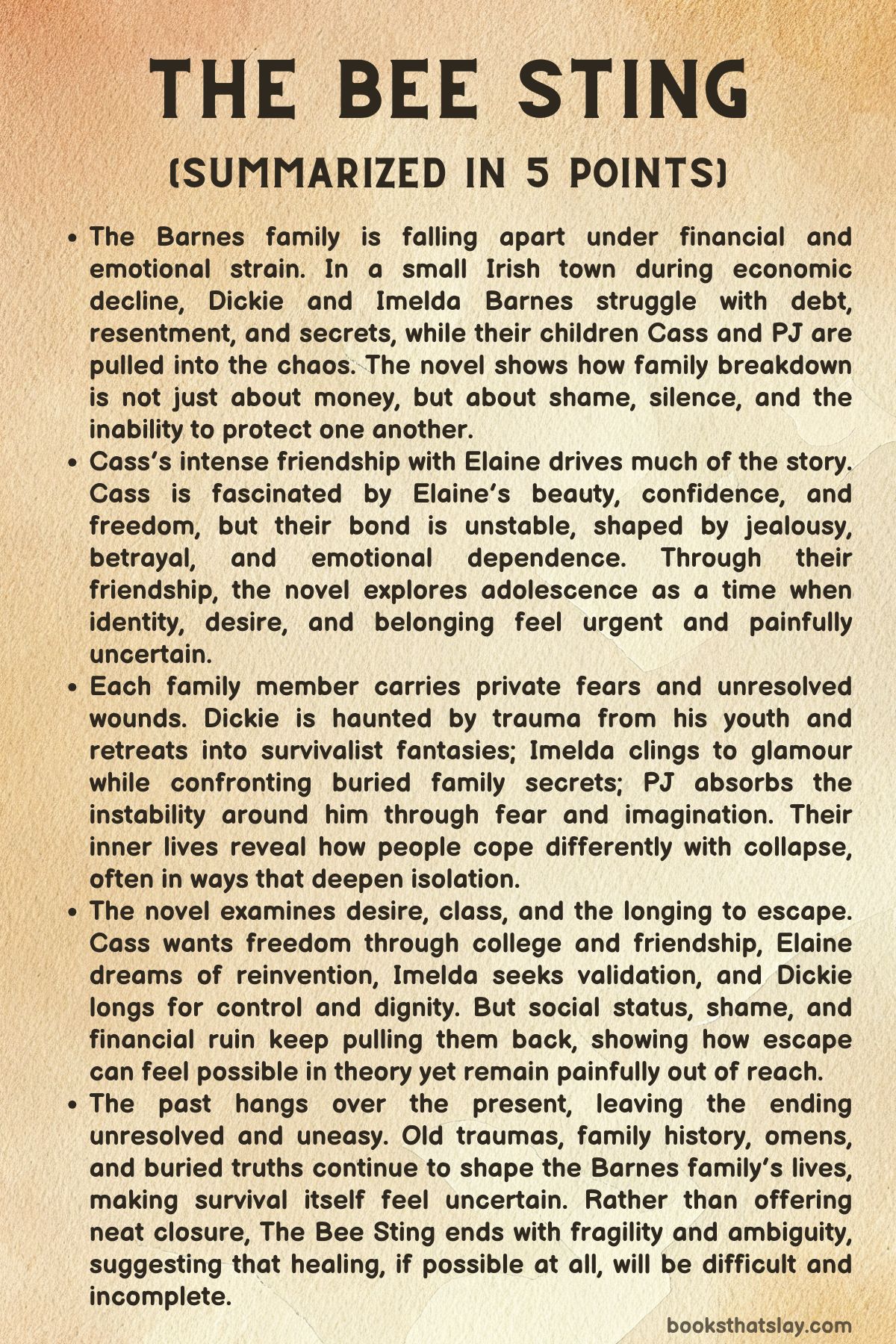
By the close, the family remains fractured, each member facing their own burden: Cass torn between friendship, failure, and longing; PJ consumed by fear and fantasies of survival; Imelda lost in suspicion, betrayal, and desire; and Dickie weighed down by debt, shame, and the ghosts of his past. Though bound together by family ties, their lives are filled with unresolved conflicts, secrets, and unspoken wounds.
The novel ends with uncertainty rather than resolution. Cass returns home from Dublin with PJ, reflecting on her failures but also considering new beginnings.
The Barnes family, like the infrastructure Victor warns about, strains under unbearable pressure. The sense is that the future remains precarious, with survival itself—emotional, moral, and physical—hanging in the balance.
Characters
Cass
Cass is the emotional core of The Bee Sting, a teenager caught between the collapse of her family and the instability of her closest friendship. Her character is defined by longing—longing for Elaine’s approval, for escape from her town, and for a sense of self beyond the chaos surrounding her.
Her deep infatuation with Elaine borders on obsession, reflecting both adolescent intensity and a fragile search for identity. Cass is clever, self-aware, and often cynical, but this sharpness hides a deep vulnerability.
She oscillates between hope and despair, yearning for college and independence while weighed down by her father’s financial ruin and her family’s dysfunction. Her relationships with Rowan and Richard show her fumbling attempts to define her sexuality and worth, though neither offers the depth she craves.
Ultimately, Cass embodies the fragility of adolescence, where friendships feel like lifelines, betrayal cuts deeply, and the future seems both terrifying and full of possibility.
Elaine
Elaine is Cass’s charismatic best friend, dazzling in her confidence and magnetic in her presence. Beautiful, bold, and restless, she symbolizes escape and rebellion in a town that feels suffocating.
Her charm attracts not only Cass but also adults like Imelda, who find in her a glamorous reflection of themselves. Elaine’s dreams evolve—from beauty pageants to poetry to a reckless pursuit of independence—but what remains constant is her hunger for freedom.
Beneath her allure, however, is a streak of cruelty and carelessness. She flirts with danger, manipulates situations, and at times mocks Cass, yet she also offers moments of profound loyalty and intimacy.
Elaine represents both the intoxicating thrill and the peril of adolescence—her wildness inspiring Cass but also threatening to leave her behind.
Imelda
Imelda, Cass’s mother, is a complex figure whose glamour and vanity mask deep insecurities and disappointments. Once accustomed to a lavish lifestyle, she struggles with the family’s financial decline, clinging to appearances while her household fractures.
Her bond with Elaine highlights her need for admiration and her fraught relationship with her daughter, who constantly feels overshadowed. Yet Imelda is more than shallow vanity; her visits to Rose reveal her desperation, confusion, and entrapment in a marriage weighed down by secrets.
She is torn between desire, loyalty, and fear, caught in webs of family betrayal and her own longing for validation. Imelda’s character captures the disillusionment of adulthood, the collapse of illusions, and the inability to reconcile past glamour with present ruin.
Dickie
Dickie, Cass’s father, is a man crushed by failures both past and present. Once a student at Trinity, his attempts to belong ended in trauma and shame, leaving scars that haunt him throughout life.
In the present, he is a poor businessman, unable to adapt to Ireland’s economic collapse, and constantly compared to more successful figures like Big Mike. His retreat into survivalist fantasies with PJ and Victor reflects both a desperate need for control and an escape from unbearable reality.
Dickie’s tenderness occasionally shines through—his efforts to connect with Cass, his bond with PJ—but he is too broken, too consumed by guilt and fear, to bridge the gaps in his family. His character reveals how past traumas can cripple the present, leaving a man paralyzed between shame, duty, and a yearning for redemption that never comes.
PJ
PJ, Cass’s younger brother, represents innocence under siege. Sensitive, anxious, and imaginative, he is overwhelmed by his parents’ fighting and the instability of his home.
His deception to reach Dublin underscores both his resourcefulness and his desperation for connection, particularly with Cass. His vulnerability—blisters on his feet, his asthma, his paranoia—contrasts with the rough, careless world around him.
Yet PJ is also perceptive, able to sense the fractures in his family and the dangers that lurk unspoken. He yearns for safety but is pulled into his father’s apocalyptic projects, learning survival skills as though the collapse of their world is inevitable.
PJ’s journey reflects the confusion of childhood in the face of adult failures, where survival becomes both literal and emotional.
Victor
Victor McHugh is an unsettling presence, a figure of survivalist wisdom who draws Dickie and PJ deeper into fantasies of collapse. He embodies practicality, teaching them how to dig wells, hunt squirrels, and prepare for disaster, but beneath this pragmatism lies a darker pull.
He thrives on secrecy, on the illusion of control through survival, and in doing so exacerbates Dickie’s retreat from reality. For PJ, he is both a mentor and a corrupter, exposing him to guns and the harshness of survivalist thinking.
Victor’s influence sharpens the family’s sense of impending doom, making him less a savior than a catalyst for further disintegration.
Rose
Rose, the elderly relative in the care facility, serves as a spectral voice of memory and omen. Her mind drifts between lucidity and delusion, but in her fragmented speech lie warnings, secrets, and echoes of the family’s past.
She embodies the weight of history and generational trauma, muttering about curses, ghosts, and betrayals. To Imelda, Rose is both a source of torment and a figure of truth, though her messages are always ambiguous.
Her confusion—mixing names, recalling weddings, and shouting about Cass’s fate—creates an atmosphere of dread and inevitability. Rose symbolizes the persistence of the past in haunting the present, a reminder that the Barnes family’s struggles are rooted in deeper, older wounds.
Themes
Friendship and Obsession
The relationship between Cass and Elaine lies at the heart of The Bee Sting, capturing the intensity, beauty, and volatility of teenage friendship. Cass’s admiration for Elaine borders on obsession, as she measures her own worth through Elaine’s beauty, confidence, and charisma.
This imbalance highlights the fragility of friendships built on unequal dynamics, where one friend holds power by embodying everything the other desires to be. Elaine thrives on attention and reinvention, constantly shifting her ambitions from beauty pageants to poetry to wild escapades, while Cass struggles to anchor herself in her friend’s whirlwind.
Their bond oscillates between fierce loyalty and subtle betrayals—Cass hiding the chapbook, Elaine mocking Cass in front of others, both girls drifting toward rival companions. Yet, despite these fractures, their connection remains magnetic, pulling them together in moments of shared laughter, reckless freedom, and whispered promises of escape.
The novel portrays how adolescent friendships can simultaneously nurture and wound, offering a sense of belonging while fostering insecurity. Ultimately, Cass’s fixation on Elaine mirrors her broader yearning for transformation: the desire to leave behind the limitations of her family and town.
The friendship becomes a testing ground for identity, sexuality, and self-worth, illustrating how the bonds of youth can be both sustaining and destructive, and how obsession can blur the line between love, dependence, and fear of abandonment.
Family Breakdown and Inheritance of Failure
The Barnes family embodies the collapse of both personal and societal structures in post-crash Ireland. Dickie’s failing car dealership, Imelda’s desperation to maintain status, and the children’s flailing attempts to find stability all underscore how fragile the family has become.
Financial ruin is not just economic but emotional, corroding trust and intensifying conflict. The past looms heavily: Imelda haunted by her father-in-law’s suspicions and the suggestion of curses, Dickie scarred by his violent encounter in college and sidelined by his own family business, Cass humiliated by her parents’ decline, and PJ overwhelmed by secrecy and fear.
The motif of construction—Dickie and PJ’s “shelter” and the massive well they dig—becomes an image of futile resistance against inevitable collapse, a literal descent into the ground as the family tries to shore itself against disaster. Yet, these acts of survivalism are also attempts at connection, as Dickie clings to PJ in a way he fails with Cass.
The intergenerational weight of failure becomes inescapable: Rose’s dementia mixes memory with omens, Maurice’s guilt poisons his son’s attempts at agency, and the children inherit instability rather than guidance. The family’s breakdown reflects a broader theme of decline, where old certainties—economic stability, marriage, respectability—are swept away, leaving only fractured bonds and unspoken resentments.
Sexuality, Desire, and Shame
Sexual identity and desire permeate the narrative, often entangled with secrecy and shame. Cass’s ambiguous feelings for Elaine suggest a desire she cannot fully articulate, masked by jokes, admiration, and dependence.
Their kiss under Richard’s manipulation reveals how suppressed emotions surface in chaotic and unexpected ways, transforming a moment of exploitation into one of liberation through laughter and solidarity. At the same time, Dickie’s past in Dublin reveals the darker dimensions of sexuality.
His encounter with Sean is marked by violence, repression, and humiliation, leaving him traumatized and fearful of exposure. His inability to reconcile desire with shame echoes throughout his later life, contributing to his retreat into survivalist projects rather than emotional intimacy.
Even Imelda’s flirtation with Mike and her wavering between passion and fear reflect how sexuality is bound up with betrayal, secrecy, and the fear of ruin. Across generations, sexuality is presented as a force that promises intimacy and truth but is equally capable of destruction when distorted by societal pressures, religious conservatism, or personal repression.
The novel portrays desire as a destabilizing force, one that unsettles identities and relationships, revealing the human need for connection but also the damage wrought by secrecy and shame.
Class, Power, and the Desire for Escape
Economic and social class operate as silent forces that shape the characters’ aspirations and humiliations. Elaine’s charisma is amplified by her father’s wealth, giving her a confidence Cass cannot match, while Cass’s family faces decline and embarrassment as the dealership fails.
Imelda clings to appearances, her obsession with beauty, glamour, and luxury contrasting with the reality of mounting debts and household decay. For Cass, the longing for escape is not just from her town but from the limitations imposed by class—her desire to go to Trinity, to reinvent herself, mirrors Elaine’s restless pursuit of sophistication.
At the same time, Dickie’s college years underscore how class insecurity cripples self-confidence, leaving him ashamed and easily manipulated by the codes of elite culture at Trinity. His humiliation echoes in Cass’s own experiences of being displaced by others more confident or wealthy.
The survivalist projects in the forest further highlight how collapse pushes the family downward, from middle-class respectability to a near-primitive existence of hunting squirrels and digging wells. In The Bee Sting, escape is both dream and illusion: the characters imagine freedom in college, love affairs, or secret retreats, but social and economic forces persistently pull them back.
The desire to break free from class structures becomes one of the novel’s most poignant frustrations.
The Haunting Presence of the Past
The past saturates the present lives of the Barnes family, shaping their fears, choices, and relationships. Dickie’s trauma in Dublin lingers, feeding paranoia and silence, while Maurice’s earlier dominance still cripples his son’s confidence.
Imelda’s memories of lost glamour and her father-in-law’s suspicions weigh on her sense of identity, and Rose’s dementia becomes a fractured voice of memory, mixing reality with hallucination, warning with confusion. Even Cass and PJ feel the echo of the past in family secrets and whispered scandals, from Imelda’s earlier engagement to Frank to Rose’s cryptic warnings.
The bee sting at Imelda’s wedding becomes a central symbol: a seemingly minor incident transformed into an omen of decline, echoing through family lore as a sign of misfortune and humiliation. This layering of memory and superstition suggests how families construct meaning from accidents, projecting failure or curses onto their histories.
For the children, these legacies manifest as burdens, leaving them struggling against forces they cannot fully understand or escape. The novel demonstrates how the past is not static but active, intruding upon the present in unpredictable ways, shaping identity and destiny with both clarity and confusion.
In The Bee Sting, the persistence of memory, trauma, and superstition reveals how the weight of history can suffocate hope, yet also bind family members in ways they cannot sever.