The Bell Witches Summary, Characters and Themes
The Bell Witches by Lindsey Kelk is a supernatural coming-of-age story that blends Southern gothic mystery with modern fantasy. It follows Emily James, a Welsh teenager who travels to Savannah, Georgia, after her father’s death to meet the American family she never knew existed.
Drawn into the grand but eerie Bell House and the secrets of her lineage, Emily discovers that she belongs to a powerful line of witches bound by prophecy, love, and betrayal. As she uncovers the truth about her ancestry, she must confront magic, monsters, and the dangerous legacy her grandmother is determined to preserve—at any cost.
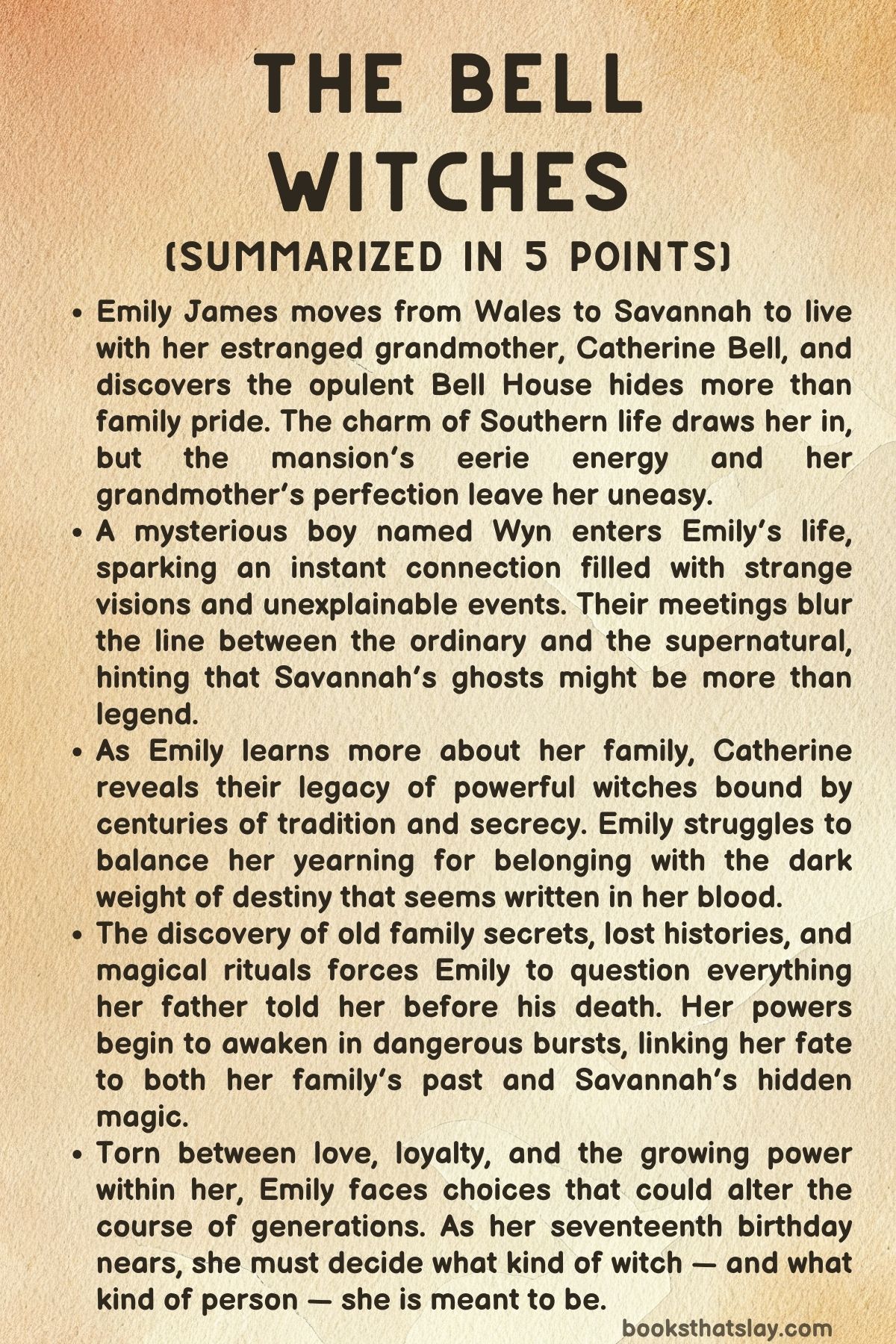
Summary
Emily James arrives in Savannah to live with her grandmother Catherine Bell and aunt Ashley after her father’s death. Bell House, their ancestral home, is beautiful yet intimidating, filled with Southern charm and mystery.
Catherine, graceful and warm, insists Emily belongs there, though her perfection feels unnervingly controlled. Emily soon learns that her father, Paul, had cut all ties with the Bells years ago, telling her they were dead.
Catherine blames herself for their estrangement and pleads for a second chance. Longing for family, Emily accepts her grandmother’s affection, settling into her father’s old room filled with his books and memories.
That night, Emily sees a strange boy standing beneath an oak tree outside her window. She experiences a fleeting but vivid vision of kissing him before he vanishes.
The next day, Catherine takes her through the historic streets of Savannah, describing the Bells’ deep roots in local society and their motto: “A Bell protects her own. ” During a visit to a friend’s home, Emily meets Lydia and Jackson Powell, twin grandchildren of Catherine’s acquaintance.
The twins are lively and teasing, and Lydia calls Emily “the missing Bell baby,” referencing her family’s disappearance from Savannah legend. When Emily accidentally chokes on a sprig of rosemary, she experiences a vision of her parents alive and happy decades earlier.
Disoriented, she flees into the square, where she meets the mysterious boy again—Wyn Evans, a photography student. Their connection is instant, and his easy humor draws her in.
He compares Spanish moss to rootless wanderers like himself and Emily. Catherine interrupts them abruptly, clearly disapproving of Wyn, and drags Emily home.
At Bell House, Catherine forbids Emily from dating before her seventeenth birthday and insists she avoid Wyn. She shows Emily the grand rooms of the estate but forbids her from entering the blue-door craft room or the top floor, claiming it’s unsafe.
When Emily disobeys and glimpses a ceiling painted with constellations, Catherine’s fear seems out of proportion. Later, in the library, Catherine recounts family history, explaining that generations of Bell women—each named Emma Catherine—have lived there since the 1700s.
Emily is stunned to learn her father changed her name after leaving Savannah. When she overhears Catherine and Ashley arguing that the truth could “kill her or she’ll kill us first,” she faints.
Catherine revives her, pretending it was just exhaustion, and later brings her to Bonaventure Cemetery to “meet the family. ” The cemetery’s beauty unsettles Emily as Catherine points out the Bell monument and a sealed crypt for every Emma Catherine Bell.
A massive grey wolf attacks them, and in the struggle, Emily kills it using Catherine’s silver brooch. Catherine hides the evidence and warns Emily never to speak of it.
The next morning, Emily wakes healed, her wound replaced by a faint scar, and finds the brooch beside her bed as a “gift. ” Catherine acts as if nothing happened, though her composure feels brittle.
Emily escapes for a meeting with Wyn. They explore Savannah, sharing stories and laughter.
Wyn reveals a deep sadness beneath his charm, and Emily feels safe with him. But when a whisper calls her birth name—Emma Catherine Bell—she faints again.
Recovering in Wyn’s arms, she lies about the wolf, calling it a “dog. ” Before parting, they promise to meet again.
Later, Lydia visits Bell House, and the girls bond. They try unlocking Emily’s late father’s computer, which he used for his research.
Lydia’s curiosity about Emily’s romance with Wyn turns into genuine friendship. They sneak out to meet Wyn, and Emily confides in him about her life.
He reveals his secret—he isn’t in summer school but searching for his missing brother, Cole, in Savannah. Their mutual honesty deepens their bond, and their first kiss unleashes a wave of magic: white flames and lavender smoke swirl around them.
The next morning, flowers bloom out of season. Emily begins to realize her emotions are linked to her power.
Catherine takes her to a private dinner and tells her the family prophecy: one Bell witch will rise to protect or destroy their line. She insists Emily is that witch and must undergo the “Becoming,” a magical rite on her seventeenth birthday.
Catherine explains that werewolves serve as protectors of witch families and reveals the wolf Emily killed was real. Horrified, Emily loses control of her magic, shaking the room until Catherine strikes her to stop it.
Catherine praises her strength but warns that her gift must be controlled.
When Wyn appears to say he must return home—his brother’s disappearance has taken a tragic turn—Emily is heartbroken. Rain falls as he leaves, echoing her grief.
Days pass with no word from him. Lydia tries to cheer her up, but Emily grows increasingly consumed by guilt over the wolf and fear for Wyn.
Together, they manage to unlock Paul’s computer, discovering he had been researching their ancestors—women accused of witchcraft who fled to America. He had been tracing their magical bloodline, not writing fiction.
Catherine awakens Emily one night and drives her to a cottage for the Wilcuma, the welcoming ritual before her official Becoming. But Wyn’s sudden silence torments her.
When she tells Catherine she would give up her power to save him, Catherine insists the ritual must continue. While cleaning the woodshed, Emily speaks with Ashley, who reveals that Catherine has always controlled those around her, even sabotaging her relationships.
Emily discovers her mother’s clothes and experiences a vision of her birth, realizing her grandmother’s magic was present that night. When Emily loses contact with both Wyn and Catherine through her magical senses, panic unleashes her power, injuring Ashley.
Emily heals her using the earth’s energy but learns such aid demands blood.
Ashley, now lucid, exposes the truth: Catherine caused the storm that killed Paul to lure Emily back to Savannah and fulfill the prophecy. Ashley has been magically bound to the estate as Catherine’s caretaker for years.
Emily breaks the enchantment, freeing her aunt. Then Jackson calls—Lydia is unconscious, and Catherine was seen carrying a boy’s body into the cemetery.
Emily realizes Wyn is in danger.
With Ashley’s help, Emily rushes to Bonaventure. She finds Catherine waiting in the underground Bell chapel.
Wyn lies bound in silver chains soaked with aconite. Catherine admits she killed Paul “for the greater good” and intends to drain Emily’s power to preserve the family’s magic.
To save Wyn, Emily agrees to complete the Becoming. As the moon reaches its peak, she is flooded with ancestral power.
Wyn breaks free, transforms into a wolf, and attacks Catherine, but she stabs him with a ritual dagger. His claws accidentally cut Emily, spilling her blood onto the altar.
Catherine begins the draining, and Emily’s power erupts as black fire, summoning generations of red-haired Bell witches. They offer her a choice—embrace her own will or repeat history.
Guided by Wyn’s voice, Emily controls the flames, freezing the fire into snow. The spirits strip Catherine of her power and vanish, leaving her alive but broken.
At dawn, Wyn lies human and weak, but he and Emily survive. She confesses she killed his brother Cole, not knowing who he was.
Though devastated, Wyn forgives her, understanding the manipulation behind it. He must return home to face his pack but vows to come back.
As Bell House brightens, Ashley regains freedom, Lydia recovers, and the home feels alive again. Catherine disappears, and Emily, now the last Bell witch, claims her place as the new guardian of the family line.
She decides to stay in Savannah—where there has always been, and always will be, an Emma Catherine Bell.
Characters
Emily James
Emily James is the heart and soul of The Bell Witches, a young girl grappling with grief, identity, and destiny. Her journey begins with loss—the death of her father—and soon spirals into a world of hidden magic, ancestral secrets, and dark revelations.
Emily’s initial vulnerability stems from her longing for belonging and her naïve hope that family can fill the void left by her father’s absence. Her move from Wales to Savannah marks not just a geographical transition but a spiritual one; she moves from ignorance of her heritage to the heavy burden of inheriting it.
Emily is defined by her resilience and her capacity for empathy, especially in how she navigates the revelations about her family’s magical past and her own powers. Her love for Wyn deepens her humanity, grounding her even as her powers threaten to consume her.
Over the course of the novel, she transforms from a confused, lonely teenager into a powerful witch who redefines the Bell legacy on her own terms, rejecting the toxic control of her lineage.
Catherine Bell
Catherine Bell is the matriarch of the Bell family, embodying the allure and danger of Southern grace. Outwardly refined and maternal, Catherine hides a ruthless will beneath her polished exterior.
Her charm masks manipulation; her kindness often serves her own ends. Through Catherine, The Bell Witches explores the theme of control—both magical and emotional.
Her obsession with prophecy and legacy drives her to commit unspeakable acts, including the death of her son Paul, all in the name of preserving the family’s power. Catherine is neither purely villainous nor entirely sympathetic.
She is a woman warped by tradition, grief, and her belief in destiny. Her relationship with Emily is complex: she truly loves her granddaughter, yet sees her as a vessel to restore the Bell power rather than a person with free will.
By the novel’s end, Catherine’s downfall comes not from hatred but from her inability to understand love without control, making her one of the most compelling tragic figures in the story.
Ashley Bell
Ashley Bell serves as both a foil and an ally to Emily. Initially cold and distant, she evolves into one of the few truly self-aware members of the Bell family.
Trapped under Catherine’s dominance, Ashley’s bitterness and sarcasm hide years of pain and subjugation. Her character represents those who are bound not just by magic but by family obligation and guilt.
As the story unfolds, Ashley’s complexity deepens—she is both victim and enabler of Catherine’s tyranny. Yet her eventual rebellion and alliance with Emily mark her redemption.
Through Ashley, the novel contrasts inherited power with earned courage; she breaks free not by wielding magic, but by reclaiming her autonomy and compassion. Her care for Emily and her sharp intelligence ground the story in realism amid the supernatural chaos.
Wyn Evans
Wyn Evans is the embodiment of freedom, emotion, and love that stands in contrast to the rigid control of the Bell world. A photography student with an artist’s soul, he mirrors Emily’s yearning for connection and truth.
His mysterious charm and quiet strength make him both a romantic interest and a moral compass for Emily. The revelation of his identity as a werewolf—and his brother Cole’s tragic connection to Emily—adds layers of tragedy and destiny to their relationship.
Wyn’s love for Emily transcends fear and betrayal, symbolizing the harmony possible between two worlds: the magical and the human. His willingness to forgive and protect her even after learning she killed his brother speaks to his extraordinary empathy.
Wyn’s character is a testament to the idea that love, rather than blood or power, defines true strength.
Paul James
Paul James, though absent for most of the story, looms large in its emotional landscape. His rejection of the Bell family and its magic sets the entire narrative in motion.
A man torn between love and legacy, Paul symbolizes rebellion against inherited power. His choice to hide the truth from Emily—telling her his family was dead—stems not from cruelty but from desperation to protect her from the darkness he escaped.
In death, Paul becomes a tragic echo of what Emily might have become had she surrendered to fear instead of embracing her identity. His presence lingers in the ancestral home, the books he left behind, and the memories his family tries to bury.
Through him, The Bell Witches explores the cost of breaking free from destiny—and the grief that follows when love and fear intertwine.
Lydia Powell
Lydia Powell is a refreshing burst of modern energy amid the decaying grandeur of Savannah’s old families. Outspoken, witty, and loyal, she becomes Emily’s first real friend and bridge to the outside world.
Lydia’s curiosity and courage contrast sharply with Emily’s initial hesitance, helping her to rediscover joy and normalcy amid chaos. As the story deepens, Lydia’s connection to Emily’s mother through the shared locket hints at generational ties that extend beyond bloodlines.
Her temporary possession and recovery symbolize the collateral damage caused by the Bell family’s curse—ordinary lives disrupted by ancestral greed. Lydia’s friendship ultimately grounds Emily, reminding her that magic without love and laughter is meaningless.
Jackson Powell
Jackson Powell, Lydia’s twin brother, is a subtler presence, serving as both comic relief and emotional support. His flirtatious charm and easygoing nature balance the intensity of Emily’s world.
Yet beneath his playful exterior lies quiet strength and a protective instinct toward his sister and Emily alike. Jackson’s role expands when he helps Emily confront the truth about Catherine and drives her to Bonaventure Cemetery for the final confrontation.
He embodies loyalty and decency—qualities that shine even brighter against the backdrop of deception and magic. Jackson may not wield power, but his courage and kindness make him essential to the story’s emotional resolution.
Cole Evans
Cole Evans exists primarily as a haunting presence, shaping both Wyn’s and Emily’s journeys. His transformation into a werewolf and subsequent death at Emily’s hands form the emotional crux of the novel’s tragic tension.
Through Cole, The Bell Witches explores the blurred line between victim and monster. He represents what happens when love, loyalty, and magic collide without understanding.
His death is both accident and prophecy, binding Wyn and Emily in shared pain and destiny. Though seen only in flashbacks and visions, Cole’s shadow lingers as a reminder of the cost of power and the consequences of secrets.
Themes
Grief and Identity
Emily’s journey in The Bell Witches begins with profound loss, but her grief is more than mourning her father—it becomes the catalyst for rediscovering who she is. The absence of her father creates a void that is both emotional and existential, forcing her to confront questions about her lineage and the truths he concealed.
Her move from Wales to Savannah signifies a passage from the known to the unknown, where her identity begins to unravel in layers. Grief here acts as both a wound and a map—it destabilizes Emily yet propels her toward understanding the self she was denied.
Every encounter in Bell House, from the haunting perfection of her grandmother Catherine to the whispers in Lafayette Square, becomes part of an awakening. Through loss, Emily learns that identity is not inherited passively; it is wrestled from pain and memory.
The haunting is not just supernatural but emotional—the ghosts of her past and family secrets coexist within her, blurring the boundary between blood and belonging. Her father’s attempt to sever her from the Bell legacy ironically ensures that she must confront it.
By the end, grief transforms from an isolating force into a source of strength. Emily learns that mourning and becoming are intertwined: to fully live, she must carry both love and loss, truth and mystery.
Power and Control
Power in The Bell Witches manifests through bloodlines, magic, and manipulation. Catherine Bell epitomizes the allure and danger of control—her dominance over her daughters and granddaughter is masked as protection but driven by fear of losing authority.
Her craft, her house, and even her family are instruments through which she maintains power. Emily’s awakening magic threatens this system because it represents ungoverned potential, a kind of natural, untamed power that challenges generational control.
The story presents an ongoing struggle between imposed power and inherited will. Catherine’s insistence on rituals, secrecy, and obedience contrasts with Emily’s yearning for autonomy.
The Becoming ritual—meant to bind Emily under Catherine’s supervision—becomes a metaphor for generational power dynamics, where youth must decide whether to replicate or resist inherited hierarchies. Magic becomes the language of control, but also rebellion; Emily’s ability to heal, protect, and even destroy signifies her growth beyond submission.
The moment she rejects Catherine’s manipulation and claims her own strength marks her transformation from a subject of power to its master. The novel thus critiques the illusion of benevolent control and celebrates the dangerous but necessary act of claiming one’s agency.
Love and Destiny
Love in The Bell Witches is portrayed as both liberating and perilous. Emily’s connection with Wyn begins with an almost supernatural pull, suggesting a bond written by fate.
Yet as the story unfolds, love becomes an act of defiance rather than destiny. Her affection for Wyn challenges Catherine’s belief in prophecy and predetermined outcomes.
The novel explores whether love is truly chosen or simply the fulfillment of a magical lineage. Wyn’s dual identity as human and wolf complicates their relationship, symbolizing the duality within Emily herself—between her human longing and her inherited power.
Their bond evolves from infatuation into a form of salvation, rooted in empathy and sacrifice. When Emily learns she killed Wyn’s brother, love transcends romance and becomes about truth and forgiveness.
It no longer exists to fulfill a prophecy but to free them from it. Through love, Emily redefines destiny—not as an inevitable path but as something rewritten through choice.
The story suggests that real love demands confrontation with the darkest truths and that only through this confrontation can one achieve freedom from ancestral design.
Family and Legacy
The Bell family stands as a haunting reflection of how legacy can imprison those who inherit it. The grandeur of Bell House, with its locked rooms and whispered secrets, becomes a physical manifestation of generational trauma.
Catherine’s obsession with preserving the Bell lineage transforms heritage into a burden. Emily’s father rejected it to save his daughter, while Catherine clung to it to preserve her own power.
The family’s history of witches, prophecies, and repetition of names like “Emma Catherine Bell” underscores the cycle of expectation—each generation forced to relive the last. Emily’s rebellion against this pattern represents the breaking of an ancestral curse.
Her choice to embrace her power without succumbing to her grandmother’s manipulation is both personal liberation and generational healing. The novel explores the paradox of inheritance: family connects us, yet it can also confine.
By the end, Emily accepts her place in the Bell lineage, not as a continuation of its control but as its transformation. The past no longer dictates her; she reclaims it as her foundation rather than her fate.
Fate, Choice, and Transformation
Throughout The Bell Witches, fate and free will battle for dominance. Catherine’s belief in prophecy dictates every decision, convincing her that destiny justifies her cruelty.
Emily’s journey dismantles this notion, showing that fate without choice is only another form of imprisonment. The Becoming, intended to seal her destiny, becomes the stage where she redefines it.
Her confrontation with Catherine is not only a battle of power but of philosophies—submission to destiny versus creation of one’s own path. Transformation, both physical and spiritual, underscores this theme.
The evolution of Emily’s magic, the resurrection of ancestral spirits, and even the shifting architecture of Bell House mirror her internal change. Transformation is not portrayed as a sudden revelation but a painful reconfiguration of truth.
When Emily chooses compassion over vengeance, she proves that destiny is not fixed but fluid, molded by the courage to act differently. The closing image of her standing as the new Emma Catherine Bell, conscious yet free, embodies the triumph of choice over fate—the ultimate transformation from heir to creator.