The Black Wolf Summary, Characters and Themes
The Black Wolf by Louise Penny is a mystery that revolves around Chief Inspector Armand Gamache and his team as they uncover a dangerous conspiracy involving environmental crimes, political corruption, and a massive threat to both Canada and the United States. Set against the backdrop of a seemingly tranquil village and a web of intrigue at the highest levels, the novel explores themes of loyalty, sacrifice, and the pursuit of justice.
As the investigation unfolds, Gamache must confront his own personal demons while working to uncover the truth behind the dark forces manipulating events from the shadows. It’s the 20th book in the Chief Inspector Armand Gamache series.
Summary
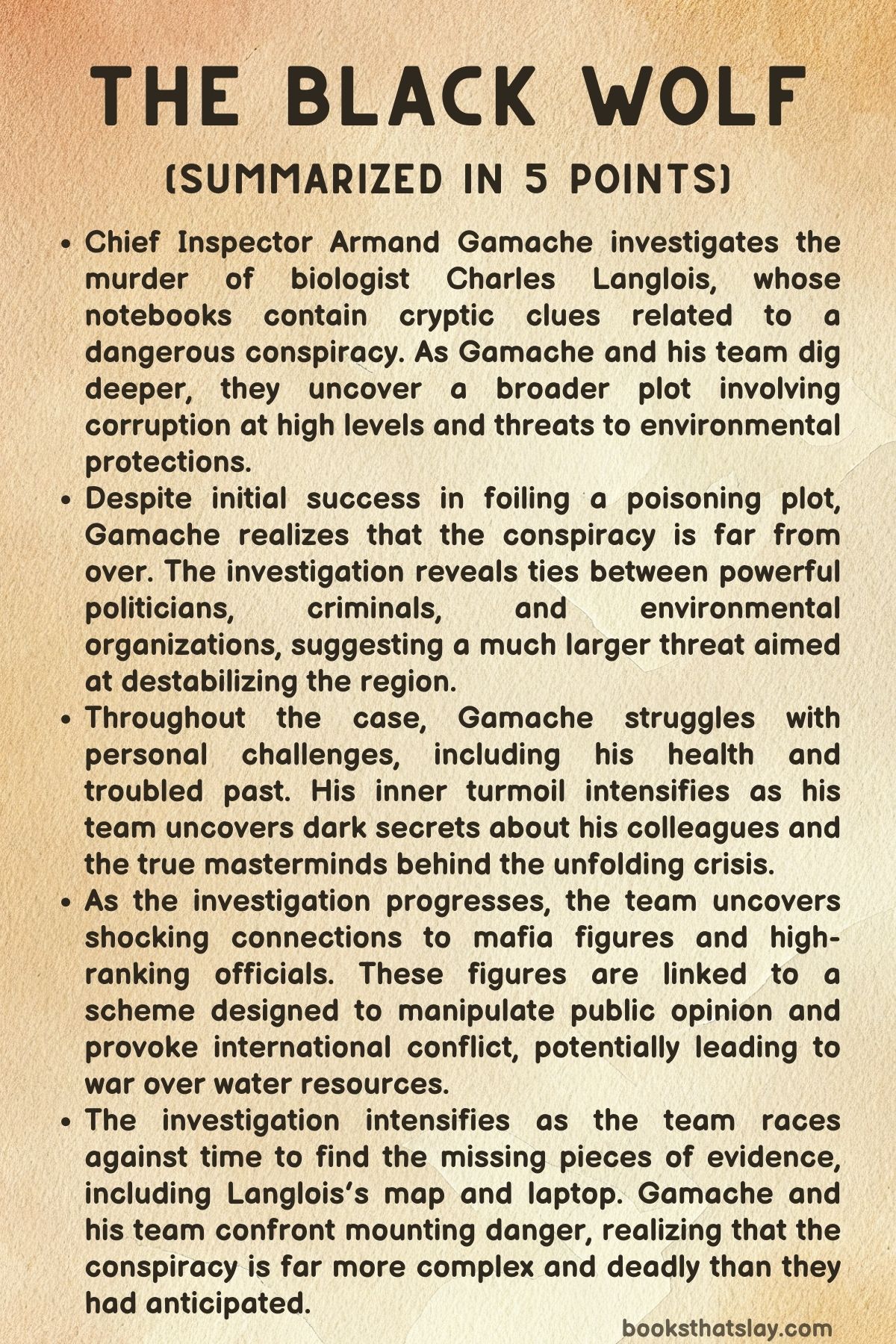
The Black Wolf follows Chief Inspector Armand Gamache and his team as they investigate a complicated and dangerous conspiracy that threatens both the safety of the environment and the stability of North America. The investigation begins with the mysterious death of Charles Langlois, a biologist who had been researching pollution and criminal activities in remote lakes near the Canada-U.S. border.
Before his death, Langlois had left behind cryptic notebooks that contained clues to a far-reaching plot. Initially thought to be related to a poisoning plot targeting Montréal’s water system, Gamache and his team soon realize the scope of the threat is much larger and more dangerous than they had anticipated.
Langlois’s notebooks hold vital information, and it is the second notebook—seemingly benign at first—that contains the key to unraveling the entire conspiracy. As Gamache revisits the notebooks and collaborates with his team, including Isabelle Lacoste and Jean-Guy Beauvoir, they discover that Langlois had uncovered something darker: a corrupt network of politicians, criminals, and industry magnates conspiring to destroy environmental protections and allow unchecked pollution.
This revelation sends Gamache and his team racing to uncover the full extent of the conspiracy, all while dealing with personal struggles and mounting pressure from external forces.
The investigation leads Gamache to suspect that the true mastermind behind the plot is someone much more powerful and influential than initially believed. The team uncovers links between Marcus Lauzon, a former Deputy Prime Minister, and a series of high-profile political and business figures who are part of the criminal network.
The goal of the conspiracy appears to be the destabilization of environmental laws, allowing industries to pollute the land and water without consequence. As Gamache digs deeper, he becomes increasingly concerned that Lauzon may not be the true mastermind, but instead a pawn in a much larger game orchestrated by unseen forces.
As the investigation progresses, Armand and his team are confronted with threats from all sides. The team’s work takes them to the remote lake where Langlois had made his final discoveries, and they uncover a buried body, further solidifying the belief that Langlois had been murdered because of what he had uncovered.
Alongside this investigation, Armand is also grappling with personal issues, particularly his health. Still recovering from a traumatic injury caused by a gunshot in a previous case, Armand struggles with the physical and emotional toll his work has taken on him.
Despite this, his resolve remains unshaken, and he continues to push forward with the investigation, relying on the emotional support of his wife, Reine-Marie, and his tight-knit community in Three Pines.
The investigation reveals more complex layers of corruption, with connections to figures like Joseph Moretti, a mafia boss who seems to have ties to the poisoning plot. Gamache and his team begin to understand that the situation is far worse than they had initially thought, and their search for answers becomes a race against time.
The discovery of Langlois’s laptop and the mysterious map he had created points the team toward a final showdown, where they must uncover the truth before it is too late.
As the investigation continues, the team discovers disturbing connections between the poisoning plot, the mafia, and a network of government officials in both Canada and the U.S. The team realizes that the conspiracy is even more widespread than they could have imagined, with implications that could lead to an international crisis. The plan seems to involve manipulating public opinion and creating a narrative of fear, particularly around environmental issues such as water scarcity.
The stakes grow higher as the team uncovers evidence that could expose a political maneuver that could spark a conflict between Canada and the U.S.
Meanwhile, Armand is forced to confront his own personal demons. His past decisions, particularly his choice to protect his family at the cost of abandoning his team during a terrorist threat, continue to haunt him.
Jean-Guy, his trusted colleague, has voiced his anger and disappointment over this decision, and Armand is plagued by guilt. As tensions rise, Armand struggles to reconcile his own actions with the demands of his work, questioning whether he has made the right choices throughout his career.
The conspiracy continues to unfold, leading to shocking revelations about the true extent of the corruption and the forces behind the plot. Armand and his team realize that the stakes are higher than ever as they confront not only powerful political figures but also a mafia syndicate that has managed to infiltrate the highest levels of government.
The investigation reveals that the poisoning plot was just a small part of a much larger scheme to provoke a conflict between Canada and the U.S., using manipulated narratives and fake news to stoke fear and create a false justification for military action.
With the help of Vivienne LaPierre, an environmental biologist, Armand and his team begin to piece together the final clues that could expose the full scale of the conspiracy. However, the investigation is fraught with danger, as they face not only external threats but also the possibility that someone within their own ranks may be compromised.
Despite the mounting pressure, Armand and his team press on, determined to uncover the truth before it is too late.
In the end, the investigation leads to a confrontation with the masterminds behind the plot, but the resolution comes at a personal cost. Armand is forced to confront the complexities of the situation, both professionally and personally, and the team faces the consequences of their actions.
As they reflect on the case, they are left with lingering doubts about the true extent of the conspiracy and the ongoing threat of future conflict. The story concludes with the realization that the battle is far from over, and the forces behind the plot are still at large, waiting for their next move.
Characters
Armand Gamache
Armand Gamache, the Chief Inspector of the Sûreté du Québec, is the heart and soul of the investigation in The Black Wolf. He is a man of integrity, compassion, and exceptional intelligence, but his personal demons and physical suffering make him a deeply layered character.
Gamache is haunted by past decisions, especially his controversial choice to prioritize saving his family over his team during a terrorist threat, which has left him with unresolved guilt. Despite his vulnerabilities, particularly his deteriorating hearing and the trauma of past gunshot injuries, his dedication to justice remains unshaken.
His calm demeanor hides a fierce determination to uncover the truth, no matter the cost. As the investigation unfolds, his leadership is tested not only by the external threats of a grand conspiracy but also by his internal battles.
His ability to inspire loyalty and maintain focus in the face of mounting pressures showcases his strength, even as he is forced to confront painful truths about his colleagues and his own role in the unfolding drama. Through his journey, Gamache emerges as a complex, empathetic figure whose moral compass guides the investigation, even when the stakes grow ever higher.
Jean-Guy Beauvoir
Jean-Guy Beauvoir, Gamache’s trusted colleague, is a character torn between loyalty to his mentor and his own troubled past. While he is a skilled investigator, his relationship with Gamache is strained due to past personal conflicts, particularly surrounding a traumatic terrorist incident.
Jean-Guy’s frustration is evident as he grapples with feelings of betrayal, but he also has a deep respect for Gamache’s leadership. Over the course of the investigation, Jean-Guy’s anger and sense of injustice become central to his character arc.
His professional skills are put to the test as the case takes unexpected turns, and his personal turmoil adds a layer of complexity to his character. As a key member of the investigation team, Jean-Guy’s ability to process information under pressure and his moral compass play crucial roles in the story.
His internal struggle makes him one of the most compelling characters, as he seeks redemption and closure, not only in the investigation but also in his relationship with Gamache.
Isabelle Lacoste
Isabelle Lacoste, a biologist working alongside Gamache, is sharp, intuitive, and a vital part of the investigative team. Her expertise is essential in understanding the environmental threats at the heart of the case, particularly the significance of the mysterious lakes and the clues hidden within them.
Lacoste is characterized by her resilience and dedication to the truth, often pushing the boundaries of the investigation to uncover the deeper layers of the conspiracy. She faces personal challenges as well, particularly the pressure of working in a high-stakes environment where the risks are not just professional but also personal.
Her relationship with Gamache is one of mutual respect and trust, with her scientific knowledge providing a critical balance to his more traditional investigative methods. Lacoste’s determination to uncover the truth and her ability to handle the emotional weight of the case make her a key player in the investigation, providing both intellectual insight and emotional strength to the team.
Marcus Lauzon
Marcus Lauzon, the former Deputy Prime Minister, is a complex and morally ambiguous figure. Initially believed to be a key player in the poisoning plot, Lauzon’s true role in the conspiracy is far more intricate.
While his political connections and previous actions suggest complicity, it becomes clear that he may not be the mastermind but rather a pawn in a much larger, more dangerous game. His escape from arrest and his involvement in the broader web of corruption complicate the investigation for Gamache and his team.
Lauzon’s character is defined by his ambition and desire for power, but as the investigation progresses, his motivations become more difficult to decipher. His presence in the story adds a layer of intrigue, as the true scope of his involvement in the conspiracy remains shrouded in uncertainty, highlighting the complex interplay of politics, power, and manipulation.
Reine-Marie Gamache
Reine-Marie Gamache, Armand’s loving wife, serves as a grounding force for him throughout the investigation. While she is not directly involved in the case, her emotional support provides a stark contrast to the intense pressure Armand faces.
Reine-Marie is portrayed as a deeply empathetic and understanding woman, one who is able to offer her husband a refuge from the turmoil of his professional life. However, her own feelings about the people from Armand’s past, particularly the complicated relationship he has with Jeanne Caron, add an additional layer of tension.
Reine-Marie’s presence in the story highlights the personal stakes involved in the investigation, as Armand’s professional challenges inevitably bleed into his home life. Despite the external threats, Reine-Marie’s unwavering support for Armand and her role as his emotional anchor underscores the strength of their relationship and the resilience of their bond in the face of adversity.
Jeanne Caron
Jeanne Caron, a former adversary of Armand’s, plays a pivotal role in the unfolding conspiracy. While initially at odds with Armand, she becomes a key figure in helping unravel the complex web of political intrigue.
Caron’s relationship with Armand is marked by a shared history of tension, particularly due to past events involving their son Daniel. Despite this, Caron’s role in the investigation becomes crucial as she aids Armand in navigating the political landscape that underpins the conspiracy.
Her character is driven by a mix of personal and professional motivations, which makes her actions unpredictable and adds layers to the plot. The dynamic between Caron, Armand, and Reine-Marie is central to the emotional undercurrent of the narrative, as the complexities of past wounds and present dilemmas intersect, showing how individuals with difficult histories can find common ground in the face of a greater threat.
Vivienne LaPierre
Vivienne LaPierre, an environmental biologist, is another key member of the investigative team. Her involvement is crucial in understanding the environmental implications of the conspiracy, particularly regarding the mysterious lakes and the deadly poisoning plot.
LaPierre’s expertise and her collaboration with Isabelle Lacoste make her an invaluable resource in the search for answers. She approaches the investigation with a sense of urgency, understanding the devastating impact the conspiracy could have on both the environment and public safety.
As the investigation deepens, LaPierre’s ability to process complex scientific data and her unwavering commitment to uncovering the truth shine through, making her a strong and dependable ally in the fight to thwart the plot.
Joseph Moretti
Joseph Moretti, a mafia figure with ties to the conspiracy, adds a dark and dangerous element to the plot. His involvement in the poisoning and the larger conspiracy introduces the criminal underworld into the mix, showing how corruption and power extend far beyond the political elite.
Moretti’s motivations are rooted in profit and control, and his willingness to do whatever it takes to further his agenda makes him a formidable adversary. His connections with key political figures and his ability to manipulate events from the shadows make him a critical player in the unfolding crisis.
Moretti’s character serves as a reminder of the dangerous intersection of crime, politics, and environmental exploitation, underscoring the high stakes of the investigation. His actions drive home the point that the conspiracy is not just a political issue but a fight for survival in a world where power and resources are relentlessly contested
Themes
Corruption and Political Manipulation
In The Black Wolf, corruption and political manipulation serve as central themes, highlighting the profound impact of power dynamics and the lengths to which individuals and groups will go to maintain control. The plot revolves around an intricate conspiracy that involves politicians, industry magnates, and even government officials working together to undermine environmental protections for personal gain.
This corruption is not just limited to individuals but extends to the very institutions that are supposed to protect society, making it a systemic issue.
As Chief Inspector Armand Gamache and his team investigate, they discover that Marcus Lauzon, a former Deputy Prime Minister, is not the true mastermind behind the poisoning plot but instead a pawn in a much larger game orchestrated by more powerful figures. The involvement of high-ranking officials, such as Prime Minister James Woodford, and the manipulation of public narratives through media and fake news further illustrates the vastness of the conspiracy.
This theme of corruption exposes the fragility of political systems and the dangerous consequences when those in power prioritize their own interests over the well-being of society. The hidden forces behind the conspiracy exemplify how power, once corrupted, can create an environment where individuals are willing to destroy the very things that keep the world functioning, such as environmental protections, to advance their own agendas.
The theme of political manipulation also extends to the way in which the media is used as a tool to influence public opinion. By controlling the narrative, these powerful figures can manipulate the populace into believing lies, creating fear and tension that can lead to political instability and conflict.
The extent of this manipulation reflects the depth of corruption in the book, where truth becomes subjective, and those in power hold the ability to shape reality for the masses.
Environmentalism and Corruption
The investigation in The Black Wolf centers around the threat to the environment and the covert operations designed to dismantle environmental protections. The story portrays environmentalism not only as a moral duty but as a battleground for survival.
Biologist Charles Langlois, whose murder sets the investigation in motion, had been researching pollution and environmental crimes, and his findings ultimately lead to a larger conspiracy involving the exploitation of natural resources. This theme underscores the vital importance of environmental stewardship and the lengths to which industries and corrupt politicians will go to destroy it for financial gain.
The novel suggests that the environment is vulnerable to corporate greed and government negligence. Langlois’s research into pollution and the cover-up of illegal activities reveals how dangerous and destructive the exploitation of the environment can be when left unchecked.
The mystery surrounding Langlois’s death highlights how environmental concerns are often sidelined or deliberately suppressed when they clash with corporate and political agendas. The fact that the conspiracy centers around the theft of water resources, especially in the context of rising water shortages, is a stark reminder of how environmental issues, particularly those involving natural resources, have become central to global power struggles.
The political forces behind the conspiracy in The Black Wolf are not just undermining environmental laws for profit; they are compromising the future of entire ecosystems, illustrating the unsustainable nature of their actions and the potentially disastrous consequences for future generations.
Personal Struggles and Redemption
In addition to the external conflicts surrounding the investigation, The Black Wolf delves deeply into the personal struggles of its protagonist, Armand Gamache, and how these shape his responses to the challenges he faces. Gamache’s internal conflict—especially his guilt over past decisions and his struggles with self-doubt—forms a significant part of the emotional landscape of the story.
His decision to abandon his team during a terrorist threat, choosing to save his family instead, haunts him throughout the narrative, and the tension between his professional responsibilities and personal regrets adds a layer of complexity to his character. This theme of personal struggle is compounded by his deteriorating health, particularly his hearing loss, which serves as a constant reminder of the physical and emotional toll of his past experiences.
Gamache’s journey through these internal battles is one of redemption. Despite his vulnerabilities and the emotional weight of his past decisions, he remains determined to uncover the truth behind the conspiracy.
His resilience is driven by a need to protect those he cares about and by a deep sense of justice. In the face of personal turmoil, Gamache is unwavering in his dedication to solving the case, and this unwavering resolve is portrayed as a form of personal redemption.
His relationships with those around him—particularly with his wife, Reine-Marie—highlight the importance of emotional support and the strength found in community, even in the midst of intense personal and professional crises. Gamache’s ongoing struggle to reconcile his past with his present actions mirrors the larger theme of the fight for justice, not just for the world but for oneself.
The Fragility of Trust
Trust plays a critical role in The Black Wolf, both in the professional sphere and in personal relationships. As the investigation uncovers layers of corruption and deceit, Gamache must grapple with the fact that those around him may not be who they appear to be.
The theme of trust is tested repeatedly as the team confronts the possibility that some of their own colleagues might be compromised or involved in the conspiracy. This uncertainty forces Gamache and his team to question their loyalties, creating tension within their ranks.
The notion that trust can be easily broken by betrayal is illustrated through the interactions between the characters, as they navigate the complexities of loyalty and deception.
This theme extends beyond the professional sphere and into Gamache’s personal life. His strained relationship with Jean-Guy Beauvoir, stemming from past decisions, reveals how trust is essential in both familial and professional relationships.
The tension between Gamache and Beauvoir reflects the broader theme of how fragile trust can be when tested by difficult circumstances. Throughout the novel, Gamache must not only solve the case but also restore trust within his team, highlighting the difficulty of maintaining relationships in an environment rife with suspicion and betrayal.
At the same time, The Black Wolf explores the idea that trust, once broken, can be difficult to rebuild. The investigation itself is fraught with false leads and hidden agendas, forcing Gamache to navigate a web of lies and manipulation.
This makes the pursuit of truth even more challenging, as the very foundation of trust in the investigation is constantly in question. The theme of trust underscores the difficulty of maintaining integrity in a world where deception and corruption thrive, and it serves as a poignant reminder of the importance of truth and transparency in all areas of life.