The Blue Hour by Paula Hawkins Summary, Characters and Themes
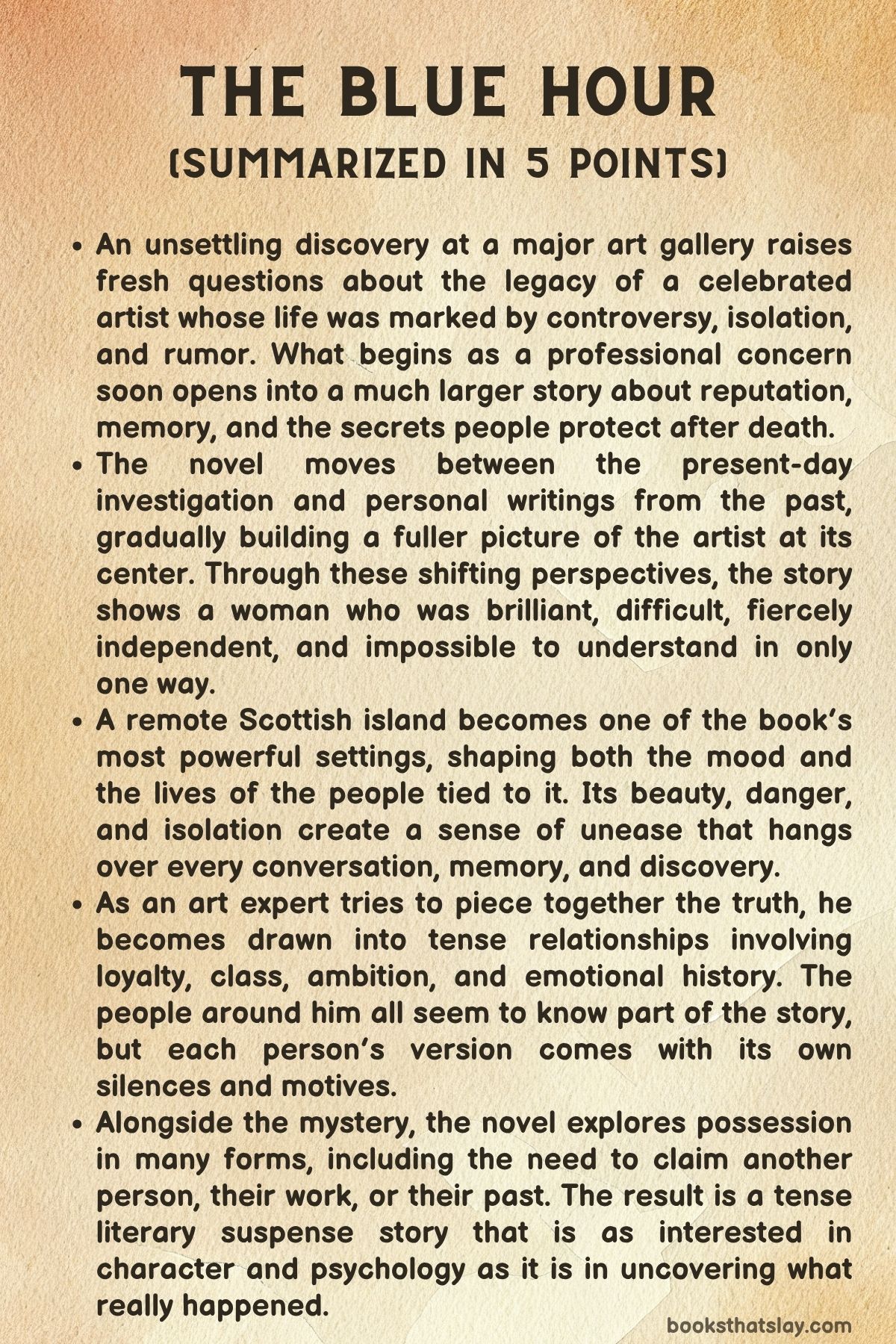
The Blue Hour by Paula Hawkins is a literary suspense novel built around art, secrecy, obsession, and the stories people tell to protect themselves. Set between a remote Scottish island and the polished world of galleries and collectors, it begins with a disturbing question about a famous sculpture and opens into a much darker history.
The novel is less interested in neat detective work than in motive, memory, and possession—of art, of land, and of other people. Hawkins creates an uneasy atmosphere in which every relationship carries strain, and each new revelation changes how the past is understood.
Summary
At the center of The Blue Hour is the legacy of Vanessa Chapman, a celebrated artist whose work continues to attract admiration years after her death. Interest in her art takes a shocking turn when a forensic anthropologist notices that one of her sculptures, on display at the Tate, appears to contain a human rib rather than an animal bone.
Because Vanessa’s husband, Julian Chapman, disappeared decades earlier after visiting her on the remote island where she lived, the discovery raises immediate suspicion. The possibility that the bone may be connected to Julian threatens to reopen old questions about Vanessa’s life and the people around her.
James Becker, an art expert who works for the Fairburn Foundation, becomes involved in the matter. The foundation controls Vanessa’s artistic estate because she unexpectedly left her work to the Lennox family, despite a bitter conflict with Douglas Lennox, the gallery owner who once represented her.
Becker is unsettled by the claim about the sculpture, but others around him quickly see the possible consequences. His wife Helena and his friend Sebastian Lennox both understand that a scandal tied to Vanessa could bring publicity, though Becker is more cautious.
He is asked to travel to Eris, the isolated Scottish island where Vanessa lived, to speak with Grace Haswell, Vanessa’s closest companion and the executor of her will. Grace still holds many of Vanessa’s papers, notebooks, and personal effects.
As Becker makes his way north, the novel begins to move between present-day inquiry and entries from Vanessa’s diaries. These diary fragments show Vanessa as brilliant, sharp, dissatisfied, and often angry.
Her marriage to Julian was already falling apart before she moved to Eris. She knew he was unfaithful, and she was involved in an affair of her own with Douglas Lennox.
She wanted distance from London, from Julian, and from the pressures of fame. Buying Eris represented freedom for her, both personal and artistic.
On the island she found fresh inspiration, began shifting from painting toward ceramics and sculpture, and built a life defined by harsh weather, solitude, and fierce independence.
Grace, meanwhile, lives alone on Eris and has spent years guarding what remains of Vanessa’s private world. When Becker first arrives, she is suspicious and hostile, especially because he represents the same foundation that benefited from Vanessa’s will.
Yet she is also drawn to him, partly because he seems to care sincerely about Vanessa’s art rather than only its financial value. Once she agrees to speak with him, she slowly begins to share papers and memories.
Through her recollections, Vanessa becomes more complicated. Grace first met her as a doctor after Vanessa injured her wrist, and from that meeting grew an attachment of enormous intensity.
Grace became not only a friend but also a protector, caretaker, and emotional anchor.
Becker’s search through the journals deepens the mystery rather than clarifying it. The diaries reveal Vanessa’s bitterness toward the art world’s fascination with her personality over her work, her resentment of Julian, and the complicated hold Douglas still had over her career.
Becker also discovers evidence of Douglas’s affair with Vanessa and his furious reaction when she suddenly canceled a major exhibition. At the same time, tensions rise at Fairburn.
Emmeline Lennox, Sebastian’s mother, despises Vanessa and wants her memory controlled. Sebastian is impatient to recover any hidden artworks Grace may still possess.
Becker, caught between scholarship, loyalty, and personal insecurity, becomes increasingly strained. His marriage is uneasy, and he is troubled by the long history between Helena and Sebastian.
Grace is also sorting through the past in private. Her thoughts reveal how much of Vanessa’s archive she has been managing selectively.
She wants Becker to understand the affection and dependence that existed between her and Vanessa, but she also withholds material that might threaten her hold on Vanessa’s memory. It becomes clear that Grace’s devotion was possessive.
She took satisfaction in limiting Vanessa’s closeness with others and, at times, interfered in Vanessa’s relationships. Even so, the bond between the two women was real and powerful.
Grace saved Vanessa from a violent local man who attacked her, and after that experience the connection between them deepened. For long stretches of Vanessa’s life on Eris, Grace became indispensable.
The story then turns more directly to the summer when Julian vanished. He arrived on Eris after the death of his lover, Celia, and despite the collapse of the marriage there was still a strong tie between him and Vanessa.
Grace resented his presence and felt threatened by the intimacy that remained between them. Vanessa left the island for a short time, expecting Julian to be gone before she returned.
Instead, when she came back, many of her artworks had been destroyed and Julian disappeared without a trace. The police investigated, but no body or car was ever found.
Vanessa refused to tell them that Julian had wrecked her work, fearing that this would only make her look guilty. The disaster also explains why she withdrew from the planned exhibition, provoking Douglas into rage and beginning the legal and personal fallout that followed.
In the present, Becker learns still more. Grace eventually admits that toward the end of Vanessa’s life, when cancer was consuming her, she helped Vanessa die.
She wants those details to remain private and fears public judgment. Becker also accidentally reveals a secret of his own: Douglas Lennox did not die in the simple hunting accident everyone believes.
Emmeline shot him, and the truth was concealed. This admission gives Grace dangerous new knowledge.
The investigation sharpens when testing confirms that the rib in the sculpture is human. Becker returns to Eris as a storm approaches, now driven by professional urgency and growing personal panic.
His suspicions toward Helena and Sebastian are rising, and he no longer knows whom to trust. Grace, for her part, feels increasingly overlooked and betrayed.
She is hurt that public accounts of Vanessa’s life erase her role, and she is furious that Becker has taken material without permission and failed to protect her importance in the story.
The final revelations come in layers. First, Grace confesses that she destroyed some of Vanessa’s hidden paintings from greed and jealousy, and that she lied in ways designed to keep Becker on the island.
Then the truth about Julian emerges. In one account, Grace says Vanessa killed him and she covered it up.
But the fuller truth is different: Grace herself killed Julian during a confrontation after he found her destroying Vanessa’s art. In a burst of rage, she struck him dead and later hid his body in the septic tank, while also disposing of his car.
Vanessa, shocked and implicated by the aftermath, allowed the disappearance to remain unresolved.
Even that is not the whole story. The human bone from the sculpture is eventually identified through DNA, and it does not belong to Julian at all.
It belongs to Nick Riley, a man from Grace’s youth. Long before Vanessa entered her life, Grace had formed an intense friendship with Nick, only to feel abandoned by him.
Years later, after he returned as an addict and once again made clear he intended to leave her behind, Grace killed him too. She buried his body on Eris, and over time one of his bones somehow entered Vanessa’s artistic materials and was used in the sculpture.
With Becker finally understanding that Grace has committed multiple murders, he becomes trapped in her world. She has drugged him with morphine, removed his means of escape, and decided that he cannot be allowed to leave with what he knows.
His final moments are disoriented and broken, and he appears to die as Grace abandons him on the causeway while the sea rises around him.
By the end, the novel recasts everything that came before. Vanessa remains difficult to pin down: selfish, talented, cruel, vulnerable, and alive on the page through her journals.
Becker’s search for truth leads only to partial understanding and then destruction. Grace, who seemed at first like a wounded keeper of memory, is revealed as someone shaped by abandonment, obsession, and violence.
The result is a story in which art preserves traces of the dead, love becomes possession, and the past refuses to stay buried.
Characters
Grace Haswell
Grace is the emotional and moral fault line of The Blue Hour. At first, she appears to be a guarded, lonely woman protecting the memory of her dead friend from outsiders who want to package and profit from it.
She lives in physical isolation, and that isolation seems to reflect a life shaped by disappointment, abandonment, and private grief. Yet the more the novel reveals, the more her solitude begins to look less like misfortune and more like the result of a long pattern in which attachment becomes possession.
Grace does not simply love intensely; she wants to secure love, control it, and defend it against any rival claim. That quality gives her great emotional force as a character, because her devotion is not false.
She genuinely cares, genuinely suffers, and genuinely believes that her bond with Vanessa is beyond ordinary friendship. At the same time, that conviction becomes dangerous because she treats her own emotional importance as justification for secrecy, manipulation, and eventually violence.
What makes Grace so compelling is that she cannot be reduced to a simple villain. She is shaped by earlier wounds that leave her terrified of being left behind.
Her memories of youth, especially the disappearance and later return of Nick Riley, suggest a person whose deepest fear is being discarded without explanation. That fear later governs how she relates to Vanessa.
She wants not only closeness but exclusivity. She inserts herself into Vanessa’s life as caretaker, rescuer, confidante, and guardian, and she resents any person or institution that might claim a competing right to Vanessa’s attention or legacy.
Her handling of letters, papers, and artworks shows how completely she believes she has earned authority over the dead woman’s story. Even when she appears calm and practical, she is arranging the terms on which others will understand the past.
Grace’s violence is not presented as random cruelty. It grows out of obsession, humiliation, jealousy, and a long habit of treating emotional betrayal as something unbearable.
That does not make her actions less horrifying, but it does explain why she remains such a disturbing presence. She is a character whose need to be loved and remembered turns into the urge to decide who gets to leave, who gets to speak, and who gets to survive.
Her tragedy lies in the fact that she confuses intimacy with ownership. By the end, she stands as both witness and destroyer, the keeper of hidden truths and the person most responsible for burying them.
Vanessa Chapman
Vanessa Chapman is the absent center around whom everyone else circles. Although she is dead before the main action begins, she dominates the novel through her diaries, her artworks, other people’s memories, and the questions her life continues to raise.
She emerges as brilliant, difficult, sharp-minded, and deeply resistant to being simplified. Many people around her try to define her by temperament: cold, arrogant, cruel, selfish, unstable.
Yet the narrative keeps pushing against those easy labels. Vanessa is certainly capable of harshness, impatience, and emotional damage, but she is also shown as a woman determined to preserve the integrity of her work in a world eager to reduce female artists to gossip, scandal, and personality.
Her move to Eris represents much more than a change of scenery. It is an act of self-creation.
She does not simply retreat; she chooses a hard, remote landscape that allows her to rebuild her artistic life on her own terms. The island gives her freedom from London society, from her failing marriage, and from the stale expectations attached to her public image.
It also gives her a new artistic language. Her shift from painting to sculpture and ceramics suggests that the island alters not just her mood but her imagination.
She becomes an artist who works more physically, more materially, and more directly with the roughness of the world around her.
Vanessa’s relationships are intense and often destructive because she resists dependence while also creating it in others. She keeps people close, then wounds them; she invites care, then rejects it; she appears fiercely independent, yet her life is full of entanglements she cannot quite sever.
Her marriage to Julian is marked by resentment, attraction, and mutual hostility. Her affair with Douglas is bound up with ambition, desire, and professional conflict.
Her bond with Grace is full of tenderness and reliance, but also possession and emotional cruelty. Vanessa does not offer stable love to anyone, partly because she seems unable to tolerate the vulnerability that real intimacy requires.
Even so, she is not emotionally empty. Her diaries reveal fear, desire, regret, anger, and, near the end, a hard-won awareness of mortality.
One of the novel’s strongest achievements is that Vanessa never becomes either saint or monster. She is a gifted woman whose force of personality attracts devotion, resentment, and mythmaking in equal measure.
Others want to inherit her, defend her, accuse her, or use her. Yet the fragments she leaves behind resist all of them.
She remains elusive because she lived with contradiction and because art, for her, was the one place where contradiction did not need to be resolved.
James Becker
James Becker functions as the reader’s route into the mystery, but he is far more than a neutral observer. He is an uneasy mixture of expertise, insecurity, loyalty, and ambition.
As a scholar and curator connected to Vanessa’s work, he genuinely wants to understand the artist on her own terms. Unlike those around him who are mostly concerned with reputation, inheritance, or publicity, Becker begins with an authentic intellectual and emotional investment in the art itself.
That sincerity gives him a degree of integrity, but it does not make him fully trustworthy or fully self-aware. He is often too eager to believe that knowledge grants moral clarity, and he underestimates how exposed he becomes once he steps inside the personal histories surrounding Vanessa.
Class anxiety shapes much of Becker’s character. He is more socially vulnerable than the Lennox family and never forgets that difference.
His background separates him from the old wealth and entitlement represented by Sebastian and Emmeline, and this creates a constant tension between gratitude and resentment. He owes much of his career to the access Fairburn has given him, but he also knows he will never truly belong to that world.
This discomfort spills into his marriage. Helena’s previous involvement with Sebastian troubles him, not only because of jealousy but because it reinforces his fear that he is, in some fundamental way, an outsider who has been temporarily admitted into a life that could still reject him.
Becker’s weakness is not greed or malice so much as a habit of drifting into compromises he thinks he can manage. He withholds information, reveals secrets impulsively, and convinces himself that he can balance professional duty with personal loyalty.
His dealings with Grace show this clearly. He approaches her first as a representative of the foundation, then as a sympathetic listener, then as a man emotionally affected by her loneliness and by the intimacy of the material she shares.
He does not fully grasp how much danger lies in that shifting position. Because he wants understanding more than confrontation, he repeatedly misses signs that Grace is controlling the frame of every exchange.
His ending is tragic because it grows from qualities that once looked admirable. Curiosity leads him deeper into private history.
Sympathy keeps him in rooms he should leave. His desire to protect both art and people prevents him from acting decisively when truth becomes too costly.
He is not a heroic investigator who masters the mystery. He is a man drawn toward meaning, and that desire leaves him vulnerable to people whose emotional lives are far more ruthless than his own.
Helena Lennox Becker
Helena occupies an interesting position because she is often seen through Becker’s anxious perspective rather than through direct access to her inner life. That distance makes her seem uncertain, but it is also what gives her power as a character.
She lives at the point where emotional intimacy, social calculation, and class expectation meet. Her marriage to Becker suggests a choice that crossed social lines and disrupted a previous path laid out for her, yet the novel never lets that choice appear simple or purely romantic.
Helena is practical, observant, and aware of how institutions work. She understands publicity, influence, and the uses of narrative better than Becker often does.
Her past with Sebastian is central to how others interpret her. Becker cannot stop reading their friendship through suspicion, while Emmeline treats it as unfinished business and a threat.
Helena, however, seems less interested in the past than in surviving the present. She is pregnant, living inside a tense household structure, and trying to navigate loyalties that do not sit comfortably together.
She can be supportive of Becker’s work while also steering him toward actions that expose him to risk. This makes her morally ambiguous in an interesting way.
She is not obviously manipulative, but she is rarely innocent. She knows more than Becker gives her credit for, and she is sometimes more decisive than he is.
What matters most about Helena is her refusal to collapse into a simple role such as faithful wife, former lover, or elegant social figure. She sees the pressure points around her clearly.
She knows Sebastian’s weaknesses, Emmeline’s hostility, and Becker’s insecurity. She also understands that the Fairburn world is sustained by silence, performance, and selective truth.
Her relationship with Becker carries warmth, but it is marked by imbalance because he wants reassurance from her that she may not be willing or able to provide. Whether or not she is entirely honest, she forces the reader to confront the fact that trust in the novel is always incomplete.
By the end, Helena seems increasingly aware that the structures around them are collapsing. Her wish to leave Fairburn suggests a practical recognition that this environment cannot sustain an ordinary domestic life.
She may not be as psychologically dominant as Grace or as vivid as Vanessa, but she plays a crucial role in showing how ordinary intimacy becomes strained when it exists inside networks of class privilege, buried secrets, and unresolved emotional debts.
Sebastian Lennox
Sebastian represents charm, entitlement, and cultivated ease, but the novel gradually reveals how much pressure and emptiness sit beneath that polished exterior. He is Becker’s longtime friend and also his rival in ways neither of them can fully escape.
Sebastian belongs naturally to the world of Fairburn, inheritance, and cultural prestige. He moves through that world with confidence because it was built for him.
Yet he is also trapped by it. He inherits not only wealth and position but the unresolved mess left by his parents, especially Douglas’s history and Emmeline’s possessive control.
He stands to gain from Vanessa’s legacy, but that same legacy also keeps opening old wounds within his family.
Sebastian’s interest in Vanessa’s work is partly sincere and partly strategic. He is fascinated by the art, yet he is equally alert to ownership, reputation, and leverage.
He wants the hidden works, the papers, and the full estate brought under control. This makes him more aggressive than Becker in dealing with Grace.
He sees hesitation as weakness and transparency as unnecessary if power can achieve the same result more quickly. That mindset shows how deeply inheritance has shaped him.
He is used to believing that things can, in the end, be made to belong where his family says they belong.
His relationship with Becker is one of the novel’s quieter tensions. There is real affection between them, but also imbalance.
Sebastian’s social privilege, physical ease, and prior connection to Helena make him a figure Becker can never regard without unease. Sebastian may not consciously seek dominance in every exchange, but he benefits from a system in which he rarely has to question his own right to occupy space, influence decisions, or direct outcomes.
That quality can make him appear almost casual at moments when others are deeply exposed.
At the same time, Sebastian is not merely shallow. He lives under expectations he did not entirely choose, and there are signs that his poise conceals dependence on structures he cannot imagine living without.
He is less emotionally raw than Becker and less psychologically extreme than Grace, but he is still a product of a world built on suppression. He shows how inherited privilege often presents itself as calm reason while quietly relying on the labor, loyalty, and silence of others.
Julian Chapman
Julian is largely known through memory, report, and aftermath, yet he is essential to the novel’s emotional and structural design. He is the missing husband whose disappearance creates the central question, but he is also more than a plot device.
Julian embodies the destructive residue of a marriage that never cleanly ended. Even after estrangement, affairs, and plans for remarriage, he remains entangled with Vanessa in ways that neither of them can fully escape.
Their bond is sustained not by affection in any stable sense, but by history, sexual charge, mutual injury, and a refusal to let the other become irrelevant.
He is portrayed as weak, resentful, and dependent. His affair with Celia and his financial vulnerability suggest a man looking for security through attachment rather than self-command.
He also appears to resent Vanessa’s success. As her artistic reputation grows, his own position seems to shrink, and that imbalance feeds anger.
Yet the novel does not depict him as a one-note parasite. Vanessa’s reactions to him show that he retained some emotional hold over her, which means he must have possessed charm, familiarity, and some capacity to draw her back into old patterns despite all the damage between them.
Julian’s destruction of Vanessa’s artwork is one of the most revealing actions associated with him. Whether understood as revenge, rage, or assertion of power, it turns emotional conflict into an assault on artistic identity.
He does not simply lash out at Vanessa personally; he attacks the work through which she has remade herself. That act explains why his presence lingers so forcefully after his disappearance.
He becomes not only the lost husband but the figure who tried to undo what Vanessa had built.
His role also matters because he helps expose the instability of appearances. Publicly, he becomes the vanished man around whom rumors gather.
Privately, he is part of a network of jealousy and dependency that includes Vanessa and Grace alike. He is less psychologically developed than those two women, but his presence activates the conditions under which their hidden violence comes to the surface.
Emmeline Lennox
Emmeline is one of the clearest embodiments of social power defended through bitterness, pride, and denial. She occupies the role of aristocratic matriarch, but she is not presented as serene or detached.
She is controlling, resentful, and deeply invested in preserving the dignity of her family’s position even when that dignity rests on lies. Her hatred of Vanessa is intense because Vanessa represents several things Emmeline cannot tolerate: sexual freedom, artistic power, public fascination, and her husband’s betrayal.
Vanessa’s continued importance after death feels, to Emmeline, like an insult that has never ended.
Her hostility toward Becker also exposes her values. She sees him as socially unsuitable, professionally inconvenient, and emotionally disruptive.
He is the person who helped redirect Helena away from Sebastian, and he is also the scholar who keeps Vanessa alive within the Fairburn world. Emmeline would prefer a cleaner order in which class, inheritance, and loyalty all align in familiar ways.
Becker’s presence unsettles that order because he moves between knowledge and intimacy, between scholarship and family scandal.
What makes Emmeline more than a stock antagonist is the fact that she too is implicated in violence. The hidden truth about Douglas’s death reveals that beneath her rigid social surface lies desperation and guilt.
That truth transforms her from a merely censorious figure into someone who has helped sustain a false narrative for years. She condemns others while living under the protection of silence herself.
This hypocrisy is central to her function in the novel. She is not simply repressive; she is an active participant in the very culture of concealment she claims to despise.
Emmeline also represents an older form of female power, one not based on artistic creation or emotional intensity but on rank, control, and the maintenance of household order. She cannot control Vanessa in life, so she tries to control Vanessa’s afterlife.
In doing so, she reveals how resentment can harden into a lifelong campaign to limit what another woman is allowed to mean.
Douglas Lennox
Douglas exists mostly through correspondence, memory, and consequence, but his shadow over the story is substantial. He is a man who fused desire, commerce, and ego so completely that his personal and professional dealings became almost indistinguishable.
As Vanessa’s former gallerist and lover, he had access to both her work and her private life, and he appears to have believed that such access entitled him to continued control. His rage when she canceled the exhibition is therefore more than a business dispute.
He experiences her withdrawal as humiliation, financial betrayal, and personal rejection all at once.
Douglas helps expose the predatory side of cultural authority. He is connected to the machinery that makes artists visible, valuable, and marketable, yet he treats that role as a form of possession.
His letters and threats reveal the ugliness behind the polished language of patronage. He wants the work, but he also wants mastery over the person producing it.
This makes him an important counterpoint to Vanessa. She may accept compromise and enter destructive relationships, but she continues trying to keep ownership of her art and choices, while Douglas reacts violently when denied access.
His presence also damages everyone around him. Emmeline is humiliated by his affairs, Sebastian inherits the moral debris of his conduct, and Becker finds himself navigating the institutional structure Douglas helped shape.
Even after death, Douglas remains capable of causing fear because the truth about him has never been fully absorbed into public reality. He stands for a form of masculine influence that expects gratitude while exercising coercion.
As a character, Douglas is less emotionally layered than Grace or Vanessa, but that is partly the point. He represents a social pattern rather than an inner mystery: the cultivated man of status whose appetites are protected by class, money, and the assumption that other people will manage the fallout.
His life and death both show how power often survives not through innocence, but through the willingness of institutions to look away.
Themes
Possession, Ownership, and the Refusal to Let Go
Nearly every important relationship in The Blue Hour is shaped by the desire to possess rather than simply to love, admire, or understand. The novel keeps returning to the question of who has the right to claim a person, a body of work, a memory, or a truth.
This pressure operates at every level. Grace believes her bond with Vanessa gives her moral authority over Vanessa’s private papers, her hidden artworks, and even the story of her life.
The Fairburn Foundation and the Lennox family believe legal inheritance gives them authority over the artistic estate. Becker believes expertise gives him a right to interpret and recover meaning from the archive.
The art world believes public importance justifies scrutiny. None of these claims is entirely false, yet none is innocent.
Each one involves taking hold of something that was never fully available.
This theme is especially powerful because the novel links emotional possession with material possession. People do not simply want Vanessa remembered; they want her organized, framed, and made useful to their needs.
Grace is the most intense example, because she experiences friendship as something that should override all competing claims. Her jealousy is not casual insecurity but a worldview in which love must be protected from dilution.
That same logic governs her crimes. When she feels abandoned or displaced, she acts as though another person’s attempt to leave is an intolerable theft.
The result is that affection becomes indistinguishable from control.
Ownership also operates through art. Vanessa’s work becomes a contested field where private desire, public value, scholarship, money, and revenge all collide.
The irony is that art, which should preserve complexity, is repeatedly treated like an asset to be cataloged and controlled. Even the discovery of a human bone in a sculpture turns the artwork into evidence, transforming creative material into forensic proof.
The novel shows how the wish to own can distort every kind of attachment. Love becomes custody.
Friendship becomes surveillance. Curatorship becomes extraction.
In this world, people do not merely mourn what they lose; they try to keep it from ever truly leaving them.
The Instability of Truth and the Manufacture of Reputation
Truth in the novel is never presented as a clean set of facts waiting to be uncovered. It exists in fragments, revisions, omissions, performances, and private documents that contradict public versions of events.
The result is a story in which reputation often carries more immediate force than reality. Vanessa is famous, controversial, and repeatedly judged, yet most people know her through interviews, gossip, critical language, and scandalous simplifications rather than through a stable understanding of her life or work.
She is labeled difficult, rude, selfish, or dangerous, but those labels often reveal as much about the people applying them as about Vanessa herself.
The narrative structure reinforces this instability. Diaries, letters, memories, and present-day investigation all provide partial access, but none offers final certainty on its own.
Diaries feel intimate, yet they are still self-presentations written from within emotion. Letters are selective and strategic.
Memory is vulnerable to jealousy, shame, longing, and self-protection. Even confession does not necessarily produce truth, because people confess for many reasons, including manipulation, guilt, vanity, or the need to control how events are understood.
Grace’s shifting explanations of the past show that revelation can be just another way of managing power.
Reputation functions almost like a second life for the characters. Vanessa’s reputation distorts the reading of her art.
Grace’s reputation as a lonely old friend hides her capacity for violence. Becker’s reputation as a trustworthy scholar obscures his own compromises and vulnerabilities.
Emmeline’s reputation for dignity and status covers a concealed act of violence. Douglas’s standing as patron and cultural authority conceals cruelty and coercion.
Again and again, the novel asks whether public identity is ever anything more than a negotiated surface.
This theme matters because the novel is not simply saying that truth is impossible. It is showing that truth is social before it is factual.
What becomes accepted depends on who has institutional power, who has access to documents, who gets to narrate the dead, and whose voice sounds respectable enough to be believed. In that sense, the central mystery is not only about what happened in the past.
It is about who gets to decide what version of the past will survive.
Female Anger, Violence, and the Rejection of Acceptable Roles
One of the most striking aspects of the novel is its insistence that women are fully capable of rage, cruelty, and violence, even when the world around them prefers to imagine otherwise. The story repeatedly exposes the cultural tendency to underestimate female aggression or to translate it into more acceptable emotional categories such as sorrow, fragility, bitterness, or madness.
Vanessa’s diaries directly reflect on this problem. She recognizes that women are often assumed to be less threatening, less physically dangerous, and less morally capable of brutality.
The novel then uses that assumption against both its characters and its readers.
Grace is the clearest expression of this theme. She is not violent in a sensational, theatrical way.
Her violence grows from emotional injury, jealousy, abandonment, and long-held resentment. That makes it all the more unsettling, because it is bound to ordinary human feelings pushed past every limit.
She kills not as a trained predator or criminal mastermind, but as someone who has allowed grievance and possession to become governing principles. The novel refuses to soften this simply because her motives are rooted in loneliness or pain.
It asks the reader to accept that care and brutality can coexist in the same person.
Vanessa also participates in this theme, though differently. She is not defined by physical violence in the same way, but she carries anger openly.
She resents condescension, sees through hypocrisy, and does not perform softness to reassure others. That refusal contributes to her negative reputation.
A difficult man may be admired as serious or uncompromising; a difficult woman is more easily treated as morally suspect. Emmeline offers another version of female anger, one shaped by class pride, humiliation, and control.
Even her violence is absorbed into silence rather than fully named.
What emerges is not a simple celebration of female fury, but a correction to sentimental views of women as naturally more nurturing, innocent, or restrained. The novel presents women as fully human in the harshest sense.
They can create, protect, manipulate, resent, destroy, and conceal. Their anger is not a side note but one of the engines of the plot.
By refusing to make that anger exceptional or symbolic, the story forces the reader to confront how often violence is misrecognized when it does not arrive in a socially familiar form.
Art, Legacy, and the Distance Between Creation and Interpretation
Art in the novel is never background decoration. It shapes character, conflict, memory, and power.
Vanessa’s work is the reason people gather around her long after death, but the novel also shows how little control an artist finally has over what becomes of that work. Paintings and sculptures are preserved, displayed, traded, studied, hidden, fought over, and reinterpreted by people whose motives vary wildly.
This creates a sustained tension between the act of making art and the afterlife that art enters once it belongs to institutions, collectors, critics, and inheritors.
Vanessa’s relationship to art is rooted in seriousness and transformation. She goes to Eris not only to escape but to make something new.
The island changes her practice, pushing her toward new materials and forms that seem closer to the landscape and to the harder edges of her own mind. Yet once those works leave her hands, they stop belonging solely to her intentions.
Becker studies them for meaning. Critics package them into narratives.
The Lennox family treats them as inheritance and cultural capital. Grace treats some of them as sacred remnants of an intimate life that institutions can never understand.
Every one of these responses contains some truth, but each response also narrows the work by attaching it to a controlling frame.
The discovery of human remains inside a sculpture makes this theme especially sharp. A piece of art becomes, at once, an object of beauty, a relic of private history, and a possible crime scene.
Interpretation changes radically depending on what is known about the material. The sculpture itself has not changed, but its meaning has.
That shift captures one of the novel’s deepest concerns: art is never stable because context keeps rewriting it. A work can be admired formally one day and treated as evidence the next.
Legacy, then, is shown as both preservation and violation. To protect an artist’s legacy may require exposing private material the artist never meant for public view.
To understand the work may involve reading diaries, letters, illnesses, affairs, humiliations, and fears into it. The novel does not offer a comfortable solution to this problem.
Instead, it suggests that art survives through misreading as much as through understanding. What endures is never pure intention.
It is the work as filtered through those who inherit it, desire it, and argue over what it means.