The Bodyguard Affair Summary, Characters and Themes
The Bodyguard Affair by Amy Lea is a contemporary romantic comedy set in Ottawa’s political world, where public image can turn private life into instant gossip. Andi Zeigler is a hardworking personal assistant to the prime minister’s wife, quietly recovering from a painful breakup and secretly writing romance novels under a pen name.
Nolan Crosby is a former soldier turned close protection officer, steady and sharp, carrying the weight of caring for his mother as her Alzheimer’s worsens. When their past “almost-hookup” collides with their present jobs, a scandal pushes them into a fake relationship that starts to feel real—while Andi’s hidden writing life threatens to become headline news.
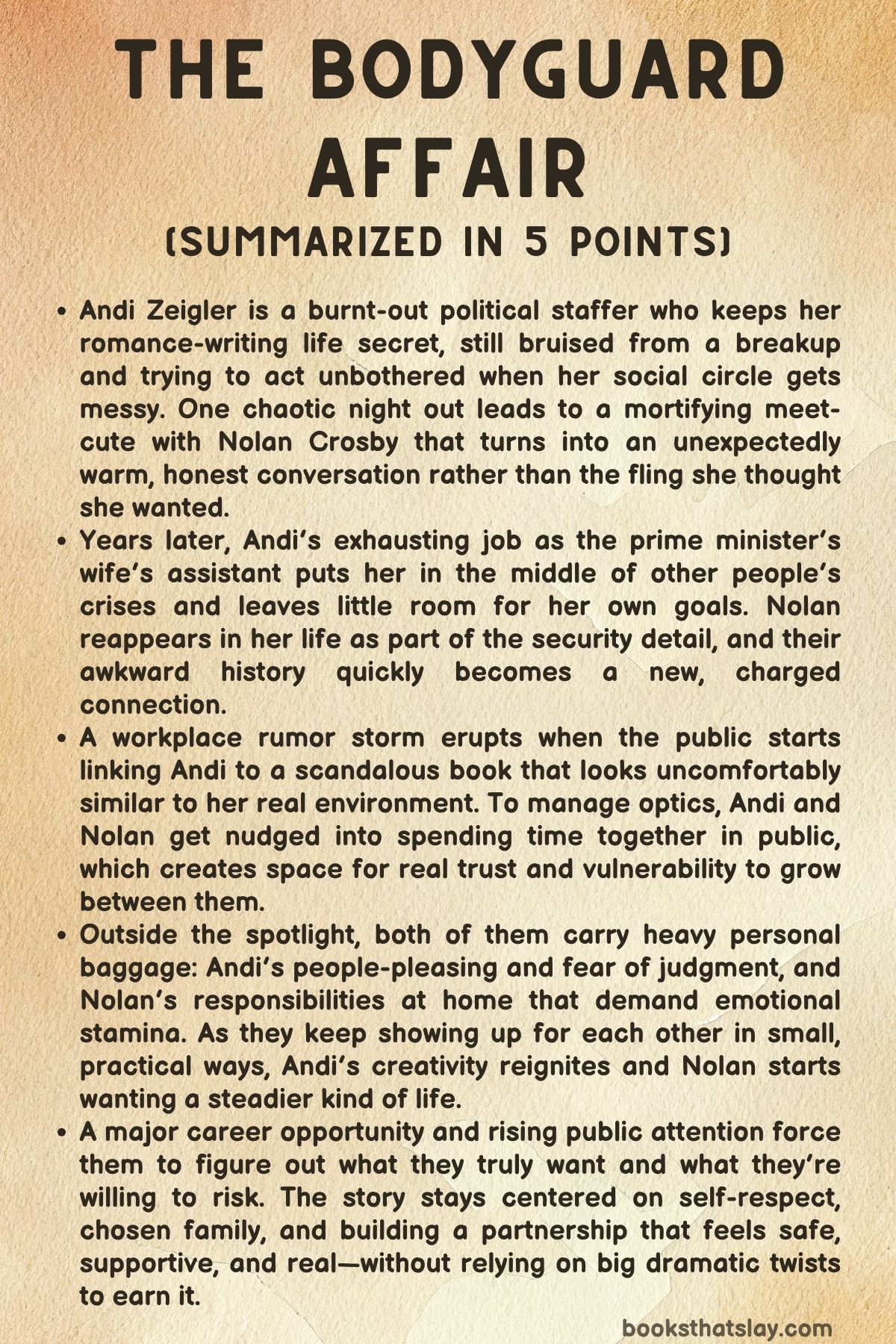
Summary
Andi Zeigler is trying to keep her head down in a busy Ottawa bar, tapping away on her tablet and hoping nobody notices she’s writing romance. Her best friend Laine shows up full of energy, pulls her onto the dance floor, and briefly shakes Andi out of the slump she’s been stuck in since breaking up with Hunter three months earlier.
Then Andi has a humiliating run-in in the unisex bathroom: while she’s half-dressed and trapped in an unlocked stall, a man opens the door and sees everything. They both panic, he apologizes, and he bolts.
Back at the table, Andi is hit with a different kind of embarrassment when she finds Laine sitting closely with Hunter—Andi’s ex, and still part of their shared political friend group. They all met as interns during an election campaign for the Democratic People’s Party, became inseparable, and promised the breakup wouldn’t wreck the friendship.
Hunter’s polished charm is still intact, but his attitude isn’t: he congratulates Andi on her new job and then sneers at it, calling her position “household staff” because she now works as the prime minister’s wife’s assistant. Andi swallows the insult.
She’s used to doing that around him.
When Andi tells Laine about the bathroom incident, Laine reacts like it’s the funniest thing she’s ever heard and immediately decides the mystery man is attractive. The man comes over to apologize properly.
His name is Nolan Crosby, and he’s awkwardly sincere. Andi wants to vanish, but Laine is delighted and insists Nolan was flirting.
The night turns sharper when Laine admits she and Hunter are together. She tries to frame it as something that “just happened,” even revealing that Hunter’s first message back when Andi and he started dating was intended for Laine.
Andi’s stomach drops. The betrayal is personal, but it’s also social: it threatens the one stable thing she thought she still had.
Laine and Hunter ask if she’s okay, and Andi forces a smile and gives them her “blessing,” even though she feels like she’s been punched.
Determined not to look crushed, Andi marches over to Nolan and blurts out a clumsy invitation. It’s reckless and unlike her, which is exactly why she does it.
Nolan—who’s supposed to be heading out the next day for a long military deployment—hesitates, but Andi is clear that she wants a no-strings night. They end up at a late-night grocery store, where Andi loads her cart with random comfort food and frozen pierogies.
On the walk home, Nolan stays alert, noticing how Andi moves through a rough area with surprising calm. She stops to chat with a homeless man named Ted and gives him food from the groceries—items she bought specifically for him.
Nolan clocks that Andi’s kindness isn’t performative. It’s a habit.
At Andi’s apartment, Nolan meets Lars, Ted’s dog, whom Andi is temporarily looking after. The dog dislikes men, but Nolan patiently wins him over with cheese.
Inside, Nolan also notices practical things: weak locks, a sliding door that needs fixing, small details that make him worry about Andi’s safety. Andi changes into pajamas, returns looking softer and more at ease, and they attempt to hook up.
It goes badly in the funniest, most human way possible: teeth clack, Nolan’s lip bleeds, Andi bumps her head, and she spirals into embarrassment, convinced she’s terrible at dating and intimacy.
Instead of pushing forward, Nolan slows everything down. He tells her they can stop, that she doesn’t have to prove anything.
The pressure drops, and what follows becomes the real turning point of their connection. They talk in bed for hours, eating cheesecake like it’s a shared secret.
Nolan learns that Andi writes romance novels and hides it from everyone, especially Laine, because she’s afraid of being mocked. Andi admits she’s starting a new book inspired by her work in politics.
Nolan, surprisingly thoughtful, encourages her to publish and suggests a pen name. They trade confessions and jokes, and by the time morning comes, they’ve built something more intimate than sex—trust.
Nolan leaves before Andi wakes up, quietly doing small acts of care: he puts the cheesecake away, finishes assembling her writing desk, makes a note about fixing her sliding door lock, and leaves Lars a final piece of cheese. His life moves on, and so does hers.
Years later, Andi is deep in the grind of her job as personal assistant to Gretchen Nichols, the prime minister’s wife. Her days are packed with errands, packing, scheduling, and damage control for household scandals—down to managing the prime minister’s laundry after a past public mess.
The work has swallowed Andi’s old political ambitions. Her romance writing still exists, but it’s squeezed into scraps of time and kept strictly private.
A new political scandal hits the government: the finance minister resigns after an affair is exposed. Gretchen is furious, Eric Nichols is under pressure, and Andi is caught in the middle of everyone’s stress.
Amid the chaos, Eric introduces the household’s new close protection officer. It’s Nolan Crosby.
The recognition is immediate and uncomfortable. Nolan remembers Andi, the cheesecake night, and the unfinished hookup.
Andi remembers everything too, including how safe she felt with him. Their first interactions are tense, but small moments soften it.
Nolan helps Andi remove a semi-permanent tattoo the Nichols kids stuck on her forehead, and their banter returns. Andi, rattled by seeing him again, finds her creativity waking up.
She starts writing in bursts for the first time in ages, churning out pages.
Then the real disaster lands: rumors spread online that Andi is having an affair with Prime Minister Eric Nichols. Photos and a story angle suggest intimacy.
Worse, reporters connect Andi’s name to a steamy romance novel about a prime minister and his assistant—The Bodyguard Affair’s heroine’s own book, published under a pen name. Andi panics and denies writing it.
Gretchen believes her, but the PR team tries to contain the narrative by limiting Andi’s visibility with Eric.
Andi suspects Nolan leaked the information because he knows she writes and he was nearby when some of the supposedly compromising moments happened. She corners Nolan and accuses him.
Under pressure, she admits the truth: she did write the book. Nolan’s response isn’t judgment—he hugs her, congratulates her, and promises he won’t expose her.
He treats her secret like something valuable, not shameful.
They step out of the storage closet they’re hiding in and immediately run into Gretchen, who assumes the hug means Andi and Nolan are dating. Gretchen’s reaction is practical in a way that makes Andi’s head spin: she thinks Andi dating Nolan could help redirect the affair narrative.
Suddenly Andi is being pushed into public outings with Nolan—football games, staged appearances, photo-friendly moments—while Nolan is tasked with being around her anyway for security work. What begins as a useful cover starts to blur into something neither of them can easily label.
Outside of work, Nolan’s private life is heavy. His mother, Lorna, is living with early-onset Alzheimer’s, slipping between lucidity and confusion.
Nolan and his sister Emma are preparing for her move into memory care, and the responsibility keeps Nolan pulled tight between duty and grief. Andi starts seeing the layers beneath his calm: how much he holds, and how little space he gives himself to fall apart.
Andi also has her own unfinished pain: Laine’s wedding invitation arrives. Laine is marrying Hunter.
Andi has been avoiding the RSVP because saying yes feels like pretending the betrayal never happened, but saying no would confirm the friendship is dead. Nolan, blunt in the right way, points out what Andi has been excusing for years—Laine’s judgment, Hunter’s cruelty, and how Andi keeps sacrificing her own comfort to keep everyone else happy.
Nolan jokes about going for the open bar and the chaos, then offers something real: he’ll go with her. With Nolan beside her, Andi feels like she can face the wedding without shrinking.
As their “dates” continue, real emotional intimacy grows. They talk honestly on walks, tease each other about their flaws, and share childhood histories that explain who they became.
Andi admits she’s a chronic people-pleaser shaped by a tense home life and a critical mother. Nolan admits his childhood was unstable, with his mother often absent and his sister and him passed between relatives.
Their connection becomes a place where neither has to perform.
Meanwhile, the scandal has an unexpected side effect: Andi’s romance novel shoots up the charts because the public is obsessed with the rumor. Andi is overwhelmed by attention, but it also cracks open a possibility she’s never let herself fully claim—writing could be more than a secret hobby.
The closer Andi and Nolan get, the more the physical tension returns, now grounded in trust instead of impulse. After weeks of growing closeness, they finally kiss and nearly go further during a lakeside moment, but the scene is interrupted by a call: Nolan’s mother has wandered off.
Andi insists on coming with him, and when they find Lorna, Andi instinctively steps into the role of “girlfriend” to make the situation feel safe. Later, Nolan admits how hard the disease has been, and how guilty he still feels for running from the responsibility early on.
Andi, frightened by how much she’s starting to rely on Nolan—and anxious about media fallout—texts him afterward that they should keep things “just friends.” Nolan agrees, even though it hurts. They both try to pretend that boundary will hold.
The trip to Mexico changes that. Surrounded by wedding festivities, old history, and the sharp reminder of what Hunter and Laine represent, Andi and Nolan become each other’s anchor.
Their closeness deepens, and Andi realizes she feels safe with Nolan in a way she’s never experienced. Nolan, in turn, realizes he’s fallen fully in love with her.
Right after that realization, Nolan is offered a major career opportunity: a prestigious royal protection assignment in Denmark for two years. It’s the kind of job he’s always wanted.
But now it comes with a price—leaving Andi just as they’ve found something real. Andi, terrified he’ll stay for her and resent it later, urges him not to decide out of emotion.
Nolan pulls back to handle his family crisis, including the painful process of moving his mother into care. On top of that, he suffers another heartbreak when a rescue dog he bonded with, Cody, is adopted by someone else.
The loss hits him hard, and he breaks down in a way he hasn’t allowed himself to in years.
Andi, meanwhile, admits to her sister that she loves Nolan too. She also reveals her biggest secret: she is the author behind the pen name, and her career is about to explode.
An agent has signed her, publishing offers are coming in, and there’s even film interest. Andi is standing at the edge of the life she wanted, but the fear of judgment still claws at her.
At a gala, Nolan finally shows up and pulls Andi away from the noise. He tells her he doesn’t want their relationship to be an arrangement anymore.
He wants something real, and he’s tired of running from attachment. Andi admits she wants the same.
Nolan then reveals a decision that surprises even him: he’s staying. He has put an offer on a house that symbolizes the home he always wanted as a kid, and he’s choosing a life that includes Andi.
But the happy moment collapses when Gretchen discovers Andi’s identity as the author. A careless slip—Andi signing her real name on a post—connects everything publicly.
Gretchen feels betrayed, media pressure spikes, and Andi panics, running home in shame. Nolan follows, steadies her, and refuses to let her destroy her future out of guilt.
He tells her the truth she’s been avoiding: she’s been living small because she’s afraid of being seen.
The fallout is messy. Andi faces her mother’s reactions and the reality of what secrecy has cost her friendships.
She also finally talks honestly with Laine, and they acknowledge the friendship has changed beyond repair, even if they can still care about each other. The closure is imperfect, but it’s real.
When Andi expects to be fired, Gretchen surprises her. She’s read the book, recognized the unhappiness in her own marriage, and decides to separate from Eric.
Gretchen doesn’t fire Andi and even suggests Andi stay with her through the transition, but Andi chooses herself. She leaves the job and commits to writing full-time.
Two weeks later, Andi signs her publishing contract with Nolan at her side. Cody returns to Nolan after the adoption fails, and Nolan adopts him for good.
They start building a future together, including moving into the yellow house Nolan bought, the one that finally feels like home.
Years later, Andi is a successful author on her sixth book tour, now publicly known and no longer hiding. Nolan supports her with a steadier job and remains present in her world.
They continue visiting Nolan’s mother in memory care, carrying both love and loss as part of their family life. At the end of a signing event, Nolan reminds Andi she’s pregnant, and they slip back into their shared tradition—playfully arguing over baby names—ready for what comes next.
Characters
Andi Zeigler
Andi Zeigler is the emotional and narrative center of The Bodyguard Affair—a woman whose competence in public is constantly at odds with her private fear of being seen too clearly. At the start, she’s smart, observant, and creatively alive, but also guarded to the point of self-erasure: she hides her romance writing because she expects ridicule, and she swallows discomfort rather than risk conflict.
That reflex shows up everywhere—from how she handles Hunter’s belittling comments to how she responds to Laine’s betrayal by forcing herself to give “permission” she doesn’t feel. Her people-pleasing isn’t simple insecurity; it’s a survival strategy shaped by a childhood spent keeping peace and managing a critical parent, which trains her to treat her own needs as negotiable.
In the political world, that training makes her useful but easy to exploit, and her job as Gretchen’s assistant becomes a symbol of how Andi’s ambitions have been slowly traded for constant service, urgency, and invisibility.
At the same time, Andi is never portrayed as passive—she’s deeply moral, quietly brave, and more generous than she knows. Her tenderness toward Ted and her protectiveness of Lars reveal a core identity built around care that doesn’t seek applause.
Even her romance writing, initially framed as “embarrassing,” is actually the most honest place she has—where she processes power, desire, and agency on her own terms. The public scandal about her novel forces her into the exact nightmare she’s been avoiding: being publicly associated with her own voice.
What’s powerful about her arc is that she doesn’t become fearless overnight; she learns to stop organizing her life around preventing judgment. Nolan’s presence accelerates this because he responds to her whole self—awkwardness, tears, overthinking, talent, and all—without punishing her for it.
By the end, Andi choosing to leave the PA role and write full-time isn’t just a career pivot; it’s a declaration that she will no longer live “small” to keep other people comfortable. Her growth lands as earned because it includes messy setbacks—panic, shame spirals, second-guessing—yet still moves toward ownership of her work, her love, and her future.
Nolan Crosby
Nolan Crosby reads, at first glance, like competence incarnate—steady, protective, physically capable—and The Bodyguard Affair uses that surface to reveal a quieter internal story about attachment and responsibility. His instinct is to watch entrances, notice weak locks, and evaluate risk, but the deeper pattern is how he tries to manage emotional danger the same way: by controlling variables, limiting vulnerability, and leaving before things get complicated.
That impulse is seeded early through his childhood instability and his mother’s absence, then amplified by adult experiences that reward stoicism. Nolan’s caretaking of Lorna complicates the “strong silent type” archetype because his strength isn’t clean or cinematic; it’s exhausted, conflicted, and sometimes resentful.
The novel allows him to be both loving and overwhelmed, both devoted and frightened of failing, which makes his protectiveness toward Andi feel less like fantasy and more like an extension of his fundamental desire to keep the people he loves from slipping out of reach.
What changes Nolan is not simply romance, but the experience of being emotionally witnessed without being managed. With Andi, he is allowed tenderness—cheesecake in bed instead of sex, laughter instead of performance, honesty instead of posturing—and that soft space becomes addictive because it’s safe.
His caregiving storyline with Lorna brings the theme of “staying” into sharp focus: Nolan has already lived through the consequences of disappearing, and he carries guilt for the times he left Emma holding the burden alone. That guilt could easily turn him into someone who chooses duty over desire, but the story pushes him toward a more mature integration—choosing a life where love isn’t a distraction from responsibility, but a reason to build stability.
His grief over Cody is a crucial emotional breaking point because it bypasses his usual control; the tears prove he isn’t numb, just armored. When he decides to stay rather than take the Denmark assignment, it’s not framed as sacrificing ambition for romance; it’s Nolan finally choosing belonging as a form of strength, and choosing a home—symbolized by the yellow house—he once believed was unattainable.
By the epilogue, Nolan’s love remains protective, but it’s no longer primarily about guarding against loss; it’s about building a life sturdy enough to hold joy.
Laine
Laine is written as both charm and rupture—a character whose bright, social energy makes her seem like the “fun” friend, while her choices expose how easily warmth can coexist with self-centeredness. In the opening, her behavior with Andi feels affectionate and familiar: she coaxes Andi into the night, boosts her confidence, and treats her embarrassment like a shared comedy rather than a humiliation.
That dynamic matters because it establishes why Andi values her so deeply; Laine represents a kind of social ease Andi doesn’t naturally have. But Laine’s confession that she’s dating Hunter lands as betrayal precisely because it comes wrapped in a breezy rationalization, as if emotional fallout is just an inconvenience that can be smoothed over with reassurance.
The story suggests Laine isn’t malicious so much as conflict-avoidant in her own way—she prefers narratives where everyone “supports” her decisions, even when those decisions cost someone else.
Laine also functions as a mirror for Andi’s boundaries. The relationship with Laine survives for too long in a hollow, performative form because Andi equates politeness with loyalty and guilt with love.
Laine’s judgment of Andi’s romance writing is especially telling: she doesn’t just fail to protect Andi—she participates in the very shame that keeps Andi hidden. Over time, the friendship fading into shallow contact feels less like a sudden breakup and more like a slow reveal of incompatibility: Andi craves safety and sincerity; Laine prioritizes social momentum and her own romantic storyline.
Their later reconciliation carries bittersweet weight because it’s not a triumphant return to “best friends,” but a realistic acknowledgement that affection doesn’t erase harm and that people outgrow the roles they once played for each other. Laine’s presence ultimately sharpens the book’s central question for Andi: who gets access to her softness, and who has earned it.
Hunter
Hunter is the most overtly antagonistic presence in Andi’s personal life, not because he’s a melodramatic villain, but because he embodies a specific kind of everyday manipulation: the person who benefits from someone else’s brilliance while steadily training them to doubt it. His early relationship with Andi begins in a familiar workplace-romance rhythm, but the pattern turns corrosive as soon as Andi’s contributions become valuable.
He takes credit for her slogan work, undermines her in meetings, and frames her ambitions as obstacles to his own—then pressures her to “step aside” while maintaining the fiction that they are still a respectful couple. The cruelty is in the subtlety: he doesn’t need to scream to dominate; he belittles, reframes, and normalizes Andi’s diminishing role until she starts treating her own goals as unreasonable.
Hunter’s role becomes even sharper when he begins dating Laine, because it violates the supposed agreement that their breakup wouldn’t fracture the group, revealing how conveniently that agreement served him. His presence at the bar, congratulating Andi while dismissing her job as “household staff,” is a concise demonstration of how he sees her: useful when supporting his image, disposable when pursuing her own path.
Importantly, the story doesn’t require Hunter to receive dramatic comeuppance for his function to work; his “win” in the political job market and his smooth movement into a new relationship show a realistic truth that complicates Andi’s healing. The story’s answer to Hunter isn’t revenge—it’s Andi reclaiming authorship of her life and refusing to measure her worth by the people who minimize it.
Gretchen Nichols
Gretchen Nichols begins as an intimidating force—demanding, image-conscious, and seemingly indifferent to how thoroughly she consumes Andi’s time and energy. Through Andi’s eyes, Gretchen’s world is relentless: constant packing, errands, crisis management, and humiliating domestic tasks disguised as professional necessity.
Gretchen’s controlling streak, including monitoring Andi’s location, paints her as a boss who treats staff as extensions of her will. Yet the novel gradually reframes her as a woman trapped inside a collapsing public marriage, forced to maintain composure while absorbing disappointment.
Her anger over Eric’s canceled anniversary isn’t just entitlement; it’s the cumulative pain of being deprioritized in private while expected to smile in public.
Gretchen’s most revealing trait is her ability to pivot—sometimes into pragmatism, sometimes into denial. When the scandal about Andi and Eric erupts, she chooses a strategy: believe Andi, shape the narrative, and manage optics.
That choice carries both generosity and self-interest, which makes her feel human rather than saintly. Her enthusiastic “solution” of pushing Andi and Nolan into a public-facing relationship shows how deeply she thinks in terms of deflection and storyline; she treats romance like PR infrastructure.
But Gretchen’s eventual arc becomes one of self-recognition. Reading Andi’s book functions like a cracked mirror: it forces Gretchen to acknowledge how unhappy she is, and instead of clinging harder, she chooses separation.
That decision is one of the more quietly radical moments, because it suggests Gretchen is not merely a demanding boss or wronged spouse—she is also a woman reclaiming agency after years of accommodation. Her final interaction with Andi is surprisingly humane: she doesn’t destroy Andi for the public mess, and she even offers continuity, but she respects Andi’s choice to leave.
Gretchen ends as a complicated figure—flawed, often difficult, but capable of growth when confronted with emotional truth.
Prime Minister Eric Nichols
Eric Nichols is positioned as powerful on paper and fragile in practice, making him an effective study of how authority can coexist with emotional helplessness. In public, he is the prime minister navigating press conferences, scandals, and optics; in private, he is a husband failing at presence and a man who uses intermediaries—often staff—to avoid direct conflict.
The image of Gretchen and Eric communicating through their employees at events highlights not just marital dysfunction but a habit of outsourcing emotional labor to people with less power. Andi folding his underwear after “Underweargate” underscores the indignities of public life, but it also hints at a man whose personal world is managed by others, blurring the line between leadership and dependence.
Eric’s breakdown during the planned anniversary dinner complicates him: he isn’t simply a neglectful spouse; he is also exhausted, guilty, and deeply uncertain about how to repair what he’s broken. His request for Andi’s advice shows both humility and irresponsibility—humility because he admits he’s lost, irresponsibility because he places the burden of his marriage on an employee.
Andi’s practical counsel functions as a narrative contrast: the assistant, not the leader, models grounded emotional intelligence. The rumor storyline also uses Eric as an instrument of systemic imbalance; the scandal attaches to Andi far more dangerously than it does to him, reminding the reader that reputational risk isn’t distributed equally.
By the end, Eric isn’t depicted as monstrous, but as emblematic of a particular kind of privileged drift—someone whose life is buffered enough that he can postpone hard conversations until the relationship collapses and someone else makes the decisive move.
Amanda Zeigler
Amanda is Andi’s most reliable emotional anchor, and her role is defined by two intertwined traits: protective clarity and affectionate bluntness. Where Andi spirals into guilt and tries to preserve old bonds out of obligation, Amanda reads situations with fewer illusions, especially regarding Laine’s wedding invitation and what it symbolically asks Andi to swallow.
She’s the person who gives Andi permission to admit the truth—that a friendship can end without anyone being “the villain,” and that loyalty doesn’t require self-abandonment. Amanda’s support is also practical rather than performative; she offers space for Andi’s messiness without demanding Andi keep the peace.
Amanda’s importance intensifies when Andi reveals she is A. A. Zed and has real publishing momentum. Amanda’s shock turns quickly into pride, and her response models the acceptance Andi has been craving.
That moment matters because Andi’s secrecy has been fueled by fear of being judged by the people closest to her; Amanda becomes evidence that intimacy doesn’t have to be conditional. Even when Amanda teases Andi about Nolan, the teasing feels like affection that assumes Andi is allowed to want things.
In a story full of characters who unintentionally pressure Andi into roles, Amanda is the rare person who consistently points Andi back to herself.
Ted
Ted appears briefly compared to the central cast, but he carries outsized thematic weight because he reveals Andi’s character through action rather than self-description. Andi’s relationship with Ted shows her as someone who sees people others overlook and who gives help in a way that preserves dignity.
She doesn’t perform charity; she quietly builds care into her routine, buying food specifically for him and checking on his health. Ted’s warmth toward Andi—calling her his “guardian angel”—is both touching and subtly instructive: it suggests that Andi’s worth is already visible in the world, even if she struggles to believe it in rooms full of political power players.
Ted also serves as an intuitive barometer for Nolan. His approval of Nolan, and the ease with which Nolan fits into that small exchange, helps establish Nolan as safe beyond physical protection.
Through Ted, the novel grounds its romance in community and ordinary kindness, preventing the story from being only about scandal, status, and headlines.
Lars
Lars, the dog Andi temporarily keeps for Ted, functions as an emotional truth-teller. His wariness around men immediately injects realism into the “random hookup” setup and forces Nolan to prove gentleness rather than assume it.
Nolan earning Lars’s trust—patiently, with cheese and calm presence—becomes a quiet demonstration of how Nolan approaches vulnerability: he doesn’t force closeness; he waits for consent. Lars also symbolizes Andi’s caretaking identity and the way she takes responsibility for others even when her own life is strained.
In a story where Andi often doubts her desirability and social competence, Lars’s guardedness and gradual acceptance reflect a deeper question about trust—who gets to come close, and under what conditions.
Lorna Crosby
Lorna is one of the most emotionally complex figures in the book because she exists in two timelines at once: the mother who was absent and unreliable during Nolan’s childhood, and the present-day woman losing herself to Alzheimer’s. That duality complicates easy judgments.
Nolan’s resentment and love are not contradictions; they’re the natural outcome of a parent who caused harm and is now also profoundly vulnerable. Lorna’s lucid moments, where she can be warm or self-aware, are especially painful because they offer fleeting glimpses of connection just as the illness steals her ability to sustain it.
Her decline forces Nolan into a role reversal that tests his identity. Caring for Lorna means living inside uncertainty—outbursts, wandering, confusion—and confronting decisions that carry guilt no matter what, such as moving her into memory care.
The reconciliation scene, where Lorna acknowledges her past absence, gives Nolan something he has needed for years: recognition. It doesn’t erase the damage, but it softens the loneliness of carrying it alone.
Emma Crosby
Emma represents the sibling who stayed—the one who absorbed responsibility when Nolan couldn’t or wouldn’t. Her presence highlights Nolan’s guilt and the long shadow of family systems where burdens are unevenly distributed.
Emma is not just a supporting caretaker; she is a point of moral reckoning for Nolan, because loving Andi and imagining a future requires Nolan to also repair the past he left behind with Emma. Their conversations about Lorna’s care and Nolan’s apology reveal a relationship marked by fatigue, devotion, and the complicated forgiveness siblings can offer when they share the same wounds but carried them differently.
Emma also broadens the story’s idea of partnership: care is not only romantic; it’s familial, ongoing, and sometimes unglamorous.
Bethany
Bethany, the PR director, embodies institutional crisis logic: contain the story, redirect attention, control visuals, minimize exposure. She’s not characterized as cruel, but as professionally decisive in a way that can feel cold to someone like Andi, whose body and reputation are suddenly the battlefield.
Bethany’s role underscores how quickly a woman’s image can be weaponized in politics and how easily “truth” becomes secondary to optics. When Bethany chooses a strategy that includes limiting Andi’s proximity to Eric, it confirms the hierarchy: the institution will protect the prime minister, and the assistant will carry the sharper edge of suspicion.
Bethany’s presence reinforces the book’s tension between private reality and public narrative, a tension that ultimately pushes Andi to stop living as if she must be managed.
Jones
Jones functions as the embodiment of Nolan’s career path and the temptation of clean, prestigious solutions. Offering Nolan the royal protection assignment in Denmark is not merely a job opportunity; it’s a test of the identity Nolan has built—someone who stays versus someone who runs toward the next posting.
Jones doesn’t need to be deeply explored for the offer to matter because what it represents is so clear: validation, ambition, escape, and the kind of future Nolan once assumed he would choose by default. The presence of Jones at that pivotal moment sharpens the romance into a genuine decision rather than a drift; Nolan’s eventual choice to stay gains weight precisely because the alternative is legitimately desirable.
Deidra
Deidra, connected to the rescue farm, is a small but significant figure because she facilitates one of Nolan’s most emotionally revealing arcs. By informing Nolan about Cody’s adoption possibility and giving him the option to apply, she becomes the person who forces Nolan to confront uncertainty honestly: you cannot responsibly claim what you’re not prepared to hold.
Deidra’s role is gentle but pivotal—she allows choice, but she does not shield Nolan from consequence. Through her, the story frames love—romantic or otherwise—as commitment, not fantasy.
Cody
Cody is more than a “cute dog subplot”; he is an emotional catalyst for Nolan’s capacity to attach. Nolan bonding with Cody happens in a space that isn’t performative and isn’t tied to duty—he isn’t protecting Cody for work, and he isn’t caretaking out of obligation.
He simply wants him. That distinction matters because it reveals Nolan’s hunger for tenderness that has no strategic purpose.
When Cody is adopted, Nolan’s grief is raw and uncontained, shattering the persona of controlled competence and showing how much feeling Nolan has been holding back. Cody returning after a failed adoption and Nolan choosing to adopt him becomes a symbolic affirmation of Nolan’s transformation: he is no longer waiting for life to be stable before he loves; he is building stability around the things he loves.
Cher
Cher, Andi’s agent, represents the external validation Andi has secretly wanted but feared she didn’t deserve. Signing with an agent and receiving major publishing offers turns Andi’s private dream into a public trajectory, forcing her to reconcile self-image with reality: she isn’t “playing” at writing; she is a professional talent.
Cher’s presence shifts the stakes from personal embarrassment to life-changing opportunity, which intensifies Andi’s panic when her identity is exposed. Functionally, Cher is the doorway out of Andi’s smaller life, and emotionally, she is proof that Andi’s voice has value beyond the safe anonymity of a pen name.
Finance Minister Kevin Kirkwood
Kevin Kirkwood is less a character and more a political spark that illuminates the ecosystem Andi works within. His resignation after the nanny exposes the affair shows how scandals erupt suddenly and how personal choices at the top create chaos that cascades downward onto staff.
His storyline contextualizes why Gretchen is already primed for rage and humiliation, and it reinforces the book’s broader theme: power doesn’t prevent mess—it just changes who pays the price when the mess becomes public.
Themes
Control, Exposure, and the Cost of Being Seen
Andi’s life is shaped by a constant attempt to control who gets access to her real self. The secrecy around her romance writing isn’t a quirky detail; it’s a survival strategy built from past experiences of being dismissed, underestimated, or judged.
She hides her work from Laine because Laine’s opinion matters too much, and because Andi has learned that the safest version of herself is the one that asks for nothing. That instinct shows up everywhere: at the bar when she swallows Hunter’s insult about her job, at work when she backs down from requesting time off, and in her reflex to smooth over discomfort so nobody else has to feel it.
The scandal that links her to her own book forces a confrontation with a fear she’s been managing for years: the fear that visibility will invite ridicule, punishment, or abandonment.
What makes the exposure so destabilizing is that it happens in multiple layers at once. The public thinks they know Andi through a sexualized rumor; Gretchen believes she knows Andi as a loyal employee; Laine believes she knows Andi as a friend who shares everything.
None of these versions is fully true, but each has consequences. The story shows how a woman’s identity can be seized and rewritten by other people’s narratives—online headlines, workplace gossip, political optics—until her own voice feels like the least powerful one in the room.
Even when the exposure benefits her career, it still arrives as a violation, because it wasn’t her choice. That tension is key: success doesn’t automatically heal the shame that comes from having your privacy taken.
Over time, Andi’s growth looks less like becoming fearless and more like learning that she can survive being known. Nolan’s role is important here because he responds to her secret with respect rather than appetite for gossip.
He treats her writing as real work, not a punchline, and that reframes exposure as something that can be negotiated instead of something that only happens to her. By the end, Andi stepping into a public author identity isn’t just a career move; it’s a refusal to keep shrinking to fit other people’s comfort.
The Bodyguard Affair treats visibility as both risk and liberation, and it doesn’t pretend the liberation is tidy. It’s earned through discomfort, accountability, and repeated choices to stay present even when hiding would feel easier.
Power Imbalances, Recognition, and the Quiet Theft of Credit
Andi’s history with Hunter establishes a pattern that repeats in different forms throughout the story: powerful people taking up space, while she adjusts herself to accommodate them. Hunter doesn’t just break her heart; he trains her to doubt her right to ambition.
He benefits from her ideas, then claims them publicly, and that dynamic leaves Andi with a confusing mix of pride and resentment—pride because she was genuinely talented, resentment because she was treated as disposable. The most painful part is how familiar it feels.
Hunter isn’t portrayed as a cartoon villain; he’s the kind of person who can sound supportive while quietly steering outcomes in his favor. That realism matters because it mirrors how professional harm often occurs: not through dramatic cruelty, but through repeated dismissals that teach someone to step back.
Her job as Gretchen’s assistant continues the theme in a different register. The work is demanding, intimate, and exhausting, but it is also structurally invisible.
Andi’s labor is essential to the household’s functioning and the family’s public image, yet she is treated as a tool rather than a person with her own life. The detail of being monitored by location is a clear signal: even her time is not fully hers.
The “Underweargate” errands and crisis management show how proximity to power doesn’t equal power; it often means cleaning up after it. Andi becomes the person who absorbs mess so others can appear composed.
In that environment, her writing—especially a book that sexualizes the assistant/leader dynamic—becomes explosive, because it exposes the fantasy that people project onto staff while ignoring the reality of their exploitation.
The rumor about Andi and the prime minister also reveals how quickly institutions will sacrifice an individual to protect the powerful. The PR response is not centered on Andi’s wellbeing; it is centered on optics, containment, and narrative control.
Even Gretchen’s “solution” of pairing Andi with Nolan is another form of using her body and public image as a tool, even when it’s framed as helpful. This is where the theme becomes especially sharp: Andi’s value is repeatedly measured by how well she can serve someone else’s story.
The scandal that boosts her book sales is a bitter twist, because her creative success is fueled by the same system that is humiliating her.
Against that backdrop, Andi’s eventual decision to leave and write full-time reads like a reclamation of recognition. She stops accepting roles where her competence is only valuable when it remains unnamed.
The story shows how credit can be stolen in tiny moments—an idea taken, an ambition minimized, a boundary ignored—and how recovering from that theft requires more than “confidence.” It requires changing the conditions of your life so your work and identity can’t be treated as public property.
Caregiving, Duty, and the Fear of Becoming Someone Who Leaves
Nolan’s storyline with his mother adds a heavy, human dimension to the romance: love isn’t only about desire or compatibility; it’s also about responsibility, endurance, and grief that doesn’t resolve on schedule. His mother’s Alzheimer’s forces him into a role that demands emotional strength while offering almost no emotional reward.
He can do everything “right” and still lose ground, still be misunderstood, still be hit by the whiplash of lucidity followed by confusion. The story captures how caregiving scrambles time: you’re dealing with the present crisis while already mourning the future.
Nolan’s life is structured around vigilance—watching for wandering, managing care logistics, coordinating with his sister and the nurse—yet he’s still one unexpected outburst away from chaos. That pressure sits under his interactions with Andi, even when they are joking or flirting.
His guilt is just as important as his devotion. Nolan admits he once ran from the responsibility after the diagnosis, leaving Emma to carry the weight.
That confession matters because it shows how caregiving can trigger shame in two directions at once: shame for feeling trapped, and shame for wanting to escape. The narrative doesn’t moralize his earlier absence; it treats it as a wound that still shapes how he sees himself.
When his mother throws a padlock at him, the scene is frightening, but it also communicates a cruel reality: the person you’re protecting can become the person who harms you, without meaning to. Nolan’s decision to keep showing up anyway becomes a measure of character, not because he’s perfect, but because he stays accountable even when it hurts.
This theme also influences his relationship with Andi. Nolan’s instinct is to handle problems alone, partly because his childhood taught him not to rely on consistency from adults.
His mother’s earlier absence created a template: attachment leads to disappointment, so independence feels safer. Alzheimer’s reverses roles in a way that intensifies that lesson.
He is the stable one now, but the stability is built on constant loss. Falling for Andi therefore isn’t just romantic; it threatens a coping mechanism.
It asks him to believe in a future that isn’t entirely under his control.
The yellow house becomes a symbol of chosen stability. It represents a home he wanted as a child and a life he thought might be out of reach.
Buying it is not only a romantic gesture; it’s an act of repairing a personal history that taught him not to expect permanence. Caregiving doesn’t disappear at the end—Lorna remains in memory care, visits continue—but Nolan’s life is no longer only crisis management.
The story treats duty as both burden and anchor, and it suggests that love can be a place where duty is shared, not carried in silence.
Belonging, Chosen Family, and Learning to Ask for More
Loneliness sits under many of Andi’s choices, even when she’s surrounded by people. At the bar, she’s literally alone in a crowd.
At work, she is constantly needed but rarely cared for. Her friendship with Laine, once central, becomes a source of quiet pain because it’s built on a version of closeness that no longer exists.
Andi’s breakup with Hunter isn’t only romantic loss; it’s also the loss of the future she thought she was building in politics and in a shared social world. That’s why Laine and Hunter getting together lands like an identity threat: it suggests Andi was never as secure in that circle as she believed.
Belonging, in this story, is not about being invited; it’s about being considered. Andi often accepts inclusion that comes with conditions—be agreeable, be helpful, don’t make it awkward, don’t take up too much space.
Her care for Ted and Lars shows another kind of belonging: she creates community through small, consistent acts. Ted calling her a “guardian angel” isn’t only gratitude; it signals that Andi’s instinct is to protect others even when she struggles to protect herself.
Taking in Lars for Ted is an act of chosen family, rooted in loyalty and compassion rather than obligation.
Nolan’s relationships echo this theme from a different angle. His childhood instability left him with a hunger for home that he doesn’t fully admit until later.
His bond with Cody at the rescue farm is telling: he connects with a timid dog who needs patience, and the attachment hits him hard because it’s uncomplicated love, the kind that doesn’t ask him to perform competence or strength. When Cody is adopted and Nolan breaks down, it reveals how many losses he has been storing without release.
That grief is also about belonging—wanting to be someone’s safe place and fearing that life will keep taking safe places away.
Andi and Nolan build belonging through ordinary time together: errands, baking, walking, talking, helping with practical problems. These are not glamorous scenes, but they establish a relationship where care is mutual.
Andi doesn’t have to earn Nolan’s attention by being impressive, and Nolan doesn’t have to hide his pain to be lovable. Their “fake dating” begins as a public strategy, but it turns into a space where they practice being seen without penalty.
That shift is crucial: belonging isn’t declared, it’s built.
The final shape of belonging includes boundaries. Andi’s reconciliation with Laine is bittersweet because it acknowledges change rather than pretending they can return to the past.
Gretchen’s decision to separate is also a boundary: a refusal to keep participating in a hollow version of togetherness. Andi leaving to write full-time is another boundary: she stops treating her dreams as optional.
The book presents belonging as something you can choose and craft—through honesty, through steady care, and through the courage to ask for more than mere acceptance.