The Bond that Burns Summary, Characters and Themes
The Bond that Burns by Briar Boleyn is a dark fantasy novel that explores power, control, and rebellion within a world where dragons and bloodlines define destiny. The story follows Medra, a student at Bloodwing Academy who becomes the center of political turmoil after accidentally awakening Nyxaris, a legendary black dragon long thought extinct.
Her rare connection to the creature makes her both a weapon and a target in the hands of ruthless highblood houses seeking dominance. Through confinement, manipulation, and dangerous alliances, Medra must uncover the truth behind the dragons’ disappearance and decide whether to submit to or defy the forces that would claim her soul.
Summary
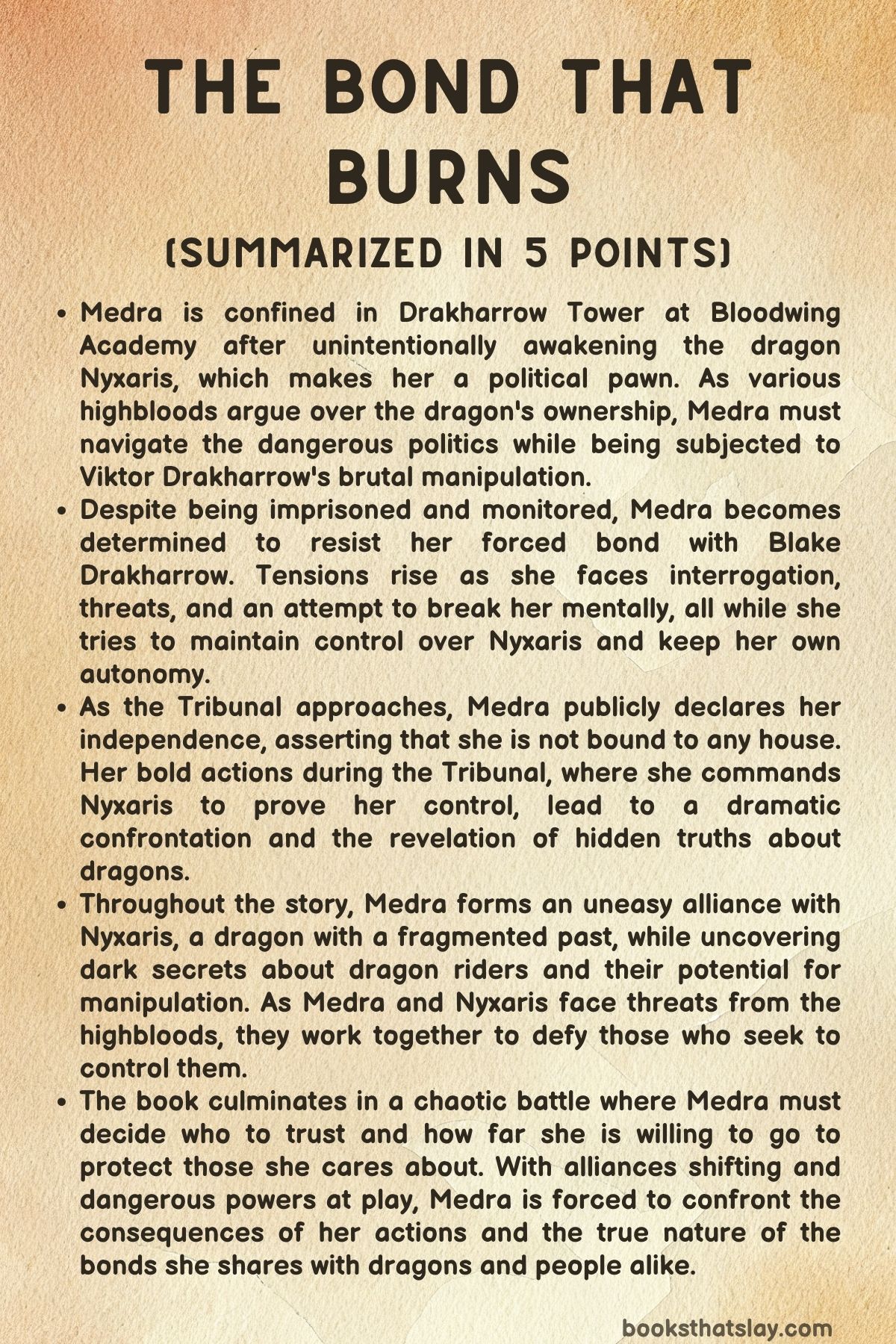
Medra’s story begins with her imprisonment in Drakharrow Tower after awakening the dragon Nyxaris, a feat that shocks the magical world of Bloodwing Academy. Treated as a valuable prisoner rather than a student, Medra’s every move is watched, and her connection to the dragon sparks fierce debate among powerful highblood families.
Each faction seeks to control her for their gain, believing that whoever owns the rider owns the dragon.
Two months before her confinement, chaos had erupted when Nyxaris burst free from his stone form. Medra, confused and afraid, faced intense questioning from influential figures including Viktor Drakharrow, Natsumi Avari, and Lord Sylvain.
They accused her of summoning the dragon and argued over ownership—House Avari claimed Nyxaris by lineage, while House Drakharrow claimed Medra herself because of her bond with Blake Drakharrow. Headmaster Kim argued for a formal tribunal to determine the matter, but fear of Nyxaris’s power drove the highbloods to act quickly.
When Viktor attempted to pry into Medra’s mind using thrallweave magic, she barely resisted his assault with the help of Professor Rodriguez, who intervened and stopped the attack.
Rodriguez secretly advised Medra to pretend she could control Nyxaris, as fear might protect her longer than honesty. He warned her that the worst outcome would be the destruction of both her and the dragon to maintain political order.
Soon after, Medra was locked in a lavish but restrictive room in Drakharrow Tower, where Blake—her unwilling betrothed—was assigned to guard and feed from her, as his vampiric nature required her blood. Their relationship, fraught with resentment and forced intimacy, highlighted her loss of autonomy and Blake’s own inner conflict between duty and affection.
As the tribunal approached, Medra endured months of isolation and manipulation. Viktor’s repeated mental attacks and threats pushed her to claim that Nyxaris obeyed her, a lie that kept her alive but deepened her peril.
Blake, torn between loyalty to his family and feelings for Medra, became both her protector and her captor. Their tense exchanges revealed layers of betrayal and pain as each tried to navigate the dangerous web of power surrounding them.
When the tribunal finally convened, Medra defied expectations. Refusing to dress as a Drakharrow consort, she appeared in neutral student colors to assert her independence.
Before an audience of nobles and regents, the leaders of the great houses debated her fate. Lady Elaria Avari argued Nyxaris belonged to her house by heritage; Viktor claimed Medra, and therefore the dragon, for House Drakharrow; Lord Mortis called for both to be destroyed to prevent future wars; and Lysander Orphos advocated for Medra’s freedom.
Amid political chaos, Medra demanded to speak, rejecting the notion that she was property and revealing that Nyxaris was not bound to anyone’s will.
To prove it, she summoned Nyxaris to the Black Keep. The dragon’s dramatic arrival stunned the crowd and confirmed her claim of communication with him.
When Mortis attacked her, Nyxaris killed him, igniting further panic. Medra denied commanding the dragon’s fire, insisting that Nyxaris acted on his own will.
She mounted him and escaped, vowing to uncover the truth behind the dragons’ disappearance.
Back at Bloodwing, Medra discovered disturbing secrets through Professor Hassan’s notes. The documents described Nyxaris as a weapon used by highbloods to suppress dissent and identified Medra as a candidate for “Soul Binding,” a ritual allowing a highblood to control a dragon by consuming the rider’s soul.
Realizing she was marked for sacrifice, Medra turned to Professor Rodriguez, who warned her that revealing too much could hasten her death. He urged her to strengthen her mental defenses and learn from Nyxaris while avoiding complete bonding, as that would make her easier to exploit.
Medra met Nyxaris again, sharing what she had learned of his grim past. Though enraged by the revelations, the dragon agreed to support her during the upcoming evaluation to ensure her survival.
Their alliance deepened into mutual respect as both sought to navigate a world eager to enslave them. During the evaluation, Nyxaris performed flawlessly, convincing the tribunal that Medra held mastery, though in truth, their bond was one of fragile trust rather than control.
Meanwhile, Blake uncovered his own family’s dark history. Under Viktor’s manipulation, he discovered his transformation into a dragon was not a curse but an intentional experiment by his uncle, who sought to create a hybrid capable of dominating dragons and riders alike.
Consumed by rage, Blake succumbed to his transformation and killed Viktor, realizing too late the monstrous legacy his bloodline carried.
As the final chaos unfolded, Medra’s world fell apart. The dragon Nyxaris was ambushed and poisoned by the Emberwatch—an order of dragon hunters disguised within the academy—led by Rodriguez and Kage Tanaka.
At the same time, Bloodwing’s Solstice Ball turned bloody when Blake’s sister Aenia murdered a student and was killed in retaliation, driving Blake into madness. These events converged in the Dragon Court, where multiple factions clashed.
Marcus Drakharrow and Catherine Mortis unleashed Molindra, a corrupted golden dragon resurrected through necromancy, bringing devastation upon all.
In the ensuing battle, Nyxaris, weakened but defiant, fought to protect Medra and her friends. Medra, channeling the spirit of her mother Orcades through a dagger, briefly seized control of the corrupted dragon, sending it—and her enemies—away into the sky.
When the dust settled, her friend Florence lay dying. Desperate, Medra begged Nyxaris to save her using forbidden magic.
At first, he refused, unwilling to repeat the mistakes of his past, but the presence of a magical creature named Neville, whose song soothed him, changed his mind. Nyxaris agreed to attempt the ritual, merging dragon blood with Florence’s to save her life, even as uncertainty and danger hung over them all.
The Bond that Burns closes on a note of uneasy hope. The dragons’ return has reignited ancient conflicts, alliances are shattered, and Medra stands between worlds—part human, part legend—determined to uncover the truth and reclaim her freedom, even as new flames of rebellion begin to rise.
Characters
Medra
Medra is the central character of The Bond that Burns, a young woman whose life is turned upside down when she accidentally awakens the black dragon, Nyxaris. Initially portrayed as a prisoner within the luxurious but confining Drakharrow Tower, Medra’s character evolves throughout the narrative as she grapples with her identity, power, and survival in a world dominated by political intrigue and manipulation.
Medra is fiercely independent and initially rejects the bond forced upon her with Blake, her betrothed. She has a strong will and often challenges the authorities that seek to control her, including Viktor Drakharrow, who attempts to manipulate her for his own gain.
Despite the intense pressure from the highbloods and her increasingly complex relationship with Nyxaris, Medra’s defiance and desire for autonomy shine through. She is intelligent and resourceful, using her wits and the potential to control the dragon as leverage.
Medra’s internal struggle is poignant, as she tries to maintain control over her life and the dragon while navigating a landscape of betrayal and power games.
Blake Drakharrow
Blake Drakharrow is initially introduced as Medra’s betrothed and one of the main antagonists of the story. His role in the political machinations of House Drakharrow is central, as his uncle Viktor seeks to use Medra as a pawn in their family’s schemes.
Blake’s character is complex, filled with contradictions. He seems to care for Medra, yet his actions often betray a lack of understanding of her autonomy, especially when he insists on their bond despite her objections.
Blake is also burdened by his family’s expectations and the mysterious changes occurring within him, which are later revealed to be related to his transformation into a dragon, a curse imposed on him by Viktor. This mutation makes him increasingly dangerous and isolates him from others, including Medra.
His emotional turmoil, anger at his family’s manipulation, and his eventual rage against Viktor lead to his violent transformation, where he becomes a dragon. The evolution of his character from a seemingly entitled, unfeeling aristocrat to a conflicted individual seeking redemption and understanding adds depth to his role in the story.
Viktor Drakharrow
Viktor Drakharrow is one of the main antagonists in The Bond that Burns. He is a member of the highbloods and is ruthless in his pursuit of power, willing to manipulate Medra and use her as a tool to gain control over the dragon Nyxaris.
Viktor’s character is driven by a desire to preserve and expand his family’s influence, even if it means using brutal methods. His attempts to force Medra into submission, including torturing her mentally with thrallweave, highlight his cruelty and lack of empathy.
Viktor sees Medra as nothing more than a means to an end, either as a tool to control Nyxaris or as a pawn in his family’s ambitions. His obsession with Nyxaris and the dragon’s potential power leads him to push boundaries, disregarding the consequences of his actions.
Despite his cold, calculating demeanor, Viktor’s relationship with his family—especially with Blake—is revealed to be more complex, marked by manipulation, control, and the disturbing use of Blake as an experiment.
Nyxaris
Nyxaris, the black dragon, is one of the most pivotal characters in The Bond that Burns. While Nyxaris is initially perceived as a tool to be controlled by the highbloods, his character develops into one of autonomy and defiance.
Medra awakens him by accident, and as the story progresses, it becomes clear that Nyxaris is not a simple beast but a dragon with his own intelligence and will. His bond with Medra is central to the plot, as he challenges the power structures of the world around him.
Nyxaris is wary of forming close ties due to his fragmented memories of the past and the betrayal he has suffered. Despite this, his relationship with Medra grows, and he begins to trust her more as she helps him uncover the truth about dragons and their history.
Nyxaris is not bound by the commands of any house, and his ultimate loyalty lies with Medra, though it remains unclear if he can ever fully trust humans again after the trauma he has experienced. His complex, multifaceted nature as both a weapon and a free entity makes him an intriguing character in the narrative.
Kage Tanaka
Kage Tanaka is a secondary character who plays a significant role in The Bond that Burns as a calm, composed, and strategic figure. He is a member of House Tanaka and is closely aligned with Medra’s circle of allies, though he remains somewhat enigmatic throughout the story.
Kage is portrayed as someone who values loyalty and is not swayed easily by the political pressures of the highbloods. His interaction with Medra is somewhat reserved, but he is a key ally in the fight against the oppressive forces that seek to control her and Nyxaris.
His transformation into a massive white wolf during the battle against Molindra adds a layer of mystery to his character, showing that there is more to him than meets the eye. Kage’s loyalty to his friends, particularly Medra, becomes more evident as the story unfolds, making him a reliable and trustworthy character in the face of danger.
Regan Pansera
Regan Pansera is introduced as a bold and assertive character, known for her confidence and her ability to influence the highbloods around her. She is a member of House Pansera and seems to have her own agenda, often pushing Viktor and other figures of power to act according to her interests.
While her role in the overall plot is more subtle compared to the primary characters, Regan’s interactions with Viktor and Medra demonstrate her political acumen and her desire for control. She is not easily intimidated, and her willingness to confront those in power adds a dynamic layer to the political intrigues that unfold throughout the novel.
Regan is also deeply involved in the manipulation of dragons and the highblood houses, often playing a game of power that places her in direct opposition to the main characters.
Florence
Florence is Medra’s friend and confidante, offering emotional support in Medra’s time of need. As a character, Florence represents innocence and purity, providing a contrast to the ruthless political machinations around her.
She is loyal to Medra, and their friendship is one of the few genuine relationships in a world dominated by power struggles. Florence’s vulnerability is starkly revealed when she becomes a pawn in Viktor’s plans, and her injuries during the Solstice ball scene highlight the dangers that come with being entangled in the highbloods’ schemes.
Florence’s fate remains uncertain, and her potential sacrifice becomes one of the emotional stakes in Medra’s journey. Her character’s eventual role in the healing ritual adds a layer of selflessness and sacrifice to the story, reinforcing the themes of loyalty and friendship.
Professor Rodriguez
Professor Rodriguez is one of the more complex adult characters in The Bond that Burns, serving as a mentor to Medra. While his role in the highbloods’ power structure is less direct, Rodriguez is a knowledgeable and experienced figure who is both wary of and sympathetic toward Medra.
His warnings about the dangers of dragons and the potential consequences of Medra’s bond with Nyxaris add an element of moral ambiguity to his character. Though he seems to care for Medra’s well-being, his pragmatic approach to survival often conflicts with Medra’s idealism and determination to resist the forces that seek to control her.
Rodriguez’s support is crucial, but his cautionary advice also highlights the risks involved in challenging the highbloods’ control over the dragons. His role as a mentor adds layers to his character, balancing loyalty with a recognition of the harsh realities Medra faces.
Themes
Power and Control
The theme of power and control plays a central role throughout The Bond that Burns, shaping the characters’ relationships and the narrative. Medra’s struggle for autonomy begins immediately when she is confined to Drakharrow Tower, stripped of her freedom and treated as a political pawn in the battle for Nyxaris.
Her captors, particularly Viktor Drakharrow, view her as an object to be controlled—either to manipulate the power of the dragon or to use her as a tool to maintain their houses’ dominance. This desire for control is not limited to Medra alone but extends to the very idea of dragon riders, who are seen as bridges for the highbloods’ power.
The highbloods’ obsession with controlling the dragon and, by extension, Medra, highlights their need to maintain supremacy and prevent any challenges to their authority.
The power dynamics shift throughout the story, especially as Medra discovers her ability to communicate with Nyxaris, which is seen as both a threat and an opportunity. The Tribunal’s evaluation of Medra revolves around their desire to assert ownership over her and the dragon, further underscoring their struggle for control.
Even within the intimate relationships, like that between Medra and Blake, there is an underlying struggle for control. Blake’s transformation and his bond with Medra reveal the destructive nature of power struggles, as both characters grapple with the consequences of their positions and the bonds they are forced into.
Blake’s eventual defiance of Viktor and the revealing of his own power signify a breaking point in the power dynamics that have dominated his life. The theme of control comes to the forefront when Medra defies the Tribunal, asserting her independence in the face of overwhelming pressure, and this rebellion highlights the personal agency that both she and Nyxaris are beginning to claim.
Identity and Autonomy
The Bond that Burns explores identity and autonomy through Medra’s journey from a passive participant in the highbloods’ schemes to an active force of resistance. Medra’s sense of self is constantly challenged, particularly by Viktor’s treatment of her as property and the expectations placed on her by her betrothal to Blake.
From the moment Medra awakens Nyxaris, she is thrust into a role she did not choose—one that pits her against powerful political forces that seek to control her body, her mind, and her future. This external pressure forces Medra to question who she really is and what she truly desires.
Her desire to break free from the chains imposed on her by the highbloods becomes central to her character development, as she slowly shifts from a victim to someone who seeks to define herself on her own terms.
Her autonomy is further tested by the bond that is being forged between her and Nyxaris, a bond that has the potential to shape both their fates. At first, Medra resists the closeness and control that Blake attempts to impose on her, especially as he feeds off her blood, symbolizing the draining of her autonomy.
However, as her relationship with Nyxaris evolves, Medra begins to gain more control over her own fate. Her defiance at the Tribunal, where she refuses to be defined by her betrothal or her bond to House Drakharrow, marks a pivotal moment in her quest for autonomy.
This theme is also explored through the relationships Medra forms with other characters, like Florence and Kage, who become part of her support system in her fight for independence. The theme of identity is further complicated when Medra learns about the potential for soul binding, realizing that her body could be used as a vessel to control Nyxaris.
This horrifying revelation forces Medra to confront not just the external threats to her autonomy but also the internal conflicts about what it means to truly be free.
Trust and Betrayal
Trust and betrayal are explored in depth in The Bond that Burns, with characters navigating treacherous relationships marked by manipulation, deception, and broken bonds. Medra’s experience with Blake is a constant tug-of-war between trust and betrayal.
At the start of the story, Blake is portrayed as a close confidant, and the bond between them is intimate. However, as the story unfolds, Blake’s true role as a tool of House Drakharrow becomes clearer, and Medra feels betrayed by him.
The manipulation she faces from Blake, especially regarding the blood bond and the betrayal of her autonomy, is compounded by his actions under Viktor’s orders. The emotional manipulation and the constant shifting of allegiances create a sense of instability in Medra’s relationships, as she is unable to trust those around her.
The theme of betrayal is not confined to personal relationships but extends to the political machinations of the highbloods. Medra’s realization that the Tribunal is not a neutral body but a political arena where the powerful manipulate and deceive for their own ends underscores the pervasive nature of betrayal in the book.
Medra is betrayed by the very institution she once trusted, and this betrayal is exacerbated by the fact that even her supposed allies, like Professor Rodriguez, have their own hidden agendas. The ultimate betrayal occurs when Blake, under Viktor’s influence, becomes part of the system that has oppressed Medra, though his own internal conflict and eventual rebellion against Viktor show the complexity of his character and his own struggle with loyalty.
This sense of betrayal is also mirrored in Nyxaris’ history, where he too feels betrayed by those who once controlled him, and this shared experience of betrayal forms the basis of the bond between Medra and the dragon. Together, they must learn to trust one another and overcome the history of manipulation and betrayal that has marked their lives.
Sacrifice and Loyalty
Sacrifice and loyalty are intricately linked themes in The Bond that Burns, especially in the context of the relationship between Medra and Nyxaris. As Medra grapples with her own survival, she must also consider the sacrifices she is willing to make for those she cares about.
When Florence is gravely injured, Medra is faced with an impossible decision: whether to use Nyxaris’ blood to save her friend, even at the risk of her own life. This moment encapsulates the theme of sacrifice, as Medra’s love for her friends and her loyalty to them drive her to put herself in danger for their sake.
However, this sacrifice is not without consequence. Medra’s willingness to sacrifice herself for others is challenged by the looming threat of highblood manipulation and the danger that any sacrifice could ultimately lead to her being consumed by the system that seeks to control her.
Nyxaris’ own sense of loyalty is tested throughout the story, particularly when Medra asks for his help in saving Florence. Initially, Nyxaris is reluctant to bond again with a human, fearing the betrayal he suffered in the past.
Yet, over time, his loyalty to Medra and his own need for justice drive him to make the ultimate sacrifice. The bond between them becomes a reflection of the sacrifices they are both willing to make for each other, and this loyalty is tested in the most extreme ways.
The theme of sacrifice is further explored when Blake, overwhelmed by guilt and the desire to atone for his actions, offers his life to Nyxaris in exchange for Florence’s survival. This moment highlights the complex dynamics of loyalty, where characters must confront the choices they’ve made and the people they are willing to sacrifice for.
The idea of loyalty, both to individuals and to causes, plays a central role in shaping the characters’ motivations and actions throughout the story.
The Corruption of Power
In The Bond that Burns, the theme of the corruption of power is explored through the actions of the highbloods, the institution of Bloodwing Academy, and the forces that seek to control Medra and Nyxaris. The highbloods, particularly Viktor Drakharrow, embody the corrupting influence of power, using their positions to manipulate and oppress those beneath them.
The power they wield is not one of benevolence or leadership but one of control, fear, and subjugation. The political landscape of the novel is one where power is gained and maintained at any cost, and this power is often exercised through exploitation and violence.
The institution of Bloodwing Academy is also a symbol of the corrupting influence of power, as it serves as a training ground for the next generation of highbloods, who are taught to control and dominate dragons and other riders. The school’s role in perpetuating the cycle of corruption is evident in the way it treats Medra and her peers—training them to be subjugated or to become agents of power in the service of their houses.
This institutional corruption is also reflected in the actions of the faculty, particularly Professor Hassan, who is aware of the highbloods’ plans for soul binding and yet does nothing to stop it, complicit in the system that seeks to control dragons and riders for political gain. The theme of the corruption of power becomes even more apparent in the way that Nyxaris is treated—his history as an enforcer and his use as a tool of terror highlight how power can corrupt not only individuals but entire systems.
As the characters confront the corrupt forces around them, they must ultimately decide whether they will continue to be pawns in this system or fight to break free from its grasp.