The Bond That Burns Summary, Characters and Themes
The Bond That Burns by Briar Boleyn is the 2nd book in the Bloodwing Academy, the first one being On Wings of Blood. Set in a world where highblood houses rule over blightborn riders, the story follows Medra as she becomes central to a dangerous shift in power after awakening the dragon Nyxaris.
What begins as imprisonment and betrayal grows into a larger struggle involving dragon history, ancient rituals, rival houses, and the question of who has the right to command another living being. The novel mixes court conflict, personal heartbreak, and escalating danger on every side.
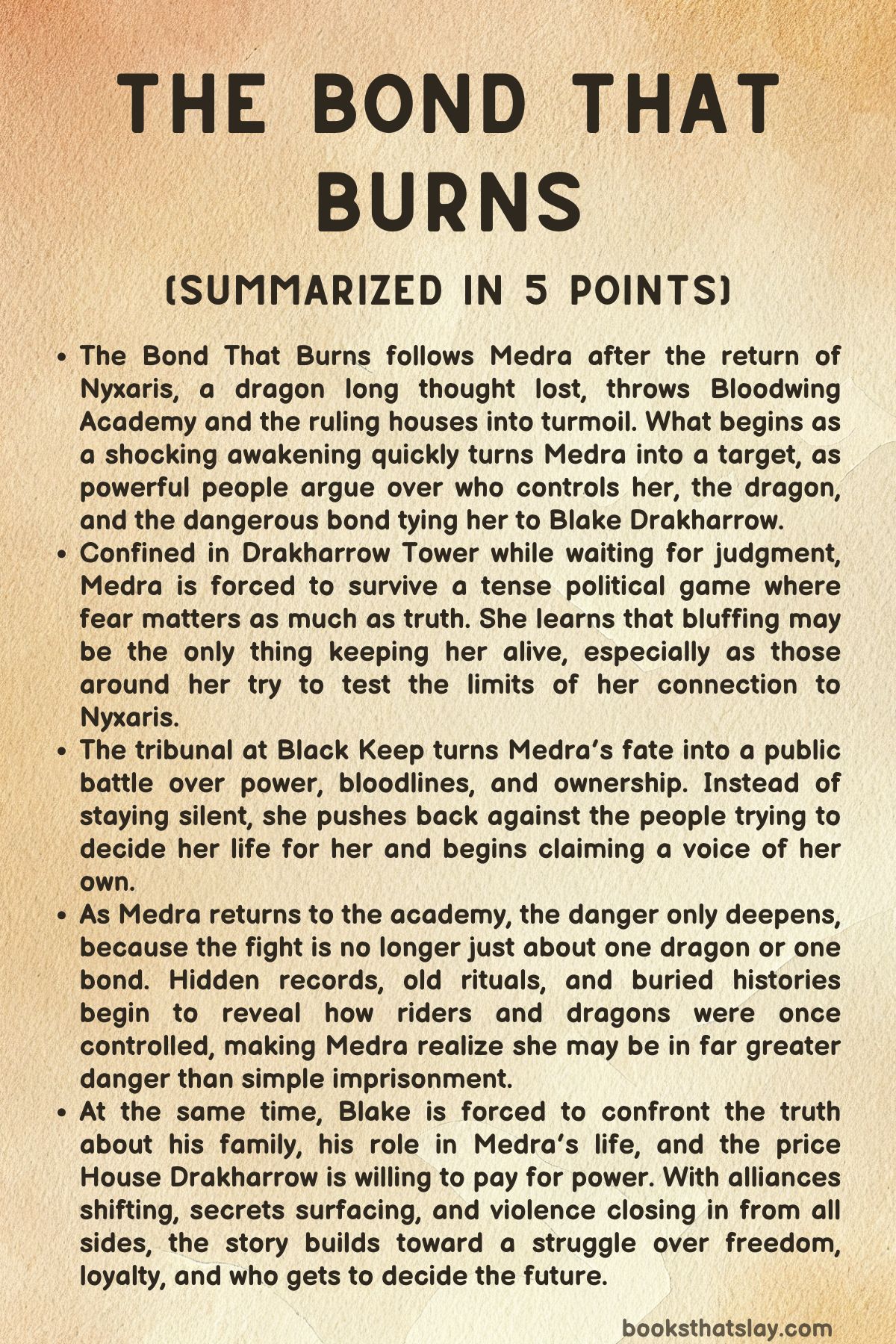
Summary
Medra spends two months confined in Drakharrow Tower after the night the dragon Nyxaris was awakened. Although the room given to her is luxurious, she feels like a prisoner.
Her isolation is worsened by the emotional damage caused by Blake Drakharrow, whose betrayal has shattered whatever trust once existed between them. From the start, her captivity is tied not only to Nyxaris’s return, but also to the fear and greed of the highblood houses, who immediately begin fighting over the meaning of what happened.
The story revisits the night Nyxaris was freed. In the Dragon Court, Medra is overwhelmed by the aftermath, but her attention is fixed more on Blake than on the dragon.
Students flood in to witness the event, only to be driven away by Headmaster Kim. Soon powerful highblood leaders arrive, including Viktor Drakharrow and Natsumi Avari.
Their argument makes clear that Nyxaris is not being seen as a living creature but as a source of power. Natsumi claims the dragon for House Avari because of old ties to her family line, while Viktor insists Nyxaris belongs to House Drakharrow because Medra is bonded to Blake.
As the debate turns uglier, Medra sees that the highbloods fear her. Instead of correcting their assumptions, she allows them to think she may be more powerful than she really is.
Lord Sylvain calls for her immediate confinement. Viktor grows enraged that the “wrong” dragon has returned and tries to invade her mind with thrallweave to force answers from her.
Medra resists, using mental defenses that have grown stronger, but the effort leaves her bleeding. Professor Rodriguez intervenes and stops Viktor.
Natsumi publicly thanks Medra, though the gesture is obviously political. Rodriguez then escorts Medra away.
On the walk to Drakharrow Tower, Rodriguez warns her that Viktor will keep trying to break into her mind and that the tribunal deciding her fate may take all summer. When Medra presses him for the truth about dragons, he admits that much of their history has been hidden.
Some dragons died of plague, but much else has been buried. He refuses to reveal everything, partly to protect himself if he is later questioned.
Most importantly, he advises Medra to keep bluffing. If the highbloods believe she can control Nyxaris, that illusion may be the only thing keeping both her and the dragon alive.
At the tower, Blake waits for her and leads her to the room that had once been prepared for her as his consort. To Medra, it is only another prison.
When Blake tries to speak, she cuts him off, declaring that after what he did, he is nothing to her. He reminds her that she is still bound to him, but she rejects him emotionally and orders him out.
He obeys, locking the door behind him.
The next day Viktor enters her room and attacks her mind again. Medra resists, which angers him enough to slap her.
He demands to know how she awakened Nyxaris. She claims it was an accident but also says the dragon spoke to her.
Then she takes a major risk and tells Viktor that Nyxaris will come when she calls and obey her command. Viktor doubts her, but he cannot afford to ignore the possibility.
When she warns that the dragon will know if she is tortured, Blake appears and forces Viktor to leave.
A later section from Blake’s point of view reveals Viktor’s true strategy. Viktor orders Blake to learn everything he can about Medra, manipulate her, and pull her loyalties toward House Drakharrow.
He warns Blake not to underestimate either Medra or the dragons and hints that old family history is darker than Blake understands.
Two months later, Medra is still confined. Blake continues visiting her for their weekly feeding because their blood bond requires her blood to sustain him.
Their meetings are bitter and humiliating. Medra offers her wrist only because she must, and Blake refuses her suggestion that he use stored blood instead.
He insists she endure the ritual directly. Their exchanges show how much resentment lies between them.
Blake acts possessive and assumes the tribunal will confirm that she belongs to House Drakharrow. After he leaves, Medra briefly mourns what might have been between them before hardening her resolve not to let him win.
At the tribunal in the Black Keep, Medra is placed in an iron chair before an audience of spectators and an eight-member panel. The real power lies with the leaders of the great houses, including Viktor, Garrick Mortis, Elaria Avari, and Lysander Orphos.
Lord Pansera acts as arbiter, but his closeness to Viktor makes his bias obvious. House Avari claims Nyxaris on historical grounds.
Viktor counters that Medra’s bond to Blake and her rider blood make both her and the dragon Drakharrow property.
Then Mortis shocks the chamber by rejecting both claims and arguing that dragons should never have returned at all. He proposes killing both Medra and Nyxaris.
Blake furiously objects. Lysander offers a more measured view, saying Nyxaris is one survivor, not the beginning of a new dragon age, and that Medra should be free to choose her own future.
Elaria openly challenges Viktor and says Medra should never have been forced into her betrothal with Blake. She even suggests Kage as a new match.
Chaos follows until Viktor crushes the idea by revealing that Blake has already fed from Medra, making the bond official in the eyes of the court.
That public humiliation pushes Medra past silence. She stands and declares that she belongs to no one.
She accuses the tribunal of debating her life as if she were an object and states that Blake manipulated her into the bond and fed from her without consent. She says she wore neutral colors because the rider should serve all the houses rather than be owned by one.
She also reveals that Nyxaris spoke to her and recognizes no house’s authority. She asks for time to continue her studies, understand her bond to the dragon, and free herself from Blake.
When Mortis demands proof, Medra leads the court outside and calls to Nyxaris. At first nothing happens, making it seem that she has failed.
Then Nyxaris appears overhead and lands in full view of everyone. Panic spreads through the crowd.
Medra uses the moment to strengthen her claim, though Nyxaris privately mocks the idea that he is under her control. Mortis refuses to back down and advances with a dagger.
Nyxaris warns Medra to move, and Kage throws himself on her to protect her just as the dragon breathes fire. Mortis is burned to ash instantly.
Afterward, Medra makes clear that Nyxaris acted on his own will. Elaria asks whether she plans to return, and Medra chooses to do so for the sake of her friends at Bloodwing.
She climbs onto Nyxaris and flies with him. During the flight, he questions her about what happened to dragons and whether the ritual that awakened him could restore others.
Medra promises to search for the truth and suggests they can use the fear they inspire to force the highbloods into revealing what was buried.
Back at Bloodwing, Blake tells her the tribunal’s verdict: she will remain at the academy under House Drakharrow’s supervision. Among friends again, Medra explains more of what Blake did and learns further disturbing details about the violence and corruption surrounding the great houses.
Her fears deepen after she secretly reads Hassan’s dossier on Nyxaris. She learns he was once used as an enforcer against rogue dragons and riders.
Even worse, Hassan’s notes on Medra focus on her potential for soul binding, an ancient ritual through which a highblood can take over a blightborn rider’s body and control a dragon directly. Medra realizes she may not be trained for survival at all, but prepared for possession.
Rodriguez confirms the danger, warns her not to trust too easily, and pushes her to strengthen her mental defenses.
When Medra later tells Nyxaris what she learned about his past, he is deeply shaken. He does not deny it, but clearly hates the thought that he may once have been a tool of terror.
Even so, he agrees to help her survive another tribunal evaluation by making it appear that she controls him.
Blake then privately warns Medra that if she or Nyxaris refuse to cooperate, Florence may be used against her. Medra breaks down in fear for her friend.
Blake, to his own surprise, comforts her rather than exploiting the moment. Their grief and anger turn into intimacy, and they sleep together.
Blake realizes that his feelings for her have become real, which only complicates everything further.
Soon after, Medra resolves to tell Florence the truth rather than keep her ignorant of the danger. At the same time, Blake confronts Viktor and uncovers the truth about his father’s death and his own changing body.
He realizes Viktor deliberately used Medra to awaken buried rider blood in him, hoping to turn him into a weapon. During the confrontation, Blake transforms in agony into a dragon-like creature.
A guard destroys his left eye, Viktor tries to let the process continue until it becomes uncontrollable, and Blake ultimately slaughters the guards.
Meanwhile, Medra is lured into a trap in the Dragon Court. Rodriguez and Kage ambush Nyxaris with special poisoned bolts.
Rodriguez intends to use the dragon’s blood to turn him back into stone, believing that this is the only way to prevent political chaos. Medra fights desperately but cannot stop him.
As the ritual begins, everyone realizes Blake is missing and something has gone terribly wrong.
Elsewhere, Florence, Theo, and Visha search for Medra. They discover Lace dead and Aenia in a blood-soaked frenzy.
Theo kills Aenia to save Florence. Blake then appears, covered in blood and carrying Aenia’s body, and they all head toward the Dragon Court.
There, events spiral into disaster. Marcus Drakharrow arrives with Catherine Mortis and an enthralled Lunaya.
Florence is shot in the chest. Rodriguez is also shot, damaging the ritual.
Kage reveals he can transform into a massive white wolf and attacks Marcus. Catherine uses blood magic and necromancy to awaken the golden dragon Molindra in a ruined half-dead form.
In the chaos, Medra wounds Molindra, allowing the spirit of Orcades, the dragon’s mother, to enter her. Orcades takes control just long enough to fly away with Marcus, Catherine, and Lunaya still aboard.
When the fighting ends, Medra thinks Florence is dead, but Rodriguez finds a faint pulse. He says the only possible cure is a dangerous mixture of dragon’s blood and rider’s blood.
Nyxaris refuses at first, furious over the betrayals and unwilling to risk another bond. Blake offers his own life if that is what it takes to save Florence.
Medra refuses to let Nyxaris kill him. The final shift comes when Neville, Florence’s fluffin, approaches Nyxaris.
The tiny creature stirs old memories in the dragon of fluffins caring for dragons and riders long ago. Touched by that loyalty and Medra’s plea, Nyxaris finally agrees to help, though he warns Florence may still die, and Medra orders Rodriguez to begin.
Characters
Medra
Medra stands at the center of the story as a character forced into power before she has any real control over it. Much of her journey is defined by captivity, coercion, and the constant pressure of being treated as an object by the ruling houses.
Even when she is given comfort, fine rooms, lessons, and guarded attention, she understands that none of it is freedom. What makes her compelling is that she never fully submits to the roles others assign her.
She is frightened, often isolated, and sometimes forced to bluff simply to stay alive, but she continues to resist mentally and emotionally. Her strength is not shown as effortless heroism.
It appears through fear, anger, pain, and stubborn endurance.
She is also intelligent in a practical way. Medra quickly recognizes that the highbloods fear what she might be able to do, and she uses that uncertainty as protection.
Even when she lacks real knowledge, she understands the value of perception. Her lies about controlling Nyxaris are not born from vanity but from survival instinct.
At the same time, she is not hardened into coldness. She remains capable of loyalty, grief, tenderness, and moral discomfort.
She cares deeply about Florence, her friends, and even Nyxaris after learning of his violent past. That emotional depth keeps her from becoming merely defiant.
She wants truth, autonomy, and justice, not just revenge.
Her relationship with Blake reveals another important part of her character. She does not simply hate him in a flat, uncomplicated way.
There is betrayal, attraction, disgust, and lingering emotional pain mixed together. That complexity makes her feel human.
She is someone who has been wronged but still cannot entirely erase what she once hoped for. By the later events, her strongest trait becomes her insistence on personhood.
Again and again she refuses to be reduced to consort, weapon, vessel, or property. That refusal is what defines her most clearly.
Blake Drakharrow
Blake is one of the most conflicted figures in The Bond That Burns. At first he appears controlling, possessive, and deeply complicit in the system that traps Medra.
He insists on the bond between them, reinforces the language of ownership, and often behaves as though his desire and his rank justify his actions. His presence around Medra is shaped by entitlement, but it is also shaped by pressure from Viktor and by the expectations of House Drakharrow.
He has been raised inside a cruel political structure and initially acts as one of its instruments.
What makes Blake more than a straightforward antagonist is the gradual exposure of his vulnerability. His point-of-view chapters reveal fear, confusion, and a growing realization that he has not understood the forces controlling his own life.
He begins by thinking he can manage Medra, manipulate her, and prove useful to his uncle, but over time he sees that he too has been used. The truth about his father, his bloodline, and his transformation destroys the illusion that he had any real safety within his own house.
This does not erase the harm he causes, but it changes the meaning of his behavior. He is both oppressor and victim, enforcer and sacrificial heir.
His feelings for Medra deepen in ways that unsettle him. He moves from strategy and desire into something more protective and emotionally exposed, though he never fully escapes the habits of dominance that shaped him.
That tension is central to his character. He can be gentle in one moment and possessive in the next.
He can recognize Medra’s pain and still participate in the structures causing it. His monstrous transformation makes literal what was already happening internally: he has been turned into a weapon by family ambition.
By the end, Blake is tragic because he is neither redeemed nor entirely damned. He is a damaged man awakening too late to the truth of what he has become.
Nyxaris
Nyxaris enters the story as a symbol of ancient power, fear, and mystery, but he gradually becomes far more than a legendary creature returned from stone. He is intelligent, proud, sarcastic, and morally complicated.
The early political struggle over him treats him as an asset to be claimed, yet his own behavior quickly proves that he is no passive possession. He listens, judges, mocks, and acts according to his own will.
His refusal to fit the role the highbloods imagine for him is one of the most important tensions in the narrative.
His bond with Medra develops through mistrust, necessity, and shared uncertainty. He does not present himself as noble or gentle.
In fact, the dossier on his past shows that he may once have been used as a brutal enforcer, tied to punishment and terror. This revelation complicates him sharply.
He is not simply a misunderstood creature oppressed by history. He may have participated in its violence.
That makes his relationship with Medra more interesting, because she must decide whether truth should end loyalty or deepen responsibility. Nyxaris himself is shaken by what she learns, which suggests buried guilt, pain, or at least a horror at what has been lost or concealed.
He also embodies memory in a world built on distortion. His survival threatens the official histories of the great houses.
Through him, old crimes begin to surface, including what may have happened to dragons, riders, and the balance of power. Yet for all his grandeur, Nyxaris is not invincible or emotionally remote.
He reacts to betrayal, recoils from painful truths, and is moved by small acts of loyalty, especially in the final decision to help save Florence. That moment gives him unexpected emotional range.
He remains dangerous, but he is not beyond feeling. He becomes one of the story’s strongest examples of a being struggling against the meaning others have forced onto him.
Viktor Drakharrow
Viktor is the clearest embodiment of ruthless ambition. He sees people as tools, bloodlines as resources, and power as something to be consolidated through cruelty if necessary.
From his first interactions with Medra, he treats her not as a person but as a strategic problem: something to interrogate, control, and exploit. His use of mental violation, threats, and physical intimidation shows that he does not merely accept violence as part of politics.
He prefers it when it is efficient and deniable. He is a man who thinks domination is the natural language of authority.
What makes him especially dangerous is his patience and calculation. Viktor does not act from simple rage, even though he can be explosive.
He plans across generations. The revelations about Blake’s father and Blake’s own transformation show that Viktor is willing to gamble with the lives of his own family for the future strength of House Drakharrow.
That gives his character a chilling consistency. He is not corrupted by ambition; he is defined by it.
Family, loyalty, and inheritance matter to him only when they serve legacy and control.
He also represents the moral rot inside the highblood order. Others may be manipulative, fearful, or self-interested, but Viktor strips away any pretense that this world runs on honor.
He believes in ownership, blood supremacy, and weaponized intimacy. Even Blake, whom he has shaped, eventually recognizes the full horror of that worldview.
Viktor’s role in the story is not only to threaten individual characters but to personify the system that has deformed all of their lives. He is terrifying because he is not chaotic.
He is disciplined, intelligent, and completely willing to sacrifice anyone to preserve power.
Professor Rodriguez
Rodriguez occupies one of the most morally unstable positions in the story. For much of the narrative, he appears to be one of the few adults who genuinely wants Medra to survive.
He warns her about Viktor, teaches her how to defend her mind, and shares dangerous truths in measured ways. Unlike the great house leaders, he does not speak to her as property.
He seems to understand both the brutality of the political system and the real stakes of dragon history. Because of that, he becomes one of the first people Medra can partly trust.
What makes him compelling is that this apparent role as protector is never simple. Rodriguez is not purely kind, nor is he idealistic.
He is pragmatic, secretive, and often severe. He tells Medra to bluff, to harden herself, and to stop thinking like a victim.
His care is real, but it is expressed through strategy rather than comfort. That alone makes him more complex than a standard mentor figure.
Later, when he helps trap Nyxaris, the full tension in his character becomes visible. He is willing to commit betrayal in the name of preventing greater chaos.
He is not driven by personal malice, but by fear of what dragons, old power, and the ruling houses might unleash.
This makes Rodriguez tragic rather than simply false. He wants to avoid catastrophe, yet his methods repeat the same logic of control he has warned Medra about.
He understands the intelligence and moral weight of dragons, and still participates in harming one. He wants Medra alive, and still becomes part of a plan that endangers her emotionally and physically.
His contradictions make him one of the most realistic adults in the story: knowledgeable, compromised, and capable of both courage and terrible decisions.
Florence
In The Bond That Burns, Florence brings warmth and emotional grounding in a story dominated by fear, control, and political manipulation. Her importance is not measured through formal power but through the stability and affection she offers Medra.
When Medra is isolated, threatened, or emotionally exhausted, Florence represents one of the few relationships untouched by ambition. Her presence reminds the reader that care, friendship, and ordinary loyalty still exist inside a violent world.
At the same time, Florence is not merely a comforting side character. Her vulnerability becomes politically significant because others recognize how much Medra loves her.
The possibility that Florence could be used as leverage shows how thoroughly the ruling powers exploit attachment. This threat also reveals Florence’s narrative role more deeply.
She is not important because she is weak, but because she is one of the few people Medra refuses to think of strategically. Florence matters on a personal level that politics cannot fully contaminate.
Her later wounding intensifies this role. The effort to save her becomes a moment where multiple character loyalties are tested at once: Medra’s desperation, Blake’s willingness to sacrifice, Nyxaris’s resistance and eventual compassion, and Neville’s symbolic influence.
Florence helps draw out the humanity of others. Even without dominating scenes, she remains central because she anchors what is worth protecting.
In a world of domination and blood claims, her presence represents tenderness without calculation.
Kage Tanaka
Kage is one of the most enigmatic characters because he moves between calm diplomacy, hidden motive, and startling violence. Early on, he seems measured and politically useful to House Avari, especially in discussions about Medra and Nyxaris.
He is associated with an alternative to Drakharrow possession, which gives him the appearance of a possible ally or counterweight. Yet the story repeatedly complicates that impression.
His calm is not innocence. It is control.
His role in the trap against Nyxaris and Medra reveals a colder side. He is willing to physically restrain Medra and participate in a plan that horrifies her, which shows that whatever sympathy he may have, he still acts within calculations larger than individual trust.
At the same time, he is not reduced to a simple traitor. His later transformation into a white wolf and attack on Marcus suggests competing loyalties and a capacity for decisive courage.
He is someone whose true commitments are difficult to read because he operates inside overlapping systems of secrecy, survival, and political necessity.
Kage works well as a character because he resists clean categorization. He is neither straightforwardly noble nor openly monstrous.
Instead, he represents the uncertainty of trying to find allies in a world where everyone is entangled in house interests, old histories, and personal agendas. His presence keeps the political landscape unstable, because he can never be understood through appearances alone.
Theo
Theo often functions as a stabilizing presence among the younger characters, but he is more than a loyal friend standing at the edges of larger events. He repeatedly shows tension, alertness, and readiness to act when danger rises.
During the tribunal he reacts strongly when Medra is threatened, and later he is the one who kills Aenia to save Florence. These moments reveal that beneath whatever outward calm he usually carries, Theo is fully capable of violence when someone he cares about is in immediate danger.
He also helps broaden the social world around Medra. Through conversations with Florence, Neville, and the others, Theo contributes to the sense that friendship within the academy is one of the few counterforces to highblood domination.
He is part of the emotional network that keeps Medra from being entirely isolated. That matters because this story is full of characters trying to claim, manipulate, or weaponize others.
Theo’s loyalty feels comparatively clean.
At the same time, he is not written as passive goodness. He belongs to a world where survival may require speed, force, and grim choices.
His decisive killing of Aenia is not framed as glorious but as necessary, and that gives him weight. He is a character who reminds the reader that even the kindest loyalties in this setting are lived under pressure.
Marcus Drakharrow
Marcus is a menace of a different kind from Viktor. Where Viktor is strategic and controlled, Marcus often seems to carry a more immediate cruelty.
He is associated with predation, violence, and moral corruption without even the mask of noble purpose. His interest in Lunaya, his past destruction of a blightborn village, and his attack on Florence all suggest someone who acts with entitlement sharpened into open brutality.
If Viktor embodies institutional evil, Marcus embodies its more personal, sadistic face.
He is dangerous because he escalates situations rapidly. In the Dragon Court confrontation, he turns an already disastrous scene into something even worse by shooting Florence and deepening the chaos around the ritual, Nyxaris, and Molindra.
His actions are not merely tactical. They feel driven by the confidence that he can violate others without consequence.
That makes him especially hateful.
Marcus also helps expose how normalized violence is within the Drakharrow line. He is not an aberration but another product of the same culture that shaped Blake and empowered Viktor.
The difference is that Marcus seems to embrace that inheritance with less internal conflict. He carries the arrogance of someone who assumes power grants moral immunity.
Because of that, he stands as one of the clearest threats in the story’s later sections.
Catherine Mortis
Catherine Mortis enters after her father’s death with a chilling degree of composure, and that alone makes her memorable. Rather than collapsing into grief or public outrage, she seems immediately able to function within the brutal logic of the political world around her.
Later, her use of blood magic and necromancy to awaken Molindra in a corrupted state confirms that she is willing to pursue power through methods that violate natural and moral boundaries alike.
Her character extends the Mortis legacy beyond Lord Mortis’s blunt hostility toward dragons. Where he represents fear and destructive reaction, Catherine represents adaptive ruthlessness.
She does not merely oppose danger; she tries to seize and reshape it. The awakening of Molindra in a half-dead form shows both ambition and recklessness.
She is willing to create something monstrous if it gives her leverage.
There is also something unsettling in how controlled she remains while chaos unfolds around her. She does not read as impulsive.
Like Viktor, she is frightening because she can remain composed while committing terrible acts. Her presence suggests that the fall of one powerful figure does not weaken the system.
It simply creates room for another, perhaps even more unpredictable, player.
Professor Hassan
Professor Hassan represents the ideological face of the system controlling riders. Her lessons are not merely educational; they are acts of conditioning.
She insists that a rider is only a channel for highblood power and that a dragon’s true loyalty belongs to the ruling house, not to the rider. Through her, the reader sees how domination is taught as doctrine.
She does not need to strike Medra physically to be threatening. Her words are designed to reduce Medra’s sense of self and prepare her for use.
The discovery of Hassan’s notes about possible soul binding deepens her menace considerably. She is not just preserving old traditions.
She may be evaluating whether Medra can be sacrificed so that someone more powerful can take control of her body and, through her, of Nyxaris. That possibility transforms her from stern instructor into someone actively involved in dehumanizing, possibly annihilating, another person’s identity.
What makes Hassan effective as a character is the way she shows that violence in this world is not only physical or political. It is intellectual and ritualized.
She gives language and structure to exploitation. In doing so, she becomes one of the clearest reminders that the greatest threats to Medra are often those who speak with institutional authority.
Regan Pansera
Regan is not one of the most powerful characters, but she plays an important role in showing how cruelty can operate socially as well as politically. Her behavior before the tribunal and later in the tower reveals her eagerness to align herself with power, especially Viktor’s side of the conflict.
She enjoys performance, insinuation, and emotional harm. When she misreads Medra’s breakdown and mocks her, it shows how little empathy she has for genuine suffering.
She functions as a character shaped by a hierarchy she has accepted and learned to exploit. Regan may not be the architect of oppression, but she willingly participates in its smaller humiliations.
That matters because stories like this are not sustained by villains alone. They are sustained by those who reinforce cruelty in daily interactions, who echo its values, and who treat another person’s pain as an opportunity for advantage or ridicule.
Lunaya Orphos
Lunaya appears in a more limited but symbolically important role. She is associated at first with political tension, particularly through the concern surrounding Marcus’s attention toward her.
That detail immediately places her in the familiar danger of being used within house politics. Later, when she appears enthralled and her blood is used in Catherine’s ritual, her role becomes much darker.
She becomes another example of how bodies and identities are stolen in this world for the ambitions of others.
Her importance lies less in fully developed interiority and more in what happens to her. She demonstrates how vulnerable even high-status figures can be when stronger wills decide to use them.
The loss of agency written into her enthrallment mirrors, in another form, the threats hanging over Medra. Through Lunaya, the story reinforces one of its central ideas: power structures do not merely command obedience, they invade the self.
Elaria Avari and Natsumi Avari
The Avari women represent political intelligence expressed in different ways. Natsumi first appears as someone who publicly thanks Medra, but the gesture is clearly strategic.
She understands how appearances matter and how quickly a public statement can shape claims around Nyxaris. Elaria, by contrast, operates on a grander political level during the tribunal, where she openly challenges Viktor and argues that Medra should not have been forced into betrothal.
Her proposal involving Kage may not be free from self-interest, but it still disrupts the assumption that Drakharrow authority is absolute.
Together they show that opposition to Viktor does not necessarily mean pure moral clarity. The Avari position is still entangled with power, lineage, and advantage.
Yet they matter because they introduce cracks into the dominant order. They make visible the conflicts among the great houses and prevent the political world from becoming too simple.
Their support is conditional, strategic, and limited, but it still creates openings that Medra is able to use.
Neville
Neville might appear small beside dragons, tribunals, and blood magic, but he serves an important emotional and symbolic function. As Florence’s fluffin, he brings softness and unexpected significance into the story.
What initially seems like a charming creature detail gains deeper meaning when fluffins are described as rare healing companions associated with dragons and riders. Neville becomes a living connection to an older world that may have held more care and mutuality than the present one.
His most important contribution comes in the moment when Nyxaris is refusing to help save Florence. Neville’s approach stirs memory in the dragon and helps shift the emotional balance of the scene.
That gives Neville a quiet but real power. He represents loyalty without ambition, attachment without control, and healing without domination.
In a story shaped by coercion, that small presence becomes surprisingly profound.
Themes
Power, Ownership, and the Denial of Personhood
Again and again, Medra is treated not as a person with agency but as an asset to be claimed, managed, or sacrificed. The tribunal debates who owns her, whether through her bloodline, her bond to Blake, or her connection to Nyxaris, and almost no one initially questions the cruelty of discussing her life as property.
This same attitude shapes Professor Hassan’s lessons, where the rider is reduced to a channel for highblood power, stripped of identity and independent purpose. Even the language surrounding Medra is transactional, with houses arguing over usefulness, control, and inheritance rather than justice.
What gives this theme force is Medra’s refusal to accept that role. Her insistence that she belongs to no one becomes more than personal defiance; it is a direct challenge to the social order.
The story shows how domination is upheld not only by violence but also by tradition, law, and political language. Medra’s resistance matters because it exposes how deeply this world depends on turning living beings into instruments.
Betrayal, Consent, and the Corruption of Intimacy
The bond between Medra and Blake gives this theme much of its emotional weight because it blurs the line between attachment and violation. What should have been a connection shaped by trust becomes something coercive when Blake feeds from her without true consent and continues to act as though the bond grants him rights over her.
Their interactions are charged with desire, resentment, grief, and anger, making the betrayal more painful than open hostility would have been. The same pattern appears elsewhere in the book through soul binding, enthrallment, and manipulation, all of which involve invading another person’s will and turning closeness into control.
This creates a world where intimacy is constantly threatened by power imbalance. Moments of tenderness do occur, especially when Blake shows guilt and care, but they never erase the damage already done.
Instead, the novel keeps asking whether affection can mean anything when freedom has been compromised. By tying emotional connection to questions of bodily autonomy and choice, the story makes betrayal feel not only personal but structural.
Buried History and the Fight for Truth
Much of the conflict grows from the fact that the past has been hidden, distorted, or deliberately erased. Medra learns early that the highbloods do not fully understand dragon history, and as she uncovers more, it becomes clear that ignorance is not accidental.
Records are guarded, truths are fragmented, and powerful figures benefit from keeping old knowledge buried. Nyxaris himself embodies this theme, because his awakening does not simply restore a lost creature; it revives a history full of violence, fear, and political lies.
The revelation that he once served as an enforcer complicates any simple idea of dragons as noble or innocent, while the possibility of restoring other dragons raises even greater stakes. Blake’s family history also fits this pattern, especially the hidden truth about his father and Viktor’s deliberate manipulation of bloodlines.
In this world, controlling the story of the past is one way of controlling the future. Medra’s search for answers becomes essential because survival depends on understanding what was done before, who benefited from it, and what forces are now trying to repeat those old abuses.
Fear of Disorder and the Violence Used to Preserve Control
The return of dragons throws the ruling order into panic because it threatens a balance built on hierarchy and fear. The highbloods are not only afraid of Nyxaris as a creature of immense power; they are afraid of what his return might disrupt in the political structure that keeps them dominant.
That fear drives many of the book’s cruelest decisions, from calls to destroy Medra and Nyxaris outright to schemes involving soul binding, poisoned attacks, and secret rituals. Characters repeatedly justify brutality as necessary for stability, suggesting that order in this society has always depended on sanctioned violence.
Rodriguez’s actions in the Dragon Court show how even those who seem more thoughtful can be pushed into ruthless choices when they believe chaos is coming. The novel presents fear not as a passive emotion but as a force that authorizes cruelty, secrecy, and preemptive harm.
What makes the theme compelling is that the threat of disorder is real, yet the attempt to control it often becomes more destructive than the danger itself.